



KYPROLIS 30 mg Inyectable

Revisión de receta online
Un médico revisará tu caso y determinará si la prescripción es médicamente apropiada.

Habla con un médico sobre este medicamento
Comenta tus síntomas y las opciones de tratamiento en una consulta online.



Cómo usar KYPROLIS 30 MG POLVO PARA SOLUCION PARA PERFUSION
Contenido del prospecto
- Introducción
- Qué es Kyprolis y para qué se utiliza
- Qué necesita saber antes de empezar a usar Kyprolis
- Cómo usar Kyprolis
- Posibles efectos adversos
- Conservación de Kyprolis
- Contenido del envase e información adicional
Introducción
Prospecto: información para el paciente
Kyprolis 10 mg polvo para solución para perfusión
Kyprolis 30 mg polvo para solución para perfusión
Kyprolis 60 mg polvo para solución para perfusión
carfilzomib
Lea todo el prospecto detenidamente antes de empezar a usar este medicamento, porque contiene información importante para usted.
- Conserve este prospecto, ya que puede tener que volver a leerlo.
- Si tiene alguna duda, consulte a su médico o enfermero.
- Si experimenta efectos adversos, consulte a su médico o enfermero, incluso si se trata de efectos adversos que no aparecen en este prospecto. Ver sección 4.
Contenido del prospecto
- Qué es Kyprolis y para qué se utiliza
- Qué necesita saber antes de empezar a usar Kyprolis
- Cómo usar Kyprolis
- Posibles efectos adversos
- Conservación de Kyprolis
- Contenido del envase e información adicional
1. Qué es Kyprolis y para qué se utiliza
Kyprolis es un medicamento que contiene el principio activo carfilzomib.
Carfilzomib funciona bloqueando el proteosoma. El proteosoma es un sistema dentro de las células que descompone las proteínas cuando están dañadas o ya no son necesarias. Previniendo la descomposición de las proteínas en las células cancerosas, que son más probables que contengan una cantidad superior de proteínas anómalas, Kyprolis causa la muerte de las células cancerosas.
Kyprolis es utilizado para tratar a pacientes adultos con mieloma múltiple que han tenido como
mínimo un tratamiento previo para esta enfermedad. El mieloma múltiple es un cáncer de células plasmáticas (un tipo de glóbulos blancos).
Se le administrará Kyprolis junto con daratumumab y dexametasona, con lenalidomida y dexametasona, o solo con dexametasona. Daratumumab, lenalidomida y dexametasona son otros medicamentos para tratar el mieloma múltiple.

¿No estás seguro de si este medicamento es adecuado para ti?
Comenta tus síntomas y tratamiento con un médico online.
2. Qué necesita saber antes de empezar a usar Kyprolis
Su médico le examinará y revisará su historia clínica completa. Será sometido a un seguimiento estricto durante el tratamiento.
Antes de iniciar el tratamiento con Kyprolis, y durante el tratamiento, se le efectuarán análisis de sangre. De este modo, se podrá verificar que dispone de suficientes glóbulos sanguíneos y que su hígado y riñones funcionan correctamente. Su médico o enfermero controlará que usted reciba suficiente cantidad de líquidos.
Debe leer el prospecto de todos los medicamentos que utiliza en combinación con Kyprolis, de modo que pueda comprender la información relacionada con estos medicamentos.
No use Kyprolis si es alérgicoa carfilzomib o a alguno de los demás componentes de este
medicamento (incluidos en la sección 6).
Advertencias y precauciones
Consulte a su médico o enfermero antes de empezar a usar Kyprolis si presenta alguna de las condiciones listadas abajo.Es posible que se deba someter a pruebas adicionales para comprobar que su corazón, sus riñones y su hígado funcionan correctamente.
- Problemas cardíacos, incluidos antecedentes de dolor torácico (angina de pecho), ataque cardíaco, latido cardíaco irregular, presión arterial alta o si alguna vez ha tomado un medicamento para el corazón
- Problemas pulmonares, incluidos antecedentes de dificultad para respirar en reposo o al realizar actividades (disnea)
- Problemas renales, incluida insuficiencia renal, o si ha recibido diálisis alguna vez
- Problemas hepáticos, incluidos antecedentes de hepatitis, hígado graso, o si alguna vez le han comunicado que su hígado no funciona correctamente
- Hemorragias inusuales, incluida la formación fácil de cardenales, hemorragias debido a una lesión, como un corte que tarda más de lo esperado en parar de sangrar; o hemorragias internas como toser sangre, vomitar sangre, heces negras, o heces con sangre roja brillante; o hemorragias cerebrales que inducen entumecimiento repentino o parálisis en un lado de la cara, piernas o brazos, dolor de cabeza intenso y repentino o dificultad de visión o dificultad del habla o dificultad para tragar (deglución). Esto puede indicar un recuento plaquetario bajo (células queayudan en la coagulación de la sangre)
- Antecedentes de coágulos sanguíneos en sus venas
- Dolor en piernas o brazos o hinchazón (que podrían ser síntomas de presencia de coágulos sanguíneos en las venas profundas de las piernas o los brazos), dolor en el pecho o dificultad respiratoria (que podrían ser síntomas de presencia de coágulos de sangre en los pulmones)
- Cualquier otra enfermedad grave para la que haya sido hospitalizado o recibido alguna mediación.
Síntomas a los que debe estar atento
Debe estar atento a determinados síntomas mientras tome Kyprolis para reducir el riesgo de problemas. Kyprolis puede empeorar algunos síntomas o producir efectos adversos graves que podrían ser mortales, como problemas cardíacos, pulmonares, renales, síndrome de lisis tumoral (una enfermedad potencialmente mortal que ocurre cuando las células cancerosas se rompen y liberan su contenido en la sangre), reacciones a la perfusión de Kyprolis, formación de hematomas o hemorragias inusuales (incluidas hemorragias internas), coágulos sanguíneos en sus venas, problemas hepáticos, determinados trastornos sanguíneos o un síndrome neurológico conocido como SEPR. Consulte el apartado ‘Signos y síntomas a los que debe estar atento’ en el apartado 4.
Informe a su médico si alguna vez ha tenido o podría tener en la actualidad una infección por el virus de la hepatitis B. El motivo es que este medicamento podría provocar que el virus de la hepatitis B se vuelva a activar. Su médico le examinará para detectar signos de esta infección antes, durante y algún tiempo después de finalizar el tratamiento con este medicamento. Informe a su médico inmediatamente si experimenta un cansancio que empeora o si nota que la piel o la parte blanca de los ojos adoptan una coloración amarillenta.
En cualquier momento de la duración del tratamiento o después de finalizarlo, informe a su médico o enfermero inmediatamente si experimenta visión borrosa, pérdida de la visión o visión doble, dificultad del habla, debilidad en un brazo o una pierna, un cambio en el modo en que camina o problemas con el equilibrio, entumecimiento persistente, disminución de la sensibilidad o pérdida de la sensibilidad, pérdida de memoria o confusión. Todos estos pueden ser síntomas de una enfermedad cerebral potencialmente mortal conocida como leucoencefalopatía multifocal progresiva (LMP). Si tenía estos síntomas antes del tratamiento con carfilzomib, informe a su médico sobre cualquier cambio que experimente en estos síntomas.
Otros medicamentos y Kyprolis
Informe a su médico si está tomando, ha tomado recientemente o pudiera tener que tomar cualquier otro medicamento. Entre ellos, cualquier medicamento obtenido sin receta, como vitaminas o medicamentos a base de plantas.
Informe a su médico o enfermero si está tomando medicamentos utilizados para prevenir el embarazo, tales como anticonceptivos orales u otros anticonceptivos hormonales, debido a que estos no pueden ser adecuados para su uso con Kyprolis.
Embarazo y lactancia
Para mujeres que toman Kyprolis
No tome Kyprolis si está embarazada, cree que podría estar embarazada o tiene intención de quedarse embarazada. El tratamiento con Kyprolis no se ha evaluado en mujeres embarazadas. Mientras tome Kyprolis, y tras 30 días después de suspender el tratamiento, debe utilizar un método anticonceptivo adecuado para asegurarse de no quedar embarazada. Debe consultar con su médico o enfermero sobre los métodos adecuados de anticoncepción.
Si se queda embarazada mientras recibe Kyprolis, informe a su médico o enfermero inmediatamente.
No tome Kyprolis si está en periodo de lactancia. Se desconoce si Kyprolis se excreta en la leche materna.
Se prevé que lenalidomida puede ser nocivo para el feto. Kyprolis se administra en combinación con lenalidomida, por lo que debe seguir el Programa de Prevención del Embarazo (consulte el prospecto de lenalidomida para información de la prevención del embarazo y hable con su médico, farmacéutico o enfermero).
Para varones que toman Kyprolis
Mientras tome Kyprolis, y tras 90 días después de suspender el tratamiento, debe utilizar un condón, incluso si su pareja está embarazada.
Si su pareja se queda embarazada mientras recibe Kyprolis o tras 90 días después de suspender el tratamiento, informe a su médico o enfermero inmediatamente.
Conducción y uso de máquinas
Mientras reciba tratamiento con Kyprolis es posible que padezca fatiga, mareos, desvanecimientos y/o caída de la presión arterial. Esto puede afectar su capacidad para conducir o utilizar máquinas. No conduzca o utilice máquinas si tiene estos síntomas.
Kyprolis contiene sodio
Este medicamento contiene 37 mg de sodio por vial de 10 mg. Esto equivale al 1,9% de la ingesta máxima diaria de 2 g de sodio recomendada para un adulto
Este medicamento contiene 109 mg de sodio por vial de 30 mg. Esto equivale al 5,5% de la ingesta máxima diaria de 2 g de sodio recomendada para un adulto.
Este medicamento contiene 216 mg de sodio por vial de 60 mg. Esto equivale al 11% de la ingesta máxima diaria de 2 g de sodio recomendada para un adulto.
Kyprolis contiene ciclodextrina
Este medicamento contiene 500 mg de ciclodextrina (sulfobutil éter beta‑ciclodextrina sódica) en cada vial de 10 mg equivalente a 88 mg/kg para un adulto de 70 kg.
Este medicamento contiene 1.500 mg de ciclodextrina (sulfobutil éter beta‑ciclodextrina sódica) en cada vial de 30 mg equivalente a 88 mg/kg para un adulto de 70 kg.
Este medicamento contiene 3.000 mg de ciclodextrina (sulfobutil éter beta‑ciclodextrina sódica) en cada vial de 60 mg equivalente e a 88 mg/kg para un adulto de 70 kg
3. Cómo usar Kyprolis
El médico o el enfermero le administrarán Kyprolis. La dosis se calculará según su altura y su peso (área de superficie corporal). Su médico o enfermero determinarán la dosis de Kyprolis que usted recibe.
Recibirá Kyprolis mediante perfusión en la vena. La perfusión puede durar hasta 30 minutos. Kyprolis se recibe 2 días seguidos cada semana, durante 3 semanas, seguidas de una semana sin tratamiento.
Cada período de 28 días es un ciclo de tratamiento. Esto significa que le administrarán Kyprolis los días 1, 2, 8, 9, 15 y 16 de cada ciclo de 28 días. Si usted recibe tratamiento con Kyprolis en combinación con lenalidomida y dexametasona, las dosis de los días 8 y 9 de cada ciclo no se administrarán a partir del ciclo 13.
La mayoría de los pacientes recibirán tratamiento mientras su enfermedad mejore o se mantenga estable. No obstante, el tratamiento con Kyprolis también se debe suspender si padece efectos adversos que no puedan ser controlados.
De forma conjunta con Kyprolis, también se le administrará lenalidomida y dexametasona, daratumumab y dexametasona, o solo dexametasona. Usted también podría recibir otros medicamentos.
Si usa más Kyprolis del que debe
Este medicamento será administrado por un médico o enfermero, por lo que es improbable que reciba más del debido. No obstante, si recibe más Kyprolis del debido, su médico le supervisará para detectar efectos adversos.
En caso de duda sobre el uso de este medicamento, consulte a su médico o enfermero.

¿Has empezado a tomar el medicamento y tienes preguntas?
Comenta tus síntomas y tratamiento con un médico online.
4. Posibles efectos adversos
Al igual que todos los medicamentos, este medicamento puede producir efectos adversos, aunque no todas las personas los sufran.
Signos y síntomas a los que debe estar atento
Algunos efectos adversos pueden ser importantes. Informe a su médico inmediatamentesi
experimenta alguno de los siguientes síntomas:
- Dolor torácico, dificultad para respirar, o hinchazón en los pies, los cuales pueden ser síntomas de problemas cardíacos
- Dificultades respiratorias, incluidas dificultad para respirar en reposo o con la actividad o tos (disnea), respiración rápida, sensación de no poder respirar cuando hay oxígeno suficiente, sibilancias (ruidos al respirar) o tos, las cuales pueden ser signos de toxicidad pulmonar
- Presión arterial muy elevada, dolor torácico intenso, dolor de cabeza agudo, confusión, visión borrosa, náuseas y vómitos o crisis de ansiedad, los cuales pueden ser signos de un trastorno conocido como crisis hipertensiva
- Dificultad para respirar en las actividades diarias o en reposo, latido cardíaco irregular,
- aceleración del pulso, cansancio, mareos y desmayos, los cuales pueden ser signos de un trastorno conocido como hipertensión pulmonar
- Hinchazón en los tobillos, los pies o las manos, pérdida de apetito, menor expulsión de orina, o resultados anómalos en los análisis de sangre, los cuales pueden ser síntomas de problemas renales o insuficiencia renal
- Un efecto adverso denominado Síndrome de Lisis Tumoral, que se puede deber a la rápida descomposición de las células tumorales y producir latidos cardíacos irregulares, insuficiencia renal o resultados anómalos en los análisis de sangre
- Fiebre, escalofríos o temblores, dolor articular, dolor muscular, congestión facial o hinchazón, de la cara, los labios, la lengua y/o la garganta que puede causar dificultad para respirar o tragar (angioedema), debilidad, dificultad para respirar, presión arterial baja, desmayos, baja frecuencia cardíaca, opresión en el pecho o dolor torácico pueden ocurrir como una reacción a la perfusión
- Formación de hematomas o hemorragias inusuales, como un corte que tarda más de lo habitual en dejar de sangrar; o hemorragias internas como toser sangre, vomitar sangre, heces negras o heces con sangre roja brillante; o hemorragias cerebrales que inducen repentino entumecimiento o parálisis en un lado de la cara, piernas o brazos, dolor de cabeza intenso y repentino o dificultad de visión o dificultad del habla o dificultad para tragar (deglución)
- Dolor en piernas o brazos o hinchazón (que podrían ser síntomas de presencia de coágulos sanguíneos en las venas profundas de las piernas o los brazos), dolor en el pecho o dificultad respiratoria (que podrían ser síntomas de presencia de coágulos de sangre en los pulmones)
- Coloración amarillenta de la piel y los ojos (ictericia), dolor o hinchazón abdominal, náuseas o vómitos, que podrían ser síntomas de problemas hepáticos, incluida insuficiencia hepática. Si alguna vez ha tenido una infección por el virus de la hepatitis B, el tratamiento con este medicamento puede provocar que la infección por el virus de la hepatitis B se vuelva a activar.
- Hemorragias, hematomas, debilidad, confusión, fiebre, náuseas, vómitos y diarrea e insuficiencia renal aguda, los cuales pueden ser signos de un trastorno sanguíneo conocido como microangiopatía trombótica
- Dolores de cabeza, confusión, convulsiones (ataques), pérdida visual y presión arterial elevada (hipertensión), los cuales pueden ser síntomas de un trastorno neurológico denominado síndrome de encefalopatía posterior reversible (SEPR).
Otros efectos adversos posibles
Efectos adversos muy frecuentes (que pueden afectar a más de 1 persona de cada 10)
- Infección pulmonar grave (neumonía)
- Infección del tracto respiratorio (infección de las vías respiratorias)
- Recuentos de plaquetas bajos, que puede causar hematomas o hemorragias (trombocitopenia)
- Recuento de glóbulos blancos bajo, que puede disminuir su capacidad de combatir las infecciones y asociarse con fiebre
- Recuento de glóbulos rojos bajo (anemia), que puede causar cansancio y fatiga
- Cambios en los análisis de sangre (disminución de los niveles sanguíneos de potasio, aumento de los niveles sanguíneos de creatinina)
- Disminución del apetito
- Dificultad para dormir (insomnio)
- Dolor de cabeza
- Entumecimiento, hormigueo o disminución de la sensibilidad en las manos y/o los pies
- Mareos
- Presión arterial alta (hipertensión)
- Dificultad para respirar
- Tos
- Diarrea
- Náuseas
- Estreñimiento
- Vómitos
- Dolor de estómago
- Dolor de espalda
- Dolor en las articulaciones
- Dolor en las extremidades, las manos o los pies
- Espasmos musculares
- Fiebre
- Escalofríos
- Hinchazón de las manos, los pies o los tobillos
- Debilidad
- Cansancio (fatiga)
Efectos adversos frecuentes (pueden afectar hasta 1 de cada 10 personas)
- Reacciones a la perfusión
- Insuficiencia cardíaca y problemas cardíacos incluidos latidos cardíacos rápidos, fuertes o irregulares
- Ataque cardíaco
- Problemas renales, incluida insuficiencia renal
- Coágulos sanguíneos en las venas (trombosis venosa profunda)
- Sofocos
- Coágulos de sangre en los pulmones
- Líquido en los pulmones
- Sibilancias (ruidos al respirar)
- Infección grave, incluida infección en la sangre (sepsis)
- Infección pulmonar
- Problemas hepáticos, incluido un aumento de las enzimas hepáticas en sangre
- Síntomas de tipo gripal (gripe)
- Reactivación del virus de la varicela que puede causar una erupción cutánea y dolor (herpes zóster)
- Infección del tracto urinario (infección de las estructuras que transportan orina)
- Tos que podría incluir opresión en el pecho o dolor, congestión nasal (bronquitis)
- Dolor de garganta
- Inflamación de la nariz y la garganta
- Moqueo en la nariz, congestión nasal o estornudos
- Infección vírica
- Infección del estómago y del intestino (gastroenteritis)
- Sangrado en el estómago e intestinos
- Cambios en los análisis de sangre (disminución de los niveles sanguíneos de sodio, magnesio, proteínas, calcio o fosfatos, aumento de los niveles sanguíneos de calcio, ácido úrico, potasio, bilirrubina o proteína c reactiva o azúcar)
- Deshidratación
- Ansiedad
- Sensación de confusión
- Visión borrosa
- Cataratas
- Presión arterial baja (hipotensión)
- Hemorragia nasal
- Cambios en la voz o ronquera
- Indigestión
- Dolor dental
- Erupción cutánea
- Dolor óseo, dolor muscular y dolor torácico
- Debilidad muscular
- Músculos doloridos
- Picazón en la piel
- Enrojecimiento de la piel
- Aumento de la sudoración
- Dolor
- Dolor, hinchazón, irritación o molestia en el lugar donde recibió la inyección intravenosa
- Zumbido en los oídos (acúfenos)
- Sensación de estar enfermo o malestar general
Efectos adversos poco frecuentes (pueden afectar hasta 1 de cada 100 personas)
- Sangrado en los pulmones
- Inflamación en el colon producido por la bacteria Clostridium difficile
- Reacción alérgica a Kyprolis
- Fallo multiorgánico
- Reducción del flujo sanguíneo hacia el corazón
- Hemorragia cerebral
- Infarto cerebral
- Dificultad para respirar, respiración rápida y/o la yema de los dedos de las manos y los labios ligeramente azules (síndrome de dificultad respiratoria aguda)
- Hinchazón del revestimiento del corazón (pericarditis), los síntomas incluyen dolor detrás del esternón, a veces difundiéndose al cuello y los hombros, en ocasiones con fiebre
- Acumulación de líquido en el revestimiento del corazón (derrame pericárdico), los síntomas incluyen dolor torácico o presión y dificultad para respirar
- Una obstrucción del flujo de bilis desde el hígado (colestasis), la cual puede causar picazón en la piel, coloración amarillenta de la piel, orina muy oscura y heces muy pálidas
- Perforación del aparato digestivo
- Infección por citomegalovirus
- Infección por el virus de la hepatitis B reactivada (inflamación vírica del hígado)
- Inflamación del páncreas
Comunicación de efectos adversos
Si experimenta cualquier tipo de efecto adverso, consulte a su médico, farmacéutico o enfermero,incluso si se trata de posibles efectos adversos que no aparecen en este prospecto.
También puede comunicarlos directamente a través del sistema nacional de notificación incluido en el Apéndice V. Mediante la comunicación de efectos adversos usted puede contribuir a proporcionar más información sobre la seguridad de este medicamento.
5. Conservación de Kyprolis
Kyprolis se conservará en la farmacia.
Mantener este medicamento fuera de la vista y del alcance de los niños.
No utilice este medicamento después de la fecha de caducidad que aparece en el vial y en la caja. La fecha de caducidad es el último día del mes que se indica.
Conservar en nevera (entre 2°C y 8°C).
No congelar.
Conservar el producto en el embalaje original para protegerlo de la luz.
El producto reconstituido debe ser una solución transparente, entre incolora y ligeramente amarillenta y no se debe administrar si se observa una alteración del color o la presencia de partículas.
Kyprolis está previsto únicamente para un solo uso. La eliminación del medicamento no utilizado y de todos los materiales que hayan estado en contacto con él se realizará de acuerdo con la normativa local.
6. Contenido del envase e información adicional
Composición de Kyprolis
- El principio activo es carfilzomib. Cada vial contiene 10 mg, 30 mg o 60 mg de carfilzomib.
- Tras la reconstitución, 1 ml de solución contiene 2 mg de carfilzomib.
- Los demás componentes son sulfobutil éter beta-ciclodextrina sódica, ácido cítrico anhidro (E330) e hidróxido sódico (ver sección 2 “Kyprolis contiene sodio”).
Aspecto del producto y contenido del envase
Kyprolis se suministra en un vial de vidrio como un polvo entre blanco y blanquecino para solución para perfusión, que se reconstituye (disuelve) antes del uso. La solución reconstituida es una solución transparente, incolora o ligeramente amarillenta.
Cada envase contiene 1 vial.
Titular de la autorización de comercialización y responsable de la fabricación
Amgen Europe B.V.
Minervum 7061,
4817 ZK Breda,
Países Bajos
Titular de la autorización de comercialización
Amgen Europe B.V.
Minervum 7061
4817 ZK Breda
Países Bajos
Fabricante
Amgen Technology (Ireland) Unlimited Company
Pottery Road
Dun Laoghaire
Co Dublin
Irlanda
Fabricante
Amgen NV
Telecomlaan 5-7
1831 Diegem
Bélgica
Pueden solicitar más información respecto a este medicamento dirigiéndose al representante local del titular de la autorización de comercialización.
België/Belgique/Belgien s.a. Amgen n.v. Tel/Tél: +32 (0)2 7752711 | Lietuva Amgen Switzerland AG Vilniaus filialas Tel: +370 5 219 7474 |
| Luxembourg/Luxemburg s.a. Amgen Belgique/Belgien Tel/Tél: +32 (0)2 7752711 |
Ceská republika Amgen s.r.o. Tel: +420 221 773 500 | Magyarország Amgen Kft. Tel.: +36 1 35 44 700 |
Danmark Amgen, filial af Amgen AB, Sverige Tlf: +45 39617500 | Malta Amgen B.V. The Netherlands Tel: +31 (0)76 5732500 |
Deutschland AMGEN GmbH Tel.: +49 89 1490960 | Nederland Amgen B.V. Tel: +31 (0)76 5732500 |
Eesti Amgen Switzerland AG Vilniaus filialas Tel: +372 586 09553 | Norge Amgen AB Tel: +47 23308000 |
Ελλ?δα Amgen Ελλ?ς Φαρμακευτικ? Ε.Π.Ε. Τηλ.: +30 210 3447000 | Österreich Amgen GmbH Tel: +43 (0)1 50 217 |
España Amgen S.A. Tel: +34 93 600 18 60 | Polska Amgen Biotechnologia Sp. z o.o. Tel.: +48 22 581 3000 |
France Amgen S.A.S. Tél: +33 (0)9 69 363 363 | Portugal Amgen Biofarmacêutica, Lda. Tel: +351 21 4220606 |
Hrvatska Amgen d.o.o. Tel: +385 (0)1 562 57 20 | România Amgen România SRL Tel: +4021 527 3000 |
Ireland Amgen Ireland Limited Tel: +353 1 8527400 | Slovenija AMGEN zdravila d.o.o. Tel: +386 (0)1 585 1767 |
Ísland Vistor hf. Sími: +354 535 7000 | Slovenská republika Amgen Slovakia s.r.o. Tel: +421 2 321 114 49 |
Italia Amgen S.r.l. Tel: +39 02 6241121 | Suomi/Finland Amgen AB, sivuliike Suomessa/Amgen AB, filial i Finland Puh/Tel: +358 (0)9 54900500 |
K?προς C.A. Papaellinas Ltd Τηλ.: +357 22741 741 | Sverige Amgen AB Tel: +46 (0)8 6951100 |
Latvija Amgen Switzerland AG Rigas filiale Tel: +371 257 25888 | United Kingdom (Northern Ireland) Amgen Limited Tel: +44 (0)1223 420305 |
Fecha de la última revisión de este prospecto
Otras fuentes de información
La información detallada de este medicamento está disponible en la página web de la Agencia Europea de Medicamentos: http://www.ema.europa.eu.
En la página web de la Agencia Europea de Medicamentos puede encontrarse este prospecto en todas las lenguas de la Unión Europea/Espacio Económico Europeo.
--------------------------------------------------------------------------------------------------------------------
Esta información está destinada únicamente a profesionales sanitarios:
Instrucciones para la reconstitución y la preparación de Kyprolis polvo para solución para perfusión para la administración intravenosa
Carfilzomib es un agente citotóxico. Por lo tanto, Kyprolis debe manipularse y prepararse con precaución. Se recomienda el uso de guantes y de otros equipos protectores.
Los viales de Kyprolis no contienen conservantes antimicrobianos y están destinados a un solo uso. Se debe aplicar una técnica aséptica adecuada.
La solución reconstituida contiene carfilzomib a una concentración de 2 mg/ml. Leer las instrucciones de preparación completas antes de la reconstitución.
- Calcular la dosis (mg/m2) y el número de viales de Kyprolis necesarios teniendo en cuenta la superficie corporal basal (ASC) del paciente. Los pacientes con un ASC superior a 2,2 m2 deben recibir una dosis basada en un ASC de 2,2 m2. No es necesario efectuar ajustes de la dosis para cambios de peso ≤ 20%.
- Extraer el vial de la nevera justo antes de su uso.
- Utilice exclusivamente una aguja de calibre 21 G o G mayor (diámetro externo de la aguja de 0,8 mm o inferior) para reconstituir de forma aséptica cada vial inyectando lentamente 5 ml (para el vial de 10 mg), 15 ml (para el vial de 30 mg) o 29 ml (para el vial de 60 mg) de agua estéril para preparaciones inyectables a través del tapón y dirigiendo la solución hacia la PARED INTERNA DEL VIAL para minimizar la formación de espuma.
- Girar y/o invertir el vial suave y lentamente durante aproximadamente 1 minuto, o hasta que se complete la disolución. NO AGITAR. Si se forma espuma, dejar que la solución se asiente en el vial hasta que disminuya la espuma (aproximadamente 5 minutos) y la solución sea transparente.
- Revisar visualmente para detectar partículas y alteraciones del color antes de la administración. El producto reconstituido debe ser una solución transparente, entre incolora y ligeramente amarillenta y no se debe administrar si se observa una alteración del color o la presencia de partículas.
- Desechar cualquier porción no utilizada que quede en el vial.
- Kyprolis se puede administrar directamente como perfusión intravenosa o de forma opcional, en una bolsa para vía intravenosa. No se debe administrar como pulso o bolo intravenoso.
- Al administrarlo en una bolsa para vía intravenosa, utilice exclusivamente una aguja de calibre 21 G o G mayor (diámetro externo de la aguja de 0,8 mm o inferior) para extraer la dosis calculada del vial y diluir en una bolsa para vía intravenosa de 50 o 100 ml con solución inyectable de glucosa al 5%.
Desde un punto de vista microbiológico, el producto se debe utilizar inmediatamente. Si no se utiliza inmediatamente, los tiempos y las condiciones de conservación en uso son responsabilidad del usuario y no deben ser superiores a 24 horas a entre 2°C y 8°C.
La eliminación del medicamento no utilizado y de todos los materiales que hayan estado en contacto con él se realizará de acuerdo con la normativa local.
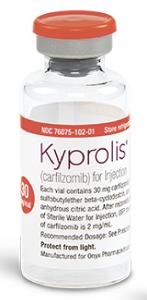
- País de registro
- Forma farmacéuticaINYECTABLE, 30 mg
- Código ATCL01XG02
- Principio activo
- Requiere recetaSí
- Fabricante
- ComposiciónSULFOBUTILETER BETACICLODEXTRINA (1500 mg mg), HIDROXIDO DE SODIO (E 524) (C.S.P. 0.3 MILIMOLES mg)
- Esta información es de carácter general y no sustituye la consulta con un profesional sanitario.
- Alternativas a KYPROLIS 30 MG POLVO PARA SOLUCION PARA PERFUSIONForma farmacéutica: INYECTABLE, 10 mgPrincipio activo: CarfilzomibFabricante: Amgen Europe B.V.Requiere recetaForma farmacéutica: INYECTABLE PERFUSION, 60 mgPrincipio activo: CarfilzomibFabricante: Amgen Europe B.V.Requiere recetaForma farmacéutica: INYECTABLE, 1 mgPrincipio activo: BortezomibFabricante: Accord Healthcare S.L.U.Requiere receta
Médicos online para KYPROLIS 30 MG POLVO PARA SOLUCION PARA PERFUSION
Comenta la dosis, los posibles efectos secundarios, interacciones, contraindicaciones o la revisión de receta de KYPROLIS 30 MG POLVO PARA SOLUCION PARA PERFUSION, sujeto a valoración médica y a la normativa local.
Obtén una receta de KYPROLIS 30 MG POLVO PARA SOLUCION PARA PERFUSION online
Rellena un formulario de 2 minutos
Cuéntanos tus síntomas, historial y el medicamento que necesitas.
Elige un médico o nosotros te asignamos uno
Escoge un especialista o te conectamos con el próximo médico disponible.
El médico revisa tu caso
Normalmente en 30 minutos. Puede hacerte preguntas adicionales por chat.
Recógela en cualquier farmacia
Receta electrónica enviada a tu correo, válida en toda España.
Preguntas frecuentes
KYPROLIS 30 MG POLVO PARA SOLUCION PARA PERFUSION requiere receta en España. Puedes confirmarlo con un médico online según tu caso.
El principio activo de KYPROLIS 30 MG POLVO PARA SOLUCION PARA PERFUSION es Carfilzomib. Esta información ayuda a identificar medicamentos con la misma composición pero con diferentes nombres comerciales.
KYPROLIS 30 MG POLVO PARA SOLUCION PARA PERFUSION es fabricado por Amgen Europe B.V.. La marca y el envase pueden variar según el distribuidor.
Los Médicos de familia, Psiquiatras, Dermatólogos, Cardiólogos, Endocrinólogos, Gastroenterólogos, Neumólogos, Nefrólogos, Reumatólogos, Hematólogos, Infectólogos, Alergólogos, Geriatras, Pediatras, Oncólogos pueden valorar la prescripción de KYPROLIS 30 MG POLVO PARA SOLUCION PARA PERFUSION cuando esté clínicamente indicado. Puedes reservar una videoconsulta para comentar tu caso y las opciones de tratamiento.
España cuenta con una infraestructura sanitaria bien desarrollada en ciudades principales como Madrid, Barcelona, Valencia y Sevilla. Las farmacias están ampliamente disponibles y operan bajo estrictas regulaciones, garantizando el acceso a medicamentos con receta.
Puedes comprar KYPROLIS 30 MG POLVO PARA SOLUCION PARA PERFUSION en Madrid, Barcelona, Sevilla o Valencia en cualquier farmacia local con una receta válida.
Para obtener una receta, puedes utilizar Oladoctor:
Otros medicamentos con el mismo principio activo (Carfilzomib) incluyen KYPROLIS 10 MG POLVO PARA SOLUCION PARA PERFUSION, KYPROLIS 60 MG POLVO PARA SOLUCION PARA PERFUSION, BORTEZOMIB ACCORD 1 MG POLVO PARA SOLUCION INYECTABLE EFG. Pueden tener diferentes nombres comerciales o formulaciones, pero contienen el mismo componente terapéutico. Consulta siempre con un médico antes de cambiar o iniciar un nuevo medicamento.
