



KISQALI 200 mg Comprimidos Recubiertos Con Película

Revisión de receta online
Un médico revisará tu caso y determinará si la prescripción es médicamente apropiada.

Habla con un médico sobre este medicamento
Comenta tus síntomas y las opciones de tratamiento en una consulta online.



Cómo usar KISQALI 200 MG COMPRIMIDOS RECUBIERTOS CON PELICULA
Contenido del prospecto
- Introducción
- Qué es Kisqali y para qué se utiliza
- Qué necesita saber antes de empezar a tomar Kisqali
- Cómo tomar Kisqali
- Posibles efectos adversos
- Conservación de Kisqali
- Contenido del envase e información adicional
Introducción
Prospecto: información para el paciente
Kisqali 200mg comprimidos recubiertos con película
ribociclib
Lea todo el prospecto detenidamente antes de empezar a tomar este medicamento, porque contiene información importante para usted.
- Conserve este prospecto, ya que puede tener que volver a leerlo.
- Si tiene alguna duda, consulte a su médico, farmacéutico o enfermero.
- Este medicamento se le ha recetado solamente a usted, y no debe dárselo a otras persona aunque tengan los mismos síntomas que usted, ya que puede perjudicarles.
- Si experimenta efectos adversos, consulte a su médico, farmacéutico o enfermero, incluso si se trata de efectos adversos que no aparecen en este prospecto. Ver sección 4.
Contenido del prospecto
- Qué es Kisqali y para qué se utiliza
- Qué necesita saber antes de empezar a tomar Kisqali
- Cómo tomar Kisqali
- Posibles efectos adversos
- Conservación de Kisqali
- Contenido del envase e información adicional
1. Qué es Kisqali y para qué se utiliza
Qué es Kisqali
Kisqali contiene el principio activo ribociclib, que pertenece a un grupo de medicamentos denominados inhibidores de quinasas dependientes de ciclinas (CDK) 4 y 6.
Para qué se utiliza Kisqali
Kisqali se utiliza en pacientes con un tipo de cáncer de mama denominado cáncer de mama positivo para el receptor hormonal y negativo para el receptor del factor de crecimiento epidérmico humano (HER2), que:
- está localizado en la mama o puede haberse extendido a los ganglios linfáticos en la región de la mama, sin que se haya detectado la expansión a otras partes del cuerpo, se ha extirpado quirúrgicamente, y tiene ciertas características que aumentan el riesgo de que vuelva a aparecer. Se utiliza en combinación con un inhibidor de la aromatasa, que se utiliza como terapia hormonal para el cáncer (cáncer de mama precoz). Las mujeres que no han llegado a la menopausia y los hombres también serán tratados con un medicamento denominado agonista de la hormona liberadora de la hormona luteizante (LHRH) que bloquea la producción de algunas hormonas.
- es avanzado o metastásico. Esto significa que el cáncer ha crecido fuera de la mama y se ha extendido a los ganglios linfáticos de la mama (localmente avanzado) o que se ha extendido a otras partes del cuerpo (metastásico). Kisqali se utiliza en combinación con un inhibidor de la aromatasa o con fulvestrant, que se utilizan como tratamientos hormonales contra el cáncer. Las mujeres que no han llegado a la menopausia también serán tratadas con un medicamento denominado agonista de la hormona liberadora de la hormona luteizante (LHRH) que bloquea la producción de algunas hormonas.
Cómo actúa Kisqali
Kisqali actúa bloqueando las señales de crecimiento transmitidas por las proteínas CDK 4 y 6, y de esta manera impide el crecimiento y la diseminación de las células cancerosas. En el cáncer de mama precoz, puede prevenir que el cáncer reaparezca después de la cirugía (el tratamiento después de la cirugía se llama tratamiento adyuvante). En el cáncer de mama avanzado o metastásico, puede retrasar la progresión del cáncer.
Si tiene dudas sobre cómo actúa Kisqali o el motivo por el que se le ha prescrito este medicamento, consulte a su médico, farmacéutico o enfermero.

¿No estás seguro de si este medicamento es adecuado para ti?
Comenta tus síntomas y tratamiento con un médico online.
2. Qué necesita saber antes de empezar a tomar Kisqali
Siga las instrucciones de su médico cuidadosamente. Pueden ser diferentes de la información general en este prospecto.
No tome Kisqali
- si es alérgico a ribociclib, cacahuetes, soja o a alguno de los demás componentes de este medicamento (incluidos en la sección 6).
Si cree que puede ser alérgico, consulte con su médico.
Advertencias y precauciones
Consulte a su médico, farmacéutico o enfermero antes de empezar a tomar Kisqali.
Si se encuentra en alguna de las siguientes situaciones antes de tomar Kisqali, consulte a su médico o farmacéutico:
- Si tiene fiebre, dolor de garganta o llagas en la boca debido a infecciones (signos de un nivel bajo de glóbulos blancos).
- Si tiene algún problema en el hígado o ha tenido anteriormente algún tipo de enfermedad en el hígado.
- Si tiene o ha tenido problemas en el corazón o alteraciones del ritmo cardiaco, tales como un ritmo cardiaco irregular, incluyendo una enfermedad llamada síndrome del QT prolongado (prolongación del intervalo QT) o niveles bajos de potasio, magnesio, calcio o fósforo en la sangre.
Si se encuentra en alguna de las siguientes situaciones durante su tratamiento con Kisqali, informe a su médico o farmacéutico:
- Si presenta una combinación de alguno de los siguientes síntomas: erupción, enrojecimiento de la piel, ampollas en los labios, ojos o boca, descamación en la piel, fiebre alta, síntomas similares a la gripe y aumento de tamaño de los ganglios linfáticos (pueden ser signos de una reacción grave en la piel).
En caso de una reacción grave en la piel, su médico le indicará que debe interrumpir el tratamiento con Kisqali inmediatamente.
- Problemas para respirar, tos y dificultad respiratoria (pueden ser signos de problemas en el pulmón o respiratorios).
Si es necesario, su médico puede interrumpir o reducir su dosis de Kisqali o decidir suspender el tratamiento con Kisqali de forma permanente.
Controles durante el tratamiento con Kisqali
Antes y durante el tratamiento con Kisqali le realizarán análisis de sangre periódicos para comprobar la función del hígado y la cantidad de células sanguíneas (glóbulos blancos, glóbulos rojos y plaquetas) y los electrolitos (sales en la sangre incluyendo potasio, calcio, magnesio y fosfato) en el cuerpo. También se le controlará la actividad del corazón antes y durante el tratamiento con Kisqali con una prueba llamada electrocardiograma (ECG). Si es necesario, se le van a realizar análisis adicionales para evaluar la función del riñón durante el tratamiento con Kisqali. Si es necesario, su médico puede reducir la dosis de Kisqali o suspenderlo temporalmente para permitir que se recupere el hígado, el riñón, las células sanguíneas, los niveles de electrolitos o la actividad del corazón. Su médico puede decidir interrumpir el tratamiento con Kisqali de forma definitiva.
Niños y adolescentes
No se debe utilizar Kisqali en niños y adolescentes por debajo de 18 años.
Otros medicamentos yKisqali
Antes de tomar Kisqali, informe a su médico o farmacéutico si está tomando, ha tomado recientemente o pudiera tener que tomar cualquier otro medicamento, incluyendo medicamentos con receta y sin receta, medicamentos a base de plantas, o suplementos, porque estos pueden influenciar el efecto de Kisqali. Informe siempre a su médico si le han prescrito un nuevo medicamento después de empezar el tratamiento con Kisqali.
Esto incluye en particular:
- Tamoxifeno, otro medicamento para el tratamiento del cáncer de mama.
- Algunos medicamentos utilizados para tratar infecciones fúngicas, como ketoconazol, itraconazol, voriconazol o posaconazol.
- Algunos medicamentos utilizados para tratar VIH/SIDA como ritonavir, saquinavir, indinavir, lopinavir, nelfinavir, telaprevir y efavirenz.
- Algunos medicamentos utilizados para tratar las convulsiones o ataques (antiepilépticos) como carbamacepina y fenitoina.
- Hierba de San Juan (también conocida como Hypericum perforatum) – un medicamento a base de plantas utilizado para tratar la depresión y otras enfermedades.
- Algunos medicamentos utilizados para tratar problemas de ritmo cardiaco o presión arterial elevada como amiodarona, disopiramida, procainamida, quinidina, sotalol y verapamilo.
- Medicamentos antimaláricos como cloroquina.
- Antibióticos como claritromicina, telitromicina, moxifloxacina, rifampicina, ciprofloxacino, levofloxacino y azitromicina.
- Algunos medicamentos utilizados para la sedación o la anestesia como midazolam.
- Algunos medicamentos utilizados como antipsicóticos como haloperidol.
- Medicamentos utilizados para tratar la angina como bepridilo.
- Metadona,utilizado para tratar el dolor o la adicción a los opiáceos.
- Medicamentos como ondansetron intravenoso, utilizado para prevenir las náuseas y vómitos causados por la quimioterapia (tratamiento con medicamentos para el cáncer).
Kisqali puede aumentar o disminuir los niveles en la sangre de otros medicamentos. Esto incluye en particular:
- Medicamentos utilizados para tratar los síntomas de la hiperplasia de próstata benigna como alfuzosina.
- Tamoxifeno, otro medicamento para el tratamiento del cáncer de mama.
- Antiarrítmicos como amiodarona o quinidina.
- Antipsicóticos como pimocida o quetiapina.
- Medicamentos utilizados para mejorar los niveles de grasa en la sangre como simvastatina o lovastatina, pitavastatina, pravastatina o rosuvastatina.
- Medicamentos utilizados para tratar los niveles altos de azúcar en la sangre (p.ej.diabetes) como metformina.
- Medicamentos utilizados para tratar enfermedades cardiacas como digoxina.
- Medicamentos utilizados para tratar la hipertensión arterial pulmonar y la disfunción eréctil como sildenafilo.
- Medicamentos utilizados para tratar la tensión arterial baja o la migraña como ergotamina o dihidroergotamina.
- Algunos medicamentos utilizados para tratar los ataques epilépticos o que se utilizan para la sedación o anestesia como midazolam.
- Medicamentos utilizados para tratar alteraciones del sueño como triazolam.
- Analgésicos como alfentanilo y fentanilo.
- Medicamentos utilizados para el tratamiento de trastornos gastrointestinales como cisapride.
- Medicamentos utilizados para prevenir el rechazo de un trasplante de órgano como tacrolimus, sirolimus y ciclosporina (también utilizados para tratar la inflamación en artritis reumatoide y psoriasis).
- Everolimus, utilizado para varios tipos de cáncer y esclerosis tuberosa (también utilizado para prevenir el rechazo de un órgano trasplantado).
Consulte a su médico o farmacéutico si no está seguro si su medicamento es uno de los descritos anteriormente.
Toma de Kisqali con alimentos y bebida
No coma pomelo ni alimentos que contengan pomelo ni beba zumos que contengan pomelodurante su tratamiento con Kisqali. Puede cambiar la forma cómo se procesa Kisqali en su cuerpo y puede aumentar la cantidad de Kisqali en la sangre, haciéndolo menos efectivo.
Embarazo y lactancia
Si está embarazada o en periodo de lactancia, cree que podría estar embarazada o tiene intención de quedarse embarazada, consulte a su médico antes de utilizar este medicamento.
Su médico comentará con usted los posibles riesgos de tomar Kisqali durante el embarazo.
Embarazo y mujeres en edad fértil
No se debe utilizar Kisqali durante el embarazo ya que puede dañar al feto. Si usted es una mujer en edad fértil deberá tener un test de embarazo negativo antes de empezar a tomar el tratamiento con Kisqali. Debe utilizar una anticoncepción efectiva (p.ej. anticonceptivos de doble barrera como preservativos y diafragma) mientras esté tomando Kisqali y durante al menos 21 días después de la última dosis. Consulte con su médico las opciones de anticoncepción efectiva.
Lactancia
No debe dar el pecho mientras está tomando Kisqali y durante al menos 21 días después de la última dosis.
Conducción y uso de máquinas
El tratamiento con Kisqali puede causar cansancio, mareo o sensación de dar vueltas. Por lo tanto se debe tener precaución al conducir o utilizar máquinas durante el tratamiento con Kisqali.
Kisqali contiene lecitina de soja
Si es alérgico a los cacahuetes o a la soja, no tome este medicamento.
3. Cómo tomar Kisqali
Siga exactamente las instrucciones de administración de este medicamento indicadas por su médico, farmacéutico o enfermero. Su médico, farmacéutico o enfermero le informará exactamente sobre cuántos comprimidos debe tomar y qué días debe tomarlos. En caso de duda, consulte de nuevo a su médico, farmacéutico o enfermero. No cambie la dosis de Kisqali o la pauta de tratamiento sin hablar con su médico.
No debe superar la dosis recomendada prescrita por su médico.
CuántoKisqali debe tomar
Dosis de inicio recomendada de Kisqali | Número de comprimidos | |
Cáncer de mama precoz | 400 mg una vez al día | 2 comprimidos de 200 mg |
Cáncer de mama avanzado o metastásico | 600 mg una vez al día | 3 comprimidos de 200 mg |
Nota: Un ciclo de tratamiento dura 28 días. Tome Kisqali una vez al día sólo del día 1 al 21 de un ciclo de 28 días. No tome Kisqali los días 22 a 28 del ciclo. |
- La caja de Kisqali incluye un calendario que le permite hacer un seguimiento de su dosis diaria de Kisqali marcando un círculo para cada comprimido que toma durante el ciclo de 28 días.
- Su médico le informará exactamente sobre cuántos comprimidos de Kisqali debe tomar. En determinadas situaciones (p.ej. en caso de problemas de hígado o riñón) su médico le indicará que tome una dosis más baja de Kisqali.
Es muy importante seguir las instrucciones de su médico. Si presenta algunos efectos adversos su médico puede decidir que tome una dosis más baja, que interrumpa el tratamiento con Kisqali o que deje de tomarlo de forma definitiva.
Cuándo tomar Kisqali
Tome Kisqali una vez al día a la misma hora cada día, preferentemente por la mañana. Esto le ayudará a recordar tomar su medicamento y a detectar cualquier efecto adverso que pueda ocurrir para que pueda contactar con su médico rápidamente.
Cómo tomar Kisqali
Los comprimidos de Kisqali se deben tragar enteros (los comprimidos no se deben masticar, triturar o partir antes de tragarlos). No tome un comprimido que esté roto, agrietado o dañado.
Toma de Kisqali con alimentos y bebida
Debe tomar Kisqali una vez al día cada día a la misma hora, preferentemente por la mañana. Lo puede tomar con o sin comida.
Durante cuánto tiempo tomar Kisqali
Tome Kisqali una vez al día los días 1 al 21 de un ciclo de 28 días. Continúe el tratamiento con Kisqali durante el tiempo que le indique su médico.
En el cáncer de mama precoz, se recomienda una duración máxima del tratamiento de 3 años. En el cáncer de mama avanzado o metastásico éste es un tratamiento a largo plazo. Su médico controlará periódicamente su situación para comprobar que el tratamiento está teniendo el efecto deseado.
Si toma más Kisqali del que debe
Si toma demasiados comprimidos, o si otra persona toma su medicamento, contacte con un médico o acuda a un hospital inmediatamente. Muestre el envase de Kisqali. Puede necesitar tratamiento médico.
Si olvidó tomar una dosis de Kisqali
Si sufre vómitos después de tomar la dosis o si se olvida de tomar una dosis, no tome la dosis olvidada de ese día. Tome la próxima dosis al día siguiente a la hora prescrita.
No tome una dosis doble para compensar las dosis olvidadas. Por el contrario, espere hasta la hora que debe tomar la próxima dosis y entonces tome la dosis de forma habitual.
Si interrumpe el tratamiento con Kisqali
Si considera que la dosis que toma es demasiado alta o demasiado baja, contacte con su médico. No interrumpa el tratamiento con Kisqali a menos que su médico se lo indique Si interrumpe el tratamiento con Kisqali puede provocar que su cáncer empeore.
Si tiene cualquier otra duda sobre el uso de este medicamento, pregunte a su médico, farmacéutico o enfermero.

¿Has empezado a tomar el medicamento y tienes preguntas?
Comenta tus síntomas y tratamiento con un médico online.
4. Posibles efectos adversos
Al igual que todos los medicamentos, este medicamento puede producir efectos adversos, aunque no todas las personas los sufran. Lea este apartado con atención. Los efectos adversos que podrían ser graves se presentan en primer lugar (“Algunos efectos adversos pueden ser graves”), y a continuación se describen todo el resto de efectos adversos (“Otros posibles efectos adversos”) en orden descendente de frecuencia.
Cáncer de mama precoz
Algunos efectos pueden ser graves
Su médico puede indicarle que tome una dosis más baja, que interrumpa el tratamiento con Kisqali o que suspenda el tratamiento de forma permanente. Informe inmediatamente a su médico si tiene alguno de los siguientes síntomas durante el tratamiento con Kisqali:
- Fiebre, sudor o escalofríos, tos, síntomas similares a la gripe, pérdida de peso, dificultad para respirar, sangre en la flema, dolor en el cuerpo, partes del cuerpo calientes o dolorosas, diarrea o dolor de estómago, o sensación de mucho cansancio (signos o síntomas de infecciones). Muy frecuentes (pueden afectar a más de 1 de cada 10pacientes).
- Fiebre, escalofríos, debilidad e infecciones frecuentes con síntomas como dolor de garganta o llagas en la boca. Estos pueden ser signos o bien de un nivel bajo de glóbulos blancos (muy frecuentes, pueden afectar a más de 1 de cada 10pacientes)o bien de un nivel bajo de linfocitos, que son un tipo de glóbulos blancos (frecuentes, pueden afectar a 1 de cada 10pacientes).
- Resultados anormales en los análisis de sangre que dan información sobre la salud del hígado (controles de la función del hígado anormales). Muy frecuentes (pueden afectar a más de 1 de cada 10pacientes).
- Sangrado espontáneo o aparición de moratones (signos de un nivel bajo de plaquetas). Frecuentes (pueden afectar a 1 de cada 10pacientes).
- Disminución del nivel de potasio en la sangre, que puede alterar el ritmo cardiaco. Frecuentes (puede afectar a 1 de cada 10pacientes).
- Dolor o molestias en el pecho, cambios en el latido de su corazón (rápido o lento), palpitaciones, mareos, desmayos, desvanecimientos, coloración azul en los labios, dificultad para respirar, hinchazón (edema) de sus extremidades inferiores o piel (estos pueden ser signos de problemas del corazón). Frecuentes (pueden afectar a hasta 1 de cada 10pacientes).
- Cansancio, piel amarilla con picor, o color amarillento de la parte blanca de los ojos, náuseas o vómitos, pérdida de apetito, dolor en la parte superior derecha del vientre (abdomen), orina de color oscuro o marrón, o si sufre sangrados o moratones más fácilmente de lo normal (estos pueden ser signos de un problema del hígado). Frecuentes (pueden afectar a hasta 1 de cada 10pacientes).
- Inflamación en los pulmones, que puede causar tos seca, dolor en el pecho, fiebre, falta de aire y dificultad para respirar (estos pueden ser signos de la enfermedad pulmonar intersticial/neumonitis que, en casos graves, puede ser mortal). Frecuentes (pueden afectar a hasta 1 de cada 10pacientes).
- Dolor de garganta o úlceras en la boca con un único episodio de fiebre de al menos 38,3 ºC o fiebre por encima de 38 ºC durante más de una hora y/o con infección (neutropenia febril). Poco frecuentes (pueden afectar a hasta 1 de cada 100pacientes).
Otros posibles efectos adversos
Otros efectos adversos incluyen los siguientes que se detallan a continuación. Si estos efectos adversos pasan a ser graves, informe a su médico, farmacéutico o enfermero.
Muy frecuentes(pueden afectar más de 1 de cada 10pacientes)
- Dolor de garganta, rinitis, fiebre (signos de una infección del tracto respiratorio)
- Micción (orinar) dolorosa y frecuente (signos de infección del tracto urinario)
- Náuseas (sentirse mal)
- Dolor de cabeza
- Fatiga (cansancio)
- Astenia (debilidad)
- Alopecia (pérdida de cabello o debilitamiento del cabello)
- Diarrea
- Estreñimiento
- Tos
- Dolor abdominal (en el vientre)
- Pirexia (fiebre)
Frecuentes(pueden afectar a hasta 1 de cada 10pacientes)
- Erupción
- Mareo o aturdimiento
- Cansancio, palidez de la piel (signo potencial de un bajo nivel de glóbulos rojos, anemia)
- Vómitos
- Prurito (picor)
- Edema periférico (manos, tobillos o pies hinchados)
- Disnea (falta de aire, dificultad para respirar)
- Estomatitis (úlceras en la boca con inflamación de las encías)
- Dolor orofaríngeo (dolor de garganta)
- Nivel bajo de calcio en la sangre, que puede causar en algunos casos calambres
- Reducción de apetito
- Resultados de análisis de sangre para la función del riñón anómalos (alto nivel de creatinina en la sangre)
Cáncer de mama avanzado o metastásico
Algunos efectos adversos pueden ser graves
Su médico puede indicarle que tome una dosis más baja, que interrumpa el tratamiento con Kisqali o que suspenda el tratamiento de forma permanente.Informe inmediatamente a su médico si tiene alguno de los siguientes síntomas durante el tratamiento con Kisqali:
- Fiebre, sudor o escalofríos, tos, síntomas similares a la gripe, pérdida de peso, dificultad para respirar, sangre en la flema, dolor en el cuerpo, partes del cuerpo calientes o dolorosas, diarrea o dolor de estómago, o sensación de mucho cansancio (signos o síntomas de infecciones). Muy frecuentes (pueden afectar a 1 de cada 10pacientes)
- Fiebre, escalofríos, debilidad e infecciones frecuentes con síntomas como dolor de garganta o llagas en la boca (signos de un nivel bajo de leucocitos o linfocitos, que son tipos de glóbulos blancos). Muy frecuentes (pueden afectar más de 1 de cada 10pacientes).
- Resultados anormales en los análisis de sangre que dan información sobre la salud del hígado (controles de la función del hígado anormales). Muy frecuentes (pueden afectar más de 1 de cada 10pacientes).
- Sangrado espontáneo o aparición de moratones (signos de un nivel bajo de plaquetas). Frecuentes (pueden afectar a 1 de cada 10pacientes)
- Dolor de garganta o úlceras en la boca con un único episodio de fiebre de al menos 38,3 ºC o fiebre por encima de 38 ºC durante más de una hora y/o con infección (neutropenia febril). Frecuentes (puede afectar a hasta 1 de cada 10pacientes).
- Cansancio, piel amarilla con picor, o color amarillento de la parte blanca de los ojos, náuseas o vómitos, pérdida de apetito, dolor en la parte superior derecha del vientre (abdomen), orina de color oscuro o marrón, o si sufre sangrados o moratones más fácilmente de lo normal (estos pueden ser signos de un problema del hígado). Frecuentes (pueden afectar a hasta 1 de cada 10pacientes).
- Disminución del nivel de potasio en la sangre, que puede alterar el ritmo cardiaco. Frecuente (puede afectar a 1 de cada 10pacientes).
- Dolor o molestias en el pecho, cambios en el latido de su corazón (rápido o lento), palpitaciones, mareos, desmayos, desvanecimientos, coloración azul en los labios, dificultad para respirar, hinchazón (edema) de sus extremidades inferiores o piel (estos pueden ser signos de problemas del corazón). Frecuentes (pueden afectar a hasta 1 de cada 10pacientes).
- Inflamación en los pulmones, que puede causar tos seca, dolor en el pecho, fiebre, falta de aire y dificultad para respirar (estos pueden ser signos de la enfermedad pulmonar intersticial/neumonitis que, en casos graves, puede ser mortal). Frecuentes (pueden afectar a hasta 1 de cada 10pacientes).
- Infección grave con aumento de la frecuencia cardiaca, dificultad para respirar o respiración rápida, fiebre y escalofríos (estos pueden ser signos de sepsis que es una infección en el sistema sanguíneo que puede amenazar la vida). Poco frecuentes (pueden afectar a hasta 1 de cada 100pacientes).
- Reacción grave en la piel que podría incluir una combinación de alguno de los siguientes síntomas: erupción, enrojecimiento de la piel, ampollas en los labios, ojos o boca, descamación de la piel, fiebre alta, síntomas similares a la gripe, aumento de tamaño de los ganglios linfáticos (necrólisis epidérmica tóxica [NET]). Frecuencia no conocida (no puede estimarse la frecuencia a partir de los datos disponibles).
Otros posibles efectos adversos
Otros efectos adversos incluyen los siguientes que se detallan a continuación. Si estos efectos adversos pasan a ser graves, informe a su médico, farmacéutico o enfermero.
Muy frecuentes(pueden afectar más de 1 de cada 10pacientes)
- Cansancio, palidez en la piel (posible signo de un nivel bajo de glóbulos rojos, anemia)
- Dolor de garganta, rinitis, fiebre (signos de una infección del tracto respiratorio)
- Micción (orinar) frecuente y dolorosa (signos de infección del tracto urinario)
- Disminución del apetito
- Dolor de cabeza
- Mareo o aturdimiento
- Disnea (falta de aire, dificultad para respirar)
- Tos
- Náuseas (sentirse mal)
- Diarrea
- Vómitos
- Estreñimiento
- Dolor abdominal (en el vientre)
- Estomatitis (llagas en la boca con inflamación de las encías)
- Dispepsia (molestia en el estómago, mala digestión, ardor de estómago)
- Alopecia (pérdida de cabello o debilitamiento del cabello)
- Erupción
- Prurito (picor)
- Dolor de espalda
- Fatiga (cansancio)
- Edema periférico (hinchazón en las manos, tobillos o pies)
- Pirexia (fiebre)
- Astenia (debilidad)
Frecuentes(pueden afectar a hasta 1 de cada 10pacientes)
- Dolor abdominal, náuseas, vómitos y diarrea (signos de gastroenteritis, que es una infección del tracto gastrointestinal)
- Nivel reducido de calcio en la sangre, que puede en algunos casos provocar calambres
- Nivel reducido de fosfato en la sangre
- Vértigo (sensación de estar girando)
- Ojos llorosos
- Sequedad ocular
- Nivel reducido de potasio en la sangre, que puede provocar alteraciones en el ritmo cardíaco
- Disgeusia (sabor extraño en la boca)
- Piel seca
- Eritema (enrojecimiento de la piel)
- Vitíligo (pérdida del color de la piel en manchas)
- Dolor orofaríngeo (dolor de garganta)
- Boca seca
- Resultados del análisis de sangre para la función del riñón anormales (nivel alto de creatinina en la sangre)
Rara(puede afectar a hasta 1 de cada 1000pacientes)
Una reacción cutánea que causa puntos rojos o manchas en la piel, que pueden parecer una diana o un «ojo de buey» con un centro de color rojo oscuro rodeado de anillos rojos más pálidos (eritema multiforme)
Comunicación de efectos adversos
Si experimenta cualquier tipo de efecto adverso, consulte a su médico, farmacéutico o enfermero, incluso si se trata de efectos adversos que no aparecen en este prospecto. También puede comunicarlos directamente a través del sistema nacional de notificación incluido en el Apéndice V. Mediante la comunicación de efectos adversos usted puede contribuir a proporcionar más información sobre la seguridad de este medicamento.
5. Conservación de Kisqali
Mantener este medicamento fuera de la vista y del alcance de los niños.
No utilice este medicamento después de la fecha de caducidad que aparece en la caja y el blíster. La fecha de caducidad es el último día del mes que se indica.
Farmacia: Conservar en nevera (entre 2 ºC y 8 ºC) durante un periodo de hasta 10 meses.
Paciente: Conservar por debajo de 25 ºC durante un periodo de hasta 2 meses. Conservar en el envase original.
No tome este medicamento si observa cualquier daño en el envase o si muestra algún signo de manipulación.
Los medicamentos no se deben tirar por los desagües ni a la basura. Pregunte a su farmacéutico cómo deshacerse de los envases y de los medicamentos que ya no necesita. De esta forma, ayudará a proteger el medio ambiente.
6. Contenido del envase e información adicional
Composición deKisqali
- El principio activo es ribociclib. Cada comprimido recubierto con película contiene succinato de ribociclib equivalente a 200 mg de ribociclib.
- Los demás componentes son:
Núcleo del comprimido: celulosa microcristalina; crospovidona tipo A; hidroxipropil celulosa de bajo grado de sustitución; estearato de magnesio; sílice coloidal anhidra.
Material de la cubierta pelicular: óxido de hierro negro (E172); óxido de hierro rojo (E172); lecitina de soja (E322) (ver “Kisqali contiene lecitina de soja” en la sección 2); alcohol polivinílico (parcialmente hidrolizado); talco; dióxido de titanio (E171); goma xantana.
Aspecto deKisqaliy contenido del envase
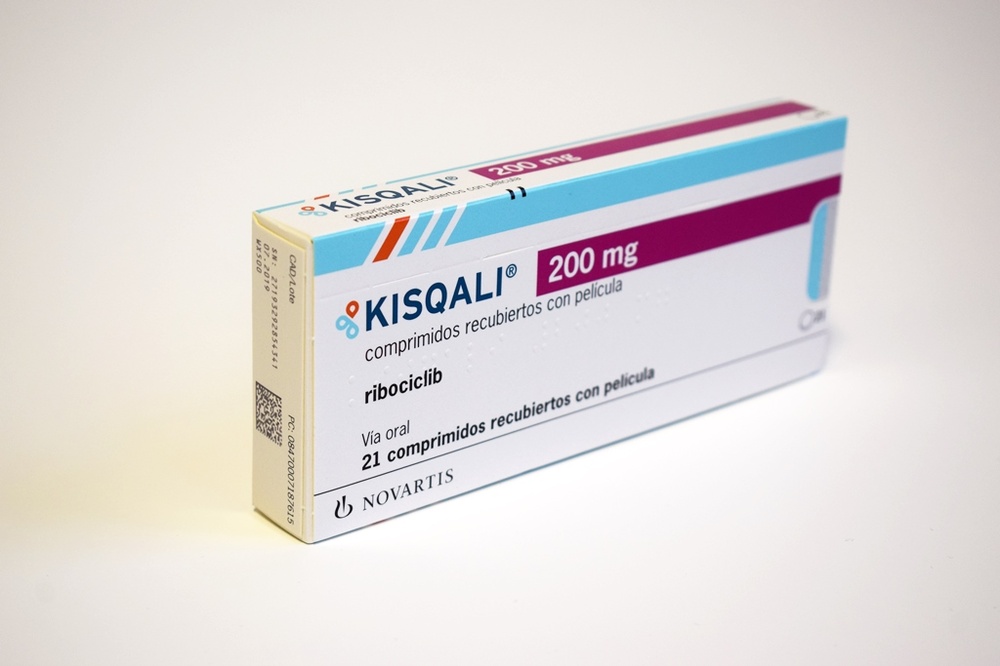
Kisqali se presenta como comprimidos recubiertos con película en blísters.
Los comprimidos recubiertos con película son de color violeta grisáceo claro, sin ranura, redondos, grabado con «RIC» en una cara y «NVR» en la otra cara.
Están disponibles los siguientes tamaños de envase: Envases que contienen 21, 42 o 63 comprimidos recubiertos con película y envases múltiples que contienen 63 (3 envases de 21), 126 (3 envases de 42) o 189 (3 envases de 63) comprimidos recubiertos con película.
Envases de Kisqali que contienen 63 comprimidos, destinados para los pacientes que toman la dosis de ribociclib diaria de 600 mg (3 comprimidos una vez al día).
Envases de Kisqali que contienen 42 comprimidos, destinados para los pacientes que toman la dosis de ribociclib diaria de 400 mg (2 comprimidos una vez al día).
Envases de Kisqali que contienen 21 comprimidos, destinados para los pacientes que toman la dosis más baja de ribociclib diaria de 200 mg (1 comprimido una vez al día).
Puede que solamente estén comercializados algunos tamaños de envases.
Titular de la autorización de comercialización
Novartis Europharm Limited
Vista Building
Elm Park, Merrion Road
Dublín 4
Irlanda
Responsable de la fabricación
Novartis Pharma GmbH
Roonstrasse 25
90429 Nuremberg
Alemania
Lek Pharmaceuticals d.d.
Verovškova Ulica 57
1526 Ljubljana
Eslovenia
Novartis Pharmaceutical Manufacturing LLC
Verovškova Ulica 57
1000 Ljubljana
Eslovenia
Novartis Pharma GmbH
Sophie-Germain-Strasse 10
90443 Nürnberg
Alemania
Pueden solicitar más información respecto a este medicamento dirigiéndose al representante local del titular de la autorización de comercialización:
België/Belgique/Belgien Novartis Pharma N.V. Tél/Tel: +32 2 246 16 11 | Lietuva SIA Novartis Baltics Lietuvos filialas Tel: +370 5 269 16 50 |
| Luxembourg/Luxemburg Novartis Pharma N.V. Tél/Tel: +32 2 246 16 11 |
Ceská republika Novartis s.r.o. Tel: +420 225 775 111 | Magyarország Novartis Hungária Kft. Tel.: +36 1 457 65 00 |
Danmark Novartis Healthcare A/S Tlf: +45 39 16 84 00 | Malta Novartis Pharma Services Inc. Tel: +356 2122 2872 |
Deutschland Novartis Pharma GmbH Tel: +49 911 273 0 | Nederland Novartis Pharma B.V. Tel: +31 88 04 52 111 |
Eesti SIA Novartis Baltics Eesti filiaal Tel: +372 66 30 810 | Norge Novartis Norge AS Tlf: +47 23 05 20 00 |
Ελλ?δα Novartis (Hellas) A.E.B.E. Τηλ: +30 210 281 17 12 | Österreich Novartis Pharma GmbH Tel: +43 1 86 6570 |
España Novartis Farmacéutica, S.A. Tel: +34 93 306 42 00 | Polska Novartis Poland Sp. z o.o. Tel.: +48 22 375 4888 |
France Novartis Pharma S.A.S. Tél: +33 1 55 47 66 00 | Portugal Novartis Farma ‑ Produtos Farmacêuticos, S.A. Tel: +351 21 000 8600 |
Hrvatska Novartis Hrvatska d.o.o. Tel. +385 1 6274 220 | România Novartis Pharma Services Romania SRL Tel: +40 21 31299 01 |
Ireland Novartis Ireland Limited Tel: +353 1 260 12 55 | Slovenija Novartis Pharma Services Inc. Tel: +386 1 300 75 50 |
Ísland Vistor hf. Sími: +354 535 7000 | Slovenská republika Novartis Slovakia s.r.o. Tel: +421 2 5542 5439 |
Italia Novartis Farma S.p.A. Tel: +39 02 96 54 1 | Suomi/Finland Novartis Finland Oy Puh/Tel: +358 (0)10 6133 200 |
Κ?προς Novartis Pharma Services Inc. Τηλ: +357 22 690 690 | Sverige Novartis Sverige AB Tel: +46 8 732 32 00 |
Latvija SIA Novartis Baltics Tel: +371 67 887 070 |
Fecha de la última revisión de este prospecto
Otras fuentes de información
La información detallada de este medicamento está disponible en la página web de la Agencia Europea de Medicamentos: https://www.ema.europa.eu
- País de registro
- Forma farmacéuticaCOMPRIMIDO, 200 mg
- Código ATCL01EF02
- Disponibilidad en farmaciasProblema de suministro reportado
- Principio activo
- Requiere recetaSí
- Fabricante
- Esta información es de carácter general y no sustituye la consulta con un profesional sanitario.
- Alternativas a KISQALI 200 MG COMPRIMIDOS RECUBIERTOS CON PELICULAForma farmacéutica: CAPSULA, 100 mgPrincipio activo: PalbociclibFabricante: Pfizer Europe Ma EeigRequiere recetaForma farmacéutica: COMPRIMIDO, 100 mgPrincipio activo: PalbociclibFabricante: Pfizer Europe Ma EeigRequiere recetaForma farmacéutica: CAPSULA, 125 mgPrincipio activo: PalbociclibFabricante: Pfizer Europe Ma EeigRequiere receta
Médicos online para KISQALI 200 MG COMPRIMIDOS RECUBIERTOS CON PELICULA
Comenta la dosis, los posibles efectos secundarios, interacciones, contraindicaciones o la revisión de receta de KISQALI 200 MG COMPRIMIDOS RECUBIERTOS CON PELICULA, sujeto a valoración médica y a la normativa local.
Obtén una receta de KISQALI 200 MG COMPRIMIDOS RECUBIERTOS CON PELICULA online
Rellena un formulario de 2 minutos
Cuéntanos tus síntomas, historial y el medicamento que necesitas.
Elige un médico o nosotros te asignamos uno
Escoge un especialista o te conectamos con el próximo médico disponible.
El médico revisa tu caso
Normalmente en 30 minutos. Puede hacerte preguntas adicionales por chat.
Recógela en cualquier farmacia
Receta electrónica enviada a tu correo, válida en toda España.
Preguntas frecuentes
KISQALI 200 MG COMPRIMIDOS RECUBIERTOS CON PELICULA requiere receta en España. Puedes confirmarlo con un médico online según tu caso.
El principio activo de KISQALI 200 MG COMPRIMIDOS RECUBIERTOS CON PELICULA es Ribociclib. Esta información ayuda a identificar medicamentos con la misma composición pero con diferentes nombres comerciales.
KISQALI 200 MG COMPRIMIDOS RECUBIERTOS CON PELICULA es fabricado por Novartis Europharm Limited. La marca y el envase pueden variar según el distribuidor.
Los Médicos de familia, Psiquiatras, Dermatólogos, Cardiólogos, Endocrinólogos, Gastroenterólogos, Neumólogos, Nefrólogos, Reumatólogos, Hematólogos, Infectólogos, Alergólogos, Geriatras, Pediatras, Oncólogos pueden valorar la prescripción de KISQALI 200 MG COMPRIMIDOS RECUBIERTOS CON PELICULA cuando esté clínicamente indicado. Puedes reservar una videoconsulta para comentar tu caso y las opciones de tratamiento.
España cuenta con una infraestructura sanitaria bien desarrollada en ciudades principales como Madrid, Barcelona, Valencia y Sevilla. Las farmacias están ampliamente disponibles y operan bajo estrictas regulaciones, garantizando el acceso a medicamentos con receta.
Puedes comprar KISQALI 200 MG COMPRIMIDOS RECUBIERTOS CON PELICULA en Madrid, Barcelona, Sevilla o Valencia en cualquier farmacia local con una receta válida.
Para obtener una receta, puedes utilizar Oladoctor:
Otros medicamentos con el mismo principio activo (Ribociclib) incluyen IBRANCE 100 MG CAPSULAS DURAS, IBRANCE 100 MG COMPRIMIDOS RECUBIERTOS CON PELICULA, IBRANCE 125 MG CAPSULAS DURAS. Pueden tener diferentes nombres comerciales o formulaciones, pero contienen el mismo componente terapéutico. Consulta siempre con un médico antes de cambiar o iniciar un nuevo medicamento.
