



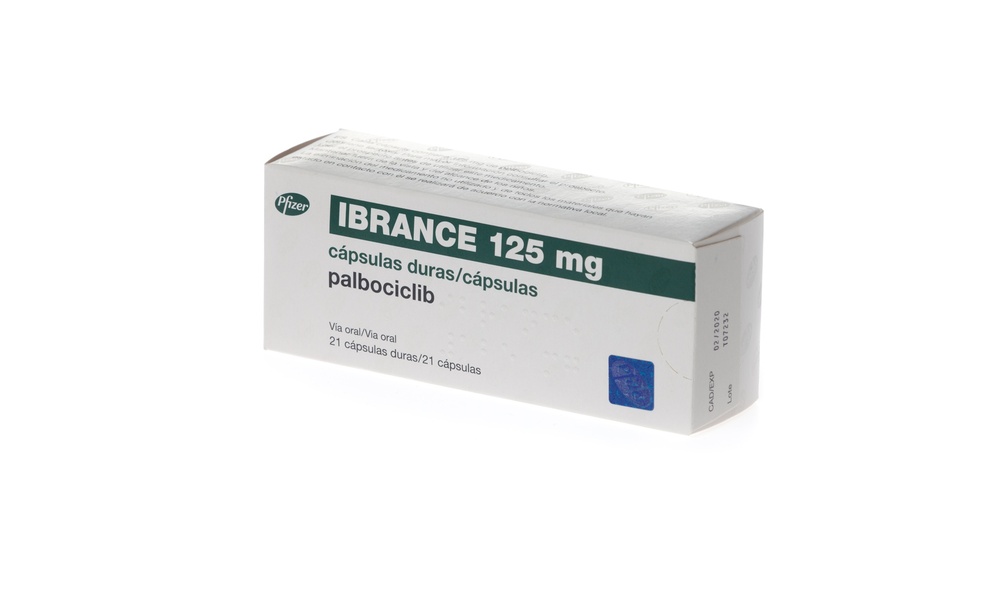
IBRANCE 125 mg Hard Capsules

Prescription review online
A doctor will review your case and decide whether a prescription is medically appropriate.

Talk to a doctor about this medicine
Discuss your symptoms and possible next steps in a quick online consultation.



How to use IBRANCE 125 mg HARD CAPSULES
Contents of the leaflet
- Introduction
- What is IBRANCE and what is it used for
- What you need to know before you take IBRANCE
- How to take IBRANCE
- Possible side effects
- Storage of IBRANCE
- Contents of the pack and other information
Introduction
Package Leaflet: Information for the Patient
IBRANCE 75mg hard capsules
IBRANCE 100mg hard capsules
IBRANCE 125mg hard capsules
palbociclib
Read all of this leaflet carefully before you start taking this medicine because it contains important information for you.
- Keep this leaflet, you may need to read it again.
- If you have any further questions, ask your doctor, pharmacist, or nurse.
- This medicine has been prescribed for you only. Do not pass it on to others. It may harm them, even if their signs of illness are the same as yours.
- If you get any side effects, talk to your doctor, pharmacist, or nurse. This includes any possible side effects not listed in this leaflet. See section 4.
Contents of the pack
- What is IBRANCE and what is it used for
- What you need to know before you take IBRANCE
- How to take IBRANCE
- Possible side effects
- Storage of IBRANCE
- Contents of the pack and other information
1. What is IBRANCE and what is it used for
IBRANCE is a medicine for the treatment of cancer that contains the active substance palbociclib.
Palbociclib works by blocking certain proteins called cyclin-dependent kinases 4 and 6, which regulate cell growth and division. Blocking these proteins can slow down the growth of cancer cells and delay the progression of cancer.
IBRANCE is used to treat patients with certain types of breast cancer (positive for the hormonal receptor and negative for the human epidermal growth factor receptor 2) that have spread beyond the original tumor and/or to other organs. It is given in combination with aromatase inhibitors or fulvestrant, which are used as hormonal treatments for cancer.

Not sure if this medicine is right for you?
Discuss your symptoms and treatment with a doctor online.
2. What you need to know before you take IBRANCE
Do not take IBRANCE
- if you are allergic to palbociclib or any of the other ingredients of this medicine (listed in section 6).
- You should avoid taking preparations that contain St. John's Wort, a herbal medicine used to treat mild depression and anxiety, during treatment with IBRANCE.
Warnings and precautions
Talk to your doctor, pharmacist, or nurse before you start taking IBRANCE.
IBRANCE may reduce the number of white blood cells and weaken your immune system. Therefore, you may be at a greater risk of getting an infection while taking IBRANCE.
Tell your doctor, pharmacist, or nurse if you have signs or symptoms of an infection, such as chills or fever.
You will have regular blood tests during treatment to check if IBRANCE is affecting your blood cells (white blood cells, red blood cells, and platelets).
IBRANCE may cause severe or life-threatening lung inflammation during treatment, which can lead to death. Tell your healthcare professional immediately if you have any new or worsening symptoms, including:
- Difficulty breathing or shortness of breath.
- Dry cough.
- Chest pain.
Children and adolescents
IBRANCE is not indicated for the treatment of children or adolescents (under 18 years of age).
Other medicines and IBRANCE
Tell your doctor or pharmacist if you are taking, have recently taken, or might take any other medicines. IBRANCE may affect the way other medicines work.
In particular, the following medicines may increase the risk of side effects with IBRANCE:
- Lopinavir, indinavir, nelfinavir, ritonavir, telaprevir, and saquinavir used to treat HIV/AIDS infection.
- Clarithromycin and telithromycin, antibiotics used to treat bacterial infections.
- Voriconazole, itraconazole, ketoconazole, and posaconazole used to treat fungal infections.
- Nefazodone, used to treat depression.
IBRANCE may increase the side effects associated with the following medicines:
- Quinidine, used to treat heart rhythm problems.
- Colchicine, used to treat gout.
- Pravastatin and rosuvastatin, used to lower cholesterol levels.
- Sulfasalazine, used to treat rheumatoid arthritis.
- Alfentanil, used for anesthesia in surgery; fentanyl, used before surgery as a pain reliever, as well as an anesthetic.
- Cyclosporine, everolimus, tacrolimus, and sirolimus, used in organ transplantation to prevent rejection.
- Dihydroergotamine and ergotamine, used to treat migraines.
- Pimozide, used to treat schizophrenia and chronic psychosis.
The following medicines may decrease the effectiveness of IBRANCE:
- Carbamazepine and phenytoin, used to stop seizures or epileptic fits.
- Enzalutamide for the treatment of prostate cancer.
- Rifampicin, used to treat tuberculosis (TB).
- St. John's Wort, a herbal medicine used to treat mild depression and anxiety.
Taking IBRANCE with food and drinks
Avoid grapefruit and grapefruit juice while taking IBRANCE, as it may increase the side effects of IBRANCE.
Pregnancy, breastfeeding, and fertility
Do not take IBRANCE if you are pregnant.
Avoid becoming pregnant while taking IBRANCE.
Talk to your doctor about the use of contraceptive methods if there is any possibility that you or your partner may become pregnant.
If you are pregnant or breastfeeding, think you may be pregnant, or are planning to have a baby, ask your doctor or pharmacist for advice before taking this medicine.
Women of childbearing age who are taking this medicine or their partner must use adequate contraceptive measures (such as double-barrier contraception like condoms and diaphragm). These measures should be used during treatment and for at least 3 weeks after finishing treatment in women and up to 14 weeks in men.
Breastfeeding
Do not breastfeed while taking IBRANCE. It is not known if IBRANCE passes into breast milk.
Fertility
Palbociclib may decrease fertility in men.
Therefore, men should consider sperm preservation before starting treatment with IBRANCE.
Driving and using machines
Fatigue is a very common side effect of IBRANCE. If you feel unusually tired, be careful when driving or using machines.
IBRANCE contains lactose and sodium
This medicine contains lactose (present in milk and dairy products). If your doctor has told you that you have an intolerance to some sugars, talk to them before taking this medicine.
This medicine contains less than 1 mmol of sodium (23 mg) per capsule; this is essentially "sodium-free".
3. How to take IBRANCE
Follow exactly the administration instructions of this medicine given by your doctor or pharmacist. If you are unsure, talk to your doctor or pharmacist again.
The recommended dose is 125 mg of IBRANCE once daily for 3 weeks, followed by 1 week without taking IBRANCE. Your doctor will tell you how many IBRANCE capsules to take.
If you experience certain side effects while taking IBRANCE (see section 4 "Possible side effects"), your doctor may reduce your dose or interrupt treatment, temporarily or permanently. The dose may be reduced to one of the available doses of 100 mg or 75 mg.
Take IBRANCE once daily, approximately at the same time every day, and with food, preferably in a meal.
Swallow the capsule whole with a glass of water. Do not chew or crush the capsules. Do not open the capsules.
If you take more IBRANCE than you should
If you take too much IBRANCE, talk to a doctor or go to a hospital straight away. You may need emergency treatment.
Take the pack and this leaflet with you.
If you forget to take IBRANCE
If you forget a dose or vomit, take the next dose as planned. Do not take a double dose to make up for the missed capsules.
If you stop taking IBRANCE
Do not stop taking IBRANCE unless your doctor tells you to.
If you have any further questions on the use of this medicine, ask your doctor or pharmacist.

Started taking the medicine and have questions?
Discuss your symptoms and treatment with a doctor online.
4. Possible side effects
Like all medicines, this medicine can cause side effects, although not everybody gets them.
Tell your doctor immediately if you experience any of the following symptoms:
- Fever, chills, weakness, difficulty breathing, bleeding, or bruising, which could be a sign of a serious blood disorder.
- Difficulty breathing, dry cough, or chest pain, which could be a sign of lung inflammation.
Other side effects of IBRANCE may include:
Very common side effects (may affect more than 1 in 10 people):
Infections.
Reduction in the number of white blood cells, red blood cells, and platelets.
Feeling tired.
Decreased appetite.
Inflammation of the mouth and lips (stomatitis), nausea, vomiting, diarrhea.
Rash.
Hair loss.
Weakness.
Fever.
Liver changes in blood tests.
Dry skin.
Common side effects (may affect up to 1 in 10 people):
Fever with a reduced white blood cell count (febrile neutropenia).
Blurred vision, increased tear production, dry eye.
Taste disorder (dysgeusia).
Nosebleeds.
Uncommon side effects (may affect up to 1 in 100 people):
Skin inflammation that causes red scaly patches and may be accompanied by joint pain and fever (cutaneous lupus erythematosus [CLE]).
Reporting of side effects
If you get any side effects, talk to your doctor, pharmacist, or nurse. This includes any possible side effects not listed in this leaflet. You can also report side effects directly via the Spanish Medicines Surveillance System for Human Use: www.notificaRAM.es. By reporting side effects, you can help provide more information on the safety of this medicine.
5. Storage of IBRANCE
Keep this medicine out of the sight and reach of children.
Do not use this medicine after the expiry date which is stated on the carton or blister and on the container after EXP. The expiry date is the last day of the month stated.
This medicine does not require any special storage conditions.
Do not use this medicine if you notice that the packaging is damaged or shows signs of deterioration.
Medicines should not be disposed of via wastewater or household waste. Ask your pharmacist how to dispose of medicines no longer required. This will help protect the environment.
6. Contents of the pack and other information
Composition of IBRANCE
- The active substance is palbociclib. IBRANCE hard capsules are available in different strengths:
- IBRANCE 75 mg hard capsules: each capsule contains 75 mg of palbociclib.
- IBRANCE 100 mg hard capsules: each capsule contains 100 mg of palbociclib.
- IBRANCE 125 mg hard capsules: each capsule contains 125 mg of palbociclib.
- The other ingredients are:
Capsule content: microcrystalline cellulose, lactose monohydrate, sodium starch glycolate type A, colloidal anhydrous silica, magnesium stearate.
Capsule shell: gelatin, red iron oxide (E172), yellow iron oxide (E172), titanium dioxide (E171). Printing ink: shellac, titanium dioxide (E171), ammonium hydroxide (28% solution), propylene glycol, simethicone (see section 2 "IBRANCE contains lactose and sodium").
Appearance of the product and pack size
- IBRANCE 75 mg is presented as hard capsules, opaque, with a light orange body (with "PBC 75" printed in white) and a light orange cap (with "Pfizer" printed in white).
- IBRANCE 100 mg is presented as hard capsules, opaque, with a light orange body (with "PBC 100" printed in white) and a caramel cap (with "Pfizer" printed in white).
- IBRANCE 125 mg is presented as hard capsules, opaque, with a caramel body (with "PBC 125" printed in white) and a caramel cap (with "Pfizer" printed in white).
IBRANCE 75 mg, 100 mg, and 125 mg are available in blisters of 21 or 63 hard capsules and in plastic bottles of 21 hard capsules.
Not all pack sizes may be marketed.
Marketing authorisation holder
Pfizer Europe MA EEIG
Boulevard de la Plaine 17
1050 Brussels
Belgium
Manufacturer
Pfizer Manufacturing Deutschland GmbH
Betriebsstätte Freiburg
Mooswaldallee 1
79090 Freiburg
Germany
You can request more information about this medicine from the local representative of the marketing authorisation holder:
Spain
Pfizer, S.L.
Tel: +34 91 490 99 00
Date of last revision of this leaflet:
Detailed information on this medicine is available on the European Medicines Agency website: http://www.ema.europa.eu.
- Country of registration
- Dosage formCAPSULE, 125 mg
- ATC codeL01EF01
- Active substance
- Prescription requiredYes
- Manufacturer
- CompositionLACTOSA MONOHIDRATO (92.958 mg mg)
- This information is for reference only and does not constitute medical advice. Always consult a doctor before taking any medication. Oladoctor is not responsible for medical decisions based on this content.
- Alternatives to IBRANCE 125 mg HARD CAPSULESDosage form: CAPSULE, 100 mgActive substance: palbociclibManufacturer: Pfizer Europe Ma EeigPrescription requiredDosage form: TABLET, 100 mgActive substance: palbociclibManufacturer: Pfizer Europe Ma EeigPrescription requiredDosage form: TABLET, 125 mgActive substance: palbociclibManufacturer: Pfizer Europe Ma EeigPrescription required
Online doctors for IBRANCE 125 mg HARD CAPSULES
Discuss questions about IBRANCE 125 mg HARD CAPSULES, including use, safety considerations and prescription review, subject to medical assessment and local regulations.
Get IBRANCE 125 mg HARD CAPSULES Prescription Online
Fill in a 2-min form
Tell us your symptoms, history, and what medicine you're requesting.
Pick a doctor or let us assign
Choose a specialist or we'll match you with the next available doctor.
Doctor reviews your case
Usually within 30 minutes. They may ask follow-up questions via chat.
Collect from any pharmacy
Electronic prescription sent to your email — valid across Spain.
Frequently Asked Questions
IBRANCE 125 mg HARD CAPSULES requires a prescription in Spain. You can check with a doctor online whether this medicine may be appropriate for your situation.
The active ingredient in IBRANCE 125 mg HARD CAPSULES is palbociclib. This information helps identify medicines with the same composition but different brand names.
IBRANCE 125 mg HARD CAPSULES is manufactured by Pfizer Europe Ma Eeig. Pharmacy brands and packaging may differ depending on the distributor.
Doctors such as Family doctors, Psychiatrists, Dermatologists, Cardiologists, Endocrinologists, Gastroenterologists, Pulmonologists, Nephrologists, Rheumatologists, Hematologists, Infectious disease physicians, Allergists, Geriatricians, Paediatricians, Oncologists may assess whether IBRANCE 125 mg HARD CAPSULES is appropriate, depending on your situation and local regulations. You can book an online consultation to discuss your symptoms and possible next steps.
Spain has a well-developed healthcare infrastructure across major cities such as Madrid, Barcelona, Valencia, and Seville. Pharmacies are widely available and operate under strict regulations, ensuring access to prescribed medications.
You can buy IBRANCE 125 mg HARD CAPSULES in Madrid, Barcelona, Seville, or Valencia at any local pharmacy with a valid prescription.
To obtain a prescription, you can use Oladoctor:
Other medicines with the same active substance (palbociclib) include IBRANCE 100 mg HARD CAPSULES, IBRANCE 100 mg FILM-COATED TABLETS, IBRANCE 125 mg FILM-COATED TABLETS. These may have different brand names or formulations but contain the same therapeutic ingredient. Always consult a doctor before switching or starting a new medicine.
