


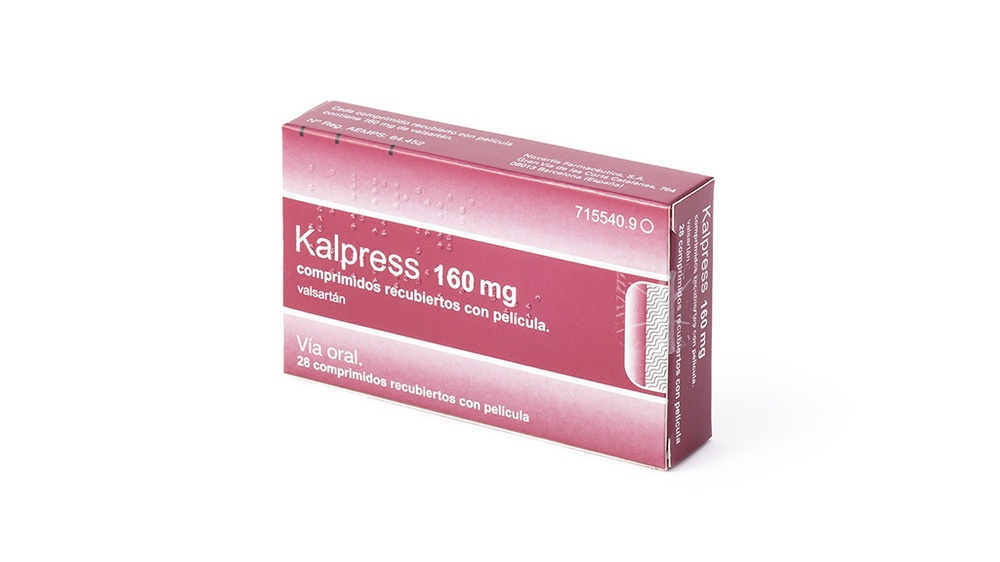
Kalpress 160 mg comprimidos recubiertos con película

Revisión de receta online
Un médico revisará tu caso y determinará si la prescripción es médicamente apropiada.

Habla con un médico sobre este medicamento
Comenta tus síntomas y las opciones de tratamiento en una consulta online.



Cómo usar KALPRESS 160 mg COMPRIMIDOS RECUBIERTOS CON PELICULA
Contenido del prospecto
- Introducción
- Qué es Kalpress y para qué se utiliza
- Qué necesita saber antes de empezar a tomar Kalpress
- Cómo tomar Kalpress
- Posibles efectos adversos
- Conservación de Kalpress
- Contenido del envase e información adicional
Introducción
Prospecto: información para el usuario
Kalpress 160mg comprimidos recubiertos con película
valsartán
Lea todo el prospecto detenidamente antes de empezar a tomar este medicamento,porque contiene información importante para usted.
- Conserve este prospecto, ya que puede tener que volver a leerlo.
- Si tiene alguna duda, consulte a su médico o farmacéutico.
- Este medicamento se le ha recetado solamente a usted, y no debe dárselo a otras personas aunque tengan los mismos síntomas que usted, ya que puede perjudicarles.
- Si experimenta efectos adversos, consulte a su médico o farmacéutico, incluso si se trata de efectos adversos que no aparecen en este prospecto. Ver sección 4.
Contenido del prospecto
- Qué es Kalpress y para qué se utiliza
- Qué necesita saber antes de empezar a tomar Kalpress
- Cómo tomar Kalpress
- Posibles efectos adversos
- Conservación de Kalpress
- Contenido del envase e información adicional
1. Qué es Kalpress y para qué se utiliza
Kalpress contiene el principio activo: valsartán y pertenece a una clase de medicamentos conocidos como antagonistas de los receptores de la angiotensina II, que ayudan a controlar la presión arterial alta. La angiotensina II es una sustancia del cuerpo que hace que los vasos sanguíneos se estrechen, causando un aumento de la presión arterial. Kalpress actúa bloqueando el efecto de la angiotensina II. Como consecuencia, los vasos sanguíneos se relajan y la presión arterial disminuye.
Kalpress 160 mg comprimidos recubiertos con película se puede utilizar para tres afecciones diferentes:
- para tratar la presión arterial alta en adultos y en niños y adolescentes de6 amenos de 18años de edad.La presión arterial alta aumenta la carga de trabajo del corazón y de las arterias. Si no se trata, puede dañar los vasos sanguíneos del cerebro, corazón y riñones, y puede provocar un infarto cerebral, insuficiencia cardiaca o insuficiencia renal. La presión arterial alta aumenta el riesgo de ataques cardiacos. La disminución de la presión arterial a valores normales reduce el riesgo de desarrollar estos trastornos.
- para tratar a pacientes adultos después de un ataque cardiaco reciente(infarto de miocardio). “Reciente” significa aquí entre 12 horas y 10 días.
- para tratar la insuficiencia cardiaca sintomática en pacientes adultos.Kalpress se utiliza cuando no es posible utilizar un grupo de medicamentos llamados Inhibidores de la Enzima Convertidora de Angiotensina (IECAs) (una medicación para tratar la insuficiencia cardiaca), o puede utilizarse añadido a los IECAs cuando no es posible usar otros medicamentos para el tratamiento de la insuficiencia cardiaca.Entre los síntomas de la insuficiencia cardiaca figuran la dificultad para respirar y la hinchazón de pies y piernas por retención de líquidos. Se debe a que el músculo cardiaco no puede bombear la sangre con suficiente fuerza para proporcionar toda la sangre necesaria para el cuerpo.

¿No estás seguro de si este medicamento es adecuado para ti?
Comenta tus síntomas y tratamiento con un médico online.
2. Qué necesita saber antes de empezar a tomar Kalpress
No tome Kalpress:
- si es alérgico(hipersensible) al valsartán o a cualquiera de los demás componentes de este medicamento (incluidos en la sección 6).
- si sufre una enfermedad grave del hígado.
- si está embarazadade más de 3 meses(es mejor evitar también Kalpress durante los primeros meses del embarazo – ver sección Embarazo).
- si tiene diabetes o insuficiencia renal y le están tratando con un medicamento para reducir la presión arterial que contiene aliskirén.
Si alguna de las situaciones anteriores le afecta, informe a su médico y no tomeKalpress.
Advertencias y precauciones:
Consulte a su médico
- si sufre una enfermedad del hígado.
- si sufre una enfermedad grave del riñón o si está siendo sometido a diálisis.
- si sufre un estrechamiento de la arteria del riñón.
- si ha sido sometido recientemente a un trasplante de riñón (recibió un riñón nuevo).
- si sufre una enfermedad cardiaca grave diferente de la insuficiencia cardiaca o del ataque cardiaco.
- si ha experimentado hinchazón de la lengua y la cara causada por una reacción alérgica llamada angioedema cuando tomaba otros medicamentos (incluidos los IECAs), informe a su médico. Si tiene estos síntomas cuando toma Kalpress, interrumpa inmediatamente su tratamiento con Kalpress y nunca vuelva a tomarlo. Ver también sección 4 “Posibles efectos adversos”.
- si presenta dolor abdominal, náuseas, vómitos o diarrea después de tomar Kalpress. Su médico decidirá si continuar con el tratamiento. No deje de tomar Kalpress por su cuenta.
- si está utilizando medicamentos que aumentan la cantidad de potasio en sangre. Entre ellos figuran los suplementos de potasio o sustitutos de la sal que contienen potasio, los medicamentos ahorradores de potasio y la heparina. Puede ser necesario controlar regularmente la cantidad de potasio en la sangre.
- si sufre aldosteronismo, una enfermedad en la que las glándulas suprarrenales producen demasiada hormona aldosterona. En este caso, no se recomienda tomar Kalpress.
- si ha perdido mucho líquido (deshidratación) a causa de una diarrea, vómitos o dosis elevadas de diuréticos (medicamentos para aumentar la eliminación de orina).
- si está tomando alguno de los siguientes medicamentos utilizados para tratar la hipertensión (presión arterial alta):
- un inhibidor de la enzima convertidora de angiotensina (IECA) (por ejemplo enalapril, lisinopril, ramipril), en particular si sufre problemas renales relacionados con la diabetes
- aliskirén
- si le están tratando con un IECA junto con otros medicamentos específicos para el tratamiento de su insuficiencia cardiaca, conocidos como antagonistas de los receptores de mineralocorticoides (ARM) (por ejemplo, espironolactona, eplerenona) o betabloqueantes (por ejemplo, metoprolol).
Puede que su médico le controle la función renal, la presión arterial y los niveles de electrolitos (por ejemplo, potasio) en la sangre a intervalos regulares.
Ver también la información bajo el encabezado “No tome Kalpress”.
Debe informar a su médico si cree que está (o podría estar) embarazada. Kalpress no está recomendado al inicio del embarazo, y no debe tomarse si está embarazada de más de 3 meses, ya que podría causar serios daños a su bebé si lo usa en este periodo (ver la sección embarazo).
Uso de Kalpress con otros medicamentos
Informe a su médico o farmacéutico si está utilizando, ha utilizado recientemente o podría tener que utilizar cualquier otro medicamento.
El efecto del tratamiento con Kalpress puede verse alterado si se toma junto con ciertos medicamentos. Puede que su médico deba modificar su dosis y/o tomar otras precauciones o, en algunos casos, interrumpir el tratamiento de alguno de los medicamentos. Esto es aplicable tanto a los medicamentos adquiridos con receta como sin receta, especialmente:
- otros medicamentos que disminuyan la presión arterial,especialmente diuréticos(medicamentos para aumentar la eliminación de orina), IECAs (tales como enalapril, lisinopril, etc.,) o aliskirén (ver también la información bajo los encabezados “No tome Kalpress” y “Advertencias y precauciones)”.
- medicamentos que aumentan la cantidad de potasioen sangre. Entre ellos figuran los suplementos de potasio o sustitutos de la sal que contienen potasio, los medicamentos ahorradores de potasio y la heparina.
- ciertos medicamentos para tratar el dolorllamados antiinflamatorios no esteroideos (AINEs).
- algunos antibióticos (del grupo de la rifampicina), un fármaco utilizado para proteger frente al rechazo en un trasplante (ciclosporina) o un fármaco antirretroviral utilizado para tratar la infección por HIV/SIDA (ritonavir). Estos fármacos pueden aumentar el efecto de Kalpress.
- litio,un medicamento utilizado para tratar ciertos tipos de enfermedades psiquiátricas.
Además:
- si está siendo tratado tras un ataque cardiaco,no se recomienda la combinación con IECAs(una medicación para tratar un ataque cardiaco).
- si está siendo tratado para la insuficiencia cardiaca,no se recomienda la triple combinación con IECAs y otros medicamentos específicos para el tratamiento de su insuficiencia cardiaca, conocidos como antagonistas de los receptores de mineralocorticoides (ARM) (por ejemplo, espironolactona, eplerenona) o betabloqueantes(por ejemplo, metoprolol).
Embarazo y lactancia
- Debe informar a su médico si está embarazada(o si sospecha que pudiera estarlo).Su médico generalmente le recomendará que deje de tomar Kalpress antes de quedarse embarazada o tan pronto como sepa que está embarazada y le recomendará que tome otro medicamento en lugar de Kalpress. No se recomienda utilizar Kalpress al inicio del embarazo, y en ningún caso debe administrarse a partir del tercer mes de embarazo ya que puede causar daños graves a su bebé cuando se administra a partir de ese momento.
- Informe a su médico si está en periodo de lactancia o va a comenzar con el mismo. No se recomienda el uso de Kalpress durante la lactancia materna, y su médico elegirá otro tratamiento para usted si desea dar de mamar, especialmente si su bebé es recién nacido o prematuro.
Conducción y uso de máquinas
Antes de conducir un vehículo, usar herramientas o manejar máquinas, o llevar a cabo otras actividades que requieran concentración, asegúrese de conocer como le afecta Kalpress. Al igual que muchos otros medicamentos utilizados para tratar la presión arterial alta, Kalpress puede causar mareos y afectar la capacidad de concentración.
3. Cómo tomar Kalpress
Para obtener los mejores resultados y reducir el riesgo de efectos adversos, tome siempre este medicamento exactamente como le indique su médico. En caso de duda, pregunte a su médico o farmacéutico. Las personas con presión arterial alta no notan a menudo ningún signo de la enfermedad; muchas se sienten de forma normal. Esto hace que sea muy importante acudir a sus citas con el médico, incluso si se siente bien.
Pacientes adultos con presión arterial alta:la dosis recomendada es de 80 mg al día. En algunos casos su médico puede recetarle dosis más elevadas (p.ej. 160 mg o 320 mg). También puede combinar Kalpress con otro medicamento (p.ej. un diurético).
Uso en niños y adolescentes de6 amenos de 18años de edad con presión arterial alta:
En pacientes que pesan menos de 35 kg la dosis recomendada de inicio para los comprimidos de valsartán es 40 mg una vez al día.
En pacientes que pesan 35 kg o más la dosis recomendada de inicio para Kalpress comprimidos es 80 mg una vez al día.
En algunos casos su médico puede recetarle dosis más elevadas (la dosis puede aumentarse a 160 mg y hasta un máximo de 320 mg).
En niños que tengan dificultad al tragar los comprimidos, se recomienda la administración de la solución oral.
Pacientes adultos después de un ataque cardiaco reciente:después de un ataque cardiaco el tratamiento se inicia generalmente a las 12 horas, normalmente, con una dosis baja de 20 mg, administrada dos veces al día. La dosis de 20 mg se obtiene dividiendo el comprimido de 40 mg. Su médico aumentará esta dosis gradualmente a lo largo de varias semanas hasta un máximo de 160 mg dos veces al día. La dosis final dependerá de su tolerancia particular.
Kalpress se puede administrar junto con otros tratamientos para el ataque cardiaco, y su médico decidirá qué tratamiento es adecuado para usted.
Pacientes adultos con insuficiencia cardiaca:el tratamiento se inicia generalmente con 40 mg dos veces al día. Su médico aumentará la dosis gradualmente a lo largo de varias semanas hasta un máximo de 160 mg dos veces al día. La dosis final dependerá de su tolerancia particular.
Kalpress se puede administrar junto con otros tratamientos para la insuficiencia cardiaca, y su médico decidirá qué tratamiento es adecuado para usted.
Puede tomar Kalpress con o sin alimentos. Trague Kalpress con un vaso de agua.
Tome Kalpress aproximadamente a la misma hora cada día.
Posología no cubierta con las presentaciones disponibles de Kalpress
Las presentaciones de Kalpress disponibles (80 mg, 160 mg y 320 mg) no permiten administrar la dosis recomendada para el tratamiento de inicio del infarto de miocardio reciente o insuficiencia cardiaca en adultos, ni para el tratamiento de la hipertensión arterial en niños < 35 kg. En dichos casos, se deberá recurrir a presentaciones de otros medicamentos que permitan administrar 20 mg o 40 mg de valsartán.
Si toma más Kalpress del que debe
Si nota un fuerte mareo y/o desmayo, contacte con su médico inmediatamente y túmbese. Si accidentalmente ha tomado demasiados comprimidos, contacte con su médico, farmacéutico u hospital. También puede llamar al Servicio de Información Toxicológica, teléfono 91 562 04 20 indicando el medicamento y la cantidad tomada.
Si olvidó tomar Kalpress
Si olvida tomar una dosis, tómela tan pronto como lo recuerde. No obstante, si es casi la hora de la dosis siguiente, sáltese la dosis olvidada.
No tome una dosis doble para compensar las dosis olvidadas.
Si interrumpe el tratamiento conKalpress
Si deja su tratamiento con Kalpress su enfermedad puede empeorar. No deje de tomar el medicamento a menos que se lo indique su médico.
Si tiene cualquier otra duda sobre el uso de este medicamento, pregunte a su médico o farmacéutico.

¿Has empezado a tomar el medicamento y tienes preguntas?
Comenta tus síntomas y tratamiento con un médico online.
4. Posibles efectos adversos
Al igual que todos los medicamentos, este medicamento puede producir efectos adversos, aunque no todas las personas los sufran.
Algunos efectos adversos pueden ser graves y pueden necesitar atención médica inmediata:
Puede experimentar síntomas de angioedema (una reacción alérgica específica), tales como
- hinchazón en la cara, labios, lengua o garganta
- dificultad para respirar o tragar
- urticaria, picor
Si experimenta alguno de estos síntomas, deje de tomar Kalpress y póngase en contacto con su médico inmediatamente (ver también sección 2 “Advertencias y precauciones”).
Otros efectos adversos incluyen:
Frecuentes(pueden afectar hasta 1 de cada 10 personas):
- mareo
- presión arterial baja con o sin síntomas como mareo y desmayo al ponerse de pie
- reducción de la función renal (signos de deterioro renal)
Poco frecuentes(pueden afectar hasta 1 de cada 100 personas):
- angioedema (ver sección “Algunos síntomas necesitan atención médica inmediata”)
- pérdida súbita del conocimiento (síncope)
- sensación de rotación (vértigo)
- marcada reducción de la función renal (signos de insuficiencia renal aguda)
- espasmos musculares, ritmo cardiaco anormal (signos de hiperpotasemia)
- falta de aliento, dificultad para respirar estando acostado, hinchazón de los pies o piernas (signos de insuficiencia cardiaca)
- dolor de cabeza
- tos
- dolor abdominal
- náuseas
- diarrea
- cansancio
- debilidad
Muy raras(pueden afectar hasta 1 de cada 10 000 personas)
- angioedema intestinal: hinchazón en el intestino que cursa con síntomas como dolor abdominal, náuseas, vómitos y diarrea.
Frecuencia no conocida(no puede estimarse a partir de los datos disponibles):
- ampollas en la piel (signo de dermatitis ampollosa)
- pueden tener lugar reacciones alérgicas con erupción cutánea, picor y urticaria; síntomas de fiebre, hinchazón y dolor de las articulaciones, dolor muscular, hinchazón de los ganglios linfáticos y/o síntomas similares a los de la gripe (signos de enfermedad del suero)
- manchas rojas purpúreas, fiebre, picor (signos de inflamación de los vasos sanguíneos, también llamada vasculitis)
- hemorragia o moretones más frecuentes de lo habitual (signos de trombocitopenia)
- dolor muscular (mialgia)
- fiebre, dolor de garganta o úlceras en la boca por infecciones (síntomas de bajo nivel de glóbulos blancos, también llamado neutropenia)
- reducción del nivel de hemoglobina y reducción del porcentaje de glóbulos rojos en la sangre (que, en casos graves, puede ocasionar una anemia)
- aumento del nivel de potasio en sangre (que, en casos graves, puede provocar espasmos musculares y un ritmo cardiaco anormal)
- elevación de los valores de la función hepática (que puede indicar lesión hepática), incluyendo un aumento del nivel de bilirrubina en sangre (que, en casos graves, puede provocar que la piel y los ojos se pongan amarillos)
- aumento del nivel del nitrógeno ureico en sangre y aumento del nivel de creatinina sérica (que pueden indicar anomalías de la función renal)
- nivel bajo de sodio en sangre (que, en casos graves, puede provocar cansancio, confusión, fasciculación muscular y/o convulsiones)
La frecuencia de algunos efectos adversos puede variar en función de su estado. Por ejemplo, ciertos efectos adversos como el mareo y la reducción de la función renal se observaron con menos frecuencia en pacientes adultos tratados con presión arterial alta que en pacientes adultos tratados por insuficiencia cardiaca o después de un ataque cardiaco reciente.
Los efectos adversos en niños y adolescentes son similares a los observados en adultos.
Comunicación de efectos adversos
Si experimenta cualquier tipo de efecto adverso, consulte a su médico o farmacéutico, incluso si se trata de posibles efectos adversos que no aparecen en este prospecto. También puede comunicarlos directamente a través del Sistema Español de Farmacovigilancia de Medicamentos de Uso Humano (www.notificaRAM.es). Mediante la comunicación de efectos adversos usted puede contribuir a proporcionar más información sobre la seguridad de este medicamento.
5. Conservación de Kalpress
- Mantener fuera de la vista y del alcance de los niños.
- No utilice este medicamento después de la fecha de caducidad que aparece en el envase. La fecha de caducidad es el último día del mes que se indica.
- No conservar a temperatura superior a 30°C. Conservar en el embalaje original para protegerlo de la humedad.
- No utilice este medicamento si observa que el envase está dañado o muestra signos de manipulación.
- Los medicamentos no se deben tirar por los desagües ni a la basura. Deposite los envases y los medicamentos que no necesita en el Punto SIGRE de la farmacia. En caso de duda pregunte a su farmacéutico cómo deshacerse de los envases y de los medicamentos que no necesita. De esta forma ayudará a proteger el medio ambiente.
6. Contenido del envase e información adicional
Composición deKalpress
- El principio activo es valsartán. Cada comprimido recubierto con película contiene 160 mg de valsartán.
- Los demás componentes son celulosa microcristalina, crospovidona tipo A, sílice coloidal anhidra, estearato de magnesio. El recubrimiento del comprimido contiene hipromelosa, dióxido de titanio (E 171), macrogol 8000, óxido de hierro rojo (E 172), óxido de hierro amarillo (E 172), óxido de hierro negro (E 172).
Aspecto del producto y contenido del envase
Los comprimidos recubiertos con película de Kalpress 160 mg son de color naranja grisáceo, ovalados, con una ranura en una cara. Tienen la marca “DX” en un lado de la ranura y ”DX” en el otro lado de la ranura y “NVR” en la cara contraria del comprimido. La ranura es sólo para poder fraccionar y facilitar la deglución, pero no para dividir en dosis iguales.
Los comprimidos se presentan en envases blister con 7, 14, 28, 30, 56, 90 o 98 comprimidos y en envases blister calendario con 14, 28, 56, 98 y 280 comprimidos. También se hallan disponibles envases blister precortados unidosis de 56x1, 98x1 o 280x1 comprimidos.
Puede que solamente estén comercializados algunos tamaños de envase.
Titular de la autorización de comercialización
Novartis Farmacéutica S.A.Gran Vía de les Corts Catalanes, 76408013 Barcelona
Tel: 93-306 42 00
Responsable de la fabricación
Novartis Farmacéutica, S.A.
Gran Vía de les Corts Catalanes, 76408013 Barcelona
España
Novartis Farma – Productos Farmacêuticos, S.A.
Avenida Professor Doutor Cavaco Silva, n.° 10E (Taguspark, Porto Salvo).
Oeiras Parish. 2740 255
Portugal
Novartis Sverige AB
Torshamnsgatan 48
164 40 Kista
Suecia
Novartis Farma S.p.A.
Viale Luigi Sturzo 43
20154 Milano (MI)
Italia
Novartis Farma S.p.A.
Via Provinciale, Schito131
80058 Torre Annunziata (NA)
Italia
Pueden solicitar más información respecto a este medicamento dirigiéndose al representante local del titular de la autorización de comercialización:
Laboratorios Gebro Pharma, S.A.
Avenida Tibidabo, 29
08022 Barcelona, España
Tel: +34 93 205 86 86
Este medicamento está autorizado en losestados miembros del Espacio Económico Europeo conlos siguientes nombres:
Suecia | Angiosan |
Alemania | Cordinate |
Grecia | Dalzad |
Italia | Rixil |
Portugal | Tareg |
España | Kalpress |
Fecha de la última revisión de este prospecto:Octubre 2020
La información detallada y actualizada de este medicamento está disponible en la página Web de la Agencia Española de Medicamentos y Productos Sanitarios (AEMPS) htpp://www.aemps.gob.es/
- País de registro
- Forma farmacéuticaCOMPRIMIDO, 160mg
- Código ATCC09CA03
- Precio medio en farmacia16.3 EUR
- Principio activo
- Requiere recetaSí
- Fabricante
- Esta información es de carácter general y no sustituye la consulta con un profesional sanitario.
- Alternativas a KALPRESS 160 mg COMPRIMIDOS RECUBIERTOS CON PELICULAForma farmacéutica: COMPRIMIDO, 160 mg valsartanPrincipio activo: ValsartanFabricante: Novartis Farmaceutica S.A.Requiere recetaForma farmacéutica: COMPRIMIDO, 320 mgPrincipio activo: ValsartanFabricante: Novartis Farmaceutica S.A.Requiere recetaForma farmacéutica: SOLUCIÓN/SUSPENSIÓN ORAL, 3 mg/mlPrincipio activo: ValsartanFabricante: Novartis Farmaceutica S.A.Requiere receta
Médicos online para KALPRESS 160 mg COMPRIMIDOS RECUBIERTOS CON PELICULA
Comenta la dosis, los posibles efectos secundarios, interacciones, contraindicaciones o la revisión de receta de KALPRESS 160 mg COMPRIMIDOS RECUBIERTOS CON PELICULA, sujeto a valoración médica y a la normativa local.
Preguntas frecuentes
KALPRESS 160 mg COMPRIMIDOS RECUBIERTOS CON PELICULA requiere receta en España. Puedes confirmarlo con un médico online según tu caso.
El principio activo de KALPRESS 160 mg COMPRIMIDOS RECUBIERTOS CON PELICULA es Valsartan. Esta información ayuda a identificar medicamentos con la misma composición pero con diferentes nombres comerciales.
El precio medio en farmacia de KALPRESS 160 mg COMPRIMIDOS RECUBIERTOS CON PELICULA es de aproximadamente 16.3 EUR. Puede variar según el fabricante y la forma farmacéutica.
KALPRESS 160 mg COMPRIMIDOS RECUBIERTOS CON PELICULA es fabricado por Novartis Farmaceutica S.A.. La marca y el envase pueden variar según el distribuidor.
Los Médicos de familia, Psiquiatras, Dermatólogos, Cardiólogos, Endocrinólogos, Gastroenterólogos, Neumólogos, Nefrólogos, Reumatólogos, Hematólogos, Infectólogos, Alergólogos, Geriatras, Pediatras, Oncólogos pueden valorar la prescripción de KALPRESS 160 mg COMPRIMIDOS RECUBIERTOS CON PELICULA cuando esté clínicamente indicado. Puedes reservar una videoconsulta para comentar tu caso y las opciones de tratamiento.
La receta la emite un médico tras valorar tu estado de salud. En España, KALPRESS 160 mg COMPRIMIDOS RECUBIERTOS CON PELICULA se dispensa en las farmacias con esa receta médica. Una consulta online no garantiza su emisión: la decisión corresponde siempre al médico.
Para solicitar una valoración puedes usar Oladoctor:
Otros medicamentos con el mismo principio activo (Valsartan) incluyen DIOVAN 160 mg COMPRIMIDOS RECUBIERTOS CON PELICULA, DIOVAN 320 mg COMPRIMIDOS RECUBIERTOS CON PELICULA, DIOVAN 3mg/ml SOLUCION ORAL. Pueden tener diferentes nombres comerciales o formulaciones, pero contienen el mismo componente terapéutico. Consulta siempre con un médico antes de cambiar o iniciar un nuevo medicamento.
