


Imunocare 50 mg/g crema

Solicitud de receta online
Un médico revisará tu caso y determinará si la prescripción es médicamente apropiada.

Habla con un médico sobre este medicamento
Comenta tus síntomas y las opciones de tratamiento en una consulta online.



Cómo usar IMUNOCARE 50 MG/G CREMA
Contenido del prospecto
- Introducción
- Qué es IMUNOCARE y para qué se utiliza
- Qué necesita saber antes de empezar a usar IMUNOCARE
- Cómo usar IMUNOCARE
- Posibles efectos adversos
- Conservación de IMUNOCARE
- Contenido del envase e información adicional.
Introducción
Prospecto: información para el usuario
Imunocare 50 mg/g cremaimiquimod
Lea todo el prospecto detenidamente antes de empezar a usar este medicamento, porque contiene información importante para usted.
- Conserve este prospecto, ya que puede tener que volver a leerlo.
- Si tiene alguna duda, consulte a su médico o farmacéutico.
- Este medicamento se le ha recetado solamente a usted y no debe dárselo a otras personas, aunque tengan los mismos síntomas que usted, ya que puede perjudicarles.
- Si experimenta efectos adversos, consulte a su médico o farmacéutico incluso si se trata de efectos adversos que no aparecen en este prospecto. Ver sección 4.
Contenido del prospecto:
- Qué es IMUNOCARE y para qué se utiliza
- Que necesita saber antes de empezar a usar IMUNOCARE
- Cómo usar IMUNOCARE
- Posibles efectos adversos
5 Conservación de IMUNOCARE
- Contenido del envase e información adicional
1. Qué es IMUNOCARE y para qué se utiliza
Imunocare está indicado para tres enfermedades distintas. Su médico puede prescribirle Imunocare para el tratamiento de:
- Verrugas (condilomas acuminados) en la superficie de los genitales (órganos sexuales) y alrededor del ano (conducto posterior).
- Carcinoma basocelular superficial. Ésta es una forma común de cáncer de piel de crecimiento lento y que es muy poco probable que se extienda a otras partes del cuerpo. Suele aparecer en personas mayores y de mediana edad, especialmente en las de piel clara debido a una excesiva exposición al sol. Si no se trata, el carcinoma basocelular puede provocar desfiguración, especialmente en el rostro, por lo que es fundamental la detección precoz y el tratamiento.
- Queratosis actínica La queratosis actínica consiste en zonas ásperas de la piel que se encuentran en personas que se han expuesto a mucha luz solar durante su vida. Algunas son pieles coloreadas, otras son grisáceas, rosas, rojas o marrones. Pueden ser lisas y escamosas, o abultadas, duras y verrugosas. Imunocare debe ser utilizado exclusivamente para queratosis actínicas lisas en cara y cuero cabelludo de pacientes con sistema inmune sano cuando su doctor decida que Imunocare es el tratamiento más apropiado.
Imunocare ayuda al propio sistema inmunitario del cuerpo para producir sustancias naturales que ayudan a combatir su carcinoma basocelular, la queratosis actínica o el virus que ha provocado la aparición de la verruga.

¿No estás seguro de si este medicamento es adecuado para ti?
Comenta tus síntomas y tratamiento con un médico online.
2. Qué necesita saber antes de empezar a usar IMUNOCARE
No use Imunocare
- Si es alérgico a imiquimod (el principio activo) o a cualquiera de los demás componentes de este medicamento (incluido en la sección 6).
Advertencias y precauciones
- Si ha usado antes Imunocare u otros preparados similares, debe consultar a su médico antes de iniciar este tratamiento.
- Consulte a su médico si tiene problemas con su sistema inmunitario.
- No debe usar Imunocare hasta que la zona a tratar haya curado después de un tratamiento f armacológico o quirúrgico anterior.
- Evite el contacto con los ojos, labios y fosas nasales. En caso de contacto accidental, retirar la crema lavando con agua.
- No aplique la crema internamente.
- No debe utilizar más crema de la que su doctor le aconseje.
- No cubra la zona tratada con vendas u otros apósitos después de aplicar Imunocare.
- Si en el área tratada se producen demasiadas molestias, debe eliminarse la crema con un jabón suave y agua. Tan pronto como se haya resuelto el problema, puede volver a aplicar la crema.
- Coméntele a su médico si sufre alteraciones en el recuento sanguíneo.
Debido al modo de acción de Imunocare, existe la posibilidad de que la crema agrave la inflamación existente en la zona de tratamiento.
- Si le están tratando verrugas genitales, siga estas precauciones adicionales:
- Los varones con verrugas bajo el prepucio deben empujar hacia atrás la piel del prepucio todos los días y lavarse por debajo. Si no se hace un lavado diario del prepucio es más probable que se produzcan signos de tirantez, hinchazón y descamación de la piel, y como resultado que se produzcan más dificultades para retirar hacia atrás el prepucio. Si se producen estos síntomas, interrumpa el tratamiento inmediatamente y póngase en contacto con su médico.
- Si tiene úlceras abiertas: no empiece a utilizar Imunocare hasta que las úlceras hayan sanadopor completo.
- Si tiene verrugas internas: no utilice Imunocare en la uretra (el orificio a través del que pasa la orina), en la vagina (canal del parto), el cuello uterino (órgano femenino interno) ni en ninguna zona del interior del ano (recto).
- No debe usar esta medicación durante más de un ciclo de tratamiento si tiene problemas del sistema inmune, tanto si es debido a una enfermedad como a medicamentos que esté tomando. Si piensa que éste pueda ser su caso, consulte con su médico.
- Si está infectado por VIH (SIDA) debe informar a su médico, ya que no está demostrado que el tratamiento con Imunocare sea igual de eficaz en estos pacientes.
- Si decide mantener relaciones sexuales mientras todavía tenga las verrugas, aplique Imunocare después, nunca antes, del acto sexual. Imunocare puede debilitar los preservativos y los diafragmas, por lo que la crema no debe dejarse puesta durante la actividad sexual. Recuerde que Imunocare no protege de la transmisión del VIH ni de otras enfermedades de transmisión sexual a otras personas.
- Si le están tratando de carcinoma basocelular o queratosis actínica siga estas precauciones adicionales:
- No debe utilizar lámparas solares ni aparatos de bronceado y evite la luz sola lo máximo posible durante el tratamiento con Imunocare crema. Para salir de casa, utilice prensas protectoras y sombreros de ala ancha.
Durante el uso de Imunocare y hasta la curación, es probable que la zona de tratamiento tenga un aspecto notablemente distinto al de la piel normal.
Niños y adolescentes
No está recomendado para uso en niños y adolescentes.
Uso de IMUNOCARE con otros medicamentos
Comunique a su médico o farmacéutico si está utilizando o ha utilizado recientemente o podría tener que utilizar cualquier otro medicamento.
No se conocen medicamentos que sean incompatibles con Imunocare.
Embarazo y lactancia
Si está embarazada o en periodo de lactancia, cree que podría estar embarazada o tiene intención de quedarse embarazada, consulte a su médico o farmacéutico antes de utilizar este medicamento para que evalúe los riesgos y beneficios de utilizar Imunocare durante el embarazo. Los estudios en animales no indican que se produzcan efectos perjudiciales directos o indirectos durante el embarazo.
No dé el pecho a su bebé mientras esté utilizando Imunocare, puesto que no se sabe si imiquimod pasa a la leche materna.
Conducción y uso de máquinas
Según los efectos adversos descritos en el apartado 4 es improbable que el tratamiento tenga algún efecto sobre la capacidad de conducir y uso de máquinas.
Imunocare contiene parahidroxibenzoato de metilo, parahidroxibenzoato de propilo, alcohol cetílico, alcohol estearílico y alcohol bencílico.
Puede producir reacciones alérgicas (posiblemente retardadas) porque contiene parahidroxibenzoato de metilo (E 218) y parahidroxibenzoato de propilo (E 216).
Este medicamento puede producir reacciones locales en la piel (como dermatitis de contacto) porque contiene alcohol alcohol cetílico y alcohol estearílico.
Este medicamento contiene 5 mg de alcohol bencilico en cada gramo. El alcohol bencilico puede provocar reacciones alérgicas.
El alcohol bencílico puede provocar irritación local moderada.
3. Cómo usar IMUNOCARE
Niños y adolescentes
No está recomendado para uso en niños y adolescentes
Adultos
Siga exactamente las instrucciones de administración de este medicamento indicadas por su médico o farmacéutico. En caso de duda, consulte de nuevo a su médico o farmacéutico.
Lávese las manos cuidadosamente antes y después de la aplicación de la crema. No cubra la zona tratada con vendas u otros vendajes después de que se haya aplicado Imunocare.
Abra un nuevo sobre cada vez que aplique la crema. Deseche toda la crema que quede en el sobre después de su aplicación. No guarde el sobre abierto para utilizarlo otro día.
La frecuencia y la duración del tratamiento difieren en el caso de las verrugas genitales, el carcinoma basocelular y la queratosis actínica (consulte las instrucciones específicas para cada indicación).
Imunocare Instrucciones de Aplicación
Si está siendo tratado de verrugas genitales:
Instrucciones para la correcta utilización del medicamento: (Lu, Mi y Vi)
- Antes de acostarse, lávese las manos y la zona de tratamiento con un jabón suave y agua. Seque bien.
- Abra un sobre nuevo y deposite la crema en la punta de su dedo.
- Aplique una capa fina de Imunocare en una zona verrugosa limpia y seca y extiéndala suavemente por la piel hasta que la crema se absorba .
- Después de aplicar Imunocare, tire el sobre abierto y lávese las manos con agua y jabón.
- Deje actuar la crema sobre las verrugas entre 6 y 10 horas. Durante este tiempo no se duche ni se bañe.
- Después de 6-10 horas, lave la zona donde aplicó Imunocare con agua y un jabón suave.
Aplique Imunocare 3 veces a la semana. Por ejemplo, aplique la crema los lunes, miércoles y viernes. Un s obre contiene cantidad de crema suficiente para cubrir un área verrugosa de 20 cm2.
Los hombres no circuncidados que se traten verrugas situadas debajo del prepucio deberán empujarlo hacia atrás y lavarse la zona todos los días (consulte la sección 2 “Qué necesita saber antes de empezar a usar Imunocare ”).
Continúe utilizando Imunocare tal como le hayan indicado hasta que sus verrugas hayan desaparecido completamente (la mitad de las mujeres a las que les desaparecen las verrugas, les sucede a las 8 semanas, la mitad de los hombres a los que les desaparecen verrugas, les sucede a las 12 semanas, sin embargo, en algunos pacientes las verrugas pueden desaparecer hasta en 4 semanas).
No utilice Imunocare durante más de 16 semanas para el tratamiento de cada episodio de verrugas.
Si estima que la acción de Imunocare es demasiado fuerte o débil, coménteselo a su médico o farmacéutico.
Si está siendo tratadode carcinoma basocelular:
Instrucciones para la correcta utilización del medicamento (Lu, Ma, Mi, Ju y Vi)
- Antes de acostarse, lávese las manos y la zona de tratamiento con jabón suave y agua. Seque bien.
- Abra un sobre nuevo y deposite un poco de crema en la punta del dedo.
- Aplique Imunocare en la zona afectada y 1 cm más alrededor de la zona afectada (aproximadamente un dedo), extiéndala suavemente por la piel hasta que la crema se absorba.
- Después de aplicar la crema, tire el sobre abierto y lávese las manos con agua y jabón.
- Deje actuar Imunocare sobre la piel durante unas 8 horas. Durante este tiempo no se duche ni se bañe.
- Después de unas 8 horas, lave la zona donde aplicó Imunocare con jabón suave y agua.
Aplique la cantidad suficiente de Imunocare para cubrir la zona de tratamiento y 1 cm adicional alrededor de la zona de tratamiento diariamente, durante 5 días consecutivos cada semana, durante 6 semanas. Por ejemplo, aplique la crema de lunes a viernes. No aplique la crema ni el sábado ni el domingo.
Si está siendo tratado de queratosis actínica:
Instrucciones para la correcta utilización del medicamento: (Lu, Mi y Vi)
- Antes de acostarse, lávese las manos y la zona de tratamiento con jabón suave y agua. Seque bien.
- Abra un sobre nuevo y deposite un poco de crema en la punta del dedo.
- Aplique Imunocare a la zona afectada. Extiéndala suavemente por la zona hasta que la crema se absorba.
- Después de aplicar la crema, tire el sobre abierto y lávese las manos con agua y jabón.
- Deje actuar Imunocare sobre la piel durante unas 8 horas. Durante este tiempo no se duche ni se bañe.
- Después de unas 8 horas, lave la zona donde aplicó Imunocare con jabón suave y agua.
Aplique Imunocare 3 veces a la semana. Por ejemplo, aplique la crema los lunes, miércoles y viernes. Un sobre contiene cantidad de crema suficiente para cubrir un área de 25 cm2. Continúe el tratamiento durante 4 semanas. Cuatro semanas después de acabar el primer tratamiento, su médico evaluará su piel. Si no han desaparecido todas las lesiones pueden ser necesarias otras cuatro semanas de tratamiento.
Si usa más Imunocare del que debe
Elimine el sobrante con agua y un jabón suave. Cuando desaparezca la reacción cutánea puede proseguir el tratamiento.
En caso de sobredosis o ingestión accidental, consulte inmediatamente a su médico o farmacéutico o llame al Servicio de Información Toxicológica, teléfono 91 562 04 20, indicando el medicamento y la cantidad administrada.
Si olvidó usar Imunocare
Si olvidó una dosis, aplique la crema tan pronto como sea posible y continúe la pauta habitual.
No aplique la crema más de una vez al día.
Si tiene cualquier otra duda sobre el uso de este producto, pregunte a su médico o farmacéutico.

¿Has empezado a tomar el medicamento y tienes preguntas?
Comenta tus síntomas y tratamiento con un médico online.
4. Posibles efectos adversos
Al igual que todos los medicamentos, este medicamento puede producir efectos adversos, aunque no todas las personas los sufran.
Las frecuencias de los efectos adversos se definen como:
Efectos adversos muy frecuentes | Pueden afectar a más de 1 de cada 10 personas |
Efectos adversos frecuentes | Pueden afectar hasta 1 de cada 10 personas |
Efectos adversos poco frecuentes | Pueden afectar hasta 1 de cada 100 personas |
Efectos adversos raros | Pueden afectar hasta 1 de cada 1.000 personas |
Efectos adversos muy raros | Pueden afectar hasta 1 de cada 10.000 personas |
Consulte a su médico o farmacéutico si no se siente bien durante la administración de Imunocare.
Algunos pacientes han presentado cambios de coloración de la piel en la zona donde se aplicó Imunocare. Aunque estos cambios tienden a mejorar con el tiempo, podrían ser permanentes en algunos pacientes.
Si su piel presenta una reacción adversa al utilizar Imunocare, interrumpa la aplicación de la crema, lave la zona con agua y un jabón suave y póngase en contacto con su médico o farmacéutico.
En algunos individuos se ha detectado una disminución en los recuentos sanguíneos. Una disminución en los recuentos sanguíneos puede hacerle más susceptible a las infecciones, producirle contusiones más fácilmente o causarle fatiga. Si nota cualquiera de estos síntomas, comuníqueselo a su médico.
Algunos pacientes que padecen transtornos autoinmunes pueden experimentar empeoramiento de su enfermedad. Consulte a su médico, si experimenta cualquier cambio durante el tratamiento con Imunocare crema.
En raras ocasiones, se han producido reacciones dermatológicas graves. Interrumpa el tratamiento con Imunocare y comuníqueselo a su médico inmediatamente si nota lesiones dérmicas o manchas en la piel que comienzan como pequeñas zonas rojas y evolucionan hasta parecer pequeñas dianas posiblemente con inflamación, fiebre, sensación de malestar general, problemas visuales, quemazón, ojos hinchados o doloridos y boca inflamada.
Un número reducido de pacientes ha experimentado pérdida de cabello en la zona tratada o en la zona que rodea a la misma.
- Si está siendo tratado de verrugas genitales:
Muchos de los efectos adversos de Imunocare se deben a su acción local sobre la piel.
Efectos adversos muy frecuentes:enrojecimiento (61% de los pacientes), descamación de la piel (30% de los pacientes), formación de escamas e hinchazón. También pueden producirse endurecimientos debajo de la piel, pequeñas úlceras abiertas, costras formadas durante la cicatrización o pequeñas ampollas debajo de la piel. También puede sentir picor (32% de los pacientes), sensación de quemazón (26% de los pacientes) o dolor en las áreas donde aplica Imunocare (8% de los pacientes). La mayor parte de estas reacciones cutáneas son moderadas y la piel vuelve a adquirir un aspecto normal en aproximadamente dos semanas después de terminar el tratamiento.
Efectos adversos frecuentes:algunos pacientes (4% o menos) han experimentado dolor de cabeza.
Efectos adversos poco frecuentes:fiebre, síntomas gripales, dolores articulares y musculares, prolapso uterino, dolor durante el coito en la mujer, dificultades para la erección, aumento de la sudoración, mareos, síntomas estomacales e intestinales, zumbido en los oídos, rubor, cansancio, vértigo, migraña, hormigueo, insomnio, depresión, pérdida del apetito, inflamación de las glándulas, infecciones bacterianas, virales y fúngicas (por ejemplo, úlceras frías), infección vaginal (incluida afta), tos y resfriados con dolor de garganta.
Efectos adversos muy raros:reacciones graves y dolorosas, particularmente cuando se ha utilizado más cantidad de crema de la recomendada. Reacciones cutáneas dolorosas en la abertura de la vagina han hecho en muy raras ocasiones que algunas mujeres tuvieran dificultad para orinar. Si esto le ocurre debe buscar asistencia médica de inmediato.
- Si le están tratando un carcinoma basocelular:
Muchos de los efectos adversos de Imunocare se deben a la acción local sobre su piel. Las reacciones cutáneas locales pueden ser un signo de que el fármaco está actuando de la manera prevista.
Efectos adversos muy frecuentes:la piel tratada puede presentar ligeros picores.
Efectos adversos frecuentes:hormigueo, pequeñas zonas inflamadas en la piel, dolor, quemazón, irritación, hemorragia, enrojecimiento o erupción. Si alguna reacción cutánea resulta demasiado molesta durante el tratamiento, consulte con su médico. Éste puede aconsejarle dejar de aplicarse Imunocare durante unos días (es decir, un breve descanso del tratamiento). Si aparece pus u otro signo de infección, comuníqueselo a su médico. Aparte de las reacciones cutáneas, otros efectos habituales son inflamación de las glándulas y dolor de espalda.
Efectos adversos poco frecuentes:algunos pacientes experimentan alteraciones en el lugar de aplicación (secreción, inflamación, hinchazón, formación de escamas, piel agrietada, ampollas, dermatitis) o irritabilidad, mareos, boca seca, síntomas gripales y cansancio.
- Si le están tratando queratosis actínica:
Muchos de los efectos adversos de Imunocare se deben a la acción local sobre su piel. Las reacciones cutáneas locales pueden ser un signo de que el fármaco está actuando de la manera prevista.
Efectos adversos muy frecuentes:la piel tratada puede presentar ligeros picores.
Efectos adversos frecuentes: dolor, quemazón, irritación, o enrojecimiento.
Si alguna reacción cutánea resulta demasiado molesta durante el tratamiento, consulte con su médico.
Éste puede aconsejarle dejar de aplicarse Imunocare durante unos días (es decir, un breve descanso del tratamiento).
Si aparece pus u otro signo de infección, comuníqueselo a su médico. Aparte de las reacciones cutáneas, otros efectos frecuentes son cefalea, anorexia, náuseas, dolor muscular y articular y cansancio.
Efectos adversos poco frecuentes:algunos pacientes experimentan alteraciones en el lugar de aplicación (hemorragia, inflamación, secreción, sensibilidad, hinchazón, pequeñas zonas inflamadas en la piel, hormigueo, formación de escamas, formación de cicatrices, ulceración o sensación de calor o molestia), o inflamación de la piel que recubre la nariz, obstrucción nasal, gripe o síntomas pseudogripales, depresión, irritación ocular, inflamación del párpado, dolor de garganta, diarrea, queratosis actínica, enrojecimiento, hinchazón de la cara, úlceras, dolor en una extremidad, fiebre, debilidad o temblores.
Comunicación de efectos adversos
Si experimenta cualquier tipo de efecto adverso, consulte a su médico o farmacéutico incluso si se tratan de posibles efectos adversos que no aparecen en este prospecto. También puede comunicarlos directamente a través del Sistema Español de Farmacovigilancia de Medicamentos de Uso Humano: https://www.notificaram.es. Mediante la comunicación de efectos adversos usted puede contribuir a proporcionar más información sobre la seguridad de este medicamento.
5. Conservación de IMUNOCARE
Mantener fuera de la vista y del alcance de los niños.
No requiere condiciones especiales de conservación
No utilice Imunocare después de la fecha de caducidad que aparece en el envase. La fecha de caducidad es el último día del mes que se indica.
Una vez abiertos los sobres no se deben volver a utilizar.
Los medicamentos no se deben tirar por los desagües ni a la basura. Deposite los envases y los medicamentos que no necesita en el PUNTO SIGRE de la farmacia. En caso de duda pregunte a su farmacéutico cómo deshacerse de los envases y de los medicamentos que no necesita. De esta forma, ayudará a proteger el medio ambiente.
6. Contenido del envase e información adicional.
Composición de Imunocare
- El principio activo es imiquimod. Cada gramo de crema contiene 50 mg de imiquimod. Cada sobre contiene 250 mg de crema.
- Los demás componentes (excipientes) son: ácido isosteárico, alcohol bencílico, alcohol cetílico, alcohol estearílico, vaselina blanca, polisorbato 60, monoestearato de sorbitano, glicerol, parahidroxibenzoato de metilo (E 218), parahidroxibenzoato de propilo (E 216), goma xantana y agua purificada.
Aspecto del producto y contenido del envase
Cada sobre contiene 250 mg de una crema ligera de color blanco o casi blanco.
Cada envase contiene 12 o 24 sobres de 4 capas laminadas (PET/ALU/PET/LDPE) de un solo uso.
No todos los tamaños pueden estar comercializados.
Titular de la autorización decomercialización y responsable de la fabricación
Titular de la autorización de comercialización
INDUSTRIAL FARMACÉUTICA CANTABRIA, S.A.
Barrio Solía 30
La Concha de Villaescusa
39690 Cantabria (España)
Responsable de la fabricación
INDUSTRIAL FARMACÉUTICA CANTABRIA, S.A.
C/ Pirita, 9
Torrejón de Ardoz
28850 Madrid
España
Fecha de laúltima revisión de este prospecto: Enero 2024
La información detallada de este medicamento está disponible en la página web de la Agencia Española de Medicamentos y Productos Sanitarios (AEMPS) http://www.aemps.gob.es/
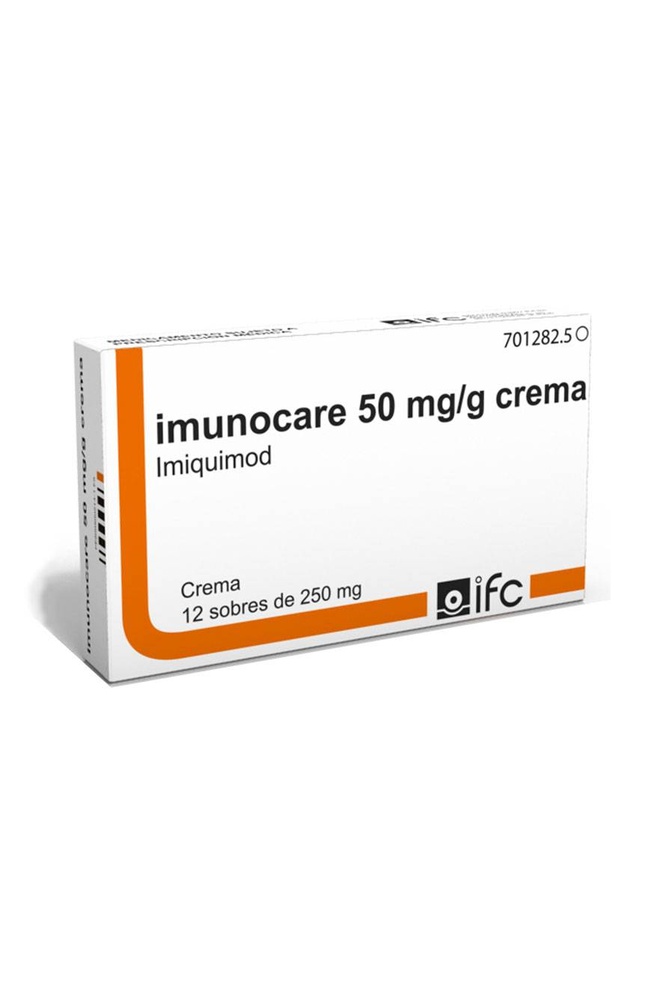
- País de registro
- Forma farmacéuticaCREMA, 50 mg/g
- Código ATCD06BB10
- Precio medio en farmacia37.78 EUR
- Principio activo
- Requiere recetaSí
- Fabricante
- ComposiciónCETILICO, ALCOHOL (5,50 mg mg), ESTEARILICO, ALCOHOL (7,75 mg mg), SORBITAN MONOESTEARATO (1,575 mg mg), PARAHIDROXIBENZOATO DE METILO (E-218) (0,50 mg mg), PARAHIDROXIBENZOATO DE PROPILO (0,05 mg mg), GLICEROL (E 422) (5,00 mg mg), ALCOHOL BENCILICO (5,00 mg mg), POLISORBATO 60 (8,50 mg mg)
- Esta información es de carácter general y no sustituye la consulta con un profesional sanitario.
- Alternativas a IMUNOCARE 50 MG/G CREMAForma farmacéutica: CREMA, 50 mg/gPrincipio activo: ImiquimodFabricante: Viatris Healthcare LimitedRequiere recetaForma farmacéutica: CREMA, 50 mg/gPrincipio activo: ImiquimodFabricante: Viatris Healthcare LimitedRequiere recetaForma farmacéutica: CREMA, 5 %Principio activo: ImiquimodFabricante: Mibe Pharma Espana S.L.Requiere receta
Médicos online para IMUNOCARE 50 MG/G CREMA
Comenta la dosis, los posibles efectos secundarios, interacciones, contraindicaciones o si una receta es apropiada para IMUNOCARE 50 MG/G CREMA, sujeto a valoración médica y a la normativa local.



Preguntas frecuentes
IMUNOCARE 50 MG/G CREMA requiere receta en España. Puedes confirmarlo con un médico online según tu caso.
El principio activo de IMUNOCARE 50 MG/G CREMA es Imiquimod. Esta información ayuda a identificar medicamentos con la misma composición pero con diferentes nombres comerciales.
El precio medio en farmacia de IMUNOCARE 50 MG/G CREMA es de aproximadamente 37.78 EUR. Puede variar según el fabricante y la forma farmacéutica.
IMUNOCARE 50 MG/G CREMA es fabricado por Industrial Farmaceutica Cantabria S.A.. La marca y el envase pueden variar según el distribuidor.
Los Médicos de familia, Psiquiatras, Dermatólogos, Cardiólogos, Endocrinólogos, Gastroenterólogos, Neumólogos, Nefrólogos, Reumatólogos, Hematólogos, Infectólogos, Alergólogos, Geriatras, Pediatras, Oncólogos pueden valorar la prescripción de IMUNOCARE 50 MG/G CREMA cuando esté clínicamente indicado. Puedes reservar una videoconsulta para comentar tu caso y las opciones de tratamiento.
La receta la emite un médico tras valorar tu estado de salud. En España, IMUNOCARE 50 MG/G CREMA se dispensa en las farmacias con esa receta médica. Una consulta online no garantiza su emisión: la decisión corresponde siempre al médico.
Para solicitar una valoración puedes usar Oladoctor:
Otros medicamentos con el mismo principio activo (Imiquimod) incluyen ALDARA 5% CREMA, ALDARA 5% CREMA, IMIKERADERM 50 MG/G CREMA. Pueden tener diferentes nombres comerciales o formulaciones, pero contienen el mismo componente terapéutico. Consulta siempre con un médico antes de cambiar o iniciar un nuevo medicamento.
