



HIPERTENE 10 mg Comprimidos

Revisión de receta online
Un médico revisará tu caso y determinará si la prescripción es médicamente apropiada.

Habla con un médico sobre este medicamento
Comenta tus síntomas y las opciones de tratamiento en una consulta online.



Cómo usar HIPERTENE 10 mg COMPRIMIDOS
Contenido del prospecto
- Introducción
- Qué es HIPERTENE y para qué se utiliza
- Qué necesita saber antes de empezar a tomar HIPERTENE
- Cómo tomar HIPERTENE
- Posibles efectos adversos
- Conservación de HIPERTENE
- Contenido del envase e información adicional
Introducción
Prospecto: información para el usuario
HIPERTENE 10 mg comprimidos
Imidapril
Lea todo el prospecto detenidamente antes de empezar a tomar este medicamento, porque contiene información importante para usted.
- Conserve este prospecto, ya que puede tener que volver a leerlo.
- Si tiene alguna duda, consulte a su médico o farmacéutico.
- Este medicamento se le ha recetado solamente a usted, y no debe dárselo a otras personas aunque tengan los mismos síntomas que usted, ya que puede perjudicarles.
- Si experimenta efectos adversos, consulte a su médico o farmacéutico, incluso si se trata de efectos adversos que no aparecen en este prospecto. Ver sección 4.
Contenido del prospecto
- Qué es HIPERTENE y para qué se utiliza
- Qué necesita saber antes de empezar a tomar HIPERTENE
- Cómo tomar HIPERTENE
- Posibles efectos adversos
- Conservación de HIPERTENE
- Contenido del envase e información adicional
1. Qué es HIPERTENE y para qué se utiliza
HIPERTENE está indicado en el tratamiento de la tensión arterial elevada(hipertensión). HIPERTENE pertenece a un grupo de medicamentos denominado inhibidores de la ECA (enzima convertidora de la angiotensina).
Si usted tiene tensión arterial elevada, HIPERTENE actuará dilatando los vasos sanguíneos, de modo que la sangre circule más fácilmente. Cómo la presión sanguínea depende del diámetro de los vasos sanguíneos, su presión sanguínea descenderá con la ayuda de HIPERTENE. También será más fácil para su corazón bombear la sangre a través de los vasos hacia todo el cuerpo.

¿No estás seguro de si este medicamento es adecuado para ti?
Comenta tus síntomas y tratamiento con un médico online.
2. Qué necesita saber antes de empezar a tomar HIPERTENE
No tome HIPERTENE
- Si usted es alérgicoal imidapril, a otros inhibidores ECA o a cualquiera de los demás componentes de este medicamento (incluidos en la sección 6).
- Si usted ha sufrido alguna vez un angioedema (una reacción alérgica graveque se manifiesta por hinchazón de las manos, pies o tobillos, cara, labios, lengua y garganta, y que puede llevar a dificultad al tragar o respirar) después de tomar un medicamento similar a imidapril (inhibidor ECA).
- Si usted o algún familiar próximo ha experimentado un angioedema.
- Si usted tiene alguna enfermedad renalo si tiene necesidad de hacer diálisis.
- Si tiene diabetes o insuficiencia renal y le están tratando con un medicamento para bajar la presión arterial que contiene aliskiren.
- Si está embarazada de más de 3 meses (también es mejor evitar Hipertene al inicio del embarazo – ver sección Embarazo).
No tome HIPERTENE si se encuentra en alguna de las situaciones anteriores.
Advertencias y precauciones
Consulte a su médico o farmacéutico antes de empezar a tomar HIPERTENE
- Si usted está deshidratado debido a tratamiento con diuréticos (medicamentos para orinar), diálisis, una dieta baja en salo porque ha tenido vómitos o diarrea fuertes y prolongados. Tiene mayor probabilidad de sufrir una bajada importante de tensión (hipotensión) al comienzo de la toma de los comprimidos y puede sentir mareo o desfallecimiento.
- Si le han dicho que usted tiene problemas cardíacos. Consulte a su médico si cree que usted puede tenerlos.
- Si usted tiene problemas de hígado.
- Si usted es diabético.
- Si usted está siguiendo un tratamiento con suplementos de potasio o sustitutos de la sal conteniendo potasio.
- Si usted está siguiendo un tratamiento con alopurinolpara prevenir la gota, piedras en los riñones o niveles elevados de ácido úrico.
- Si usted está siguiendo un tratamiento con procainamidapara corregir los latidos cardíacos irregulares y para frenar un latido rápido de corazón.
- Si está tomando un medicamento conteniendo litioutilizado para tratar la manía o la depresión.
- Si usted es alérgico a picaduras de insectos y está siguiendo algún tratamiento por hipersensibilidad.
- Si usted está siguiendo algún tratamiento para su sistema inmunitario, por ejemplo después de un trasplante.
- Si ha sido sometido recientemente a un trasplante de riñón.
- Si usted sigue algún tratamiento denominado “aféresis de LDL”para reducir los niveles de colesterol en sangre.
- Si usted sufre un problema llamado “enfermedad cerebrovascular”(estrechamiento de los vasos sanguíneos en el cerebro).
- Si usted sufre una enfermedad conocida como “enfermedad vascular del colágeno”,como artritis reumatoide.
- Si usted va a ser sometido a una cirugíao va a recibir una anestesia, informe a su médico o dentista.
- Si su tensión sanguínea no está suficientemente baja. Este tipo de medicamentos parece ser menos eficaz en personas de raza negra.
- Si siente una hinchazón repentina de los labios y cara, lengua y garganta, cuello y también posiblemente de las manos y pies, dificultad para tragar y respirar, urticaria y ronquera (“angioedema”).Esto puede ocurrir en cualquier momento durante el tratamiento. Las personas de raza negra pueden tener mayor riesgo de sufrir esta situación. Si desarrolla estos síntomas informe inmediatamentea su médico.
- Si está tomando alguno de los siguientes medicamentos utilizados para tratar la presión arterial alta (hipertensión):
- Un antagonista de los receptores de angiotensina II (ARA) (también conocidos como “sartanes” - por ejemplo, valsartán, telmisartán, irbesartán), en particular si sufre problemas renales relacionados con la diabetes.
- Aliskiren.
Puede que su médico le controle la función renal, la presión arterial y los niveles de electrolitos en la sangre (por ejemplo, potasio), a intervalos regulares.
Ver también la información bajo el encabezado “No tome HIPERTENE”.
Si está embarazada (o si sospecha que pudiera estarlo) debe informar a su médico. No se recomienda el uso de HIPERTENE al inicio del embarazo, y no debe utilizarse a partir del tercer mes de embarazo porque puede causar daños graves a su bebé (ver sección Embarazo).
Niños y adolescentes
El uso de comprimidos de HIPERTENE no se recomienda en niños.
Mientras toma HIPERTENE
Si desarrolla alguno de los siguientes síntomas informe a su médico inmediatamente:
- Si usted se siente aturdido después de la primera dosis. Algunas personas reaccionan a la primera dosis o cuando la dosis se aumenta, y sienten vértigo, debilidad, desfallecimiento o náuseas.
- Temperatura elevada, dolor de garganta o úlceras en la boca (éstos pueden ser síntomas de infección causada por el descenso de glóbulos blancos en la sangre).
- Amarilleo de la piel y los ojos (ictericia) que pueden ser signo de enfermedad de hígado.
Será necesario hacer exámenes médicos periódicos mientras tome HIPERTENE, lo que incluye análisis de sangre regulares. Se realizará una monitorización cuidadosa cuando comience el tratamiento o en caso de modificación de dosis. Su médico le indicará la frecuencia necesaria de visitas.
Uso de HIPERTENE con otros medicamentos
Comunique a su médico o farmacéutico si está utilizando, ha utilizado recientemente o podría tener que utilizar cualquier otro medicamento.
Medicamentos | Usados por ejemplo en el tratamiento de: |
Diuréticos ahorradores de potasio (medicamentos para orinar) (espironolactona, triamtereno o amiloride) | Fallo cardiaco, enfermedad de hígado, algunas enfermedades de riñón |
Comprimidos de potasio o líquidos sustitutos de la sal conteniendo potasio. | Niveles bajos de potasio en sangre |
Diuréticos no ahorradores de potasio (medicamentos para orinar) (tiazida, furosemida) | Tensión alta, edema (hinchazón de los dedos de las manos, piernas, dedos de los pies y cara) |
Litio | Manía o depresión |
Antiinflamatorios no esteroideos (AINE) (indometacina, diflunisal, o diclofenaco, celecoxib o valdecoxib y aspirina). | Dolor muscular, rigidez e inflamación (artritis) |
Oro inyectable | Dolor, rigidez e inflamación (artritis) |
Antihipertensivos (como metildopa, clonidina, moxonidina) | Tensión alta |
Nitroglicerina u otros nitratos | Enfermedad de corazón, dolor en el pecho |
Antidiabéticos (insulina), antidiabéticos orales (metformina, pioglitazona) | Diabetes |
Trombolíticos (clopidogrel); betabloqueantes (bisoprolol, metoprolol) | Ataque al corazón, tensión alta |
Antidepresivos tricíclicos (como amitriptilina); neurolépticos (como fenotiazinas o butirofenonas) | Depresión y enfermedades mentales |
Rifampicina | Tuberculosis (denominada TB) y otras infecciones micobacterianas |
Antiácidos (ranitidina, pantoprazol) | Acidez, acidez de estómago, indigestión ácida |
Simpaticomiméticos (medicamentos que estimulan el sistema nervioso central) como efedrina, salbutamol (que también pueden ser utilizados en algunos remedios para la tos y resfriados) y noradrenalina o adrenalina | Tensión baja, shock, fallo cardiaco, asma o alergias |
Alopurinol | Prevención de gota, tratamiento de piedras renales o niveles elevados de ácido úrico |
Procainamida | Latidos cardiacos irregulares y para disminuir la frecuencia cardiaca rápida |
Anestésicos (agentes que eliminan los impulsos nerviosos) | Utilizados en cirugía, incluso en el dentista |
Inmunosupresores (medicamentos que eliminan la respuesta inmunológica del organismo) | Utilizados, por ejemplo, cuando se ha sometido recientemente a un trasplante de órgano |
Puede que su médico deba modificar su dosis y/o tomar otras precauciones:
Si está tomando un antagonista de los receptores de angiotensina II (ARA) o aliskiren (ver también la información bajo los encabezados “No tome HIPERTENE” y “Advertencias y precauciones”).
Embarazo y lactancia
Embarazo
Debe informar a su médico si está embarazada, cree que podría estar embarazada o tiene intención de quedarse embarazada, antes de utilizar este medicamento. Por lo general su médico le aconsejará que deje de tomar HIPERTENE antes de quedarse embarazada o tan pronto como se quede embarazada, y le recomendará tomar otro medicamento antihipertensivo en su lugar. No se recomienda tomar HIPERTENE al inicio del embarazo y en ningún caso debe administrarse a partir del tercer mes de embarazo, ya que puede causar daños graves a su bebé, cuando se administra a partir de ese momento.
Lactancia
Informe a su médico si va a iniciar o está en periodo de lactancia puesto que no se recomienda administrar HIPERTENE a mujeres durante la lactancia. Su médico puede decidir administrarle un tratamiento que sea más adecuado si quiere dar el pecho, especialmente a recién nacidos o prematuros.
Conducción y uso de máquinas:
HIPERTENE puede hacer que se sienta mareado o con sueño. Absténgase de conducir un vehículo o utilizar máquinas hasta qué conozca si HIPERTENE le afecta.
HIPERTENE contiene lactosa.
Si su médico le ha informado de que tiene intolerancia a algunos azúcares, consulte a su médico antes de tomar este medicamento.
3. Cómo tomar HIPERTENE
Siga exactamente las instrucciones de administración de este medicamento indicadas por su médico o farmacéutico. En caso de duda, consulte de nuevo a su médico o farmacéutico.
Instrucciones
- Tomar los comprimidos aproximadamente 15 minutos antes de las comidas
- Tragar los comprimidos con mucha agua
- Tomar los comprimidos siempre a la misma hora
- El comprimido se puede partir en dosis iguales
Posología (adultos)
La dosis inicial usual es de 5 mg al día. Después de 3 semanas será necesario medir de nuevo su tensión para valorar los resultados. Su médico puede aumentar la dosis diaria a 10 mg ó hasta 20 mg.
El médico puede indicarle comenzar con 2,5 mg al día
- si usted tiene ligeros problemas de riñón o problemas de hígado
- si usted tiene problemas de corazón, dolor de pecho, problemas relacionados con los vasos sanguíneos cerebrales, niveles bajos de sal y/o fluidos, o
- si hay riesgo de que su tensión pueda bajar bruscamente
Pacientes mayores de 65 años de edad
Su médico empezará su tratamiento con 2,5 mg una vez al día y aumentará hasta 10 mg, dependiendo de su reacción al tratamiento.
El uso de comprimidos de HIPERTENE no está recomendado en niños.
Si toma más HIPERTENE del que debe
Si usted ha tomado accidentalmente más comprimidos de la dosis prescrita, consulte inmediatamente a su médico. Recuerde que debe llevar los comprimidos sobrantes y el envase con usted. Los signos y síntomas más frecuentes de sobredosis son disminución de tensión arterial, shock y estupor (un estado de casi pérdida total de conciencia), disminución del latido cardiaco, alteraciones de los niveles de potasio u otros electrolitos y fallo renal. Esto puede producir una sensación de malestar general, sentir el latido de su corazón o hinchazón de los dedos de las manos, piernas y dedos de los pies (edema).
Si olvidó tomar HIPERTENE
No tome la dosis olvidada y después continúe con la dosificación a la hora habitual. No tome una dosis doble para compensar las dosis olvidadas.
Si interrumpe el tratamiento con HIPERTENE
No deje de tomar HIPERTENE excepto si su médico lo recomienda. Si deja de tomar este medicamento, su tensión arterial puede subir. Si su tensión arterial es demasiado alta, puede afectar al funcionamiento de su corazón y riñones.
Si tiene cualquier otra duda sobre el uso de este medicamento, pregunte a su médico o farmacéutico.

¿Has empezado a tomar el medicamento y tienes preguntas?
Comenta tus síntomas y tratamiento con un médico online.
4. Posibles efectos adversos
Al igual que todos los medicamentos, este medicamento puede producir efectos adversos, aunque no todas las personas los sufran.
Es muy importante que contacte inmediatamente con su médico y deje de tomar HIPERTENE si desarrolla alguno de los siguientes síntomas:
- dolor de cabeza, vértigo, mareo, posiblemente acompañado por alteración de la visión. Esto es particularmente importante al iniciarse el tratamientoo cuando la dosis se aumenta
- dificultad al respirar
- erupción o comezón
- una reacción alérgica grave que causa hinchazón en la cara o garganta (angioedema)
- ampollas en la piel, boca, ojos y órganos genitales (necrólisis epidérmica tóxica, síndrome de Stevens-Johnson)
- amarilleo de piel y ojos causados por problemas de hígado o de la sangre (ictericia)
Informe a su médico o farmacéutico, si desarrolla cualquiera de los siguientes efectos adversos:
Efectos adversos frecuentes(pueden afectar hasta 1 de cada 10 personas)
- fatiga/sueño
- tos
- ganas de vomitar (náusea)
Efectos adversos poco frecuentes(pueden afectar hasta 1 de cada 100 personas)
- sentir su propio latido de corazón (palpitaciones)
- estrechamiento de los vasos sanguíneos del cerebro (enfermedad cerebrovascular)
- sensación de desmayo
- hormigueo o adormecimiento de las manos o pies
- hinchazón e irritación dentro de la nariz
- vómito
- dolor en la parte superior del abdomen
- indigestión (malestar en el estómago)
- bronquitis
- infección vírica
- infección del tracto respiratorio superior
- dolor de pecho
- dolor de las extremidades
- hinchazón de los dedos de las manos, piernas y dedos de los pies (edema)
Efectos adversos raros(pueden afectar hasta 1 de cada 1.000 personas)
- reducción (disminución en el número) de los glóbulos blancos, que hace más probable que existan infecciones
- reducción (disminución en el número) de glóbulos rojos, que puede causar palidez en la piel, debilidad y falta de aire
Efectos sobre los resultados de los análisis de sangre
HIPERTENE puede provocar alteraciones en la composición de la sangre. Su médico realizará análisis sanguíneos de forma regular y le explicará los resultados
Los siguientes efectos adversos fueron descritos con este tipo de medicamentos:
- visión borrosa
- trastornos de equilibrio; confusión; zumbidos de oídos
- cansancio; depresión; trastornos de sueño; impotencia
- alteraciones del gusto
- alteraciones del ritmo cardiaco (más rápido, irregular); ataque cardiaco; síntomas isquémicos transitorios
- aumento de riesgo de hemorragia o hematomas
- urticaria; enrojecimiento de la piel
- caída de cabello
- falta de aire; pitos
- inflamaciones - por ejemplo de las cavidades nasales (sinusitis), lengua (glositis), hígado (hepatitis),páncreas (pancreatitis) o del revestimiento del estómago (gastritis)
- diarrea; estreñimiento; sequedad de boca
- bloqueo intestinal; inflamación de los intestinos causando cólicos
- problemas renales
- fiebre
- dolores musculares; dolores en las articulaciones.
Comunicación de efectos adversos
Si experimenta cualquier tipo de efecto adverso, consulte a su médico o farmacéutico, incluso si se trata de posibles efectos adversos que no aparecen en este prospecto. También puede comunicarlos directamente a través del Sistema Español de Farmacovigilancia de medicamentos de Uso Humano : https://www.notificaram.es. Mediante la comunicación de efectos adversos usted puede contribuir a proporcionar más información sobre la seguridad de este medicamento.
5. Conservación de HIPERTENE
Mantener este medicamentos fuera de la vista y del alcance de los niños.
No conservar los comprimidos a temperatura superior a 30ºC. Conservar en el cartonaje original.
No utilice este medicamento después de la fecha de caducidad que aparece en el envase y el blíster después de CAD. La fecha de caducidad es el último día del mes que se indica.
Los medicamentos no se deben tirar por los desagües ni a la basura. Deposite los envases y los medicamentos que no necesita en el Punto SIGRE de la farmacia. En caso de duda pregunte a su farmacéutico cómo deshacerse de los envases y de los medicamentos que no necesita. De esta forma, ayudará a proteger el medio ambiente.
6. Contenido del envase e información adicional
Composición de HIPERTENE
- El principio activo es imidapril (hidrocloruro). Cada comprimido contiene 10 mg de hidrocloruro de imidapril.
- Los demás componentes son: Hidrogenofosfato de calcio anhidro, almidón pregelatinizado, lactosa monohidrato, croscarmelosa sódica y diestearato de glicerol.
Aspecto del producto y contenido del envase
Los comprimidos de HIPERTENE son biconvexos, blanquecinos, con un borde plano, ranurado en ambas caras.
El medicamento está disponible en blisters aluminio /aluminio, envases con 7, 10, 14, 15, 20, 28, 30, 50, 56, 84, 90, 100 y 1000 comprimidos.
Puede que solamente estén comercializados algunos tamaños de envases.
Titular de la autorización de comercialización
Laboratorios BIAL, S.A.
C/ Alcalá 265, Edificio 2, Planta 2ª
28027 Madrid
España
Responsable de la fabricación
BIAL - PORTELA & CIA, S.A.
À Avenida da Siderurgia Nacional (S. Mamede do Coronado) - 4745-457 - Portugal
G.L. PHARMA GMBH
Schlossplatz, 1 (Lannach) - 8502 - Austria
Central Pharma (Contract Packing) Limited
Caxrton Road Bedford MK41 0XZ Reino Unido
Este medicamento está autorizado en los estados miembros del Espacio Económico Europeo con los siguientes nombres
Tanatril: Austria, Francia, Grecia, Reino Unido
Cardipril: Portugal
Hipertene: España
Fecha de la última revisión de este prospecto: 04/2016
La información detallada y actualizada de este medicamento está disponible en la página Web de la Agencia Española de Medicamentos y Productos Sanitarios (AEMPS) http://www.aemps.gob.es/.
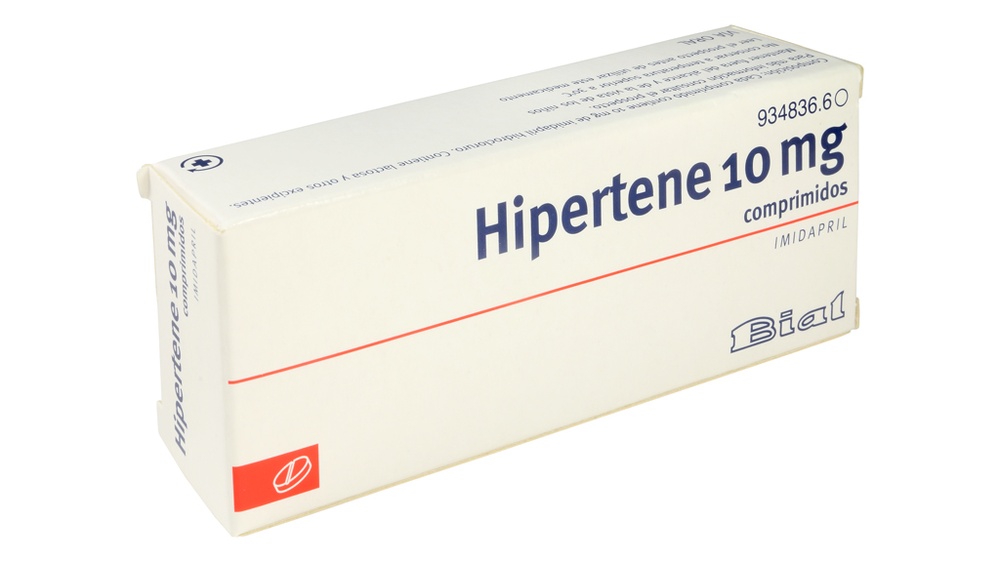
- País de registro
- Forma farmacéuticaCOMPRIMIDO, 10 mg
- Código ATCC09AA16
- Precio medio en farmacia5.87 EUR
- Principio activo
- Requiere recetaSí
- Fabricante
- ComposiciónLACTOSA MONOHIDRATO (72,0 mg mg), CROSCARMELOSA SODICA (6,7 mg mg), DIESTEARATO DE GLICEROL (6,0 mg mg)
- Esta información es de carácter general y no sustituye la consulta con un profesional sanitario.
- Alternativas a HIPERTENE 10 mg COMPRIMIDOSForma farmacéutica: COMPRIMIDO, 20 mgPrincipio activo: imidaprilFabricante: Laboratorios Bial S.A.Requiere recetaForma farmacéutica: COMPRIMIDO, 5 mgPrincipio activo: imidaprilFabricante: Laboratorios Bial S.A.Requiere recetaForma farmacéutica: COMPRIMIDO, 10 mgPrincipio activo: imidaprilFabricante: Dari Pharma S.L.Requiere receta
Médicos online para HIPERTENE 10 mg COMPRIMIDOS
Comenta la dosis, los posibles efectos secundarios, interacciones, contraindicaciones o la revisión de receta de HIPERTENE 10 mg COMPRIMIDOS, sujeto a valoración médica y a la normativa local.
Obtén una receta de HIPERTENE 10 mg COMPRIMIDOS online
Rellena un formulario de 2 minutos
Cuéntanos tus síntomas, historial y el medicamento que necesitas.
Elige un médico o nosotros te asignamos uno
Escoge un especialista o te conectamos con el próximo médico disponible.
El médico revisa tu caso
Normalmente en 30 minutos. Puede hacerte preguntas adicionales por chat.
Recógela en cualquier farmacia
Receta electrónica enviada a tu correo, válida en toda España.
Preguntas frecuentes
HIPERTENE 10 mg COMPRIMIDOS requiere receta en España. Puedes confirmarlo con un médico online según tu caso.
El principio activo de HIPERTENE 10 mg COMPRIMIDOS es imidapril. Esta información ayuda a identificar medicamentos con la misma composición pero con diferentes nombres comerciales.
El precio medio en farmacia de HIPERTENE 10 mg COMPRIMIDOS es de aproximadamente 5.87 EUR. Puede variar según el fabricante y la forma farmacéutica.
HIPERTENE 10 mg COMPRIMIDOS es fabricado por Laboratorios Bial S.A.. La marca y el envase pueden variar según el distribuidor.
Los Médicos de familia, Psiquiatras, Dermatólogos, Cardiólogos, Endocrinólogos, Gastroenterólogos, Neumólogos, Nefrólogos, Reumatólogos, Hematólogos, Infectólogos, Alergólogos, Geriatras, Pediatras, Oncólogos pueden valorar la prescripción de HIPERTENE 10 mg COMPRIMIDOS cuando esté clínicamente indicado. Puedes reservar una videoconsulta para comentar tu caso y las opciones de tratamiento.
España cuenta con una infraestructura sanitaria bien desarrollada en ciudades principales como Madrid, Barcelona, Valencia y Sevilla. Las farmacias están ampliamente disponibles y operan bajo estrictas regulaciones, garantizando el acceso a medicamentos con receta.
Puedes comprar HIPERTENE 10 mg COMPRIMIDOS en Madrid, Barcelona, Sevilla o Valencia en cualquier farmacia local con una receta válida.
Para obtener una receta, puedes utilizar Oladoctor:
Otros medicamentos con el mismo principio activo (imidapril) incluyen HIPERTENE 20 mg COMPRIMIDOS, HIPERTENE 5 mg COMPRIMIDOS, IMIDAPRIL DARI PHARMA 10 MG COMPRIMIDOS EFG. Pueden tener diferentes nombres comerciales o formulaciones, pero contienen el mismo componente terapéutico. Consulta siempre con un médico antes de cambiar o iniciar un nuevo medicamento.
