



HEMOSOL 5145 mg/2033 mg /3090 Mg/6450 Mg/5400 Mg Hemofiltracion

Revisión de receta online
Un médico revisará tu caso y determinará si la prescripción es médicamente apropiada.

Habla con un médico sobre este medicamento
Comenta tus síntomas y las opciones de tratamiento en una consulta online.



Cómo usar HEMOSOL B0 SOLUCION PARA HEMOFILTRACION Y HEMODIALISIS
Contenido del prospecto
- Introducción
- Qué es Hemosol B0 y para qué se utiliza
- Antes de usar Hemosol B0
- Cómo usar Hemosol B0
- Posibles efectos adversos
- Conservación de Hemosol B0
- Información adicional
Introducción
Prospecto: Información para el usuario
Hemosol B0 solución para hemodiálisis y hemofiltración
Cloruro de sodio/cloruro de calcio dihidratado/cloruro de magnesio hexahidratado/ácido láctico/bicarbonato de sodio.
Lea todo el prospecto detenidamente antes de empezar a usar este medicamento, porque contiene información importante para usted.
- Conserve este prospecto ya que puede tener que volver a leerlo.
- Si tiene alguna duda, consulte a su médico, farmacéutico o enfermero.
- Si experimenta efectos adversos, consulte a su médico, farmacéutico o enfermero, incluso si se trata de efectos adversos no mencionados en este prospecto. Ver sección 4.
En este prospecto:
- Qué es Hemosol B0 y para qué se utiliza
- Qué necesita saber antes de empezar a usar Hemosol B0
- Cómo usar Hemosol B0
- Posibles efectos adversos
- Conservación de Hemosol B0
- Contenido del envase e información adicional
1. Qué es Hemosol B0 y para qué se utiliza
Hemosol B0 se utiliza en hospitales en tratamientos de cuidados intensivos para corregir el desequilibrio químico de la sangre provocado por la insuficiencia renal. El objetivo de los tratamientos es eliminar de la sangre los productos de desecho que se acumulan cuando los riñones no funcionan bien.
Hemosol B0 se usa en estos tipos de tratamiento para adultos y niños de todas las edades:
- hemofiltración,
- hemodiafiltración y
- hemodiálisis.

¿No estás seguro de si este medicamento es adecuado para ti?
Comenta tus síntomas y tratamiento con un médico online.
2. Antes de usar Hemosol B0
No use Hemosol B0:
Si es alérgico a uno de los principios activos o a alguno de los demás componentes (incluidos en la sección 6).
Advertencias y precauciones
Consulte a su médico, farmacéutico o enfermero antes de empezar a usar Hemosol B0.
Hemosol B0 es un producto de uso hospitalario que solo debe ser administrado por profesionales médicos. Estos asegurarán que el medicamento se utiliza de forma segura.
El estado de la sangre se comprobará antes y durante el tratamiento. Se controlará, por ejemplo, el equilibrio ácido-básico y la concentración de sales en la sangre (electrolitos), incluidas todas las entradas (perfusión intravenosa) y salidas (diuresis) de líquidos, incluso las que no estén relacionadas directamente con el tratamiento.
Puesto que Hemosol B0 no contiene potasio, hay que prestar especial atención a los niveles de potasio en sangre. Si los niveles son bajos, es posible que haya que administrar un suplemento potásico.
Niños
No existen advertencias ni precauciones específicas para los niños derivadas del uso de este medicamento.
Uso de Hemosol B0 con otros medicamentos
Informe a su médico o farmacéutico si está tomando, ha tomado recientemente o podría tener que tomar cualquier otro medicamento.
Debe hacerlo porque los niveles de concentración en la sangre de algunos medicamentos pueden reducirse durante el tratamiento con Hemosol B0. Su médico decidirá si hay que cambiar alguno de los medicamentos que toma.
En concreto, hable con su médico si toma alguno de estos medicamentos:
- Medicamentos digitálicos (para el tratamiento de algunas insuficiencias cardíacas) ya que el riesgo de arritmias cardíacas inducidas por estos medicamentos aumenta cuando los niveles de concentración de potasio en la sangre son bajos (hipopotasemia).
- Vitamina D y medicamentos que contengan calcio ya que pueden aumentar el riesgo de concentración alta de calcio en la sangre (hipercalcemia).
- Cualquier suplemento de solución de bicarbonato de sodio (u otra fuente tamponada) ya que puede incrementar el riesgo de compuestos básicos en la sangre (alcalosis metabólica).
Cuando se usa citrato como anticoagulante, puede reducir los niveles de calcio en el plasma.
Embarazo, lactancia y fertilidad
Si está embarazada o en periodo de lactancia, cree que podría estar embarazada o tiene intención de quedarse embarazada, consulte a su médico o farmacéutico antes de utilizar este medicamento. No se prevén efectos en la fertilidad, en el embarazo ni en los recién nacidos/bebés lactantes. Su médico decidirá si se le debe administrar Hemosol B0 en caso de estar embarazada o en periodo de lactancia.
Conducción y uso de máquinas
Hemosol B0 no afecta a la capacidad para conducir vehículos o manejar maquinaria.
3. Cómo usar Hemosol B0
Hemosol B0 es un producto que sólo debe ser administrado por profesionales médicos.
El volumen de Hemosol B0 y, por lo tanto, la dosis empleada, dependerá de sus condiciones. El volumen de dosis será determinado por el médico responsable del tratamiento.
Hemosol B0 puede administrarse directamente en el torrente sanguíneo (por vía intravenosa) o mediante hemodiálisis, una técnica en la que la solución fluye en un lado de la membrana de diálisis mientras la sangre lo hace por el otro.
Si usa más Hemosol B0 del que debe
Hemosol B0 es un producto de uso hospitalario que solo debe administrar profesionales médicos. Además se lleva a cabo un control exhaustivo del balance hídrico, equilibrio electrolítico y ácido-básico.
Por lo tanto, es improbable que use más Hemosol B0 del que debe.
En el caso improbable de que se le administre una sobredosis, el médico adoptará las medidas correctivas necesarias y ajustará la dosis.
La sobredosis puede derivar en:
- sobrecarga de líquidos en la sangre,
- elevación del nivel de bicarbonato en la sangre (alcalosis metabólica),
- y/o reducción de los niveles de sales en la sangre (hipofosfatemia, hipopotasemia).
Para consultar las instrucciones de uso, ver sección “Esta información está destinada únicamente a profesionales del sector sanitario”.
Si tiene cualquier otra duda sobre el uso de este medicamento, pregunte a su médico, farmacéutico o enfermero.

¿Has empezado a tomar el medicamento y tienes preguntas?
Comenta tus síntomas y tratamiento con un médico online.
4. Posibles efectos adversos
Al igual que todos los medicamentos, este medicamento puede producir efectos adversos, aunque no todas las personas los sufran.
Se han notificado los siguientes efectos adversos:
Frecuencia no conocida (no puede estimarse a partir de los datos disponibles)
- Variaciones en los niveles de sales en la sangre (desequilibrios electrolíticos, como, por ejemplo, hipofosfatemia, hipopotasemia).
- Aumento de la concentración de bicarbonato en el plasma (alcalosis metabólica) o reducción de la concentración de bicarbonato en el plasma (acidosis metabólica).
- Volumen de agua en el cuerpo anormalmente elevado o reducido (hiper o hipovolemia).
- Náuseas.
- Vómitos.
- Calambres musculares,
- Presión sanguínea baja (hipotensión).
Comunicación de efectos adversos
Si experimenta cualquier tipo de efecto adverso, consulte a su médico, farmacéutico o enfermero, incluso si se trata de posibles efectos adversos que no aparecen en este prospecto. También puede comunicarlos directamente a través del Sistema Español de Farmacovigilancia de Medicamentos de Uso Humano: www.notificaRAM.es.
Mediante la comunicación de efectos adversos usted puede contribuir a proporcionar más información sobre la seguridad de este medicamento.
5. Conservación de Hemosol B0
Mantener este medicamento fuera de la vista y del alcance de los niños.
No utilice este medicamento después de la fecha de caducidad que aparece en el la parte posterior de la bolsa y en la etiqueta después de CAD. La fecha de caducidad es el último día del mes que se indica.
No conservar a temperatura inferior a 4°C.
Se ha demostrado la estabilidad física y química de la solución reconstituida durante 24 horas mantenida a 22°C. Desde un punto de vista microbiológico, la solución reconstituida deberá utilizarse inmediatamente. El uso de la solución almacenada en otras condiciones y con otros tiempos es responsabilidad del usuario y no debería ser superior a 24 horas, incluida la duración del tratamiento.
Los medicamentos no se deben tirar por los desagües ni a la basura. Pregunte a su farmacéutico cómo deshacerse de los envases y de los medicamentos que ya no necesita. De esta forma, ayudará a proteger el medio ambiente.
6. Información adicional
HEMOSOL B0 – PVC CON CONECTOR LUER Y VÁLVULA
Composición de Hemosol B0
Los principios activos antes y después de la reconstitución son:
Principios activos antes de la reconstitución:
1000 ml de solución del compartimento pequeño (A)contienen:
Cloruro de calcio, 2H2O 5,145 g
Cloruro de magnesio, 6 H2O 2,033 g
Ácido láctico 5,4 g
1000 ml de solución del compartimento grande (B)contienen:
Bicarbonato de sodio 3,09 g
Cloruro de sodio 6,45 g
Principios activos después de la reconstitución:
Las soluciones de los compartimentos A (250 ml) y B (4750 ml) se mezclan para producir una solución reconstituida (5000 ml) con la siguiente composición:
mmol/l
Calcio, Ca2+ 1,75
Magnesio, Mg2+ 0,5
Sodio, Na+ 140
Cloruro Cl- 109,5
Lactato 3
Bicarbonato, HCO3- 32
Osmolaridad teórica: 287 mOsm/l
Los demás componentes son:dióxido de carbono (E-290) y agua para preparaciones inyectables.
Aspecto del producto y contenido del envase
Hemosol B0 se presenta en una bolsa de dos compartimentos. La bolsa está recubierta por un envoltorio transparente.
La solución final reconstituida se obtiene después de romper el vástago rompible y mezclar ambas soluciones.
La solución reconstituida es transparente e incolora. Cada bolsa (A+B) contiene 5000 ml de solución para hemofiltración, hemodiafiltración y/o hemodiálisis.
Cada caja contiene dos bolsas y un prospecto.
Titular de la autorización de comercialización:
Vantive Belgium SRL
Boulevard d´Angleterre 2
1420 Braine-l´Alleud
Bélgica
Fabricante:
Bieffe Medital S.P.A.
Via Stelvio 94,
23035 Sondalo (SO),
Italia
o
Vantive Manufacturing Limited
Moneen Road,
Castlebar, Co. Mayo F23 XR63
Irlanda
Pueden solicitar más información respecto a este medicamento dirigiéndose al representante local del titular de la autorización de comercialización:
Vantive Health, S.L.
Polígono industrial sector 14
C/ Pouet de Camilo nº2
46394 Ribarroja del Turia
Valencia
España
Este medicamento está autorizado en los estados miembros del Espacio Económico Europeo y en el Reino Unido (Irlanda del Norte) con los siguientes nombres:
Alemania, Austria, Bélgica, Bulgaria, Croacia, Chipre, Dinamarca, Eslovaquia, Eslovenia, España, Estonia, Finlandia, Francia, Grecia, Islandia, Irlanda, Letonia, Lituania, Luxemburgo, Malta, Noruega, Países Bajos, Polonia, Portugal, Reino Unido (Irlanda del Norte), República Checa y Suecia: Hemosol B0.
Fecha de la última revisión de este prospecto: 11/2018
__________________________________________________________________________
Esta información está destinada únicamente a profesionales del sector sanitario
Hemosol B0 solución para hemodiálisis y hemofiltración
Precauciones
Debe seguir con exactitud las instrucciones de uso y manipulación de Hemosol B0.
Las soluciones de los dos compartimentos deberánmezclarse antes de usarse.El uso de una solución de hemofiltración contaminada puede producir sepsis, shock y trastornos mortales.
Para aumentar la comodidad del paciente, se puede calentar Hemosol B0 hasta alcanzar los 37°C. El calentamiento previo al uso de la solución se debe realizar antes de la reconstitución utilizando solo calor seco. Las soluciones no se deben calentar en agua ni en un horno microondas. Antes de la administración y siempre que la solución y el recipiente lo permitan, se debe comprobar visualmente que la solución no contenga partículas ni haya perdido el color original. No administre la solución a menos que esta sea transparente y el precinto esté intacto.
La adición de bicarbonato de sodio de sustitución puede aumentar el riesgo de alcalosis metabólica.
Antes y durante el tratamiento, debe controlarse cuidadosamente el equilibrio electrolítico y ácido - básico. Puesto que Hemosol B0 no contiene potasio, debe controlarse la concentración de potasio en el suero antes y después de la hemofiltración y/o hemodiálisis. Puede ser necesaria la adición de potasio.
Puede añadirse hasta 1,2 mmol/l de fosfato a la solución. Si se añade fosfato potásico, la concentración de potasio total no debe superar los 4 mEq/l (4 mmol/l).
El volumen y la velocidad a la que se usa Hemosol B0 dependerán de la concentración de electrolitos en la sangre, del equilibrio ácido-base y del estado clínico general del paciente. La pauta de administración (dosis, velocidad de la perfusión y volumen acumulado) de Hemosol B0 debe determinarla un médico. La aplicación continuada de hemofiltración eliminará el exceso de líquidos y electrolitos.
En caso de desequilibrio hídrico, se debe controlar estrechamente la situación clínica y corregir el equilibro de líquidos según sea necesario.
La sobredosis dará como resultado sobrecarga de líquidos en pacientes con insuficiencia renal, lo que podría tener consecuencias muy graves como, por ejemplo, insuficiencia cardiaca congestiva o alteraciones del equilibrio ácido-básico o electrolítico.
La solución no contiene glucosa, por lo que su administración puede provocar hipoglucemia. Los niveles de glucosa en la sangre se deben supervisar con regularidad.
Hemosol B0 contiene bicarbonato y lactato (un precursor del bicarbonato), que pueden afectar al equilibrio ácido-base del paciente. Si durante el tratamiento con la solución aparece alcalosis metabólica o esta empeora, es posible que sea necesario reducir la velocidad de perfusión o suspender la administración.
Posología
Las velocidades de flujo comúnmente utilizadas para la solución de sustitución en hemofiltración y hemodiafiltración son:
Adultos: 500‑3.000 ml/hora
Las velocidades de flujo comúnmente utilizadas para la solución de diálisis (dializado) en hemodiálisis continua son:
Adultos: 500‑2.500 ml/hora
Las velocidades de flujo comúnmente utilizadas en adultos son de entre 2.000 y 2.500 ml/h aproximadamente, lo que corresponde a un volumen de líquido diario aproximado de entre 48 y 60 L.
Población pediátrica
El intervalo de velocidad de flujo para la solución de sustitución en hemofiltración y hemodiafiltración y para la solución de diálisis (dializado) en hemodiálisis continua es:
Niños (desde neonatos hasta adolescentes de hasta 18 años): de 1.000 a 2.000 ml/h/1,73 m2.
Pueden ser necesarias velocidades de flujo hasta 4.000 ml/h/1,73 m2, especialmente en los niños de menor edad (≤ 10 kg). En general, la velocidad de flujo absoluta (en ml/h) en la población pediátrica no debe superar la velocidad de flujo máxima para adultos.
Instrucciones de empleo y manipulación
La solución de electrolitos (compartimento A pequeño) se añade a la solución tampón (compartimento B grande) después de romper el vástago rompible inmediatamente antes de usarla para obtener la solución reconstituida.
Utilizar únicamente con equipos de sustitución renal extracorpórea adecuados.
Se debe emplear una técnica aséptica durante todo el proceso de manipulación y administración al paciente.
Use la solución si el envoltorio no está dañado, todos los precintos están intactos, el vástago rompible no está roto y la solución es transparente. Apriete la bolsa para asegurarse de que no haya fugas. Si se descubre alguna fuga, deseche la solución inmediatamente ya que no se puede garantizar su esterilidad.
El compartimento grande B tiene un puerto de inyección para añadir otros fármacos que sean necesarios una vez reconstituida la solución.
Es responsabilidad del médico juzgar la compatibilidad de un medicamento añadido a la solución de Hemosol B0. Para ello deberá comprobar posibles cambios de color y/o una posible precipitación, complejos insolubles o cristales. Antes de añadir un medicamento, verificar si es soluble y estable en agua dentro de los límites de pH del Hemosol B0 (el rango de pH de la solución reconstituida es de 7,0 a 8,5). Los aditivos podrían no ser compatibles. Se deben consultar las instrucciones de uso del medicamento que se va a añadir.
Elimine cualquier líquido del puerto de inyección, sujete la bolsa en posición vertical hacia abajo, añada el fármaco a través del puerto de inyección y mezcle completamente. La solución debe administrarse inmediatamente. La introducción y el mezclado de los aditivos siempre debe realizarse antes de conectar la bolsa de la solución al circuito extracorpóreo.
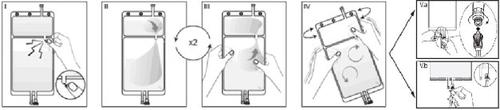
IRetire el envoltorio de la bolsa inmediatamente antes de usarla y deseche los demás materiales de embalaje. Abra el la sello rompiendo el vástago situado entre los dos compartimentos de la bolsa. El vástago quedará dentro de la bolsa (véase la figura I, a continuación).
IIAsegúrese de que todo el líquido del compartimento pequeño A pase al compartimento grande B (véase la figura II, a continuación).
IIIAclare dos vecesel compartimento pequeño A llevando la solución mezclada de vuelta a este compartimento y de nuevo al compartimento grande B (véase la figura III, a continuación).
IVUna vez vaciado el compartimento pequeño A, agite el compartimento grande B para que se mezcle completamente su contenido. La solución ya está lista para su uso y la bolsa puede colgarse en el equipo (véase la figura IV, a continuación).
VLa línea de diálisis o de sustitución puede conectarse a cualquiera de los dos puertos de acceso.
V.aSi se utiliza el conector luer, quite el tapón mediante un movimiento de giro y extracción y conecte el conector luer macho de la línea de diálisis o sustitución en el receptor luer hembra de la bolsa mediante un movimiento de empuje y giro. Asegúrese de que la conexión está bien hecha y apretada. La conexión se abrirá. Compruebe que el líquido circula libremente (véase la figura V.a, a continuación).
Si la línea de diálisis o sustitución se desconecta del conector luer, el conector se cerrará y el flujo de la solución se detendrá. El puerto luer es un puerto sin aguja que se puede limpiar.
V.bSi se utiliza el puerto de inyección, retire primero el tapón levantándolo. El puerto de inyección es un puerto que se puede desinfectar con torunda. Introduzca después el espigón a través de la pared de goma. Compruebe que el líquido circula libremente (véase la figura V.b, a continuación)
La solución debe utilizarse inmediatamente después de retirar el envoltorio. De no utilizarse inmediatamente, la solución reconstituida debe usarse dentro de las 24 horas posteriores, incluida la duración del tratamiento, después de la adición de la solución de electrolitos a la solución tampón.
La solución reconstituida es de un solo uso. Deseche la solución sobrante inmediatamente después del uso.
La eliminación del medicamento no utilizado y de todos los materiales que hayan estado en contacto con él, se realizará de acuerdo con la normativa local.
----------------------------------------------------------------------------------------------------------------------
HEMOSOL B0 – PVC CON CONECTOR LUER Y VÁSTAGO ROMPIBLE
Composición de Hemosol B0
Los principios activos antes y después de la reconstitución son:
Principios activos antes de la reconstitución:
1000 ml de solución del compartimento pequeño (A)contienen:
Cloruro de calcio, 2H2O 5,145 g
Cloruro de magnesio, 6 H2O 2,033 g
Ácido láctico 5,4 g
1000 ml de solución del compartimento grande (B)contienen:
Bicarbonato de sodio 3,09 g
Cloruro de sodio 6,45 g
Principios activos después de la reconstitución:
Las soluciones de los compartimentos A (250 ml) y B (4750 ml) se mezclan para producir una solución reconstituida (5000 ml) con la siguiente composición:
mmol/l
Calcio, Ca2+ 1,75
Magnesio, Mg2+ 0,5
Sodio, Na+ 140
Cloruro Cl- 109,5
Lactato 3
Bicarbonato, HCO3- 32
Osmolaridad teórica: 287 mOsm/l
Los demás componentes son:dióxido de carbono (E-290) y agua para preparaciones inyectables.
Aspecto del producto y contenido del envase
Hemosol B0 se presenta en una bolsa de dos compartimentos. La bolsa está recubierta por un envoltorio transparente.
La solución final reconstituida se obtiene después de romper el vástago rompible y mezclar ambas soluciones.
La solución reconstituida es transparente e incolora. Cada bolsa (A+B) contiene 5000 ml de solución para hemofiltración, hemodiafiltración y/o hemodiálisis.
Cada caja contiene dos bolsas y un prospecto.
Titular de la autorización de comercialización:
Vantive Belgium SRL
Boulevard d´Angleterre 2
1420 Braine-l´Alleud
Bélgica
Fabricante:
Bieffe Medital S.P.A.
Via Stelvio 94,
23035 Sondalo (SO),
Italia
o
Vantive Manufacturing Limited
Moneen Road,
Castlebar, Co. Mayo F23 XR63
Irlanda
Pueden solicitar más información respecto a este medicamento dirigiéndose al representante local del titular de la autorización de comercialización:
Vantive Health, S.L.
Polígono industrial sector 14
C/ Pouet de Camilo nº2
46394 Ribarroja del Turia
Valencia
España
Este medicamento está autorizado en los estados miembros del Espacio Económico Europeo y en el Reino Unido (Irlanda del Norte) con los siguientes nombres:
Alemania, Austria, Bélgica, Bulgaria, Croacia, Chipre, Dinamarca, Eslovaquia, Eslovenia, España, Estonia, Finlandia, Francia, Grecia, Islandia, Irlanda, Letonia, Lituania, Luxemburgo, Malta, Noruega, Países Bajos, Polonia, Portugal, Reino Unido (Irlanda del Norte), República Checa y Suecia: Hemosol B0.
Fecha de la última revisión de este prospecto: 11/2018
__________________________________________________________________________
Esta información está destinada únicamente a profesionales del sector sanitario
Hemosol B0 solución para hemodiálisis y hemofiltración
Precauciones
Debe seguir con exactitud las instrucciones de uso y manipulación de Hemosol B0.
Las soluciones de los dos compartimentos deberánmezclarse antes de usarse.El uso de una solución de hemofiltración contaminada puede producir sepsis, shock y trastornos mortales.
Para aumentar la comodidad del paciente, se puede calentar Hemosol B0 hasta alcanzar los 37°C. El calentamiento previo al uso de la solución se debe realizar antes de la reconstitución utilizando solo calor seco. Las soluciones no se deben calentar en agua ni en un horno microondas. Antes de la administración y siempre que la solución y el recipiente lo permitan, se debe comprobar visualmente que la solución no contenga partículas ni haya perdido el color original. No administre la solución a menos que esta sea transparente y el precinto esté intacto.
La adición de bicarbonato de sodio de sustitución puede aumentar el riesgo de alcalosis metabólica.
Antes y durante el tratamiento, debe controlarse cuidadosamente el equilibrio electrolítico y ácido - básico. Puesto que Hemosol B0 no contiene potasio, debe controlarse la concentración de potasio en el suero antes y después de la hemofiltración y/o hemodiálisis. Puede ser necesaria la adición de potasio.
Puede añadirse hasta 1,2 mmol/l de fosfato a la solución. Si se añade fosfato potásico, la concentración de potasio total no debe superar los 4 mEq/l (4 mmol/l).
El volumen y la velocidad a la que se usa Hemosol B0 dependerán de la concentración de electrolitos en la sangre, del equilibrio ácido-base y del estado clínico general. La pauta de administración (dosis, velocidad de la perfusión y volumen acumulado) de Hemosol B0 debe determinarla un médico. La aplicación continuada de hemofiltración eliminará el exceso de líquidos y electrolitos.
En caso de desequilibrio hídrico, se debe controlar estrechamente la situación clínica y corregir el equilibro de líquidos según sea necesario.
La sobredosis dará como resultado sobrecarga de líquidos en pacientes con insuficiencia renal, lo que podría tener consecuencias muy graves como, por ejemplo, insuficiencia cardiaca congestiva o alteraciones del equilibrio ácido-básico o electrolítico.
La solución no contiene glucosa, por lo que su administración puede provocar hipoglucemia. Los niveles de glucosa en la sangre se deben supervisar con regularidad.
Hemosol B0 contiene bicarbonato y lactato (un precursor del bicarbonato), que pueden afectar al equilibrio ácido-base del paciente. Si durante el tratamiento con la solución aparece alcalosis metabólica o esta empeora, es posible que sea necesario reducir la velocidad de perfusión o suspender la administración.
Posología
Las velocidades de flujo comúnmente utilizadas para la solución de sustitución en hemofiltración y hemodiafiltración son:
Adultos: 500‑3.000 ml/hora
Las velocidades de flujo comúnmente utilizadas para la solución de diálisis (dializado) en hemodiálisis continua son:
Adultos: 500‑2.500 ml/hora
Las velocidades de flujo comúnmente utilizadas en adultos son de entre 2.000 y 2.500 ml/h aproximadamente, lo que corresponde a un volumen de líquido diario aproximado de entre 48 y 60 L.
Población pediátrica
El intervalo de velocidad de flujo para la solución de sustitución en hemofiltración y hemodiafiltración y para la solución de diálisis (dializado) en hemodiálisis continua es:
Niños (desde neonatos hasta adolescentes de hasta 18 años): de 1.000 a 2.000 ml/h/1,73 m2.
Pueden ser necesarias velocidades de flujo hasta 4.000 ml/h/1,73 m2, especialmente en los niños de menor edad (≤ 10 kg). En general, la velocidad de flujo absoluta (en ml/h) en la población pediátrica no debe superar la velocidad de flujo máxima para adultos.
Instrucciones de empleo y manipulación
La solución de electrolitos (compartimento A pequeño) se añade a la solución tampón (compartimento B grande) después de romper el vástago rompible inmediatamente antes de usarla para obtener la solución reconstituida.
Utilizar únicamente con equipos de sustitución renal extracorpórea adecuados.
Se debe emplear una técnica aséptica durante todo el proceso de manipulación y administración al paciente.
Use la solución si el envoltorio no está dañado, todos los precintos están intactos, el vástago rompible no está roto y la solución es transparente. Apriete la bolsa para asegurarse de que no haya fugas. Si se descubre alguna fuga, deseche la solución inmediatamente ya que no se puede garantizar su esterilidad.
El compartimento grande B tiene un puerto de inyección para añadir otros fármacos que sean necesarios una vez reconstituida la solución.
Es responsabilidad del médico juzgar la compatibilidad de un medicamento añadido a la solución de Hemosol B0. Para ello deberá comprobar posibles cambios de color y/o una posible precipitación, complejos insolubles o cristales.
Antes de añadir un medicamento, verificar si es soluble y estable en agua dentro de los límites de pH del Hemosol B0 (el rango de pH de la solución reconstituida es de 7,0 a 8,5). Los aditivos podrían no ser compatibles. Se deben consultar las instrucciones de uso del medicamento que se va a añadir.
Elimine cualquier líquido del puerto de inyección, sujete la bolsa en posición vertical hacia abajo, añada el fármaco a través del puerto de inyección y mezcle completamente. La solución debe administrarse inmediatamente. La introducción y el mezclado de los aditivos siempre debe realizarse antes de conectar la bolsa de la solución al circuito extracorpóreo.
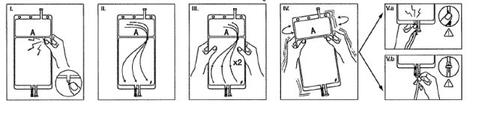
IRetire el envoltorio de la bolsa inmediatamente antes de usarla y deseche los demás materiales de embalaje. Abra el precinto rompiendo el vástago rompible situado entre los dos compartimentos de la bolsa. El vástago se quedará dentro de la bolsa (véase la figura I, a continuación).
IIAsegúrese de que todo el líquido del compartimento pequeño A pase al compartimento grande B (véase la figura II, a continuación).
IIIAclare dos vecesel compartimento pequeño A forzando a la solución mezclada a volver a este compartimento y luego otra vez al compartimento grande B (véase la figura III, a continuación).
IVUna vez vaciado el compartimento pequeño A, agite el compartimento grande B para que se mezcle completamente su contenido. La solución ya está preparada para usar y la bolsa puede colgarse en el equipo (véase la figura IV, a continuación).
VLa línea de líquido de diálisis o de sustitución puede conectarse a cualquiera de los dos puertos de acceso.
V.aSi se utiliza el acceso luer, quite el tapón y conecte el conector luer lock macho de la línea de líquido de diálisis o sustitución en el receptor luer hembra de la bolsa; hágalo fuertemente. Rompa con los dedos el vástago rompible de color por su base, y muévalo hacia delante y hacia atrás. No utilice herramientas. Compruebe que el vástago está completamente separado y que el líquido circula libremente. El vástago permanecerá en el puerto luer durante el tratamiento (véase la figura V.a, a continuación)
V.bSi se utiliza el puerto de inyección, retire primero el tapón levantándolo. El puerto de inyección es un puerto que se puede desinfectar con torunda. Introduzca después el espigón a través de la pared de goma. Compruebe que el líquido circula libremente (véase la figura V.b, a continuación)
La solución debe utilizarse inmediatamente después de retirar el envoltorio. De no utilizarse inmediatamente, la solución reconstituida debe usarse dentro de las 24 horas posteriores, incluida la duración del tratamiento, después de la adición de la solución de electrolitos a la solución tampón.
La solución reconstituida es de un solo uso. Deseche la solución sobrante inmediatamente después del uso.
La eliminación del medicamento no utilizado y de todos los materiales que hayan estado en contacto con él, se realizará de acuerdo con la normativa local.
-----------------------------------------------------------------------------------------------------------------------
HEMOSOL B0 – POLIOLEFINA CON CONECTOR LUER Y VÁLVULA
Composición de Hemosol B0
Los principios activos antes y después de la reconstitución son:
Principios activos antes de la reconstitución:
1000 ml de solución del compartimento pequeño (A)contienen:
Cloruro de calcio, 2H2O 5,145 g
Cloruro de magnesio, 6 H2O 2,033 g
Ácido láctico 5,4 g
1000 ml de solución del compartimento grande (B)contienen:
Bicarbonato de sodio 3,09 g
Cloruro de sodio 6,45 g
Principios activos después de la reconstitución:
Las soluciones de los compartimentos A (250 ml) y B (4750 ml) se mezclan para producir una solución reconstituida (5000 ml) con la siguiente composición:
mmol/l
Calcio, Ca2+ 1,75
Magnesio, Mg2+ 0,5
Sodio, Na+ 140
Cloruro Cl- 109,5
Lactato 3
Bicarbonato, HCO3- 32
Osmolaridad teórica: 287 mOsm/l
Los demás componentes son:dióxido de carbono (E-290) y agua para preparaciones inyectables.
Aspecto del producto y contenido del envase
Hemosol B0 se presenta en una bolsa de dos compartimentos. La bolsa está recubierta por un envoltorio transparente.
La solución final reconstituida se obtiene después de romper el sello desplegable y mezclar ambas soluciones.
La solución reconstituida es transparente e incolora. Cada bolsa (A+B) contiene 5000 ml de solución para hemofiltración, hemodiafiltración y/o hemodiálisis.
Cada caja contiene dos bolsas y un prospecto.
Titular de la autorización de comercialización:
Vantive Belgium SRL
Boulevard d´Angleterre 2
1420 Braine-l´Alleud
Bélgica
Fabricante:
Bieffe Medital S.P.A.
Via Stelvio 94,
23035 Sondalo (SO),
Italia
o
Vantive Manufacturing Limited
Moneen Road,
Castlebar, Co. Mayo F23 XR63
Irlanda
Pueden solicitar más información respecto a este medicamento dirigiéndose al representante local del titular de la autorización de comercialización:
Vantive Health, S.L.
Polígono industrial sector 14
C/ Pouet de Camilo nº2
46394 Ribarroja del Turia
Valencia
España
Este medicamento está autorizado en los estados miembros del Espacio Económico Europeo y en el Reino Unido (Irlanda del Norte) con los siguientes nombres:
Alemania, Austria, Bélgica, Bulgaria, Croacia, Chipre, Dinamarca, Eslovaquia, Eslovenia, España, Estonia, Finlandia, Francia, Grecia, Islandia, Irlanda, Letonia, Lituania, Luxemburgo, Malta, Noruega, Países Bajos, Polonia, Portugal, Reino Unido (Irlanda del Norte), República Checa y Suecia: Hemosol B0.
Fecha de la última revisión de este prospecto: 11/2018
__________________________________________________________________________
Esta información está destinada únicamente a profesionales del sector sanitario
Hemosol B0 solución para hemodiálisis y hemofiltración
Precauciones
Debe seguir con exactitud las instrucciones de uso y manipulación de Hemosol B0.
Las soluciones de los dos compartimentos deberánmezclarse antes de usarse.El uso de una solución de hemofiltración contaminada puede producir sepsis, shock y trastornos mortales.
Para aumentar la comodidad del paciente, se puede calentar Hemosol B0 hasta alcanzar los 37°C. El calentamiento previo al uso de la solución se debe realizar antes de la reconstitución utilizando solo calor seco. Las soluciones no se deben calentar en agua ni en un horno microondas. Antes de la administración y siempre que la solución y el recipiente lo permitan, se debe comprobar visualmente que la solución no contenga partículas ni haya perdido el color original. No administre la solución a menos que esta sea transparente y el precinto esté intacto.
La adición de bicarbonato de sodio de sustitución puede aumentar el riesgo de alcalosis metabólica.
Antes y durante el tratamiento, debe controlarse cuidadosamente el equilibrio electrolítico y ácido - básico. Puesto que Hemosol B0 no contiene potasio, debe controlarse la concentración de potasio en el suero antes y después de la hemofiltración y/o hemodiálisis. Puede ser necesaria la adición de potasio.
Puede añadirse hasta 1,2 mmol/l de fosfato a la solución. Si se añade fosfato potásico, la concentración de potasio total no debe superar los 4 mEq/l (4 mmol/l).
El volumen y la velocidad a la que se usa Hemosol B0 dependerán de la concentración de electrolitos en la sangre, del equilibrio ácido-base y del estado clínico general. La pauta de administración (dosis, velocidad de la perfusión y volumen acumulado) de Hemosol B0 debe determinarla un médico. La aplicación continuada de hemofiltración eliminará el exceso de líquidos y electrolitos.
En caso de desequilibrio hídrico, se debe controlar estrechamente la situación clínica y corregir el equilibro de líquidos según sea necesario.
La sobredosis dará como resultado sobrecarga de líquidos en pacientes con insuficiencia renal, lo que podría tener consecuencias muy graves como, por ejemplo, insuficiencia cardiaca congestiva o alteraciones del equilibrio ácido-básico o electrolítico.
La solución no contiene glucosa, por lo que su administración puede provocar hipoglucemia. Los niveles de glucosa en la sangre se deben supervisar con regularidad.
Hemosol B0 contiene bicarbonato y lactato (un precursor del bicarbonato), que pueden afectar al equilibrio ácido-base del paciente. Si durante el tratamiento con la solución aparece alcalosis metabólica o esta empeora, es posible que sea necesario reducir la velocidad de perfusión o suspender la administración.
Posología
Las velocidades de flujo comúnmente utilizadas para la solución de sustitución en hemofiltración y hemodiafiltración son:
Adultos: 500‑3.000 ml/hora
Las velocidades de flujo comúnmente utilizadas para la solución de diálisis (dializado) en hemodiálisis continua son:
Adultos: 500‑2.500 ml/hora
Las velocidades de flujo comúnmente utilizadas en adultos son de entre 2.000 y 2.500 ml/h aproximadamente, lo que corresponde a un volumen de líquido diario aproximado de entre 48 y 60 L.
Población pediátrica
El intervalo de velocidad de flujo para la solución de sustitución en hemofiltración y hemodiafiltración y para la solución de diálisis (dializado) en hemodiálisis continua es:
Niños (desde neonatos hasta adolescentes de hasta 18 años): de 1.000 a 2.000 ml/h/1,73 m2.
Pueden ser necesarias velocidades de flujo hasta 4.000 ml/h/1,73 m2, especialmente en los niños de menor edad (≤ 10 kg). En general, la velocidad de flujo absoluta (en ml/h) en la población pediátrica no debe superar la velocidad de flujo máxima para adultos.
Instrucciones de empleo y manipulación
La solución de electrolitos (compartimento A pequeño) se añade a la solución tampón (compartimento B grande) después de romper el sello despegable inmediatamente antes de usarla para obtener la solución reconstituida.
Utilizar únicamente con equipos de sustitución renal extracorpórea adecuados.
Se debe emplear una técnica aséptica durante todo el proceso de manipulación y administración al paciente.
Use la solución si el envoltorio no está dañado, todos los precintos están intactos, el sello despegable no está roto y la solución es transparente. Apriete la bolsa para asegurarse de que no haya fugas. Si se descubre alguna fuga, deseche la solución inmediatamente ya que no se puede garantizar su esterilidad.
El compartimento grande B tiene un puerto de inyección para añadir otros fármacos que sean necesarios una vez reconstituida la solución.
Es responsabilidad del médico juzgar la compatibilidad de un medicamento añadido a la solución de Hemosol B0. Para ello deberá comprobar posibles cambios de color y/o una posible precipitación, complejos insolubles o cristales.
Antes de añadir un medicamento, verificar si es soluble y estable en agua dentro de los límites de pH del Hemosol B0 (el rango de pH de la solución reconstituida es de 7,0 a 8,5). Los aditivos podrían no ser compatibles. Se deben consultar las instrucciones de uso del medicamento que se va a añadir.
Elimine cualquier líquido del puerto de inyección, sujete la bolsa en posición vertical hacia abajo, añada el fármaco a través del puerto de inyección y mezcle completamente. La solución debe administrarse inmediatamente. La introducción y el mezclado de los aditivos siempre debe realizarse antes de conectar la bolsa de la solución al circuito extracorpóreo.
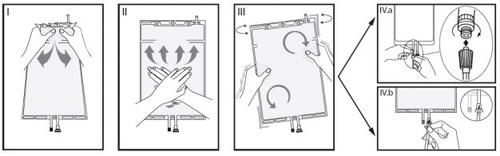
IRetire el envoltorio de la bolsa inmediatamente antes de usarla y deseche los demás materiales de embalaje. Abra el precinto sujetando el compartimento pequeño entre las dos manos y apriete hasta que se cree una abertura en el sello despegable entre ambos compartimentos (véase la figura I, a continuación).
IIPresione el compartimento grande con ambas manos hasta que el sello despegable entre los dos compartimentos esté totalmente abierto (véase la figura II, a continuación).
IIIAsegúrese de que las soluciones estén completamente mezcladas agitando la bolsa suavemente. La solución ya está lista para su uso y la bolsa puede colgarse en el equipo (véase la figura III, a continuación).
IVLa línea de diálisis o de sustitución puede conectarse a cualquiera de los dos puertos de acceso.
IV.aSi se utiliza el conector luer, quite el tapón con un movimiento de giro y extracción y conecte el conector luer macho de la línea de diálisis o sustitución en el receptor luer hembra de la bolsa mediante un movimiento de empuje y giro. Asegúrese de que la conexión está bien hecha y apretada. El conector se abrirá. Compruebe que el líquido circula libremente (véase la figura IV.a, a continuación).
Si la línea de diálisis o sustitución se desconecta del conector luer, el conector se cerrará y el flujo de la solución se detendrá. El puerto luer es un puerto sin aguja que se puede limpiar.
IV.bSi se utiliza el puerto de inyección, retire primero el tapón levantándolo. El puerto de inyección es un puerto que se puede desinfectar con torunda. Introduzca después el espigón a través de la pared de goma. Compruebe que el líquido circula libremente (véase la figura IV.b, a continuación).
La solución debe utilizarse inmediatamente después de retirar el envoltorio. De no utilizarse inmediatamente, la solución reconstituida debe usarse dentro de las 24 horas posteriores, incluida la duración del tratamiento, después de la adición de la solución de electrolitos a la solución tampón.
La solución reconstituida es de un solo uso. Deseche la solución sobrante inmediatamente después del uso.
La eliminación del medicamento no utilizado y de todos los materiales que hayan estado en contacto con él, se realizará de acuerdo con la normativa local.
- País de registro
- Forma farmacéuticaHEMOFILTRACION, 5145 mg / 2033 mg / 3090 mg / 6450 mg / 5400 mg
- Requiere recetaSí
- Fabricante
- Esta información es de carácter general y no sustituye la consulta con un profesional sanitario.
- Alternativas a HEMOSOL B0 SOLUCION PARA HEMOFILTRACION Y HEMODIALISISForma farmacéutica: HEMOFILTRACION, 2 mmol potasio/lPrincipio activo: HemofiltratesFabricante: Nikkiso BelgiumRequiere recetaForma farmacéutica: HEMOFILTRACION, 4 mmol potasio/lPrincipio activo: HemofiltratesFabricante: Nikkiso BelgiumRequiere recetaForma farmacéutica: HEMOFILTRACION, -Principio activo: HemofiltratesFabricante: Nikkiso BelgiumRequiere receta
Médicos online para HEMOSOL B0 SOLUCION PARA HEMOFILTRACION Y HEMODIALISIS
Comenta la dosis, los posibles efectos secundarios, interacciones, contraindicaciones o la revisión de receta de HEMOSOL B0 SOLUCION PARA HEMOFILTRACION Y HEMODIALISIS, sujeto a valoración médica y a la normativa local.









Obtén una receta de HEMOSOL B0 SOLUCION PARA HEMOFILTRACION Y HEMODIALISIS online
Rellena un formulario de 2 minutos
Cuéntanos tus síntomas, historial y el medicamento que necesitas.
Elige un médico o nosotros te asignamos uno
Escoge un especialista o te conectamos con el próximo médico disponible.
El médico revisa tu caso
Normalmente en 30 minutos. Puede hacerte preguntas adicionales por chat.
Recógela en cualquier farmacia
Receta electrónica enviada a tu correo, válida en toda España.
Preguntas frecuentes
HEMOSOL B0 SOLUCION PARA HEMOFILTRACION Y HEMODIALISIS requiere receta en España. Puedes confirmarlo con un médico online según tu caso.
HEMOSOL B0 SOLUCION PARA HEMOFILTRACION Y HEMODIALISIS es fabricado por Vantive Belgium. La marca y el envase pueden variar según el distribuidor.
Los Médicos de familia, Psiquiatras, Dermatólogos, Cardiólogos, Endocrinólogos, Gastroenterólogos, Neumólogos, Nefrólogos, Reumatólogos, Hematólogos, Infectólogos, Alergólogos, Geriatras, Pediatras, Oncólogos pueden valorar la prescripción de HEMOSOL B0 SOLUCION PARA HEMOFILTRACION Y HEMODIALISIS cuando esté clínicamente indicado. Puedes reservar una videoconsulta para comentar tu caso y las opciones de tratamiento.
España cuenta con una infraestructura sanitaria bien desarrollada en ciudades principales como Madrid, Barcelona, Valencia y Sevilla. Las farmacias están ampliamente disponibles y operan bajo estrictas regulaciones, garantizando el acceso a medicamentos con receta.
Puedes comprar HEMOSOL B0 SOLUCION PARA HEMOFILTRACION Y HEMODIALISIS en Madrid, Barcelona, Sevilla o Valencia en cualquier farmacia local con una receta válida.
Para obtener una receta, puedes utilizar Oladoctor:
Otros medicamentos con el mismo principio activo () incluyen ACCUSOL 35 POTASIO 2 mmol/L SOLUCION PARA HEMOFILTRACION, HEMODIALISIS Y HEMODIAFILTRACION, ACCUSOL 35 POTASIO 4 mmol/L SOLUCION PARA HEMOFILTRACION, HEMODIALISIS Y HEMODIAFILTRACION, ACCUSOL 35 SOLUCION PARA HEMOFILTRACION, HEMODIALISIS Y HEMODIAFILTRACION. Pueden tener diferentes nombres comerciales o formulaciones, pero contienen el mismo componente terapéutico. Consulta siempre con un médico antes de cambiar o iniciar un nuevo medicamento.
