



FREEFLEX CLORURO SODICO 0,9% Inyectable Perfusión

Revisión de receta online
Un médico revisará tu caso y determinará si la prescripción es médicamente apropiada.

Habla con un médico sobre este medicamento
Comenta tus síntomas y las opciones de tratamiento en una consulta online.



Cómo usar FREEFLEX CLORURO SODICO 0,9%
Contenido del prospecto
- Introducción
- Qué es Freeflex Cloruro Sódico 0,9% y para qué se utiliza
- Qué necesita saber antes de empezar a usar Freeflex Cloruro Sódico 0,9%
- Cómo usar Freeflex Cloruro Sódico 0,9%
- Posibles efectos adversos
- Conservación de Freeflex Cloruro Sódico 0,9%
- Contenido del envase e información adicional
Introducción
Prospecto: información para el usuario
Freeflex Cloruro Sódico 0,9%
cloruro sódico
Lea todo el prospecto detenidamente antes de empezar a usar este medicamento, porque contiene información importante para usted.
- Conserve este prospecto, ya que puede tener que volver a leerlo.
- Si tiene alguna duda, consulte a su médico, farmacéutico o enfermero.
- Este medicamento se le ha recetado solamente a usted, y no debe dárselo a otras personas aunque tengan los mismos síntomas que usted, ya que puede perjudicarles.
- Si experimenta efectos adversos, consulte a su médico, farmacéutico o enfermero, incluso si se trata de efectos adversos que no aparecen en este prospecto. Ver sección 4.
Contenido del prospecto
- Qué es Freeflex Cloruro Sódico 0,9% y para qué se utiliza
- Qué necesita saber antes de empezar a usar Freeflex Cloruro Sódico 0,9%
- Cómo usar Freeflex Cloruro Sódico 0,9%
- Posibles efectos adversos
- Conservación de Freeflex Cloruro Sódico 0,9%
- Contenido del envase e información adicional
1. Qué es Freeflex Cloruro Sódico 0,9% y para qué se utiliza
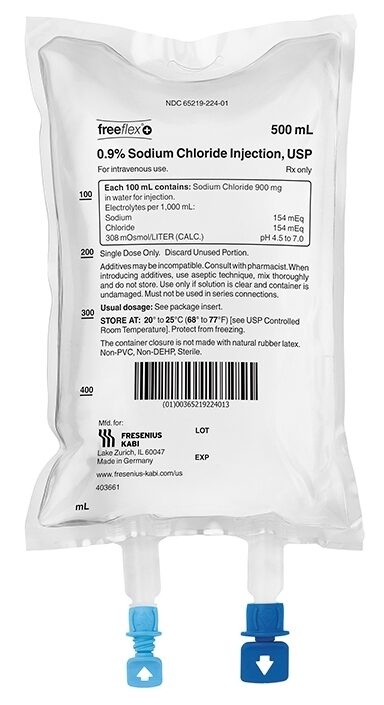
Freeflex Cloruro Sódico 0,9% es una solución para perfusión intravenosa que se presenta en bolsas freeflex® de 50 ml, 100 ml, 250 ml, 500 ml y 1000 ml, con sobrebolsa para el aporte intravascular de agua, sodio y cloruros.
Está indicado para:
- Reequilibrio iónico por aporte de cloruros y sodios
- Deshidratación extracelular
- Hipovolemia

¿No estás seguro de si este medicamento es adecuado para ti?
Comenta tus síntomas y tratamiento con un médico online.
2. Qué necesita saber antes de empezar a usar Freeflex Cloruro Sódico 0,9%
No use Freeflex Cloruro Sódico 0,9%
Si es alérgico al principio activo o a alguno de los demás componentes de este medicamento (incluidos en la sección 6).
Si padece acidosis, hipercloremia, hipopotasemia, insuficiencia renal y/o cardíaca, hipernatremia, hiperhidratación, edemas en general, hipertensión, insuficiencia hepática o si está en tratamientos prolongados con cortiscoteroides o ACTH.
Advertencias y precauciones
Consulte a su médico, farmacéutico o enfermero antes de empezar a usar Freeflex Cloruro Sódico 0,9%.
Otros medicamentos y Freeflex Cloruro Sódico 0,9%
No se han observado interacciones con otros preparados.
Embarazo y lactancia
Si está embarazada o en periodo de lactancia, cree que podría estar embarazada o tiene intención de quedarse embarazada, consulte a su médico o farmacéutico antes de utilizar este medicamento.
No se han realizado estudios sobre este grupo de población. Dadas las características del preparado, se valorará la relación beneficio/riesgo.
3. Cómo usar Freeflex Cloruro Sódico 0,9%
Siga exactamente las instrucciones de administración de este medicamento indicadas por su médico o farmacéutico. En caso de duda, consulte de nuevo a su médico o farmacéutico.
La dosis recomendada debe adaptarse según el peso y estado de deshidratación del paciente.
Si usa más Freeflex Cloruro Sódico 0,9% del que debe
Dada la naturaleza de sus componentes no se han descrito intoxicaciones.
El aporte de dosis excesivas puede dar lugar a hipenatremia con deshidratación de los órganos internos y acidosis hiperclorérmica.
Hipertensión arterial. Edema agudo.
En caso de sobredosis o ingestión accidental, consultar al Servicio de Información Toxicológica. Teléfono (91) 562 04 20.

¿Has empezado a tomar el medicamento y tienes preguntas?
Comenta tus síntomas y tratamiento con un médico online.
4. Posibles efectos adversos
Al igual que todos los medicamentos, este medicamento puede producir efectos adversos, aunque no todas las personas los sufran.
No se han descrito efectos adversos, pero si se produce cualquier reacción adversa atribuible a la toma del medicamento, consulte a su médico o farmacéutico.
Comunicación de efectos adversos
Si experimenta cualquier tipo de efecto adverso, consulte a su médico o farmacéutico, incluso si se trata de posibles efectos adversos que no aparecen en este prospecto. También puede comunicarlos directamente a través del Sistema Español de Farmacovigilancia de Medicamentos de Uso Humano website: www.notificaRAM.es. Mediante la comunicación de efectos adversos usted puede contribuir a proporcionar más información sobre la seguridad de este medicamento.
5. Conservación de Freeflex Cloruro Sódico 0,9%
Mantener este medicamento fuera de la vista y del alcance de los niños.
No utilice este medicamento después de la fecha de caducidad que aparece en el envase después de CAD. La fecha de caducidad es el último día del mes que se indica.
6. Contenido del envase e información adicional
Composición de Freeflex Cloruro Sódico 0,9%
- El principio activo es cloruro de sodio. Cada 100 ml de solución contienen 0,9 g de cloruro de sodio.
- El único excipiente es agua para preparaciones inyectables.
Composición electrolítica | mmol/l | meq/l |
Ión sodio | 154 | 154 |
Ión cloruro | 154 | 154 |
Osmolaridad teórica: 308 mosmol/l
Aspecto del producto y contenido del envase
Solución inyectable para perfusión intravenosa en bolsas freeflex® de 50 ml, 100 ml, 250 ml, 500 ml y 1000 ml, con sobrebolsa.
Titular de la autorización de comercialización y responsable de la fabricación
Titular de la autorización de comercialización:
Fresenius Kabi España, S.A.U.
C/ Marina 16-18,
08005-Barcelona
Responsable de la fabricación:
Fresenius Kabi Deutschland GmbH
Werk Friedberg Freseniusstraβe 1
D-61169 Friedberg
Fresenius Kabi France, S.A.
6, Rue du Rempart, B.P. 611
(Louviers) F-27400 Francia
HP Halden Pharma AS
Svinesundsveien 80
1788 Halden
Noruega
Fresenius Kabi India PVT. LTD.
A-3 MIDC, Ranajangoan Ganpati, ‘tal. Shirur.
412220 Maharashtra
India
Fecha de la última revisión de este prospecto: Marzo 2023.
La información detallada y actualizada de este medicamento está disponible en la página Web de la Agencia Española de Medicamentos y Productos Sanitarios (AEMPS) http://www.aemps.es
--------------------------------------------------------------------------------------------------------------------
Esta información está destinada únicamente a profesionales sanitarios:
INSTRUCCIONES PARA LA CORRECTA ADMINISTRACIÓN DEL PREPARADO
Inspección visual
- No extraer la freeflex? de su sobrebolsa hasta el momento inmediato anterior a su uso.
- Comprobar la composición, número de lote y fecha de caducidad.
- Inspeccionar el conjunto comprobando la integridad del envase primario. No utilizar si este envase no está íntegro.
Eliminación de la sobrebolsa
Algunas freeflex? llevan una sobrebolsa como protección durante el almacenamiento. La sobrebolsa, con sistema de apertura “peel”, puede eliminarse de la siguiente forma:
- Localizar las lengüetas del extremo donde están los ports de la bolsa.
- Separar las dos mitades de la sobrebolsa, dejando la bolsa sobre una superficie limpia.
Preparación para la administración
Las bolsas freeflex? están diseñadas para una administración sin entrada de aire. Si tiene que utilizarse un equipo de perfusión con entrada de aire, asegurarse de que éste esté siempre cerrado.
- Apretar la freeflex? para asegurarse de que no tiene fugas y examinar la solución para observar la presencia de partículas visibles o precipitados. NO ADMINISTRAR SI LA SOLUCIÓN NO ES TRANSPARENTE Y/O EL ENVASE NO ESTÁ INTACTO.
- Utilizando una técnica aséptica, preparar el equipo de perfusión con el regulador de flujo cerrado.
- Identificar el port de administración (azul) en forma de flecha indicando la salida de la bolsa.
- Sacar el tapón protector del port de administración de la freeflex?, cogiendo firmemente las aletas inferiores con una mano y romper el tapón en forma de flecha mediante una acción sostenida de giro.
- Coger la base del port de administración colocando los dedos detrás del protector y empujar firmemente el punzón del equipo de administración dentro del port. Deberá sentirse una ligera resistencia al romperse la membrana del port. Para prevenir fugas insertar el punzón hasta el fondo del port de administración.
- Suspender la bolsa en el colgador y purgar el equipo de administración de acuerdo con las instrucciones del fabricante. Realizar la venopuntura y unir inmediatamente el equipo de administración a la cánula intravenosa. Ajustar el regulador de flujo hasta conseguir la velocidad de goteo deseada.
- Las freeflex? están calibradas para indicar el volumen aproximado que se ha infundido. La escala debe leerse estirando la bolsa y leyendo el volumen en la superficie superior del líquido. Para una medición más exacta del volumen de fluido debería utilizarse un equipo de administración con cámara de medición.
Para añadir medicación
Las bolsas freeflex? tienen un port para la adición de medicamentos independiente y con un tapón autocerrable. Debido a que el port está protegido por un tapón protector soldado herméticamente, no es necesario desinfectar el lugar de adición de medicamentos antes de su primer uso.
Adiciones mediante jeringuillas
- Identificar el port de adición de medicamentos (blanco) en forma de flecha indicando un flujo de entrada a la bolsa.
- Usando una técnica aséptica, preparar una jeringuilla con la medicación, utilizando una aguja de 20-22 G.
- Sacar el tapón protector del port de adición de medicamentos de la bolsa cogiendo firmemente las aletas inferiores con una mano y romper el tapón en forma de flecha mediante una acción sostenida de giro.
- Mantener el port de adición de medicamentos colocando los dedos detrás del protector e insertar totalmente la aguja, de forma que perfore el tapón exterior y la membrana interna. Su construcción rígida previene cualquier posibilidad de que la aguja penetre por los lados del port.
- Añadir la medicación y extraer la aguja. Para prevenir cualquier formación de aerosol, debería mantenerse un hisopo estéril alrededor del tapón.
Se recomiendan los siguientes volúmenes máximos de adición:
Tamaño de la bolsa freeflex? (ml) Adición máxima recomendada (ml)
- 50
- 50
- 100
- 150
- 250
NOTA: Los aditivos pueden ser incompatibles por lo que deberá buscarse un asesoramiento experto antes de añadir medicación a freeflex?. Si el médico decide añadir medicación, debe emplearse una técnica aséptica. Se recomienda que la medicación se añada sólo bajo supervisión del farmacéutico. No almacenar soluciones a las que se haya añadido medicación.
- Agitar y apretar la freeflex? para asegurar una completa mezcla de la medicación. Con medicamentos densos tales como el cloruro potásico es aconsejable apretar ambos ports mientras la bolsa está en posición vertical e invertir la bolsa varias veces.
- Si es necesario, puede colocarse un tapón protector sobre el port de adición de medicamentos para prevenir adiciones posteriores.
Adiciones mediante equipos de reconstitución
- Identificar el port de adición de medicamentos (blanco) en forma de flecha indicando un flujo de entrada a la bolsa.
- Sacar el tapón protector del port de adición de medicamentos de la bolsa cogiendo firmemente las aletas inferiores con una mano y romper el tapón en forma de flecha mediante una acción sostenida de giro.
- Utilizando una técnica aséptica, sacar el equipo de reconstitución de su embalaje y empujar el extremo estrecho sobre el port de adición de medicamentos de forma que las aletas del port ajusten con las ranuras del equipo de reconstitución. Parar cuando la superficie superior de las aletas alcance el primer paro de la ranura. En esta posición la parte superior de la aguja del equipo de reconstitución está entre el tapón y la membrana interna, de forma que no puede escapar fluido de la freeflex?.
- Usando una técnica aséptica, preparar el vial de la medicación y conectarlo al extremo abierto del equipo de reconstitución.
- Conectar la medicación a la solución intravenosa girando el equipo de reconstitución de forma que las aletas del port ajusten con la ranura interna y empujando el vial y el equipo de reconstitución hasta que la superficie superior de las aletas alcancen el segundo paro.
- Con el vial invertido, apretar y liberar la freeflex? varias veces para transferir solución al vial del medicamento. Agitar para disolver el medicamento. Nota:Si el medicamento es un líquido, este paso 6 puede omitirse.
- Invertir la freeflex? de forma que el vial quede encima de la bolsa y transferir la medicación a la bolsa apretando y liberando la bolsa varias veces para que el aire estéril empuje el líquido fuera del vial.
- Si la solubilidad del medicamento es baja, puede ser necesario repetir los pasos 6 y 7.
- Cuando la transferencia es completa, sacar el equipo de reconstitución de la freeflex? y desechar el vial y el equipo de reconstitución en un lugar seguro. El equipo de reconstitución está diseñado para un sólo uso y no deberá utilizarse para posteriores adiciones a ésta u otra freeflex?.
NOTA: Los aditivos pueden ser incompatibles por lo que deberá buscarse un asesoramiento experto antes de añadir medicación a freeflex?. Si el médico decide añadir medicación, debe emplearse una técnica aséptica. Se recomienda que la medicación se añada sólo bajo supervisión del farmacéutico. No almacenar soluciones a las que se haya añadido medicación.
- Agitar y apretar la freeflex? para asegurar una completa mezcla de la medicación. Con medicamentos densos tales como el cloruro potásico es aconsejable apretar ambos ports mientras la bolsa está en posición vertical e invertir la bolsa varias veces.
- Si es necesario, puede colocarse un tapón protector sobre el port de adición de medicamentos para prevenir adiciones posteriores.
Avisos:
- No ventear
- No administrar si la solución no es transparente y la freeflex?no está intacta
- Si aparecen reacciones adversas detener la perfusión
- Se recomienda que los equipos de perfusión se cambien al menos una vez cada 24 horas
- País de registro
- Forma farmacéuticaINYECTABLE PERFUSION, 100ml
- Código ATCB05BB91
- Principio activo
- Requiere recetaSí
- Fabricante
- ComposiciónHIDROXIDO DE SODIO (E 524) (0-0,008 ml mg)
- Esta información es de carácter general y no sustituye la consulta con un profesional sanitario.
- Alternativas a FREEFLEX CLORURO SODICO 0,9%Forma farmacéutica: INYECTABLE PERFUSION, 100 mlPrincipio activo: Solutions affecting the electrolyte balanceFabricante: Fresenius Kabi España, S.A.U.Requiere recetaForma farmacéutica: INYECTABLE PERFUSION, 900 mg sodio cloruro/ 100 mlPrincipio activo: Solutions affecting the electrolyte balanceFabricante: B Braun Medical S.A.Requiere recetaForma farmacéutica: INYECTABLE PERFUSION, 900 mgPrincipio activo: Solutions affecting the electrolyte balanceFabricante: Fresenius Kabi España, S.A.U.Requiere receta
Médicos online para FREEFLEX CLORURO SODICO 0,9%
Comenta la dosis, los posibles efectos secundarios, interacciones, contraindicaciones o la revisión de receta de FREEFLEX CLORURO SODICO 0,9%, sujeto a valoración médica y a la normativa local.









Obtén una receta de FREEFLEX CLORURO SODICO 0,9% online
Rellena un formulario de 2 minutos
Cuéntanos tus síntomas, historial y el medicamento que necesitas.
Elige un médico o nosotros te asignamos uno
Escoge un especialista o te conectamos con el próximo médico disponible.
El médico revisa tu caso
Normalmente en 30 minutos. Puede hacerte preguntas adicionales por chat.
Recógela en cualquier farmacia
Receta electrónica enviada a tu correo, válida en toda España.
Preguntas frecuentes
FREEFLEX CLORURO SODICO 0,9% requiere receta en España. Puedes confirmarlo con un médico online según tu caso.
El principio activo de FREEFLEX CLORURO SODICO 0,9% es Solutions affecting the electrolyte balance. Esta información ayuda a identificar medicamentos con la misma composición pero con diferentes nombres comerciales.
FREEFLEX CLORURO SODICO 0,9% es fabricado por Fresenius Kabi España, S.A.U.. La marca y el envase pueden variar según el distribuidor.
Los Médicos de familia, Psiquiatras, Dermatólogos, Cardiólogos, Endocrinólogos, Gastroenterólogos, Neumólogos, Nefrólogos, Reumatólogos, Hematólogos, Infectólogos, Alergólogos, Geriatras, Pediatras, Oncólogos pueden valorar la prescripción de FREEFLEX CLORURO SODICO 0,9% cuando esté clínicamente indicado. Puedes reservar una videoconsulta para comentar tu caso y las opciones de tratamiento.
España cuenta con una infraestructura sanitaria bien desarrollada en ciudades principales como Madrid, Barcelona, Valencia y Sevilla. Las farmacias están ampliamente disponibles y operan bajo estrictas regulaciones, garantizando el acceso a medicamentos con receta.
Puedes comprar FREEFLEX CLORURO SODICO 0,9% en Madrid, Barcelona, Sevilla o Valencia en cualquier farmacia local con una receta válida.
Para obtener una receta, puedes utilizar Oladoctor:
Otros medicamentos con el mismo principio activo (Solutions affecting the electrolyte balance) incluyen CLORURO DE SODIO MEIN 0,9% SOLUCION PARA PERFUSION, FISIOLOGICO B. BRAUN 0,9% SOLUCION PARA PERFUSION, KABIPAC CLORURO DE SODIO 9 MG/ML SOLUCION PARA PERFUSION. Pueden tener diferentes nombres comerciales o formulaciones, pero contienen el mismo componente terapéutico. Consulta siempre con un médico antes de cambiar o iniciar un nuevo medicamento.
