



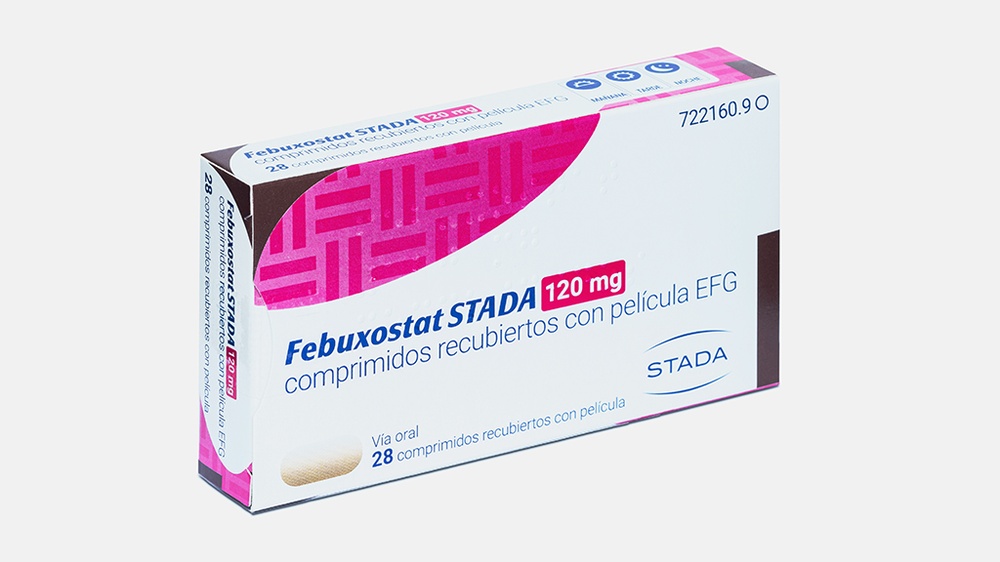
FEBUXOSTAT 120 mg Film-Coated Tablets

Prescription review online
A doctor will review your case and decide whether a prescription is medically appropriate.

Talk to a doctor about this medicine
Discuss your symptoms and possible next steps in a quick online consultation.



How to use FEBUXOSTAT STADA 120 mg FILM-COATED TABLETS
Contents of the leaflet
- Introduction
- What is Febuxostat Stada and what is it used for
- What you need to know before you take Febuxostat Stada
- How to take Febuxostat Stada
- Possible side effects
- Storage of Febuxostat Stada
- Container Content and Additional Information
Introduction
Package Leaflet: Information for the User
Febuxostat STADA 120 mg film-coated tablets EFG
Read all of this leaflet carefully before you start taking this medicine because it contains important information for you.
- Keep this leaflet, you may need to read it again.
- If you have any further questions, ask your doctor or pharmacist.
- This medicine has been prescribed for you only. Do not pass it on to others. It may harm them, even if their signs of illness are the same as yours.
- If you get any side effects, talk to your doctor or pharmacist. This includes any possible side effects not listed in this leaflet. See section 4.
Contents of the pack and other information:
- What is Febuxostat Stada and what is it used for
- What you need to know before you take Febuxostat Stada
- How to take Febuxostat Stada
- Possible side effects
5 Storage of Febuxostat Stada
- Contents of the pack and further information
1. What is Febuxostat Stada and what is it used for
Febuxostat Stada tablets contain the active substance febuxostat and are used to treat gout, which is associated with an excess in the body of a chemical compound called uric acid (urate). In some people, uric acid builds up in the blood to the point where it cannot be dissolved. When this happens, urate crystals form both inside and around the joints and kidneys. These crystals can cause sudden and severe pain, redness, heat, and swelling in the joints (this is called a gout attack). If left untreated, large deposits called tophi can form around the joints and inside them. Tophi can damage the joints and bones.
Febuxostat works by reducing the concentration of uric acid. Keeping uric acid levels low by taking febuxostat once a day prevents the formation of crystals and, over time, reduces symptoms. If uric acid levels are kept low for a long enough time, the size of tophi is also reduced.
Febuxostat 120 mg tablets are also used in the treatment and prevention of high levels of uric acid in the blood, which can occur when chemotherapy is started for the treatment of blood cell cancer.
When chemotherapy is administered, cancer cells are destroyed, and as a result, uric acid levels in the blood increase, unless their formation is prevented.
Febuxostat is for adults.

Not sure if this medicine is right for you?
Discuss your symptoms and treatment with a doctor online.
2. What you need to know before you take Febuxostat Stada
Do not take Febuxostat Stada
? if you are allergic to febuxostat or any of the other ingredients of this medicine (listed in section 6).
Warnings and precautions
Consult your doctor or pharmacist before starting to take febuxostat:
- if you have or have had heart failure, heart problems, or stroke
- if you have or have had kidney disease and/or severe allergic reactions to allopurinol (a medicine used to treat gout)
- if you have or have had liver disease or liver function disorders
- if you are being treated for high uric acid levels due to Lesch-Nyhan syndrome (a rare inherited disease in which there is too much uric acid in the blood)
- if you have thyroid problems.
If you experience allergic reactions to febuxostat, stop taking this medicine (see also section 4). Possible symptoms of allergic reactions may be:
- rash including severe forms (e.g., blisters, nodules, exfoliative rashes that cause itching), itching
- swelling of the limbs or face
- difficulty breathing
- fever with swollen lymph nodes
- also severe allergic reactions that can be life-threatening, associated with cardiac arrest.
Your doctor may decide to permanently discontinue treatment with febuxostat.
Stevens-Johnson Syndrome
Rare cases of life-threatening skin rashes have been reported with the use of febuxostat, initially appearing on the trunk as reddish spots in the shape of a target or circular spots that often have a blister in the center. It can also include ulcers in the mouth, throat, nose, genitals, and conjunctivitis (red and swollen eyes). The rash can evolve into generalized blisters or skin peeling.
If you have developed Stevens-Johnson Syndrome with the use of febuxostat, you should not restart treatment with febuxostat at any time. If you develop a rash or these skin symptoms, go to the doctor immediately and tell them that you are taking this medicine.
If you experience a gout attack (severe pain that starts suddenly accompanied by sensitivity, redness, heat, and swelling of a joint), wait for the attack to subside before starting treatment with febuxostat.
Some people may experience a gout attack when starting to take certain medications that control uric acid levels. Not everyone experiences these attacks, but they can occur even while taking febuxostat, especially during the first few weeks or months of treatment. It is essential to continue taking febuxostat, as this medicine continues to work to reduce uric acid. If you continue to take febuxostat daily, gout attacks will become less frequent and less painful.
If necessary, your doctor will prescribe other medications to prevent or treat the symptoms of attacks (such as pain and joint swelling).
In patients with very high levels of urates (e.g., those undergoing chemotherapy for cancer), treatment with medications to reduce uric acid may produce the accumulation of xanthine in the urinary tract, with the possible formation of stones, although this has not been observed in patients treated with febuxostat for Tumor Lysis Syndrome.
Your doctor may perform blood tests to check that the liver is working normally.
Children and adolescents
Do not give this medicine to children under 18 years of age, as the safety and efficacy have not been established.
Other medicines and Febuxostat Stada
Tell your doctor or pharmacist if you are taking, have recently taken, or might take any other medicines.
It is especially important that you inform your doctor or pharmacist if you are using medicines that contain any of the following substances, as they may interact with febuxostat, and your doctor may need to take special precautions:
? Mercaptopurine (used to treat cancer)
? Azathioprine (used to reduce the immune response)
? Theophylline (used to treat asthma)
Pregnancy and breastfeeding
It is not known if febuxostat can harm the fetus. Febuxostat should not be used during pregnancy. It is not known if febuxostat passes into breast milk. Do not use febuxostat if you are breastfeeding or planning to breastfeed.
If you are pregnant or breastfeeding, think you may be pregnant, or are planning to have a baby, ask your doctor or pharmacist for advice before taking this medicine.
Driving and using machines
Be aware that you may experience dizziness, drowsiness, blurred vision, and numbness or tingling during treatment, so if this happens, do not drive or operate machinery.
Febuxostat Stada contains sodium
This medicine contains 1.8 mg of sodium (less than 1 mmol of sodium (23 mg)) per tablet; this is essentially "sodium-free".
3. How to take Febuxostat Stada
Follow the instructions for administration of this medicine exactly as indicated by your doctor. If you are unsure, consult your doctor or pharmacist again.
Dose
The recommended dose is one tablet per day.
Gout
Febuxostat is available in 80 mg or 120 mg tablets. Your doctor will prescribe the most suitable dose for you.
Continue to take febuxostat every day, even if you no longer have gout attacks.
Prevention and treatment of high uric acid levels in patients undergoing chemotherapy for cancer
Febuxostat is available in 120 mg tablets.
Start taking febuxostat two days before chemotherapy and continue to use it as indicated by your doctor.
Treatment is usually short-term.
Method of administration
Tablets should be swallowed and can be taken with or without food.
If you take more Febuxostat Stada than you should
In case of accidental overdose, consult your doctor or go to the nearest emergency center.
In case of overdose or accidental ingestion, consult your doctor or pharmacist immediately, or call the Toxicology Information Service, phone: 91 562 04 20, indicating the medicine and the amount ingested. It is recommended to take the package and the package leaflet of the medicine to the healthcare professional.
If you forget to take Febuxostat Stada
If you forget a dose of febuxostat, take it as soon as you remember, unless it is almost time for the next dose; in this case, skip the missed dose and take the next one at the usual time. Do not take a double dose to make up for missed doses.
If you stop taking Febuxostat Stada
Even if you feel better, do not stop taking febuxostat, unless your doctor tells you to. If you stop taking febuxostat, uric acid levels may rise again, and symptoms may worsen due to the formation of new urate crystals in the joints and kidneys.
If you have any further questions on the use of this medicine, ask your doctor or pharmacist.

Started taking the medicine and have questions?
Discuss your symptoms and treatment with a doctor online.
4. Possible side effects
Like all medicines, this medicine can cause side effects, although not everybody gets them.
Stop taking this medicine and contact your doctor immediately or go to the nearest hospitalif you experience any of the following rare side effects (may affect up to 1 in 1000 people), as you may experience a severe allergic reaction:
- anaphylactic reactions, hypersensitivity to the medicine (see also section 2 "Warnings and precautions")
- life-threatening skin rashes characterized by blistering and peeling of the skin and mucous membranes (e.g., mouth and genitals), painful ulcers in the mouth and/or genital areas, accompanied by fever, sore throat, and fatigue (Stevens-Johnson syndrome/toxic epidermal necrolysis), or by swollen lymph nodes, liver enlargement, hepatitis (including liver failure), increased white blood cell count in blood (hypersensitivity to drugs with eosinophilia and systemic symptoms - DRESS syndrome) (see section 2)
- generalized skin rashes
Common side effects(may affect up to 1 in 10 people) are:
? abnormal liver test results
? diarrhea
? headache
? rash (including various types of rash, see "uncommon" and "rare" sections below)
? nausea
? increased gout symptoms
? localized swelling due to fluid retention in tissues (edema)
- dizziness
- breathing difficulties
- itching
- pain in the limbs, muscle/joint pain
- fatigue
Other side effects not mentioned above are included below.
Uncommon side effects(may affect up to 1 in 100 people) are:
- decreased appetite, change in blood sugar levels (diabetes) whose symptom may be excessive thirst, increased blood fats, weight gain
- decreased sex drive
- difficulty sleeping, drowsiness
- numbness, tingling, decreased or altered sensitivity (hypoesthesia, hemiparesis, or paresthesia), altered sense of taste, decreased sense of smell (hyposmia)
- ECG abnormalities (electrocardiogram), irregular or rapid heartbeat, palpitations
- hot flashes or flushing (redness of the face or neck), increased blood pressure, bleeding (hemorrhage, observed only in patients receiving chemotherapy for blood diseases)
- cough, chest discomfort or pain, inflammation of the nasal passages and/or throat (upper respiratory tract infection), bronchitis, lower respiratory tract infection
- dry mouth, abdominal pain or discomfort, gas, upper abdominal pain, heartburn or indigestion, constipation, frequent bowel movements, vomiting, stomach upset
- itchy rash, hives, skin inflammation or discoloration, small red or purple spots on the skin, small bumps on the skin, skin rash and bumps, increased sweating, night sweats, hair loss, skin redness (erythema), psoriasis, eczema, other skin disorders
- muscle cramps, muscle weakness, bursitis or arthritis (joint inflammation, usually accompanied by pain, swelling, or stiffness), back pain, muscle spasms, muscle and/or joint stiffness
- blood in urine, abnormally frequent urination, abnormal urine tests (increased protein concentration in urine), reduced kidney function, urinary tract infection
- fatigue, chest pain, chest discomfort
- gallstones or bile duct stones (cholelithiasis)
- increased levels of thyroid-stimulating hormone (TSH) in blood
- changes or decrease in urine volume due to kidney inflammation (tubulointerstitial nephritis)
- liver inflammation (hepatitis)
- yellowing of the skin (jaundice)
- bladder infection
- liver damage
- increased levels of creatine phosphokinase in blood (a indicator of muscle damage)
- sudden cardiac death
- low red blood cell count (anemia)
- depression
- sleep disorder
- loss of taste
- burning sensation
- feeling of dizziness or "spinning" (vertigo)
- circulatory failure
- lung infection (pneumonia)
- mouth sores; mouth inflammation
- gastrointestinal perforation
- rotator cuff syndrome
- polymyalgia rheumatica
- feeling of heat
- sudden loss of vision due to blockage of an eye artery
Reporting of side effects
If you experience any side effects, talk to your doctor or pharmacist, even if it is possible side effects not listed in this leaflet. You can also report side effects directly through the Spanish Medicines Monitoring System for Human Use: https://www.notificaram.es. By reporting side effects, you can help provide more information on the safety of this medicine.
5. Storage of Febuxostat Stada
Keep this medicine out of the sight and reach of children.
Do not use this medicine after the expiry date which is stated on the carton and on the blister after EXP. The expiry date is the last day of the month shown.
This medicine does not require any special storage conditions.
Medicines should not be disposed of via wastewater or household waste. Dispose of the packaging and any unused medicine in the pharmacy's SIGRE collection point. Ask your pharmacist how to dispose of the packaging and any unused medicine. This will help protect the environment.
6. Container Content and Additional Information
Composition of Febuxostat Stada
The active ingredient is febuxostat.
Each tablet contains 120 mg of febuxostat (as hemihydrate).
The other components are:
Tablet core:microcrystalline cellulose, sodium glycolate starch (derived from potato), anhydrous colloidal silica, magnesium stearate, copovidone.
Tablet coating:Opadry II yellow 85F42129 containing: polyvinyl alcohol, titanium dioxide (E171), macrogol, talc, yellow iron oxide (E172).
Appearance of the Product and Container Content
Yellow, oblong, biconvex, film-coated tablets, 18 mm x 8 mm
Febuxostat Stada 120 mg is available in PVC/PVDC/Al blisters of 14, 28, 84, and 98 film-coated tablets.
Only some pack sizes may be marketed.
Marketing Authorization Holder and Manufacturer
Marketing Authorization Holder
Laboratory STADA, S.L.
Frederic Mompou, 5
08960 Sant Just Desvern (Barcelona)
Spain
Manufacturer
STADA Arzneimittel AG
Stadastrasse 2 – 18
61118 Bad Vilbel
Germany
or
STADA Arzneimittel GmbH
Muthgase 36
1190 Vienna
Austria
or
Clonmel Healthcare Ltd.
Waterford Road
Clonmel, Co. Tipperary
Ireland
or
STADA M&D SRL
Str. Trascaului, nr 10
RO-401135, Turda
Romania
This medicinal product is authorized in the Member States of the European Economic Area under the following names:
Austria | Febuxostat STADA 120 mg Filmtabletten |
Belgium | Febuxostat EG 120mg filmomhulde tabletten |
Germany | Febuxostat AL 120 mg Filmtabletten |
Spain | Febuxostat STADA 120 mg film-coated tablets EFG |
France | Febuxostat EG 120 mg, film-coated tablet |
Croatia | Febuksostat STADA 120 mg film-coated tablets |
Hungary | Febuxostat STADA 120 mg film tablet |
Ireland | Febuxostat Clonmel 120 mg Film-coated tablets |
Italy | Febuxostat EG |
Luxembourg | Febuxostat EG 120 mg film-coated tablets |
United Kingdom | Febuxostat STADA 120 mg film-coated tablets |
Date of the last revision of this leaflet:April 2024
Detailed and updated information on this medicinal product is available on the website of the Spanish Agency for Medicines and Health Products (AEMPS) http://www.aemps.gob.es/
- Country of registration
- Dosage formTABLET, 120 mg
- ATC codeM04AA03
- Average pharmacy price19.84 EUR
- Active substance
- Prescription requiredYes
- Manufacturer
- This information is for reference only and does not constitute medical advice. Always consult a doctor before taking any medication. Oladoctor is not responsible for medical decisions based on this content.
- Alternatives to FEBUXOSTAT STADA 120 mg FILM-COATED TABLETSDosage form: TABLET, 120 mgActive substance: febuxostatManufacturer: Menarini International Operations Luxembourg S.A.Prescription requiredDosage form: TABLET, 80 mgActive substance: febuxostatManufacturer: Menarini International Operations Luxembourg S.A.Prescription requiredDosage form: TABLET, 120 mgActive substance: febuxostatManufacturer: Aristo Pharma GmbhPrescription required
Online doctors for FEBUXOSTAT STADA 120 mg FILM-COATED TABLETS
Discuss questions about FEBUXOSTAT STADA 120 mg FILM-COATED TABLETS, including use, safety considerations and prescription review, subject to medical assessment and local regulations.
Get FEBUXOSTAT STADA 120 mg FILM-COATED TABLETS Prescription Online
Fill in a 2-min form
Tell us your symptoms, history, and what medicine you're requesting.
Pick a doctor or let us assign
Choose a specialist or we'll match you with the next available doctor.
Doctor reviews your case
Usually within 30 minutes. They may ask follow-up questions via chat.
Collect from any pharmacy
Electronic prescription sent to your email — valid across Spain.
Frequently Asked Questions
FEBUXOSTAT STADA 120 mg FILM-COATED TABLETS requires a prescription in Spain. You can check with a doctor online whether this medicine may be appropriate for your situation.
The active ingredient in FEBUXOSTAT STADA 120 mg FILM-COATED TABLETS is febuxostat. This information helps identify medicines with the same composition but different brand names.
The average pharmacy price for FEBUXOSTAT STADA 120 mg FILM-COATED TABLETS is around 19.84 EUR. Prices may vary depending on the manufacturer and dosage form.
FEBUXOSTAT STADA 120 mg FILM-COATED TABLETS is manufactured by Laboratorio Stada S.L.. Pharmacy brands and packaging may differ depending on the distributor.
Doctors such as Family doctors, Psychiatrists, Dermatologists, Cardiologists, Endocrinologists, Gastroenterologists, Pulmonologists, Nephrologists, Rheumatologists, Hematologists, Infectious disease physicians, Allergists, Geriatricians, Paediatricians, Oncologists may assess whether FEBUXOSTAT STADA 120 mg FILM-COATED TABLETS is appropriate, depending on your situation and local regulations. You can book an online consultation to discuss your symptoms and possible next steps.
Spain has a well-developed healthcare infrastructure across major cities such as Madrid, Barcelona, Valencia, and Seville. Pharmacies are widely available and operate under strict regulations, ensuring access to prescribed medications.
You can buy FEBUXOSTAT STADA 120 mg FILM-COATED TABLETS in Madrid, Barcelona, Seville, or Valencia at any local pharmacy with a valid prescription.
To obtain a prescription, you can use Oladoctor:
Other medicines with the same active substance (febuxostat) include ADENURIC 120 mg FILM-COATED TABLETS, ADENURIC 80 mg FILM-COATED TABLETS, FEBUXOSTAT ARISTO 120 mg FILM-COATED TABLETS. These may have different brand names or formulations but contain the same therapeutic ingredient. Always consult a doctor before switching or starting a new medicine.
