


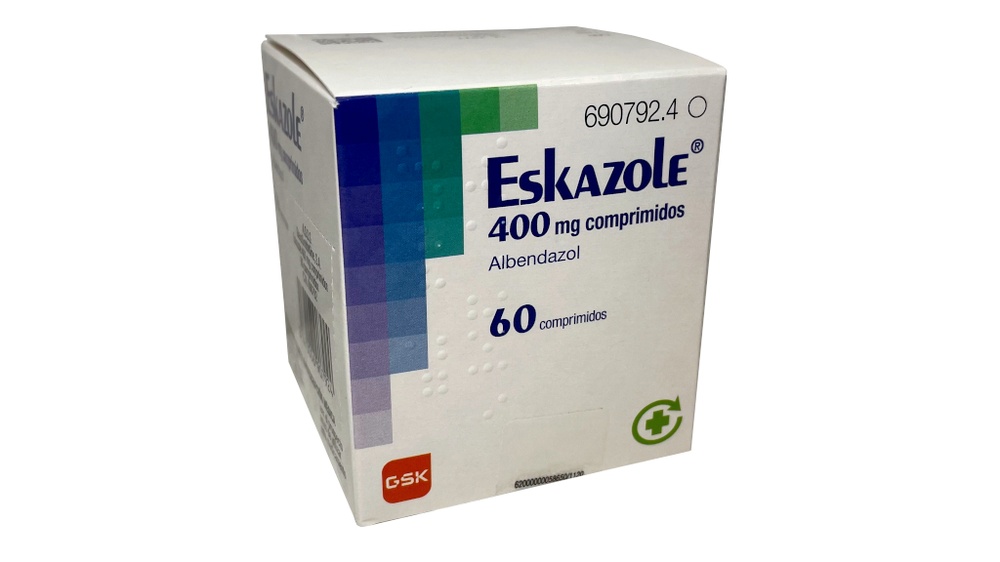
Eskazole 400 mg comprimidos

Revisión de receta online
Un médico revisará tu caso y determinará si la prescripción es médicamente apropiada.

Habla con un médico sobre este medicamento
Comenta tus síntomas y las opciones de tratamiento en una consulta online.



Cómo usar ESKAZOLE 400 MG COMPRIMIDOS
Contenido del prospecto
- Introducción
- Qué es 1. Qué es Eskazole 400 mg comprimidos y para qué se utiliza y para qué se utiliza
- Qué necesita saber antes de empezar a tomar Eskazole 400 mg comprimidos
- Cómo tomar Eskazole 400 mg comprimidos
- ?
- ?
- ?
- Posibles efectos adversos
- Trastornos generales y alteraciones en el lugar de la administración
- Conservación de Eskazole 400 mg comprimidos
- Contenido del envase e información adicional
Introducción
Prospecto: información para el usuario
Eskazole 400mg comprimidos
albendazol
Lea todo el prospecto detenidamente antes de empezar a tomar este medicamento, porque contiene información importante para usted.
- Conserve este prospecto, ya que puede tener que volver a leerlo.
- Si tiene alguna duda, consulte a su médico o farmacéutico.
- Este medicamento se le ha recetado solamente a usted, y no debe dárselo a otras personas aunque tengan los mismos síntomas que usted, ya que puede perjudicarles.
- Si experimenta efectos adversos, consulte a su médico o farmacéutico, incluso si se trata de efectos adversos que no aparecen en este prospecto. Ver sección 4.
Contenido del prospecto
- Qué es Eskazole 400 mg comprimidos y para qué se utiliza
- Qué necesita saber antes de empezar a tomar Eskazole 400 mg comprimidos
- Cómo tomar Eskazole 400 mg comprimidos
- Posibles efectos adversos
- Conservación de Eskazole 400 mg comprimidos
- Contenido del envase e información adicional
1. Qué es 1. Qué es Eskazole 400 mg comprimidos y para qué se utiliza y para qué se utiliza
Eskazole es un medicamento con actividad antihelmíntica y antiprotozoaria frente a parásitos intestinales y tisulares.
Eskazole está indicado en el tratamiento de las siguientes infecciones helmínticas sistémicas: equinococosis o enfermedad hidatídica y neurocisticercosis.

¿No estás seguro de si este medicamento es adecuado para ti?
Comenta tus síntomas y tratamiento con un médico online.
2. Qué necesita saber antes de empezar a tomar Eskazole 400 mg comprimidos
No tome Eskazole 400mg comprimidos
- Si es alérgico al albendazol o a alguno de los demás componentes de este medicamento (incluidos en la sección 6).
- Si está embarazada o cree que pudiera estarlo. Se aconseja que las mujeres en edad fértil utilicen un método anticonceptivo eficaz durante el tratamiento y hasta un mes después de terminado el mismo.
Advertencias y precauciones
Consulte a su médico o farmacéutico antes de empezar a tomar Eskazole 400 mg comprimidos.
- Su médico realizará pruebas de la función hepática antes de comenzar cada ciclo de tratamiento y al menos cada 2 semanas durante el mismo. Si las enzimas aumentan significativamente debe interrumpirse el tratamiento. Su médico valorará si puede continuar el tratamiento con Eskazole cuando las enzimas hepáticas hayan vuelto a la normalidad.
- Su médico realizará recuentos sanguíneos al comienzo del tratamiento y cada dos semanas durante el mismo para vigilar el recuento sanguíneo. El tratamiento con albendazol debe suspenderse si se producen disminuciones clínicamente significativas en el recuento sanguíneo.
- Si usted es una mujer en edad fértil. Para evitar la administración de Eskazole durante los primeros meses de embarazo, se debe iniciar el tratamiento sólo después de realizar un test de embarazo con resultado negativo. Este test debe repetirse al menos una vez antes de iniciar el siguiente ciclo. Se debe evitar el embarazo durante y hasta al menos un mes después de interrumpir el tratamiento.
- Antes de iniciar el tratamiento con Eskazole, en los casos raros de neurocisticercosis en la retina, su médico vigilará si existen lesiones en la retina. En caso de que estas lesiones se visualicen, se sopesará el beneficio de la terapia frente a los posibles daños retinales.
- Si está siendo tratado de una infección por parásitos, puede tener también una infección rara y grave del cerebro llamada neurocisticercosis y puede no saberlo. Cuando los parásitos mueren se produce una reacción en el cerebro. Entre los síntomas se incluyen convulsiones, dolor de cabeza y problemas con la vista.
Toma deEskazole 400mg comprimidos con otros medicamentos
Informe a su médico o farmacéutico si está utilizando, ha utilizado recientemente o pudiera tener que utilizar cualquier otro medicamento.
Se ha observado que cimetidina (para el tratamiento de las úlceras de estómago), prazicuantel (para el tratamiento de infecciones por parásitos) y dexametasona (para el tratamiento de la inflamación o alergia) aumentan los niveles plasmáticos del metabolito activo de albendazol.
Se ha observado que ritonavir (para el tratamiento de las infecciones por VIH), fenitoína, carbamacepina y fenobarbital (para el tratamiento de ataques (convulsiones) y de epilepsia) pueden reducir los niveles plasmáticos del metabolito activo de albendazol.
Embarazo y lactancia
Si está embarazada o en periodo de lactancia, cree que podría estar embarazada o tiene intención de quedarse embarazada, consulte a su médico o farmacéutico antes de utilizar este medicamento.
No se debe administrar Eskazole durante el embarazo ni a mujeres que crean que pueden estar embarazadas. Se aconseja que las mujeres en edad fértil utilicen un método anticonceptivo eficaz durante el tratamiento y hasta un mes después de terminado el mismo. Se debe iniciar el tratamiento sólo después de realizar un test de embarazo con resultado negativo.
No se dispone de información suficiente relativa a la excreción de albendazol en la leche materna. Por lo tanto, no se debe utilizar Eskazole durante la lactancia.
Conducción y uso de máquinas
Eskazole puede producir vértigo. Por lo tanto, se recomienda precaución al conducir o utilizar maquinaria.
Eskazole 400mg comprimidos contiene lactosa
Este medicamento contiene lactosa. Si su médico le ha indicado que padece una intolerancia a ciertos azúcares, consulte con él antes de tomar este medicamento.
Eskazole 400mg comprimidos contiene amarillo anaranjado S
Este medicamento puede producir reacciones alérgicas porque contiene amarillo anaranjado S. Puede provocar asma, especialmente en pacientes alérgicos al ácido acetilsalicílico.
Eskazole 400mg comprimidos contiene sodio
Este medicamento contiene menos de 23 mg de sodio (1 mmol) por comprimido; esto es, esencialmente “exento de sodio”.
Eskazole 400mg comprimidos contiene alcohol bencílico
Este medicamento contiene 0,98 mg de alcohol bencílico en cada comprimido.
El alcohol bencílico puede provocar reacciones alérgicas.
Consulte a su médico o farmacéutico si está embarazada o en periodo de lactancia. Esto es debido a que se pueden acumular grandes cantidades de alcohol bencílico en su organismo y provocar efectos adversos (acidosis metabólica).
Consulte a su médico o farmacéutico si tiene enfermedades de hígado o riñón. Esto es debido a que se pueden acumular en el organismo grandes cantidades de alcohol bencílico y provocar efectos adversos (acidosis metabólica).
El alcohol bencílico se ha relacionado con el riesgo de efectos adversos que incluyen problemas respiratorios (“síndrome de jadeo”) en niños.
3. Cómo tomar Eskazole 400 mg comprimidos
Siga exactamente las instrucciones de administración de este medicamento indicadas por su médico o farmacéutico. En caso de duda, consulte de nuevo a su médico o farmacéutico.
Las dosis son dependientes de los parásitos implicados, el peso del paciente y la gravedad de la infección.
Eskazole debe tomarse con alimentos para facilitar su absorción. Tragar los comprimidos con agua. Para aquellas personas que encuentren dificultad en tragar los comprimidos enteros, especialmente los niños pequeños, los comprimidos se pueden triturar o masticar con un poco de agua.

¿Has empezado a tomar el medicamento y tienes preguntas?
Comenta tus síntomas y tratamiento con un médico online.
?
Pacientes con peso mayor de 60kg:dosis diaria total de 800 mg, fraccionada en dos dosis de 400 mg durante un total de 28 días.
Pacientes con peso menor de 60kg:dosis diaria total de 15 mg/kg administrada en dos tomas fraccionadas iguales (dosis máxima de 800 mg/día), durante un total de 28 días.
Estos ciclos de 28 días de tratamiento pueden repetirse con periodos de 14 días de descanso entre los ciclos dependiendo de la indicación terapéutica, para un total de 3 ciclos.
- Quistes múltiples e inoperables:
Se pueden administrar hasta tres ciclos de 28 días de tratamiento con Eskazole para el tratamiento de los quistes hepáticos, pulmonares y peritoneales. En localizaciones óseas o cerebrales puede requerirse un tratamiento más prolongado.
- Antes de la cirugía:
Deben administrarse dos ciclos de 28 días antes de la cirugía. En los casos en los que la intervención quirúrgica sea precisa antes de finalizar los dos ciclos, debe administrarse Eskazole durante el mayor tiempo posible.
- Después de la cirugía:
En los casos en que sólo se haya administrado un ciclo preoperatorio corto (inferior a 14 días) y en aquellos en los que se requiera cirugía de urgencia, se debe administrar Eskazole postoperatoriamente durante dos ciclos de 28 días, separados por un periodo de descanso de 14 días. Además, en caso de que los quistes sean viables después del tratamiento prequirúrgico, o si ha habido derrame, debe administrarse un tratamiento completo de dos ciclos.
- Después de un drenaje percutáneo de los quistes: Tratamiento similar al de después de la cirugía.
?
Pacientes con peso mayor de 60kg:dosis diaria total de 800 mg, fraccionada en dos dosis de 400 mg durante ciclos de 28 días con periodos de 14 días sin tratamiento entre los ciclos.
Pacientes con peso menor de 60kg:dosis diaria total de 15 mg/kg administrada en dos tomas fraccionadas iguales (dosis máxima de 800 mg/día), durante ciclos de 28 días con periodos de 14 días sin tratamiento entre los ciclos.
El tratamiento se administra en ciclos de 28 días. Puede ser continuado durante meses o incluso años.
Se ha utilizado tratamiento continuado a la misma dosis durante periodos de hasta 20 meses.
El seguimiento actual sugiere que los tiempos de supervivencia se mejoran de manera sustancial tras el tratamiento prolongado. Se ha demostrado que el tratamiento continuo en un número limitado de pacientes puede llevar a una cura aparente.
?
Pacientes con peso mayor de 60kg:Dosis diaria total de 800 mg, fraccionada en dos dosis de 400 mg de 7 a 30 días dependiendo de la respuesta.
Pacientes con peso menor de 60kg:Dosis diaria total de 15 mg/kg administrada en dos tomas fraccionadas iguales (dosis máxima de 800 mg/día), de 7 a 30 días dependiendo de la respuesta.
Puede administrarse un segundo ciclo después de un periodo de 14 días sin tratamiento entre ambos ciclos.
La duración del tratamiento para la neurocisticercosis es diferente de acuerdo con el tipo de quistes:
- Quistes parenquimatosos / granulomas:
El tratamiento se realiza durante un mínimo de 7 días y hasta un máximo de 28 días.
- Quistes aracnoideos y ventriculares:
Normalmente el tratamiento dura 28 días en quistes no parenquimatosos.
- Quistes en racimo:
Se requiere un tratamiento mínimo de 28 días. La duración viene determinada por la respuesta radiológica y clínica y el tratamiento se administra como un tratamiento continuo.
Los pacientes tratados de neurocisticercosis deben recibir el tratamiento anticonvulsivante y esteroídico que se requiera. Durante la primera semana de tratamiento, se deben administrar corticosteroides por vía oral o intravenosa para prevenir los episodios de hipertensión cerebral.
Uso en niños y adolescentes
No se recomienda el uso de Eskazole en niños menores de 6 años.
Las recomendaciones posológicas en niños de 6 años o más son iguales a las de los adultos.
Uso en personas de edad avanzada
La experiencia en pacientes de 65 años o más es limitada. Los informes indican que no se requieren ajustes de dosis.
Uso en pacientes con insuficiencia renal
No se requieren ajustes de dosis, sin embargo, los pacientes con evidencia de insuficiencia renal deben ser monitorizados con precaución.
Uso en pacientes con insuficiencia hepática
Los pacientes con resultados anormales de las pruebas de función hepática (transaminasas) antes de comenzar el tratamiento con albendazol deben ser evaluados con precaución y debe suspenderse el tratamiento si aumentan de forma significativa las enzimas hepáticas o disminuye el recuento sanguíneo total.
Si toma más Eskazole 400mg comprimidos del que debe
No hay experiencia de sobredosificación con Eskazole. En caso de sobredosis o ingestión accidental, consulte inmediatamente a su médico o farmacéutico, o llame al Servicio de Información Toxicológica, teléfono 91 562 04 20 indicando el medicamento y la cantidad utilizada.
Si olvidó tomar Eskazole 400mg comprimidos
No tome una dosis doble para compensar las dosis olvidadas.
Si interrumpe el tratamiento con Eskazole 400mg comprimidos
No deje de tomar Eskazole para que el resultado de su tratamiento no se vea comprometido. Por lo tanto, siga detenidamente las instrucciones de su médico.
Si tiene cualquier otra duda sobre el uso de este medicamento, pregunte a su médico o farmacéutico.
4. Posibles efectos adversos
Al igual que todos los medicamentos, este medicamento puede producir efectos adversos, aunque no todas las personas los sufran.
Por convenio (o consenso) las frecuencias se clasifican en las siguientes categorías:
Muy frecuentes (al menos 1 de cada 10 pacientes)
Frecuentes (al menos 1 de cada 100 pacientes)
Poco frecuentes (al menos 1 de cada 1 000 pacientes)
Raros (al menos 1 de cada 10 000 pacientes)
Muy raros (menos de 1 por cada 10 000 pacientes)
Uso en infecciones helmínticas sistémicas:
Trastornos de la sangre y del sistema linfático
Poco frecuentes: leucopenia.
Muy raros: pancitopenia, anemia aplásica, agranulocitosis.
Se ha asociado leucopenia con el tratamiento con albendazol cuando se tratan pacientes con equinococosis.
Los pacientes con enfermedad hepática, incluyendo equinococosis hepática, parecen ser más susceptibles a la supresión de la médula ósea.
Trastornos del sistema inmunológico
Poco frecuentes: reacciones de hipersensibilidad incluyendo rash, prurito y urticaria.
Trastornos de sistema nervioso
Muy frecuentes: cefalea.
Frecuentes: vértigo.
Trastornos gastrointestinales
Frecuentes: alteraciones gastrointestinales (dolor abdominal, naúseas y vómitos).
Cuando se trata a pacientes con equinococosis se han asociado alteraciones gastrointestinales con albendazol.
Trastornos hepatobiliares
Muy frecuentes: aumento, de leve a moderado, de las enzimas hepáticas.
Poco frecuentes: hepatitis.
Trastornos de la piel y del tejido subcutáneo
Frecuentes: alopecia reversible (debilidad capilar y moderada pérdida de pelo).
Muy raros: eritema multiforme, síndrome de Stevens-Johnson.
Trastornos generales y alteraciones en el lugar de la administración
Frecuentes: fiebre.
Si considera que alguno de los efectos adversos que sufre es grave o si aprecia cualquier efecto adverso no mencionado en este prospecto, informe a su médico o farmacéutico.
Comunicación de efectos adversos
Si experimenta cualquier tipo de efecto adverso, consulte a su médico o farmacéutico, incluso si se trata de posibles efectos adversos que no aparecen en este prospecto.
También puede comunicarlos directamente a través del Sistema Español de Farmacovigilancia de Medicamentos de Uso Humano, www.notificaRAM.es. Mediante la comunicación de efectos adversos usted puede contribuir a proporcionar más información sobre la seguridad de este medicamento.
5. Conservación de Eskazole 400 mg comprimidos
No conservar a temperatura superior a 30 ºC.
Mantener este medicamento fuera de la vista y del alcance de los niños.
No utilice este medicamento después de la fecha de caducidad que aparece en la etiqueta del envase. La fecha de caducidad es el último día del mes que se indica.
Los medicamentos no se deben tirar por los desagües ni a la basura. Deposite los envases y los
medicamentos que no necesita en el Punto SIGREde la farmacia. En caso de duda, pregunte a su farmacéutico cómo deshacerse de los envases y de los medicamentos que no necesita. De esta forma, ayudará a proteger el medio ambiente.
6. Contenido del envase e información adicional
Composición de Eskazole 400mg comprimidos
- El principio activo es albendazol. Cada comprimido contiene 400 mg de albendazol.
- Los demás componentes son: almidón de maíz, povidona, lauril sulfato de sodio, croscarmelosa sódica, celulosa microcristalina, amarillo anaranjado S (E-110), estearato de magnesio, aroma de vainilla (contiene alcohol bencílico y propilenglicol (E-1520)), aroma de frutos de la pasión, aroma de naranja, lactosa monohidrato, sacarina sódica.
Aspecto del producto y contenido del envase
Los comprimidos de Eskazole son moteados, de color naranja pálido, ovalados, biconvexos, con una ranura en un lado y grabados con "ALB 400" en el otro. Los comprimidos tienen un olor afrutado característico.
El envase contiene 60 comprimidos. El envase es un bote de plástico (polipropileno) con una tapa de plástico (polietileno).
Titular de la autorización de comercialización y responsable de la fabricación
Titular de la autorización de comercialización
GlaxoSmithKline, S.A.
P.T.M. C/ Severo Ochoa, 2
28760 Tres Cantos (Madrid)
España
Tel: +34 900 202 700
Responsable de la fabricación
GlaxoSmithKline Trading Services Limited
12 Riverwalk,
Citywest Business Campus
Dublín 24,
Irlanda
Fecha de la última revisión de este prospecto:mayo 2024
La información detallada de este medicamento está disponible en la página Web de la Agencia Española de Medicamentos y Productos Sanitarios (AEMPS) http://www.aemps.gob.es/.
- País de registro
- Forma farmacéuticaCOMPRIMIDO, 400 mg
- Código ATCP02CA03
- Precio medio en farmacia92.76 EUR
- Disponibilidad en farmaciasProblema de suministro reportado
- Principio activo
- Requiere recetaSí
- Fabricante
- ComposiciónLACTOSA MONOHIDRATO (107 mg mg), LAURILSULFATO DE SODIO (4 mg mg), AMARILLO ANARANJADO S (E 110, CI=15985) (1 mg mg), SACARINA SODICA (2 mg mg), SABOR A FRUTA DE LA PASION (3 mg mg), CROSCARMELOSA SODICA (40 mg mg)
- Esta información es de carácter general y no sustituye la consulta con un profesional sanitario.
- Alternativas a ESKAZOLE 400 MG COMPRIMIDOSForma farmacéutica: COMPRIMIDO, 100 mgPrincipio activo: mebendazolFabricante: Esteve Pharmaceuticals S.A.Requiere recetaForma farmacéutica: SOLUCIÓN/SUSPENSIÓN ORAL, 100 mg mebendazol/ 5 mlPrincipio activo: mebendazolFabricante: Esteve Pharmaceuticals S.A.Requiere recetaForma farmacéutica: COMPRIMIDO, 3 mgPrincipio activo: IvermectinaFabricante: Industrial Farmaceutica Cantabria S.A.Requiere receta
Médicos online para ESKAZOLE 400 MG COMPRIMIDOS
Comenta la dosis, los posibles efectos secundarios, interacciones, contraindicaciones o la revisión de receta de ESKAZOLE 400 MG COMPRIMIDOS, sujeto a valoración médica y a la normativa local.









Preguntas frecuentes
ESKAZOLE 400 MG COMPRIMIDOS requiere receta en España. Puedes confirmarlo con un médico online según tu caso.
El principio activo de ESKAZOLE 400 MG COMPRIMIDOS es albendazol. Esta información ayuda a identificar medicamentos con la misma composición pero con diferentes nombres comerciales.
El precio medio en farmacia de ESKAZOLE 400 MG COMPRIMIDOS es de aproximadamente 92.76 EUR. Puede variar según el fabricante y la forma farmacéutica.
ESKAZOLE 400 MG COMPRIMIDOS es fabricado por Glaxosmithkline S.A.. La marca y el envase pueden variar según el distribuidor.
Los Médicos de familia, Psiquiatras, Dermatólogos, Cardiólogos, Endocrinólogos, Gastroenterólogos, Neumólogos, Nefrólogos, Reumatólogos, Hematólogos, Infectólogos, Alergólogos, Geriatras, Pediatras, Oncólogos pueden valorar la prescripción de ESKAZOLE 400 MG COMPRIMIDOS cuando esté clínicamente indicado. Puedes reservar una videoconsulta para comentar tu caso y las opciones de tratamiento.
La receta la emite un médico tras valorar tu estado de salud. En España, ESKAZOLE 400 MG COMPRIMIDOS se dispensa en las farmacias con esa receta médica. Una consulta online no garantiza su emisión: la decisión corresponde siempre al médico.
Para solicitar una valoración puedes usar Oladoctor:
Otros medicamentos con el mismo principio activo (albendazol) incluyen LOMPER 100 mg COMPRIMIDOS, LOMPER 20 mg/ml SUSPENSION ORAL, IVERCARE 3 MG COMPRIMIDOS EFG. Pueden tener diferentes nombres comerciales o formulaciones, pero contienen el mismo componente terapéutico. Consulta siempre con un médico antes de cambiar o iniciar un nuevo medicamento.
