



IVERCARE 3 mg Tablets

Prescription review online
A doctor will review your case and decide whether a prescription is medically appropriate.

Talk to a doctor about this medicine
Discuss your symptoms and possible next steps in a quick online consultation.



How to use IVERCARE 3 mg TABLETS
Contents of the leaflet
- Introduction
- What is Ivercare and what is it used for
- What you need to know before taking Ivercare
- Pregnancy, breastfeeding, and fertility
- Driving and using machines
- How to take Ivercare
- Possible side effects
- Allergic reactions
- Other side effects
- Storage of Ivercare
- Contents of the pack and further information
- Composition ofIvercare
Introduction
Package Leaflet: Information for the Patient
Ivercare3mg tablets EFG
Read the entire package leaflet carefully before starting to take this medication
because it contains important information for you.
- Keep this package leaflet, as you may need to read it again.
- If you have any questions, consult your doctor or pharmacist.
- This medication has been prescribed to you only, and you should not give it to others, even if they have the same symptoms as you, as it may harm them.
- If you experience side effects, consult your doctor or pharmacist, even if they are side effects not listed in this package leaflet. See section 4.
Contents of the package leaflet
- What is Ivercare and what is it used for
- What you need to know before taking Ivercare
- How to take Ivercare
- Possible side effects
- Storage of Ivercare
- Contents of the pack and further information
1. What is Ivercare and what is it used for
This medication contains the active ingredient ivermectin. It is a type of medication used to treat infections caused by some parasites.
It is used to treat:
- A intestinal infection called strongyloidiasis (anguilulosis), caused by a type of nematode called Strongyloides stercoralis.
- A blood infection called microfilaremia due to lymphatic filariasis. It is a condition caused by a larva called Wuchereria bancrofti. Ivermectin does not act against adult worms, only against larvae.
- Scabies (skin mites). It occurs when tiny mites are introduced under the skin. This can cause intense itching. This medication should only be used when your doctor confirms or suspects that you have scabies.
This medication does not prevent you from contracting these infections.It does not act against adult parasites.
This medication should only be used when your doctor confirms or suspects that you have a parasitic infection.

Not sure if this medicine is right for you?
Discuss your symptoms and treatment with a doctor online.
2. What you need to know before taking Ivercare
Do not useIvercare
If you are allergic to ivermectin or any of the other components of this medication (listed in section 6). The signs of an allergic reaction to a medication can include skin rash, difficulty breathing, or fever.
If you have ever suffered from a severe skin rash or skin peeling, blisters, or sores in the mouth after taking ivermectin.
In general, if after taking any medication you experience unusual symptoms of sudden onset such as skin rash, hives, or fever, you can assume that you are allergic to that medication.
Do not use this medication if you are in any of the above cases. If you have doubts, consult your doctor or pharmacist before starting to take this medication.
Warnings and precautions
Consult your doctor or pharmacist before starting to take this medication.
Severe skin reactions, such as Stevens-Johnson syndrome and toxic epidermal necrolysis, have been reported with ivermectin treatment. Stop taking ivermectin and seek immediate medical attention if you observe any of the symptoms described in section 4 related to these severe skin reactions.
Before starting treatment with this medication, inform your doctor about your complete medical history. Inform your doctor:
- If you have a weakened immune system (immune disease).
- If you live or have lived in an area of Africa where there are cases of human parasitic infestation with the filarial parasite Loa loa, also known as eye worm.
- If you currently live or have lived in Africa.
The simultaneous use of diethylcarbamazine (DEC) for the treatment of a concomitant infection with Onchocerca volvulusmay increase the risk of experiencing side effects that can sometimes be serious.
If any of the above applies to your case (or you are not sure), consult your doctor or pharmacist before taking this medication.
This medication is not indicated for the prevention of tropical parasitic infestations. It is not effective against adult parasitic worms and can only be used after a doctor's recommendation when parasitic infestation is confirmed or strongly suspected.
Children
The safety of using this medication in children weighing less than 15 kg has not been evaluated. For more information, see section 3.
Elderly
Clinical studies conducted with this medication have not included sufficient patients aged 65 or older to determine if their response is different from that of younger patients. Other clinical experimentation has not identified differences when comparing the response of elderly patients to that of younger patients. In general, the treatment of an elderly patient should be cautious and take into account that in this age range there is a higher incidence of liver, kidney, or heart failure, as well as concomitant diseases and pharmacological treatments.
Other medications and Ivercare
Inform your doctor or pharmacist if you are taking, have recently taken, or may need to take any other medication.
In general, you should consult your doctor or pharmacist before taking any medication.
Pregnancy, breastfeeding, and fertility
If you are pregnant or breastfeeding, think you may be pregnant, or plan to become pregnant, consult your doctor or pharmacist before taking this medication.
Pregnancy
If you are pregnant, do not take this medication unless your doctor indicates otherwise.
Breastfeeding
This medication is excreted in breast milk.
If you are breastfeeding, inform your doctor and do not use this treatment unless your doctor indicates otherwise.
Consult your doctor or pharmacist before taking any medication.
Fertility
This medication has no adverse effect on fertility in rats when applying a dose three times higher than the maximum recommended for humans, of 200 μg/kg (with a frequency of mg/m2/d).

Started taking the medicine and have questions?
Discuss your symptoms and treatment with a doctor online.
Driving and using machines
The influence of this medication on the ability to drive and use machines has not been studied. In some patients, it cannot be ruled out that they may experience side effects such as dizziness, drowsiness, tremors, or a sensation of spinning, which can affect the ability to drive and use machines.
If you experience these symptoms, avoid driving or using machines.
3. How to take Ivercare
Follow the administration instructions of this medication exactly as indicated by your doctor or pharmacist. In case of doubt, consult your doctor or pharmacist again.
Treatment of gastrointestinal strongyloidiasis (anguilulosis)
The recommended dose is 200 μg of ivermectin per kilogram of body weight, administered orally in a single dose.
As a guide, the dose based on body weight is:
BODY WEIGHT (kg) DOSE (number of 3 mg tablets)
From 15 to 24 one
From 25 to 35 two
From 36 to 50 three
From 51 to 65 four
From 66 to 79 five
≥ 80 six
Treatment of microfilaremia caused by Wuchereria bancrofti(lymphatic filariasis)
The recommended dose in mass treatment campaigns for microfilaremia caused by Wuchereria bancrofti(lymphatic filariasis) is between 150 and 200 μg of ivermectin per kilogram of body weight, approximately, administered orally in a single dose every 6 months.
In endemic areas where treatment can only be administered once every 12 months, the recommended dose is between 300 and 400 μg per kilogram of body weight to maintain adequate inhibition of microfilaremia in treated patients.
As a guide, the dose based on body weight is:
BODY WEIGHT | DOSE administered every 6 months | DOSE administered every 12 months |
(kg) | (number of 3 mg tablets) | (number of 3 mg tablets) |
From 15 to 25 | one | two |
From 26 to 44 | two | four |
From 45 to 64 | three | six |
From 65 to 84 | four | eight |
Alternatively, in case it is not possible to determine the weight, the dose of ivermectin for administration in mass treatment campaigns can be determined based on the patient's height as follows:
HEIGHT | DOSE administered every 6 months | DOSE administered every 12 months |
(in cm) | (number of 3 mg tablets) | (number of 3 mg tablets) |
From 90 to 119 | one | two |
From 120 to 140 | two | four |
From 141 to 158 | three | six |
> 158 | four | eight |
Treatment of human scabies
- Take a dose of 200 μg per kilogram of body weight.
- You will not notice improvement until 4 weeks have passed since treatment.
- Your doctor may determine if a second dose should be administered 8-15 days later.
Other aspects to consider when receiving treatment for scabies
Anyone who comes into contact with you, especially your partner or family members, should see a doctor as soon as possible. The doctor will determine if these people should also receive treatment. If the people infected with whom you are in contact do not receive immediate treatment, there is a risk that they may infect you again.
You should take hygiene measures to prevent a new infection (for example, keeping your fingernails short and clean) and strictly follow official recommendations for washing clothes and bedding.
If you think the effect of this medication is too strong or too weak, consult your doctor or pharmacist.
Method of administration
The tablets are administered orally.
Always follow the dose indicated by your doctor. In case of doubt, consult your doctor or pharmacist.
In children under 6 years of age, the tablets should be broken before swallowing.
The treatment consists of a single dose. The number of tablets prescribed should be taken at the same time, as a single dose. The tablets should be taken with water and on an empty stomach. Do not consume any food during the 2 hours before or after taking the medication, as the influence of food on the absorption of the medication in the body is unknown.
If you take more Ivercare than you should
Consult your doctor or pharmacist immediately.
In case of overdose or accidental ingestion, consult your doctor or pharmacist immediately or call the Toxicology Information Service, phone 91 562 04 20, indicating the medication and the amount ingested.
If you forget to take Ivercare
Always follow your doctor's instructions. Do not take a double dose to make up for forgotten doses. If you have any other doubts about the use of this medication, consult your doctor or pharmacist.
4. Possible side effects
Like all medications, this medication can cause side effects, although not everyone experiences them.
These side effects are usually not serious or long-lasting. They may be more likely in people infected with several parasites, especially in the case of the Loa loaworm. The following side effects may occur with this medication:
Allergic reactions
If you experience an allergic reaction, go to the doctor immediately. The symptoms can include:
- Sudden fever
- Sudden skin reactions (such as rash or itching) or other severe skin reactions
- Difficulty breathing
Go to the doctor immediately if you observe any of these side effects.
Other side effects
- Liver disease (acute hepatitis)
- Changes in the results of some laboratory tests (increased liver enzymes, increased bilirubin in blood, increased eosinophils)
- Blood in the urine
The side effects listed below will depend on the reason why you are taking this medication, as well as whether you have any other infection.
People with a severe infection by the Loa loawormmay experience the following side effects:
- Abnormal brain activity
- Pain in the neck or back
- Bleeding in the eyes (or red eyes)
- Difficulty breathing
- Loss of control of sphincters
- Difficulty standing or walking
- Changes in mental state
- Feeling of drowsiness or confusion
- Lack of response to other people or entering a coma
People infected with the Onchocerca volvulusworm, which causes onchocerciasis, may experience the following side effects:
- Itching or rash
- Muscle or joint pain
- Fever
- Nausea or vomiting
- Inflammation of the lymph nodes
- Swelling, especially in the hands, ankles, or feet
- Diarrhea
- Dizziness
- Low blood pressure (hypotension). You may feel dizzy or faint when standing up
- Increased heart rate
- Headache or fatigue
- Changes in vision and other vision problems such as infection, redness, or strange sensations
- Bleeding in the eyes or swelling of the eyelids
- Worsening of asthma
People with strongyloidiasis (anguilulosis)may experience the following side effects:
- Exceptional weakness
- Lack of appetite, stomach pain, constipation, or diarrhea
- Nausea or vomiting
- Feeling of drowsiness or dizziness
- Tremors or shaking
- Decreased number of white blood cells (leukopenia)
- Decreased number of red blood cells or hemoglobin (anemia), red blood cell pigment.
In the case of strongyloidiasis (anguilulosis), it is also possible to detect adult worms in the stool.
People with microfilaremia due to lymphatic filariasis caused by Wuchereria bancroftimay experience the following side effects:
- Headache
- Sweating or fever
- Exceptional weakness
- Muscle, joint, or general body pain
- Lack of appetite, nausea
- Stomach pain (abdominal or epigastric pain)
- Cough or sore throat
- Breathing difficulties
- Low blood pressure when standing up or standing (you may feel dizzy or faint)
- Chills
- Dizziness
- Pain or discomfort in the testicle
People with scabiesmay experience the following side effects:
- Possible worsening of itching (pruritus) when starting treatment, which usually does not last long.
Stop taking ivermectin and seek immediate medical attention if you observe any of the following symptoms:
Reddish patches, or circular or coin-shaped patches on the chest, often with central blisters, skin peeling, ulcers in the mouth, throat, nose, genitals, and eyes. These severe skin rashes can be preceded by fever and flu-like symptoms (Stevens-Johnson syndrome, toxic epidermal necrolysis).
Reporting side effects
If you experience any side effect, consult your doctor or pharmacist, even if it is a possible side effect not listed in this package leaflet. You can also report side effects directly through the Spanish Pharmacovigilance System for Human Use Medicines: www.notificaram.es. By reporting side effects, you can contribute to providing more information on the safety of this medication.
5. Storage of Ivercare
Keep this medication out of sight and reach of children.
Do not use this medication after the expiration date that appears on the packaging after CAD. The expiration date is the last day of the month indicated.
This medication does not require special storage conditions. Keep in the original packaging to protect it from light.
Medications should not be thrown down the drain or into the trash. Deposit the packaging and medications you no longer need in the SIGRE Point of the pharmacy. If in doubt, ask your pharmacist how to dispose of the packaging and medications you no longer need. This way, you will help protect the environment.
6. Contents of the pack and further information
Composition ofIvercare
- The active ingredient is ivermectin.
Each tablet contains 3 mg of ivermectin.
- The other components are:
Microcrystalline cellulose (E460), pregelatinized corn starch, citric acid (E330), butylhydroxyanisole (E320), and magnesium stearate (E470b).
Appearance of the product and packaging content
This medication is presented in the form of white, unmarked, round tablets, in packs of 4, 10, or 20 tablets.
The blisters are packaged in a foldable cardboard box.
Only some pack sizes may be marketed.
Marketing authorization holder and manufacturer
Marketing authorization holder
Industrial Farmacéutica Cantabria S.A.
Barrio Solía 30
La Concha de Villaescusa
39690 Cantabria (Spain)
Manufacturer
Laboratorios Liconsa S.A.
Avda. Miralcampo, Nº 7
Polígono Industrial Miralcampo
19200 Azuqueca de Henares (Guadalajara)
Spain
This leaflet was last revised in: April 2023
Detailed information on this medication is available on the website of the Spanish Agency for Medicines and Health Products (AEMPS) (http://www.aemps.gob.es/)
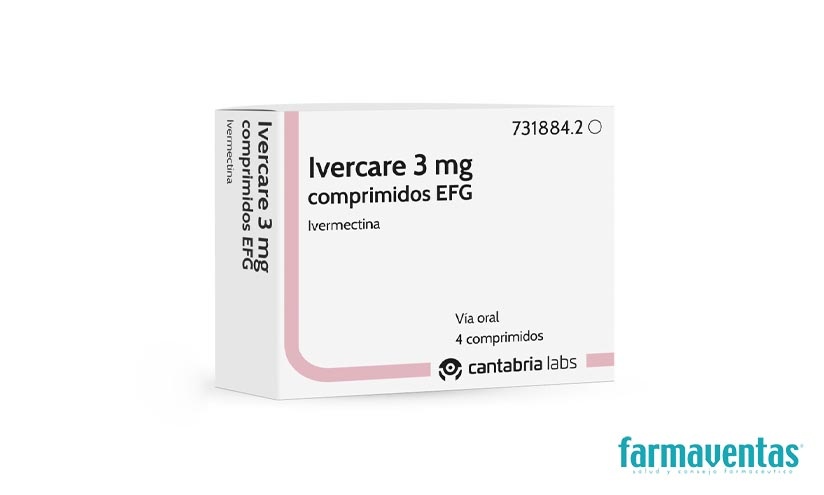
- Country of registration
- Dosage formTABLET, 3 mg
- ATC codeP02CF01
- Average pharmacy price17.48 EUR
- Active substance
- Prescription requiredYes
- Manufacturer
- CompositionBUTILHIDROXIANISOL (E 320) (0,02 mg mg)
- This information is for reference only and does not constitute medical advice. Always consult a doctor before taking any medication. Oladoctor is not responsible for medical decisions based on this content.
- Alternatives to IVERCARE 3 mg TABLETSDosage form: TABLET, 3 mgActive substance: ivermectinManufacturer: Galenicum Derma S.L.Prescription requiredDosage form: TABLET, 3 mgActive substance: ivermectinManufacturer: Teva B.V.Prescription requiredDosage form: TABLET, 3 mgActive substance: ivermectinManufacturer: Glenmark Arzneimittel GmbhPrescription required
Online doctors for IVERCARE 3 mg TABLETS
Discuss questions about IVERCARE 3 mg TABLETS, including use, safety considerations and prescription review, subject to medical assessment and local regulations.









Get IVERCARE 3 mg TABLETS Prescription Online
Fill in a 2-min form
Tell us your symptoms, history, and what medicine you're requesting.
Pick a doctor or let us assign
Choose a specialist or we'll match you with the next available doctor.
Doctor reviews your case
Usually within 30 minutes. They may ask follow-up questions via chat.
Collect from any pharmacy
Electronic prescription sent to your email — valid across Spain.
Frequently Asked Questions
IVERCARE 3 mg TABLETS requires a prescription in Spain. You can check with a doctor online whether this medicine may be appropriate for your situation.
The active ingredient in IVERCARE 3 mg TABLETS is ivermectin. This information helps identify medicines with the same composition but different brand names.
The average pharmacy price for IVERCARE 3 mg TABLETS is around 17.48 EUR. Prices may vary depending on the manufacturer and dosage form.
IVERCARE 3 mg TABLETS is manufactured by Industrial Farmaceutica Cantabria S.A.. Pharmacy brands and packaging may differ depending on the distributor.
Doctors such as Family doctors, Psychiatrists, Dermatologists, Cardiologists, Endocrinologists, Gastroenterologists, Pulmonologists, Nephrologists, Rheumatologists, Hematologists, Infectious disease physicians, Allergists, Geriatricians, Paediatricians, Oncologists may assess whether IVERCARE 3 mg TABLETS is appropriate, depending on your situation and local regulations. You can book an online consultation to discuss your symptoms and possible next steps.
Spain has a well-developed healthcare infrastructure across major cities such as Madrid, Barcelona, Valencia, and Seville. Pharmacies are widely available and operate under strict regulations, ensuring access to prescribed medications.
You can buy IVERCARE 3 mg TABLETS in Madrid, Barcelona, Seville, or Valencia at any local pharmacy with a valid prescription.
To obtain a prescription, you can use Oladoctor:
Other medicines with the same active substance (ivermectin) include IVERGALEN 3 mg TABLETS, IVERMECTIN TEVA 3 mg TABLETS, IVERTILENE 3 mg TABLETS. These may have different brand names or formulations but contain the same therapeutic ingredient. Always consult a doctor before switching or starting a new medicine.
