


Enyglid 0,5 mg comprimidos

Revisión de receta online
Un médico revisará tu caso y determinará si la prescripción es médicamente apropiada.

Habla con un médico sobre este medicamento
Comenta tus síntomas y las opciones de tratamiento en una consulta online.



Cómo usar Enyglid 0,5 mg comprimidos EFG
Contenido del prospecto
- Introducción
- Qué es Enyglid y para qué se utiliza
- Qué necesita saber antes de empezar a tomar Enyglid
- Cómo tomar Enyglid
- Posibles efectos adversos
- Conservación de Enyglid
- Contenido del envase e información adicional
Introducción
Prospecto: información para el paciente
Enyglid 0,5 mg comprimidos EFG
Enyglid 1 mg comprimidos EFG
Enyglid 2 mg comprimidos EFG
repaglinida
Lea todo el prospecto detenidamente antes de empezar a tomar este medicamento, porque contiene información importante para usted.
- Conserve este prospecto, ya que puede tener que volver a leerlo.
- Si tiene alguna duda, consulte a su médico o farmacéutico.
- Este medicamento se le ha recetado solamente a usted, y no debe dárselo a otras personas aunque tengan los mismos síntomas que usted, ya que puede perjudicarles.
- Si experimenta efectos adversos, consulte a su médico o farmacéutico, incluso si se trata de efectos adversos que no aparecen en este prospecto. Ver sección 4.
Contenido del prospecto:
- Qué es Enyglid y para qué se utiliza
- Qué necesita saber antes de empezar a tomar Enyglid
- Cómo tomar Enyglid
- Posibles efectos adversos
- Conservación de Enyglid
- Contenido del envase e información adicional
1. Qué es Enyglid y para qué se utiliza
Enyglid es un medicamento antidiabético oral que contiene repaglinidala cual ayuda a su páncreas a producir más insulina y a bajar su azúcar en sangre (glucosa).
La diabetes tipo 2 es una enfermedad en la que el páncreas no produce insulina suficiente para controlar el nivel de azúcar en la sangre o en la que el cuerpo no responde normalmente a la insulina que produce.
Enyglid se utiliza para controlar la diabetes tipo 2 en adultos, como un complemento de la dieta y ejercicio: el tratamiento debe iniciarse si la dieta, el ejercicio físico y la reducción de peso por sí solos no han resultado suficientes para controlar (o disminuir) el nivel de azúcar en la sangre.
Enyglid también puede administrarse junto con metformina.
Se ha demostrado que Enyglid reduce el nivel de azúcar en sangre, lo cual contribuye a evitar complicaciones de la diabetes.

¿No estás seguro de si este medicamento es adecuado para ti?
Comenta tus síntomas y tratamiento con un médico online.
2. Qué necesita saber antes de empezar a tomar Enyglid
No tome Enyglid
- Si es alérgico a la repaglinida o a alguno de los demás componentes de este medicamento (incluidos en la sección 6).
- Si padece diabetes tipo 1.
- Si el nivel de ácido en su sangre se ha incrementado (cetoacidosis diabética).
- Si padece enfermedad grave del hígado.
- Si toma gemfibrozilo (un medicamento que disminuye los niveles de grasa en la sangre).
Advertencias y precauciones
Consulte a su médico antes de empezar a tomar Enyglid:
- Si tiene problemas de hígado. Enyglid no está recomendado para pacientes con enfermedad moderada del hígado. Enyglid no debería tomarse si padece una enfermedad grave del hígado (ver No tome Enyglid).
- Si tiene problemas de riñón. Enyglid debería tomarse con precaución.
- Si va a someterse a una importante intervención quirúrgicao acaba de sufrir una enfermedad o infección grave. En estas circunstancias puede no conseguirse el control diabético.
- Si es menor de 18o mayor de 75 años, Enyglid no está recomendado. No se ha estudiado en estos grupos de edad.
Consulte con su médicosi alguno de los casos mencionados le ocurre. Puede que Enyglid no esté indicado para usted. El médico le aconsejará.
Niños y adolescentes
No tome este medicamento si es menor de 18 años.
Si tiene una hipoglucemia (nivel bajo de azúcar en sangre)
Puede sufrir una hipoglucemia si su nivel de azúcar en sangre es demasiado bajo. Esto puede ocurrir si:
- Toma demasiado Enyglid.
- Hace más ejercicio físico de lo normal.
- Toma otros medicamentos o tiene problemas de riñón o de hígado (ver otros apartados de la sección 2. Qué necesita saber antes de empezar a tomar Enyglid).
Los síntomas de aviso de una hipoglucemiaaparecen repentinamente y pueden ser: sudor frío, piel fría y pálida, dolor de cabeza, palpitaciones, náuseas, apetito excesivo, trastornos visuales temporales, fatiga, cansancio y debilidad no habituales, nerviosismo o temblor, ansiedad, confusión y dificultad de concentración.
Si su nivel de azúcar en sangre es bajo o si siente que va a tener una hipoglucemia:tome comprimidos de glucosa o bien un producto o bebida azucarada y luego descanse.
Cuando los síntomas de la hipoglucemia desaparezcan o cuando los niveles de azúcar en sangre se estabilicencontinúe el tratamiento con Enyglid.
Informe a los demás que es diabéticoy que si pierde la conciencia, debido a una hipoglucemia, deben recostarle de lado y buscar inmediatamente asistencia médica. No deben darle nada de comer o beber, ya que podría asfixiarse.
- Si la hipoglucemia graveno se trata, puede causar lesión cerebral (transitoria o permanente) incluso la muerte.
- Si una hipoglucemiale hace perder la consciencia o si sufre hipoglucemias repetidas info a su médico. Quizá tenga que ajustar la cantidad o pauta de administración de Enyglid, la alimentación o el ejercicio.
Si su nivel de azúcar en sangre es muy alto
Su nivel de azúcar en sangre puede ser muy alto (hiperglucemia). Esto puede ocurrir:
- Si toma demasiado poco Enyglid,
- Si tiene una infección o fiebre,
- Si come más de lo normal,
- Si hace menos ejercicio de lo normal.
Los síntomas de aviso de un nivel de azúcar en sangre demasiado altoaparecen gradualmente. Éstos incluyen: orina abundante, sed, piel seca y sensación de sequedad en la boca. Informe a su médico. Puede que tenga que ajustar la cantidad de Enyglid, la alimentación o el ejercicio.
Uso de Enyglid con otros medicamentos
Informe a su médicoo farmacéutico si está tomando, ha tomado recientemente o podría tener que tomar cualquier otro medicamento.
Si su médico se lo receta, puede tomar Enyglid junto con metformina, otro medicamento para la diabetes.
Si toma gemfibrozilo (utilizado para disminuir los niveles de grasa en la sangre) no debe tomar Enyglid.
La respuesta de su cuerpo a Enyglid puede cambiar si toma otros medicamentos, especialmente:
- Inhibidores de la monoaminoxidasa (IMAO) (para el tratamiento de la depresión).
- Betabloqueantes (para el tratamiento de la hipertensión arterial o enfermedades del corazón).
- Inhibidores-(ECA) (para el tratamiento de enfermedades del corazón).
- Salicilatos (p.ej. aspirina).
- Octreotida (para el tratamiento del cáncer).
- Medicamentos antiinflamatorios no esteroideos (AINES) (un tipo de analgésico).
- Esteroides (esteroides anabolizantes y corticosteroides, para la anemia o para tratar la inflamación).
- Anticonceptivos orales (para impedir el embarazo).
- Tiazidas (diuréticos).
- Danazol (para el tratamiento de los quistes mamarios y la endometriosis).
- Productos tiroideos (para el tratamiento de niveles bajos de hormonas tiroideas).
- Simpaticomiméticos (para el tratamiento del asma).
- Claritromicina, trimetoprim, rifampicina (medicamentos antibióticos).
- Itraconazol, ketoconazol (medicamento para las infecciones producidas por hongos).
- Gemfibrozilo (para tratar niveles altos de grasa en sangre).
- Ciclosporina (para suprimir el sistema inmune).
- Deferasirox (para reducir la sobrecarga férrica crónica)
- Clopidogrel (para prevenir la formación de coágulos sanguíneos)
- Fenitoina, carbamazepina, fenobarbital (para tratar la epilepsia).
- Hierba de San Juan (planta medicinal herbal).
Uso de Enyglid con alcohol
El alcohol puede alterar la capacidad de Enyglid de reducir el nivel de azúcar en sangre. Permanezca alerta a los síntomas de una hipoglucemia.
Embarazo y lactancia
Si está embarazada o en periodo de lactancia, cree que podría estar embarazada o tiene intención de quedarse embarazada, consulte a su médico antes de utilizar este medicamento.
No debe tomar Enyglid si está embarazada o planea estarlo.
No debe tomar Enyglid si es madre lactante.
Conducción y uso de máquinas
La capacidad para conducir automóviles y utilizar máquinas puede verse afectada si su nivel de azúcar en sangre es bajo o alto. Tenga en cuenta que podría ponerse en peligro o poner en peligro a otros.
Consulte con su médico la posibilidad de conducir un coche, si:
- Tiene hipoglucemias frecuentes
- Tiene pocos o no tiene síntomas de hipoglucemia
Enyglid contiene sodio
Este medicamento contiene menos de 1 mmol de sodio (23 mg) por comprimido; esto es, esencialmente “exento de sodio”.
3. Cómo tomar Enyglid
Siga exactamente las instrucciones de administración de este medicamento indicadas por su médico. En caso de duda, consulte de nuevo a su médico.
El médico calculará su dosis.
- Normalmente la dosis inicial es de 0,5 mg tomada justamente antes de cada comida principal. Los comprimidos deben tomarse con un vaso de agua justo antes o en los 30 minutos anteriores a cada comida principal.
- La dosis puede ser ajustada por su médico hasta 4 mg, que debe tomarse justo antes o en los 30 minutos anteriores a cada comida principal. La dosis máxima recomendada es de 16 mg al día.
No tome más Enyglid del que le ha recomendado su médico.
Si toma más Enyglid del que debe
Si toma demasiados comprimidos, su azúcar en sangre puede llegar a ser demasiado bajo y producirle una hipoglucemia. Por favor, lea qué es una hipoglucemia y cómo tratarla en la sección Si tiene una hipoglucemia.
Si olvidó tomar Enyglid
Si olvida tomar una dosis, tome la siguiente dosis como lo hace normalmente.
No tome una dosis doble para compensar las dosis olvidadas.
Si interrumpe el tratamiento con Enyglid
Tenga en cuenta que el efecto deseado no se consigue si deja de tomar Enyglid. Su diabetes puede empeorar. Si es necesario cualquier cambio en su tratamiento, consulte antes con su médico.
Si tiene cualquier otra duda sobre el uso de este medicamento, pregunte a su médico o farmacéutico.

¿Has empezado a tomar el medicamento y tienes preguntas?
Comenta tus síntomas y tratamiento con un médico online.
4. Posibles efectos adversos
Al igual que todos los medicamentos, este medicamento puede producir efectos adversos, aunque no todas las personas los sufran.
Hipoglucemia
El efecto adverso más frecuente es la hipoglucemia que puede afectar hasta 1 de cada 10 personas (ver Si tiene una hipoglucemia en la sección 2). Las reacciones hipoglucémicas normalmente son leves o moderadas pero ocasionalmente pueden dar lugar a pérdida de consciencia o coma hipoglucémico. Si esto ocurre, necesita asistencia médica inmediatamente.
Alergia
Los casos de alergia son muy raros (puede afectar hasta 1 de cada 10.000 personas). Síntomas como hinchazón, dificultad para respirar, palpitaciones, síntomas de mareo y sudoración, pueden ser signos de una reacción anafiláctica. Contacte con su médico inmediatamente.
Otros efectos adversos
Frecuentes(pueden afectar hasta 1 de cada 10 personas)
- Dolor de estómago
- Diarrea
Raros(pueden afectar hasta 1 de cada 1.000 personas)
- Síndrome coronario agudo (pero puede no ser debido al medicamento)
Muy raros(pueden afectar hasta 1 de cada 10.000 personas):
- Vómitos
- Estreñimiento
- Trastornos visuales
- Problemas graves de hígado, función del hígado anormal como aumento de las enzimas hepáticas en sangre
Frecuencia no conocida (no pueden estimarse la frecuencia con los datos disponibles)
- Hipersensibilidad (tales como sarpullido, picores, rojeces e hinchazón)
- Sensación de malestar (náuseas)
Comunicación de efectos adversos
Si experimenta efectos adversos, consulte a su médico o farmacéutico, incluso si se trata de efectos adversos que no aparecen en este prospecto.También puede comunicarlos directamente a través del sistema nacional de notificación incluido en el Apéndice V. Mediante la comunicación de efectos adversos usted puede contribuir a proporcionar más información sobre la seguridad de este medicamento.
5. Conservación de Enyglid
Mantener este medicamento fuera de la vista y del alcance de los niños
No utilice este medicamento después de la fecha de caducidad que aparece en el blíster o en el embalaje de cartón. La fecha de caducidad es el último día del mes que se indica.
Conservar en el embalaje original para protegerlo de la luz.
Los medicamentos no se deben tirar por los desagües ni a la basura. Pregunte a su farmacéutico cómo deshacerse de los envases y de los medicamentos que ya no necesita. De esta forma ayudará a proteger el medio ambiente.
6. Contenido del envase e información adicional
Composición de Enyglid
- El principio activo es repaglinida. Cada comprimido contiene 0,5 mg, 1 mg o 2 mg de repaglinida.
- Los demás componentes son celulosa microcristalina (E460), fosfato cálcico hidrogenado, croscarmelosa sódica, povidona K25, glicerol, estearato magnésico, meglumina, poloxamer, óxido de hierro amarillo (E172) solo en los comprimidos de 1 mg y óxido de hierro rojo (E172) solo en los comprimidos de 2 mg. Ver sección 2 “Enyglid contiene sodio”.
Aspecto de Enyglid y contenido del envase
Los comprimidos de 0,5 mg son blancos, redondos y biconvexos con bordes biselados.
Los comprimidos de 1 mg son marrón amarillento pálidos, redondos y biconvexos con bordes biselados y posibles manchas oscuras.
Los comprimidos de 2 mg son rosados, jaspeados, redondos y biconvexos con bordes biselados y posibles manchas oscuras.
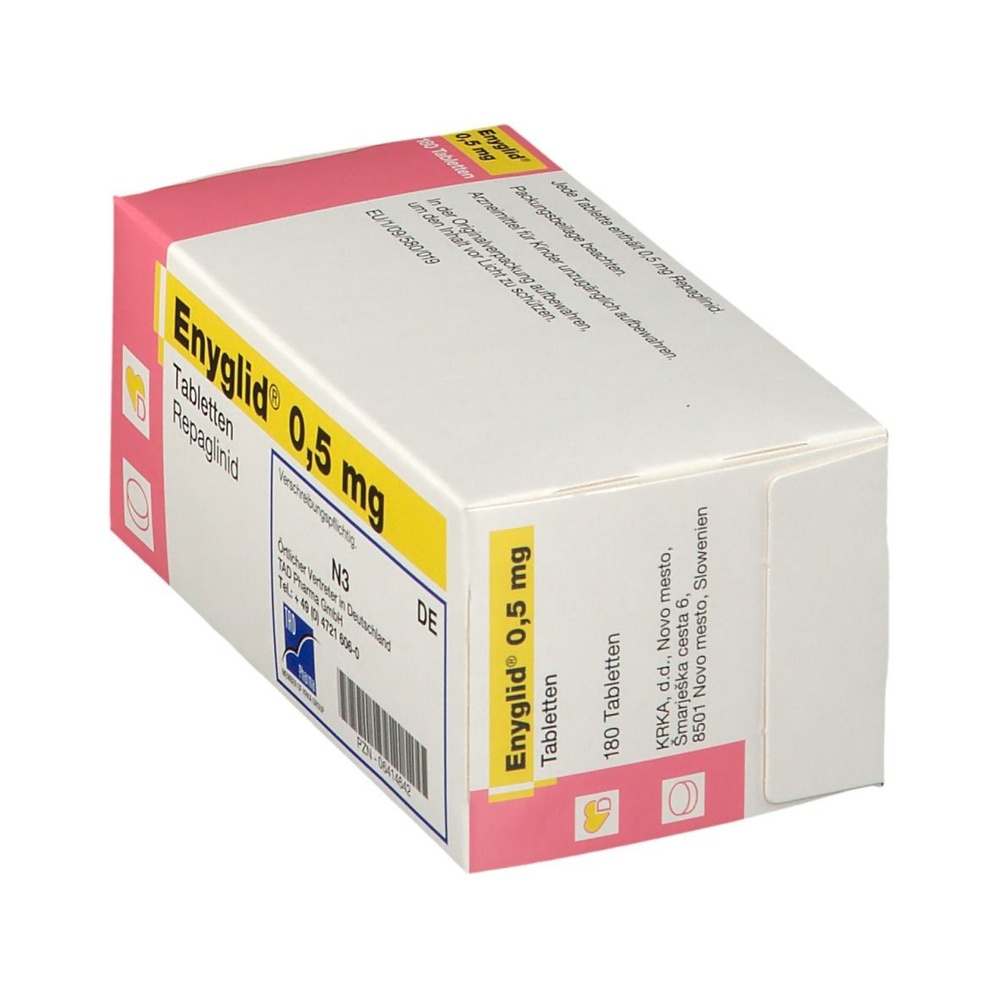
Disponibles estuches de 30, 60, 90, 120, 180, 270 o 360 comprimidos en blísters. Puede que solamente estén comercializados algunos tamaños de envases.
Titular de la autorización de comercialización
KRKA, d.d., Novo mesto, Šmarješka cesta 6, 8501 Novo mesto, Eslovenia
Responsable de la fabricaciónKRKA, d.d., Novo mesto, Šmarješka cesta 6, 8501 Novo mesto, Eslovenia
TAD Pharma GmbH, Heinz-Lohmann-Straβe 5, 27472 Cuxhaven, Alemania
KRKA - FARMA d.o.o., V. Holjevca 20/E, 10450 Jastrebarsko, Croacia
Pueden solicitar más información respecto a este medicamento dirigiéndose al representante local del titular de la autorización de comercialización:
België/Belgique/Belgien KRKA Belgium, SA. Tél/Tel: + 32 (0) 487 50 73 62 | Lietuva UAB KRKA Lietuva Tel: + 370 5 236 27 40 |
| Luxembourg/Luxemburg KRKA Belgium, SA. Tél/Tel: + 32 (0) 487 50 73 62 (BE) |
Ceská republika KRKA CR, s.r.o. Tel: + 420 (0) 221 115 150 | Magyarország KRKA Magyarország Kereskedelmi Kft. Tel.: + 36 (1) 355 8490 |
Danmark KRKA Sverige AB Tlf: + 46 (0)8 643 67 66 (SE) | Malta
Tel: + 356 21 445 885 |
Deutschland TAD Pharma GmbH Tel: + 49 (0) 4721 606-0 | Nederland KRKA Belgium, SA. Tel: + 32 (0) 487 50 73 62 (BE) |
Eesti KRKA, d.d., Novo mesto Eesti filiaal Tel: + 372 (0) 6 671 658 | Norge KRKA Sverige AB Tlf: + 46 (0)8 643 67 66 (SE) |
Ελλáδα KRKA EΛΛAΣ EΠE Τηλ: +30 2100101613 | Österreich KRKA Pharma GmbH, Wien Tel: + 43 (0)1 66 24 300 |
España KRKA Farmacéutica, S.L. Tel: + 34 911 61 03 80 | Polska KRKA-POLSKA Sp. z o.o. Tel.: + 48 (0)22 573 7500 |
France KRKA France Eurl Tél: + 33 (0)1 57 40 82 25 | Portugal KRKA Farmacêutica, Sociedade Unipessoal Lda. Tel: + 351 (0)21 46 43 650 |
Hrvatska KRKA – FARMA d.o.o Tel: + 385 1 6312 100 | România KRKA Romania S.R.L., Bucharest Tel: + 4021 310 66 05 |
Ireland KRKA Pharma Dublin, Ltd. Tel: + 353 1 413 3710 | Slovenija KRKA, d.d., Novo mesto Tel: + 386 (0) 1 47 51 100 |
Ísland LYFIS ehf. Sími: + 354 534 3500 | Slovenská republika KRKA Slovensko, s.r.o. Tel: + 421 (0) 2 571 04 501 |
Italia KRKA Farmaceutici Milano S.r.l. Tel: + 39 02 3300 8841 | Suomi/Finland KRKA Finland Oy Puh/Tel: + 358 20 754 5330 |
Κúπρος KI.PA. (PHARMACAL) LIMITED Τηλ: + 357 24 651 882 | Sverige KRKA Sverige AB Tel: + 46 (0)8 643 67 66 (SE) |
Latvija KRKA Latvija SIA Tel: + 371 6 733 86 10 | United Kingdom (Northern Ireland) KRKA Pharma Dublin, Ltd. Tel: + 353 1 413 3710 |
Fecha de la última revisión de este prospecto:
La información detallada de este medicamento está disponible en la página web de la Agencia Europea del Medicamento (EMA) http://www.ema.europa.eu/.
- País de registro
- Forma farmacéuticaCOMPRIMIDO, 0,5 mg
- Código ATCA10BX02
- Principio activo
- Requiere recetaSí
- Fabricante
- ComposiciónCROSCARMELOSA SODICA (5,00 mg mg), GLICEROL (E 422) (4,00 mg mg)
- Esta información es de carácter general y no sustituye la consulta con un profesional sanitario.
- Alternativas a Enyglid 0,5 mg comprimidos EFGForma farmacéutica: COMPRIMIDO, 1 mgPrincipio activo: repaglinidaFabricante: Krka D.D. Novo MestoRequiere recetaForma farmacéutica: COMPRIMIDO, 2 mgPrincipio activo: repaglinidaFabricante: Krka D.D. Novo MestoRequiere recetaForma farmacéutica: COMPRIMIDO, 0,5 mgPrincipio activo: repaglinidaFabricante: Novo Nordisk A/SRequiere receta
Médicos online para Enyglid 0,5 mg comprimidos EFG
Comenta la dosis, los posibles efectos secundarios, interacciones, contraindicaciones o la revisión de receta de Enyglid 0,5 mg comprimidos EFG, sujeto a valoración médica y a la normativa local.

Preguntas frecuentes
Enyglid 0,5 mg comprimidos EFG requiere receta en España. Puedes confirmarlo con un médico online según tu caso.
El principio activo de Enyglid 0,5 mg comprimidos EFG es repaglinida. Esta información ayuda a identificar medicamentos con la misma composición pero con diferentes nombres comerciales.
Enyglid 0,5 mg comprimidos EFG es fabricado por Krka D.D. Novo Mesto. La marca y el envase pueden variar según el distribuidor.
Los Médicos de familia, Psiquiatras, Dermatólogos, Cardiólogos, Endocrinólogos, Gastroenterólogos, Neumólogos, Nefrólogos, Reumatólogos, Hematólogos, Infectólogos, Alergólogos, Geriatras, Pediatras, Oncólogos pueden valorar la prescripción de Enyglid 0,5 mg comprimidos EFG cuando esté clínicamente indicado. Puedes reservar una videoconsulta para comentar tu caso y las opciones de tratamiento.
La receta la emite un médico tras valorar tu estado de salud. En España, Enyglid 0,5 mg comprimidos EFG se dispensa en las farmacias con esa receta médica. Una consulta online no garantiza su emisión: la decisión corresponde siempre al médico.
Para solicitar una valoración puedes usar Oladoctor:
Otros medicamentos con el mismo principio activo (repaglinida) incluyen Enyglid 1 mg comprimidos EFG, Enyglid 2 mg comprimidos EFG, NOVONORM 0,5 mg, COMPRIMIDOS. Pueden tener diferentes nombres comerciales o formulaciones, pero contienen el mismo componente terapéutico. Consulta siempre con un médico antes de cambiar o iniciar un nuevo medicamento.
