



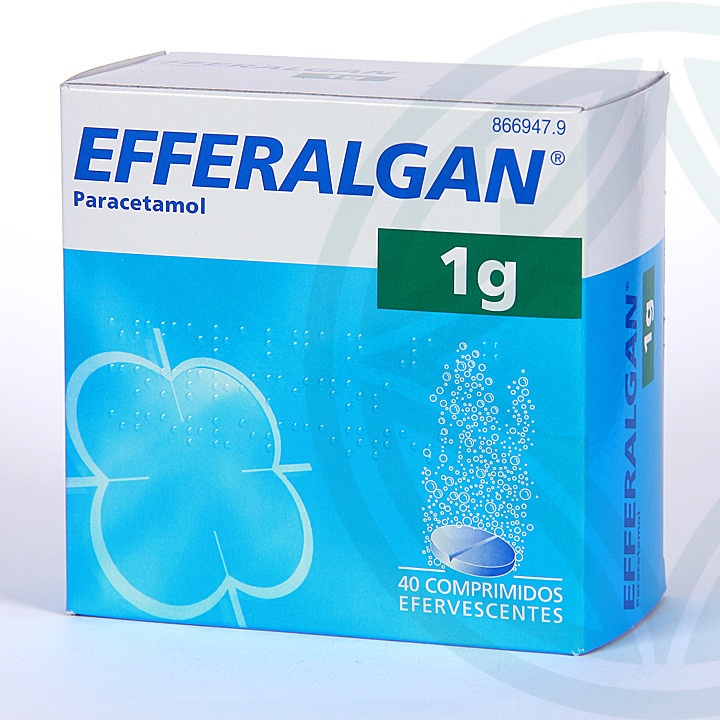
EFFERALGAN 1 G COMPRIMIDOS EFERVESCENTES

Revisión de receta online
Un médico revisará tu caso y determinará si la prescripción es médicamente apropiada.

Habla con un médico sobre este medicamento
Comenta tus síntomas y las opciones de tratamiento en una consulta online.



Cómo usar EFFERALGAN 1 G COMPRIMIDOS EFERVESCENTES
Contenido del prospecto
- Introducción
- Qué es Efferalgan y para qué se utiliza
- Qué necesita saber antes de empezar a tomar Efferalgan
- Embarazo y lactancia
- Conducción y uso de máquinas
- La influencia del paracetamol sobre la capacidad para conducir y utilizar máquinas es nula o insignificante.
- Cómo tomar Efferalgan
- Posibles efectos adversos
- Conservación de Efferalgan
- Contenido del envase e información adicional
Introducción
Prospecto: información para el usuario
Efferalgan 1 g comprimidos efervescentes
paracetamol
Lea todo el prospecto detenidamente antes de empezar a tomar este medicamento, porque contiene información importante para usted.
Siga exactamente las instrucciones de administración del medicamento contenidas en este prospecto o las indicadas por su médico o farmacéutico.
- Conserve este prospecto, ya que puede tener que volver a leerlo.
- Si tiene alguna duda, consulte a su médico o farmacéutico.
- Este medicamento se le ha recetado a usted y no debe dárselo a otras personas, aunque tengan los mismos síntomas, ya que puede perjudicarles.
- Si experimenta efectos adversos, consulte a su médico o farmacéutico, incluso si se trata de efectos adversos que no aparecen en el prospecto. Ver sección 4.
Contenido del prospecto
- Qué es Efferalgan y para qué se utiliza
- Qué necesita saber antes de empezar a tomar Efferalgan
- Cómo tomar Efferalgan
- Posibles efectos adversos
- Conservación de Efferalgan
- Contenido del envase e información adicional
1. Qué es Efferalgan y para qué se utiliza
Efferalgan pertenece al grupo de medicamentos llamados analgésicos y antipiréticos.
Este medicamento se utiliza para el tratamiento sintomático del dolor leve o moderado y de la fiebre, en adultos y adolescentes a partir de 15 años y peso superior a 50 kg.

¿No estás seguro de si este medicamento es adecuado para ti?
Comenta tus síntomas y tratamiento con un médico online.
2. Qué necesita saber antes de empezar a tomar Efferalgan
No tome Efferalgan:
- si es alérgico (hipersensible) al paracetamol o a cualquiera de los demás componentes de este medicamento (incluidos en la sección 6).
Advertencias y precauciones
Consulte a su médico o farmacéutico antes de empezar a tomar Efferalgan.
- No tomar más cantidad de medicamento que la recomendada en el apartado 3. Cómo tomar Efferalgan.
- Debe evitarse el uso simultáneo de este medicamento con otros medicamentos que contengan paracetamol, por ejemplo medicamentos para la gripe y el catarro, ya que las dosis altas pueden dar lugar a daño en el hígado. No use más de un medicamento que contenga paracetamol sin consultar al médico.
- Los alcohólicos crónicos, deberán tener la precaución de no tomar más de 2 g/en 24 horas de paracetamol.
- No se recomienda el consumo de alcohol durante el tratamiento.
- Los pacientes con desnutrición crónica, anorexia, caquexia, bulimia o ayuno deberán consultar con el médico antes de tomar el medicamento.
- Los pacientes con enfermedades del riñón debido a su contenido en paracetamol de 1 g no pueden tomar este medicamento. Los que padecen enfermedades del hígado, del corazón o del pulmón y los pacientes con anemia, deberán consultar con el médico antes de tomar este medicamento.
- Cuando se está en tratamiento con algún medicamento para tratar la epilepsia debe consultar al médico antes de tomar este medicamento, debido a que cuando se usan al mismo tiempo, se disminuye la eficacia y se potencia la hepatotoxicidad del paracetamol, especialmente en tratamientos con dosis altas de paracetamol.
- Informe a su médico antes de tomar este medicamento si es paciente asmático sensible al ácido acetilsalicílico.
- El paracetamol puede producir reacciones graves en la piel, como pustulosis exantemática aguda generalizada(PEAG), síndrome de Stevens-Johnson (SJS), y Necrólisis Epidérmica Tóxica (NET), que puede ser mortal. Los pacientes deben ser informados sobre las señales de reacciones graves en la piel, y se debe interrumpir el uso del medicamento ante el primer síntoma de erupción en la piel o cualquier otro signo de hipersensibilidad.
- El uso frecuente de analgésicos durante mucho tiempo puede provocar o empeorar los dolores de cabeza. Si sufre de cefaleas crónicas y ha estado más de 3 meses tomando analgésicos, al menos en días alternos, no debe aumentar la dosis de analgésicos, sino consultar con su médico.
Durante el tratamiento con Efferalgan, informe inmediatamente a su médico si:
- Si tiene enfermedades graves, como insuficiencia renal grave o sepsis (cuando las bacterias y sus toxinas circulan en la sangre, lo que provoca daños en los órganos), o si padece malnutrición, alcoholismo crónico o si también está tomando flucloxacilina (un antibiótico). Se ha notificado una enfermedad grave denominada acidosis metabólica (una anomalía en la sangre y los líquidos) en pacientes en estas situaciones cuando se utiliza paracetamol a dosis regulares durante un período prolongado o cuando se toma paracetamol junto con flucloxacilina. Los síntomas de acidosis metabólica pueden incluir: dificultad respiratoria grave con respiración profunda y rápida, somnolencia, sensación de malestar (náuseas) y vómitos.
Niños y adolescentes
Debido a la dosis de paracetamol, este medicamento no debe usarse en niños ni en adolescentes menores de 15 años (y peso inferior a 50 kg). Pregunte a su farmacéutico sobre las presentaciones disponibles que permitan la adecuada dosificación de estos pacientes.
Interacciones con pruebas analíticas
Si le van a hacer alguna prueba analítica (incluidos análisis de sangre, orina, etc.) comunique a su médico que está tomando este medicamento, ya que puede alterar los resultados.
El paracetamol puede alterar los valores de las determinaciones analíticas de ácido úrico y glucosa.
Otros medicamentos y Efferalgan
Informe a su médico o farmacéutico si está tomando, ha tomado recientemente o pudiera tener que tomar cualquier otro medicamento.
En particular, si está tomando algunos de los siguientes medicamentos, ya que puede ser necesario modificar la dosis de algunos de ellos o la interrupción del tratamiento:
- Medicamento para evitar coágulos en la sangre: Anticoagulantes orales (acenocumarol, warfarina)
- Medicamentos para tratar la epilepsia: Antiepilépticos (lamotrigina, fenitoína u otras hidantoínas, fenobarbital, metilfenobarbital, primidona, carbamacepina)
- Medicamentos para tratar la tuberculosis: isoniazida, rifampicina
- Medicamentos para tratar la depresión y las convulsiones: Barbitúricos (utilizados como hipnóticos, sedantes y anticonvulsivantes)
- Medicamentos para disminuir los niveles de colesterol en sangre: colestiramina
- Medicamentos utilizados para aumentar la eliminación de orina (diuréticos del asa como los del grupo furosemida)
- Medicamentos utilizados para el tratamiento de la gota: probenecid y sulfinpirazona
- Medicamentos utilizados para evitar náuseas y vómitos: Metoclopramida y domperidona
- Medicamentos utilizados en el tratamiento de la tensión arterial alta (hipertensión) y las alteraciones del ritmo del corazón (arritmias cardiacas): Propranolol
- Flucloxacilina (antibiótico): debido a un riesgo grave de alteración de la sangre y los fluidos (denominada acidosis metabólica con alto desequilibrio aniónico) que debe ser tratada urgentemente (véase la sección 2).
Toma de Efferalgan con alimentos, bebidas y alcohol
La toma de paracetamol en pacientes que consumen habitualmente alcohol puede provocar daño en el hígado.
La toma de este medicamento con alimentos no afecta a la eficacia del mismo.
Embarazo y lactancia
Si está embarazada o en período de lactancia, cree que podría estar embarazada o tiene intención de quedarse embarazada, consulte a su médico o farmacéutico antes de utilizar este medicamento. En caso necesario, se puede utilizar Efferalgan 1g durante el embarazo.
Debe utilizar la dosis más baja posible que reduzca el dolor o la fiebre y utilizarla durante el menor tiempo posible. Contacte con su médico o matrona si el dolor o la fiebre no disminuyen o si necesita tomar el medicamento con más frecuencia.
El paracetamol pasa a la leche materna, por lo que las mujeres en período de lactancia deben consultar a su médico o farmacéutico antes de tomar este medicamento.

¿Has empezado a tomar el medicamento y tienes preguntas?
Comenta tus síntomas y tratamiento con un médico online.
Conducción y uso de máquinas
La influencia del paracetamol sobre la capacidad para conducir y utilizar máquinas es nula o insignificante.
Efferalgan contiene sorbitol (E-420), sodio, benzoato de sodio (E-211), fructosa, glucosa y sacarosa.
Este medicamento contiene 252 mg de sorbitol (E-420) en cada comprimido.
El sorbitol es una fuente de fructosa. Si su médico le ha indicado que usted (o su hijo) padecen una intolerancia a ciertos azúcares, o se les ha diagnosticado intolerancia hereditaria a la fructosa (IHF), una enfermedad genética rara, en la que el paciente no puede descomponer la fructosa, consulte usted (o su hijo) con su médico antes de tomar este medicamento.
Este medicamento contiene 394 mg de sodio (componente principal de la sal de mesa/para cocinar) en cada comprimido. Esto equivale a aproximadamente el 20% de la ingesta diaria máxima de sodio recomendada para un adulto. Consulte con su médico o farmacéutico si necesita 1 o más comprimidos diarios por un período prolongado especialmente si le han recomendado una dieta baja en sal (sodio).
Este medicamento contiene 100 mg de benzoato de sodio (E-211) en cada comprimido. El benzoato de sodio puede aumentar el riesgo de ictericia (coloración amarillenta de la piel y los ojos) en los recién nacidos (hasta de 4 semanas de edad).
Este medicamento contiene 1,93 mg de fructosa en cada comprimido. Este medicamento contiene glucosa y sacarosa. Si su médico le ha indicado que padece una intolerancia a ciertos azucares, consulte con el antes de tomar este medicamento. La fructosa, la glucosa y la sacarosa pueden dañar los dientes en caso de tratamientos crónicos o muy prolongados.
3. Cómo tomar Efferalgan
Siga exactamente las instrucciones de administración de este medicamento indicadas por su médico. En caso de duda, consulte de nuevo a su médico.
Este medicamento se toma por vía oral.
Disolver el comprimido en un vaso de agua y no tomar hasta que haya cesado completamente el burbujeo.
Los comprimidos no se deben masticar ni tragar.
Tomar siempre la dosis menor que sea efectiva.
La dosis recomendada es:
Adultos y adolescentes mayores de 15 años (y peso superior a 50 kg)
1 comprimido (1 g de paracetamol) cada 6 - 8 horas, 3 ó 4 veces al día.
No sobrepasar en ningún caso 1 gramo de paracetamol por toma. No tomar más de 4 g de paracetamol en 24 horas repartidos en 4 tomas.
Pacientes de edad avanzada:
Su médico le indicará la frecuencia y si precisa reducir la dosis. Se deben tener en cuenta factores de riesgo concomitantes, algunos de los cuales se presentan con mayor frecuencia en los ancianos, y que requieren un ajuste de dosis.
Pacientes con enfermedades del hígado:
Deben tomar la cantidad de medicamento prescrita por su médico con un intervalo mínimo entre cada toma de 8h.
No tomar más de 2 gramos de paracetamol en 24 horas, repartidos en varias tomas.
Pacientes con enfermedades del riñón:
Debido a que este medicamento contiene 1 gramo de paracetamol por comprimido estos enfermos no pueden tomar este medicamento.
Uso en niños y adolescentes
Debido al contenido de paracetamol por comprimido (1 g), este medicamento no debe utilizarse en pacientes menores de 15 años (ver sección 2).
La toma de este medicamento está supeditada a la aparición de los síntomas, dolor o la fiebre. A medida que éstos desaparezcan, se debe suspender el tratamiento.
Se debe evitar el uso de dosis diarias altas de paracetamol durante periodos prolongados de tiempo ya que se incrementa el riesgo de sufrir efectos adversos tales como daño en el hígado.
Si el dolor se mantiene durante más de 5 días, la fiebre durante más de 3 días, o bien el dolor o la fiebre empeoran o aparecen otros síntomas, se debe consultar al médico y reevaluar la situación clínica.
Si toma más Efferalgan del que debe
Debe consultar inmediatamente a su médico o a su farmacéutico.
Los síntomas de sobredosis pueden ser: mareos, vómitos, pérdida de apetito, coloración amarillenta de la piel y los ojos (ictericia) y dolor abdominal.
Se han observado los siguientes acontecimientos tras una sobredosis de paracetamol:
- Incapacidad aguda de los riñones para funcionar correctamente.
- Enfermedad en la que se forman pequeños coágulos en el torrente sanguíneo que obstruyen los vasos sanguíneos.
- Casos raros de inflamación del páncreas.
Si ha ingerido una sobredosis, debe acudir inmediatamente a un centro médico aunque no note los síntomas, ya que a menudo éstos no se manifiestan hasta pasados 3 días desde la ingestión de la sobredosis, incluso en casos de intoxicación grave.
Cuando ha tomado una sobredosis, el tratamiento de la sobredosis es más eficaz si se inicia dentro de las 4 horas siguientes a la toma de la sobredosis del medicamento.
Los pacientes en tratamiento con barbitúricos o los alcohólicos crónicos, una sobredosis de paracetamol les puede resultar más tóxica que al resto de los pacientes.
En caso de sobredosis o ingestión accidental, acudir inmediatamente a un centro médico o llamar al Servicio de Información Toxicológica (teléfono 91 562 04 20), indicando el medicamento y la cantidad ingerida.
4. Posibles efectos adversos
Al igual que todos los medicamentos, este medicamento puede producir efectos adversos, aunque no todas las personas los sufran.
Los posibles efectos adversos de este medicamento son:
Efectos adversos raros que pueden afectar hasta 1 de cada 1.000 personas: malestar, aumento de los niveles de transaminasas en sangre, reacción anafiláctica (incluyendo hipotensión), shock anafiláctico, hipersensibilidad y angioedema.
Efectos adversos muy raros que pueden afectar hasta 1 de cada 10.000 personas: enfermedades del riñón, orina turbia, dermatitis alérgica (erupción cutánea), ictericia (coloración amarillenta de la piel), alteraciones sanguíneas (agranulocitosis, leucopenia, neutropenia, anemia hemolítica) e hipoglucemia (bajada de azúcar en sangre). Se han notificado muy raramente casos de reacciones graves en la piel.
Efectos adversos con frecuencia desconocida: púrpura, eritema fijo medicamentoso (mancha rojiza/morada en la piel que reaparece en el mismo lugar), broncoespasmo (contracción excesiva y prolongada de los músculos de las vías respiratorias que provoca dificultad para respirar) y una enfermedad grave que puede hacer que la sangre sea más ácida (denominada acidosis metabólica) en pacientes con enfermedad grave que utilizan paracetamol (ver sección 2).
El paracetamol puede dañar el hígado cuando se toma en dosis altas o en tratamientos prolongados.
Comunicación de efectos adversos
Si experimenta cualquier tipo de efecto adverso,consulte a su médico o farmacéutico, incluso si se trata de posibles efectos adversos que no aparecen en este prospecto. También puede comunicarlos directamente a través del Sistema Español de Farmacovigilancia de Medicamentos de Uso Humano https://www.notificaram.es. Mediante la comunicación de efectos adversos usted puede contribuir a proporcionar más información sobre la seguridad de este medicamento.
5. Conservación de Efferalgan
Mantener este medicamento fuera de la vista y del alcance de los niños.
Este medicamento no requiere condiciones especiales de conservación.
No utilice este medicamento después de la fecha de caducidad que aparece indicada en el envase después de CAD. La fecha de caducidad es el último día del mes que se indica.
Los medicamentos no se deben tirar por los desagües ni a la basura. Deposite los envases y los medicamentos que no necesita en el Punto SIGRE de la farmacia. Pregunte a su farmacéutico cómo deshacerse de los envases y de los medicamentos que ya no necesita. De esta forma, ayudará a proteger el medio ambiente.
6. Contenido del envase e información adicional
Composición de Efferalgan
El principio activo es paracetamol. Cada comprimido contiene 1 g de paracetamol.
Los demás componentes (excipientes) son ácido cítrico, bicarbonato sódico, carbonato sódico, sorbitol (E-420), docusato sódico, povidona, sacarina sódica, benzoato de sodio (E-211), aroma de pomelo-naranja (contiene fructosa, glucosa, sacarosa). Ver sección 2 Efferalgan contiene sorbitol (E-420), sodio, benzoato de sodio (E-211), fructosa, glucosa y sacarosa.
Aspecto de Efferalgany contenido del envase
Comprimidos efervescentes de color blanco a blanquecino, planos y redondos, con bordes biselados, junto con una ranura.
La ranura no debe utilizarse para fraccionar el comprimido.
Se presenta en envases de 8 ó 20 comprimidos efervescentes acondicionados en tiras de aluminio en caja de cartón.
Puede que no todos los tamaños de envase estén comercializados.
Titular de la autorización de comercialización
UPSA SAS
3 rue Joseph Monier
92500 Rueil-Malmaison
Francia
Responsable de la fabricación
UPSA
979, Avenue des Pyrénées
47520 Le Passage - FRANCE
o
UPSA
304, Av. Dr. Jean Bru
Agen, Francia
Representante local
NEWLINE PHARMA, S.L.U.
Calle Tarragona 151-157, Planta 11, Puerta 1, Bloque A
08014 Barcelona (España)
Tel.: 931851380
Fecha de la última revisión de este prospecto:junio 2025
La información detallada de este medicamento está disponible en la página web de la Agencia Española de Medicamentos y Productos Sanitarios (AEMPS) http://www.aemps.gob.es/
- País de registro
- Forma farmacéuticaCOMPRIMIDO EFERVESCENTE, 1 g paracetamol
- Código ATCN02BE01
- Precio medio en farmacia2.5 EUR
- Principio activo
- Requiere recetaSí
- Fabricante
- ComposiciónDOCUSATO DE SODIO (0,00026 g mg), SORBITOL (0,2522 g mg), BENZOATO DE SODIO (E 211) (0,100 g mg), HIDROGENOCARBONATO DE SODIO (0,900 g mg), CARBONATO DE SODIO ANHIDRO (0,300 g mg), SACARINA SODICA (0,017 g mg)
- Esta información es de carácter general y no sustituye la consulta con un profesional sanitario.
- Alternativas a EFFERALGAN 1 G COMPRIMIDOS EFERVESCENTESForma farmacéutica: COMPRIMIDO, 1 gPrincipio activo: ParacetamolFabricante: Uxa Farma S.A.Requiere recetaForma farmacéutica: COMPRIMIDO, 1 gPrincipio activo: ParacetamolFabricante: Laboratorios Cinfa S.A.No requiere recetaForma farmacéutica: COMPRIMIDO, 1 gPrincipio activo: ParacetamolFabricante: Laboratorios Cinfa S.A.No requiere receta
Médicos online para EFFERALGAN 1 G COMPRIMIDOS EFERVESCENTES
Comenta la dosis, los posibles efectos secundarios, interacciones, contraindicaciones o la revisión de receta de EFFERALGAN 1 G COMPRIMIDOS EFERVESCENTES, sujeto a valoración médica y a la normativa local.









Obtén una receta de EFFERALGAN 1 G COMPRIMIDOS EFERVESCENTES online
Rellena un formulario de 2 minutos
Cuéntanos tus síntomas, historial y el medicamento que necesitas.
Elige un médico o nosotros te asignamos uno
Escoge un especialista o te conectamos con el próximo médico disponible.
El médico revisa tu caso
Normalmente en 30 minutos. Puede hacerte preguntas adicionales por chat.
Recógela en cualquier farmacia
Receta electrónica enviada a tu correo, válida en toda España.
Preguntas frecuentes
EFFERALGAN 1 G COMPRIMIDOS EFERVESCENTES requiere receta en España. Puedes confirmarlo con un médico online según tu caso.
El principio activo de EFFERALGAN 1 G COMPRIMIDOS EFERVESCENTES es Paracetamol. Esta información ayuda a identificar medicamentos con la misma composición pero con diferentes nombres comerciales.
El precio medio en farmacia de EFFERALGAN 1 G COMPRIMIDOS EFERVESCENTES es de aproximadamente 2.5 EUR. Puede variar según el fabricante y la forma farmacéutica.
EFFERALGAN 1 G COMPRIMIDOS EFERVESCENTES es fabricado por Upsa S.A.S.. La marca y el envase pueden variar según el distribuidor.
Los Médicos de familia, Psiquiatras, Dermatólogos, Cardiólogos, Endocrinólogos, Gastroenterólogos, Neumólogos, Nefrólogos, Reumatólogos, Hematólogos, Infectólogos, Alergólogos, Geriatras, Pediatras, Oncólogos pueden valorar la prescripción de EFFERALGAN 1 G COMPRIMIDOS EFERVESCENTES cuando esté clínicamente indicado. Puedes reservar una videoconsulta para comentar tu caso y las opciones de tratamiento.
España cuenta con una infraestructura sanitaria bien desarrollada en ciudades principales como Madrid, Barcelona, Valencia y Sevilla. Las farmacias están ampliamente disponibles y operan bajo estrictas regulaciones, garantizando el acceso a medicamentos con receta.
Puedes comprar EFFERALGAN 1 G COMPRIMIDOS EFERVESCENTES en Madrid, Barcelona, Sevilla o Valencia en cualquier farmacia local con una receta válida.
Para obtener una receta, puedes utilizar Oladoctor:
Otros medicamentos con el mismo principio activo (Paracetamol) incluyen ABEZEN 1 G COMPRIMIDOS RECUBIERTOS CON PELICULA, ANTIDOL 1 G COMPRIMIDOS RECUBIERTOS, ANTIDOL 1 G COMPRIMIDOS. Pueden tener diferentes nombres comerciales o formulaciones, pero contienen el mismo componente terapéutico. Consulta siempre con un médico antes de cambiar o iniciar un nuevo medicamento.
