



DULOXETINA CINFAMED 60 mg CAPSULAS DURAS GASTRORRESISTENTES

Revisión de receta online
Un médico revisará tu caso y determinará si la prescripción es médicamente apropiada.

Habla con un médico sobre este medicamento
Comenta tus síntomas y las opciones de tratamiento en una consulta online.



Cómo usar DULOXETINA CINFAMED 60 MG CAPSULAS DURAS GASTRORRESISTENTES EFG
Contenido del prospecto
- Introducción
- Qué es Duloxetina cinfamed y para qué se utiliza
- Qué necesita saber antes de empezar a tomar Duloxetina cinfamed
- Cómo tomar Duloxetina cinfamed
- Posibles efectos adversos
- Conservación de Duloxetina cinfamed
- Contenido del envase e información adicional
Introducción
Prospecto: información para el usuario
Duloxetina cinfamed 60 mg cápsulas duras gastrorresistentes EFG
Lea todo el prospecto detenidamente antes de empezar a tomar este medicamento, porque contiene información importante para usted.
- Conserve este prospecto, ya que puede tener que volver a leerlo.
- Si tiene alguna duda, consulte a su médico o farmacéutico.
- Este medicamento se le ha recetado solamente a usted y no debe dárselo a otras personas aunque tengan los mismos síntomas que usted, ya que puede perjudicarles.
- Si experimenta efectos adversos, consulte a su médico o farmacéutico, incluso si se trata de efectos adversos que no aparecen en este prospecto. Ver sección 4.
Contenido del prospecto:
- Qué es Duloxetina cinfamed y para qué se utiliza
- Qué necesita saber antes de empezar a tomar Duloxetina cinfamed
- Cómo tomar Duloxetina cinfamed
- Posibles efectos adversos
- Conservación de Duloxetina cinfamed
- Contenido del envase e información adicional
1. Qué es Duloxetina cinfamed y para qué se utiliza
Este medicamento contiene el principio activo duloxetina. Duloxetina cinfamed aumenta los niveles de serotonina y noradrenalina en el sistema nervioso.
Duloxetina se emplea en adultos para tratar:
- la depresión
- el trastorno de ansiedad generalizada (sensación crónica de ansiedad o nerviosismo)
- el dolor neuropático diabético (a menudo descrito como quemazón, dolor punzante, como pinchazos, escozor, o como un calambre eléctrico. Puede haber una pérdida de sensibilidad en el área afectada, o puede ocurrir que al tocar la zona o ponerla en contacto con calor, frío o presión se produzca dolor)
Duloxetina comienza a actuar en la mayoría de personas con depresión o ansiedad a las dos semanas tras haber comenzado el tratamiento, pero pueden pasar entre 2 y 4 semanas hasta que comience a sentirse mejor. Informe a su médico si no nota mejoría tras este tiempo. Su médico puede seguir dándole este medicamento cuando se encuentre mejor para prevenir que su depresión o ansiedad vuelva a aparecer.
En las personas con dolor neuropático diabético pueden pasar algunas semanas antes de que comience a encontrarse mejor. Consulte a su médico si no se encuentra mejor a los 2 meses.

¿No estás seguro de si este medicamento es adecuado para ti?
Comenta tus síntomas y tratamiento con un médico online.
2. Qué necesita saber antes de empezar a tomar Duloxetina cinfamed
No tome Duloxetina cinfamed si:
- es alérgico a la duloxetina o a alguno de los demás componentes de este medicamento (incluidos en la sección 6)
- tiene insuficiencia hepática
- tiene insuficiencia renal grave
- está tomando o ha tomado en los últimos 14 días otro medicamento conocido como inhibidor de la monoaminoxidasa (IMAO) (ver “Otros medicamentos y Duloxetina cinfamed”)
- está tomando fluvoxamina, que se utiliza normalmente para tratar la depresión, ciprofloxacino o enoxacino, que se utilizan en el tratamiento de algunas infecciones
- está tomando otros medicamentos que contengan duloxetina (ver “Otros medicamentos y Duloxetina cinfamed”)
Consulte a su médico si tiene tensión arterial alta o una enfermedad cardíaca. Su médico le indicará si debe tomar duloxetina.
Advertencias y precauciones
Duloxetina puede no ser adecuado para usted por las siguientes razones. Consulte a su médico antes de empezar a tomar duloxetina si:
- está usando otros medicamentos para tratar la depresión (ver “Otros medicamentos y Duloxetina cinfamed”)
- está tomando Hierba de San Juan, un tratamiento a base de plantas (Hypericum perforatum)
- tiene alguna enfermedad del riñón
- ha sufrido convulsiones (ataques epilépticos)
- ha sufrido manía
- sufre trastorno bipolar
- tiene problemas oculares, como algunos tipos de glaucoma (presión ocular incrementada)
- ha tenido problemas hemorrágicos (tendencia a desarrollar hematomas), especialmente si está embarazada (ver “Embarazo y lactancia”)
- tiene riesgo de tener niveles bajos de sodio (por ejemplo si está tomando diuréticos, especialmente si es usted una persona de edad avanzada)
- está en tratamiento con otros medicamentos que puedan producir daños en el hígado
- está tomando otros medicamentos que contengan duloxetina (ver “Otros medicamentos y Duloxetina cinfamed”)
Duloxetina puede provocar una sensación de inquietud o incapacidad para permanecer sentado o estar quieto. Si esto le sucede debe comunicárselo a su médico.
Algunos medicamentos del grupo al que pertenece duloxetina (llamados ISRS/IRSN) pueden causar síntomas de disfunción sexual (ver sección 4). En algunos casos, estos síntomas persisten después de suspender el tratamiento.
Pensamientos de suicidio y empeoramiento de su depresión o trastorno de ansiedad
Si se encuentra deprimido y/o padece trastornos de ansiedad, puede en ocasiones tener pensamientos de autolesión o de suicidio. Estos pensamientos pueden verse incrementados al principio del tratamiento con antidepresivos, puesto que todos estos medicamentos tardan un tiempo en ejercer su efecto, normalmente unas dos semanas pero a veces más tiempo.
Es más probable que tenga pensamientos de este tipo si:
- ha tenido previamente pensamientos de autolesión o suicidio
- es un adulto joven. Existe información procedente de ensayos clínicos, que ha mostrado un riesgo aumentado de comportamiento suicida en adultos menores de 25 años que padecen un trastorno psiquiátrico y que están siendo tratados con antidepresivos.
Contacte con su médico o diríjase directamente al hospital en el momento que tenga cualquier pensamiento de autolesión o de suicidio.
Puede ser útil que le comente a un familiar o amigo cercano que se encuentra deprimido o que padece un trastorno de ansiedad, y pedirles que lean este prospecto. Puede pedirles que le digan si notan que su depresión o ansiedad está empeorando, o si están preocupados por cambios en su comportamiento.
También debe contactar con su médico:
Si experimenta signos y síntomas de inquietud, alucinaciones, pérdida de coordinación, latido rápido del corazón, aumento de la temperatura corporal, cambios rápidos de la tensión arterial, reflejos hiperactivos, diarrea, coma, náuseas, vómitos, ya que puede estar sufriendo un síndrome serotoninérgico.
En su forma más grave, el síndrome serotoninérgico puede parecerse al Síndrome Neuroléptico Maligno (SNM). Los signos y síntomas del SNM pueden incluir una combinación de fiebre, latido rápido del corazón, sudoración, rigidez muscular grave, confusión, aumento de las enzimas musculares (determinado mediante un análisis de sangre).
Niños y adolescentes menores de 18 años
Duloxetina normalmente no debe usarse en niños y adolescentes menores de 18 años. Además, debe saber que los pacientes menores de 18 años cuando toman esta clase de medicamentos tienen un riesgo incrementado de aparición de efectos secundarios tales como intento de suicidio, pensamientos suicidas y hostilidad (predominantemente agresión, comportamiento oposicionista e ira). A pesar de esto su médico puede prescribir este medicamento a pacientes menores de 18 años porque decida que puede ser beneficioso para el paciente. Si su médico ha prescrito duloxetina a un paciente menor de 18 años y usted quiere hablar sobre ello, por favor vuelva al médico. Usted debe informar a su médico si alguno de los síntomas arriba indicados aparece o empeora en pacientes menores de 18 años que estén tomando duloxetina. Además, en este grupo de edad todavía no se han demostrado los efectos de seguridad a largo plazo de duloxetina relacionados con el crecimiento, maduración y desarrollo cognitivo y del comportamiento.
Otros medicamentos y Duloxetina cinfamed
Informe a su médico o farmacéutico si está tomando, ha tomado recientemente o pudiera tener que tomar cualquier otro medicamento.
El componente principal de este medicamento, duloxetina, se utiliza en otros medicamentos para otros tratamientos:
- dolor neuropático diabético, depresión, ansiedad e incontinencia urinaria
Se debe evitar utilizar más de uno de estos medicamentos al mismo tiempo. Compruebe con su médico si está ya utilizando otros medicamentos que contengan duloxetina.
Su médico decidirá si usted puede tomar duloxetina con otros medicamentos. No comience ni deje de utilizar ningún medicamento, incluidos los adquiridos sin receta médica y las plantas medicinales, sin antes consultarlo con su médico.
También debe comunicar a su médico si está tomando cualquiera de los siguientes medicamentos:
Inhibidores de la monoaminoxidasa (IMAOs):no debe tomar duloxetina si está tomando, o ha tomado recientemente (en los últimos 14 días), otro medicamento antidepresivo conocido como inhibidor de la monoaminoxidasa (IMAO). Como ejemplos de IMAOs se incluye moclobemida (un antidepresivo) y linezolid (un antibiótico). Tomar un IMAO junto con muchos medicamentos de prescripción médica, incluido este medicamento, puede provocar efectos adversos graves incluso poner en peligro su vida. Debe esperar al menos 14 días tras la interrupción de un tratamiento con un IMAO antes de tomar duloxetina. De igual modo, debe esperar al menos 5 días después de dejar el tratamiento con duloxetina antes de comenzar el tratamiento con un IMAO.
Medicamentos que causan somnolencia:Esto incluye los medicamentos recetados por su médico como benzodiazepinas, analgésicos potentes, antipsicóticos, fenobarbital y antihistamínicos.
Medicamentos que aumentan los niveles de serotonina: Triptanos, tramadol, triptófano, inhibidores selectivos de la recaptación de serotonina (ISRS, como paroxetina y fluoxetina), IRSN (como venlafaxina), antidepresivos tricíclicos (como clomipramina, amitriptilina), petidina, Hierba de San Juan e IMAOs (como moclobemida y linezolid). Estos medicamentos aumentan el riesgo de producir efectos adversos; si observa cualquier síntoma poco común cuando utiliza alguno de estos medicamentos junto con duloxetina, debe comunicárselo a su médico.
Anticoagulantes orales o antiagregantes plaquetarios:Medicamentos que diluyen la sangre o previenen la formación de coágulos en la sangre. Estos medicamentos pueden incrementar el riesgo de sangrado.
Toma de Duloxetina cinfamed con alimentos, bebidas y alcohol
Este medicamento se puede tomar con o sin comida. Debe tener precaución si toma alcohol cuando esté en tratamiento con duloxetina.
Embarazo y lactancia
Si está embarazada o en periodo de lactancia, cree que podría estar embarazada o tiene intención de quedarse embarazada, consulte a su médico o farmacéutico antes de utilizar este medicamento.
- Informe a su médico si se queda embarazada o si está intentando quedarse embarazada mientras esté en tratamiento con duloxetina. Únicamente debe utilizar este medicamento después de valorar con su médico los beneficios potenciales y cualquier riesgo potencial para el feto.
- Asegúrese de que su matrona y/o su médico saben que está tomando duloxetina. Otros medicamentos similares (ISRSs), tomados durante el embarazo, pueden incrementar el riesgo de producir una enfermedad grave en bebés, llamada hipertensión pulmonar persistente del recién nacido (HPPRN), que hace que el bebé respire más rápidamente y que adquiera una coloración azulada. Estos síntomas comienzan normalmente durante las primeras 24 horas tras el nacimiento del bebé. Si esto le ocurre a su bebé, debería ponerse en contacto inmediatamente con su matrona y/o médico.
- Si toma duloxetina cuando se acerca el final de su embarazo, su bebé puede tener algunos síntomas cuando nazca. Normalmente comienzan en el momento del nacimiento o durante los primeros días tras el nacimiento de su bebé. Entre estos síntomas se pueden incluir músculos débiles, temblores, nerviosismo, que el bebé no se alimente correctamente, problemas con la respiración y convulsiones. Si su bebé tiene cualquiera de estos síntomas cuando haya nacido o si está preocupada por la salud de su bebé, póngase en contacto con su médico o matrona, que le podrán aconsejar.
- Si toma duloxetina cuando se acerca el final de su embarazo, existe un mayor riesgo de hemorragia vaginal excesiva poco después del nacimiento, especialmente si ha tenido problemas hemorrágicos. Su médico o matrona deben saber que está tomando duloxetina para que le puedan aconsejar.
- Los datos disponibles sobre el uso de duloxetina durante los tres primeros meses de embarazo no muestran un aumento general del riesgo de defectos de nacimiento en el niño. Si toma duloxetina durante la segunda mitad del embarazo, puede haber un mayor riesgo de que el bebé nazca antes de tiempo (6 bebés prematuros adicionales por cada 100 mujeres que toman duloxetina en la segunda mitad del embarazo), sobre todo entre las semanas 35 y 36 de embarazo.
- Informe a su médico si está dando el pecho. No se recomienda el uso de este medicamento durante la lactancia. Pida consejo a su médico o farmacéutico.
Conducción y uso de máquinas
Durante el tratamiento con duloxetina puede que se sienta somnoliento o mareado. No conduzca ni maneje herramientas o máquinas hasta que sepa cómo le afecta el tratamiento con duloxetina.
Duloxetina cinfamed contiene sacarosa
Este medicamento contiene sacarosa. Si su médico le ha indicado que padece una intolerancia a ciertos azúcares, consulte con él antes de tomar este medicamento.
Duloxetina cinfamed contiene sodio
Este medicamento contiene menos de 1 mmol de sodio (23 mg) por cápsula; esto es, esencialmente “exento de sodio”.
3. Cómo tomar Duloxetina cinfamed
Siga exactamente las instrucciones de administración de este medicamento indicadas por su médico o farmacéutico. En caso de duda, consulte de nuevo a su médico o farmacéutico.
Duloxetina se debe tomar por vía oral. Debe tragar la cápsula entera con agua.
Para la depresión y el dolor neuropático diabético:
La dosis recomendada de duloxetina es de 60 mg una vez al día, pero su médico le prescribirá la dosis que es mejor para usted.
Para el trastorno de ansiedad generalizada:
La dosis normal de inicio de duloxetina es de 30 mg una vez al día después de lo cual la mayoría de los pacientes recibirán 60 mg una vez al día, pero su médico le prescribirá la dosis que es mejor para usted. Puede ajustarse la dosis hasta 120 mg al día dependiendo de su respuesta a duloxetina.
Para no olvidar la toma de este medicamento, puede serle útil tomarlo a las mismas horas todos los días.
Comente con su médico durante cuánto tiempo debe tomar duloxetina. No deje de tomar este medicamento, o cambie su dosis sin consultar con su médico. Es importante tratar su enfermedad de forma adecuada para ayudarle a mejorar. Si no se trata, puede que su enfermedad no desaparezca y puede llegar a ser más grave y más difícil de tratar.
Si toma más Duloxetina cinfamed del que debe
Llame a su médico o farmacéutico inmediatamente si toma más cantidad de duloxetina de la prescrita por su médico. Dentro de los síntomas producidos por una sobredosis se incluyen somnolencia, coma, síndrome serotoninérgico (una reacción rara que puede causar sensación de intensa felicidad, somnolencia, torpeza, inquietud, sensación de estar bebido, fiebre, sudoración o rigidez muscular) convulsiones, vómitos y alta frecuencia cardíaca.
En caso de sobredosis o ingestión accidental consulte inmediatamente a su médico o farmacéutico o llame al Servicio de Información Toxicológica, teléfono 91 562 04 20, indicando el medicamento y la cantidad ingerida.
Si olvidó tomar Duloxetina cinfamed
Si olvida tomar una dosis, tómela tan pronto como se acuerde. De todas formas, si es la hora de la siguiente dosis, salte la dosis olvidada y tome una dosis única como lo hace normalmente. No tome una dosis doble para compensar las dosis olvidadas. No tome más cantidad de duloxetina de la prescrita para usted en un día.
Si interrumpe el tratamiento con Duloxetina cinfamed
NO deje de tomar sus cápsulas sin el consejo de su médico aunque se encuentre mejor. Si su médico piensa que usted no necesita seguir tomando duloxetina, él o ella le indicarán que reduzca su dosis durante al menos 2 semanas antes de dejar el tratamiento.
Algunos pacientes, que dejan repentinamente el tratamiento con este medicamento han presentado síntomas tales como:
- mareos, sensación de hormigueo como pinchazos o sensación de calambre eléctrico (especialmente en la cabeza), alteraciones del sueño (sueños intensos, pesadillas, incapacidad para dormir), fatiga, somnolencia, sensación de inquietud o agitación, sensación de ansiedad, náuseas o vómitos, temblor, dolores de cabeza, dolor muscular, sensación de irritabilidad, diarrea y sudoración excesiva o vértigo.
Estos síntomas normalmente no son importantes y desaparecen en unos pocos días, pero si usted tiene síntomas que sean molestos pida consejo a su médico.
Si tiene cualquier otra duda sobre el uso de este medicamento, pregunte a su médico o farmacéutico.

¿Has empezado a tomar el medicamento y tienes preguntas?
Comenta tus síntomas y tratamiento con un médico online.
4. Posibles efectos adversos
Al igual que todos los medicamentos, este medicamento puede producir efectos adversos, aunque no todas las personas los sufran. Estos efectos normalmente son de leves a moderados y desaparecen, con frecuencia, en unas pocas semanas.
Efectos adversos muy frecuentes (pueden afectar a más de 1 de cada 10 pacientes)
- dolor de cabeza, somnolencia
- malestar (náuseas), sequedad de boca
Efectos adversos frecuentes (pueden afectar hasta 1 de cada 10 pacientes)
- pérdida de apetito
- dificultad para dormir, sensación de agitación, disminución del deseo sexual, ansiedad, dificultad o incapacidad para tener un orgasmo, sueños inusuales
- mareos, sensación de lentitud, temblor, adormecimiento, incluyendo adormecimiento, picor u hormigueo en la piel
- visión borrosa
- acúfenos (percepción de sonidos en el oído cuando no hay sonido en el exterior)
- sentir palpitaciones en el pecho
- aumento de la tensión arterial, rubor
- aumento de bostezos
- estreñimiento, diarrea, dolor de estómago, vómitos, ardor de estómago o indigestión, gases
- aumento de sudoración, erupción (picor)
- dolor muscular, espasmos musculares
- dolor al orinar, orinar con frecuencia
- dificultad para conseguir una erección, cambios en la eyaculación
- caídas (mayoritariamente en personas de edad avanzada), fatiga
- pérdida de peso
Los niños y adolescentes menores de 18 años de edad con depresión tratados con este medicamento, sufrieron una disminución en el peso cuando comenzaron a tomar este medicamento. Tras 6 meses de tratamiento, el peso aumentó niveles similares de otros niños y adolescentes de la misma edad y sexo.
Efectos adversos poco frecuentes (pueden afectar hasta 1 de cada 100 pacientes)
- inflamación de la garganta que provoca ronquera
- pensamientos suicidas, dificultad para dormir, rechinar de dientes, sensación de desorientación, falta de motivación
- espasmos y movimientos involuntarios de los músculos, sensación de inquietud o incapacidad para permanecer sentado o estar quieto, nerviosismo, dificultad para concentrarse, cambios en el sentido del gusto, dificultad para controlar movimientos p. ej.: falta de coordinación o movimientos involuntarios de los músculos, síndrome de piernas inquietas, sueño de baja calidad
- dilatación de las pupilas (el punto negro del centro del ojo), problemas de visión
- sensación de mareo o vértigo, dolor de oído
- latidos rápidos y/o irregulares del corazón
- desvanecimientos, mareos, sensación de mareo o desvanecimiento al levantarse, frío en los dedos de las manos y/o pies
- espasmos de la garganta, sangrado de la nariz
- vomitar sangre, o heces de color negro, gastroenteritis, eructos, dificultad para tragar
- inflamación del hígado que puede causar dolor abdominal y coloración amarilla de la piel o de la parte blanca de los ojos
- sudores nocturnos, ronchas, sudores fríos, sensibilidad a la luz del sol, aumento de la tendencia a tener hematomas
- rigidez muscular, espasmos musculares
- dificultad o incapacidad para orinar, dificultad para comenzar la micción, necesidad de orinar durante la noche, necesidad de orinar más de lo normal, disminución del flujo de orina
- sangrados vaginales anormales, periodos menstruales anormales, incluyendo menstruaciones abundantes, dolorosas, irregulares o prolongadas, excepcionalmente menstruaciones ligeras o faltas, dolor en los testículos o escroto
- dolor en el pecho, sensación de frío, sed, escalofríos, sensación de calor, alteración en la forma de caminar
- aumento de peso
- duloxetina puede provocar efectos de los que puede no darse cuenta, tales como incremento de las enzimas hepáticas o de los niveles de potasio en sangre, creatinfosfoquinasa, azúcar o colesterol.
Efectos adversos raros (pueden afectar hasta 1 de cada 1.000 pacientes)
- reacciones alérgicas graves, que causen dificultad para respirar o mareos con hinchazón de la lengua o labios, reacciones alérgicas
- disminución de la actividad de la glándula tiroides, que puede causar cansancio o aumento de peso
- deshidratación, bajos niveles de sodio en sangre (mayoritariamente en personas de edad avanzada; los síntomas pueden incluir sensación de mareo, debilidad, confusión, sueño o mucho cansancio, náuseas o vómitos, los síntomas más serios son desvanecimientos, convulsiones o caídas), síndrome de secreción inadecuada de hormona antidiurética (SIADH)
- comportamiento suicida, manía (hiperactividad, pensamiento acelerado y disminución de la necesidad de dormir), alucinaciones, agresividad e ira
- “Síndrome serotoninérgico” (una reacción rara que puede causar sensación de intensa felicidad, somnolencia, torpeza, inquietud, sensación de estar bebido, fiebre, sudoración o rigidez muscular), convulsiones
- aumento de la presión en el ojo (glaucoma)
- Tos, sibilancias y falta de aliento, que pueden ir acompañados de fiebre alta
- inflamación de la boca, sangre roja brillante en las heces, mal aliento, inflamación del intestino grueso (dando lugar a diarrea)
- fallo hepático, coloración amarilla de la piel o de la parte blanca de los ojos (ictericia)
- Síndrome de Stevens-Johnson (enfermedad grave con formación de ampollas en la piel, boca, ojos y genitales), reacciones alérgicas graves que causan hinchazón de la cara o garganta (angioedema)
- contracciones del músculo de la mandíbula
- olor inusual de la orina
- síntomas menopáusicos, producción anormal de leche materna en hombres o mujeres
- hemorragia vaginal excesiva poco después del nacimiento (hemorragia posparto)
Efectos adversos muy raros (pueden afectar hasta 1 de cada 10.000 pacientes)
- inflamación de los vasos sanguíneos de la piel (vasculitis cutánea)
Efectos adversos con frecuencia no conocida (no puede estimarse a partir de los datos disponibles)
- signos y síntomas de una afección llamada “miocardiopatía por estrés”, que puede incluir dolor en el pecho, dificultad en la respiración, mareos, desvanecimientos y latidos irregulares
Comunicación de efectos adversos
Si experimenta cualquier tipo de efecto adverso, consulte a su médico o farmacéutico, incluso si se trata de posibles efectos adversos que no aparecen en este prospecto. También puede comunicarlos directamente a través del Sistema Español de Farmacovigilancia de Medicamentos de Uso Humano: https://www.notificaram.es. Mediante la comunicación de efectos adversos usted puede contribuir a proporcionar más información sobre la seguridad de este medicamento.
5. Conservación de Duloxetina cinfamed
Mantener este medicamento fuera de la vista y del alcance de los niños.
No utilice este medicamento después de la fecha de caducidad que aparece en el envase después de CAD. La fecha de caducidad es el último día del mes que se indica.
No conservar a temperatura superior a 30ºC.
Los medicamentos no se deben tirar por los desagües ni a la basura. Deposite los envases y los medicamentos que no necesita en el Punto SIGRE de la farmacia. En caso de duda, pregunte a su farmacéutico cómo deshacerse de los envases y de los medicamentos que no necesita. De esta forma, ayudará a proteger el medio ambiente.
6. Contenido del envase e información adicional
Composición de Duloxetina cinfamed
El principio activo es duloxetina.
Cada cápsula contiene 60 mg de duloxetina (como hidrocloruro).
Los demás componentes son:
Contenido de la cápsula: hipromelosa, talco, dióxido de titanio (E-171), copolímero de ácido metacrílico-etil acrilato (1:1) dispersión al 30% (laurilsulfato de sodio, polisorbato 80 y copolímero de ácido metacrílico-etil acrilato), citrato de trietilo, esferas de azúcar (sacarosa y almidón de maíz) y sacarosa.
Cubierta de la cápsula: índigo carmín /azul FD&C 2 (E-132), dióxido de titanio (E-171) y gelatina.
Cuerpo de la cápsula: índigo carmín /azul FD&C 2 (E-132), óxido de hierro amarillo (E-172), dióxido de titanio (E-171) y gelatina.
Tinta negra: shellac, hidróxido de potasio y óxido de hierro negro (E-172).
Aspecto del producto y contenido del envase
Cápsulas de gelatina dura, con cuerpo de color verde opaco y tapa de color azul opaco, rellenas con esferas de color blanquecino a beige/salmón e impresas con “E” en la tapa y “129” en el cuerpo.
Duloxetina cinfamed 60 mg está disponible en envases blíster PVC/PVDC-Alu de 28 y 56 cápsulas duras gastrorresistentes.
Titular de la autorización de comercialización y responsable de la fabricación
Titular de la autorización de comercialización:
Laboratorios Cinfa, S.A.
Carretera Olaz-Chipi, 10. Polígono Industrial Areta
31620 Huarte (Navarra) – España
Responsable de la fabricación:
TOWA PHARMACEUTICAL EUROPE, SL
C/ de Sant Martí 75-97, Martorelles
08107 Barcelona
o
Laboratorios Cinfa, S.A.
Carretera Olaz-Chipi, 10. Polígono Industrial Areta
31620 Huarte (Navarra) – España
Fecha de la última revisión de este prospecto:Agosto 2024
La información detallada de este medicamento está disponible en la página web de la Agencia Española de Medicamentos y Productos Sanitarios (AEMPS) http://www.aemps.gob.es/
Puede acceder a información detallada y actualizada sobre este medicamento escaneando con su teléfono móvil (smartphone) el código QR incluido en prospecto y cartonaje. También puede acceder a esta información en la siguiente dirección de internet: https://cima.aemps.es/cima/dochtml/p/86282/P_86282.html
Código QR a: https://cima.aemps.es/cima/dochtml/p/86282/P_86282.html
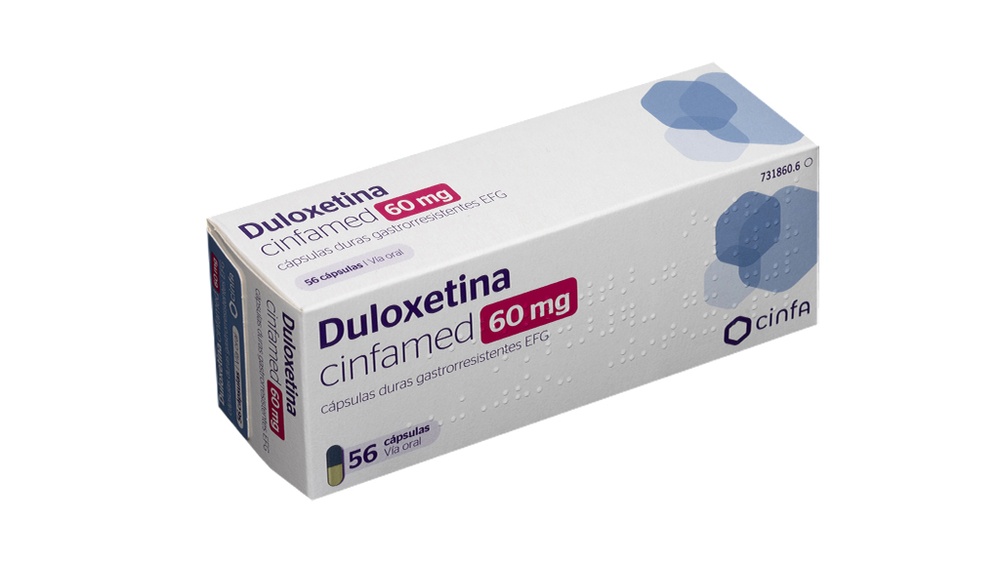
- País de registro
- Forma farmacéuticaCAPSULA, 60 mg
- Código ATCN06AX21
- Precio medio en farmacia26.73 EUR
- Principio activo
- Requiere recetaSí
- Fabricante
- ComposiciónAZUCAR , ESFERAS DE (142,60 mg mg), SACAROSA (5,085 mg mg), LAURILSULFATO DE SODIO (1,55 mg mg), POLISORBATO 80 (0,51 mg mg), SACAROSA (142,6 - 130,48 mg mg), POTASIO, HIDROXIDO DE (E-525) (0.05-0.1 % mg)
- Esta información es de carácter general y no sustituye la consulta con un profesional sanitario.
- Alternativas a DULOXETINA CINFAMED 60 MG CAPSULAS DURAS GASTRORRESISTENTES EFGForma farmacéutica: CAPSULA, 30 mgPrincipio activo: duloxetineFabricante: Eli Lilly Nederland B.V.Requiere recetaForma farmacéutica: CAPSULA, 30 mgPrincipio activo: duloxetineFabricante: Eli Lilly Nederland B.V.Requiere recetaForma farmacéutica: CAPSULA, 60 mgPrincipio activo: duloxetineFabricante: Eli Lilly Nederland B.V.Requiere receta
Médicos online para DULOXETINA CINFAMED 60 MG CAPSULAS DURAS GASTRORRESISTENTES EFG
Comenta la dosis, los posibles efectos secundarios, interacciones, contraindicaciones o la revisión de receta de DULOXETINA CINFAMED 60 MG CAPSULAS DURAS GASTRORRESISTENTES EFG, sujeto a valoración médica y a la normativa local.






Obtén una receta de DULOXETINA CINFAMED 60 MG CAPSULAS DURAS GASTRORRESISTENTES EFG online
Rellena un formulario de 2 minutos
Cuéntanos tus síntomas, historial y el medicamento que necesitas.
Elige un médico o nosotros te asignamos uno
Escoge un especialista o te conectamos con el próximo médico disponible.
El médico revisa tu caso
Normalmente en 30 minutos. Puede hacerte preguntas adicionales por chat.
Recógela en cualquier farmacia
Receta electrónica enviada a tu correo, válida en toda España.
Preguntas frecuentes
DULOXETINA CINFAMED 60 MG CAPSULAS DURAS GASTRORRESISTENTES EFG requiere receta en España. Puedes confirmarlo con un médico online según tu caso.
El principio activo de DULOXETINA CINFAMED 60 MG CAPSULAS DURAS GASTRORRESISTENTES EFG es duloxetine. Esta información ayuda a identificar medicamentos con la misma composición pero con diferentes nombres comerciales.
El precio medio en farmacia de DULOXETINA CINFAMED 60 MG CAPSULAS DURAS GASTRORRESISTENTES EFG es de aproximadamente 26.73 EUR. Puede variar según el fabricante y la forma farmacéutica.
DULOXETINA CINFAMED 60 MG CAPSULAS DURAS GASTRORRESISTENTES EFG es fabricado por Laboratorios Cinfa S.A.. La marca y el envase pueden variar según el distribuidor.
Los Médicos de familia, Psiquiatras, Dermatólogos, Cardiólogos, Endocrinólogos, Gastroenterólogos, Neumólogos, Nefrólogos, Reumatólogos, Hematólogos, Infectólogos, Alergólogos, Geriatras, Pediatras, Oncólogos pueden valorar la prescripción de DULOXETINA CINFAMED 60 MG CAPSULAS DURAS GASTRORRESISTENTES EFG cuando esté clínicamente indicado. Puedes reservar una videoconsulta para comentar tu caso y las opciones de tratamiento.
España cuenta con una infraestructura sanitaria bien desarrollada en ciudades principales como Madrid, Barcelona, Valencia y Sevilla. Las farmacias están ampliamente disponibles y operan bajo estrictas regulaciones, garantizando el acceso a medicamentos con receta.
Puedes comprar DULOXETINA CINFAMED 60 MG CAPSULAS DURAS GASTRORRESISTENTES EFG en Madrid, Barcelona, Sevilla o Valencia en cualquier farmacia local con una receta válida.
Para obtener una receta, puedes utilizar Oladoctor:
Otros medicamentos con el mismo principio activo (duloxetine) incluyen CYMBALTA 30 MG CAPSULAS DURAS GASTRORRESISTENTES, CYMBALTA 30 MG CAPSULAS DURAS GASTRORRESISTENTES, CYMBALTA 60 MG CAPSULAS DURAS GASTRORRESISTENTES. Pueden tener diferentes nombres comerciales o formulaciones, pero contienen el mismo componente terapéutico. Consulta siempre con un médico antes de cambiar o iniciar un nuevo medicamento.
