



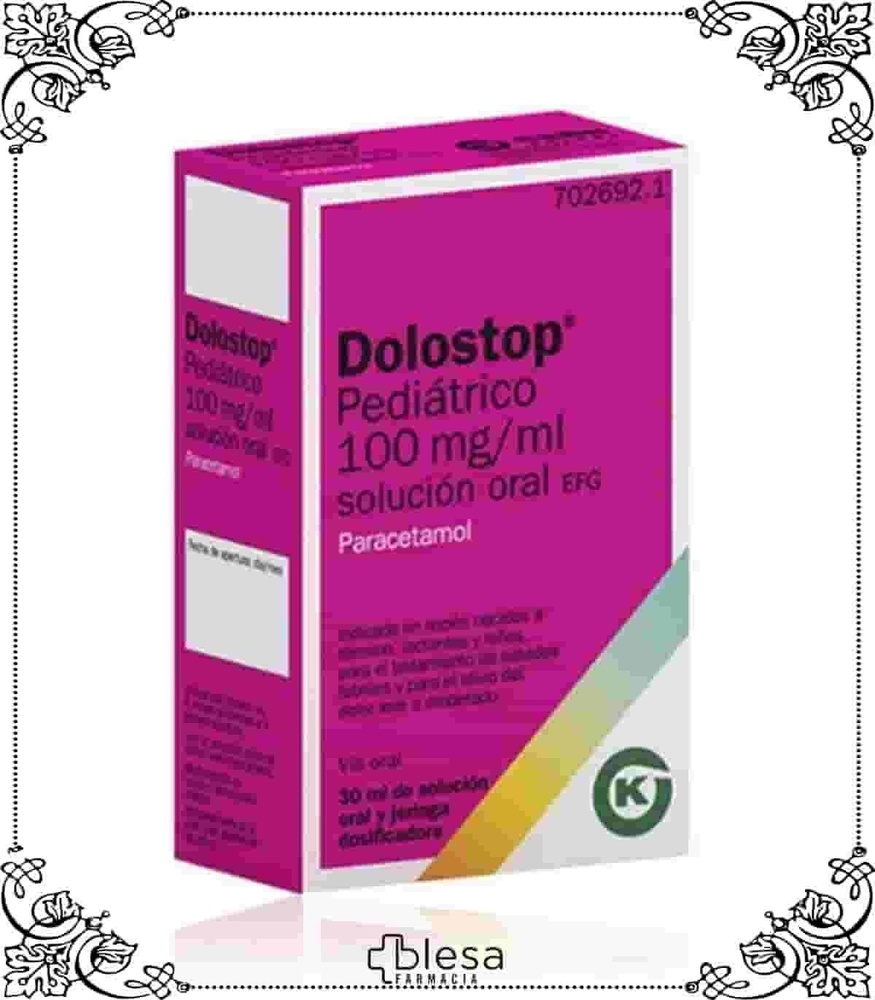
DOLOSTOP PEDIÁTRICO 100 MG/ML SOLUCIÓN ORAL

Revisión de receta online
Un médico revisará tu caso y determinará si la prescripción es médicamente apropiada.

Habla con un médico sobre este medicamento
Comenta tus síntomas y las opciones de tratamiento en una consulta online.



Cómo usar DOLOSTOP PEDIÁTRICO 100 MG/ML SOLUCION ORAL
Contenido del prospecto
- Introducción
- Qué es Dolostop Pediátrico y para qué se utiliza
- Qué necesita saber antes de empezar a tomar Dolostop Pediátrico
- Cómo tomar Dolostop Pediátrico
- Posibles efectos adversos
- Conservación de Dolostop Pediátrico
- Contenido del envase e información adicional
Introducción
Prospecto: Información para el usuario
DolostopPediátrico 100 mg/ml solución oral
Paracetamol
Lea todo el prospecto detenidamente antes de empezar a tomar este medicamento, porque contiene información importante para usted.
Siga exactamente las instrucciones de administración del medicamento contenidas en este prospecto o las indicadas por su médico, farmacéutico o enfermero.
- Conserve este prospecto ya que puede tener que volver a leerlo.
- Si necesita consejo o más información, consulte a su farmacéutico.
- Si experimenta efectos adversos, consulte a su médico, farmacéutico o enfermero, incluso si se trata de efectos adversos que no aparecen en este prospecto. Ver sección 4.
- Debe consultar a un médico si empeora o si no mejora después de 3 días. Si la fiebre persiste durante más de 3 días o el dolor más de 3 días en niños (2 días para el dolor de garganta).
Contenido del prospecto:
- Qué es Dolostop Pediátrico y para qué se utiliza
- Qué necesita saber antes de empezar a tomar Dolostop Pediátrico
- Cómo tomar Dolostop Pediátrico
- Posibles efectos adversos
- Conservación de Dolostop Pediátrico
- Contenido del envase e información adicional
1. Qué es Dolostop Pediátrico y para qué se utiliza
Paracetamol pertenece a un grupo de medicamentos llamados analgésicos y antipiréticos.
Este medicamento está indicado en recién nacidos a término, lactantes y niños, para el tratamiento de estados febriles y para el alivio del dolor leve o moderado.

¿No estás seguro de si este medicamento es adecuado para ti?
Comenta tus síntomas y tratamiento con un médico online.
2. Qué necesita saber antes de empezar a tomar Dolostop Pediátrico
No tomeDolostopPediátrico
- Si es alérgico (hipersensible) a paracetamol o a cualquiera de los demás componentes de este medicamento (incluidos en la sección 6).
- Si padece una enfermedad grave del hígado.
Advertencias y precauciones
Consulte a su médico o farmacéutico antes de empezar a tomar este medicamento.
- No exceder la dosis recomendada en la sección 3. Para ello compruebe que no se administran simultáneamente otros medicamentos que contengan paracetamol.
- Los pacientes con enfermedades leves o moderadas del hígado deben consultar con el médico antes de tomar el medicamento.
- Los pacientes con enfermedades del riñón, corazón o pulmón, con anemia (disminución de la tasa de hemoglobina en la sangre, a causa o no, de una disminución de glóbulos rojos), y en pacientes con malnutrición crónica o deshidratados deben consultar con el médico antes de tomar el medicamento.
- El consumo de bebidas alcohólicas puede provocar que paracetamol produzca daño en el hígado.
- Si el dolor se mantiene durante más de 3 días (2 días para el dolor de garganta) o la fiebre durante más de 3 días, o empeoran o aparecen otros síntomas, se debe interrumpir el tratamiento y consultar al médico. Evitar tratamientos prolongados.
Durante el tratamiento con Dolostop, informe inmediatamente a su médico si:
Si tiene enfermedades graves, como insuficiencia renal grave o sepsis (cuando las bacterias y sus toxinas circulan en la sangre, lo que provoca daños en los órganos), o si padece malnutrición, alcoholismo crónico o si también está tomando flucloxacilina (un antibiótico). Se ha notificado una enfermedad grave denominada acidosis metabólica (una anomalía en la sangre y los líquidos) en pacientes en estas situaciones cuando se utiliza paracetamol a dosis regulares durante un período prolongado o cuando se toma paracetamol junto con flucloxacilina. Los síntomas de acidosis metabólica pueden incluir: dificultad respiratoria grave con respiración profunda y rápida, somnolencia, sensación de malestar (náuseas) y vómitos.
Niños
Debe consultar al médico antes de administrar este medicamento a niños menores de 2 años.
Uso deDolostopPediátrico con otros medicamentos
Comunique a su médico o farmacéutico que está utilizando o ha utilizado recientemente o pudiera tener que utilizar cualquier otro medicamento.
Nosedebeutilizarjuntoconotrosmedicamentosparatratareldolorolafiebre(analgésicos/antipiréticos)amenosquesumédicoseloindique.
El Paracetamol puede aumentar la toxicidad del cloranfenicol.
Los barbitúricos pueden potenciar la toxicidad del Paracetamol.
En caso de tratamientos con anticoagulantes orales se puede administrar ocasionalmente como analgésico de elección.
En particular si está utilizando medicamentos que contengan en su composición alguno de los siguientes principios activos, ya que puede ser necesario modificar la dosis o la interrupción del tratamiento de cualquiera de ellos:
- Anticoagulantes orales (acenocumarol , warfarina).
- Anticonvulsivantes (lamotrigina, fenitoína, fenobarbital, metilfenobarbital, primidona).
- Antituberculosos (isoniazida, rifampicina).
- Colestiramina (utilizado para disminuir los niveles de colesterol en sangre).
- Medicamentos utilizados para el tratamiento de la gota (antigotosos) (probenecid).
- Algunos medicamentos utilizados para aumentar la eliminación de orina (diuréticos del asa como los del grupo furosemida).
- Metoclopramida y domperidona (utilizados para evitar las náuseas y los vómitos).
- Propranolol utilizado en el tratamiento de la tensión arterial alta (hipertensión) y las alteraciones del ritmo del corazón (arritmias cardiacas).
- Flucloxacilina (antiobiótico), debido a un riesgo grave de alteración de la sangre y los fluidos (denominada acidosis metabólica con alto desequilibrio aniónico) que debe ser tratada urgentemente (ver sección 2).
Interferencias con pruebas analíticas:
Si le van a realizar alguna prueba analítica (incluyendo análisis de sangre, orina, pruebas cutáneas que utilizan alérgenos, etc.), comunique a su médico que está tomando este medicamento, ya que puede alterar los resultados de dichas pruebas.
Uso deDolostopPediátrico con alimentos, bebidas y alcohol
Este medicamento puede tomarse con o sin alimentos y administrarse directamente o diluido con agua, leche o zumo de frutas.
La utilización de paracetamol en pacientes que consumen habitualmente alcohol (tres o más bebidas alcohólicas al día) puede dañar el hígado.
Embarazo, lactancia y fertilidad
Si está embarazada o en periodo de lactancia, o cree que podría estar embarazada o tiene intención de quedarse embarazada, consulte con su médico o farmacéutico antes de utilizar este medicamento.
El uso oral de paracetamol no produce efectos indeseables ni en la embarazada, ni en el feto, ni en el recién nacido. Los estudios de reproducción no muestran malformaciones ni efectos tóxicos. En caso necesario, el paracetamol se puede usar durante el embarazo. Debe utilizar la dosis más baja posible que reduzca el dolor o la fiebre y utilizarla durante el menor tiempo posible. Contacte con su médico si el dolor o la fiebre no disminuyen o si necesita tomar el medicamento con más frecuencia.
El paracetamol pasa a la leche materna, aunque no se han producido comunicaciones de efectos adversos en niños. Por lo tanto, puede utilizarse en mujeres en periodo de lactancia si no excede la dosis recomendada. Se debe tener precaución en el caso de uso prolongado.
Conducción y uso de máquinas
Puede disminuir la capacidad para conducir o manejar maquinaria por contener propilenglicol, ya que puede producir síntomas parecidos a los del alcohol.
DolostopPediátricocontiene propilenglicol (E-1520)y glucosa
Este medicamento contiene 2,72 mg de propilenglicol en cada ml.
Si el bebé tiene menos de 4 semanas de edad, consulte a su médico o farmacéutico, en particular si al bebé se le han administrado otros medicamentos que contengan propilenglicol o alcohol.
Este medicamento contiene glucosa. Si su médico le ha indicado que padece una intolerancia a ciertos azúcares, consulte con él antes de tomar este medicamento.
3. Cómo tomar Dolostop Pediátrico
Siga exactamente las instrucciones de administración del medicamento contenidas en este prospecto o las indicadas por su médico, farmacéutico o enfermero. En caso de dudas, pregunte a su médico o farmacéutico.
Recuerde tomar su medicamento.
Su médico le indicará la duración del tratamiento. No suspenda el tratamiento antes, ya que entonces no se obtendrían los resultados esperados. Del mismo modo tampoco emplee este medicamento más tiempo del indicado por su médico.
La dosificación de la solución se realiza en ml (100 mg/ml), mediante la jeringa para uso oral de 2 ó 5 ml.
Uso en niños
En niños menores de 2 años la dosis debe ser siempre establecida por su médico.
Niños de 0 a 10 años:
La dosis diaria recomendada de paracetamol es de 60 mg/kg/día, es decir, 10 mg/kg cada 4 horas (hasta 6 tomas/día) ó 15 mg/kg cada 6 horas (hasta 4 tomas en 24 hs). En niños menores de 1 año, son preferibles dosis de 10 mg/kg .
Para la administración de 10mg/kgcon un intervalo mínimo de 4 horas,la pauta recomendada es la siguiente:
Peso del niño | Edad (orientativo) | Volumen/toma en ml | cantidad de paracetamol/toma en mg |
3 - 4 kg | de 0 a 3 meses | 0,4ml | 4 0 mg |
4 a 8 kg | de 4 a 11 meses | 0,4-0,8ml | 40-80 mg |
8 a 10 kg | de 12 a 23 meses | 0,8-1 ml | 80-100 mg |
10 a 15 kg | de 2 a 3 años | 1-1,5ml | 100-150 mg |
15 a 20 kg | de 4 a 5 años | 1,5-2,0ml | 1 50-200 mg |
2 0 a 25 kg | de 6 a 8 años | 2,0-2,5ml | 200-250 mg |
25 a 32 kg | de 9 a 10 años | 2,5-3,2ml | 2 50-320 mg |
Para un cálculo directo, también puede multiplicarse el peso del niño en kg por 0,10. El resultado son losml de solución a administrar.
Estas dosis se pueden repetir cada 4 horas.
Alternativamente se pueden administrar dosis de 15 mg/kgcon intervalo mínimo de 6 hs. En este caso para un cálculo directo, puede multiplicarse el peso del niño en kg por 0,15. El resultado son los ml de solución a administrar.
La administración del preparado está supeditada a la aparición de los síntomas dolorosos o febriles. A medida que éstos desaparezcan debe suspenderse esta medicación.
Si usted estima que la acción de este medicamento es demasiado fuerte o débil, comuníqueselo a su médico o farmacéutico.
Forma de uso y vía de administración
Vía oral
Instrucciones de uso:
1.- Abrir el frasco siguiendo las instrucciones indicadas en el tapón (en la primera apertura el precinto se romperá).
2.- Introducir la jeringa para uso oral, presionando en el orificio del tapón perforado.
3.- Invertir el frasco y retirar la dosis necesaria.
4.- Administrar directamente o diluir con agua, leche o zumo de frutas.
5.- La jeringa para uso oral debe lavarse con agua después de cada toma.
Tápese bien el frasco después de cada administración.
Si toma másDolostopPediátricodel que debiera
En caso de sobredosis o ingesta accidental, consulte inmediatamente a su médico o farmacéutico o llame al servicio de Información Toxicológica, teléfono 91 562 04 20, indicando el medicamento y la cantidad ingerida.
Si se ha ingerido una sobredosis debe acudirse rápidamente a un Centro Médico aunque no haya síntomas, ya que a menudo, éstos, muy graves, no se manifiestan hasta pasados 3 días desde la ingestión de la sobredosis, aún en casos de intoxicación grave. Los síntomas por sobredosis pueden ser: mareos, vómitos, pérdida del apetito, coloración amarillenta de la piel y de los ojos (ictericia) y dolor abdominal.
Se considera sobredosis de paracetamol, la ingestión de una sola toma de más de 6 g en adultos y más de 100 mg por kg de peso en niños. El tratamiento de la sobredosis es más eficaz si se inicia dentro de las 4 horas siguientes a la ingestión del medicamento.
En el caso de que el paciente esté en tratamiento con barbitúricos o padezca alcoholismo crónico puede ser más susceptible a una sobredosis de paracetamol.
Si olvidó tomarDolostopPediátrico
No tome una dosis doble para compensar las dosis olvidadas.
En caso de que haya olvidado una dosis, tome otra tan pronto como sea posible y continúe con el horario habitual. Sin embargo, si la hora de la siguiente toma está muy próxima, salte la dosis que olvidó y tome la dosis siguiente en su hora habitual.

¿Has empezado a tomar el medicamento y tienes preguntas?
Comenta tus síntomas y tratamiento con un médico online.
4. Posibles efectos adversos
Como todos los medicamentos, paracetamol puede producir efectos adversos, aunque no todas las personas los sufran.
Este medicamento puede producir los siguientes efectos adversos:
- Raros (pueden afectar hasta 1 de cada 1.000 personas): malestar, niveles aumentados de transaminasas hepáticas y bajada de tensión.
- Muy raras (pueden afectar hasta 1 de cada 10.000 personas): reacciones graves en la piel, alteraciones del hígado (como ictericia), bajada de glucosa, alteraciones sanguíneas (trombocitopenia, agranulocitosis, leucopenia, neutropenia, anemia hemolítica), orina turbia y alteraciones del riñón.
- De frecuencia no conocida (no puede estimarse a partir de los datos disponibles): Una enfermedad grave que puede hacer que la sangre sea más ácida (denominda acidosis metabólica) en pacientes con enfermedad grave que utilizan paracetamol (ver sección 2).
Comunicación de efectos adversos
Si experimenta cualquier tipo de efecto adverso, consulte con su médico o farmacéutico, incluso si se trata de efectos adversos que no aparecen en este prospecto. También puede comunicarlos directamente a través del Sistema Español de Farmacovigilancia de Medicamentos de uso humano: www.notificaram.es. Mediante la comunicación de efectos adversos puede contribuir a proporcionar más información sobre la seguridad de este medicamento.
5. Conservación de Dolostop Pediátrico
Mantener este medicamento fuera de la vista y del alcance de los niños.
Conservar el frasco en el embalaje exterior para protegerlo de la luz.
No utilice este medicamento después de la fecha de caducidad indicada en el envase después de “CAD”. La fecha de caducidad es el último día del mes que se indica.
Una vez abierto, el contenido del frasco debe ser utilizado en 6 meses.
Los medicamentos no se deben tirar por los desagües ni a la basura. Deposite los envases y los medicamentos que no necesita en el Punto SIGRE de su farmacia habitual. En caso de duda pregunte a su farmacéutico cómo deshacerse de los envases y de los medicamentos que no necesita. De esta forma ayudará a proteger el medio ambiente.
6. Contenido del envase e información adicional
Composición deDolostopPediátrico
- El principio activo es paracetamol. Cada ml de solución contiene 100 mg de paracetamol.
- Los demás componentes (excipientes) son: macrogol 600, glicerol (E-422), sucralosa (E-955), enmascarador del sabor (contiene propilenglicol (E-1520)) aroma de fresa (contiene propilenglicol (E-1520)), rojo carmín (E-120) (contiene glucosa) y agua.
Aspecto del producto y contenido del envase
Dolostop Pediátrico 100 mg/ml solución oral se presenta en forma de solución transparente, de color rojo y con olor característico a fresa.
Envase de 30 ml:
Frasco de plástico (PET) transparente con 30 ml de solución oral, con un adaptador de plástico (LDPE) para inserir la jeringa dosificadora y cerrado mediante un tapón de plástico (HDPE). Se incluye una jeringa de plástico de 2 ml.
Envase de 60 ml:
Frasco de plástico (PET) transparente con 60 ml de solución oral. Con un adaptador de plástico (LDPE) para inserir la jeringa dosificadora y cerrado mediante un tapón de plástico (HDPE). Se incluye una jeringa de plástico de 5 ml.
Titular de la autorización de comercialización y responsable de la fabricación
Kern Pharma, S.L.
Venus, 72 - Pol. Ind. Colón II
08228 Terrassa - Barcelona
España
Fecha de la última revisión de este prospecto:Febrero 2025
La información detallada y actualizada de este medicamento está disponible en la página web de la Agencia Española de Medicamentos y Productos Sanitarios (AEMPS) http://www.aemps.gob.es/.
- País de registro
- Forma farmacéuticaSOLUCIÓN/SUSPENSIÓN ORAL, 100 mg/ml
- Código ATCN02BE01
- Principio activo
- Requiere recetaNo
- Fabricante
- ComposiciónGLICEROL (E 422) (409.0 mg mg), ROJO CARMIN, COCHINILLA (E-120; CI=75470) (0.4 mg mg)
- Esta información es de carácter general y no sustituye la consulta con un profesional sanitario.
- Alternativas a DOLOSTOP PEDIÁTRICO 100 MG/ML SOLUCION ORALForma farmacéutica: COMPRIMIDO, 1 gPrincipio activo: ParacetamolFabricante: Uxa Farma S.A.Requiere recetaForma farmacéutica: COMPRIMIDO, 1 gPrincipio activo: ParacetamolFabricante: Laboratorios Cinfa S.A.No requiere recetaForma farmacéutica: COMPRIMIDO, 1 gPrincipio activo: ParacetamolFabricante: Laboratorios Cinfa S.A.No requiere receta
Médicos online para DOLOSTOP PEDIÁTRICO 100 MG/ML SOLUCION ORAL
Comenta la dosis, los posibles efectos secundarios, interacciones, contraindicaciones o la revisión de receta de DOLOSTOP PEDIÁTRICO 100 MG/ML SOLUCION ORAL, sujeto a valoración médica y a la normativa local.









Obtén una receta de DOLOSTOP PEDIÁTRICO 100 MG/ML SOLUCION ORAL online
Rellena un formulario de 2 minutos
Cuéntanos tus síntomas, historial y el medicamento que necesitas.
Elige un médico o nosotros te asignamos uno
Escoge un especialista o te conectamos con el próximo médico disponible.
El médico revisa tu caso
Normalmente en 30 minutos. Puede hacerte preguntas adicionales por chat.
Recógela en cualquier farmacia
Receta electrónica enviada a tu correo, válida en toda España.
Preguntas frecuentes
DOLOSTOP PEDIÁTRICO 100 MG/ML SOLUCION ORAL no requiere receta en España. Puedes confirmarlo con un médico online según tu caso.
El principio activo de DOLOSTOP PEDIÁTRICO 100 MG/ML SOLUCION ORAL es Paracetamol. Esta información ayuda a identificar medicamentos con la misma composición pero con diferentes nombres comerciales.
DOLOSTOP PEDIÁTRICO 100 MG/ML SOLUCION ORAL es fabricado por Kern Pharma S.L.. La marca y el envase pueden variar según el distribuidor.
Los Médicos de familia, Psiquiatras, Dermatólogos, Cardiólogos, Endocrinólogos, Gastroenterólogos, Neumólogos, Nefrólogos, Reumatólogos, Hematólogos, Infectólogos, Alergólogos, Geriatras, Pediatras, Oncólogos pueden valorar la prescripción de DOLOSTOP PEDIÁTRICO 100 MG/ML SOLUCION ORAL cuando esté clínicamente indicado. Puedes reservar una videoconsulta para comentar tu caso y las opciones de tratamiento.
España cuenta con una infraestructura sanitaria bien desarrollada en ciudades principales como Madrid, Barcelona, Valencia y Sevilla. Las farmacias están ampliamente disponibles y operan bajo estrictas regulaciones, garantizando el acceso a medicamentos con receta.
Puedes comprar DOLOSTOP PEDIÁTRICO 100 MG/ML SOLUCION ORAL en Madrid, Barcelona, Sevilla o Valencia en cualquier farmacia local con una receta válida.
Para obtener una receta, puedes utilizar Oladoctor:
Otros medicamentos con el mismo principio activo (Paracetamol) incluyen ABEZEN 1 G COMPRIMIDOS RECUBIERTOS CON PELICULA, ANTIDOL 1 G COMPRIMIDOS RECUBIERTOS, ANTIDOL 1 G COMPRIMIDOS. Pueden tener diferentes nombres comerciales o formulaciones, pero contienen el mismo componente terapéutico. Consulta siempre con un médico antes de cambiar o iniciar un nuevo medicamento.
