



DISNEUMON 5 mg /Ml Producto De Uso Nasal

Revisión de receta online
Un médico revisará tu caso y determinará si la prescripción es médicamente apropiada.

Habla con un médico sobre este medicamento
Comenta tus síntomas y las opciones de tratamiento en una consulta online.



Cómo usar DISNEUMON PERNASAL 5 MG/ML SOLUCION PARA PULVERIZACION
Contenido del prospecto
- Introducción
- Qué es Disneumon pernasal y para qué se utiliza
- Qué necesita saber antes de empezar a usar Disneumon pernasal
- Cómo usar Disneumon pernasal
- Posibles efectos adversos
- Conservación de Disneumon pernasal
- Contenido del envase e información adicional
Introducción
Prospecto: información para el usuario
Disneumon pernasal 5 mg/ml solución para pulverización nasal
fenilefrina hidrocloruro
Lea todo el prospecto detenidamente antes de empezar a usar este medicamento, porque contiene información importante para usted.
- Conserve este prospecto, ya que puede tener que volver a leerlo.
- Si tiene alguna duda, consulte a su médico, farmacéutico o enfermero.
- Este medicamento se le ha recetado a solamente a usted, y no debe dárselo a otras personas, aunque tengan los mismos síntomas que usted ya que puede perjudicarles.
- Si experimenta efectos adversos, consulte a su médico, farmacéutico o enfermero, incluso si se trata de efectos adversos que no aparecen en este prospecto. Ver sección 4.
Contenido del prospecto
- Qué es Disneumon pernasal y para qué se utiliza
- Qué necesita saber antes de empezar a usar Disneumon pernasal
- Cómo tomar Disneumon pernasal
- Posibles efectos adversos
- Conservación de Disneumon pernasal
- Contenido del envase e información adicional
1. Qué es Disneumon pernasal y para qué se utiliza
El principio activo de Disneumon pernasal es fenilefrina hidrocloruro; el cual pertenece al grupo de los medicamentos denominados descongestivos nasales.
La fenilefrina administrada por vía nasal posee una acción vasoconstrictora local intensa, rápida y prolongada que produce descongestión nasal.
Esta indicado en el tratamiento sintomático de la congestión y secreción nasal por resfriado común o procesos alérgicos, sinusitis u otras alteraciones del tracto respiratorio superior en adultos y niños mayores de 12 años.
Si los síntomas persisten durante más de tres días o se agravan, consulte a su médico.
Debe consultar a un médico si empeora o si no mejora después de 3 días.

¿No estás seguro de si este medicamento es adecuado para ti?
Comenta tus síntomas y tratamiento con un médico online.
2. Qué necesita saber antes de empezar a usar Disneumon pernasal
No use Disneumon pernasal
- Si es alérgico a la fenilefrina o a alguno de los demás componentes de este medicamento (incluidos en la sección 6).
Si padece hipertensión o enfermedad vascular periférica (mala circulación), enfermedades cardíacas, diabetes, hipertiroidismo, síndrome de Raynaud o hipertrofia prostática.
Si está siendo tratado con medicamentos para la depresión (inhibidores de la monoaminooxidasa (IMAO) o en las dos semanas siguientes a su retirada o antidepresivos tricíclicos).
Si le han realizado recientemente una operación en la cabeza (si ha sufrido alguna intervención quirúrgica craneal, transnasal o transoral)
Si padece una enfermedad de los ojos con aumento de la presión (glaucoma de ángulo cerrado) o sequedad de la mucosa nasal con formación de costras (rinitis seca).
Los niños menores de 6 años no deben utilizar este medicamento.
Advertencias y precauciones
Consulte a su médico, farmacéutico o enfermero antes de empezar a usar Disneumon pernasal.
Consulte a su médico antes de utilizar este medicamento si:
- tiene niveles altos de azúcar en sangre (diabetes)
- tiene la tensión alta (hipertensión)
- Si sufre de enfermedad cardíaca, incluidas enfermedades crónicas del corazón, insuficiencia vascular periférica, trastornos del ritmo cardíaco, taquicardia (frecuencia cardíaca elevada), bradicardia (frecuencia cardíaca baja), bloqueo cardíaco parcial, angina de pecho;
- Si tiene una enfermedad de los vasos sanguíneos, como la arteriosclerosis (endurecimiento y engrosamiento de las paredes de los vasos sanguíneos);
- Si sufre de mala circulación sanguínea en el cerebro;
- padece alguna enfermedad de la próstata con dificultad al orinar (hipertrofia prostática)
- padece alguna enfermedad del tiroides (hipertiroidismo)
- padece síndrome de Raynaud
- está tomando medicamentos para la depresión o para el asma (del grupo denominado “broncodilatadores adrenérgicos”).
- Si sufre de un glaucoma de ángulo cerrado (una enfermedad de los ojos poco común).
En pacientes con insuficiencia cardíaca grave, la fenilefrina podría agravar la insuficiencia cardíaca debido a la constricción de los vasos sanguíneos.
Su presión arterial será monitorizada durante el tratamiento. Si sufre de enfermedad cardíaca, se realizará una monitorización adicional de sus funciones vitales.
No exceda la dosis recomendada.
Si aparece insomnio (muy raras veces) procure evitar aplicar el medicamento a última hora de la tarde o por la noche.
Si los síntomas persisten durante más de tres días o se agravan, consulte a su médico.
Se debe evitar el uso excesivo o continuado del medicamento (habitualmente menos de 5 días seguidos) ya que puede producir congestión de rebote con aumento de la congestión y secreción nasal
Para evitar contagios, el medicamento no se debe utilizar por más de una persona
Se informa a los deportistas que este medicamento contiene un componente que puede establecer un resultado analítico de control del dopaje como positivo.
Niños
Consulte con su médico para utilizar este medicamento en niños entre 6 y 12 años.
No debe administrarse a niños menores de 6 años.
Otros medicamentos y Disneumon pernasal
Informe a su médico o farmacéutico, si está utilizando, ha utilizado recientemente o pudiera tener que utilizar cualquier otro medicamento.
Este medicamento no debe administrarse junto con antidepresivos (inhibidores de la monoaminooxidasa -IMAO - o antidepresivos tricíclicos ya que puede tener efectos cardiovasculares como hipertensión debido al efecto vasoconstrictor de la fenilefrina.) o bloqueantes adrenérgicos utilizados en el tratamiento del asma.
Embarazo,lactancia y fertilidad
Si está embarazada o en periodo de lactancia, cree que podría estar embarazada o tiene intención de quedarse embarazada, consulte a su médico o farmacéutico antes de utilizar este medicamento. Este medicamento no debe usarse durante el embarazo.
Las mujeres en período de lactancia deben consultar al médico antes de utilizar este medicamento.
Conducción y uso de máquinas
No se han descrito. Si nota somnolencia o mareos, no conduzca ni utilice máquinas.
Disnuemon pernasal contiene sodio
Este medicamento contiene menos de 23 mg de sodio (1mmol) por mililitro, esto es, esencialmente “exento de sodio”.
3. Cómo usar Disneumon pernasal
Siga exactamente las instrucciones de administración del medicamento contenidas en este prospecto o las indicadas por su médico, farmacéutico o enfermero. En caso de duda, pregunte a su médico, farmacéutico o enfermero.
Adultos y niños mayores de 12 años: 1 aplicación en cada orificio nasal, pudiendo repetirse cada 4-6 horas. No se debe acortar el tiempo entre aplicación y aplicación.
En niños entre 6 y 12 años
se recomienda una aplicación en cada orificio nasal cada 6 horas.
Uso en niños y adolescentes
Niños entre 6 y 12 años
Consulte con su médico para utilizar este medicamento en niños entre 6 y 12 años
Niños menores de 6 años
No debe administrarse a niños menores de 6 años.
Forma de administración
Vía nasal.
Para una correcta administración de este medicamentoes necesario que el frasco y la cabeza permanezcan en posición vertical, tal y como se indica en el dibujo, mientras se pulsa con el dedo en la parte superior del difusor. Cada pulsación ha de ser breve, es decir, el tiempo imprescindible para pulsar a fondo y soltar.


En este momento y simultáneamente, se debe efectuar una inspiración profunda para facilitar así la máxima penetración del medicamento.
Si inclina el frasco o la cabeza al pulsar, puede provocar el escape del gas propulsor dejando el aerosol sin presión e inutilizable.
Siguiendo estas recomendaciones, es improbable que surjan inconvenientes en el uso normal del medicamento. No obstante, en algún caso aislado puede producirse un fallo mecánico de la válvula o del difusor que impida la salida del líquido. Si esto ocurre, debe sustituirse el producto por uno nuevo.
Si usa más Disneumon pernasal del que debe
Con dosis elevadas o en caso de ingestión accidental pueden aparecer efectos no deseados tales como dolores de cabeza, nerviosismo, insomnio, palpitaciones, hipertensión y visión borrosa.
En caso de sobredosis o ingestión accidental, consulte inmediatamente a su médico o farmacéutico o llame al Servicio de Información Toxicológica, teléfono 91 562 04 20, indicando el medicamento y la cantidad ingerida.
Si olvidó usar Disneumon pernasal
No aplique una dosis doble para compensar las dosis olvidadas.
Si interrumpe el tratamiento con Disneumon pernasal
Si tiene cualquier otra duda sobre el uso de este medicamento, pregunte a su médico, farmacéutico o enfermero.

¿Has empezado a tomar el medicamento y tienes preguntas?
Comenta tus síntomas y tratamiento con un médico online.
4. Posibles efectos adversos
Al igual que todos los medicamentos, este medicamento puede producir efectos adversos, aunque no todas las personas los sufran.
Son frecuentes dolor de cabeza, estornudos, picor nasal, rinitis, sequedad o sensación de quemazón en la mucosa nasal y dependencia del medicamento. Las siguientes reacciones adversas son poco frecuentes, especialmente cuando se administran dosis excesivas, puede producirse vértigo, nerviosismo, taquicardia, mareo, vómitos, náuseas, malestar, erupción cutánea, hipertensión y palpitaciones, y dificultad para conciliar el sueño.
El uso excesivo o continuado del medicamento puede producir congestión de rebote con aumento de la congestión, secreción nasal, dificultades al orinar y retención de orina en pacientes con problemas de próstata.
Si se observa cualquier otra reacción adversa no descrita anteriormente, consulte a su médico o farmacéutico.
El uso excesivo o continuado del medicamento puede producir congestión de rebote con aumento de la congestión y secreción nasal.
Si se observa cualquier otra reacción adversa no descrita anteriormente, consulte a su médico o farmacéutico.
Comunicación de efectos adversos
Si experimenta cualquier tipo de efecto adverso, consulte a su médico, farmacéutico o enfermero, incluso si se trata de posibles efectos adversos que no aparecen en este prospecto. También puede comunicarlos directamente a través del Sistema Español de Farmacovigilancia de medicamentos de Uso Humano: https://www.notificaram.es. Mediante la comunicación de efectos adversos usted puede contribuir a proporcionar más información sobre la seguridad de este medicamento.
5. Conservación de Disneumon pernasal
Mantener este medicamento fuera de la vista y del alcance de los niños.
No utilice este medicamento después de la fecha de caducidad que aparece en la caja después de CAD o EXP. La fecha de caducidad es el último día del mes que se indica.
El envase presurizado no debe exponerse a la luz directa solar ni a a temperaturas superiores a 50 ºC.
No se debe perforar, romper, ni quemar, incluso aunque parezca que está vacío
Los medicamentos no se deben tirar por los desagües ni a la basura. Deposite los envases y los medicamentos que no necesita en el Punto SIGRE de la farmacia. En caso de duda pregunte a su farmacéutico cómo deshacerse de los envases y de los medicamentos que no necesita. De esta forma, ayudará a proteger el medio ambiente.
6. Contenido del envase e información adicional
Composición de Disneumon pernasal
El principio activo es fenilefrina (en forma de hidrocloruro).Cada ml de solución contiene 5 mg de principio activo.
- Los demás componentes (excipientes) son: sacarina sódica (E-954), cloruro sódico, propionato sódico, aroma mentol, aroma eucaliptol, agua purificada y nitrógeno a presión.
Aspecto del producto y contenido del envase
Frasco de vidrio rojo con aplicador nasal blanco con 25 ml de solución para pulverización nasal.
Titular de la autorización de comercialización
Cooper Consumer Health B.V.
Verrijn Stuartweg 60,
1112 AX Diemen,
Países Bajos
Responsable de la fabricación
Recipharm Parets, S.L.
Ramón y Cajal, 2, 08150 Parets del Vallés (Barcelona)
España
Pueden solicitar más información respecto a este medicamento dirigiéndose al representante local del titular de la autorización de comercialización:
Vemedia Pharma Hispania, S.A.
C/ Aragón, 182, 5ª planta
08011 - Barcelona
España
Fecha de la última revisión de este prospecto:abril 2020
La información detallada y actualizada de este medicamento está disponible en la página web de la Agencia Española de Medicamentos y Productos Sanitarios (AEMPS) https://www.aemps.gob.es
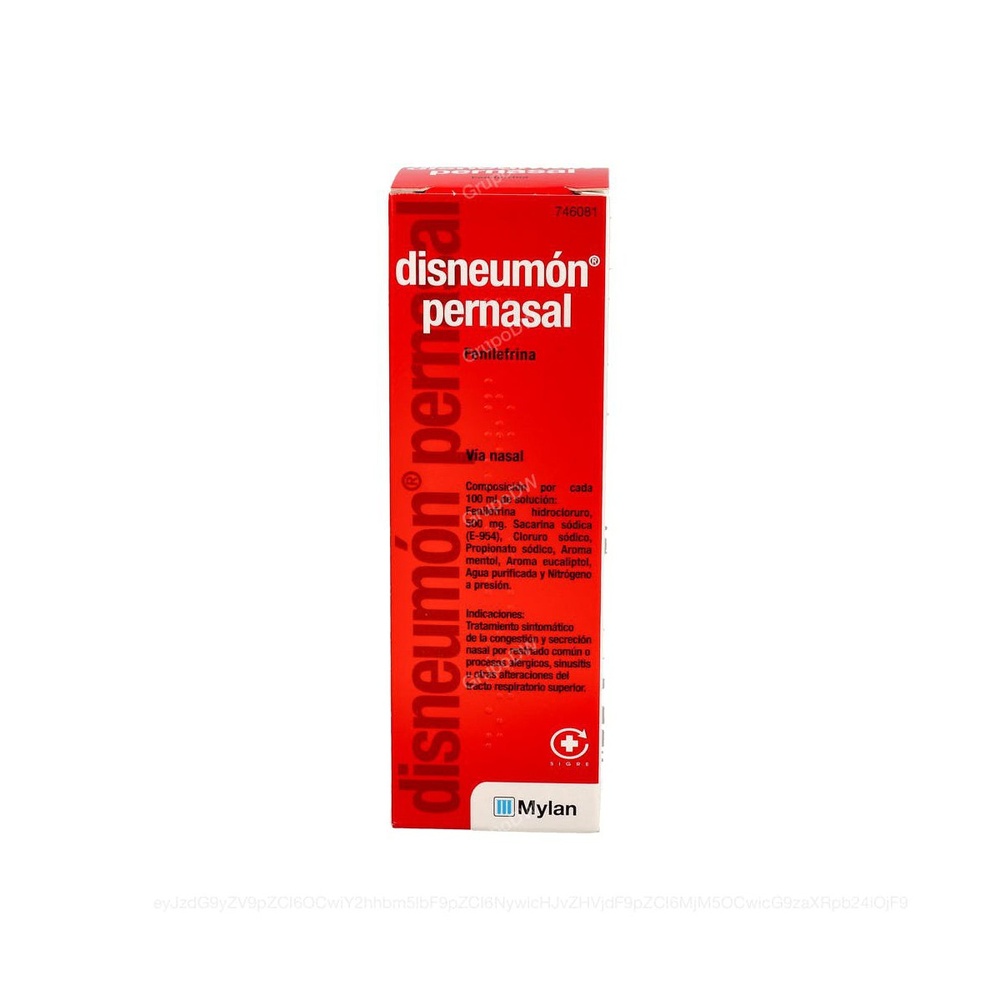
- País de registro
- Forma farmacéuticaPRODUCTO USO NASAL, 5 mg
- Código ATCR01AA04
- Principio activo
- Requiere recetaNo
- Fabricante
- ComposiciónCLORURO DE SODIO (6 mg mg), SACARINA SODICA (0,5 mg mg), PROPIONATO SODICO (2,5 mg mg)
- Esta información es de carácter general y no sustituye la consulta con un profesional sanitario.
- Alternativas a DISNEUMON PERNASAL 5 MG/ML SOLUCION PARA PULVERIZACIONForma farmacéutica: PRODUCTO USO NASAL, 1 mgPrincipio activo: ximetazolinaNo requiere recetaForma farmacéutica: PRODUCTO USO NASAL, 0,5 mg/mlPrincipio activo: oxymetazolineFabricante: Pharmex Advanced Laboratories S.L.No requiere recetaForma farmacéutica: PRODUCTO USO NASAL, Xilometazolina hidrocloruro 0,1%Principio activo: ximetazolinaFabricante: Kern Pharma S.L.No requiere receta
Médicos online para DISNEUMON PERNASAL 5 MG/ML SOLUCION PARA PULVERIZACION
Comenta la dosis, los posibles efectos secundarios, interacciones, contraindicaciones o la revisión de receta de DISNEUMON PERNASAL 5 MG/ML SOLUCION PARA PULVERIZACION, sujeto a valoración médica y a la normativa local.

Obtén una receta de DISNEUMON PERNASAL 5 MG/ML SOLUCION PARA PULVERIZACION online
Rellena un formulario de 2 minutos
Cuéntanos tus síntomas, historial y el medicamento que necesitas.
Elige un médico o nosotros te asignamos uno
Escoge un especialista o te conectamos con el próximo médico disponible.
El médico revisa tu caso
Normalmente en 30 minutos. Puede hacerte preguntas adicionales por chat.
Recógela en cualquier farmacia
Receta electrónica enviada a tu correo, válida en toda España.
Preguntas frecuentes
DISNEUMON PERNASAL 5 MG/ML SOLUCION PARA PULVERIZACION no requiere receta en España. Puedes confirmarlo con un médico online según tu caso.
El principio activo de DISNEUMON PERNASAL 5 MG/ML SOLUCION PARA PULVERIZACION es fenilefrina. Esta información ayuda a identificar medicamentos con la misma composición pero con diferentes nombres comerciales.
DISNEUMON PERNASAL 5 MG/ML SOLUCION PARA PULVERIZACION es fabricado por Cooper Consumer Health B.V.. La marca y el envase pueden variar según el distribuidor.
Los Médicos de familia, Psiquiatras, Dermatólogos, Cardiólogos, Endocrinólogos, Gastroenterólogos, Neumólogos, Nefrólogos, Reumatólogos, Hematólogos, Infectólogos, Alergólogos, Geriatras, Pediatras, Oncólogos pueden valorar la prescripción de DISNEUMON PERNASAL 5 MG/ML SOLUCION PARA PULVERIZACION cuando esté clínicamente indicado. Puedes reservar una videoconsulta para comentar tu caso y las opciones de tratamiento.
España cuenta con una infraestructura sanitaria bien desarrollada en ciudades principales como Madrid, Barcelona, Valencia y Sevilla. Las farmacias están ampliamente disponibles y operan bajo estrictas regulaciones, garantizando el acceso a medicamentos con receta.
Puedes comprar DISNEUMON PERNASAL 5 MG/ML SOLUCION PARA PULVERIZACION en Madrid, Barcelona, Sevilla o Valencia en cualquier farmacia local con una receta válida.
Para obtener una receta, puedes utilizar Oladoctor:
Otros medicamentos con el mismo principio activo (fenilefrina) incluyen AMIDRIN 1 mg/ml SOLUCION PARA PULVERIZACION NASAL, CUVENAX 35 microgramos/PULSACION SOLUCION PARA PULVERIZACION NASAL, IDASAL 1mg/ml SOLUCION PARA PULVERIZACION NASAL. Pueden tener diferentes nombres comerciales o formulaciones, pero contienen el mismo componente terapéutico. Consulta siempre con un médico antes de cambiar o iniciar un nuevo medicamento.
