



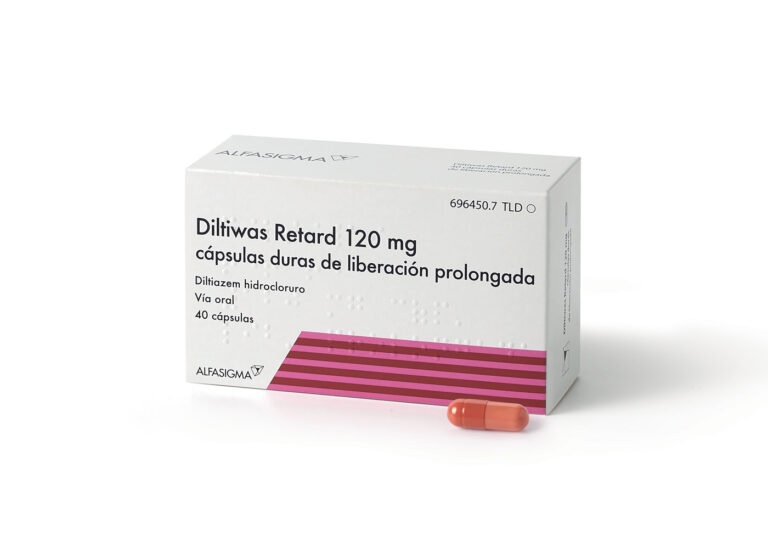
DILTIWAS RETARD 120 mg Cápsulas duras de liberación prolongada

Revisión de receta online
Un médico revisará tu caso y determinará si la prescripción es médicamente apropiada.

Habla con un médico sobre este medicamento
Comenta tus síntomas y las opciones de tratamiento en una consulta online.



Cómo usar DILTIWAS RETARD 120 MG CÁPSULAS DURAS DE LIBERACIÓN PROLONGADA
Contenido del prospecto
- Introducción
- Qué es Diltiwas Retard y para qué se utiliza
- Qué necesita saber antes de tomar Diltiwas Retard
- Cómo tomar Diltiwas Retard
- Posibles efectos adversos
- Conservación de Diltiwas Retard
- Contenido del envase e información adicional
Introducción
Prospecto: información para el usuario
Diltiwas Retard 120 mg cápsulas duras de liberación prolongada
diltiazem hidrocloruro
Lea todo el prospecto detenidamente antes de empezar a tomar este medicamento, porque contiene información importante para usted.
- Conserve este prospecto, ya que puede tener que volver a leerlo.
Si tiene alguna duda, consulte a su médico o farmacéutico.
- Este medicamento se le ha recetado solamente a usted, y no debe dárselo a otras personas aunque tengan los mismos síntomas que usted, ya que puede perjudicarles.
- Si experimenta efectos adversos, consulte a su médico o farmacéutico, incluso si se trata de efectos adversos que no aparecen en este prospecto. Ver sección 4.
Contenido del prospecto
- Qué es Diltiwas Retard y para qué se utiliza
- Qué necesita saber antes de empezar a tomar Diltiwas Retard
- Cómo tomar Diltiwas Retard
- Posibles efectos adversos
- Conservación de Diltiwas Retard
- Contenido del envase e información adicional
1. Qué es Diltiwas Retard y para qué se utiliza
Diltiwas Retard es un medicamento que pertenece a un grupo de fármacos denominados antagonistas del calcio que actúa reduciendo las necesidades de oxígeno del corazón y aumentando la cantidad de sangre que llega al músculo cardíaco.
Diltiwas Retard está indicado en el tratamiento y profilaxis de la cardiopatía isquémica.

¿No estás seguro de si este medicamento es adecuado para ti?
Comenta tus síntomas y tratamiento con un médico online.
2. Qué necesita saber antes de tomar Diltiwas Retard
No tome Diltiwas Retard
- si es alérgico al diltiazem hidrocloruro o a alguno de los demás componentes de este medicamento (incluidos en la sección 6).
- si padece ciertas enfermedades de corazón como diversos tipos de arritmia (latidos irregulares del corazón debidos a síndrome del nodo sinusal o bloqueo auriculo-ventricular de segundo o tercer grado, excepto si lleva marcapasos.
- si tiene un pulso muy lento por debajo de 40 latidos por minuto.
- si padece insuficiencia ventricular izquierda (cuando el ventrículo izquierdo no bombea por completo la masa de sangre oxigenada hacia el resto del cuerpo) con acumulación de líquido en los pulmones.
- si padece insuficiencia cardiaca congestiva con edema pulmonar (incapacidad del corazón para bombear sangre suficiente al resto del cuerpo y acumulación de líquido).
- si recibe al mismo tiempo una infusión de dantroleno (un medicamento para relajar los músculos) por vía intravenosa.
- si padece hipotensión (tensión arterial baja).
- si padece infarto agudo de miocardio complicado con pulso muy lento, hipotensión grave e insuficiencia ventricular izquierda). Si está embarazada o está planeando quedarse embarazada.
- si es una mujer en edad fértil y no utiliza un método anticonceptivo apropiado.
- si está en período de lactancia.
- si está tomando un medicamento que contenga ivabradina para el tratamiento de ciertas enfermedades cardíacas.
- si ya está tomando un medicamento que contiene lomitapida utilizado para el tratamiento de niveles altos de colesterol (ver sección: “Toma de Diltiwas con otros medicametos”).
Advertencias y precauciones
Consulte a su médico o farmacéutico antes de empezar a tomar Diltiwas Retard
- Si tiene antecedentes de insuficiencia cardíaca, dificultad nueva para respirar, latidos cardíacos lentos o presión arterial baja. Se han notificado casos de lesión renal en pacientes con estas afecciones, es posible que su médico necesite controlar su función renal.
- Si se trata de un paciente geriátrico.
- Si padece alguna arritmia cardíaca (enfermedad del nodo sinusal, bloqueo auriculo-ventricular), si su ritmo cardíaco es lento o si recibe tratamiento con otros medicamentos utilizados para tratar enfermedades del corazón (beta bloqueantes, digitálicos) ya que el uso de diltiazem en estas situaciones puede dar lugar a un pulso y ritmo cardíaco excesivamente lentos (bradicardia).
- Si presenta hipotensión: el tratamiento con diltiazem puede dar lugar a una bajada excesiva en la tensión arterial. Su médico le informará acerca de cómo evitar los síntomas resultantes de la hipotensión y qué medidas tomar si se presentan esos síntomas.
- Si padece alguna enfermedad del hígado o del riñón o es anciano: dado que no hay datos disponibles en estos pacientes, Diltiwas Retard debe ser utilizado con precaución.
- En niños: no existe experiencia sobre el uso de Diltiwas Retard en niños.
- Si le aparece una erupción cutánea provocada por diltiazem, su médico valorará estos síntomas y le indicará las medidas a tomar.
- Si requiere anestesia general, debe informar al anestesista del tratamiento con diltiazem.
- Al no haberse comparado el efecto terapéutico entre las distintas especialidades con diltiazem de liberación inmediata o modificada (retard) no se recomienda la sustitución de una por otra salvo expresa recomendación del médico prescriptor.
Toma de Diltiwas Retard con otros medicamentos
Informe a su médico o farmacéutico si está utilizando, ha utilizado recientemente o pudiera tener que utilizar cualquier otro medicamento.
En particular, no tome este medicamento e informe a su médico si está tomando:
Medicamentos que contienen lomitapida utilizados para el tratamiento de los niveles altos de colesterol. Diltiazem puede aumentar la concentración de lomitapida que puede conducir a un aumento en la probabilidad y la gravedad de los efectos secundarios relacionados con el hígado.
Litio (utilizado para el tratamiento de algunas enfermedades mentales): riesgo de aumento de la neurotoxicidad inducida por el litio.
Derivados de nitrato (para tratar la hipertensión): aumento de los efectos hipotensores y desvanecimientos (efectos vasodilatadores aditivos). En todos los pacientes tratados con Diltiwas Retard, la prescripción de los derivados de nitrato sólo debe ser efectuada en dosis gradualmente crecientes.
Teofilina (utilizada para el asma): aumento de los niveles de teofilina en sangre.
Alfa-antagonistas (para tratar la hipertensión): aumento de los efectos antihipertensivos:
El tratamiento concomitante con los alfa-antagonistas puede producir o agravar la hipotensión. La combinación de diltiazem con un alfa-antagonista debe ser considerada solamente con el control estricto de la presión arterial.
Amiodarona (utilizada para disminuir el ritmo del corazón), digoxina (utilizada para tratar enfermedades del corazón): aumento del riesgo de bradicardia (descenso de los latidos del corazón). Se debe tener precaución cuando éstos se combinan con diltiazem, particularmente en sujetos de edad avanzada y cuando se utilizan dosis altas.
Beta-bloqueantes (para tratar la hipertensión): posibilidad de alteraciones en el corazón.
Otros agentes antiarrítmicos (se utilizan para prevenir o suprimir las alteraciones del ritmo cardíaco): dado que el diltiazem tiene propiedades antiarrítmicas, no se recomienda su prescripción concomitante con otros agentes antiarrítmicos.
Carbamazepina (para tratar la epilepsia): aumento en los niveles en sangre de carbamazepina.
Rifampicina (antibiótico): riesgo de disminución de los niveles en sangre de diltiazem después de iniciar el tratamiento con rifampicina.
Agentes utilizados para disminuir el ácido del estómago (cimetidina, ranitidina): aumento de las concentraciones en sangre de diltiazem.
Ciclosporina (utilizado para suprimir el sistema inmunitario): aumento de los niveles en sangre de ciclosporina.
El uso conjunto de Diltiwas Retard con otros fármacos deberá realizarse bajo control médico y ajustando las dosis de forma progresiva.
Debido a la posibilidad de efectos aditivos, es necesario tener precaución y valorar cuidadosamente a los pacientes que reciben Diltiwas Retard de forma simultánea con otros agentes que se sabe que afectan al corazón.
Diltiwas Retard se metaboliza en el hígado por la isoenzima CYP3A4 pero también la inhibe. Otros fármacos tienen un metabolismo similar o contrario y se pueden dar casos de aumento de las concentraciones en sangre de uno u otro fármaco según inhiban o no ese enzima del hígado.
Benzodiazepinas (midazolam, triazolam utilizados para tratar la ansiedad): diltiazem aumenta significativamente las concentraciones en sangre de midazolam y triazolam.
Corticoides (metilprednisolona, utilizada para tratar problemas inflamatorios): diltiazem puede aumentar la concentración en sangre de metilprednisolona y puede ser necesario un ajuste de la dosis de metilprednisolona.
Estatinas: (medicamentos para disminuir los niveles de colesterol en sangre): diltiazem aumenta la concentración en sangre de algunas estatinas. Existe riesgo de miopatía (trastorno en los músculos) y rabdomiolisis (necrosis de los músculos con complicaciones como la insuficiencia renal) con el uso simultáneo de diltiazem y algunas estatinas.
Toma de Diltiwas Retard con alimentos, bebidas y alcohol
Las cápsulas de Diltiwas Retard deben tragarse enteras, sin masticar y con una cantidad suficiente de líquido preferiblemente antes de las comidas.
Durante el tratamiento de este medicamento no debe tomar alcohol, ya que podría producirse un
descenso de la presión arterial con mareos y/o desmayos.
Embarazo, lactancia y fertilidad
Si está embarazada o en periodo de lactancia, cree que podría estar embarazada o tiene intención de quedarse embarazada, consulte a su médico o farmacéutico antes de utilizar este medicamento.
No tome Diltiwas Retard si está embarazada o cree que puede estarlo, si tiene previsto quedarse embarazada o si se encuentra en período de lactancia.
Las mujeres en edad fértil deben utilizar un método anticonceptivo efectivo. Si se queda embarazada mientras está tomando Diltiwas Retard, interrumpa la toma del medicamento inmediatamente y consulte con su médico. Diltiwas Retard puede inducir malformaciones en el feto.
Diltiwas Retard se excreta en la leche materna, por tanto, no debe dar el pecho si se encuentra en tratamiento con este medicamento. Si el uso de este medicamento se considera imprescindible, debe utilizarse un método alternativo para la alimentación infantil.
Conducción y uso de máquinas
Sobre la base de las reacciones adversas, referidas, es decir, mareos (frecuente), malestar general (frecuente), la capacidad de conducir y utilizar máquinas puede estar alterada. Por lo tanto es conveniente que no se realicen tareas que requieran especial atención (conducción de vehículos, manejar maquinaria peligrosa, etc.), hasta que la respuesta al medicamento sea satisfactoria.
Diltiwas Retard contiene sacarosa
Este medicamento contiene sacarosa. Si su médico le ha indicado que padece una intolerancia a ciertos azúcares, consulte con él antes de tomar este medicamento.
3. Cómo tomar Diltiwas Retard
Siga exactamente las instrucciones de administración de este medicamento indicadas por su médico. En caso de duda, consulte de nuevo a su médico o farmacéutico.
Diltiwas Retard se administra por vía oral. Su médico le indicará cuantas cápsulas debe usted tomar cada día.
Adultos:
La dosis es de 1 cápsula cada 12 horas. Su médico le irá aumentando la dosis gradualmente hasta obtener la respuesta óptima.
Pacientes ancianos, insuficiencia renal o hepática:
El ajuste inicial de la dosis deberá realizarse con precaución.
Todas las modificaciones de la dosis y el control de las mismas se realizarán bajo supervisión médica.
Ingiera las cápsulas enteras, sin masticar, con una cantidad suficiente de líquido (por ejemplo, un vaso de agua). Diltiwas Retard debe tomarse preferiblemente antes de las comidas.
Tome Diltiwas Retard todos los días y aproximadamente a la misma hora. Tomar las cápsulas a la misma hora cada día tendrá un mejor efecto en su presión sanguínea. También le ayudará a recordar cuándo tomar las cápsulas.
Su médico le indicará la duración de su tratamiento con Diltiwas Retard. No suspenda el tratamiento antes ya que puede ser perjudicial para su salud.
Si usted tiene la impresión de que el efecto de Diltiwas Retard es demasiado fuerte o demasiado débil, consulte a su médico o a su farmacéutico.
Si toma más Diltiwas Retard del que debe
Si toma más cápsulas de las que debe, informe a su médico o acuda inmediatamente al servicio de urgencias de un hospital. Lleve consigo el envase del medicamento. Esto es para que el médico sepa lo que ha tomado. Los siguientes efectos pueden ocurrir: sensación de mareo o debilidad, visión borrosa, dolor en el pecho, dificultad para respirar, desmayos, latidos cardíacos inusualmente rápidos o lentos, dificultad para hablar, confusión, disminución de la función renal, coma y muerte súbita.
En caso de sobredosis o ingestión accidental, consulte inmediatamente a su médico o farmacéutico o llame al Servicio de Información Toxicológica, teléfono 91 562 04 20, indicando el medicamento y la cantidad ingerida.
Si olvidó tomarDiltiwas Retard
No tome una dosis doble para compensar las dosis olvidadas. Es importante que tome Diltiwas Retard regularmente a la misma hora cada día. Si olvida tomar una dosis, tómela en cuanto pueda. Sin embargo, si ya es casi la hora de la siguiente dosis, no tome la cápsula olvidada.
Si interrumpe el tratamiento conDiltiwas Retard
Si interrumpe el tratamiento con Diltiwas Retard, usted puede tener un empeoramiento de su enfermedad, presentando síntomas tales como dolor u opresión en el pecho o una subida brusca en la presión arterial. No interrumpa el tratamiento con Diltiwas Retard sin antes consultarlo con su médico.
Si tiene cualquier otra duda sobre el uso de este medicamento, pregunte a su médico o farmacéutico.

¿Has empezado a tomar el medicamento y tienes preguntas?
Comenta tus síntomas y tratamiento con un médico online.
4. Posibles efectos adversos
Al igual que todos los medicamentos, este medicamento puede producir efectos adversos, aunque no todas las personas los sufran.
Los efectos adversos de diltiazem varían en intensidad de un paciente a otro y deben tenerse en cuenta especialmente al inicio del tratamiento o al cambiar de medicación.
A continuación se listan los efectos adversos frecuentes (pueden afectar a más de 1 de cada 100 personas):
- Enrojecimiento de la cara
- hinchazón de piernas
- lentitud anormal del ritmo cardíaco
- náuseas
- dolor de cabeza
- malestar
- vértigo
- cansancio físico intenso
A continuación se listan los efectos adversos poco frecuentes (pueden afectar hasta 1 de cada 1000 personas):
- reducción de la presión arterial al ponerse de pie
- palpitaciones
- enrojecimiento de la piel
- urticaria con o sin fiebre
- respuesta anormal de la piel a la luz
A continuación se listan los efectos adversos raros (pueden afectar hasta 1 de cada 10.000 personas):
- menor capacidad del corazón para bombear sangre
- trastorno de la digestión
- dolor de estómago
- estreñimiento
- sequedad de boca
- elevaciones moderadas de las transaminasas hepáticas, generalmente transitorio
- inflamación del hígado (hepatitis), generalmente transitorio
- descamación generalizada de la piel
- erupción aguda de pústulas
- enrojecimiento de la piel con desprendimiento
- erupción generalizada de ampollas
- hinchazón de las encías
- hinchazón de los pechos en los hombres, reversible tras el cese del tratamiento con diltiazem.
A continuación se listan los efectos adversos de frecuencia muy rara no conocida (pueden afectar hasta 1 de cada más de 10.000 personas):
- separación y exfoliación de la piel a causa de muerte celular
A continuación se listan los efectos adversos con frecuencia no conocida: no puede estimarse a partir de los datos disponibles
- Estado en el que el sistema de defensa del organismo ataca el tejido normal provocando síntomas como articulaciones inflamadas, cansancio y erupciones cutáneas (llamado "síndrome tipo lupus").
Comunicación de efectos adversos
Si experimenta cualquier tipo de efecto adverso, consulte a su médico o farmacéutico, incluso si se trata de posibles efectos adversos que no aparecen en este prospecto. También puede comunicarlos directamente a través del Sistema Español de Farmacovigilancia de Medicamentos de Uso Humano: https.//www.notificaRAM.es
Mediante la comunicación de efectos adversos usted puede contribuir a proporcionar más información sobre la seguridad de este medicamento.
5. Conservación de Diltiwas Retard
Este medicamento no requiere condiciones especiales de conservación.
Mantener este medicamento fuera de la vista y del alcance de los niños.
No utilice este medicamento después de la fecha de caducidad que aparece en la caja después de CAD. La fecha de caducidad es el último día del mes que se indica.
Los medicamentos no se deben tirar por los desagües ni a la basura. Deposite los envases y los medicamentos que no necesita en el Punto SIGRE de la farmacia. Pregunte a su farmacéutico cómo deshacerse de los envases y de los medicamentos que ya no necesita. De esta forma, ayudará a proteger el medio ambiente.
6. Contenido del envase e información adicional
Composición de Angileptol sabor menta
Cada comprimido contiene:
- Los principios activos:
Clorhexidina dihidrocloruro, 5 mg
Benzocaína, 4 mg
Enoxolona, 3 mg
- Los demás componentes (excipientes) son: sorbitol (E420), acesulfamo potásico (E950), estearato de magnesio y aroma de menta
Aspecto del producto y contenido del envase
Angileptol son comprimidos para chupar, de color blanco, redondos y con la letra griega σ en una de las caras.
Se presenta en envases que contienen 15 y 30 comprimidos para chupar.
Otras presentaciones
Angileptol Sabor menta-eucalipto
Angileptol Sabor miel-limón
Titular de la autorización de comercialización
Alfasigma España S.L.
C/ Aribau 195, 4º
08021 Barcelona. España
Responsable de la fabricaciónPharmaloop, S.L
Polígono Industrial Azque C/Bolivia, 15
28806 Alcalá de Henares (Madrid). ESPAÑA
o
Alfasigma, S.p.A.
Via Pontina, Km 30,400
00071 Pomezia (Roma). ITALIA
Fecha de la última revisión de este prospecto:Septiembre 2021
Otras fuentes de información
La información detallada de este medicamento está disponible en la página web de la Agencia Española de Medicamentos y Productos Sanitarios (AEMPS) http://www.aemps.gob.es
- País de registro
- Forma farmacéuticaCAPSULA LIBERACION MODIFICADA, 120 mg
- Código ATCC08DB01
- Precio medio en farmacia12.18 EUR
- Principio activo
- Requiere recetaSí
- Fabricante
- ComposiciónSACAROSA (78,6 mg mg)
- Esta información es de carácter general y no sustituye la consulta con un profesional sanitario.
- Alternativas a DILTIWAS RETARD 120 MG CÁPSULAS DURAS DE LIBERACIÓN PROLONGADAForma farmacéutica: CAPSULA LIBERACION MODIFICADA, 120 mgPrincipio activo: diltiazemFabricante: Viatris Healthcare LimitedRequiere recetaForma farmacéutica: CAPSULA LIBERACION MODIFICADA, 180 mgPrincipio activo: diltiazemFabricante: Viatris Healthcare LimitedRequiere recetaForma farmacéutica: CAPSULA LIBERACION MODIFICADA, 300 mgPrincipio activo: diltiazemFabricante: Viatris Healthcare LimitedRequiere receta
Médicos online para DILTIWAS RETARD 120 MG CÁPSULAS DURAS DE LIBERACIÓN PROLONGADA
Comenta la dosis, los posibles efectos secundarios, interacciones, contraindicaciones o la revisión de receta de DILTIWAS RETARD 120 MG CÁPSULAS DURAS DE LIBERACIÓN PROLONGADA, sujeto a valoración médica y a la normativa local.
Obtén una receta de DILTIWAS RETARD 120 MG CÁPSULAS DURAS DE LIBERACIÓN PROLONGADA online
Rellena un formulario de 2 minutos
Cuéntanos tus síntomas, historial y el medicamento que necesitas.
Elige un médico o nosotros te asignamos uno
Escoge un especialista o te conectamos con el próximo médico disponible.
El médico revisa tu caso
Normalmente en 30 minutos. Puede hacerte preguntas adicionales por chat.
Recógela en cualquier farmacia
Receta electrónica enviada a tu correo, válida en toda España.
Preguntas frecuentes
DILTIWAS RETARD 120 MG CÁPSULAS DURAS DE LIBERACIÓN PROLONGADA requiere receta en España. Puedes confirmarlo con un médico online según tu caso.
El principio activo de DILTIWAS RETARD 120 MG CÁPSULAS DURAS DE LIBERACIÓN PROLONGADA es diltiazem. Esta información ayuda a identificar medicamentos con la misma composición pero con diferentes nombres comerciales.
El precio medio en farmacia de DILTIWAS RETARD 120 MG CÁPSULAS DURAS DE LIBERACIÓN PROLONGADA es de aproximadamente 12.18 EUR. Puede variar según el fabricante y la forma farmacéutica.
DILTIWAS RETARD 120 MG CÁPSULAS DURAS DE LIBERACIÓN PROLONGADA es fabricado por Alfasigma Espana S.L.. La marca y el envase pueden variar según el distribuidor.
Los Médicos de familia, Psiquiatras, Dermatólogos, Cardiólogos, Endocrinólogos, Gastroenterólogos, Neumólogos, Nefrólogos, Reumatólogos, Hematólogos, Infectólogos, Alergólogos, Geriatras, Pediatras, Oncólogos pueden valorar la prescripción de DILTIWAS RETARD 120 MG CÁPSULAS DURAS DE LIBERACIÓN PROLONGADA cuando esté clínicamente indicado. Puedes reservar una videoconsulta para comentar tu caso y las opciones de tratamiento.
España cuenta con una infraestructura sanitaria bien desarrollada en ciudades principales como Madrid, Barcelona, Valencia y Sevilla. Las farmacias están ampliamente disponibles y operan bajo estrictas regulaciones, garantizando el acceso a medicamentos con receta.
Puedes comprar DILTIWAS RETARD 120 MG CÁPSULAS DURAS DE LIBERACIÓN PROLONGADA en Madrid, Barcelona, Sevilla o Valencia en cualquier farmacia local con una receta válida.
Para obtener una receta, puedes utilizar Oladoctor:
Otros medicamentos con el mismo principio activo (diltiazem) incluyen ANGIODROX 120 mg CAPSULAS DURAS DE LIBERACION PROLONGADA, ANGIODROX 180 mg CAPSULAS DURAS DE LIBERACION PROLONGADA, ANGIODROX 300 mg CAPSULAS DURAS DE LIBERACION PROLONGADA. Pueden tener diferentes nombres comerciales o formulaciones, pero contienen el mismo componente terapéutico. Consulta siempre con un médico antes de cambiar o iniciar un nuevo medicamento.
