



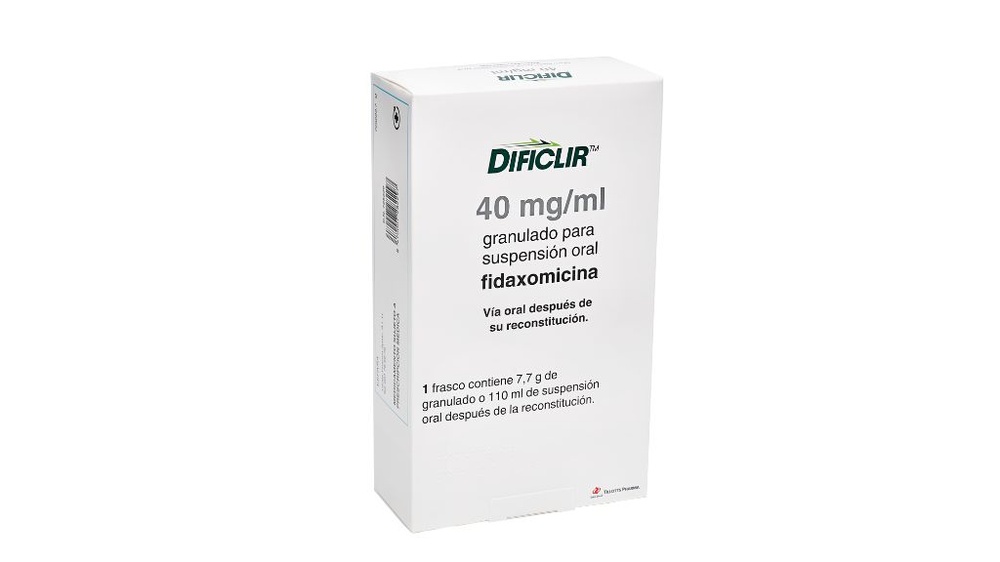
DIFICLIR 40 mg /Ml Granulado Para Suspensión Oral

Revisión de receta online
Un médico revisará tu caso y determinará si la prescripción es médicamente apropiada.

Habla con un médico sobre este medicamento
Comenta tus síntomas y las opciones de tratamiento en una consulta online.



Cómo usar DIFICLIR 40 MG/ML GRANULADO PARA SUSPENSION ORAL
Contenido del prospecto
- Introducción
- Qué es DIFICLIR y para qué se utiliza
- Qué necesita saber antes de empezar a tomar DIFICLIR
- Cómo tomar DIFICLIR
- Posibles efectos adversos
- Conservación de DIFICLIR
- Contenido del envase e información adicional
Introducción
Prospecto: información para el usuario
DIFICLIR 40 mg/ml granulado para suspensión oral
fidaxomicina
Lea todo el prospecto detenidamente antes de empezar a tomar este medicamento, porque contiene información importante para usted.
- Conserve este prospecto, ya que puede tener que volver a leerlo.
- Si tiene alguna duda, consulte a su médico o farmacéutico.
- Este medicamento se le ha recetado solamente a usted, y no debe dárselo a otras personas aunque tengan los mismos síntomas que usted, ya que puede perjudicarles.
- Si experimenta efectos adversos, consulte a su médico o farmacéutico, incluso si se trata de efectos adversos que no aparecen en este prospecto. Ver sección 4.
Contenido del prospecto
- Qué es DIFICLIR y para qué se utiliza
- Qué necesita saber antes de empezar a tomar DIFICLIR
- Cómo tomar DIFICLIR
- Posibles efectos adversos
- Conservación de DIFICLIR
- Contenido del envase e información adicional
1. Qué es DIFICLIR y para qué se utiliza
DIFICLIR es un antibiótico que contiene el principio activo fidaxomicina.
DIFICLIR en suspensión oral se utiliza en adultos, adolescentes y niños desde el nacimiento hasta menos de 18 años, para tratar infecciones del revestimiento del colon (intestino grueso) por unas bacterias denominadas Clostridioides difficile. Esta enfermedad grave puede provocar una diarrea intensa y dolorosa. DIFICLIR actúa matando las bacterias que causan la infección y ayuda a reducir la diarrea asociada.

¿No estás seguro de si este medicamento es adecuado para ti?
Comenta tus síntomas y tratamiento con un médico online.
2. Qué necesita saber antes de empezar a tomar DIFICLIR
No tome DIFICLIR
- Si es alérgico a fidaxomicina o a alguno de los demás componentes de este medicamento (incluidos en la sección 6).
Advertencias y precauciones
Consulte a su médico o farmacéutico antes de empezar a tomar DIFICLIR.
Si cree que puede tener una reacción alérgica grave como dificultad para respirar (disnea), inflamación de la cara o la garganta (angioedema), erupción grave, picazón (prurito) grave, o ronchas graves (urticaria), interrumpa el tratamiento con DIFICLIR y acuda urgentemente a su médico, farmacéutico o al servicio de urgencias de su hospital (ver sección 4).
Si es alérgico a los macrólidos (un tipo de antibiótico), consulte a su médico antes de usar este medicamento. Su médico le dirá si este medicamento es apropiado para usted.
Si tiene problemas de hígado o de riñón, consulte a su médico antes de usar este medicamento. Su médico le dirá si este medicamento es apropiado para usted.
Se dispone de datos limitados sobre el uso de fidaxomicina en casos graves de la enfermedad (p. ej. colitis pseudomembranosa). Su médico sabrá si su enfermedad está dentro de las categorías graves y le indicará si este medicamento es apropiado para usted.
Otros medicamentos y DIFICLIR
Informe a su médico o farmacéutico si está utilizando, ha utilizado recientemente o pudiera tener que utilizar cualquier otro medicamento.
Los niveles en sangre de DIFICLIR se pueden ver afectados por otros medicamentos que toma, y los niveles en sangre de otros medicamentos se pueden ver afectados por la toma de DIFICLIR. Algunos ejemplos de dichos medicamentos son:
- ciclosporina (un medicamento utilizado para inhibir las reacciones inmunitarias del organismo que se utiliza, por ejemplo, después de un trasplante de órgano o de médula ósea, para la psoriaris o el eczema, o para la artritis reumatoide o el síndrome nefrótico)
- ketoconazol (un medicamento utilizado para tratar las infecciones por hongos)
- eritromicina (un medicamento utilizado para tratar las infecciones de oído, nariz, garganta, pecho y piel)
- claritromicina (un medicamento utilizado para tratar las infecciones de pecho, las infecciones de garganta y senos, las infecciones de piel y tejidos y las infecciones por Helicobacter pyloriasociadas a úlcera duodenal o de estómago)
- verapamilo (un medicamento utilizado para tratar la tensión arterial alta o para prevenir ataques de dolor de pecho, o utilizado tras un ataque al corazón, para prevenir otro)
- dronedarona y amiodarona (medicamentos utilizados para controlar el latido cardíaco)
- dabigatrán etexilato (un medicamento utilizado para prevenir la formación de coágulos de
sangre después de cirugía de reemplazo de cadera o rodilla).
No debe usar DIFICLIR en combinación con alguno de estos medicamentos, a menos que su médico le indique lo contrario. Si usa alguno de estos medicamentos, por favor consulte a su médico antes de tomar este medicamento.
Embarazo y lactancia
No debe tomar DIFICLIR si está embarazada, a menos que su médico le indique lo contrario.
Esto se debe a que se desconoce si fidaxomicina puede perjudicar a su bebé.
Si está embarazada o cree que podría estar embarazada, consulte a su médico o farmacéutico antes de utilizar este medicamento.
Se desconoce si fidaxomicina pasa a la leche materna, aunque no se prevé que lo haga. Si está en periodo de lactancia, consulte a su médico o farmacéutico antes de utilizar este medicamento.
Conducción y uso de máquinas
No se prevé que DIFICLIR afecte a su capacidad para conducir, utilizar herramientas o máquinas.
DIFICLIR contiene benzoato de sodio (E211)
Este medicamento contiene 2,5 mg de benzoato de sodio (E 211) en cada ml de suspensión oral. El benzoato de sodio (E 211) puede aumentar el riesgo de ictericia (coloración amarillenta de la piel y los ojos) en los recién nacidos (hasta de 4 semanas de edad).
DIFICLIR contiene sodio
Este medicamento contiene menos de 1 mmol de sodio (23 mg) por 5 ml de suspensión; esto es, esencialmente “exento de sodio”.
3. Cómo tomar DIFICLIR
Siga exactamente las instrucciones de administración de este medicamento indicadas por su médico o farmacéutico. En caso de duda, consulte de nuevo a su médico o farmacéutico.
Su médico determinará la dosis en función de su peso.
La dosificación estándar para los pacientes que pesen al menos 12,5 kg es 200 mg (5 ml de suspensión oral) administrados dos veces al día (cada 12 horas) durante 10 días (ver el esquema 1 más abajo). Para los adultos y los niños mayores (p. ej., adolescentes) puede ser más adecuada otra formulación de este medicamento (comprimidos); consulte a su médico o farmacéutico.
Es posible que su médico le haya prescrito una dosificación alterna. La recomendación para una dosificación alterna es la administración dos veces al día durante los días 1-5. No tome la dosis el día 6, y luego una vez al día en días alternos durante los días 7 a 25 (ver también el esquema 2 a continuación).
Esquema 1 – Dosificación estándar
DÍA | 1 | 2 | 3 | 4 | 5 | 6 | 7 | 8 | 9 | 10 |
Mañana | 5 ml | 5 ml | 5 ml | 5 ml | 5 ml | 5 ml | 5 ml | 5 ml | 5 ml | 5 ml |
Noche | 5 ml | 5 ml | 5 ml | 5 ml | 5 ml | 5 ml | 5 ml | 5 ml | 5 ml | 5 ml |
Esquema 2 – Dosificación alterna
DÍA | 1 | 2 | 3 | 4 | 5 | |||||
Mañana | 5 ml | 5 ml | 5 ml | 5 ml | 5 ml | |||||
Noche | 5 ml | 5 ml | 5 ml | 5 ml | 5 ml | |||||
DÍA | 6 | 7 | 8 | 9 | 10 | 11 | 12 | 13 | 14 | 15 |
- | 5 ml | - | 5 ml | - | 5 ml | - | 5 ml | - | 5 ml | |
DÍA | 16 | 17 | 18 | 19 | 20 | 21 | 22 | 23 | 24 | 25 |
- | 5 ml | - | 5 ml | - | 5 ml | - | 5 ml | - | 5 ml |
5 ml - Dificlir 40 mg / ml granulado para suspensión oral
- No suspensión
La dosis recomendada para niños según su peso corporal es la siguiente:
Rango de peso del paciente | Mg por dosis (cada 12 horas) | Volumen de la suspensión oral de fidaxomicina (cada 12 horas) |
< 4,0 kg | 40 mg | 1 ml |
4,0 - < 7,0 kg | 80 mg | 2 ml |
7,0 - < 9,0 kg | 120 mg | 3 ml |
9,0 - < 12,5 kg | 160 mg | 4 ml |
≥ 12,5 kg | 200 mg | 5 ml |
Puede tomar DIFICLIR antes, durante o después de las comidas.
Cómo tomar la dosis de DIFICLIR utilizando una jeringa oral
Su farmacéutico o profesional sanitario preparará la suspensión oral de DIFICLIR antes de dársela a usted. Si no le han proporcionado el producto en forma de suspensión, contacte con su farmacéutico o profesional sanitario.
Instrucciones de uso:
Utilice la jeringa oral y el adaptador que le ha proporcionado su farmacéutico o profesional sanitario para asegurarse de medir la cantidad adecuada. Si no le han proporcionado una jeringa oral y un adaptador, contacte con su farmacéutico o profesional sanitario.
Su farmacéutico le informará sobre cómo medir el medicamento utilizando la jeringa oral. Lea las siguientes instrucciones antes de utilizar DIFICLIR en suspensión.
- Saque el frasco de la nevera 15 minutos antes de la administración.
- Después de 15 minutos, agítelo 10 veces con suavidad y déjelo reposar durante 1 minuto.
- Compruebe que el líquido tenga un aspecto uniforme y sin grumos (es decir, homogéneo).
- Retire el tapón y acople el adaptador al frasco siguiendo las instrucciones de su farmacéutico o profesional sanitario.
- Introduzca la punta de la jeringa oral en el adaptador hasta que quede firmemente colocada.
- Invierta el frasco tres veces y déjelo boca abajo, de manera que la jeringa se encuentre en la parte inferior.
- Tire del émbolo de la jeringa oral para extraer del frasco invertido el volumen de medicamento prescrito por el médico.
- Mantenga le jeringa unida y ponga el frasco boca arriba; teniendo cuidado de no mover el émbolo. Retire suavemente la jeringa del adaptador y confirme que ha medido la dosis apropiada.
- Administre lentamente la suspensión oral directamente en la boca del paciente hasta dispensar todo el líquido.
- Si dispone de un adaptador a presión, déjelo colocado en el cuello del frasco o siga las instrucciones de su farmacéutico o profesional sanitario.
- Tras la administración, guarde la suspensión restante en la nevera.
- Para poder reutilizar la jeringa oral, enjuáguela con agua potable tibia (3 veces como mínimo) o hasta que salga agua transparente de la jeringa. Seque lo mejor que pueda las superficies externas e internas. Deje secar hasta el siguiente uso.
Si empezó a utilizar este producto en un hospital, su farmacéutico o profesional sanitario le entregará la suspensión, la jeringa oral y el adaptador en el momento del alta.
Si toma más DIFICLIR del que debe
Si ha tomado más suspensión oral de la que debe tomar, consulte a un médico. Lleve el envase del medicamento consigo para que el médico pueda saber lo que ha tomado.
Si olvidó tomar DIFICLIR
Tome la suspensión oral en cuanto se acuerde, a no ser que sea la hora de la siguiente dosis. En este caso, sáltese la dosis olvidada. No tome una dosis doble para compensar las dosis olvidadas.
Si interrumpe el tratamiento con DIFICLIR
No deje de tomar DIFICLIR, a menos que su médico le haya recomendado hacerlo.
Siga tomando este medicamento hasta que finalice el tratamiento, incluso aunque se sienta mejor.
Si deja de tomar este medicamento demasiado pronto, la infección podría reaparecer.
Si tiene cualquier otra duda sobre el uso de este medicamento, pregunte a su médico o farmacéutico.

¿Has empezado a tomar el medicamento y tienes preguntas?
Comenta tus síntomas y tratamiento con un médico online.
4. Posibles efectos adversos
Al igual que todos los medicamentos, este medicamento puede producir efectos adversos, aunque no todas las personas los sufran.
Puede ocurrir una reacción alérgica grave, incluyendo dificultad para respirar (disnea), inflamación de la cara o la garganta (angioedema), erupción grave o picazón (prurito) grave (ver sección 2). Si dichas reacciones ocurren, interrumpa el tratamiento con DIFICLIR y acuda urgentemente a su médico, farmacéutico o al servicio de urgencias de su hospital.
Los efectos adversos más frecuentes(pueden afectar hasta 1 de cada 10 personas) son:
- vómitos
- náuseas
- estreñimiento.
Otros posibles efectos adversos son los siguientes:
Efectos adversos poco frecuentes(pueden afectar hasta 1 de cada 100 personas)
- disminución del apetito
- mareo, dolor de cabeza
- sequedad de boca, gusto alterado (disgeusia)
- sensación de estar lleno, gases (flatulencia)
- erupción, picazón (prurito)
Efectos adversos de frecuencia no conocida(la frecuencia no puede estimarse a partir de los datos disponibles)
- inflamación de la cara y la garganta (angioedema), dificultad para respirar (disnea)
Otros efectos adversos en niños y adolescentes
- ronchas
Comunicación de efectos adversos
Si experimenta cualquier tipo de efecto adverso, consulte a su médico o farmacéutico, incluso si se trata de posibles efectos adversos que no aparecen en este prospecto. También puede comunicarlos directamente a través del sistema nacional de notificación incluido en el Apéndice V. Mediante la comunicación de efectos adversos usted puede contribuir a proporcionar más información sobre la seguridad de este medicamento.
5. Conservación de DIFICLIR
Mantener este medicamento fuera de la vista y del alcance de los niños.
No utilice este medicamento después de la fecha de caducidad que aparece en el envase después de “CAD”. La fecha de caducidad es el último día del mes que se indica.
DIFICLIR se le proporcionará en forma de una suspensión que podrá conservar durante un máximo de 27 días. Conservar en nevera (entre 2 ºC y 8 ºC). No utilice la suspensión después de la fecha de caducidad escrita en la etiqueta del frasco.
Los medicamentos no se deben tirar por los desagües ni a la basura. Pregunte a su farmacéutico cómo deshacerse de los envases y de los medicamentos que ya no necesita. De esta forma, ayudará a proteger el medio ambiente.
6. Contenido del envase e información adicional
Composición de DIFICLIR
- El principio activo es fidaxomicina.
- Los demás componentes son: celulosa microcristalina, glicolato sódico de almidón, goma xantana, ácido cítrico, citrato de sodio, benzoato de sodio (ver sección 2), sucralosa y aroma de bayas mixta
Aspecto del producto y contenido del envase
DIFICLIR se presenta en un frasco de vidrio de color ámbar como un granulado para suspensión oral de color entre blanco y blanco amarillento. Su farmacéutico o profesional sanitario le proporcionará DIFICLIR en forma de suspensión de color entre blanco y blanco amarillento. El envase no contiene la jeringa oral ni el adaptador necesarios para administrar este producto. Ambos le serán facilitados por su farmacéutico u otro profesional sanitario.
DIFICLIR también está disponible en forma de comprimidos recubiertos con película.
Puede que solamente estén comercializados algunos tamaños de envases.
Titular de la autorización de comercialización
Tillotts Pharma GmbH
Warmbacher Strasse 80
79618 Rheinfelden
Alemania
Responsable de la fabricación
Almac Pharma Services Limited
Seagoe Industrial Estate, Portadown, Craigavon,
BT63 5UA,
Reino Unido
Tillotts Pharma GmbH
Warmbacher Strasse 80
79618 Rheinfelden
Alemania
Fecha de la última revisión de este prospecto:
La información detallada de este medicamento está disponible en la página web de la Agencia Europea de Medicamentos:http://www.ema.europa.eu
--------------------------------------------------------------------------------------------------------------------
Esta información está destinada únicamente a profesionales sanitarios:
Instrucciones de reconstitución:
- Agitar el frasco de vidrio para comprobar que el granulado se mueve libremente y que no está apelmazado.
- Medir 105 ml de agua purificada y añadirla al frasco de vidrio. Hay que tener en cuenta que no se ha establecido la estabilidad del granulado de fidaxomicina suspendido en agua mineral, agua del grifo u otros líquidos.
- Cerrar el frasco de vidrio y agitarlo enérgicamente durante al menos 1 minuto.
- Comprobar que en el líquido resultante no quedan grumos ni gránulos apelmazados en el fondo del frasco. Si se observan grumos o gránulos apelmazados, volver a agitar enérgicamente el frasco de vidrio durante al menos 1 minuto.
- Dejar reposar el frasco durante 1 minuto.
- Comprobar si la suspensión obtenida es homogénea.
- Escribir la fecha de caducidad de la suspensión reconstituida en la etiqueta del frasco (el periodo de validez de la suspensión reconstituida es de 27 días).
- Conservar el frasco a una temperatura comprendida entre 2 y 8 ºC antes y durante su uso.
- Elegir una jeringa oral y un adaptador del frasco adecuados para dispensar medicamentos líquidos a fin de medir la dosis correctamente.
Después de la reconstitución, la suspensión (110 ml) tendrá un color entre blanco y blanco amarillento.
El profesional sanitario debe elegir una jeringa oral y un adaptador disponibles en el mercado que sean adecuados para dispensar medicamentos líquidos y permitan al paciente o al cuidador medir la dosis correcta. El adaptador debe ser adecuado para utilizarlo junto con la jeringa oral seleccionada y encajar en el cuello del frasco (por ejemplo, un adaptador de frascos a presión de 27 mm o un adaptador de frascos universal).
Si el tratamiento con fidaxomicina se inicia en el entorno hospitalario y el paciente recibe el alta antes de finalizar el tratamiento en el hospital, se le deberá facilitar la suspensión oral junto a una jeringa oral y un adaptador adecuados. Los pacientes o sus cuidadores no deben preparar la suspensión oral en casa.
En la siguiente tabla se muestra la capacidad de la jeringa oral recomendada para medir la dosis de la suspensión oral.
Capacidad de la jeringa oral sugerida para una dispensación precisa
Volumen de dosificación prescrito | Capacidad de la jeringa oral recomendada |
1 ml | Jeringa oral de 1 ml |
2 – 5 ml | Jeringa oral de 5 ml |
Si es posible, se debe marcar o resaltar en la jeringa oral la graduación correspondiente a la dosis apropiada (de acuerdo con la tabla de dosificación de la sección 3).
Administración a través de tubo de alimentación enteral:
En caso de administración a través de un tubo de alimentación enteral, el profesional sanitario debe elegir un tubo de alimentación enteral disponible en el mercado adecuado. Los tubos de alimentación parenteral de polivinilcloruro (PVC) y poliuretano (PUR) han mostrado ser compatibles con la suspensión oral. En la siguiente tabla se muestra el tamaño del tubo de alimentación enteral y el volumen de lavado de agua recomendados.
Tamaño del tubo de alimentación enteral y volumen de lavado recomendados
Tamaño recomendado del tubo (diámetro) | Volumen de lavado recomendado * |
4 Fr | al menos 1 ml |
5 Fr | al menos 2 ml |
6 – 7 Fr | al menos 3 ml |
8 Fr | al menos 4 ml |
- En base a tubos de 120 cm
- País de registro
- Forma farmacéuticaSOLUCIÓN/SUSPENSIÓN ORAL, 40 mg/ml
- Código ATCA07AA12
- Principio activo
- Requiere recetaSí
- Fabricante
- ComposiciónCITRATO DE SODIO (E-331) (0.121 g mg), BENZOATO DE SODIO (E 211) (0.275 g mg)
- Esta información es de carácter general y no sustituye la consulta con un profesional sanitario.
- Alternativas a DIFICLIR 40 MG/ML GRANULADO PARA SUSPENSION ORALForma farmacéutica: COMPRIMIDO, 200 mg fidaxomicinaPrincipio activo: FidaxomicinaFabricante: Tillotts Pharma GmbhRequiere recetaForma farmacéutica: CAPSULA, 250 mgPrincipio activo: paromomycinFabricante: Pfizer S.L.Requiere recetaForma farmacéutica: SOLUCIÓN/SUSPENSIÓN ORAL, 100.000 UI nistatina/mlPrincipio activo: NistatinaFabricante: SubstipharmRequiere receta
Médicos online para DIFICLIR 40 MG/ML GRANULADO PARA SUSPENSION ORAL
Comenta la dosis, los posibles efectos secundarios, interacciones, contraindicaciones o la revisión de receta de DIFICLIR 40 MG/ML GRANULADO PARA SUSPENSION ORAL, sujeto a valoración médica y a la normativa local.









Obtén una receta de DIFICLIR 40 MG/ML GRANULADO PARA SUSPENSION ORAL online
Rellena un formulario de 2 minutos
Cuéntanos tus síntomas, historial y el medicamento que necesitas.
Elige un médico o nosotros te asignamos uno
Escoge un especialista o te conectamos con el próximo médico disponible.
El médico revisa tu caso
Normalmente en 30 minutos. Puede hacerte preguntas adicionales por chat.
Recógela en cualquier farmacia
Receta electrónica enviada a tu correo, válida en toda España.
Preguntas frecuentes
DIFICLIR 40 MG/ML GRANULADO PARA SUSPENSION ORAL requiere receta en España. Puedes confirmarlo con un médico online según tu caso.
El principio activo de DIFICLIR 40 MG/ML GRANULADO PARA SUSPENSION ORAL es Fidaxomicina. Esta información ayuda a identificar medicamentos con la misma composición pero con diferentes nombres comerciales.
DIFICLIR 40 MG/ML GRANULADO PARA SUSPENSION ORAL es fabricado por Tillotts Pharma Gmbh. La marca y el envase pueden variar según el distribuidor.
Los Médicos de familia, Psiquiatras, Dermatólogos, Cardiólogos, Endocrinólogos, Gastroenterólogos, Neumólogos, Nefrólogos, Reumatólogos, Hematólogos, Infectólogos, Alergólogos, Geriatras, Pediatras, Oncólogos pueden valorar la prescripción de DIFICLIR 40 MG/ML GRANULADO PARA SUSPENSION ORAL cuando esté clínicamente indicado. Puedes reservar una videoconsulta para comentar tu caso y las opciones de tratamiento.
España cuenta con una infraestructura sanitaria bien desarrollada en ciudades principales como Madrid, Barcelona, Valencia y Sevilla. Las farmacias están ampliamente disponibles y operan bajo estrictas regulaciones, garantizando el acceso a medicamentos con receta.
Puedes comprar DIFICLIR 40 MG/ML GRANULADO PARA SUSPENSION ORAL en Madrid, Barcelona, Sevilla o Valencia en cualquier farmacia local con una receta válida.
Para obtener una receta, puedes utilizar Oladoctor:
Otros medicamentos con el mismo principio activo (Fidaxomicina) incluyen DIFICLIR 200 MG COMPRIMIDOS RECUBIERTOS CON PELICULA, HUMATIN 250 MG CAPSULAS DURAS, MYCOSTATIN 100.000 UI/ml SUSPENSION ORAL. Pueden tener diferentes nombres comerciales o formulaciones, pero contienen el mismo componente terapéutico. Consulta siempre con un médico antes de cambiar o iniciar un nuevo medicamento.
