


Dexmedetomidina Altan 4 microgramos/ml solución para perfusión

Solicitud de receta online
Un médico revisará tu caso y determinará si la prescripción es médicamente apropiada.

Habla con un médico sobre este medicamento
Comenta tus síntomas y las opciones de tratamiento en una consulta online.



Cómo usar DEXMEDETOMIDINA ALTAN 4 MICROGRAMOS/ML SOLUCION PARA PERFUSION
Contenido del prospecto
- Introducción
- Qué es Dexmedetomidina Altan y para qué se utiliza
- Qué necesita saber antes de empezar a usar Dexmedetomidina Altan
- Cómo usar Dexmedetomidina Altan
- Posibles efectos adversos
- Conservación de Dexmedetomidina Altan
- Contenido del envase e información adicional
Introducción
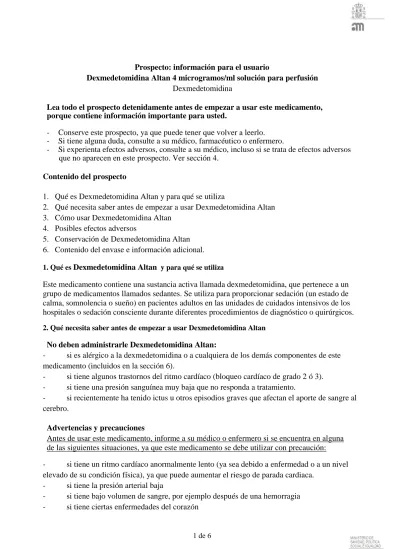
Prospecto: información para el usuario
Dexmedetomidina Altan 4 microgramos/ml solución para perfusión
Dexmedetomidina
Lea todo el prospecto detenidamente antes de empezar a usar este medicamento, porque contiene información importante para usted.
- Conserve este prospecto, ya que puede tener que volver a leerlo.
- Si tiene alguna duda, consulte a su médico, farmacéutico o enfermero.
- Si experienta efectos adversos, consulte a su médico, incluso si se trata de efectos adversos que no aparecen en este prospecto. Ver sección 4.
Contenido del prospecto
- Qué es Dexmedetomidina Altan y para qué se utiliza
- Qué necesita saber antes de empezar a usar Dexmedetomidina Altan
- Cómo usar Dexmedetomidina Altan
- Posibles efectos adversos
- Conservación de Dexmedetomidina Altan
- Contenido del envase e información adicional.
1. Qué es Dexmedetomidina Altan y para qué se utiliza
Este medicamento contiene una sustancia activa llamada dexmedetomidina, que pertenece a un grupo de medicamentos llamados sedantes. Se utiliza para proporcionar sedación (un estado de calma, somnolencia o sueño) en pacientes adultos en las unidades de cuidados intensivos de los hospitales o sedación consciente durante diferentes procedimientos de diagnóstico o quirúrgicos.

¿No estás seguro de si este medicamento es adecuado para ti?
Comenta tus síntomas y tratamiento con un médico online.
2. Qué necesita saber antes de empezar a usar Dexmedetomidina Altan
No deben administrarle Dexmedetomidina Altan:
- si es alérgico a la dexmedetomidina o a cualquiera de los demás componentes de este medicamento (incluidos en la sección 6).
- si tiene algunos trastornos del ritmo cardíaco (bloqueo cardíaco de grado 2 ó 3).
- si tiene una presión sanguínea muy baja que no responda a tratamiento.
- si recientemente ha tenido ictus u otros episodios graves que afectan el aporte de sangre al cerebro.
Advertencias y precauciones
Antes de usar este medicamento, informe a su médico o enfermero si se encuentra en alguna de las siguientes situaciones, ya que este medicamento se debe utilizar con precaución:
- si tiene un ritmo cardíaco anormalmente lento (ya sea debido a enfermedad o a un nivel elevado de su condición física), ya que puede aumentar el riesgo de parada cardiaca.
- si tiene la presión arterial baja
- si tiene bajo volumen de sangre, por ejemplo después de una hemorragia
- si tiene ciertas enfermedades del corazón
- si tiene una edad avanzada
- si tiene un trastorno neurológico (por ejemplo, lesiones de la cabeza o de la médula espinal o accidente cerebrovascular)
- si tiene problemas graves del hígado
- si alguna vez ha desarrollado una fiebre grave después de algunos medicamentos, especialmente los anestésicos
Este medicamento puede causar una gran cantidad de orina y sed excesiva, contacte a
un médico si ocurren estos efectos adversos. Consulte la sección 4 para más información.
Se ha observado un mayor riesgo de mortalidad en pacientes de 65 años o menos cuando usan este medicamento, especialmente en pacientes ingresados en la unidad de cuidados intensivos por razones distintas al cuidado postoperatorio, con una enfermedad más grave al ingresar a la unidad de cuidados intensivos y con una edad más joven. El médico decidirá si este medicamento sigue siendo adecuado para usted. El médico tendrá en cuenta los beneficios y riesgos de este medicamento para usted, en comparación con el tratamiento con otros sedantes.
Uso de Dexmedetomidina Altan con otros medicamentos
Informe a su médico o enfermero si está utilizando, ha utilizado recientemente o podría tener que utilizar cualquier otro medicamento.
Los siguientes medicamentos pueden aumentar el efecto de Dexmedetomidina Altan:
- medicamentos que ayudan a dormir o causan sedación (p.ej., midazolam, propofol)
- medicamentos para el dolor fuerte (p.ej., opioides como la morfina, codeína)
- medicamentos anestésicos (p.ej., sevoflurano, isoflurano)
Si usted está usando medicamentos que disminuyen la presión de su sangre y su frecuencia cardíaca, la administración conjunta con Dexmedetomidina Altan puede incrementar este efecto. Dexmedetomidina Altan no se debe usar con medicamentos que pueden causar parálisis temporal.
Embarazo y lactancia
Dexmedetomidina Altan no debe utilizarse durante el embarazo o la lactancia, a menos que sea claramente necesario. Consulte a su médico o farmacéutico antes de utilizar este medicamento.
Conducción y uso de máquinas
Dexmedetomidina Altan tiene un impacto importante en la habilidad para conducir y usar máquinas. Una vez se le haya administrado Dexmedetomidina Altan no debe conducir, operar máquinas o trabajar en situaciones peligrosas hasta que los efectos hayan pasado completamente. Consulte con su médico cuándo podrá retomar estas actividades y este tipo de trabajo.
Dexmedetomidina Altan contiene glucosa
Este medicamento contiene glucosa. Los pacientes con diabetes mellitus deben tener en cuenta que este medicamento contiene 5,5 g de glucosa por cada 100 ml.
3. Cómo usar Dexmedetomidina Altan
Cuidados Intensivos hospitalarios
Este medicamento se le administra por un médico o un enfermero en la unidad de cuidados intensivos de un hospital.
Sedación de procedimiento / sedación consciente
Dexmedetomidina Altan lo administra un médico o un enfermero antes y/o durante procedimientos de diagnóstico o quirúrgicos que requieren sedación, p. ej. sedación de procedimientos/sedación consciente.
Su médico decidirá la dosis adecuada para usted. La cantidad de Dexmedetomidina Altan depende de su edad, corpulencia, estado general de salud, el nivel de sedación necesario y cómo responde al medicamento. Su médico puede cambiar su dosis si es necesario y controlará su corazón y su presión arterial durante el tratamiento.
Dexmedetomidina Altan se le administra como una perfusión (goteo) en sus venas.
Después de la sedación/despertar
- Su médico le mantendrá bajo supervisión durante algunas horas tras la sedación, para asegurarse que usted se encuentra bien.
- No debe irse a casa si no va acompañado.
- Los medicamentos que ayudan a dormir, causan sedación a su vez aquellos destinados a calmar el dolor intenso puede que no estén recomendados durante un período de tiempo después del tratamiento con Dexmedetomidina Altan. Consulte con su médico sobre el uso de este tipo de medicamentos y sobre el uso de alcohol.
Si le han administrado más Dexmedetomidina Altan del que debe:
Si le han dado demasiado Dexmedetomidina Altan, su presión arterial puede subir o bajar, los latidos de su corazón pueden ser más lentos y se puede sentir más somnoliento. Su médico sabrá cómo tratarlo teniendo en cuenta su estado.
Si tiene cualquier otra duda sobre el uso de este medicamento, pregunte a su médico.

¿Has empezado a tomar el medicamento y tienes preguntas?
Comenta tus síntomas y tratamiento con un médico online.
4. Posibles efectos adversos
Al igual que todos los medicamentos, este medicamento puede producir efectos adversos, aunque no todas las personas los sufran.
Muy frecuentes (afectan a más de 1 de cada 10 personas)
- frecuencia cardíaca lenta
- presión arterial baja o alta
- cambio en el patrón respiratorio o detención de la respiración
Frecuentes (afectan entre 1 y 10 de cada 100 personas)
- dolor de pecho o ataque al corazón
- frecuencia cardíaca rápida
- niveles bajos o altos de azúcar
- náuseas, vómitos o sequedad en la boca
- inquietud
- temperatura alta
- síntomas después de dejar el medicamento
Poco frecuentes (afectan entre 1 y 10 de cada 1.000 personas)
- función del corazón disminuida, parada cardiaca.
- hinchazón del estómago
- sed
- una condición en la que hay demasiado ácido en el cuerpo
- nivel bajo de albúmina en la sangre
- dificultad para respirar
- alucinaciones
- el medicamento no es lo suficientemente eficaz.
Frecuencia no conocida (no puede estimarse a partir de los datos disponibles)
- gran cantidad de orina y sed excesiva – pueden ser síntomas de un trastorno hormonal llamado diabetes insípida. Contacte con un médico si esto ocurre.
Comunicación de efectos adversos
Si experimenta cualquier tipo de efecto adverso, consulte a su médico, farmacéutico o enfermero, incluso si se trata de posibles efectos adversos que no aparecen en este prospecto. También puede comunicarlos directamente a través del Sistema Español de Farmacovigilancia de Medicamentos de Uso Humano www.notificaRAM.es. Mediante la comunicación de efectos adversos usted puede contribuir a proporcionar más información sobre la seguridad de este medicamento.
5. Conservación de Dexmedetomidina Altan
Mantener este medicamento fuera de la vista y del alcance de los niños.
Este medicamento no requiere condiciones especiales de conservacion.
No use este medicamento después de la fecha de caducidad que aparece en el envase después de CAD. La fecha de caducidad es el último día del mes que se indica.
Su médico, enfermero o farmacéutico sabe cómo almacenar Dexmedetomidina Altan correctamente (ver sección 6).
Después de la primera apertura, Dexmedetomidina Altan debe usarse preferiblemente de inmediato.
Los medicamentos no se deben tirar por los desagües. Pregunte a su médico o farmacéutico cómo deshacerse de los envases y de los medicamentos que ya no necesita. De esta forma, ayudará a proteger el medio ambiente.
6. Contenido del envase e información adicional
Composición de Dexmedetomidina Altan
- El principio activo es la Dexmedetomidina. Cada ml contiene hidrocloruro de dexmedetomidina equivalente a 4 microgramos de dexmedetomidina.
- Los demás componentes son glucosa monohidrato y agua para preparaciones inyectables.
Aspecto del producto y contenido del envase
La dexmedetomidina se suministra en una bolsa como solución transparente e incolora. Una bolsa contiene 100 ml de solución.
Dexmedetomidina Altan 4 microgramos/ml de solución para perfusión está disponible en la siguiente presentaciones:
- Solución de 100 ml en una bolsa de polipropileno flexible de 100 ml con una sobrebolsa de aluminio
Cada bolsa de polipropileno contiene un punto para el llenado y cierre del puerto de la bolsa PVC libre y un puerto de administración PVC libre.
Tamaños de envases
Bolsa de polipropileno: 1 x 100 ml, 4 x 100 ml.
Puede que solamente estén comercializados algunos tamaños de envases.
Titular de la autorización de comercialización y responsable de la fabricación
Titular de la autorización de comercialización
Altan Pharmaceuticals S.A.
C/ Cólquide, Nº 6, Portal 2, 1ª Planta, Oficina F.
Edificio Prisma, Las Rozas, 28230 Madrid – España
Responsable de la fabricación
Altan Pharmaceuticals, S.A.
Polígono Industrial de Bernedo, s/n,
01118 Bernedo, Álava.- España
Fecha de la última revisión de este prospecto:Abril 2023
La información detallada de este medicamento está disponible en la página web de la Agencia Española de Medicamentos y Productos sanitarios (AEMPS) http://www.aemps.gob.es
----------------------------------------------------------------------------------------------------------
Esta información está destinada únicamente a profesionales del sector sanitario:
Dexmedetomidina Altan 4 microgramos/ml solución para perfusión
Forma de administración
Dexmedetomidina Altan se debe administrar por profesionales sanitarios expertos en el manejo de pacientes que requieren cuidados intensivos o en el manejo de la anestesia en pacientes en el quirófano.
- Dexmedetomidina Altan no debe diluirse antes de usar: se suministra listo para usar.
- Para uso único. Cualquier solución no utilizada debe desecharse. Solo se debe usar una solución transparente, libre de partículas e incolora.
- Dexmedetomidina debe administrarse solo como una infusión intravenosa utilizando un dispositivo para perfusión controlada.
- Dexmedetomidina no debe administrarse como una dosis en bolo.
Posología
Indicación 1. Para la sedación de pacientes adultos en la UCI (Unidad de Cuidados Intensivos) que no requieran un nivel de sedación más profundo que despertarse en respuesta a la estimulación verbal (correspondiente a un grado de 0 a -3 en la Escala de Sedación y Agitación de Richmond (RASS)).
Los pacientes que ya se encuentran intubados y sedados pueden cambiar a dexmedetomidina con una velocidad de perfusión inicial de 0,7 microgramos/kg/h, que luego puede ajustarse gradualmente dentro del rango de dosis de 0,2 a 1,4 microgramos/kg/h con el fin de alcanzar el nivel deseado de sedación, en función de la respuesta del paciente. Se debe considerar una velocidad de perfusión inferior para pacientes delicados. La dexmedetomidina es muy potente y la velocidad de perfusión se da por hora. Después de ajustar la dosis, no se alcanzará un nuevo estado de equilibrio hasta transcurrida una hora.
Dosis máxima:No se debe exceder la dosis máxima de 1,4 microgramos/kg/h. Los pacientes que no alcancen un nivel adecuado de sedación con la dosis máxima de dexmedetomidina deben cambiar a un agente sedante alternativo.
Indicación 2. Para la sedación de pacientes adultos no intubados, antes de y/o durante procedimientos diagnósticos o quirúrgicos que requieren una sedación, p. ej. para sedación de procedimiento/sedación consciente.
Inicio de la sedación de procedimiento:Una perfusión de carga de 1,0 microgramo/kg durante 10 minutos. Para procedimientos menos invasivos como la cirugía oftálmica, una perfusión de carga de 0,5 microgramos/kg administrados durante 10 minutos puede ser adecuada.
Mantenimiento de la sedación de procedimiento:La perfusión de mantenimiento se inicia generalmente a 0,6-0,7 microgramos/kg/hora y se ajusta para conseguir el efecto clínico deseado con dosis que oscilan de 0,2 a 1 microgramo/kg/hora. Se debe ajustar la tasa de la perfusión de mantenimiento para conseguir el nivel de sedación deseado.
Caducidad
La solución para perfusión debe usarse inmediatamente, después de la primera apertura.
- País de registro
- Forma farmacéuticaINYECTABLE PERFUSION, 4 µg/ml
- Código ATCN05CM18
- Principio activo
- Requiere recetaSí
- Fabricante
- ComposiciónGLUCOSA MONOHIDRATO (55 g mg)
- Esta información es de carácter general y no sustituye la consulta con un profesional sanitario.
- Alternativas a DEXMEDETOMIDINA ALTAN 4 MICROGRAMOS/ML SOLUCION PARA PERFUSIONForma farmacéutica: INYECTABLE PERFUSION, 100 microgramos dexmedetomidina/mlPrincipio activo: DexmedetomidinaFabricante: Orion CorporationRequiere recetaForma farmacéutica: INYECTABLE PERFUSION, 100 µg/mlPrincipio activo: DexmedetomidinaFabricante: Orion CorporationRequiere recetaForma farmacéutica: INYECTABLE PERFUSION, 100 microgramos dexmedetomidina/mlPrincipio activo: DexmedetomidinaFabricante: Orion CorporationRequiere receta
Médicos online para DEXMEDETOMIDINA ALTAN 4 MICROGRAMOS/ML SOLUCION PARA PERFUSION
Comenta la dosis, los posibles efectos secundarios, interacciones, contraindicaciones o si una receta es apropiada para DEXMEDETOMIDINA ALTAN 4 MICROGRAMOS/ML SOLUCION PARA PERFUSION, sujeto a valoración médica y a la normativa local.









Preguntas frecuentes
DEXMEDETOMIDINA ALTAN 4 MICROGRAMOS/ML SOLUCION PARA PERFUSION requiere receta en España. Puedes confirmarlo con un médico online según tu caso.
El principio activo de DEXMEDETOMIDINA ALTAN 4 MICROGRAMOS/ML SOLUCION PARA PERFUSION es Dexmedetomidina. Esta información ayuda a identificar medicamentos con la misma composición pero con diferentes nombres comerciales.
DEXMEDETOMIDINA ALTAN 4 MICROGRAMOS/ML SOLUCION PARA PERFUSION es fabricado por Altan Pharmaceuticals Sa. La marca y el envase pueden variar según el distribuidor.
Los Médicos de familia, Psiquiatras, Dermatólogos, Cardiólogos, Endocrinólogos, Gastroenterólogos, Neumólogos, Nefrólogos, Reumatólogos, Hematólogos, Infectólogos, Alergólogos, Geriatras, Pediatras, Oncólogos pueden valorar la prescripción de DEXMEDETOMIDINA ALTAN 4 MICROGRAMOS/ML SOLUCION PARA PERFUSION cuando esté clínicamente indicado. Puedes reservar una videoconsulta para comentar tu caso y las opciones de tratamiento.
La receta la emite un médico tras valorar tu estado de salud. En España, DEXMEDETOMIDINA ALTAN 4 MICROGRAMOS/ML SOLUCION PARA PERFUSION se dispensa en las farmacias con esa receta médica. Una consulta online no garantiza su emisión: la decisión corresponde siempre al médico.
Para solicitar una valoración puedes usar Oladoctor:
Otros medicamentos con el mismo principio activo (Dexmedetomidina) incluyen DEXDOR 100 MICROGRAMOS/ML CONCENTRADO PARA SOLUCION PARA PERFUSION (25X2 ml), DEXDOR 100 MICROGRAMOS/ML CONCENTRADO PARA SOLUCION PARA PERFUSION, DEXDOR 100 MICROGRAMOS/ML CONCENTRADO PARA SOLUCION PARA PERFUSION. Pueden tener diferentes nombres comerciales o formulaciones, pero contienen el mismo componente terapéutico. Consulta siempre con un médico antes de cambiar o iniciar un nuevo medicamento.
