



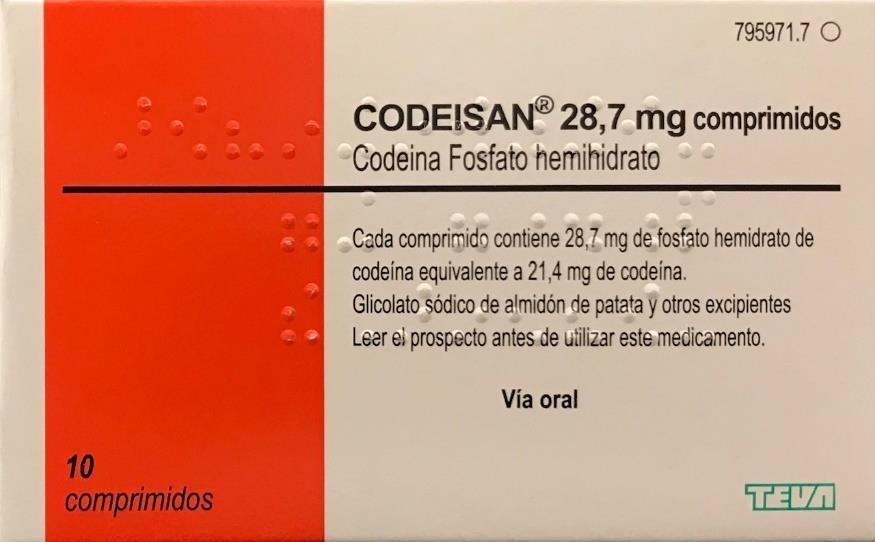
CODEISAN 28,7 mg COMPRIMIDOS

Revisión de receta online
Un médico revisará tu caso y determinará si la prescripción es médicamente apropiada.

Habla con un médico sobre este medicamento
Comenta tus síntomas y las opciones de tratamiento en una consulta online.



Cómo usar CODEISAN 28,7 mg COMPRIMIDOS
Contenido del prospecto
- Introducción
- Qué es Codeisan y para qué se utiliza
- Qué necesita saber antes de empezar a tomar Codeisan
- Cómo tomar Codeisan
- Posibles efectos adversos
- Conservación de Codeisan
- Contenido del envase e información adicional
Introducción
Prospecto: información para el usuario
Codeisan 28,7 mg comprimidos
codeína fosfato hemihidrato
Lea todo el prospecto detenidamente antes de empezar a tomar este medicamento, porque contiene información importante para usted.
- Conserve este prospecto, ya que puede tener que volver a leerlo.
- Si tiene alguna duda, consulte a su médico o farmacéutico.
- Este medicamento se le ha recetado solamente a usted y no debe dárselo a otras personas, aunque tengan los mismos síntomas, ya que puede perjudicarles.
- Si experimienta efectos adversos, consulte a su médico o farmacéutico, incluso si se trata de efectos adversos que no aparecen en este prospecto. Ver sección 4.
Contenido del prospecto:
- Qué es Codeisan y para qué se utiliza
- Qué necesita saber antes de empezar a tomar Codeisan
- Cómo tomar Codeisan
- Posibles efectos adversos
- Conservación de Codeisan
- Contenido del envase e información adicional
1. Qué es Codeisan y para qué se utiliza
El fosfato de codeína es una sal hidrosoluble de codeína. La codeína calma la tos (antitusígeno), por lo que se utiliza en el tratamiento sintomático de la tos improductiva (tos sin secreciones).
La codeína también se puede utilizar en niños de más de 12 años de edad para el tratamiento a corto plazo del dolor moderado que no se alivia por otros analgésicos como paracetamol o ibuprofeno solos.
Este medicamento contiene codeína. La codeína pertenece a un grupo de medicamentos llamados analgésicos opiáceos que actúan aliviando el dolor. Se puede utilizar sóla o en combinación con otros analgésicos como paracetamol.

¿No estás seguro de si este medicamento es adecuado para ti?
Comenta tus síntomas y tratamiento con un médico online.
2. Qué necesita saber antes de empezar a tomar Codeisan
No tome Codeisan
- si es alérgico a la codeína o a cualquiera de los demás componentes de este medicamento
(incluidos en la sección 6),
- si tiene problemas respiratorios (enfermedad pulmonar obstructiva crónica, ataques
agudos de asma o depresión respiratoria),
- si tiene ileo paralítico (obstrucción intestinal) o se encuentra en riesgo de tenerlo,
- si sufre diarrea asociada a colitis pseudomembranosa o diarrea causada por intoxicación,
- para aliviar el dolor en niños o adolescentes (0-18 años de edad) tras la extracción de las
- amigdalas o adenoides debido al síndrome de apnea del sueño obstructiva
- si tiene menos de 12 años de edad.
- si sabe que metaboliza muy rápido la codeína en morfina.
- si está en periodo de lactancia.
Advertencias y precauciones
Consulte a su médico o farmacéutico antes de empezar a tomar este medicamento.
- Si tiene problemas de corazón, pulmón, hígado, vesícula biliar o riñones, así como en casos de alteraciones de la próstata (hipertrofia prostática), estrechamiento de la uretra (estenosis uretral), insuficiencia adrenal (enfermedad de Addison), trastornos intestinales obstructivos o inflamatorios, colitis ulcerosa crónica, pancreatitis aguda, hipotiroidismo, esclerosis múltiple.
- La codeína se transforma en morfina en el hígado por una enzima. La morfina es la sustancia que produce el efecto de la codeína y alivia el dolor y los síntomas de la tos. Algunas personas tienen una variante de esta enzima que puede afectarles de manera distinta. En algunas personas, no se produce morfina o se produce en cantidades muy bajas, y no proporcionará suficiente alivio del dolor o de la tos. Otras personas son más propensas a sufrir reacciones adversas graves porque en ellas se produce una cantidad muy alta de morfina. Si sufre alguno de los siguientes efectos adversos, debe dejar de tomar este medicamento y debe buscar ayuda médica inmediatamente: respiración lenta o superficial, confusión, somnolencia, pupilas contraídas, malestar o sensación de malestar, estreñimiento, falta de apetito.
- Las personas de edad avanzada o debilitadas suelen ser más sensibles a los efectos y reacciones adversas de este medicamento especialmente a la depresión respiratoria.
- En caso de fuerte golpe en la cabeza (trauma craneal) y elevada presión en el interior del cerebro (intracraneal), la codeína puede aumentar la presión del líquido cefalorraquídeo pudiendo aumentar el efecto depresor respiratorio (respiración lenta o insuficiente).
- Al igual que otros opiáceos, la codeína puede inhibir el movimiento intestinal empeorando el estreñimiento en pacientes con estreñimiento crónico.
- Abuso y dependencia:La administración prolongada y excesiva de codeína puede ocasionar dependencia y/o tolerancia, especialmente en personas con tendencia al abuso y adicción. La codeína debe usarse con precaución en pacientes con antecedentes de abuso o dependencia de drogas. Después de tratamientos prolongados, debe interrumpir gradualmente la administración según le indique su médico.
- Este medicamento no se debe tomar durante más de tres días. Si el dolor no mejora después de tres días pida consejo a su médico.
Niños y adolescentes
- Uso en niños y adolescentes tras cirugía
No se debe utilizar codeína para el alivio del dolor en niños y adolescentes tras la extracción de amígdalas o adenoides debido al síndrome de apnea del sueño obstructiva.
- Uso en niños con problemas respiratorios
No se recomienda el uso de codeína en niños con problemas respiratorios, dado que los síntomas de la toxicidad de la morfina pueden ser peores en estos niños.
- Adolescentes mayores de 12 años de edad
No se recomienda el uso de codeína en adolescentes con problemas respiratorios para el tratamiento de la tos.
- No se recomienda el uso de codeína en niños en los que puedan existir problemas respiratorios como es el caso de trastornos neuromusculares, enfermedad respiratoria o del corazón grave, infecciones pulmonares o de las vías aéreas superiores, trauma múltiple o aquellos niños que hayan sido sometidos a procedimientos quirúrgicos extensos.
- Los menores de 12 años de edad presentan un mayor riesgo de sufrir reacciones adversas tras la administración de codeína; estas reacciones pueden resultar muy graves en los niños que degradan la codeína en gran cantidad o rápidamente (metabolizadores extensos o ultrarrápidos).
Uso de Codeisan con otros medicamentos
Informe a su médico o farmacéutico si está tomando, ha tomado recientemente o podría tener que tomar cualquier otro medicamento.
- Depresores del sistema nervioso central (SNC): La administración de codeína junto con otros fármacos depresores del SNC (como analgésicos narcóticos, ansiolíticos, antipsicóticos, bloqueantes neuromusculares, antidepresivos, antihistamínicos H1, neurolépticos, bloqueantes adrenérgicos) puede provocar depresión aditiva del SNC, por lo que deberá reducirse la dosis.
- El uso concomitante de codeína y medicamentos sedantes como las benzodiazepinas o medicamentos relacionados aumenta el riesgo de somnolencia, dificultad para respirar (depresión respiratoria), coma y puede ser potencialmente mortal. Debido a esto, el uso concomitante solo debe considerarse cuando otras opciones de tratamiento no son posibles.
Sin embargo, si su médico le prescribe codeína junto con medicamentos sedantes, su médico debe limitar la dosis y la duración del tratamiento concomitante.
Informe a su médico sobre todos los medicamentos sedantes que esté tomando y siga de cerca la recomendación de la dosis de su médico. Podría ser útil informar a amigos o familiares que estén al tanto de los signos y síntomas indicados anteriormente. Póngase en contacto con su médico cuando experimente dichos síntomas.
- El uso con agonistas opiáceos como la buprenorfina puede incrementar los efectos de la codeína. El uso con antagonistas opiáceos como la naltrexona puede retrasar los efectos de la codeína.
- La administración simultánea con anticolinérgicos puede provocar íleo paralítico y/o retención urinaria.
- El uso de antidepresivos como los inhibidores de la monoaminooxidasa (IMAO) o los antidepresivos tricíclicos, puede potenciar los efectos de la codeína o los antidepresivos.
- La administración de antihistamínicos como la hidroxizina pueden producir aumento de la analgesia y sedación.
Algunas fenotiazinas (utilizados para enfermedades nerviosas, mentales y emocionales) aumentan la analgesia inducida por codeína, mientras que otras la disminuyen.
Uso de Codeisan con alcohol
El consumo de alcohol puede incrementar la somnolencia por potenciar el efecto depresor de la codeína sobre el sistema nervioso central.
Embarazo, lactancia y fertilidad
Si está embarazada, cree que podría estar embarazada o tiene intención de quedarse embarazada, consulte a su médico o farmacéutico antes de utilizar este medicamento.
Embarazo
No se recomienda el uso de codeína durante el embarazo. Su uso puede causar dependencia física en el feto, lo que lleva a síntomas de abstinencia en el recién nacido.
Lactancia
No tome codeína si está en periodo de lactancia. La codeína y la morfina pasan a la leche materna.
Conducción y uso de máquinas
La codeína puede producir somnolencia alterando la capacidad mental y/o física requerida para la realización de actividades potencialmente peligrosas, como la conducción de vehículos o manejo de máquinas. Evite conducir vehículos o utilizar máquinas durante el tratamiento.
Uso en deportistas
Este medicamento contiene un componente que puede establecer un resultado analítico de control de opiáceos como positivo.
Codeisan contiene sodio
Este medicamento contiene menos de 1 mmol de sodio (23 mg) por comprimido; esto es, esencialmente “exento de sodio”.
3. Cómo tomar Codeisan
Siga exactamente las instrucciones de administración de este medicamento indicadas por su médico o farmacéutico. En caso de duda, consulte de nuevo a su médico o farmacéutico.
Las dosis deben ser individualizadas para cada paciente. La codeína se debe utilizar en la dosis efectiva más baja durante el menor tiempo posible. Esta dosis puede tomarse hasta 4 veces al día, a intervalos no inferiores a 6 horas. Se debe usar la dosis eficaz menor para controlar los síntomas.
La administración del medicamento está supeditada a la aparición de síntomas, pudiéndose reducir la dosificación a medida que vaya desapareciendo la sintomatología.
Este medicamento no se debe utilizar durante más de 3 días. Si el dolor no mejora después de 3 días, pida consejo a su médico.
Adultos
Analgésico:
La dosis recomendada es de 1 comprimido cada 6 horas.
Si no se obtiene el efecto analgésico deseado puede incrementarse la dosis a 2 comprimidos por toma, hasta un máximo de 6 comprimidos en 24 horas.
Antitusígeno:
La dosis recomendada es de 1 comprimido cada 6 horas.
Uso en niños y adolescentes
Este medicamento está contraindicado en niños menores de 12 años.
Niños de 12 años y mayores
Analgésico:
Los niños de 12 años de edad o mayores deben tomar 1 comprimido cada 6 horas, cuando sea necesario. Si no se obtiene el efecto analgésico deseado puede incrementarse la dosis a 2 comprimidos por toma, hasta un máximo de 6 comprimidos en 24 horas.
Los niños menores de 12 años de edad no deben tomar Codeisan, debido al riesgo de problemas respiratorios graves.
Población de edad avanzada
Debido a que estos pacientes pueden eliminar la codeína más lentamente puede ser necesario un reajuste posológico. Debe reducirse la dosis máxima diaria y aumentar el intervalo de administración. La dosis deberá ser individualizada para cada paciente.
La ranura sirve únicamente para partir el comprimido si le resulta difícil tragarlo entero.
Si toma más Codeisan del que debe:
En la intoxicación por codeína pueden aparecer los siguientes signos y síntomas:
- Depresión respiratoria
- Somnolencia que progresa a estupor o coma
- Flacidez musculo-esquelética
- Piel fría y viscosa
- Bradicardia (disminución de la frecuencia de los latidos)
- Hipotensión (disminución de la presión sanguínea)
- Miosis (contracción de las pupilas)
Y en la intoxicación grave:
- Apnea (falta de respiración), colapso circulatorio, parada cardíaca y muerte.
Tratamiento
- Reestablecer un intercambio respiratorio adecuado mediante una vía aérea permeable y ventilación asistida.
- Administración de carbón activado.
- La aspiración y lavado gástrico pueden resultar útiles para eliminar el fármaco no absorbido y deben ser seguidos de la administración de carbón activado.
La naloxona (que contrarresta el efecto de la codeína) es el antídoto contra la depresión respiratoria y debe administrarse por vía intravenosa a dosis adecuadas.
En caso de sobredosis o ingestión accidental, consultar al Servicio de Información
Toxicológica. Teléfono 91 562 04 20.
Si olvidó tomar Codeisan
No tome una dosis doble para compensar las dosis olvidadas. Continúe tomando su dosis normal cuando le toque.
Si interrumpe el tratamiento con Codeisan
Puede aparecer dependencia física y tolerancia con la administración repetida de este fármaco.
La administración debe suspenderse gradualmente tras su uso prolongado.
Si tiene cualquier otra duda sobre el uso de este medicamento, pregunte a su médico o farmacéutico.

¿Has empezado a tomar el medicamento y tienes preguntas?
Comenta tus síntomas y tratamiento con un médico online.
4. Posibles efectos adversos
Al igual que todos los medicamentos, este medicamento puede producir efectos adversos, aunque no todas las personas los sufran.
Los efectos adversos son generalmente leves. Por favor, sea consciente de que muchos de los efectos pueden ser síntomas de su enfermedad y por tanto mejoraran cuando usted empiece a encontrarse mejor.
Frecuencia no conocida (no puede estimarse a partir de los datos disponibles):
- Cambios de humor.
- Cefalea, somnolencia.
- Taquicardia, bradicardia y palpitaciones
- Hipotensión
- Depresión respiratoria
- Estreñimiento, nausea, vómitos, sequedad de boca, pancreatitis
- Prurito
- Vértigo
- Espasmos biliares
- Retención urinaria
Comunicación de efectos adversos:
Si experimenta cualquier tipo de efecto adverso, consulte a su médico o farmacéutico, incluso si se trata de posibles efectos adversos que no aparecen en este prospecto. También puede comunicarlos directamente a través del Sistema Español de Farmacovigilancia de
Medicamentos de Uso Humano: https://www.notificaram.es. Mediante la comunicación de efectos adversos usted puede contribuir a proporcionar más información sobre la seguridad de este medicamento.
5. Conservación de Codeisan
Mantener este medicamento fuera de la vista y del alcance de los niños.
No utilice este medicamento después de la fecha de caducidad que aparece en el envase después de CAD. La fecha de caducidad es el último día del mes que se indica.
No requiere condiciones especiales de conservación.
Mantener en el embalaje original perfectamente cerrado.
Los medicamentos no se deben tirar por los desagües ni a la basura. Deposite los envases y los medicamentos que no necesita en el Punto SIGRE de la farmacia. En caso de duda pregunte a su farmacéutico cómo deshacerse de los envases y de los medicamentos que no necesita. De esta forma ayudará a proteger el medio ambiente.
6. Contenido del envase e información adicional
Composición de Codeisan
El principio activo es fosfato de codeina hemihidrato (28,7 mg). Cada comprimido contiene
28,7 mg de fosfato de codeína equivalente a 21,4 mg de codeína.
Los demás componentes son: talco (E-553b), fosfato cálcico dibásico, celulosa microcristalina (E-460i), estearato de magnesio (E-470b), dióxido de sílice coloidal (E-551) y carboximetilalmidón sódico tipo A (de patata).
Aspecto del producto y contenido del envase
Codeisan son comprimidos redondos, planos y biselados de color blanco, con una cara grabada con C y la otra ranurada.
Codeisan se presenta en envases de 10 y 20 comprimidos.
Puede que solamente esten comercializados algunos tamaños de envases.
Titular de la autorización de comercialización
Teva Pharma S.L.U.
C/ Anabel Segura 11, Edificio Albatros B, 1ª planta
28108 Alcobendas- Madrid
Responsable de la fabricación
Teva Pharma S.L.U.
Polígono Malpica, C/ C, 4.
50016 Zaragoza
Fecha de la última revisión de este prospecto: Junio 2018
La información detallada y actualizada de este medicamento está disponible en la página Web
de la Agencia Española de Medicamentos y Productos Sanitarios (AEMPS)
http://www.aemps.gob.es/
- País de registro
- Forma farmacéuticaCOMPRIMIDO, 28,7 mg codeina fosfato hemihidrato
- Código ATCR05DA04
- Precio medio en farmacia4.48 EUR
- Principio activo
- Requiere recetaSí
- Fabricante
- ComposiciónCARBOXIMETILALMIDON SODICO (15 mg mg)
- Esta información es de carácter general y no sustituye la consulta con un profesional sanitario.
- Alternativas a CODEISAN 28,7 mg COMPRIMIDOSForma farmacéutica: SOLUCIÓN/SUSPENSIÓN ORAL, 6,33 mg codeina fosfafto hemihidrato/5 mlPrincipio activo: codeínaFabricante: Teva Pharma S.L.U.Requiere recetaForma farmacéutica: SOLUCIÓN/SUSPENSIÓN ORAL, 10 mgPrincipio activo: codeínaFabricante: Italfarmaco S.A.Requiere recetaForma farmacéutica: SOLUCIÓN/SUSPENSIÓN ORAL, 500 mg dextrometorfano hidrobromuroPrincipio activo: dextromethorphanFabricante: Pharminicio S.L.No requiere receta
Médicos online para CODEISAN 28,7 mg COMPRIMIDOS
Comenta la dosis, los posibles efectos secundarios, interacciones, contraindicaciones o la revisión de receta de CODEISAN 28,7 mg COMPRIMIDOS, sujeto a valoración médica y a la normativa local.









Obtén una receta de CODEISAN 28,7 mg COMPRIMIDOS online
Rellena un formulario de 2 minutos
Cuéntanos tus síntomas, historial y el medicamento que necesitas.
Elige un médico o nosotros te asignamos uno
Escoge un especialista o te conectamos con el próximo médico disponible.
El médico revisa tu caso
Normalmente en 30 minutos. Puede hacerte preguntas adicionales por chat.
Recógela en cualquier farmacia
Receta electrónica enviada a tu correo, válida en toda España.
Preguntas frecuentes
CODEISAN 28,7 mg COMPRIMIDOS requiere receta en España. Puedes confirmarlo con un médico online según tu caso.
El principio activo de CODEISAN 28,7 mg COMPRIMIDOS es codeína. Esta información ayuda a identificar medicamentos con la misma composición pero con diferentes nombres comerciales.
El precio medio en farmacia de CODEISAN 28,7 mg COMPRIMIDOS es de aproximadamente 4.48 EUR. Puede variar según el fabricante y la forma farmacéutica.
CODEISAN 28,7 mg COMPRIMIDOS es fabricado por Teva Pharma S.L.U.. La marca y el envase pueden variar según el distribuidor.
Los Médicos de familia, Psiquiatras, Dermatólogos, Cardiólogos, Endocrinólogos, Gastroenterólogos, Neumólogos, Nefrólogos, Reumatólogos, Hematólogos, Infectólogos, Alergólogos, Geriatras, Pediatras, Oncólogos pueden valorar la prescripción de CODEISAN 28,7 mg COMPRIMIDOS cuando esté clínicamente indicado. Puedes reservar una videoconsulta para comentar tu caso y las opciones de tratamiento.
España cuenta con una infraestructura sanitaria bien desarrollada en ciudades principales como Madrid, Barcelona, Valencia y Sevilla. Las farmacias están ampliamente disponibles y operan bajo estrictas regulaciones, garantizando el acceso a medicamentos con receta.
Puedes comprar CODEISAN 28,7 mg COMPRIMIDOS en Madrid, Barcelona, Sevilla o Valencia en cualquier farmacia local con una receta válida.
Para obtener una receta, puedes utilizar Oladoctor:
Otros medicamentos con el mismo principio activo (codeína) incluyen CODEISAN 1,26 mg/ml JARABE, TOSEINA 2 mg/ml SOLUCION ORAL, BICASAN 2 MG/ML JARABE. Pueden tener diferentes nombres comerciales o formulaciones, pero contienen el mismo componente terapéutico. Consulta siempre con un médico antes de cambiar o iniciar un nuevo medicamento.
