



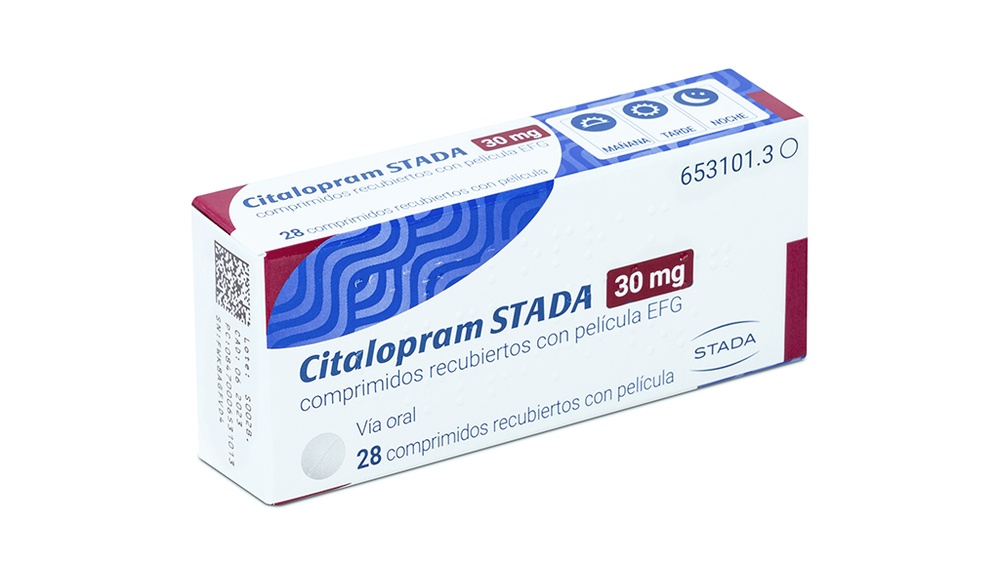
CITALOPRAM 30 mg Comprimidos Recubiertos Con Película

Revisión de receta online
Un médico revisará tu caso y determinará si la prescripción es médicamente apropiada.

Habla con un médico sobre este medicamento
Comenta tus síntomas y las opciones de tratamiento en una consulta online.



Cómo usar CITALOPRAM STADA 30 mg COMPRIMIDOS RECUBIERTOS CON PELICULA EFG
Contenido del prospecto
- Introducción
- Qué es Citalopram Stada y para qué se utiliza
- Qué necesita saber antes de empezar a tomar Citalopram Stada
- Cómo tomar Citalopram Stada
- Posibles efectos adversos
- Conservación de Citalopram Stada
- Contenido del envase e información adicional
Introducción
Prospecto: información para el usuario
Citalopram Stada 30 mg comprimidos recubiertos con película EFG
Lea todo el prospecto detenidamente antes de empezar a tomar este medicamento, porque contiene información importante para usted.
- Conserve este prospecto, ya que puede tener que volver a leerlo.
- Si tiene alguna duda, consulte a su médico o farmacéutico.
- Este medicamento se le ha recetado solamente a usted, y no debe dárselo a otras personas aunque tengan los mismos síntomas que usted, ya que puede perjudicarles.
- Si experimenta efectos adversos, consulte a su médico o farmacéutico incluso si se trata de efectos adversos que no aparecen en este prospecto. Ver sección 4.
Contenido del prospecto:
- Qué es Citalopram Stada y para qué se utiliza
- Qué necesita saber antes de empezar a tomar Citalopram Stada
- Cómo tomar Citalopram Stada
- Posibles efectos adversos
- Conservación de Citalopram Stada
- Contenido del envase e información adicional
1. Qué es Citalopram Stada y para qué se utiliza
Citalopram Stada es un medicamento antidepresivo que pertenece al grupo de los “inhibidores selectivos de la recaptación de serotonina” (ISRS). Estos medicamentos ayudan a corregir ciertos desequilibrios químicos en el cerebro, que causan los síntomas de su enfermedad.
Citalopram está indicado en:
- Tratamiento de la depresión y prevención de recaídas y recurrencias.
- Tratamiento del trastorno de angustia con o sin agorafobia.
- Tratamiento del trastorno obsesivo compulsivo (TOC).
Su médico, de todas formas, puede prescribirle citalopram para cualquier otro propósito. Pregunte a su médico si tiene alguna duda de por qué le ha prescrito citalopram.

¿No estás seguro de si este medicamento es adecuado para ti?
Comenta tus síntomas y tratamiento con un médico online.
2. Qué necesita saber antes de empezar a tomar Citalopram Stada
No tome Citalopram Stada
- Si es alérgico al citalopram o a alguno de los demás componentes de este medicamento (incluidos en la sección 6).
- Si está tomando otros medicamentos que pertenecen a un grupo llamado inhibidores de la monoaminooxidasa (IMAO). Los IMAO incluyen medicamentos como fenelzina, iproniazida, isocarboxazida, nialamida, tranilcipromina, selegilina (empleados en el tratamiento del Parkinson), moclobemida (utilizado para el tratamiento de la depresión) y linezolid (un antibiótico).
- Si padece desde el nacimiento algún tipo de alteración del ritmo del corazón o ha sufrido alguna vez algún episodio de este tipo (esto se observa con el electrocardiograma, una prueba que sirve para evaluar cómo funciona el corazón).
- Si está tomando medicamentos porque padece alguna enfermedad que altera el ritmo del corazón.
- Si está tomando medicamentos que pueden llegar a afectar el ritmo del corazón.
Consulte también la sección “Uso de Citalopram Stada con otros medicamentos” que se encuentra más abajo.
Incluso si usted ha terminado el tratamiento con IMAOs, necesitará esperar 2 semanas antes de iniciar su tratamiento con citalopram.
Debe transcurrir un día después de haber tomado moclobemida.
Después de terminar con citalopram, debe transcurrir una semana antes de tomar cualquier IMAO.
Advertencias y precauciones
Consulte a su médico o farmacéutico antes de empezar a tomar citalopram.
Por favor, informe a su médico si tiene usted cualquier otra condición o enfermedad ya que su médico puede tener que tomarlo en consideración. En particular, informe a su médico:
- Si tiene episodios maníacos o trastorno de angustia.
- Si padece insuficiencia hepática o renal. Su médico puede necesitar ajustar la dosis.
- Si padece diabetes. El tratamiento con citalopram puede alterar el control glucémico. Puede necesitar un ajuste de la dosis de insulina y/o de hipoglucemiantes orales.
- Si padece epilepsia. El tratamiento con citalopram debe suspenderse si se presentan convulsiones o si se produce un aumento en la frecuencia de las convulsiones (véase también la sección 4 "Posibles efectos adversos").
- Si tiene antecedentes de alteraciones hemorrágicas o si desarrolla hematomas inusuales o si está embarazada (ver “Embarazo, lactancia y fertilidad”).
- Si tiene un nivel disminuido de sodio en sangre.
- Si está recibiendo tratamiento electroconvulsivo.
- Si padece o ha padecido algún problema de corazón o ha sufrido recientemente un infarto cardiaco.
- Si cuando está en reposo su corazón late despacio (esto se conoce como bradicardia) y/o cree que su organismo puede estar teniendo pérdidas de sal, por ejemplo porque ha tenido diarrea y vómitos intensos durante varios días o porque ha usado diuréticos (medicamentos para orinar).
- Si ha notado que los latidos de su corazón son rápidos o irregulares o ha sufrido desmayos o mareos al incorporarse desde la posición de sentado o tumbado. Esto podría indicar que tiene alguna alteración del ritmo del corazón.
- Si tiene un problema con la dilatación de las pupilas oculares (midriasis).
- Si tiene o ha tenido problemas oculares anteriormente como ciertos tipos de glaucoma (aumento de la presión en el ojo).
Consulte a su médico, incluso si cualquiera de las circunstancias anteriormente mencionadas le hubiera ocurrido alguna vez.
Algunos medicamentos del grupo al que pertenece citalopram, (llamados ISRS/IRSN) pueden causar síntomas de disfunción sexual (ver sección 4). En algunos casos, estos síntomas persisten después de suspender el tratamiento.
Algunos pacientes con enfermedad maníacodepresiva pueden entrar en una fase maníaca. Esta se caracteriza por un cambio de ideas poco común y rápido, alegría desproporcionada y actividad física excesiva. Si usted experimenta esto, contacte con su médico.
Síntomas tales como inquietud o dificultad para sentarse o permanecer de pie (acatisia) también pueden ocurrir durante las primeras semanas del tratamiento. Informe a su médico inmediatamente si usted experimenta estos síntomas.
Información especial relacionada con su enfermedad
Al igual que otros medicamentos usados para tratar la depresión o enfermedades relacionadas, la mejoría no se alcanza inmediatamente. Después de iniciar el tratamiento con citalopram, pueden pasar varias semanas antes de que experimente alguna mejoría.
En el tratamiento del trastorno de angustia, normalmente, pasan 2-4 semanas antes de que se observe alguna mejoría.
Al inicio del tratamiento algunos pacientes pueden experimentar un aumento de la ansiedad, que desaparecerá con el tratamiento de continuación. Por tanto, es muy importante que siga exactamente las instrucciones de su médico y no interrumpa el tratamiento o cambie la dosis sin consultar a su médico.
Pensamientos suicidas y empeoramiento de su depresión o trastorno de ansiedad
Si usted se encuentra deprimido y/o sufre un trastorno de ansiedad, puede en algunas ocasiones tener pensamientos en los que se haga daño o se quite la vida. Éstos pueden ir aumentando al tomar antidepresivos por primera vez, puesto que todos estos medicamentos requieren un tiempo para empezar a hacer efecto, generalmente alrededor de unas dos semanas, aunque en algunos casos podría ser mayor el tiempo.
Ustedsería más propenso a tener este tipo de pensamientos:
- Si usted previamente ha tenido pensamientos en los que se quite la vida o se hace daño.
- Si usted es un adulto joven. Información de ensayos clínicos ha demostrado un aumento del riesgo de conductas suicidas en adultos jóvenes (menores de 25 años) con enfermedades psiquiátricas que fueron tratados con un antidepresivo.
Si en cualquier momento usted tiene pensamientos en los que se hace daño o se quite la vida, contacte a su médico o diríjase directamente a un hospital.
Puede ser de ayuda para usted decirle a un pariente o un amigo cercanoque usted está deprimido o que tiene un trastorno de ansiedad y pedirle que lea este prospecto. Puede preguntarles si piensan que su depresión o trastorno de ansiedad ha empeorado, o si están preocupados por los cambios en su actitud.
Niños y adolescentes
Citalopram no deberá utilizarse normalmente en el tratamiento de niños y adolescentes menores de 18 años. A la vez, debe saber que en pacientes menores de 18 años existe un mayor riesgo de efectos adversos como intentos de suicidio, ideas de suicidio y hostilidad (predominantemente agresión, comportamiento de confrontación e irritación) cuando ingieren esta clase de medicamentos. Pese a ello, el doctor que le corresponda puede prescribir citalopram a pacientes menores de 18 años cuando decida que es lo más conveniente para el paciente. Si el médico que le corresponda ha prescrito citalopram a un paciente menor de 18 años y desea discutir esta decisión, por favor, vuelva a su médico. Debe informar a su médico si alguno de los síntomas descritos anteriormente progresa o experimenta complicaciones cuando pacientes menores de 18 años están tomando citalopram. A la vez, los efectos a largo plazo por lo que a la seguridad se refiere y relativos al crecimiento, la madurez y el desarrollo cognitivo y conductual de citalopram en este grupo de edad todavía no han quedado demostrados.
Uso de Citalopram Stada con otros medicamentos
Informe a su médico o farmacéutico si está utilizando, ha utilizado recientemente o podría tener que utilizar cualquier otro medicamento.
Algunos medicamentos pueden afectar la acción de otros y ello puede causar a veces reacciones adversas graves.
Informe a su médico si está utilizando alguno de los siguientes medicamentos:
- Inhibidores no selectivos de la monoaminooxidasa (IMAOs) conteniendo fenelzina, iproniazida, isocarboxazida, nialamida y tranilcipromina como sustancias activas. Si usted ha tomado alguno de estos medicamentos deberá esperar 14 días antes de empezar a tomar citalopram. Al finalizar el tratamiento con citalopram, usted deberá esperar 7 días antes de tomar alguno de estos medicamentos.
- Inhibidores selectivos reversibles MAO-A conteniendo moclobemida (utilizado para el tratamiento de la depresión).
- El antibiótico linezolid.
- Litio (utilizado para la profilaxis y el tratamiento del trastorno maniacodepresivo) y triptófano.
- Imipramina y desipramina (ambos usados para tratar la depresión).
- Inhibidores irreversibles MAO-B, conteniendo selegilina (utilizada para el tratamiento de la enfermedad de Parkinson); éstos aumentan el riesgo de efectos adversos. La dosis de selegilina no debe exceder de 10 mg al día.
- Metoprolol (utilizado para la presión sanguínea elevada y/o enfermedad cardiaca); los niveles sanguíneos de metoprolol se incrementan pero no se han observado signos del efecto aumentado o efectos adversos del metoprolol.
- Sumatriptán y medicamentos similares (utilizados para tratar la migraña) y tramadol y medicamentos similares (opioides, utilizados en el dolor grave) incrementan el riesgo de efectos adversos, si usted tiene algún síntoma inusual utilizando esta combinación, debe ver a su médico.
- Cimetidina, lansoprazol y omeprazol (utilizados para tratar la úlcera de estómago), fluconazol (utilizado para tratar infecciones por hongos), fluvoxamina (antidepresivo) y ticlopidina (utilizada para reducir el riesgo de accidente cerebrovascular). Los niveles de citalopram en sangre pueden estar aumentados, pero no se ha comunicado aumento de los efectos adversos de citalopram.
- Medicamentos que afectan la función plaquetaria (por ejemplo, algunos fármacos antipsicóticos, ácido acetilsalicílico (utilizado para el dolor), fármacos antiinflamatorios no esteroideos (utilizados para la artritis); aumentan ligeramente el riesgo de alteraciones hemorrágicas.
- Hierba de S. Juan (Hypericum perforatum) (un remedio a base de plantas medicinales utilizado para la depresión); la administración concomitante con citalopram puede aumentar el riesgo de efectos adversos.
- Mefloquina (utilizado para tratar la malaria), bupropión (utilizado para tratar la depresión) y tramadol (usado para tratar el dolor grave) debido a un posible riesgo de disminuir el umbral para las convulsiones.
- Neurolépticos (medicamentos para tratar esquizofrenia, psicosis), debido a un posible riesgo de disminuir el umbral para las convulsiones, y antidepresivos.
- Antiarrítmicos clase IA y III, antipsicóticos (p. ej. derivados de la fenotiazina, pimozida, haloperidol), antidepresivos tricíclicos, determinados agentes antimicrobianos (esparfloxacino, moxifloxacino, eritromicina IV, pentamidina, medicamentos contra la malaria particularmente halofantrina), ciertos antihistamínicos (astemizol, mizolastina).
- Medicamentos que disminuyen los niveles de potasio o magnesio en sangre ya que ello incrementa el riesgo de sufrir alteraciones del ritmo cardiaco, que suponen un riesgo para la vida. No tome citalopram si está tomando medicamentos porque usted ya padece alguna enfermedad que altera el ritmo del corazón o si está tomando medicamentos que por ellos mismos pudieran llegar a afectar el ritmo del corazón. Si tiene dudas sobre este tema consulte a su médico.
Toma de Citalopram Stada con alimentos, bebidas y alcohol
Citalopram puede tomarse con o sin alimentos (ver sección 3. “Cómo tomar Citalopram Stada”).
Se ha observado que citalopram no aumenta los efectos del alcohol. Sin embargo, es aconsejable evitar el consumo de alcohol durante el tratamiento con citalopram.
Embarazo, lactancia y fertilidad
Si está embarazada o en periodo de lactancia, cree que podría estar embarazada o tiene intención de quedarse embarazada, consulte a su médico o farmacéutico antes de utilizar este medicamento.
Las mujeres embarazadas no deben, normalmente tomar citalopram, ni las madres deben amamantar a sus bebés mientras toman este medicamento, a menos que usted y su médico hayan analizado los riesgos y beneficios implicados.
Si usted toma citalopram durante los últimos 3 meses de su embarazo y hasta la fecha del nacimiento, sea consciente que pueden observarse en el bebé recién nacido los siguientes efectos: dificultad respiratoria, piel azulada, ataques, cambios de la temperatura corporal, dificultades para alimentarse, vómitos, azúcar bajo en sangre, rigidez o flojedad muscular, reflejos intensos, temblores, inquietud, irritabilidad, letargo, lloro constante, somnolencia y dificultades para dormirse. Si su bebé recién nacido tiene alguno de estos síntomas, por favor, contacte con su médico inmediatamente.
Si toma citalopram en la etapa final del embarazo puede producirse un mayor riesgo de sangrado vaginal abundante poco después del parto, especialmente si tiene antecedentes de alteraciones hemorrágicas. Su médico o matrona deben saber que usted está tomando citalopram para poderle aconsejar.
Citalopram pasa a la leche materna en pequeña cantidad. Hay riesgo de efectos en el niño. Si está tomando citalopram informe a su médico antes de iniciar la lactancia.
Asegúrese que su matrona y/o médico están informados que está siendo tratada con citalopram.
Durante el embarazo, particularmente en los últimos 3 meses, medicamentos como citalopram pueden aumentar el riesgo de una enfermedad grave en recién nacidos, denominada hipertensión pulmonar persistente neonatal (HPPN), en la cual el bebé respira rápido y se pone azulado. Estos síntomas suelen empezar durante las primeras 24 h después del nacimiento. Si aparecen en su bebé debe contactar con su matrona y/o médico inmediatamente.
Citalopram ha demostrado reducir la calidad del esperma en modelos animales. Teóricamente, este efecto podría afectar la fertilidad, pero hasta la fecha no se ha observado su impacto en la fertilidad humana.
Conducción y uso de máquinas
Durante el tratamiento con citalopram puede que se sienta somnoliento o mareado. No conduzca ni maneje herramientas o máquinas hasta que sepa cómo le afecta el tratamiento con citalopram.
Citalopram Stada contiene lactosa
Este medicamento contiene lactosa. Si su médico le ha indicado que padece una intolerancia a ciertos azúcares, consulte con él antes de tomar este medicamento.
Citalopram Stadacontiene sodio
Este medicamento contiene menos de 1 mmol de sodio (23 mg) por comprimido; esto es, esencialmente “exento de sodio”.
3. Cómo tomar Citalopram Stada
Siga exactamente las instrucciones de administración de este medicamento indicadas por su médico o farmacéutico. En caso de duda, consulte de nuevo a su médico o farmacéutico.
Adultos
Depresión
La dosis de inicio recomendada es de 20 mg al día. Si así lo estima necesario, su médico podrá aumentarle esta dosis hasta alcanzar un máximo de 40 mg diarios.
Trastorno de angustia
La dosis de inicio recomendada es de 10 mg al día durante la primera semana antes de aumentarla a los 20-30 mg diarios. Si así lo estima necesario, su médico podrá subirle esta dosis hasta alcanzar un máximo de 40 mg diarios.
Trastorno obsesivo-compulsivo (TOC)
La dosis de inicio recomendada es de 20 mg al día. Si así lo estima necesario, su médico podrá aumentarle esta dosis hasta alcanzar un máximo de 40 mg diarios.
Pacientes de edad avanzada (mayores de 65 años)
En los pacientes de edad avanzada se debe iniciar el tratamiento con la mitad de la dosis recomendada, por ejemplo, 10-20 mg al día.
En términos generales los pacientes de edad avanzada no deben tomar más de 20 mg al día.
Pacientes con riesgos especiales
Los pacientes que tengan enfermedades del hígado no deben tomar más de 20 mg al día.
Uso en niños y adolescentes
Citalopram no debe administrarse a niños o adolescentes. Para información adicional, por favor ver la sección 2 “Qué necesita saber antes de empezar a tomar Citalopram Stada”.
Cómo y cuándo tomar Citalopram Stada
Citalopram se toma cada día como dosis única diaria.
Los comprimidos se pueden tomar en cualquier momento del día independientemente de las comidas. Los comprimidos deben ingerirse con un vaso de agua. No los mastique (tienen sabor amargo).
Duración del tratamiento
Como otros medicamentos para la depresión, el trastorno de angustia y el trastorno obsesivo-compulsivo, pueden ser necesarias algunas semanas antes de que usted encuentre alguna mejoría. Siga tomando citalopram incluso si pasa algún tiempo antes de que sienta alguna mejora en su enfermedad.
Nunca varíe la dosis del medicamento sin hablar antes con su médico.
La duración del tratamiento es individual, generalmente como mínimo 6 meses. Continúe tomando los comprimidos durante el tiempo recomendado por su médico. No deje de tomarlos incluso si se encuentra mejor a menos que se lo haya indicado su médico. La enfermedad de base puede persistir durante un período largo y si usted interrumpe su tratamiento demasiado pronto, sus síntomas pueden reaparecer.
Los pacientes con depresiones recurrentes se benefician del tratamiento de continuación, a veces durante varios años, para prevenir la aparición de nuevos episodios depresivos.
Si toma más Citalopram Stada del que debe
En caso de sobredosis o ingestión accidental, consulte inmediatamente a su médico o farmacéutico, o llame al Servicio de Información Toxicológica, teléfono: 91 562 04 20, indicando el medicamento y la cantidad ingerida. Se recomienda llevar el envase y el prospecto del medicamento al profesional sanitario.
Algunos de los síntomas de una sobredosis pueden incluir latidos irregulares del corazón con riesgo para la vida, convulsiones, cambios en el ritmo del corazón, somnolencia, coma, vómitos, temblores, disminución de la presión sanguínea, aumento de la presión sanguínea, náuseas (sentirse mareado), síndrome serotoninérgico (ver sección 4. “Posibles efectos adversos”), agitación, mareos, dilatación de las pupilas, sudoración, piel azulada, hiperventilación (aumento del ritmo respiratorio).
Si olvidó tomar Citalopram Stada
Si olvidó tomar una dosis, tome la siguiente dosis a la hora habitual. No tome una dosis doble para compensar las dosis olvidadas.
Si interrumpe el tratamiento con Citalopram Stada
No deje de tomar citalopram hasta que su médico le diga que lo haga. Cuando haya completado su período de tratamiento, por lo general se recomienda que la dosis de citalopram se reduzca gradualmente durante varias semanas.
La retirada brusca de la medicación puede producir algunos trastornos leves o transitorios tales como mareos, sensación de hormigueo, alteraciones del sueño (sueños intensos, pesadillas, incapacidad de dormir), sensación de ansiedad, dolor de cabeza, sensación de mareo (náuseas), vómitos, sudoración, sensación de inquietud o agitación, temblores, sentimiento de confusión o desorientación, sentimientos de emoción o irritación, diarrea (heces sueltas), alteraciones visuales, pulso rápido o palpitaciones.
Cuando haya terminado el periodo de su tratamiento, generalmente se recomienda que la dosis de citalopram sea reducida gradualmente durante un par de semanas en lugar de interrumpirla bruscamente.
Si tiene cualquier otra duda sobre el uso de este medicamento, pregunte a su médico o farmacéutico.

¿Has empezado a tomar el medicamento y tienes preguntas?
Comenta tus síntomas y tratamiento con un médico online.
4. Posibles efectos adversos
Al igual que todos los medicamentos, este medicamento puede producir efectos adversos, aunque no todas las personas los sufran.
Los efectos adversos suelen desaparecer después de algunas semanas de tratamiento. Por favor, tenga en cuenta que muchos de los efectos también pueden ser síntomas de su enfermedad y por lo tanto mejorarán cuando usted empiece a sentirse mejor.
Algunos pacientes han notificado los siguientes efectos adversos graves.
Si usted tiene alguno de los siguientes síntomas debe dejar de tomar citalopram y ver a su médico inmediatamente.
- Fiebre elevada, agitación, confusión, temblores y contracciones repentinas de músculos; pueden ser signos de una situación poco común denominada síndrome serotoninérgico que se ha notificado con el uso combinado de antidepresivos.
- Si nota hinchazón de la piel, lengua, labios o cara, o tiene dificultades respiratorias o de deglución (reacción alérgica).
- Sangrados inusuales incluyendo sangrados gastrointestinales.
Efectos adversos raros pero graves (pueden afectar hasta 1 de cada 1.000 personas):
Si usted tiene alguno de los siguientes síntomas debe dejar de tomar citalopram y acudir a su médico inmediatamente.
- Hiponatremia: nivel bajo de sodio en sangre que puede producir cansancio, confusión y contracción muscular.
- Latidos del corazón rápidos e irregulares o sensación de desmayo puesto que podrían ser síntomas de un problema grave del corazón conocido como Torsade de Pointes.
Los siguientes efectos adversos son, generalmente leves y, normalmente, desaparecen después de algunos días de tratamiento. Por favor, sea consciente de que varios de los efectos mencionados abajo pueden ser síntomas de su enfermedad y, por tanto, mejorarán cuando usted empiece a encontrarse mejor.
Si los efectos adversos son molestos o duran más que algunos días, consulte a su médico.
La sequedad de boca incrementa el riesgo de caries. Por tanto, debe cepillarse los dientes más a menudo de lo habitual.
Efectos adversos muy frecuentes (pueden afectar a más de 1 de cada 10 personas):
- Tendencia al sueño.
- Dificultad para dormir.
- Aumento de la sudoración.
- Sequedad de boca.
- Náuseas (sentirse mareado).
- Cefalea
Efectos adversos frecuentes (pueden afectar hasta 1 de cada 10 personas):
- Disminución del apetito.
- Agitación.
- Disminución de la conducta sexual.
- Ansiedad.
- Nerviosismo.
- Estado confusional.
- Sueños anormales.
- Temblores.
- Hormigueo o entumecimiento de manos o pies.
- Mareos.
- Alteración de la atención.
- Zumbidos en los oídos (tinnitus).
- Bostezos.
- Diarrea.
- Vómitos.
- Estreñimiento.
- Erupción.
- Dolor muscular y articular.
- Los hombres pueden experimentar problemas con la eyaculación y erección.
- Las mujeres pueden experimentar dificultad para alcanzar el orgasmo.
- Fatiga.
- Escozor en la piel.
- Disminución de peso.
Efectos adversos poco frecuentes (pueden afectar hasta 1 de cada 100 personas):
- Trastornos hemorrágicos cutáneos (aparición de hematomas con facilidad).
- Aumento del apetito.
- Agresividad.
- Despersonalización.
- Alucinaciones.
- Manía.
- Desmayos.
- Pupilas dilatadas.
- Latidos cardiacos rápidos.
- Latidos cardiacos lentos.
- Urticaria.
- Pérdida de pelo.
- Erupción cutánea.
- Sensibilidad a la luz.
- Dificultades para orinar.
- Hemorragia menstrual excesiva.
- Hinchazón de brazos y piernas.
- Aumento de peso.
Efectos adversos raros (pueden afectar hasta 1 de cada 1.000 personas):
- Convulsiones.
- Movimientos involuntarios.
- Alteraciones del gusto.
- Sangrado.
- Hepatitis.
- Fiebre.
Frecuencia no conocida (no puede estimarse a partir de los datos disponibles):
- Pensamientos de hacerse daño a sí mismo o pensamientos de quitarse la vida, véase también la sección "Advertencias y precauciones".
- Reducción de plaquetas en sangre, que aumenta el riesgo de sangrado o cardenales (hematoma).
- Hipersensibilidad (rash).
- Reacción alérgica grave que provoca dificultad para respirar o mareos.
- Incremento de la cantidad de orina excretada.
- Hipocaliemia: nivel bajo de potasio en sangre que puede producir debilidad muscular, contracciones o ritmo anormal del corazón.
- Crisis de angustia.
- Chirriar de dientes.
- Inquietud.
- Movimientos musculares anormales o rigidez.
- Acatisia (movimientos involuntarios de los músculos).
- Alteraciones de la visión.
- Presión sanguínea baja.
- Sangrado de la nariz.
- Trastornos hemorrágicos incluyendo sangrado de piel y mucosas (equimosis).
- Sangrado vaginal abundante poco después del parto (hemorragia posparto), ver “Embarazo, lactancia y fertilidad” en la sección 2 para más información.
- Hinchazón repentina de piel o mucosas.
- Erecciones dolorosas.
- Aumento de los niveles de hormona prolactina en sangre.
- Flujo de leche en hombres y en mujeres que no están en período de lactancia.
- Período menstrual irregular.
- Pruebas de la función hepática alteradas.
- Hipotensión ortostática (descenso importante de la tensión arterial que se produce cuando un individuo se pone de pie).
- Se ha observado un aumento del riesgo de fracturas óseas en pacientes tratados con este tipo de medicamentos.
- Ritmo cardiaco anormal.
Si experimenta efectos adversos, consulte a su médico o farmacéutico, incluso si se trata de efectos adversos que no aparecen en este prospecto.
Comunicación de efectos adversos
Si experimenta cualquier tipo de efecto adverso, consulte a su médico o farmacéutico, incluso si se trata de posibles efectos adversos que no aparecen en este prospecto. También puede comunicarlos a través del Sistema Español de Farmacovigilancia de Medicamentos de Uso Humano: https://www.notificaram.es. Mediante la comunicación de efectos adversos usted puede contribuir a proporcionar más información sobre la seguridad de este medicamento.
5. Conservación de Citalopram Stada
Mantener este medicamento fuera de la vista y del alcance de los niños.
Este medicamento no requiere condiciones especiales de conservación.
No utilice este medicamento después de la fecha de caducidad que aparece en el envase después de CAD. La fecha de caducidad es el último día del mes que se indica.
Los medicamentos no se deben tirar por los desagües ni a la basura. Deposite los envases y los medicamentos que no necesita en el Punto SIGRE de la farmacia. Pregunte a su farmacéutico cómo deshacerse de los envases y de los medicamentos que no necesita. De esta forma, ayudará a proteger el medio ambiente.
6. Contenido del envase e información adicional
Composición de Citalopram Stada
- El principio activo es citalopram (hidrobromuro). Cada comprimido contiene 30 mg de citalopram.
- Los demás componentes (excipientes) son: lactosa monohidrato, almidón de maíz sin gluten, celulosa microcristalina, copovidona, croscarmelosa de sodio, estearato de magnesio, hipromelosa, dióxido de titanio (E171) y triacetato de glicerol.
Aspecto del producto y contenido del envase
Citalopram Stada 30 mg son comprimidos recubiertos con película. Los comprimidos son blancos, redondos, recubiertos, lenticulares y con ranura en una cara. Se presenta en envases de 28 o 56 comprimidos.
Puede que solo estén comercializados algunos tamaños de envases.
Titular de la autorización de comercialización y responsable de la fabricación
Titular de la autorización de comercialización
Laboratorio STADA, S.L.
Frederic Mompou, 5
08960 Sant Just Desvern (Barcelona)
España
Responsable de la fabricación
Laboratorios Alter, S.A.
Mateo Inurria, 30
28036 Madrid
España
Fecha de la última revisión de este prospecto:septiembre 2024
La información detallada de este medicamento está disponible en la página web de la Agencia Española de Medicamentos y Productos Sanitarios (AEMPS) http://www.aemps.gob.es/
- País de registro
- Forma farmacéuticaCOMPRIMIDO, 30 mg citalopram
- Código ATCN06AB04
- Precio medio en farmacia7.68 EUR
- Principio activo
- Requiere recetaSí
- Fabricante
- ComposiciónLACTOSA HIDRATADA (121,200 mg mg), CROSCARMELOSA SODICA (4,500 mg mg)
- Esta información es de carácter general y no sustituye la consulta con un profesional sanitario.
- Alternativas a CITALOPRAM STADA 30 mg COMPRIMIDOS RECUBIERTOS CON PELICULA EFGForma farmacéutica: COMPRIMIDO, 20 MGPrincipio activo: citalopramFabricante: Laboratorios Alter S.A.Requiere recetaForma farmacéutica: COMPRIMIDO, 30 MGPrincipio activo: citalopramFabricante: Laboratorios Alter S.A.Requiere recetaForma farmacéutica: COMPRIMIDO, 10 MGPrincipio activo: citalopramFabricante: Aristo Pharma GmbhRequiere receta
Médicos online para CITALOPRAM STADA 30 mg COMPRIMIDOS RECUBIERTOS CON PELICULA EFG
Comenta la dosis, los posibles efectos secundarios, interacciones, contraindicaciones o la revisión de receta de CITALOPRAM STADA 30 mg COMPRIMIDOS RECUBIERTOS CON PELICULA EFG, sujeto a valoración médica y a la normativa local.







Obtén una receta de CITALOPRAM STADA 30 mg COMPRIMIDOS RECUBIERTOS CON PELICULA EFG online
Rellena un formulario de 2 minutos
Cuéntanos tus síntomas, historial y el medicamento que necesitas.
Elige un médico o nosotros te asignamos uno
Escoge un especialista o te conectamos con el próximo médico disponible.
El médico revisa tu caso
Normalmente en 30 minutos. Puede hacerte preguntas adicionales por chat.
Recógela en cualquier farmacia
Receta electrónica enviada a tu correo, válida en toda España.
Preguntas frecuentes
CITALOPRAM STADA 30 mg COMPRIMIDOS RECUBIERTOS CON PELICULA EFG requiere receta en España. Puedes confirmarlo con un médico online según tu caso.
El principio activo de CITALOPRAM STADA 30 mg COMPRIMIDOS RECUBIERTOS CON PELICULA EFG es citalopram. Esta información ayuda a identificar medicamentos con la misma composición pero con diferentes nombres comerciales.
El precio medio en farmacia de CITALOPRAM STADA 30 mg COMPRIMIDOS RECUBIERTOS CON PELICULA EFG es de aproximadamente 7.68 EUR. Puede variar según el fabricante y la forma farmacéutica.
CITALOPRAM STADA 30 mg COMPRIMIDOS RECUBIERTOS CON PELICULA EFG es fabricado por Laboratorio Stada S.L.. La marca y el envase pueden variar según el distribuidor.
Los Médicos de familia, Psiquiatras, Dermatólogos, Cardiólogos, Endocrinólogos, Gastroenterólogos, Neumólogos, Nefrólogos, Reumatólogos, Hematólogos, Infectólogos, Alergólogos, Geriatras, Pediatras, Oncólogos pueden valorar la prescripción de CITALOPRAM STADA 30 mg COMPRIMIDOS RECUBIERTOS CON PELICULA EFG cuando esté clínicamente indicado. Puedes reservar una videoconsulta para comentar tu caso y las opciones de tratamiento.
España cuenta con una infraestructura sanitaria bien desarrollada en ciudades principales como Madrid, Barcelona, Valencia y Sevilla. Las farmacias están ampliamente disponibles y operan bajo estrictas regulaciones, garantizando el acceso a medicamentos con receta.
Puedes comprar CITALOPRAM STADA 30 mg COMPRIMIDOS RECUBIERTOS CON PELICULA EFG en Madrid, Barcelona, Sevilla o Valencia en cualquier farmacia local con una receta válida.
Para obtener una receta, puedes utilizar Oladoctor:
Otros medicamentos con el mismo principio activo (citalopram) incluyen CITALOPRAM ALTER 20 mg COMPRIMIDOS RECUBIERTOS CON PELICULA EFG, CITALOPRAM ALTER 30 mg COMPRIMIDOS RECUBIERTOS CON PELICULA EFG, CITALOPRAM ARISTOGEN 10 MG COMPRIMIDOS RECUBIERTOS CON PELICULA EFG. Pueden tener diferentes nombres comerciales o formulaciones, pero contienen el mismo componente terapéutico. Consulta siempre con un médico antes de cambiar o iniciar un nuevo medicamento.
