


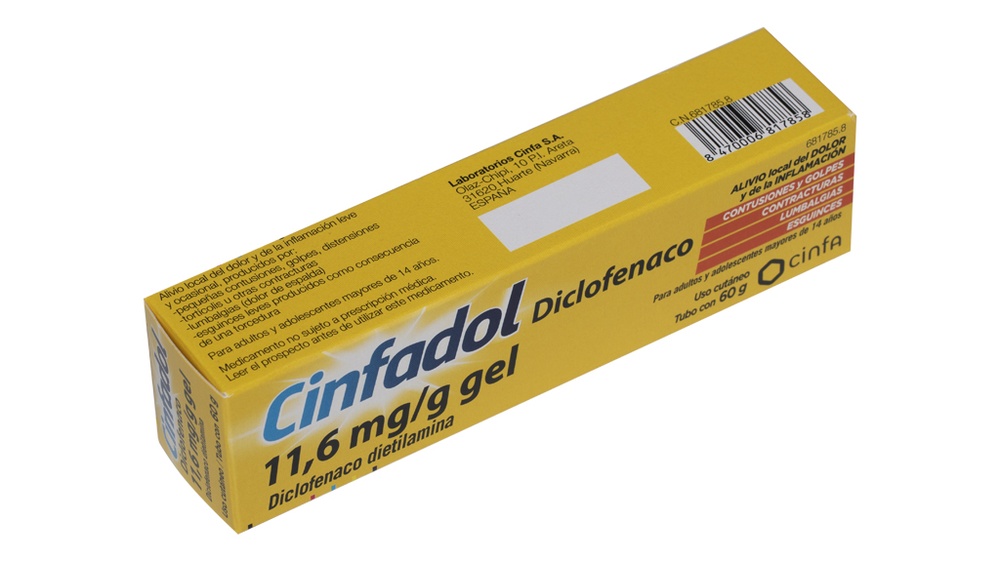
Cinfadol 11,6 mg/g gel

Revisión de receta online
Un médico revisará tu caso y determinará si la prescripción es médicamente apropiada.

Habla con un médico sobre este medicamento
Comenta tus síntomas y las opciones de tratamiento en una consulta online.



Cómo usar CINFADOL 11,6 MG/G GEL
Contenido del prospecto
- Introducción
- Qué es Cinfadol y para qué se utiliza
- Qué necesita saber antes de empezar a usar Cinfadol
- Cómo usar Cinfadol
- Posibles efectos adversos
- Conservación de Cinfadol
- Contenido del envase e información adicional
Introducción
Prospecto: información para el usuario
Cinfadol 11,6 mg/g gel
Diclofenaco dietilamina
Lea todo el prospecto detenidamente antes de empezar a usar este medicamento porque contiene información importante para usted.
Siga exactamente las instrucciones de administración del medicamento contenidas en este prospecto o las indicadas por su médico o farmacéutico.
- Conserve este prospecto, ya que puede tener que volver a leerlo.
- Si necesita consejo o más información, consulte a su farmacéutico.
- Si experimenta efectos adversos, consulte a su médico o farmacéutico, incluso si se trata de efectos adversos que no aparecen en este prospecto. Ver sección 4.
- Debe consultar a un médico si empeora o si no mejora después de 7 días.
Contenido del prospecto
- Qué es Cinfadol y para qué se utiliza
- Qué necesita saber antes de empezar a usar Cinfadol
- Cómo usar Cinfadol
- Posibles efectos adversos
- Conservación de Cinfadol
- Contenido del envase e información adicional
1. Qué es Cinfadol y para qué se utiliza
El diclofenaco dietilamina, principio activo de este medicamento, pertenece al grupo de los antiinflamatorios no esteroideos y actúa como analgésico y antiinflamatorio local.
Este medicamento está indicado en adultos y adolescentes mayores de 14 años para el alivio local del dolor y de la inflamación leve y ocasional, producidos por:
- pequeñas contusiones, golpes, distensiones,
- tortícolis u otras contracturas,
- lumbalgias (dolor de espalda),
- esguinces leves producidos como consecuencia de una torcedura.

¿No estás seguro de si este medicamento es adecuado para ti?
Comenta tus síntomas y tratamiento con un médico online.
2. Qué necesita saber antes de empezar a usar Cinfadol
No use Cinfadol
- si es alérgico al diclofenaco o a alguno de los demás componentes de este medicamento (incluidos en la sección 6),
- si alguna vez ha sufrido una reacción alérgica al diclofenaco o a cualquier otro medicamento antiinflamatorio no esteroideo utilizado en el tratamiento del dolor, la fiebre o la inflamación como el ibuprofeno o ácido acetilsalicílico (utilizado también para prevenir la coagulación de la sangre). Si no está seguro, consulte a su médico o farmacéutico.Los síntomas relacionados con una reacción alérgica a estos medicamentos pueden ser: asma, dificultad en la respiración, erupción cutánea o picor, hinchazón en la cara o en la lengua y goteo nasal,
- si está en los 3 últimos meses del embarazo,
- si es menor de 14 años,
- no aplicar sobre heridas, lesiones eccematosas, mucosas, ni en quemaduras.
Advertencias y precauciones
Consulte a su médico o farmacéutico antes de empezar a usar Cinfadol.
- No aplicar en lugares de la piel donde existan cortes o heridas abiertas, ni en las mucosas, ni sobre eczemas o lugares de la piel donde haya una erupción de la piel. Deje de utilizar el medicamento si se produce una erupción en la piel tras la aplicación.
- No utilizar en zonas extensas, utilizar exclusivamente en la zona afectada.
- Evite el contacto de Cinfadol con los ojos. Si esto ocurriera, aclare los ojos con agua limpia. Consulte a su médico o farmacéutico en caso de que sienta alguna molestia posterior.
- No utilizar vendajes oclusivos.
- No utilizar más cantidad del medicamento de la indicada, ni durante un periodo de tiempo superior al indicado, salvo por consejo de su médico.
- No aplicar simultáneamente Cinfadol en la misma zona en la que se hayan aplicado otros medicamentos.
- No ingerir este medicamento ni lo utilice en la boca. Se trata de un medicamento para uso externo únicamente. Consulte a su médico o farmacéutico en caso de ingestión accidental.
- Las zonas tratadas no deben exponerse al sol (aun estando nublado) ni a lámparas de radiaciones ultravioleta (rayos UVA).
- No utilizar durante el primer y segundo trimestre de embarazo salvo criterio médico.
Niños y adolescentes
Este medicamento no está recomendado para uso en niños y adolescentes menores de 14 años, debido a que no hay suficientes datos disponibles sobre seguridad y eficacia.
Uso de Cinfadol con otros medicamentos
Informe a su médico o farmacéutico si está utilizando, ha utilizado recientemente o pudiera tener que utilizar cualquier otro medicamento, especialmente analgésicos, incluso los adquiridos sin receta.
Embarazo y lactancia
Si está embarazada o en periodo de lactancia, cree que podría estar embarazada o tiene intención de quedarse embarazada, consulte a su médico o farmacéutico antes de utilizar este medicamento.
Embarazo
No use este medicamento si se encuentra en los 3 últimos meses de embarazo. No debe usar este medicamento durante los 6 primeros meses de embarazo, a menos que sea estrictamente necesario y lo recomiende su médico. Si necesita tratamiento durante este periodo, deberá tomar la dosis mínima posible durante el menor tiempo posible.
Las formulaciones para uso oral (p. ej., comprimidos) de diclofenaco pueden causar reacciones adversas al feto. Se desconoce si se aplica este mismo riesgo a diclofenaco cuando se utiliza sobre la piel.
Lactancia
Consulte a su médico o farmacéutico antes de utilizar cualquier medicamento.
En periodo de lactancia no use este medicamento, excepto que se lo haya indicado su médico, ya que el diclofenaco pasa a la leche materna en pequeñas cantidades. No debe aplicarse en ningún caso en madres en periodo de lactancia directamente sobre la zona del pecho ni en otras zonas, en áreas extensas de la piel durante periodos prolongados de tiempo.
Conducción y uso de máquinas
No se ha descrito ningún efecto sobre la capacidad para conducir vehículos y usar maquinaria cuando se usa externamente sobre la piel.
Cinfadol contiene propilenglicol
Este medicamento contiene 50 mg de propilenglicol en cada gramo.
El propilenglicol puede provocar irritación en la piel.
3. Cómo usar Cinfadol
Siga exactamente las instrucciones de administración del medicamento contenidas en este prospecto o las indicadas por su médico. En caso de duda, pregunte a su médico o farmacéutico.
Este medicamento es para aplicarlo únicamente sobre la piel (uso cutáneo).
La dosis recomendada es:
Adultosy adolescentes mayores de 14 años:
Aplicar 3 o 4 veces al día una pequeña cantidad de gel sobre la zona inflamada o dolorida.
La cantidad de gel variará dependiendo del tamaño de la zona afectada (normalmente, será suficiente aplicar una cantidad similar al tamaño de entre una cereza y una nuez).
Utilice la menor cantidad necesaria durante el menor tiempo que sea requerido.
Modo de utilización:
- Para la primera utilización del tubo, desenrosque el tapón. Introducir la parte posterior del tapón en la pieza que cierra el tubo. Girar el tapón hasta conseguir la apertura del tubo.
- Extienda una fina capa del gel sobre la zona de la piel donde exista el dolor y la inflamación, mediante un suave masaje.
- Cierre bien el tubo después de su utilización.
- Lávese las manos después de la aplicación del gel, a no ser que estas sean el área a tratar.
Si el dolor o la hinchazón empeoran o persisten después de 7 días de tratamiento, consulte con su médico.
Si usa másCinfadoldel que debe
Si ingiere accidentalmente Cinfadol o si lo ha utilizado sobre una gran zona de la piel y durante un largo período de tiempo, pueden ocurrir reacciones adversas similares a las producidas por el diclofenaco cuando se toma por vía oral (por ej. comprimidos).
Los síntomas principales por sobredosis son: trastornos digestivos o renales y dificultad para respirar.
Si ha aplicado demasiada cantidad del medicamento, se recomienda eliminarla lavando la zona afectada con abundante agua, o bien, retirando una parte.
En caso de sobredosis o ingestión accidental consulte inmediatamente a su médico o farmacéutico o llame al Servicio de Información Toxicológica, teléfono 91 562 04 20, indicando el medicamento y la cantidad ingerida.
Si olvidó usarCinfadol
Si olvidó aplicar este medicamento cuando correspondía, aplique el gel tan pronto como sea posible y continúe de manera normal el tratamiento.
No aplique una dosis doble para compensar las dosis olvidadas
Si interrumpe el tratamiento conCinfadol
Si tiene cualquier otra duda sobre el uso de este medicamento, pregunte a su médico o farmacéutico.

¿Has empezado a tomar el medicamento y tienes preguntas?
Comenta tus síntomas y tratamiento con un médico online.
4. Posibles efectos adversos
Al igual que todos los medicamentos, este medicamento puede producir efectos adversos, aunque no todas las personas los sufran.
Algunos efectos adversos raros y muy raros pueden ser graves:
Si usted experimenta alguno de los siguientes signos de alergia, deje de usar este medicamento y consulte con su médico o farmacéutico inmediatamente.
- Raros (pueden afectar hasta 1 de cada 1.000 pacientes): Erupción de la piel acompañada de ampollas; urticaria (ronchas rojizas, elevadas y a menudo con sensación de picor y quemazón).
- Muy raros (pueden afectar hasta 1 de cada 10.000 pacientes): Dificultad para respirar o sensación de presión en el pecho (asma); hinchazón en la cara, labios, lengua o garganta.
Efectos adversos no graves:
Pueden producirse otros efectos adversos pero estos suelen ser leves y de duración transitoria. Si nota alguno de ellos, consulte con su médico o farmacéutico lo antes posible.
- Frecuentes (pueden afectar hasta 1 de cada 10 pacientes): Erupción, picor, enrojecimiento o escozor en la piel después de usar el producto.
- Muy raros (pueden afectar hasta 1 de cada 10.000 pacientes): La piel pudiera ser más sensible a la luz del sol (fotosensibilidad). Los signos son: quemadura solar con picor, hinchazón y ampollas.
- Frecuencia no conocida (no puede estimarse a partir de los datos disponibles): Sensación de quemazón en el lugar de aplicación, piel seca.
Comunicación de efectos adversos
Si experimenta cualquier tipo de efecto adverso, consulte a su médico o farmacéutico, incluso si se trata de posibles efectos adversos que no aparecen en este prospecto. También puede comunicarlos directamente a través del Sistema Español de Farmacovigilancia de Medicamentos de Uso Humano https://www.notificaram.es. Mediante la comunicación de efectos adversos usted puede contribuir a proporcionar más información sobre la seguridad de este medicamento.
5. Conservación de Cinfadol
Mantener este medicamento fuera de la vista y del alcance de los niños.
No utilice este medicamento después de la fecha de caducidad que aparece en el envase después de CAD. La fecha de caducidad es el último día del mes que se indica.
No conservar a temperatura superior a 30ºC.
Una vez abierto, deseche el tubo con el gel restante al cabo de 12 meses.
Los medicamentos no se deben tirar por los desagües ni a la basura. Deposite los envases y los medicamentos que no necesita en el Punto SIGRE de la farmacia. En caso de duda, pregunte a su farmacéutico cómo deshacerse de los envases y de los medicamentos que no necesita. De esta forma, ayudará a proteger el medio ambiente.
6. Contenido del envase e información adicional
Composición de Cinfadol
- El principio activo es diclofenaco dietilamina. Cada gramo de gel contiene 11,6 mg de diclofenaco dietilamina, equivalentes a 10 mg de diclofenaco sódico.
- Los demás componentes son: propilenglicol, isopropanol, dietilamina, parafina líquida, polioxietileno alquil éter, carbómero 934P NF, coco-caprilato/caprato, perfume crema 1876601 y agua purificada.
Aspecto del producto y contenido del envase
Cinfadol se acondiciona en tubo de aluminio con tapón de rosca. El medicamento se presenta en tubos con 60 g y 100 g de gel.
Puede que solamente estén comercializados algunos tamaños de envases.
Titular de la autorización de comercialización y responsable de la fabricación
Titular de la autorización de comercialización
Laboratorios Cinfa, S.A.
Carretera Olaz-Chipi, 10. Polígono Industrial Areta
31620 Huarte (Navarra) - España
Responsable de la fabricación
Kern Pharma, S.L.
Polígono Ind.
Colón II C/ Venus 72
08228 Terrassa (Barcelona)
España
O
Laboratorios Cinfa, S.A.
Carretera Olaz-Chipi, 10. Polígono Industrial Areta
31620 Huarte (Navarra) - España
Fecha de la última revisión de este prospecto:Septiembre 2024
La información detallada y actualizada de este medicamento está disponible en la página web de la Agencia Española de Medicamentos y Productos Sanitarios (AEMPS) http://www.aemps.es/.
- País de registro
- Forma farmacéuticaGEL, 10 mg/g
- Código ATCM02AA15
- Principio activo
- Requiere recetaNo
- Fabricante
- ComposiciónPROPILENGLICOL (3,000 g mg)
- Esta información es de carácter general y no sustituye la consulta con un profesional sanitario.
- Alternativas a CINFADOL 11,6 MG/G GELForma farmacéutica: GEL, 23,2 mg/gPrincipio activo: DiclofenacoFabricante: Laboratorios Cinfa S.A.No requiere recetaForma farmacéutica: LIQUIDO USO TOPICO, 39,2 mg/mlPrincipio activo: DiclofenacoFabricante: Laboratorios Cinfa S.A.No requiere recetaForma farmacéutica: GEL, 1%Principio activo: DiclofenacoFabricante: Kern Pharma S.L.No requiere receta
Médicos online para CINFADOL 11,6 MG/G GEL
Comenta la dosis, los posibles efectos secundarios, interacciones, contraindicaciones o la revisión de receta de CINFADOL 11,6 MG/G GEL, sujeto a valoración médica y a la normativa local.
Preguntas frecuentes
CINFADOL 11,6 MG/G GEL no requiere receta en España. Puedes confirmarlo con un médico online según tu caso.
El principio activo de CINFADOL 11,6 MG/G GEL es Diclofenaco. Esta información ayuda a identificar medicamentos con la misma composición pero con diferentes nombres comerciales.
CINFADOL 11,6 MG/G GEL es fabricado por Laboratorios Cinfa S.A.. La marca y el envase pueden variar según el distribuidor.
Los Médicos de familia, Psiquiatras, Dermatólogos, Cardiólogos, Endocrinólogos, Gastroenterólogos, Neumólogos, Nefrólogos, Reumatólogos, Hematólogos, Infectólogos, Alergólogos, Geriatras, Pediatras, Oncólogos pueden valorar la prescripción de CINFADOL 11,6 MG/G GEL cuando esté clínicamente indicado. Puedes reservar una videoconsulta para comentar tu caso y las opciones de tratamiento.
La receta la emite un médico tras valorar tu estado de salud. En España, CINFADOL 11,6 MG/G GEL se dispensa en las farmacias con esa receta médica. Una consulta online no garantiza su emisión: la decisión corresponde siempre al médico.
Para solicitar una valoración puedes usar Oladoctor:
Otros medicamentos con el mismo principio activo (Diclofenaco) incluyen CINFADOL FORTE 23,2 MG/G GEL, CINFADOL SPRAY 39,2 MG/ML SOLUCIÓN PARA PULVERIZACIÓN CUTÁNEA, DICLOFENACO KERN PHARMA 11,6 mg/g GEL. Pueden tener diferentes nombres comerciales o formulaciones, pero contienen el mismo componente terapéutico. Consulta siempre con un médico antes de cambiar o iniciar un nuevo medicamento.
