



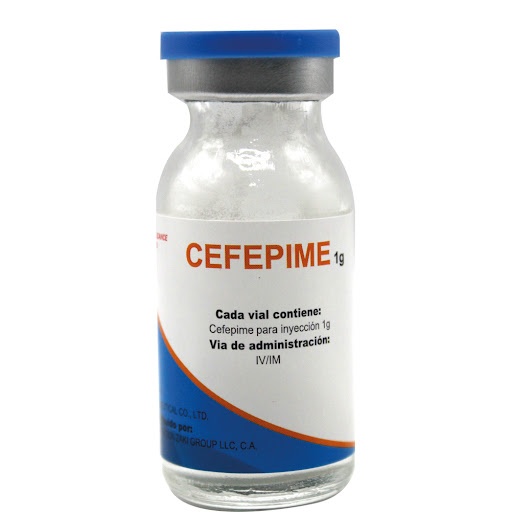
CEFEPIMA 1 g Solución inyectable

Revisión de receta online
Un médico revisará tu caso y determinará si la prescripción es médicamente apropiada.

Habla con un médico sobre este medicamento
Comenta tus síntomas y las opciones de tratamiento en una consulta online.



Cómo usar CEFEPIMA KABI 1G POLVO PARA SOLUCION INYECTABLE Y PARA PERFUSION EFG
Contenido del prospecto
- Introducción
- Qué es Cefepima Kabi y para qué se utiliza
- Qué necesita saber antes de empezar a usar Cefepima Kabi
- Cómo usar Cefepima Kabi
- Posibles efectos adversos
- Conservación de Cefepima Kabi
- Contenido del envase e información adicional
Introducción
PROSPECTO: INFORMACIÓN PARA EL USUARIO
CEFEPIMA KABI 1 g polvo para solución inyectable y para perfusión IV EFG
(cefepima)
Lea todo el prospecto detenidamente antes de empezar a usar el medicamento,
porque contiene información importante para usted.
- Conserve este prospecto, ya que puede tener que volver a leerlo.
- Si tiene alguna duda, consulte a su médico o farmacéutico.
- Si experimenta efectos adversos, consulte a su médico o farmacéutico, incluso si se
trata de posibles efectos adversos que no aparecen en este prospecto. Ver sección 4.
Contenido del prospecto:
- Qué es Cefepima Kabi y para qué se utiliza
- Qué necesita saber antes de empezar a usar Cefepima Kabi
- Cómo usar Cefepima Kabi
- Posibles efectos adversos
- Conservación de Cefepima Kabi
- Contenido del envase e información adicional
1. Qué es Cefepima Kabi y para qué se utiliza
Cefepima Kabi es un antibiótico usado para tratar infecciones en diferentes partes del
cuerpo producidas por bacterias. Pertenece a un grupo de antibióticos denominados
“cefalosporinas de cuarta generación”.
Los antibióticos se utilizan para tratar infecciones bacterianas y no sirven para tratar infecciones víricas como la gripe o el catarro. Es importante que siga las instrucciones relativas a la dosis, el intervalo de administración y la duración del tratamiento indicadas por su médico. No guarde ni reutilice este medicamento. Si una vez finalizado el tratamiento le sobra antibiótico, devuélvalo a la farmacia para su correcta eliminación. No debe tirar los medicamentos por el desagüe ni a la basura. |
La cefepima solamente actúa contra algunos tipos de bacterias, lo que significa que
solamente es apropiada para tratar algunos tipos de infecciones.
Cefepima Kabi puede tratar muchas clases de infecciones:
En adultos y niños mayores de 12 años, incluyendo:
- infecciones complicadas (graves) de vejiga y riñones (infecciones de las vías
urinarias)
- infecciones del pulmón (neumonía)
- infecciones complicadas (graves) en la cavidad abdominal
- inflamación de la membrana que envuelve la cavidad abdominal (peritonitis) asociada
con la diálisis en pacientes bajo diálisis peritoneal ambulatoria continua (CAPD)
En niños de dos meses hasta 12 años y con un peso corporal ≤ 40 kg incluyendo:
- infecciones complicadas (graves) de vejiga y riñones (infecciones de las vías
urinarias)
- infecciones del pulmón (neumonía)
La cefepima se puede usar en adultos y en niños mayores de dos meses, en el tratamiento de una invasión del torrente sanguíneo por bacterias (bacteriemia) que causada o que se sospeche que ha causado cualquiera de las infecciones mencionadas anteriormente.
La cefepima se puede usar en adultos y en niños mayores de dos meses, en el tratamiento
de pacientes neutropénicos (pacientes con bajas defensas) con fiebre que se sospecha que
podría ser debida a una infección bacteriana.

¿No estás seguro de si este medicamento es adecuado para ti?
Comenta tus síntomas y tratamiento con un médico online.
2. Qué necesita saber antes de empezar a usar Cefepima Kabi
No use Cefepima Kabi:
- si es alérgico (hipersensible) a:
? la cefepima o cualquiera de los demás componentes de este medicamento (incluidos en la sección 6)
? cualquier otro antibiótico tipo cefalosporina
- si ha tenido alguna vez una reacción alérgica aguda a otros antibióticos del
denominado tipo beta-lactámico (como la penicilina, también denominados
monobactamos y carbapenemos)
Si tiene cualquier duda, pregunte a su médico.
Informe a su médico antes de empezar a usar Cefepima Kabi
- si alguna vez ha tenido una reacción alérgicaa la cefepima o a otros antibióticos del
tipo beta-lactámicos o a cualquier medicamento. Si ha desarrollado una reacción
alérgica durante el tratamiento con Cefepima, deberá ponerse en contacto con su
médico inmediatamente, ya que podría ser grave. En ese caso, el médico suspenderá
el tratamiento inmediatamente.
- si ha sufrido alguna vez asmao una tendencia alérgica.
- si tiene problemas de riñón, es posible que se deba ajustar la dosis de Cefepima Kabi.
- si desarrolla diarrea grave y persistentedurante el tratamiento. Ello puede ser un
signo de una inflamación del intestino grueso y requiere intervención médica urgente.
- si sospecha que ha desarrollado una nueva infeccióndurante el uso prolongado de
Cefepima Kabi. Esto puede ser una infección por microorganismos no sensibles a la
cefepima y podría requerir la interrupción del tratamiento.
- si debe hacerse análisis de sangre u orina,es importante que comunique a su médico
que usa Cefepima Kabi. Este medicamento puede alterar los resultados de algunos
análisis.
Otros medicamentos y Cefepima Kabi
Informe a su médico o farmacéutico si está utilizando, ha utilizado recientemente o podría tener que tomar otros medicamentos. Esto es importante porque algunos
medicamentos no se deben tomar o usar junto con la cefepima.
En particular, informe a su médico si toma:
- cualquier otro antibiótico, especialmente aminoglucósidos (como gentamicina) o
diuréticos (como furosemida); en estos casos se deberá supervisar el funcionamiento
del riñón.
- medicamentos usados para impedir la coagulación de la sangre (anticoagulantes
cumarínicos, como la warfarina), su acción podría verse reforzada.
- ciertos tipos de antibióticos (antibióticos bacteriostáticos) pueden interferir con la
acción de la cefepima.
Embarazo y lactancia
Informe a su médico si está embarazada o piensa que puede estarlo antes de recibir
tratamiento con Cefepima Kabi. Ya que no hay ninguna información acerca del uso de
este medicamento durante el embarazo, es preferible evitar el uso de cefepima durante el
embarazo.
Pequeñas cantidades de este medicamento podrían pasar a la leche materna. Se le puede
administrar cefepima durante la lactancia, aunque deberá controlar si aparecen efectos
adversos en el lactante.
Si está embarazada o en periodo de lactancia, cree que podría estar embarazada o tiene intención de quedarse embarazada, consulte a su médico o farmacéutico antes de utilizar cualquier medicamento
Conducción y uso de máquinas
Mientras tome este medicamento, puede tener dolores de cabeza, convulsiones, vértigos, confusión o un estado alterado de la consciencia. En ese caso, no conduzca ni use ninguna máquina o herramienta.
3. Cómo usar Cefepima Kabi
Cefepima Kabi normalmente es administrada por un médico o una enfermera. Su
administración puede ser:
- por inyección lenta en una vena (intravenosa) o
- por perfusión (goteo) en una vena (perfusión intravenosa).
La dosis depende del tipo y de la gravedad de la infección. La dosis también depende de
la edad, del peso y de cómo funcionan sus riñones. Su médico se lo explicará.
Cefepima Kabi normalmente se administra de dos a tres veces al día.
La dosis habitual
- en adultos y adolescentes (mayores de 12 años) es de 4 a 6 gramos al día,
- en bebés y niños (de dos meses a 12 años) la dosis es de 100 a 150 miligramos por kg
de peso corporal al día
- la duración habitual de la terapiaes de 7 a 10 días.
- la dosis máxima para niños mayores de dos meses y adultos es de seis gramos al día.
Si usa más Cefepima Kabi del que debiera
Si cree que ha recibido más Cefepima Kabi del que debiera, informe a su médico
inmediatamente.
En caso de sobredosis o ingestión accidental, consulte inmediatamente a su médico o
farmacéutico o llame al Servicio de Información Toxicológica, teléfono: 91 562 04 20,
indicando el medicamento y la cantidad ingerida.
Si olvidó usar Cefepima Kabi
Si cree que ha olvidado una inyección o perfusión, hable con su médico.
Si interrumpe el tratamiento con Cefepima Kabi
Aunque se sienta mejor después de las primeras dosis, siga el tratamiento completo con
este medicamento. Si interrumpe el tratamiento con este medicamento demasiado pronto,
es posible que su infección no esté curada.
Si tiene cualquier otra duda sobre el uso de este medicamento, pregunte a su médico.

¿Has empezado a tomar el medicamento y tienes preguntas?
Comenta tus síntomas y tratamiento con un médico online.
4. Posibles efectos adversos
Al igual que todos los medicamentos este medicamento puede producir efectos adversos, aunque no todas las personas los sufran.
Los siguientes efectos secundarios son importantes y requerirán una acción inmediata en caso de que los sufra. Deberá interrumpir la administraciónde Cefepima Kabi y visitar a su médico inmediatamentesi aparecen los siguientes síntomas:
- Una inflamación del intestino grueso, denominada colitis pseudomembranosa (o colitis asociada a antibióticos); provoca una aguda diarrea acuosa duradera con calambres abdominales y fiebre (pueden afectar hasta 1 de cada 100 personas).
- Reacción alérgica aguda (denominada anafilaxis) asociada a la dificultad para respirar o ahogo repentino, hinchazón de cara o cuerpo, erupción, desmayo (pérdida de la conciencia) (pueden afectar hasta 1 de cada 1.000 personas).
- Erupción cutánea leve a moderada con erosiones y ampollas (eritema multiforme) (la frecuencia no puede ser estimada a partir de los datos disponibles).
- Inicio repentino de una erupción e inflamación aguda con formación de ampollas o
descamaciones de la piel, asociada a fiebre alta y articulaciones dolorosas (síndrome de
Stevens-Johnson) afectan a 1-10 personas de cada 10.000).
También se han descrito los siguientes efectos secundarios:
Muy frecuentes(pueden afectar a más de 1 de cada 10 personas).
- Falso positivo en la prueba para anticuerpos que causan la destrucción de glóbulos rojos
Frecuentes(pueden afectar hasta 1 de cada 10 personas).
- Reacciones alérgicas como erupción cutánea
- Diarrea
- Dolor, hinchazón e irritación del área de inyección/perfusión intravenosa (flebitis) e inflamación
de la vena (tromboflebitis)
- Alteración del recuento sanguíneo, incluyendo bajo número de glóbulos rojos (anemia)
y cambios en el número de leucocitos
- Alteración de valores de laboratorio especiales que indican insuficiencia hepática
Poco frecuentes(pueden afectar hasta 1 de cada 100 personas).
- Inflamación de la vagina
- Piel irritada, urticaria
- Dolor de cabeza, fiebre
- Náuseas y vómitos
- Aftas orales
- Aumento de algunos resultados de análisis de sangre (urea y creatinina) indicadores del funcionamiento del riñón
- Alteraciones del recuento sanguíneo (cambios en el número de algunos leucocitos y
plaquetas)
- Inflamación del área de perfusión
Raros(pueden afectar hasta 1 de cada 1000 personas).
- Trastorno de la percepción (parestesia), confusión, mareo, ataque epiléptico,
realteración del apetito
- Dificultades respiratorias
- Aftas
- Dolor abdominal, estreñimiento
- Ensanchamiento de vasos sanguíneos
- Escalofríos
No conocidos(la frecuencia no puede calcularse a partir de los datos disponibles)
- Reacción alérgica potencialmente mortal (shock anafiláctico)
- Alteración del recuento sanguíneo, disminución aguda en el número de glóbulos rojos (anemia) o glóbulos blancos (agranulocitosis)
- Disfunción cerebral, incluyendo un estado alterado de conciencia (estupor, coma), confusión, alucinaciones, movimientos de los músculos (mioclono)
- Insuficiencia renal (insuficiencia renal, nefropatía tóxica)
- Trastorno funcional del estómago y el intestino
- Sangrado de vasos sanguíneos dañados (hemorragia)
- Resultado positivo falso para la prueba de glucosa en orina
Comunicación de efectos adversos
Si experimenta cualquier tipo de efecto adverso, consulte a su médico o enfermera, incluso si se trata de posibles efectos adversos que no aparecen en este prospecto. También puede comunicarlos directamente a través del Sistema Español de Farmacovigilancia de medicamentos de Uso Humano: https://www.notificaram.es. Mediante la comunicación de efectos adversos usted puede contribuir a proporcionar más información sobre la seguridad de este medicamento.
5. Conservación de Cefepima Kabi
Mantener este medicamento fuera de la vista y del alcance de los niños.
No use este medicamento después de la fecha de caducidad que aparece en el envase,
después de CAD. La fecha de caducidad es el último día del mes que se indica.
No conservar a temperatura superior a 25°C.
Conservar el vial en el embalaje exterior para protegerlo de la luz.
Una vez preparada la solución con Cefepima Kabi en polvo, deberá usarla
inmediatamente. No use Cefepima Kabi si observa que la solución está turbia y
descolorida; deberá ser completamente transparente y entre incolora y amarilla ámbar.
Deberá desechar cualquier solución no utilizada.
“Los medicamentos no se deben tirar por los desagües ni a la basura. Deposite los
envases y los medicamentos que no necesita en el Punto SIGRE
de la farmacia. En
caso de duda pregunte a su farmacéutico cómo deshacerse de los envases y de los
medicamentos que no necesita. De esta forma, ayudará a proteger el medio ambiente.”
6. Contenido del envase e información adicional
Composición de Cefepima Kabi
El principio activo es cefepima en forma de cefepima dihidrocloruro monohidrato.El otro ingrediente es L-arginina.
Cada vial de cefepima Kabi 1 g polvo para solución inyectable o para perfusión contiene 1 g de cefepima (como 1189,2 mg de cefepima dihidrocloruro monohidrato).
Aspecto del producto y contenido del envase
Cefepima Kabi en polvo normalmente se mezcla con agua para preparaciones inyectables
o con otros líquidos apropiados para preparar una solución inyectable transparente en
vena (intravenosa) o una perfusión (goteo) en vena (perfusión intravenosa).
Una vez preparada, el médico puede mezclar la solución de Cefepima Kabi con otros
fluidos apropiados para perfusión.
Titular de la autorización de comercialización
FRESENIUS KABI ESPAÑA, S.A.U.
C/Marina 16-18
08005 – Barcelona (España)
Responsable de la fabricación
LABESFAL - Laboratorios Almiro S.A.
FRESENIUS KABI GROUP
3465-157 Santiago de Besteiros
PORTUGAL
Este medicamento está autorizado en los estados miembros del Espacio Económico Europeo con los siguientes nombres:
Bélgica, Países Bajos:Cefepim Fresenius Kabi 1 g, poeder voor oplossing voor injectie
of infusie;
Bulgaria:Cefepima Kabi 1 g polvo para solución inyectable o para perfusión; Cefepima
Kabi 2 g en polvo para solución inyectable o perfusión
Chipre, Grecia:Cefepima Kabi 1 g, κ?νις για δι?λυμα προς ?νεση ? ?γχυση;
España:Cefepima Kabi 1g polvo para solución inyectable o para perfusión EFG;
Polonia:Cefepim Kabi
Portugal: Cefepima Kabi
Rumanía:CEFEPIME KABI 1 g, pulbere pentru solutie injectabila sau perfuzabila;
Eslovenia:Cefepim Kabi 1 g prašek za raztopino za injiciranje ali infundiranje;
Este prospecto ha sido revisado en julio de 2015
“La información detallada y actualizada de este medicamento está disponible en la página
Web de la Agencia Española de Medicamentos y Productos Sanitarios (AEMPS) http://www.aemps.gob.es/ ”
<----------------------------------------------------------------------------------------------------------------------------------------
Esta información está destinada únicamente a médicos o profesionales del sector
sanitario:
Antes de su administración, es recomendable inspeccionar las soluciones parenterales
para verificar que están libres de partículas.
La solución podría cambiar de color tras su almacenamiento (de incoloro a amarillo
ámbar) sin que ello afecte a la potencia del producto.
Condiciones de conservación
Antes de su apertura:
No conservar a temperatura superior a 25°C.
Conservar el vial en el embalaje exterior para protegerlo de la luz.
Después de su reconstitución/dilución:
Las soluciones de cefepima se deberán usar inmediatamente después de su reconstitución.
Se ha demostrado la estabilidad química y física en uso durante dos horas a 25 ºC.
Desde el punto de vista microbiológico, la dilución debe utilizarse inmediatamente. Si no se utiliza inmediatamente, el tiempo y las condiciones de conservación antes de su uso son responsabilidad del usuario y por lo general no deberían superar las 24 horas a 2 - 8 ºC, a menos que la reconstitución se haya preparado en condiciones asépticas controladas y validadas.
Compatibilidades
Cefepima es compatible con los siguientes diluyentes y soluciones: cloruro de sodio 0,9%
(con o sin dextrosa 5%), dextrosa 10%, solución Ringer (con o sin dextrosa 5%), lactato
de sodio 6M.
Instrucciones para reconstitución, dilución y administración
Para la administración intravenosa directa, reconstituya Cefepima Kabi con agua para
preparaciones inyectables estéril, inyección de dextrosa al 5% o cloruro de sodio al 0,9%,
para los volúmenes mostrados en la siguiente tabla, “Preparación de soluciones de
cefepima”. La solución resultante se debe inyectar directamente en la vena en un
intervalo de 3 a 5 minutos o se debe inyectar en el tubo de un equipo para administrar
medicamentos mientras el paciente recibe un fluido IV compatible.
Para perfusiónintravenosa, reconstituya 1 g de solución de cefepima, tal como se ha
indicado anteriormente para la administración intravenosa directa; y añada una cantidad
apropiada de la solución resultante a un contenedor con un fluido IV compatible. El
tiempo de perfusión deberá ser de 30 minutos.
Preparación de soluciones de cefepima
Dosis y vía de administración | Volumen de diluyente que se debe agregar (ml) | Volumen disponible aproximado en el envase (ml) | Concentración aproximada de cefepima (mg/ml) |
I.V. Envase de vidrio de 1 g | 10 | 11,4 | 90 |
Eliminación
Los productos no usados y el material de desecho se deberán eliminar conforme a la
normativa local.
- País de registro
- Forma farmacéuticaINYECTABLE, 1000 mg
- Código ATCJ01DE01
- Principio activo
- Requiere recetaSí
- Fabricante
- Esta información es de carácter general y no sustituye la consulta con un profesional sanitario.
- Alternativas a CEFEPIMA KABI 1G POLVO PARA SOLUCION INYECTABLE Y PARA PERFUSION EFGForma farmacéutica: INYECTABLE, 2000 MGPrincipio activo: CefepimaFabricante: Fresenius Kabi España, S.A.U.Requiere recetaForma farmacéutica: INYECTABLE, 1000 mgPrincipio activo: CefepimaFabricante: Ldp Laboratorios Torlan S.A.Requiere recetaForma farmacéutica: INYECTABLE, 2000 mgPrincipio activo: CefepimaFabricante: Ldp Laboratorios Torlan S.A.Requiere receta
Médicos online para CEFEPIMA KABI 1G POLVO PARA SOLUCION INYECTABLE Y PARA PERFUSION EFG
Comenta la dosis, los posibles efectos secundarios, interacciones, contraindicaciones o la revisión de receta de CEFEPIMA KABI 1G POLVO PARA SOLUCION INYECTABLE Y PARA PERFUSION EFG, sujeto a valoración médica y a la normativa local.









Obtén una receta de CEFEPIMA KABI 1G POLVO PARA SOLUCION INYECTABLE Y PARA PERFUSION EFG online
Rellena un formulario de 2 minutos
Cuéntanos tus síntomas, historial y el medicamento que necesitas.
Elige un médico o nosotros te asignamos uno
Escoge un especialista o te conectamos con el próximo médico disponible.
El médico revisa tu caso
Normalmente en 30 minutos. Puede hacerte preguntas adicionales por chat.
Recógela en cualquier farmacia
Receta electrónica enviada a tu correo, válida en toda España.
Preguntas frecuentes
CEFEPIMA KABI 1G POLVO PARA SOLUCION INYECTABLE Y PARA PERFUSION EFG requiere receta en España. Puedes confirmarlo con un médico online según tu caso.
El principio activo de CEFEPIMA KABI 1G POLVO PARA SOLUCION INYECTABLE Y PARA PERFUSION EFG es Cefepima. Esta información ayuda a identificar medicamentos con la misma composición pero con diferentes nombres comerciales.
CEFEPIMA KABI 1G POLVO PARA SOLUCION INYECTABLE Y PARA PERFUSION EFG es fabricado por Fresenius Kabi España, S.A.U.. La marca y el envase pueden variar según el distribuidor.
Los Médicos de familia, Psiquiatras, Dermatólogos, Cardiólogos, Endocrinólogos, Gastroenterólogos, Neumólogos, Nefrólogos, Reumatólogos, Hematólogos, Infectólogos, Alergólogos, Geriatras, Pediatras, Oncólogos pueden valorar la prescripción de CEFEPIMA KABI 1G POLVO PARA SOLUCION INYECTABLE Y PARA PERFUSION EFG cuando esté clínicamente indicado. Puedes reservar una videoconsulta para comentar tu caso y las opciones de tratamiento.
España cuenta con una infraestructura sanitaria bien desarrollada en ciudades principales como Madrid, Barcelona, Valencia y Sevilla. Las farmacias están ampliamente disponibles y operan bajo estrictas regulaciones, garantizando el acceso a medicamentos con receta.
Puedes comprar CEFEPIMA KABI 1G POLVO PARA SOLUCION INYECTABLE Y PARA PERFUSION EFG en Madrid, Barcelona, Sevilla o Valencia en cualquier farmacia local con una receta válida.
Para obtener una receta, puedes utilizar Oladoctor:
Otros medicamentos con el mismo principio activo (Cefepima) incluyen CEFEPIMA KABI 2G POLVO PARA SOLUCION INYECTABLE Y PARA PERFUSION EFG, CEFEPIMA LDP- LABORATORIOS TORLAN 1 G POLVO PARA SOLUCION INYECTABLE Y PARA PERFUSION EFG, CEFEPIMA LDP- LABORATORIOS TORLAN 2 G POLVO PARA SOLUCION INYECTABLE Y PARA PERFUSION EFG. Pueden tener diferentes nombres comerciales o formulaciones, pero contienen el mismo componente terapéutico. Consulta siempre con un médico antes de cambiar o iniciar un nuevo medicamento.
