



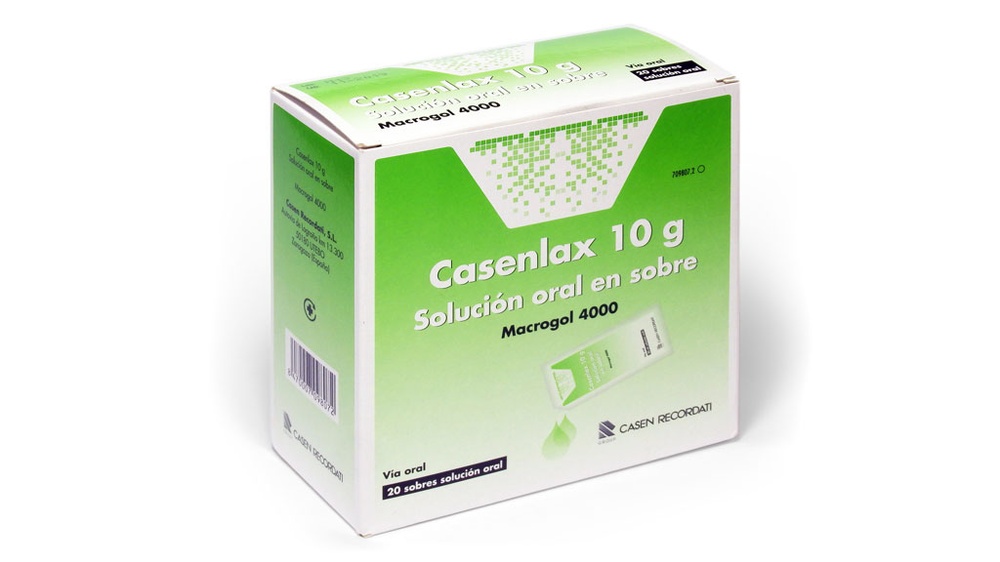
CASENLAX 10 g Solución Oral en Sobre

Revisión de receta online
Un médico revisará tu caso y determinará si la prescripción es médicamente apropiada.

Habla con un médico sobre este medicamento
Comenta tus síntomas y las opciones de tratamiento en una consulta online.



Cómo usar CASENLAX 10 G SOLUCION ORAL EN SOBRE
Contenido del prospecto
- Introducción
- Qué es Casenlax y para qué se utiliza
- Qué necesita saber antes de empezar a tomar Casenlax
- Cómo tomar Casenlax
- Posibles efectos adversos
- Conservación de Casenlax
- Contenido del envase e información adicional
Introducción
PROSPECTO: INFORMACIÓN PARA EL USUARIO
Casenlax 10g solución oral en sobre
Macrogol 4000
Lea todo el prospecto detenidamente antes de empezar a tomar este medicamento, porque contiene información importante para usted.
- Conserve este prospecto, ya que puede tener que volver a leerlo.
- Si tiene alguna duda, consulte a su médico, farmacéutico o enfermero.
- Este medicamento se le ha recetado solamente a usted, y no debe dárselo a otras personas aunque tengan los mismos síntomas que usted, ya que puede perjudicarles.
- Si experimenta efectos adversos, consulte a su médico, farmacéutico o enfermero, incluso si se trata de efectos adversos que no aparecen en este prospecto. Ver sección 4.
Contenido del prospecto:
- Qué es Casenlax y para qué se utiliza
- Qué necesita saber antes de empezar a tomar Casenlax
- Cómo tomar Casenlax
- Posibles efectos adversos
- Conservación de Casenlax
- Contenido del envase e información adicional
1. Qué es Casenlax y para qué se utiliza
El nombre de este medicamento es Casenlax 10g solución oral en sobre.
Casenlax se considera un laxante osmótico.
Casenlax se usa en el tratamiento sintomático del estreñimiento en adultos y niños mayores de 8 años. Debe usarse junto a cambios apropiados en el estilo de vida y con una dieta adecuada (ver sección 2).
Debe consultar a su médico si empeora o si no mejora.
Este medicamento contiene Macrogol (PEG = Polietilenglicol).
En caso de estreñimiento, el período de tratamiento máximo en niños es de 3 meses.

¿No estás seguro de si este medicamento es adecuado para ti?
Comenta tus síntomas y tratamiento con un médico online.
2. Qué necesita saber antes de empezar a tomar Casenlax
Estreñimiento ocasional:
El estreñimiento ocasional puede estar relacionado con un cambio reciente en el estilo de vida. Hay medicamentos que pueden utilizarse para un tratamiento a corto plazo. Consulte a su médico si recientemente ha sufrido estreñimiento no debido a cambios en su estilo de vida o estreñimiento asociado con dolor, fiebre o inflamación abdominal.
Estreñimiento crónico (estreñimiento a largo plazo):
El estreñimiento crónico puede estar causado por:• Enfermedad intestinal que requiere consultar a un médico.• Disfunción intestinal (desequilibrio) debido a hábitos dietéticos y estilo de vida.
El tratamiento incluye, entre otros:• Un aumento de la proporción de fibra en la dieta (verduras, pan integral, fruta).
- Aumento de la ingesta de agua y zumo de frutas.
- Aumento de la actividad física (hacer deporte, caminar...).• Rehabilitación del reflejo de defecación.
No tome Casenlax:
- Si es alérgico a Macrogol (PEG = polietilenglicol) o a cualquiera de los demás componentes de este medicamento (incluidos en la sección 6).
- Si tiene una enfermedad que afecte al intestino o al colon (como colitis ulcerosa, enfermedad de Crohn).
- Si tiene dolor abdominal de causa indeterminada.
- Si tiene o sospecha que puede tener una perforación gastrointestinal.
- Si tiene o sospecha que puede tener una obstrucción intestinal.
Advertencias y precauciones
Consulte a su médico, farmacéutico o enfermero antes de empezar a tomar Casenlax.
En caso de diarrea, tras el tratamiento con Casenlax, puede correr el riesgo de desarrollar trastornos electrolíticos (descenso de ciertas sales en la sangre). Es más probable que esté en riesgo si usted es una persona anciana, o tiene problemas de hígado o riñón, o está tomando diuréticos (medicamentos que facilitan la eliminación de líquidos). Si usted es alguna de estas personas y experimenta diarreas, deberá visitar a su médico para revisar sus niveles electrolíticos con un análisis de sangre.
Niños
Pregunte a su médico antes de administrar este tratamiento a su hijo, para descartar que el estreñimiento esté causado por un problema orgánico. Después de 3 meses de tratamiento, su médico deberá evaluar el estado clínico de su hijo.
Uso de Casenlax con otros medicamentos
Casenlax puede retrasar la absorción de otros medicamentos, haciendo que sean menos eficaces o ineficaces especialmente aquellos con un índice terapéutico estrecho (ej: antiepilépticos, digoxina y agentes inmunosupresores). Comunique a su médico o farmacéutico si está tomando, ha tomado recientemente o podría tener que tomar cualquier otro medicamento.
Embarazo y lactancia
Si está embarazada o en periodo de lactancia, cree que podría estar embarazada o tiene intención de quedarse embarazada, consulte a su médico o farmacéutico antes de utilizar este medicamento.
Embarazo
Casenlax puede tomarse durante el embarazo.
Lactancia
Casenlax puede tomarse durante la lactancia.
Conducción y uso de máquinas
Casenlax no tiene influencia en la capacidad de conducir y manejar maquinaria.
Casenlax contiene una cantidad insignificante de azúcar o polioles, y por lo tanto se puede recetar a pacientes diabéticos o pacientes que lleven una dieta exenta de galactosa
Casenlax contiene benzoato sódico
Este medicamento contiene 4 mg de benzoato sódico E211 en cada sobre.
Casenlax contiene sodio
Este medicamento contiene menos de 1 mmol de sodio (23 mg) por sobre; esto es, esencialmente “exento de sodio”.
3. Cómo tomar Casenlax
Siga exactamente las instrucciones de administración de este medicamento indicadas por su médico o farmacéutico. En caso de duda, consulte de nuevo a su médico o farmacéutico.
Vía oral.
La dosis recomendada es: 1 o 2 sobres al día, preferiblemente tomados en una sola dosis por la mañana. Se recomienda beber 125 ml de líquidos (por ejemplo agua) después de cada dosis.
1 sobre contiene 20 ml de solución oral y 10 g de macrogol 4000.
La dosis diaria deberá adaptarse en función de los efectos clínicos que se hayan obtenido y puede oscilar desde un sobre cada dos días (especialmente en niños) hasta un máximo de 2 sobres al día.
El efecto de Casenlax se produce a las 24-48 horas de su administración.
La mejora del tránsito intestinal tras la administración de Casenlax se mantendrá llevando un estilo de vida y una dieta saludables.
Uso en niños y adolescentes
En niños, el tratamiento no debe superar los 3 meses debido a falta de datos de ensayos clínicos durante más de 3 meses de tratamiento.
El tratamiento deberá ser finalizado gradualmente y reanudado si vuelve a producirse estreñimiento.
Si toma más Casenlax del que debe
Puede desarrollar diarrea, dolor abdominal y vómitos que desaparecen cuando el tratamiento se interrumpe temporalmente o se reduce la dosis.
Si sufre importantes diarreas o vómitos deberá contactar con su médico lo antes posible, ya que, debido a la pérdida de líquidos, puede necesitar tratamiento para prevenir la pérdida de sales (electrolitos).
En caso de sobredosis o ingestión accidental, consulte inmediatamente a su médico o farmacéutico o llame al Servicio de Información Toxicológica, teléfono: 91 562 04 20 (indicando el medicamento y la cantidad ingerida).
Si olvidó tomar Casenlax
No tome una dosis doble para compensar las dosis olvidadas.

¿Has empezado a tomar el medicamento y tienes preguntas?
Comenta tus síntomas y tratamiento con un médico online.
4. Posibles efectos adversos
Al igual que todos los medicamentos, este medicamento puede producir efectos adversos, aunque no todas las personas los sufran.
Los efectos adversos más graves son las reacciones alérgicas (hipersensibilidad) que incluyen prurito (sarpullido), erupción, edema facial (inflamación de la cara), edema de quincke (rápida inflamación de las capas internas de la piel), urticaria y shock anafiláctico. La frecuencia de estos efectos adversos ha sido notificada como muy rara (puede afectar a 1 de cada 10.000 personas) en la población adulta y con frecuencia no conocida (no puede estimarse a partir de los datos disponibles) en la población pediátrica. Si usted sufre alguna de las reacciones descritas anteriormente, por favor deje de tomar este medicamento y póngase en contacto inmediatamente con su médico.
Adultos
Generalmente, los efectos adversos son leves y transitorios, y afectan principalmente al sistema gastrointestinal. Estos efectos adversos incluyen:
Frecuentes (pueden afectar hasta 1 de cada 10 personas)
- Dolor abdominal.
- Distensión abdominal.
- Diarrea.
- Náuseas.
Poco frecuentes (pueden afectar hasta 1 de cada 100 personas)
- Vómitos.
- Necesidad urgente de ir al baño.
- Incontinencia fecal.
Frecuencia no conocida (no puede estimarse a partir de los datos disponibles)
- Trastornos electrolíticos (niveles bajos de sodio y potasio en sangre: hiponatremia e hipocalemia).
- Deshidratación causada por diarrea grave, especialmente en pacientes ancianos.
- Eritema
Niños y adolescentes
Al igual que en la población adulta, los efectos adversos son generalmente leves y transitorios y afectan principalmente al sistema gastrointestinal. Estos efectos adversos incluyen:
Frecuentes (pueden afectar hasta 1 de cada 10 personas)
- Dolor abdominal.
- Diarrea (puede causar dolor perianal).
Poco frecuentes (pueden afectar hasta 1 de cada 100 personas)
- Vómitos.
- Hinchazón.
- Náuseas.
Las dosis excesivas pueden ocasionar diarrea, dolor abdominal y vómitos que desaparecen generalmente cuando se reduce la dosis o se interrumpe temporalmente el tratamiento.
Comunicación de efectos adversos
Si experimenta cualquier tipo de efecto adverso, consulte a su médico, farmacéutico o enfermero, incluso si se trata de posibles efectos adversos que no aparecen en este prospecto. También puede comunicarlos directamente a través del Sistema Español de Farmacovigilancia de Medicamentos de Uso Humano (www.notificaRAM.es). Mediante la comunicación de efectos adversos usted puede contribuir a proporcionar más información sobre la seguridad de este medicamento.
5. Conservación de Casenlax
Mantener este medicamento fuera de la vista y del alcance de los niños.
Este medicamento no requiere condiciones especiales de conservación.
No utilice este medicamento después de la fecha de caducidad que aparece en el envase después de CAD. La fecha de caducidad es el último día del mes que se indica.
No utilice este medicamento si observa cualquier signo visible de deterioro.
Los medicamentos no se deben tirar por los desagües ni a la basura. Deposite los envases y los medicamentos que no necesita en el Punto SIGRE de la farmacia. En caso de duda pregunte a su farmacéutico cómo deshacerse de los envases y de los medicamentos que no necesita. De esta forma, ayudará a proteger el medio ambiente.
6. Contenido del envase e información adicional
Composición de Casenlax
El principio activo es: Macrogol 4000.
Cada sobre contiene 10g de macrogol 4000.
Los demás componentes (excipientes) son: Benzoato de sodio (E-211), sorbato de potasio, ácido cítrico, citrato de sodio, sucralosa y agua purificada.
Aspecto del producto y contenido del envase
Casenlax es una solución transparente, incolora, sin olor ni sabor.
Está disponible en envases de 10, 20, 30, 50 o 100 sobres.
Puede que solamente estén comercializados algunos tamaños de envases.
Titular de la autorización de comercialización y responsable de la fabricación
Casen Recordati, S.L.,
Autovía de Logroño, km 13.300
50180 UTEBO. Zaragoza (España)
Este medicamento está autorizado en los Estados miembros del Espacio Económico Europeo con los siguientes nombres:
Alemania: Casenlax 10 g Lösung zum Einnehmen in Beuteln
España: Casenlax 10g solución oral en sobre
Francia: Casenlax 10g, solution buvable en sachet
Italia: Casenlax 10 g soluzione orale in bustina
Portugal: Casenlax 10g solução oral em saquetas
Fecha de la última revisión de este prospecto: 11/2021
Otras fuentes de información
La información detallada y actualizada de este medicamento está disponible en la página web de la Agencia Española de Medicamentos y Productos Sanitarios (AEMPS) http://www.aemps.gob.es/
- País de registro
- Forma farmacéuticaSOLUCIÓN/SUSPENSIÓN ORAL, 10 g
- Código ATCA06AD15
- Principio activo
- Requiere recetaSí
- Fabricante
- ComposiciónBENZOATO DE SODIO (E 211) (0,004 g mg), SORBATO POTASICO (0,040 g mg), CITRATO DE SODIO (E-331) (0,045 g mg)
- Esta información es de carácter general y no sustituye la consulta con un profesional sanitario.
- Alternativas a CASENLAX 10 G SOLUCION ORAL EN SOBREForma farmacéutica: SOLUCIÓN/SUSPENSIÓN ORAL, 10 GPrincipio activo: macrogolFabricante: Casen Recordati S.L.Requiere recetaForma farmacéutica: SOLUCIÓN/SUSPENSIÓN ORAL, 4 gPrincipio activo: macrogolFabricante: Casen Recordati S.L.Requiere recetaForma farmacéutica: SOLUCIÓN/SUSPENSIÓN ORAL, 500 mg/mlPrincipio activo: macrogolFabricante: Casen Recordati S.L.Requiere receta
Médicos online para CASENLAX 10 G SOLUCION ORAL EN SOBRE
Comenta la dosis, los posibles efectos secundarios, interacciones, contraindicaciones o la revisión de receta de CASENLAX 10 G SOLUCION ORAL EN SOBRE, sujeto a valoración médica y a la normativa local.









Obtén una receta de CASENLAX 10 G SOLUCION ORAL EN SOBRE online
Rellena un formulario de 2 minutos
Cuéntanos tus síntomas, historial y el medicamento que necesitas.
Elige un médico o nosotros te asignamos uno
Escoge un especialista o te conectamos con el próximo médico disponible.
El médico revisa tu caso
Normalmente en 30 minutos. Puede hacerte preguntas adicionales por chat.
Recógela en cualquier farmacia
Receta electrónica enviada a tu correo, válida en toda España.
Preguntas frecuentes
CASENLAX 10 G SOLUCION ORAL EN SOBRE requiere receta en España. Puedes confirmarlo con un médico online según tu caso.
El principio activo de CASENLAX 10 G SOLUCION ORAL EN SOBRE es macrogol. Esta información ayuda a identificar medicamentos con la misma composición pero con diferentes nombres comerciales.
CASENLAX 10 G SOLUCION ORAL EN SOBRE es fabricado por Casen Recordati S.L.. La marca y el envase pueden variar según el distribuidor.
Los Médicos de familia, Psiquiatras, Dermatólogos, Cardiólogos, Endocrinólogos, Gastroenterólogos, Neumólogos, Nefrólogos, Reumatólogos, Hematólogos, Infectólogos, Alergólogos, Geriatras, Pediatras, Oncólogos pueden valorar la prescripción de CASENLAX 10 G SOLUCION ORAL EN SOBRE cuando esté clínicamente indicado. Puedes reservar una videoconsulta para comentar tu caso y las opciones de tratamiento.
España cuenta con una infraestructura sanitaria bien desarrollada en ciudades principales como Madrid, Barcelona, Valencia y Sevilla. Las farmacias están ampliamente disponibles y operan bajo estrictas regulaciones, garantizando el acceso a medicamentos con receta.
Puedes comprar CASENLAX 10 G SOLUCION ORAL EN SOBRE en Madrid, Barcelona, Sevilla o Valencia en cualquier farmacia local con una receta válida.
Para obtener una receta, puedes utilizar Oladoctor:
Otros medicamentos con el mismo principio activo (macrogol) incluyen CASENLAX 10 g POLVO PARA SOLUCION ORAL EN SOBRE, CASENLAX 4 g POLVO PARA SOLUCION ORAL EN SOBRES, CASENLAX 500 MG/ML SOLUCION ORAL. Pueden tener diferentes nombres comerciales o formulaciones, pero contienen el mismo componente terapéutico. Consulta siempre con un médico antes de cambiar o iniciar un nuevo medicamento.
