



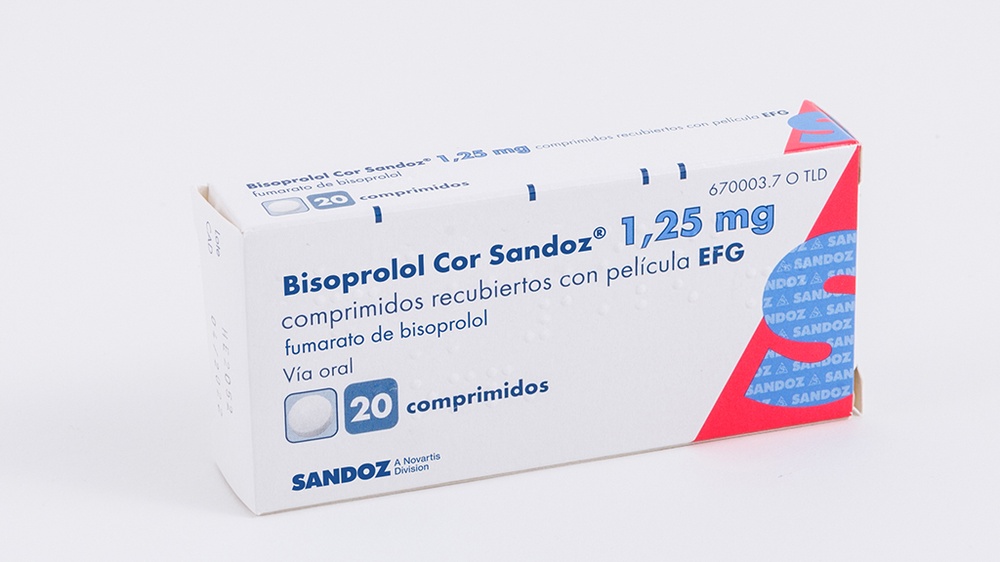
BISOPROLOL 1,25 mg Comprimidos recubiertos con película

Revisión de receta online
Un médico revisará tu caso y determinará si la prescripción es médicamente apropiada.

Habla con un médico sobre este medicamento
Comenta tus síntomas y las opciones de tratamiento en una consulta online.



Cómo usar BISOPROLOL COR SANDOZ 1,25 mg COMPRIMIDOS RECUBIERTOS CON PELICULA EFG
Contenido del prospecto
- Introducción
- Qué es Bisoprolol Cor Sandoz y para qué se utiliza
- Qué necesita saber antes de empezar a tomar Bisoprolol Cor Sandoz
- Cómo tomar Bisoprolol Cor Sandoz
- Posibles efectos adversos
- Conservación de Bisoprolol Cor Sandoz
- Contenido del envase e información adicional
Introducción
Prospecto: información para el paciente
Bisoprolol Cor Sandoz 1,25 mg comprimidos recubiertos con película EFG
fumarato de bisoprolol
Lea todo el prospecto detenidamente antes de empezar a tomar este medicamento, porque
contiene información importante para usted.
- Conserve este prospecto, ya que puede tener que volver a leerlo.
- Si tiene alguna duda, consulte a su médico o farmacéutico.
- Este medicamento se le ha recetado solamente a usted, y no debe dárselo a otras personas aunque tengan los mismos síntomas que usted, ya que puede perjudicarles.
- Si experimenta efectos adversos, consulte a su médico o farmacéutico, incluso si se trata de efectos adversos que no aparecen en este prospecto. Ver sección 4.
Contenido del prospecto
- Qué es Bisoprolol Cor Sandoz y para qué se utiliza
- Qué necesita saber antes de empezar a tomar Bisoprolol Cor Sandoz
- Cómo tomar Bisoprolol Cor Sandoz
- Posibles efectos adversos
- Conservación de Bisoprolol Cor Sandoz
- Contenido del envase e información adicional
1. Qué es Bisoprolol Cor Sandoz y para qué se utiliza
Bisoprolol pertenece a un grupo de medicamentos denominados beta-bloqueantes. Este grupo de medicamentos protegen al corazón cuando tiene demasiada actividad.
Bisoprolol se utiliza para el tratamiento de:
insuficiencia cardiaca que causa dificultad respiratoria al realizar esfuerzos o retención de líquidos. En este caso, bisoprolol se puede utilizar como tratamiento adicional con otros medicamentos para la insuficiencia cardiaca.

¿No estás seguro de si este medicamento es adecuado para ti?
Comenta tus síntomas y tratamiento con un médico online.
2. Qué necesita saber antes de empezar a tomar Bisoprolol Cor Sandoz
No tome Bisoprolol Cor Sandoz
- si es alérgico a fumarato de bisoprolol o a alguno de los demás componentes de este medicamento (incluidos en la sección 6),
- si tiene shock cardiogénico, que es una enfermedad cardiaca grave que produce pulso débil y acelerado; bajada de la presión arterial; piel fría y sudorosa; debilidad y desvanecimientos,
- si alguna vez ha sufrido asma o dificultad respiratoria grave, ya que puede afectar a su respiración,
- si tiene frecuencia cardiaca lenta (menos de 60 pulsaciones por minuto). Pregunte a su médico si tiene dudas,
- si tiene la presión arterial muy baja,
- si tiene problemas de circulación graves (que puede producir hormigueos en los dedos de las manos y pies o volverlos pálidos o azules),
- si tiene ciertos problemas graves del ritmo cardiaco,
- si tiene insuficiencia cardiaca, que acaba de ocurrir o si no está estabilizada y requiere de tratamiento hospitalario,
- si padece acidosis metabólica, que es una afección que se produce cuando existe una acumulación excesiva de ácido en la sangre. Su médico le podrá aconsejar,
- si sufre feocromocitoma no tratado, que es un tumor de la glándula adrenal.
Consulte a su médico si no está seguro de tener alguno de los problemas anteriores.
Advertencias y precauciones
Informe a su médico antes de tomar Bisoprolol Cor Sandoz
- si tiene dificultad para respirar (asma). Se debe administrar al mismo tiempo que el tratamiento broncodilatador. Puede necesitar una dosis mayor del estimulante beta2,
- si tiene diabetes. Este medicamento puede enmascarar los síntomas de un descenso de la glucosa en sangre (tales como pulso acelerado, palpitaciones o sudoración),
- si está haciendo dieta de alimentos sólidos,
- si está recibiendo tratamiento contra las reacciones de hipersensibilidad (reacciones alérgicas). Bisoprolol puede aumentar la hipersensibilidad a las sustancias a las que usted es alérgico y la gravedad de dicha reacción. El tratamiento con adrenalina puede no tener el resultado deseado. Puede necesitar una dosis mayor de adrenalina (epinefrina),
- con bloqueo cardiaco de primer grado (trastornos en la conducción cardiaca),
- si tiene angina de Prinzmetal, que es un tipo de dolor en el pecho causado por espasmos de las arterias coronarias que riegan el músculo cardiaco,
- si tiene algún problema de circulación en las extremidades de su cuerpo, por ejemplo en las manos o en los pies,
- si va a someterse a una cirugía con anestesia: si va a acudir al médico, al hospital o al dentista para una cirugía con anestesia, debe informar que medicamentos está tomando,
- si tiene o ha tenido psoriasis (una enfermad crónica de la piel que produce lesiones escamosas y sequedad),
- en feocromocitoma (tumor de la glándula adrenal). Su médico tratará esta enfermedad antes de prescribirle bisoprolol,
- si tiene un problema de tiroides. Este medicamento puede enmascarar los síntomas de una hiperactividad tiroidea.
Hasta el momento, no hay experiencia terapéutica del uso de bisoprolol en el tratamiento de la
insuficiencia cardiaca en pacientes con las siguientes enfermedades y condiciones:
- diabetes mellitus tratada con insulina (tipo I),
- enfermedad de riñón grave,
- enfermedad de hígado grave,
- ciertas enfermedades del corazón,
- ataque cardiaco en los 3 últimos meses.
El tratamiento de la insuficiencia cardiaca con bisoprolol requiere de un regular control médico. Esto es absolutamente necesario especialmente al inicio del tratamiento y tras terminar el tratamiento.
No se debe interrumpir bruscamente el tratamiento con bisoprolol a no ser que existan razones de peso.
Consulte a su médico si padece, o ha padecido en el pasado, algunas de estas situaciones.
Otros medicamentos y Bisoprolol Cor Sandoz
Informe a su médico o farmacéutico si está tomando, ha tomado recientemente o pudiera tener que tomar cualquier otro medicamento, incluso los adquiridos sin receta. Determinados medicamentos no pueden ser usados al mismo tiempo mientras que otros medicamentos requieren cambios específicos (por ejemplo, en la dosis).
Informe a su médico si está usando o le están administrando cualquiera de los siguientes medicamentos además de bisoprolol:
- medicamentos para el control de la presión arterial o medicamentos utilizados para problemas del corazón (tales como amiodarona, amlodipino, clonidina, glucósidos digitálicos, diltiazem, disopiramida, felodipino, flecainida, lidocaína, metildopa, moxonidina, fenitoína, propafenona, quinidina, rilmenidina, verapamilo),
- tranquilizantes y tratamiento para la psicosis (una enfermedad mental), p. ej., barbitúricos (también utilizados para el tratamiento de la epilepsia), fenotiazinas (también se usan contra los vómitos y las náuseas),
- medicamentos para la depresión, p. ej., antidepresivos tricíclicos, inhibidores de la MAO-A,
- medicamentos utilizados durante la anestesia (ver también sección “Advertencias y precauciones”),
- medicamentos contra el dolor (p. ej., , ácido acetilsalicílico, diclofenaco, floctafenina, indometacina, ibuprofeno, naproxeno),
- medicamentos para el asma, para la congestión nasal o para determinados trastornos oculares como glaucoma (aumento de la presión en el ojo) o para la dilatación (ampliar) de la pupila,
- medicamentos utilizados en el tratamiento del shock (p. ej., adrenalina, dobutamina, noradrenalina),
- mefloquina, un medicamento contra la malaria,
- rifampicina, un antibiótico,
- derivados de la ergotamina para el tratamiento de la migraña.
Todos estos medicamentos, al igual que bisoprolol, pueden modificar la presión arterial y/o la función cardiaca.
- Insulina u otros medicamentos para la diabetes. El efecto reductor sobre la glucosa en sangre puede amentar. Se pueden enmascarar los síntomas de un descenso de los niveles de glucosa.
Toma de Bisoprolol Cor Sandoz y alcohol
Los mareos y el dolor de cabeza que bisoprolol podría producir, pueden empeorar si consume alcohol. Si le ocurre esto, evite el consumo de alcohol.
Embarazo y lactancia
Si está embarazada o en periodo de lactancia, cree que podría estar embarazada o tiene intención de quedarse embarazada, consulte a su médico o farmacéutico antes de utilizar este medicamento. Bisoprolol puede tener efectos perjudiciales en el embarazo y/o en el feto. Existe una mayor posibilidad de parto prematuro, aborto, bajo nivel de azúcar en sangre y reducción de la frecuencia cardiaca del neonato. También puede afectar al crecimiento del bebé. Por tanto, bisoprolol no debe ser utilizado durante el embarazo.
Se desconoce si bisoprolol pasa a la leche humana y, por tanto, su uso no se recomienda durante la lactancia.
Conducción y uso de máquinas
Este medicamento puede hacer que se sienta cansado, somnoliento o mareado. Si tiene estos efectos adversos, no conduzca o utilice máquinas. Sea especialmente cauto al inicio del tratamiento, con los cambios de dosis y en combinación con el alcohol.
Bisoprolol Cor Sandoz contiene lactosa y sodio
Este medicamento contiene lactosa. Si su médico le ha indicado que padece una intolerancia a ciertos azúcares, consulte con él antes de tomar este medicamento.
Este medicamento contiene menos de 1mmol de sodio (23 mg) por comprimido recubierto con película; esto es, esencialmente “exento de sodio”.
3. Cómo tomar Bisoprolol Cor Sandoz
Siga exactamente las instrucciones de administración de este medicamento indicadas por su médico. En caso de duda, consulte de nuevo a su médico o farmacéutico.
Su médico le dirá cuántos comprimidos debe tomar. Debe tomar este medicamento por la mañana, antes, durante o después del desayuno. Trague los comprimidos con ayuda de un vaso de agua y no los mastique ni los triture.
La dosis recomendada es:
Insuficiencia cardiaca (fuerza de bombeo de corazón reducida)
Cuando inicie el tratamiento con bisoprolol, ya estará utilizando un inhibidor de la ECA, un diurético o un glucósido cardiaco (medicamentos para el corazón o para la tensión arterial).
La dosis se incrementará gradualmente hasta alcanzar la más adecuada para usted:
1,25 mg una vez al día durante una semana. Si se tolera bien, la dosis se puede aumentar a:
2,5 mg una vez al día durante una semana más. Si se tolera bien, la dosis se puede aumentar a:
3,75 mg una vez al día durante una semana más. Si se tolera bien, la dosis se puede aumentar a:
5 mg una vez al día durante las próximas 4 semanas. Si se tolera bien, la dosis se puede aumentar a:
7,5 mg una vez al día durante las próximas 4 semanas. Si se tolera bien, la dosis se puede aumentar a:
10 mg una vez al día como dosis de mantenimiento.
La dosis máxima diaria es de 10 mg de bisoprolol.
Su médico determinará la dosis óptima para usted basándose, entre otros, en los posibles efectos adversos.
Después de la primera dosis de 1,25 mg su médico le controlará la presión arterial, la frecuencia cardiaca y los trastornos de la función del corazón.
Insuficiencia hepática o renal
Los aumentos de dosis deben realizarse con mayor precaución.
Edad avanzada
Normalmente, no es necesario ajustar la dosis.
Si estima que la acción de bisoprolol, es demasiado fuerte o débil, comuníqueselo a su médico o a su farmacéutico.
Duración del tratamiento
Por lo general, el tratamiento con bisoprolol es a largo plazo.
Uso en niños y adolescentes
No hay experiencia con bisoprolol en niños y adolescentes, por tanto su uso no se recomienda en niños.
Si toma más Bisoprolol Cor Sandoz del que debe
Si ha tomado accidentalmente más dosis de lo que su médico le ha prescrito, consulte inmediatamente a su médico o farmacéutico. Lleve consigo los comprimidos sobrantes o este prospecto para que el equipo médico sepa exactamente qué es lo que ha ingerido. Los síntomas de una sobredosis pueden incluir vértigo, mareo, fatiga y/o dificultad para respirar.
Además, puede producirse una reducción de la frecuencia cardiaca, disminución de la presión sanguínea, insuficiencia cardiaca y bajada de los niveles de glucosa en sangre (lo cual puede producir sensación de hambre, sudoración y palpitaciones).
En caso de sobredosis o ingestión accidental consulte inmediatamente a su médico o farmacéutico o llame al Servicio de Información Toxicológica, teléfono: 91 562 04 20, indicando el medicamento y la cantidad ingerida.
Si olvidó tomar Bisoprolol Cor Sandoz
No tome una dosis doble para compensar las dosis olvidadas.Tome su dosis tan pronto como lo recuerde y luego continúe con la dosis normal al día siguiente.
Si interrumpe el tratamiento con Bisoprolol Cor Sandoz
El tratamiento con bisoprolol no se debe interrumpir bruscamente. Si deja de repente de tomar este medicamento, su estado podría empeorar. En lugar de esto, la dosis se debe reducir de forma gradual durante unas semanas tal y como le indicará su médico.
Si tiene cualquier otra duda sobre el uso de este producto, pregunte a su médico o farmacéutico.

¿Has empezado a tomar el medicamento y tienes preguntas?
Comenta tus síntomas y tratamiento con un médico online.
4. Posibles efectos adversos
Al igual que todos los medicamentos, este medicamento puede producir efectos adversos, aunque no todas las personas lo sufran.
Para evitar reacciones graves, hable con un médico de inmediato si se produce un efecto adverso grave de repente o empeora rápidamente.
Los efectos secundarios más graves están relacionados con la función cardíaca:
- disminución de la frecuencia cardíaca (puede afectar a más de 1 de cada 10 personas)
- empeoramiento de la insuficiencia cardíaca preexistente (puede afectar hasta 1 de cada 10 personas)
- latidos cardíacos lentos o irregulares (puede afectar hasta 1 de cada 100 personas)
Si se siente mareado o débil, o tiene dificultades para respirar, comuníquese con su médico tan pronto posible.
Debe acudir al médico inmediatamente si experimenta reacciones alérgicas graves, que pueden darse en cara, cuello, lengua, boca o tráquea, o dificultad para respirar.
Otros efectos secundarios se enumeran a continuación de acuerdo con la frecuencia con que pueden ocurrir:
Frecuentes, pueden afectar hasta 1 de cada 10 pacientes:
- Cansancio, agotamiento.
- Mareos.
- Dolor de cabeza.
- Sensación de frío o entumecimiento en las extremidades (dedos de las manos o de los pies, orejas o nariz); con más frecuencia, calambres o sensación de dolor al caminar.
- Presión arterial muy baja (hipotensión), particularmente en pacientes con fallo cardiaco.
- Sensación de mareo (náuseas), vómitos.
- Diarrea.
- Estreñimiento.
Poco frecuentes, pueden afectar hasta 1 de cada 100 pacientes:
- Caída de la presión arterial al ponerse de pie que puede causar mareos, aturdimiento o desmayos.
- Trastornos del sueño.
- Depresión.
- Irregularidades del ritmo cardiaco.
- Los pacientes con asma o con antecedentes de problemas respiratorios pueden tener dificultad para respirar.
- Debilidad muscular y calambres.
Raros, pueden afectar hasta 1 de cada 1.000 pacientes:
- Pesadillas.
- Alucinaciones (imaginar cosas).
- Desvanecimiento.
- Problemas de audición.
- Inflamación de la mucosa de la nariz, provocando mucosidad nasal con irritación.
- Reacciones alérgicas en la piel (picor, enrojecimiento, erupción cutánea).
- Sequedad de ojos por reducción del flujo lacrimal (esto puede ser problemático si se usan lentes de contacto).
- Inflamación del hígado (hepatitis), que provoca dolor abdominal, pérdida del apetito y, a veces, ictericia con coloración amarillenta del blanco de los ojos y de la piel, y oscurecimiento de la orina.
- Reducción del rendimiento sexual (alteraciones de la potencia).
- Aumento de los niveles de lípidos en sangre (triglicéridos) y de las enzimas hepáticas.
Muy raros, pueden afectar hasta 1 de cada 10.000 pacientes:
- Empeoramiento de la psoriasis o aparición de una erupción similar a la psoriasis con piel seca, formación de escamas y pérdida de cabello.
- Picor o enrojecimiento de los ojos (conjuntivitis).
Comunicación de efectos adversos
Si experimenta cualquier tipo de efecto adverso, consulte a su médico o farmacéutico, incluso si se trata de posibles efectos adversos que no aparecen en este prospecto. También puede comunicarlos directamente a través del Sistema Español de Farmacovigilancia de Medicamentos de Uso Humano: https://www.notificaram.es. Mediante la comunicación de efectos adversos usted puede contribuir a proporcionar más información sobre la seguridad de este medicamento.
5. Conservación de Bisoprolol Cor Sandoz
Mantener este medicamento fuera de la vista y del alcance de los niños.
No utilice este medicamento después de la fecha de caducidad que aparece en blíster y en el envase después de CAD. La fecha de caducidad es el último día del mes que se indica.
No utilice este medicamento 6 meses después de la apertura del frasco.
Blíster: Este medicamento no requiere condiciones especiales de conservación.
Frasco: Conservar por debajo de 30ºC.
Condiciones de conservación tras apertura del frasco: Conservar por debajo de 25ºC.
Los medicamentos no se deben tirar por los desagües ni a la basura. Deposite los envases y los medicamentos que no necesita en el Punto SIGRE de la farmacia. En caso de duda pregunte a su farmacéutico cómo deshacerse de los envases y de los medicamentos que no necesita. De esta forma ayudará a proteger el medio ambiente.
6. Contenido del envase e información adicional
Composición de Bisoprolol Cor Sandoz
- El principio activo es fumarato de bisoprolol. Cada comprimido contiene 1,25 mg de bisoprolol en forma de fumarato de bisoprolol.
- Los demás componentes (excipientes) son:
hidrógeno fosfato de calcio anhidro, celulosa microcristalina, almidón de maíz pregelatinizado, croscarmelosa de sodio, sílice coloidal anhidra, estearato de magnesio, lactosa monohidrato, hipromelosa, macrogol 4000, dióxido de titanio (E 171).
Aspecto del producto y contenido del envase
Bisoprolol Cor Sandoz 1,25 mg son comprimidos recubiertos con película, redondos y de color blanco, con la marca de impresión “BIS 1.25” en una de sus caras.
Los comprimidos se envasan en blíster (OPA-Al-PVC/Al) o frascos de HDPE con tapón de PE.
Tamaños de envase:
Blíster: 7, 10, 20, 28, 30, 50, 56, 60, 90, 98, 100, 10x20 y 10x30 comprimidos recubiertos con película.
Frascos: 10, 20, 30, 50, 60, 100, 250, 500 comprimidos recubiertos con película.
Puede que solamente estén comercializados algunos tamaños de envases.
Titular de la autorización de comercialización y responsable de la fabricación
Titular de la autorización de comercialización
Sandoz Farmacéutica, S.A.
Centro Empresarial Parque Norte
Edificio Roble
C/ Serrano Galvache, 56
28033 Madrid
España
Responsable de la fabricación
LEK PHARMACEUTICAL COMPANY D.D.
Verovskova, 57
Ljubljana – 1526
Eslovenia
SALUTAS PHARMA GMBH
Otto Von Guericke Alle, 1
Barleben D-39179
Alemania
ROWA PHARMACEUTICALS LIMITED
Newtown (Bantry, Co Cork)
Irlanda
LEK, S.A.
Ul Domaniewska 50 C
Varsovia - PL02-672
Polonia
LEK S.A.
UI Podlipie, 16
Strykow
Polonia
Este medicamento está autorizado en los estados miembros del Espacio Económico Europeo y en el Reino Unido (Irlanda del Norte) con los siguientes nombres:
Austria: Bisoprolol Sandoz 1,25 mg – Filmtabletten
Alemania: Bisoprolol Sandoz 1,25 mg Filmtabletten
Francia: BISOPROLOL Sandoz 1,25 mg, comprimé pelliculé sécable
Reino Unido
(Irlanda del norte): Bisoprolol Fumarate 1,25 mg film-coated Tablets
Italia: Bisoprolol Sandoz 1,25 mg compresse rivestite con film
Holanda: Bisoprolol fumaraat Sandoz Tablet 1,25 mg, filmomhulde tabletten
Noruega: Bisoprolol Sandoz
Polonia: Bibloc
Suecia: Bisoprolol Sandoz
Eslovenia: Byol 1,25 mg filmsko obložene tablete
Fecha dela última revisión de este prospecto: marzo 2022
La información detallada de este medicamento está disponible en la página web de la Agencia Española de Medicamentos y Productos Sanitarios (AEMPS) http://www.aemps.es
- País de registro
- Forma farmacéuticaCOMPRIMIDO, 1,25 mg
- Código ATCC07AB07
- Precio medio en farmacia2.5 EUR
- Principio activo
- Requiere recetaSí
- Fabricante
- ComposiciónCROSCARMELOSA SODICA (1,79 mg mg), LACTOSA (1,26 mg mg)
- Esta información es de carácter general y no sustituye la consulta con un profesional sanitario.
- Alternativas a BISOPROLOL COR SANDOZ 1,25 mg COMPRIMIDOS RECUBIERTOS CON PELICULA EFGForma farmacéutica: COMPRIMIDO, 10 mgPrincipio activo: bisoprololFabricante: Aurovitas Spain, S.A.U.Requiere recetaForma farmacéutica: COMPRIMIDO, 2,5 mgPrincipio activo: bisoprololFabricante: Aurovitas Spain, S.A.U.Requiere recetaForma farmacéutica: COMPRIMIDO, 5 mgPrincipio activo: bisoprololFabricante: Aurovitas Spain, S.A.U.Requiere receta
Médicos online para BISOPROLOL COR SANDOZ 1,25 mg COMPRIMIDOS RECUBIERTOS CON PELICULA EFG
Comenta la dosis, los posibles efectos secundarios, interacciones, contraindicaciones o la revisión de receta de BISOPROLOL COR SANDOZ 1,25 mg COMPRIMIDOS RECUBIERTOS CON PELICULA EFG, sujeto a valoración médica y a la normativa local.
Obtén una receta de BISOPROLOL COR SANDOZ 1,25 mg COMPRIMIDOS RECUBIERTOS CON PELICULA EFG online
Rellena un formulario de 2 minutos
Cuéntanos tus síntomas, historial y el medicamento que necesitas.
Elige un médico o nosotros te asignamos uno
Escoge un especialista o te conectamos con el próximo médico disponible.
El médico revisa tu caso
Normalmente en 30 minutos. Puede hacerte preguntas adicionales por chat.
Recógela en cualquier farmacia
Receta electrónica enviada a tu correo, válida en toda España.
Preguntas frecuentes
BISOPROLOL COR SANDOZ 1,25 mg COMPRIMIDOS RECUBIERTOS CON PELICULA EFG requiere receta en España. Puedes confirmarlo con un médico online según tu caso.
El principio activo de BISOPROLOL COR SANDOZ 1,25 mg COMPRIMIDOS RECUBIERTOS CON PELICULA EFG es bisoprolol. Esta información ayuda a identificar medicamentos con la misma composición pero con diferentes nombres comerciales.
El precio medio en farmacia de BISOPROLOL COR SANDOZ 1,25 mg COMPRIMIDOS RECUBIERTOS CON PELICULA EFG es de aproximadamente 2.5 EUR. Puede variar según el fabricante y la forma farmacéutica.
BISOPROLOL COR SANDOZ 1,25 mg COMPRIMIDOS RECUBIERTOS CON PELICULA EFG es fabricado por Sandoz Farmaceutica S.A.. La marca y el envase pueden variar según el distribuidor.
Los Médicos de familia, Psiquiatras, Dermatólogos, Cardiólogos, Endocrinólogos, Gastroenterólogos, Neumólogos, Nefrólogos, Reumatólogos, Hematólogos, Infectólogos, Alergólogos, Geriatras, Pediatras, Oncólogos pueden valorar la prescripción de BISOPROLOL COR SANDOZ 1,25 mg COMPRIMIDOS RECUBIERTOS CON PELICULA EFG cuando esté clínicamente indicado. Puedes reservar una videoconsulta para comentar tu caso y las opciones de tratamiento.
España cuenta con una infraestructura sanitaria bien desarrollada en ciudades principales como Madrid, Barcelona, Valencia y Sevilla. Las farmacias están ampliamente disponibles y operan bajo estrictas regulaciones, garantizando el acceso a medicamentos con receta.
Puedes comprar BISOPROLOL COR SANDOZ 1,25 mg COMPRIMIDOS RECUBIERTOS CON PELICULA EFG en Madrid, Barcelona, Sevilla o Valencia en cualquier farmacia local con una receta válida.
Para obtener una receta, puedes utilizar Oladoctor:
Otros medicamentos con el mismo principio activo (bisoprolol) incluyen BISOPROLOL AUROVITAS 10 MG COMPRIMIDOS RECUBIERTOS CON PELICULA EFG, BISOPROLOL AUROVITAS 2,5 MG COMPRIMIDOS RECUBIERTOS CON PELICULA EFG, BISOPROLOL AUROVITAS 5 MG COMPRIMIDOS RECUBIERTOS CON PELICULA EFG. Pueden tener diferentes nombres comerciales o formulaciones, pero contienen el mismo componente terapéutico. Consulta siempre con un médico antes de cambiar o iniciar un nuevo medicamento.
