



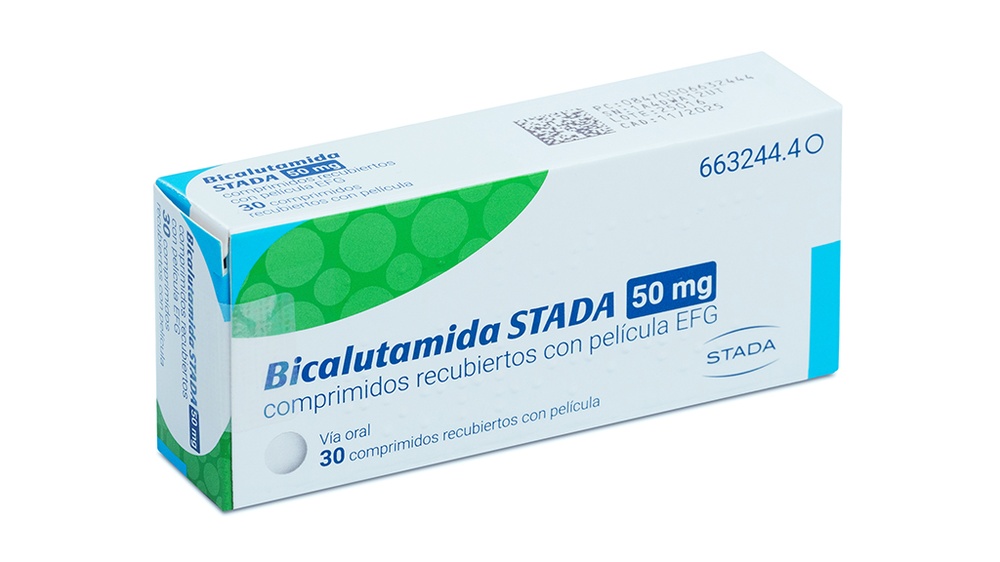
BICALUTAMIDA 50 mg Comprimidos Recubiertos Con Película

Revisión de receta online
Un médico revisará tu caso y determinará si la prescripción es médicamente apropiada.

Habla con un médico sobre este medicamento
Comenta tus síntomas y las opciones de tratamiento en una consulta online.



Cómo usar BICALUTAMIDA STADA 50 mg COMPRIMIDOS RECUBIERTOS CON PELICULA EFG
Contenido del prospecto
- Introducción
- Qué es Bicalutamida Stada y para qué se utiliza
- Qué necesita saber antes de empezar a tomar Bicalutamida Stada
- Cómo tomar Bicalutamida Stada
- Posibles efectos adversos
- Conservación de Bicalutamida Stada
- Contenido del envase e información adicional
Introducción
Prospecto: información para el usuario
Bicalutamida Stada 50 mg comprimidos recubiertos con película EFG
Lea todo el prospecto detenidamente antes de empezar a tomar este medicamento, porque contiene información importante para usted.
- Conserve este prospecto, ya que puede tener que volver a leerlo.
- Si tiene alguna duda, consulte a su médico o farmacéutico.
- Este medicamento se le ha recetado solamente a usted y no debe dárselo a otras personas aunque tengan los mismos síntomas que usted, ya que puede perjudicarles.
- Si experimenta efectos adversos, consulte a su médico o farmacéutico, incluso si se trata de efectos adversos que no aparecen en este prospecto. Ver sección 4.
Contenido del prospecto:
- Qué es Bicalutamida Stada y para qué se utiliza
- Qué necesita saber antes de empezar a tomar Bicalutamida Stada
- Cómo tomar Bicalutamida Stada
- Posibles efectos adversos
- Conservación de Bicalutamida Stada
- Contenido del envase e información adicional
1. Qué es Bicalutamida Stada y para qué se utiliza
Bicalutamida pertenece a un grupo de medicamentos denominados antiandrógenos, lo que significa que interfiere con alguna de las acciones de los andrógenos (hormonas sexuales masculinas) en el organismo.
Este medicamento se utiliza en el tratamiento de cáncer de próstata avanzado en combinación con un fármaco llamado análogo de la hormona liberadora de hormona luteinizante (LHRH) – un tratamiento hormonal adicional – o conjuntamente con la extirpación quirúrgica de los testículos.

¿No estás seguro de si este medicamento es adecuado para ti?
Comenta tus síntomas y tratamiento con un médico online.
2. Qué necesita saber antes de empezar a tomar Bicalutamida Stada
No tome Bicalutamida Stada:
- Si es alérgico al principio activo o a alguno de los demás componentes de este medicamento (incluidos en la sección 6).
- Si está tomando medicamentos para tratar la alergia como terfenadina o astemizol, ni con cisaprida, medicamento para tratar el reflujo gastroesofagico.
Bicalutamida no debe ser tomado por mujeres, ni tampoco debe ser administrado a niños ni adolescentes menores de 18 años.
Advertencias y precauciones
Consulte a su médico o farmacéutico antes de empezar a tomar este medicamento
- Si padece alguna alteración o enfermedad que afecte a su hígado. El medicamento sólo se debe tomar después de que su médico haya considerado cuidadosamente los posibles beneficios y riesgos. Si este es el caso, su médico debe realizarle regularmente pruebas de la función de su hígado. Se han notificado casos de fallecimiento (cambios hepáticos graves y fallo hepático).
- Si tiene una inflamación de los pulmones llamada enfermedad pulmonar intersticial. Los síntomas de ésta podrían incluir dificultad para respirar grave con tos o fiebre. Se han notificado fallecimientos.
- Si tiene diabetes. El tratamiento conjunto de bicalutamida con análogos LHRH puede alterar sus niveles de azúcar en sangre. El médico debe ajustar su dosis de insulina y/o medicamentos antidiabéticos.
- Si padece problemas graves de riñón. Es necesario actuar con precaución, dado que no hay experiencia con el uso de bicalutamida en estos casos.
- Si está tomando una dosis diaria de 150 mg de bicalutamida y padece una enfermedad cardiaca. Su médico puede optar por comprobar su función cardiaca periódicamente.
- Informe a su médico si padece alguna afección del corazón o de los vasos sanguíneos o está siendo tratado para ello, incluyendo medicamentos para controlar el ritmo cardíaco (arritmias). El riesgo de problemas del ritmo cardíaco puede aumentar cuando se utiliza bicalutamida.
Si alguna de las anteriores situaciones es aplicable a usted informe a su médico, él lo tendrá en cuenta durante su tratamiento con bicalutamida.
En caso de ingresar en un hospital comunique al personal sanitario que está tomando este medicamento.
Si está tomando bicalutamida, usted y/o su pareja deben utilizar un método anticonceptivo mientras usted esté en tratamiento con bicalutamida y durante los 130 días posteriores a la fecha de finalización del tratamiento.
Otros medicamentos y Bicalutamida Stada
Informe a su médico o farmacéutico si está tomando ha tomado recientemente o pudiera tener que tomar cualquier otro medicamento.
No tome bicalutamida junto con los siguientes medicamentos:
- Terfenadina o astemizol (para la fiebre del heno o alergia)
- Cisaprida (para alteraciones del estómago)
Si toma bicalutamida junto con alguno de los siguientes medicamentos, el efecto de éste y de los otros medicamentos puede verse afectado. Consulte a su médico antes de tomar cualquiera de los siguientes medicamentos junto con bicalutamida:
- Warfarina o cualquier medicamento similar para prevenir la coagulación de la sangre.
- Ciclosporina (utilizada para disminuir el sistema inmunitario a fin de prevenir y tratar el rechazo del trasplante de un órgano o de la médula ósea).
- Midazolam (medicamento utilizado para aliviar la ansiedad antes de la cirugía o de ciertos procedimientos o como anestésico antes de y durante la cirugía).
- Bloqueadores del canal de calcio (por ejemplo, diltiazem o verapamilo. Estos medicamentos se usan para tratar la presión arterial alta o algunas enfermedades cardiacas).
- Cimetidina (para tratar las úlceras de estómago).
- Ketoconazol (utilizado para tratar las infecciones por hongos de la piel y las uñas).
Bicalutamida puede interferir con algunos medicamentos utilizados para tratar problemas del ritmo cardíaco (por ejemplo: quinidina, procainamida, amiodarona y sotalol) o puede aumentar el riesgo de problemas del ritmo cardíaco cuando se utiliza con otros medicamentos (por ejemplo: metadona (utilizado para el alivio del dolor y para la desintoxicación de otros medicamentos), moxifloxacino (un antibiótico), antipsicóticos usados para tratar enfermedades mentales graves).
Embarazo, lactancia y fertilidad
Si está embarazada o en periodo de lactancia, cree que podría estar embarazada o tiene intención de quedarse embarazada, consulte a su médico o farmacéutico antes de utilizar este medicamento
Bicalutamida no debe ser tomado por mujeres, incluyendo mujeres embarazadas o madres que estén en periodo de lactancia.
La fertilidad de los varones puede reducirse temporalmente debido al tratamiento con bicalutamida, incluso con infertilidad transitoria.
Conducción y uso de máquinas
Bicalutamida puede hacerle sentir sueño por lo que debe tener cuidado al conducir o usar máquinas.
Bicalutamida Stada contiene lactosa y sodio
Este medicamento contiene lactosa. Si su médico le ha indicado que padece una intolerancia a ciertos azúcares, consulte con él antes de tomar este medicamento.
Este medicamento contiene menos de 23 mg de sodio (1mmol) por comprimido; esto es, esencialmente “exento de sodio”
3. Cómo tomar Bicalutamida Stada
Siga exactamente las instrucciones de administración de este medicamento indicadas por su médico. En caso de duda, consulte de nuevo a su médico o farmacéutico. Su médico le indicará la duración de su tratamiento.
La dosis recomendada en adultos es de 1 comprimido al día (equivalente a 50 mg de bicalutamida).
Trague el comprimido entero con ayuda de agua.
Intente tomar el comprimido a la misma hora cada día.
Si toma más Bicalutamida Stada del que debe
Si ingiere una dosis superior a la normal, contacte con su médico u hospital más próximo.
En caso de sobredosis o ingestión accidental, consultar al Servicio de Información Toxicológica. Teléfono: 91 562 04 20, indicando el medicamento y la cantidad tomada. Se recomendará llevar el envase y el prospecto del medicamento al profesional sanitario.
Si olvidó tomar Bicalutamida Stada
No tome una dosis doble para compensar las dosis olvidadas. Simplemente continúe con su tratamiento habitual.
Si interrumpe el tratamiento con Bicalutamida Stada
No deje de tomar este medicamento aunque se encuentre bien, a menos que su médico le indique lo contrario.
Si tiene cualquier otra duda sobre el uso de este medicamento, pregunte a su médico o farmacéutico.

¿Has empezado a tomar el medicamento y tienes preguntas?
Comenta tus síntomas y tratamiento con un médico online.
4. Posibles efectos adversos
Al igual que todos los medicamentos, este medicamento puede producir efectos adversos, aunque no todas las personas los sufran.
Contacte inmediatamente con su médico o farmacéutico si experimenta cualquiera de los siguientes efectos adversos muy graves:
- Erupción cutánea, picor grave de la piel (con bultos), ronchas, descamación de la piel o formación de ampollas o costras.
- Hinchazón de la cara o el cuello, los labios, la lengua y/o la garganta, que puede causar dificultades para respirar o para tragar.
- Dificultad al respirar o repentino empeoramiento de la dificultad al respirar, posiblemente con tos o fiebre. Estos pueden ser signos de la enfermedad pulmonar intersticial.
- Sangre en la orina
- Dolor abdominal
- Coloración amarilla de la piel y los ojos (ictericia). Estos pueden ser síntomas de daño hepático.
Otros posibles efectos adversos de este medicamento son:
Muy frecuentes (pueden afectar a más de 1 de cada 10 personas)
- Anemia
- Mareos
- Dolor abdominal, estreñimiento, náuseas (ganas de vomitar)
- Sofoco
- Sangre en la orina
- Erupción cutánea
- Debilidad, hinchazón
- Aumento de las mamas y sensibilidad mamaria. El aumento de las mamas puede no resolverse espontáneamente tras la interrupción de la terapia, particularmente después de un tratamiento prolongado
Frecuentes (pueden afectar hasta 1 de cada 10 personas)
- Aumento de peso
- Somnolencia
- Infarto cardiaco (se han notificado fallecimientos), insuficiencia cardiaca
- Dolor de estómago, flatulencia (gases)
- Caída del cabello (alopecia), crecimiento excesivo del vello/recrecimiento de pelo, sequedad cutánea, picor
- Disminución del apetito
- Dolor torácico
- Toxicidad en el hígado, niveles elevados de transaminasas (enzimas hepáticas), ictericia (color amarillento de piel y ojos)
- Disfunción eréctil
- Disminución del deseo sexual, depresión
- Diarrea
Poco frecuentes (pueden afectar hasta 1 de cada 100 personas)
- Enfermedad pulmonar intersticial (una inflamación de los pulmones). Se han notificado fallecimientos.
- Reacciones alérgicas (hipersensibilidad), hinchazón en la piel, urticaria
Raros (pueden afectar hasta 1 de cada 1.000 personas)
- Fallo hepático. Se han notificado fallecimientos
- Vómitos
- Aumento de la sensibilidad de la piel a la luz solar.
Frecuencia no conocida (no puede estimarse a partir de los datos disponibles)
- Cambios en el electrocardiograma ECG (prolongación del intervalo QT).
Comunicación de efectos adversos
Si experimenta cualquier tipo de efecto adverso, consulte a su médico o farmacéutico, incluso si se trata de posibles efectos adversos que no aparecen en este prospecto. También puede comunicarlos directamente a través del Sistema Español de Farmacovigilancia de Medicamentos de Uso Humano: https://www.notificaram.es. Mediante la comunicación de efectos adversos usted puede contribuir a proporcionar más información sobre la seguridad de este medicamento.
5. Conservación de Bicalutamida Stada
Mantener este medicamento fuera de la vista y del alcance de los niños.
Este medicamento no requiere condiciones especiales de conservación.
Conservar en el embalaje original.
No utilice este medicamento después de la fecha de caducidad que aparece en el envase después de CAD. La fecha de caducidad es el último día del mes que se indica.
Los medicamentos no se deben tirar por los desagües ni a la basura. Deposite los envases y los medicamentos que no necesita en el Punto SIGRE de la farmacia. Pregunte a su farmacéutico cómo deshacerse de los envases y de los medicamentos que ya no necesita. De esta forma, ayudará a proteger el medio ambiente.
6. Contenido del envase e información adicional
Composición de Bicalutamida Stada
- El principio activo es bicalutamida. Cada comprimido contiene 50 mg de bicalutamida.
- Los demás componentes son:
Núcleo: lactosa monohidrato, povidona K-30, carboximetilalmidón sódico (tipo A)(de patata), estearato magnésico,
Recubrimiento: hipromelosa, dióxido de titanio (E171), macrogol.
Aspecto del producto y contenido del envase
Este medicamento se presenta en forma de comprimidos recubiertos con película de color blanco, redondos, biconvexos. Cada envase contiene 30 comprimidos recubiertos con película.
Titular de la autorización de comercialización y responsable de la fabricación
Titular de la autorización de comercialización
Laboratorio STADA, S.L.
C/ Frederic Mompou 5
08960 Sant Just Desvern (Barcelona)
España
Responsable de la fabricación
Tecnimede
Quinta da Cerca, Caixaria
2565-187 Dois Portos (Portugal)
Fecha de la última revisión de este prospecto:Noviembre 2017
La información detallada de este medicamento está disponible en la página Web de la Agencia Española de Medicamentos y Productos Sanitarios (AEMPS) http://www.aemps.gob.es/
- País de registro
- Forma farmacéuticaCOMPRIMIDO, 50 mg bicalutamida
- Código ATCL02BB03
- Precio medio en farmacia42.37 EUR
- Principio activo
- Requiere recetaSí
- Fabricante
- ComposiciónLACTOSA HIDRATADA (60,00 mg mg), CARBOXIMETILALMIDON SODICO (4,50 mg mg), ALCOHOL ETILICO (ETANOL) (23,4 mg mg)
- Esta información es de carácter general y no sustituye la consulta con un profesional sanitario.
- Alternativas a BICALUTAMIDA STADA 50 mg COMPRIMIDOS RECUBIERTOS CON PELICULA EFGForma farmacéutica: COMPRIMIDO, 50 MGPrincipio activo: bicalutamidaFabricante: Accord Healthcare S.L.U.Requiere recetaForma farmacéutica: COMPRIMIDO, 50 MGPrincipio activo: bicalutamidaFabricante: Almus Farmaceutica S.A.U.Requiere recetaForma farmacéutica: COMPRIMIDO, 150 mgPrincipio activo: bicalutamidaFabricante: Eugia Pharma (Malta) LimitedRequiere receta
Médicos online para BICALUTAMIDA STADA 50 mg COMPRIMIDOS RECUBIERTOS CON PELICULA EFG
Comenta la dosis, los posibles efectos secundarios, interacciones, contraindicaciones o la revisión de receta de BICALUTAMIDA STADA 50 mg COMPRIMIDOS RECUBIERTOS CON PELICULA EFG, sujeto a valoración médica y a la normativa local.


Obtén una receta de BICALUTAMIDA STADA 50 mg COMPRIMIDOS RECUBIERTOS CON PELICULA EFG online
Rellena un formulario de 2 minutos
Cuéntanos tus síntomas, historial y el medicamento que necesitas.
Elige un médico o nosotros te asignamos uno
Escoge un especialista o te conectamos con el próximo médico disponible.
El médico revisa tu caso
Normalmente en 30 minutos. Puede hacerte preguntas adicionales por chat.
Recógela en cualquier farmacia
Receta electrónica enviada a tu correo, válida en toda España.
Preguntas frecuentes
BICALUTAMIDA STADA 50 mg COMPRIMIDOS RECUBIERTOS CON PELICULA EFG requiere receta en España. Puedes confirmarlo con un médico online según tu caso.
El principio activo de BICALUTAMIDA STADA 50 mg COMPRIMIDOS RECUBIERTOS CON PELICULA EFG es bicalutamida. Esta información ayuda a identificar medicamentos con la misma composición pero con diferentes nombres comerciales.
El precio medio en farmacia de BICALUTAMIDA STADA 50 mg COMPRIMIDOS RECUBIERTOS CON PELICULA EFG es de aproximadamente 42.37 EUR. Puede variar según el fabricante y la forma farmacéutica.
BICALUTAMIDA STADA 50 mg COMPRIMIDOS RECUBIERTOS CON PELICULA EFG es fabricado por Laboratorio Stada S.L.. La marca y el envase pueden variar según el distribuidor.
Los Médicos de familia, Psiquiatras, Dermatólogos, Cardiólogos, Endocrinólogos, Gastroenterólogos, Neumólogos, Nefrólogos, Reumatólogos, Hematólogos, Infectólogos, Alergólogos, Geriatras, Pediatras, Oncólogos pueden valorar la prescripción de BICALUTAMIDA STADA 50 mg COMPRIMIDOS RECUBIERTOS CON PELICULA EFG cuando esté clínicamente indicado. Puedes reservar una videoconsulta para comentar tu caso y las opciones de tratamiento.
España cuenta con una infraestructura sanitaria bien desarrollada en ciudades principales como Madrid, Barcelona, Valencia y Sevilla. Las farmacias están ampliamente disponibles y operan bajo estrictas regulaciones, garantizando el acceso a medicamentos con receta.
Puedes comprar BICALUTAMIDA STADA 50 mg COMPRIMIDOS RECUBIERTOS CON PELICULA EFG en Madrid, Barcelona, Sevilla o Valencia en cualquier farmacia local con una receta válida.
Para obtener una receta, puedes utilizar Oladoctor:
Otros medicamentos con el mismo principio activo (bicalutamida) incluyen BICALUTAMIDA ACCORD 50 mg COMPRIMIDOS RECUBIERTOS CON PELICULA EFG, BICALUTAMIDA ALMUS 50 mg COMPRIMIDOS RECUBIERTOS CON PELICULA EFG, BICALUTAMIDA AUROVITAS 150 MG COMPRIMIDOS RECUBIERTOS CON PELÍCULA EFG. Pueden tener diferentes nombres comerciales o formulaciones, pero contienen el mismo componente terapéutico. Consulta siempre con un médico antes de cambiar o iniciar un nuevo medicamento.
