

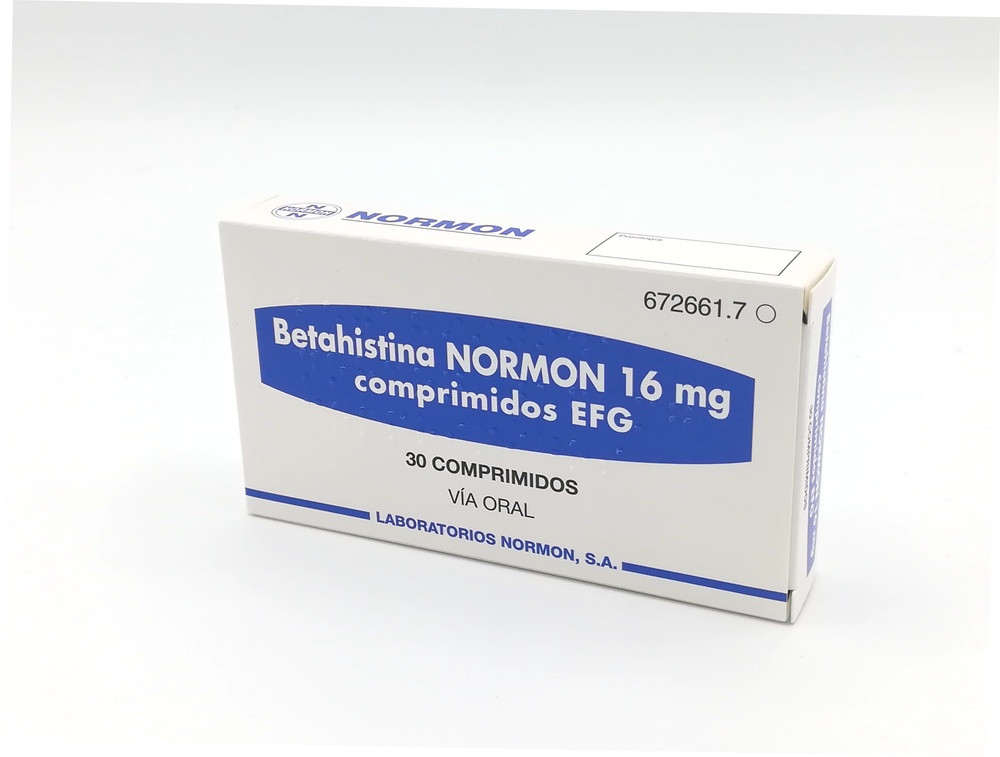
BETAHISTINA NORMON 16 mg COMPRIMIDOS




Cómo usar BETAHISTINA NORMON 16 mg COMPRIMIDOS EFG
Traducción generada por IA
Este contenido ha sido traducido automáticamente y se ofrece solo con fines informativos. No sustituye la consulta con un profesional sanitario.
Ver originalContenido del prospecto
Introducción
Prospecto: información para el usuario
Betahistina Normon 16 mg comprimidosEFG
Betahistina dihidrocloruro
L.
- Conserve este prospecto, ya que puede tener que volver a leerlo.
- Si tiene alguna duda, consulte a su médico o farmacéutico.
- Este medicamento se le ha recetado solamente a usted y no debe dárselo a otras personas aunque tengan los mismos síntomas que usted, ya que puede perjudicarles.
- Si experimenta efectos adversos, consulte a su médico, farmacéutico o enfermero, incluso si se trata de efectos adversos que no aparecen en este prospecto. Ver sección 4.

C
- Qué es Betahistina Normon y para qué se utiliza
- Qué necesita saber antes de empezar a tomar Betahistina Normon
- Cómo tomar Betahistina Normon
- Posibles efectos adversos
- Conservación de Betahistina Normon
- Contenido del envase e información adicional
1. Qué es Betahistina Normon y para qué se utiliza
Betahistina Normon pertenece a un grupo de medicamentos denominados medicamentos antivertiginosos y su principio activo es el dihidrocloruro de betahistina.
Betahistina se utiliza para el tratamiento del Síndrome de Menière, que es un trastorno que se caracteriza por presentar los siguientes síntomas: vértigos (con náuseas y vómitos), pérdida de audición y sensación de ruido dentro del oído (acúfenos).
El principio activo de este medicamento es un análogo de la histamina que actúa mejorando la circulación en el oído interno y por tanto disminuye la presión. El oído interno es uno de los órganos responsables del sentido del equilibrio.

2. Que necesita saber antes de empezar a tomar Betahistina Normon
No tome Betahistina Normon
- Si es alérgico al principio activo o a cualquiera de los demás componentes de este medicamento (incluidos en la sección 6).
- Si su médico le ha dicho que tiene un determinado cáncer de las glándulas suprarrenales llamado feocromocitoma.
Advertencias y precauciones
Consulte a su médico o farmacéutico antes de empezar a tomar betahistina:
- Si tiene asma bronquial.
- Si tiene o ha tenido úlcera de estomago
- Si sufre ronchas en la piel y picor intenso (urticaria), erupción cutánea (exantema) o fiebre de heno.
Otros medicamentos y Betahistina Normon
Informe a su médico o farmacéutico si está utilizando, ha utilizado recientemente o pudiera tener que tomar cualquier otro medicamento, incluso los adquiridos sin receta.
La administración al mismo tiempo que Betahistina Normon con medicamentos antialérgicos como los antihistamínicos (en especial los antagonistas H1) puede reducir la eficacia de ambos medicamentos.
La administración al mismo tiempo que Betahistina Normon con medicamentos inhibidores de la monoamino-oxidasa (IMAO), (usados para el tratamiento del Parkinson), puede aumentar el efecto de Betahistina Normon.
Uso de Betahistina Normon con alimentos, bebidas y alcohol
Se recomienda tomar Betahistina Normon durante o después de las comidas para evitar molestias gástricas.
Niños y adolescentes
Betahistina Normon no está recomendado para uso en niños y adolescentes menores de 18 años debido a que no existe experiencia en estos grupos de edad.
Embarazo, lactancia y fertilidad
Si está embarazada o en periodo de lactancia, cree que podría estar embarazada o tiene intención de quedarse embarazada, consulte a su médico ó farmacéutico antes de utilizar este medicamento.
Se desconoce si este medicamento afecta al feto, por lo que Betahistina Normon no debe tomarse durante el embarazo, salvo que su médico lo considere necesario.
Se desconoce si este medicamento pasa a la leche materna, por lo que si está tomando Betahistina Normon no debe amamantar a su hijo.
Conducción y uso de máquinas
Betahistina está indicada para el síndrome de Meniére. Esta enfermedad puede afectar negativamente la capacidad para conducir y usar máquinas. En los ensayos clínicos específicamente diseñados para investigar la capacidad para conducir o usar máquinas, betahistina no tuvo efectos o fueron insignificantes.
3. Cómo tomar Betahistina Normon
Siga exactamente las instrucciones de administración de este medicamento indicadas por su médico o farmacéutico. En caso de duda, consulte de nuevo a su médico o farmacéutico.
Su médico le ajustará la dosis, en función de su respuesta al tratamiento desde una dosis inicial de medio comprimido de 16 mg tres veces al día hasta un comprimido de 16 mg tres veces al día (dosis máxima). La dosis de mantenimiento se ajustará en función de su respuesta siendo la dosis mínima eficaz, medio comprimido de 16 mg tres veces al día.
Los comprimidos se deben tomar con agua. Los comprimidos de 16 mg son ranurados para poder dividirlos en dos mitades iguales y facilitar la toma de la mitad de dosis (8 mg) cuando sea necesario.
En algunos casos, la mejoría no comienza a hacerse evidente hasta las dos semanas del inicio del tratamiento. El resultado óptimo se obtiene tras varios meses de tratamiento.
Se pueden tomar los comprimidos con o sin comida. Sin embargo, si los toma en ausencia de comida, pueden causar problemas estomacales leves (que se enumeran en la sección 4). Tomando los comprimidos con comida puede ayudar a reducir los problemas estomacales.
U
Betahistina no está recomendado para uso en niños y adolescentes menores de 18 años debido a la escasez de datos sobre seguridad y eficacia.
S
En caso de sobredosis o ingestión accidental, consulte inmediatamente a su médico o farmacéutico o llame al Servicio de Información Toxicológica, teléfono: 91.562.04.20 indicando el medicamento y la cantidad ingerida.
Puede sufrir los siguientes síntomas debido a una sobredosis: náuseas, somnolencia, dolor abdominal. Puede aparecer también aceleración de los latidos del corazón (taquicardia), presión arterial baja (hipotensión), dificultad para respirar con sensación de ahogo (broncoespasmo), acumulación de líquidos en los tejidos (edema). Las convulsiones pueden ocurrir después de tomar dosis muy altas.
Se recomienda que le den un tratamiento sintomático ya que no existe un antídoto específico.
S
No tome una dosis doble para compensar las dosis olvidadas. Si olvida tomar una dosis, espere hasta la próxima toma y siga con el tratamiento normal.
SetahistinaN
Debe tomar betahistina durante tanto tiempo como le recomiende su médico. No debe interrumpir el tratamiento antes, ya que no se obtendrían los resultados esperados.
Si tiene cualquier otra duda sobre el uso de este medicamento, pregunte a su médico, farmacéutico o enfermero.
4. Posibles efectos adversos
Al igual que todos los medicamentos, este medicamento puede producir efectos adversos, aunque no todas las personas los sufran.
La clasificación por frecuencias es la siguiente:
Muy frecuentes: pueden afectar a más de 1 de cada 10 pacientes
Frecuentes: pueden afectar hasta 1 de cada 10 pacientes
Poco frecuentes: pueden afectar hasta 1 de cada 100 pacientes
Raros: pueden afectar hasta 1 de cada 1.000 pacientes
Muy raros: pueden afectar hasta 1 de cada 10.000 pacientes
Frecuencia no conocida: la frecuencia no puede estimarse a partir de los datos disponibles
En los ensayos clínicos, los efectos adversos encontrados fueron:
Trastornos gastrointestinales
Frecuentes: náuseas y dispepsia (molestia en la parte superior del abdomen con sensación de hinchazón).
Trastornos del sistema nervioso
Frecuentes: dolor de cabeza.
Después de su comercialización y en la literatura científica se han referido los siguientes efectos adversos con una frecuencia no conocida:
Trastornos del sistema inmunológico
Reacciones de hipersensibilidad, por ejemplo anafilaxia.
Trastornos gastrointestinales
Molestias gástricas ligeras (por ejemplo vómitos, dolor gastrointestinal, distensión e hinchazón abdominal). Estos efectos pueden tratarse normalmente tomando el fármaco durante las comidas o disminuyendo la dosis.
Trastornos de la piel y del tejido subcutáneo
Reacciones de hipersensibilidad cutánea y subcutánea, en particular edema angioneurótico (hinchazón de piel y mucosas, especialmente de la cara, boca, lengua y manos), urticaria, erupción cutánea y picor (prurito).
Comunicación de efectos adversos:
Si experimenta cualquier tipo de efecto adverso, consulte a su médico o farmacéutico, incluso si se trata de posibles efectos adversos que no aparecen en este prospecto. También puede comunicarlos directamente a través del Sistema Español de Farmacovigilancia de Medicamentos de Uso Humano: https://www.notificaram.es. Mediante la comunicación de efectos adversos usted puede contribuir a proporcionar más información sobre la seguridad de este medicamento.
5. Conservación de Betahistina Normon
Mantener este medicamento fuera de la vista y del alcance de los niños.
Este medicamento no requiere condiciones especiales de conservación.
No utilice este medicamento después de la fecha de caducidad que aparece en el envase y en el blíster después de CAD.
La fecha de caducidad es el último día del mes que se indica.
Los medicamentos no se deben tirar por los desagües ni a la basura. Deposite los envases y los medicamentos que no necesita en el Punto SIGRE de la farmacia. En caso de duda pregunte a su farmacéutico cómo deshacerse de los envases y de los medicamentos que no necesita. De esta forma ayudará a proteger el medio ambiente.
.
6. Contenido del envase e información adicional
Composición de Betahistina Normon
El principio activo es betahistina dihidrocloruro. Cada comprimido contiene 16 mg de betahistina dihidrocloruro.
Los demás componentes (excipientes) son: manitol (E-421), celulosa microcristalina, ácido cítrico, hidroxipropilcelulosa de baja sustitución, sílice coloidal, talco y macrogol 6000.
A
Betahistina Normon 16 mg comprimidos EFG se presenta en forma de comprimidos de color blanco o casi blanco, redondos, ranurados y serigrafiados.
Cada envase contiene 30 comprimidos.
T
T
LABORATORIOS NORMON, S.A.
Ronda de Valdecarrizo, 6 – 28760 Tres Cantos – Madrid (ESPAÑA)
Otras presentaciones
Betahistina Normon 8 mg comprimidos EFG
Fecha de la última revisión de este prospecto:Junio 2024
La información detallada de este medicamento está disponible en la página web de la Agencia Española de Medicamentos y Productos Sanitarios (AEMPS) http://www.aemps.gob.es/

-

- País de registro
- Forma farmacéuticaCOMPRIMIDO, 16 mg betahistina dihidrocloruro
- Código ATCN07CA01
- Precio medio en farmacia2.73 EUR
- Principio activo
- Requiere recetaSí
- Fabricante
- ComposiciónMANITOL (E-421) (30±10% mg mg)
- Esta información es de carácter general y no sustituye la consulta con un profesional sanitario.
- Alternativas a BETAHISTINA NORMON 16 mg COMPRIMIDOS EFGForma farmacéutica: COMPRIMIDO, 24 mgPrincipio activo: betahistineFabricante: Accord Healthcare S.L.U.Requiere recetaForma farmacéutica: COMPRIMIDO, 16 mgPrincipio activo: betahistineFabricante: Aurovitas Spain, S.A.U.Requiere recetaForma farmacéutica: COMPRIMIDO, 8 mgPrincipio activo: betahistineFabricante: Aurovitas Spain, S.A.U.Requiere receta
Médicos online para BETAHISTINA NORMON 16 mg COMPRIMIDOS EFG
Comenta la dosis, los posibles efectos secundarios, interacciones, contraindicaciones o la revisión de receta de BETAHISTINA NORMON 16 mg COMPRIMIDOS EFG, sujeto a valoración médica y a la normativa local.


 Reservar videoconsulta
  Reservar videoconsulta


 Reservar videoconsulta

Obtén una receta de BETAHISTINA NORMON 16 mg COMPRIMIDOS EFG online
Rellena un formulario de 2 minutos
Cuéntanos tus síntomas, historial y el medicamento que necesitas.
Elige un médico o nosotros te asignamos uno
Escoge un especialista o te conectamos con el próximo médico disponible.
El médico revisa tu caso
Normalmente en 30 minutos. Puede hacerte preguntas adicionales por chat.
Recógela en cualquier farmacia
Receta electrónica enviada a tu correo, válida en toda España.
Preguntas frecuentes
¿Se requiere receta para BETAHISTINA NORMON 16 mg COMPRIMIDOS EFG?
BETAHISTINA NORMON 16 mg COMPRIMIDOS EFG requires receta en España. Puedes confirmarlo con un médico online según tu caso.
¿Cuál es el principio activo de BETAHISTINA NORMON 16 mg COMPRIMIDOS EFG?
El principio activo de BETAHISTINA NORMON 16 mg COMPRIMIDOS EFG es betahistine. Esta información ayuda a identificar medicamentos con la misma composición pero con diferentes nombres comerciales.
¿Cuánto cuesta BETAHISTINA NORMON 16 mg COMPRIMIDOS EFG en farmacia?
El precio medio en farmacia de BETAHISTINA NORMON 16 mg COMPRIMIDOS EFG es de aproximadamente 2.73 EUR. Puede variar según el fabricante y la forma farmacéutica.
¿Quién fabrica BETAHISTINA NORMON 16 mg COMPRIMIDOS EFG?
BETAHISTINA NORMON 16 mg COMPRIMIDOS EFG es fabricado por Laboratorios Normon S.A.. La marca y el envase pueden variar según el distribuidor.
¿Qué médicos pueden recetar BETAHISTINA NORMON 16 mg COMPRIMIDOS EFG online?
Los Médicos de familia, Psiquiatras, Dermatólogos, Cardiólogos, Endocrinólogos, Gastroenterólogos, Neumólogos, Nefrólogos, Reumatólogos, Hematólogos, Infectólogos, Alergólogos, Geriatras, Pediatras, Oncólogos pueden valorar la prescripción de BETAHISTINA NORMON 16 mg COMPRIMIDOS EFG cuando esté clínicamente indicado. Puedes reservar una videoconsulta para comentar tu caso y las opciones de tratamiento.
¿Cómo comprar BETAHISTINA NORMON 16 mg COMPRIMIDOS EFG en España?
España cuenta con una infraestructura sanitaria bien desarrollada en ciudades principales como Madrid, Barcelona, Valencia y Sevilla. Las farmacias están ampliamente disponibles y operan bajo estrictas regulaciones, garantizando el acceso a medicamentos con receta.
Puedes comprar BETAHISTINA NORMON 16 mg COMPRIMIDOS EFG en Madrid, Barcelona, Sevilla o Valencia en cualquier farmacia local con una receta válida.
Para obtener una receta, puedes utilizar Oladoctor:
¿Cuáles son las alternativas a BETAHISTINA NORMON 16 mg COMPRIMIDOS EFG?
Otros medicamentos con el mismo principio activo (betahistine) incluyen BETAHISTINA ACCORD 24 MG COMPRIMIDOS EFG, BETAHISTINA AUROVITAS 16 MG COMPRIMIDOS EFG, BETAHISTINA AUROVITAS 8 MG COMPRIMIDOS EFG. Pueden tener diferentes nombres comerciales o formulaciones, pero contienen el mismo componente terapéutico. Consulta siempre con un médico antes de cambiar o iniciar un nuevo medicamento.
