


Bendamustina Accord 2,5 mg/ml solución inyectable

Revisión de receta online
Un médico revisará tu caso y determinará si la prescripción es médicamente apropiada.

Habla con un médico sobre este medicamento
Comenta tus síntomas y las opciones de tratamiento en una consulta online.



Cómo usar BENDAMUSTINA ACCORD 2,5 MG/ML POLVO PARA CONCENTRADO PARA SOLUCION PARA PERFUSION EFG
Contenido del prospecto
- Introducción
- Qué es Bendamustina Accord y para qué se utiliza
- Qué necesita saber antes de empezar a usar Bendamustina Accord
- Cómo usar Bendamustina Accord
- Posibles efectos adversos
- Conservación de Bendamustina Accord
- Contenido del envase e información adicional
Introducción
Prospecto: información para el usuario
Bendamustina Accord 2,5 mg/ml polvo para concentrado para solución para perfusión EFG
Hidrocloruro de bendamustina
El nombre de su medicamento es Bendamustina Accord 2,5 mg/ml polvo para concentrado para solución para perfusión pero en el resto del prospecto aparecerá como Bendamustina Accord.
Lea todo el prospecto detenidamente antes de empezar a usar el medicamento, porque contiene información importante para usted.
- Conserve este prospecto, ya que puede tener que volver a leerlo.
- Si tiene alguna duda, consulte a su médico o farmacéutico.
- Este medicamento se le ha recetado solamente a usted y no debe dárselo a otras personas, aunque tengan los mismos síntomas que usted, ya que puede perjudicarles.
- Si experimenta efectos adversos, consulte a su médico, farmacéutico o enfermero, incluso si se trata de efectos adversos que no aparecen en este prospecto. Ver sección 4.
Contenido del prospecto:
- Qué es Bendamustina Accord y para qué se utiliza
- Qué necesita saber antes de empezar a usar Bendamustina Accord
- Cómo usar Bendamustina Accord
- Posibles efectos adversos
- Conservación de Bendamustina Accord
- Contenido del envase e información adicional
1. Qué es Bendamustina Accord y para qué se utiliza
Bendamustina Accord es un medicamento que se utiliza para el tratamiento de determinados tipos de cáncer (es un medicamento citotóxico)
Bendamustina Accord se utiliza sola (monoterapia) o combinada con otros medicamentos para el tratamiento de los siguientes tipos de cáncer:
- leucemia linfocítica crónica, si la quimioterapia de combinación con fludarabina no es adecuada para usted.
- linfomas no-Hodgkin, que no han respondido, o han respondido sólo durante un periodo de tiempo corto, tras tratamiento previo con rituximab.
- mieloma múltiple, si para usted no son adecuados tratamientos que contengan talidomida o bortezomib.

¿No estás seguro de si este medicamento es adecuado para ti?
Comenta tus síntomas y tratamiento con un médico online.
2. Qué necesita saber antes de empezar a usar Bendamustina Accord
No use Bendamustina Accord
- si es alérgico a bendamustina hidrocloruro o a cualquiera de los demás componentes de este medicamento (incluidos en la sección 6)
- durante la lactancia, si el tratamiento con Bendamustina Accord es necesario durante la lactancia debe dejar de dar el pecho (ver sección Embarazo, lactancia y fertilidad)
- si padece una disfunción hepática grave (lesión de las células funcionales del hígado)
- si presenta una coloración amarillenta de la piel o del blanco de los ojos, causada por problemas del hígado o de la sangre (ictericia)
- si presenta un trastorno grave de la función medular (depresión de la médula ósea) y alteraciones graves del número de los glóbulos blancos y de las plaquetas en la sangre
- si se ha sometido a una intervención quirúrgica importante en los 30 días anteriores del inicio del tratamiento
- si ha tenido alguna infección, especialmente si se ha acompañado de una reducción del número de los glóbulos blancos (leucocitopenia)
- en combinación con vacunas de la fiebre amarilla
Advertencias y precauciones
Consulte a su médico, farmacéutico o enfermero antes de empezar a usar Bendamustina Accord
- en caso de que se haya reducido la capacidad de su médula ósea para sustituir las células sanguíneas. Debe medirse el número de los glóbulos blancos y de las plaquetas en la sangre antes de empezar el tratamiento con Bendamustina Accord, antes de cada ciclo de tratamiento y en los intervalos entre los ciclos.
- en caso de infecciones. Si presenta signos de infección, como fiebre o síntomas pulmonares, debe ponerse en contacto con su médico.
- si presenta reacciones en la piel durante el tratamiento con Bendamustina Accord. Las reacciones en la piel pueden incrementar en intensidad.
- en caso de que aparezcan erupción o ampollas rojas o liláceas y dolorosas esparcidas en la membrana mucosa (p.ej. boca o labios), en particular si ha tenido previamente sensibilidad a la luz, infecciones del sistema respiratorio (p. ej. bronquitis) y/o fiebre.
- si padece una enfermedad del corazón (p. ej., ataque cardiaco, dolor torácico, trastornos graves del ritmo cardíaco).
- si nota dolor en un costado o si observa sangre en la orina o que orina menos. Si su enfermedad es muy grave, es posible que su organismo no pueda eliminar todos los productos de desecho de las células cancerosas que se están muriendo. Esto se denomina síndrome de lisis tumoral y puede producir un fallo de su riñón y problemas cardíacos en las 48 horas siguientes a la administración de la primera dosis de Bendamustina Accord. Su médico se asegurará de que está adecuadamente hidratado le dará otros medicamentos para evitar que esto ocurra.
- en caso de reacciones alérgicas o de hipersensibilidad graves, debe prestar atención a las reacciones a la perfusión tras su primer ciclo de tratamiento.
- en cualquier momento durante o después del tratamiento, informe a su médico de inmediato si nota o alguien nota en usted: pérdida de memoria, dificultades cognitivas, dificultad para andar o pérdida de visión. Estos síntomas pueden deberse a una infección cerebral muy rara pero grave que puede resultar mortal (leucoencefalopatía multifocal progresiva o LMP).
Uso de Bendamustina Accord con otros medicamentos
Informe a su médico o farmacéutico si está utilizando, ha utilizado recientemente o podría tener que utilizar cualquier otro medicamento, incluyendo medicamentos adquiridos sin receta.
Si se utiliza Bendamustina Accord en combinación con medicamentos que inhiben la formación de sangre en la médula ósea, se puede intensificar el efecto sobre la médula.
Si se utiliza Bendamustina Accord en combinación con medicamentos que alteran su respuesta inmune, se puede intensificar este efecto.
Los citostáticos pueden reducir la eficacia de las vacunas de virus vivos. Además, los citostáticos aumentan el riesgo de infección tras la vacunación con vacunas de virus vivos (p. ej., vacunación viral).
Embarazo, lactancia y fertilidad
Si está embarazada o en periodo de lactancia, cree que podría estar embarazada o tiene intención de quedarse embarazada, consulte a su médico o farmacéutico antes de utilizar este medicamento.
Embarazo
Bendamustina Accord puede producir daño genético y ha causado malformaciones en estudios realizados con animales. No debe utilizarse durante el embarazo a menos que el médico lo considere claramente necesario. Si recibe este tratamiento, deberá pedir a un médico que le explique el riesgo de posibles efectos adversos del tratamiento para su hijo. Se recomienda la consulta genética.
Si es usted una mujer en edad fértil, tiene que utilizar medidas anticonceptivas eficaces antes y durante el tratamiento con este medicamento. No debe quedarse embarazada durante el tratamiento con este medicamento y durante al menos 6 meses después de la última dosis. Si se queda embarazada durante el tratamiento con este medicamento, deberá informar inmediatamente a su médico y buscar consejo genético.
Lactancia
Bendamustina no debe administrarse durante la lactancia. Si necesita tratamiento con este medicamento durante la lactancia, deberá suspenderla.
Consulte a su médico o farmacéutico antes de utilizar cualquier medicamento.
Anticoncepción en hombres y mujeres
Si usted es mujer, no debe quedarse embarazada durante el tratamiento con este medicamento y durante al menos 6 meses después de la última dosis.
Si usted es hombre, debe tomar las precauciones adecuadas para asegurar que su pareja no se quede embarazada durante el tratamiento con este medicamento y durante al menos 3 meses después de la última dosis.
Fertilidad
Se recomienda a los varones tratados con este medicamento que no procreen durante el tratamiento ni en los 3 meses después de la última dosis. Antes de empezar el tratamiento debe asesorarse sobre la conservación de espermatozoides, porque cabe la posibilidad de que le produzca una esterilidad permanente.
Conducción y uso de máquinas
No se han realizado estudios de los efectos sobre la capacidad para conducir y utilizar máquinas. No conduzca ni utilice maquinas si usted experimenta efectos adversos tales como mareo o falta de coordinación.
3. Cómo usar Bendamustina Accord
Utilice este medicamento exactamente como su médico o farmacéutico le haya dicho. Hable con su médico o farmacéutico si no está segura.
Bendamustina Accord se administra en una vena durante 30 a 60 minutos en diversas dosis, ya sea sola (monoterapia) o combinada con otros medicamentos.
No podrá empezar el tratamiento si su cifra de glóbulos blancos (leucocitos) es inferior a determinados niveles.
Su médico le medirá estos valores periódicamente.
Leucemia linfocítica crónica
Bendamustina Accord 100 mg por metro cuadrado de superficie corporal (que se calcula con el peso y la talla) | Los días 1 y 2 |
Este ciclo se repetirá al cabo de 4 semanas y hasta 6 veces |
Linfomas no-Hodgkin
Bendamustina Accord 120 mg por metro cuadrado de superficie corporal (que se calcula con el peso y la talla) | Los días 1 y 2 |
Este ciclo se repetirá al cabo de 3 semanas y hasta 6 veces |
Mieloma múltiple
Bendamustina Accord 120-150 mg por metro cuadrado de superficie corporal (que se calcula con el peso y la talla) | Los días 1 y 2 |
Prednisona 60 mg por metro cuadrado de superficie corporal (que se calcula con el peso y la talla) por vía intravenosa o por vía oral | Los días 1 a 4 |
Este ciclo se repetirá al cabo de 4 semanas al menos 3 veces |
El tratamiento finalizará si la cifra de glóbulos blancos (leucocitos) y/o la de plaquetas es inferior a determinados niveles. Se podrá reanudar el tratamiento cuando la cifra de leucocitos y la de plaquetas hayan aumentado.
Insuficiencia renal o hepática
Puede ser necesario ajustar la dosis en función del grado de deterioro del funcionamiento de su hígado (sobre un 30% en caso de deterioro moderado del funcionamiento del hígado). No es necesario un ajuste de dosis en caso de alteración de la función del riñón. Su médico decidirá si es necesario un ajuste de dosis.
Cómo se administra
Bendamustina Accord sólo puede ser administrado por médicos con experiencia en el tratamiento de tumores. Su médico le administrará la dosis exacta de Bendamustina Accord y tomará las precauciones necesarias.
Su médico le administrará la solución para perfusión tras su correcta preparación. La solución se administra en una vena como una perfusión breve durante 30 a 60 minutos.
Duración del tratamiento
No se definido una duración concreta del tratamiento con Bendamustina Accord. La duración del tratamiento depende de la enfermedad y de la respuesta al tratamiento.
Si le preocupa algo o tiene alguna duda sobre el tratamiento con Bendamustina Accord, hable con su médico o enfermero.
Si olvidó usar Bendamustina Accord
Si olvida una dosis de Bendamustina Accord, normalmente su médico proseguirá con la pauta posológica normal.
Si interrumpe el tratamiento con Bendamustina Accord
Su médico decidirá si se debe interrumpir el tratamiento o utilizar otra preparación diferente.
Si tiene cualquier otra duda sobre el uso de este medicamento, pregunte a su médico o farmacéutico.

¿Has empezado a tomar el medicamento y tienes preguntas?
Comenta tus síntomas y tratamiento con un médico online.
4. Posibles efectos adversos
Al igual que todos los medicamentos, este medicamento puede producir efectos adversos, aunque no todas las personas los sufran. Algunas de las reacciones mencionadas abajo pueden encontrarse después de que su médico le haya realizado unos análisis.
Las siguientes frecuencias se utilizan para evaluar las reacciones adversas:
Muy frecuentes: pueden afectar a más de 1 de cada 10 personas
Frecuentes: pueden afectar a hasta 1 de cada 10 personas
Poco frecuentes: pueden afectar a hasta 1 de cada 100 personas
Raras: pueden afectar a hasta 1 de cada 1.000 personas
Muy raras: pueden afectar a hasta 1 de cada 10.000 personas
No conocida: la frecuencia no puede ser estimada a partir de los datos disponibles
En casos muy raros se han observado alteraciones tisulares (debido al daño celular que resulta en la muerte prematura de las células) tras la inyección no intencionada en el tejido que rodea los vasos sanguíneos (extravascular). Si se administra el producto fuera de un vaso, puede haber una sensación de quemazón en el lugar de inserción de la aguja. Las consecuencias de la administración de esta forma pueden ser dolor y problemas de curación de la piel.
El efecto adverso limitante de la dosis de Bendamustina Accord es una alteración de la función de la médula ósea, que suele normalizarse. La supresión de la función de la médula ósea puede dar lugar a bajos niveles de células sanguíneas, que a su vez puede dar lugar a un aumento en el riesgo de infección, anemia o intensificación del riesgo de hemorragia.
Muy frecuentes:
- Reducción de la cifra de glóbulos blancos (defensas en sangre)
- Reducción del pigmento rojo de la sangre (hemoglobina : una proteína de los glóbulos rojos de la sangre que transporta oxígeno por el cuerpo)
- Reducción de la cifra de plaquetas (células sanguíneas incoloras que colaboran en la coagulación de la sangre)
- Infecciones
- Náuseas
- Vómitos
- Inflamación de las mucosas
- Aumento de la concentración sanguínea de creatinina (un producto químico de desecho producido por sus músculos)
- Aumento de la concentración sanguínea de urea (un producto químico de desecho)
- Fiebre
- Fatiga
- Dolor de cabeza
Frecuentes:
- Sangrado (hemorragia)
- Alteración del metabolismo causado por células cancerosas muriendo, que liberan su contenido al torrente circulatorio
- Disminución de los glóbulos rojos, que puede poner pálida la piel y causar debilidad o dificultad para respirar (anemia)
- Reducción de la cifra de neutrófilos (un tipo común de glóbulos blancos necesarios para combatir infecciones)
- Reacciones de hipersensibilidad, como inflamación alérgica de la piel (dermatitis) o urticaria
- Elevación de las enzimas hepáticas AST/ALT que pueden indicar inflamación o daño en las células del hígado
- Aumento de la enzima fosfatasa alcalina (una enzima fabricada principalmente en el hígado y los huesos)
- Aumento del pigmento de la bilis (una sustancia generada durante la normal degradación de las células rojas de la sangre)
- Bajada del nivel de potasio sanguíneo (un nutriente que es necesario para el funcionamiento de células nerviosas y musculares, incluyendo las del corazón)
- Alteración de la función (disfunción) cardiaca
- Alteración del ritmo cardiaco (arritmia)
- Elevación o descenso de la presión arterial (hipotensión o hipertensión)
- Alteración de la función pulmonar
- Diarrea
- Estreñimiento
- Úlceras en la boca (estomatitis)
- Pérdida de apetito
- Caída del cabello
- Alteraciones cutáneas
- Ausencia del periodo (amenorrea)
- Dolor
- Insomnio
- Escalofríos
- Deshidratación
- Mareo
- Erupción con picor (urticaria)
Poco frecuentes:
- Acumulación de líquido en la bolsa que envuelve el corazón (escape de líquido en el espacio pericárdico)
- Producción ineficaz de células de la sangre (el material esponjoso dentro de sus huesos donde se fabrican las células sanguíneas)
- Leucemia aguda
- Ataque cardíaco, dolor torácico (infarto de miocardio)
- Insuficiencia cardíaca
Raras:
- Infección de la sangre (sepsis)
- Reacciones alérgicas y de hipersensibilidad graves (reacciones anafilácticas)
- Signos similares a las reacciones anafilácticas (reacciones anafilactoides)
- Somnolencia
- Pérdida de voz (afonía)
- Insuficiencia circulatoria aguda (fallo en la circulación sanguínea principalmente de origen cardíaco con fallo para mantener el aporte de oxígeno y otros nutrientes a los tejidos y eliminación de toxinas)
- Enrojecimiento de la piel (eritema)
- Inflamación de la piel (dermatitis)
- Picor (prurito)
- Erupción cutánea (exantema maculoso)
- Sudoración excesiva (hiperhidrosis)
- Reducción en la función de la medula ósea que puede hacerle sentir mal o aparecer en sus análisis de sangre
Muy raras:
- Inflamación atípica primaria de los pulmones (neumonía)
- Destrucción de glóbulos rojos de la sangre
- Rápido descenso de la presión arterial, en ocasiones con reacciones o erupciones cutáneas (shock anafiláctico)
- Alteración del sentido del gusto
- Alteración de la sensibilidad (parestesias)
- Malestar y dolor en las extremidades (neuropatía periférica)
- Síndrome anticolinérgico (inhibición de la acción fisiológica de la acetilcolina, especialmente como neurotransmisor)
- Trastornos neurológicos (enfermedades del cerebro, la medula espinal y los nervios que los conectan)
- Falta de coordinación (ataxia)
- Inflamación del cerebro (encefalitis)
- Aumento de la frecuencia cardiaca (taquicardia)
- Inflamación de las venas (flebitis)
- Formación de tejido en los pulmones (fibrosis de los pulmones)
- Inflamación hemorrágica de la garganta (esofagitis hemorrágica)
- Hemorragia gástrica o intestinal
- Infertilidad
- Fallo multiorgánico
No conocidas :
- Fallo en el riñón
- Fallo en el hígado
- Ritmo cardíaco irregular y normalmente rápido (fibrilación atrial)
- Erupción o ampollas rojas o liláceas y dolorosas esparcidas en la membrana mucosa (p.ej. boca o labios), en particular si ha tenido previamente sensibilidad a la luz, infecciones del sistema respiratorio (p. ej. bronquitis) y/o fiebre.
- Pneumonitis
- Sangrado desde los pulmones
- Micción excesiva, incluso por la noche, y sed excesiva incluso después de beber líquidos (diabetes insípida nefrogénica)
Ha habido comunicaciones de tumores (síndromes mielodisplásicos, LMA, carcinoma bronquial) después del tratamiento con bendamustina. No se pudo determinar una clara relación con bendamustina.
Contacte con su médico o busque atención médica inmediatamente si sufre alguno de los siguientes efectos adversos (frecuencia no conocida):
Erupciones de la piel graves incluyendo el síndrome de Stevens-Johnson y necrólisis epidérmica tóxica. Éstos pueden aparecer como máculas o manchas circulares rojizas parecidas a una diana a menudo con ampollas centrales en el tronco, descamación, úlceras en la boca, garganta, nariz, genitales y ojos que pueden ser precedidos por fiebre y síntomas parecidos a los de la gripe.
Erupción diseminada, alta temperatura corporal, ganglios linfáticos agrandados y otras alteraciones en los órganos (Reacción al Medicamento asociada a Eosinofilia y Síntomas Sistémicos que también se conoce como DRESS o síndrome de hipersensibilidad al fármaco).
Si alguno de los efectos adversos se agrava, o si nota cualquier efecto adverso no incluido en este prospecto, por favor informe a su médico.
Comunicación de efectos adversos
Si experimenta efectos adversos, consulte a su médico, al farmacéutico del hospital o enfermera, incluso si se trata de efectos adversos que no aparecen en este prospecto. También puede comunicarlos directamente a través del Sistema Español de Farmacovigilancia de Medicamentos de Uso Humano: www.notificaRAM.es. Mediante la comunicación de efectos adversos usted puede contribuir a proporcionar más información sobre la seguridad de este medicamento.
5. Conservación de Bendamustina Accord
Mantener este medicamento fuera de la vista y del alcance de los niños.
No utilice este medicamento después de la fecha de caducidad que aparece en la etiqueta y en el envase. La fecha de caducidad es el último día del mes que se indica.
Este medicamento no requiere ninguna temperatura especial de conservación.
Conservar en el embalaje exterior para protegerlo de la luz.
Compruebe el período de validez antes de abrir o de preparar la solución.
Las soluciones para perfusión correctamente preparadas según las instrucciones que se listan al final de este prospecto son estables en bolsas de polietileno a 25ºC durante 3,5 horas y a 2ºC – 8ºC durante 2 días. Bendamustina Accord no contiene conservantes. Por tanto, la solución no debe usarse pasados estos plazos.
El usuario es responsable de mantener las condiciones asépticas.
Los medicamentos no se deben tirar por los desagües ni a la basura. Pregunte a su farmacéutico cómo deshacerse de los envases y de los medicamentos que no necesita. De esta forma ayudará a proteger el medio ambiente.
6. Contenido del envase e información adicional
Composición de Bendamustina Accord
El principio activo es hidrocloruro de bendamustina.
Un vial contiene 25 mg de hidrocloruro de bendamustina (como hidrocloruro de bendamustina monohidrato).
Un vial contiene 100 mg de hidrocloruro de bendamustina (como hidrocloruro de bendamustina monohidrato).
Tras la reconstitución, 1 ml de concentrado contiene 2,5 mg de hidrocloruro de bendamustina (como hidrocloruro de bendamustina monohidrato).
El otro componente es manitol.
Aspecto del producto y contenido del envase
Viales de vidrio ámbar con tapón de goma de bromobutilo y capuchón de aluminio de tipo flip-off.
Bendamustina Accord se comercializa en envases que contienen 5, 10 y 20 viales con 25 mg de hidrocloruro de bendamustina y 1 y 5 viales con 100 mg de hidrocloruro de bendamustina.
Puede que no todos los tamaños de envase estén comercializados.
Titular de la autorización de comercialización
Accord Healthcare, S.L.U.
World Trade Center
Moll de Barcelona, s/n
Edifici Est, 6ª planta
08039 Barcelona
Responsable de la fabricación
Accord Healthcare, S.p.z.o.o
Ul Lutomierska, 50
95-200 Pabianice
Poland
Este medicamento estáautorizado en los estados miembros del Espacio Económico Europeo con los siguientes nombres:
AT | Bendamustin Accord 2,5 mg/ml Pulver für ein Konzentrat zur Herstellung einer Infusionslösung |
DK | Bendamustinhydrochlorid Accord |
ES | Bendamustina Accord 2,5 mg/ml polvo para concentrado para solución para perfusión EFG |
FI | Bendamustin Accord 2.5 mg/ml kuiva-aine välikonsentraatiksi infuusionestettä varten, liuos |
IE | Bendamustin 25 mg/100 mg Powder for concentrate for Solution for Infusion |
IS | Bendamustin Accord 2,5 mg/ml stofnfyririnnrennslisþykkni, lausn |
NO | Bendamustin Accord |
PL | Bendamustin Accord |
SK | Bendamustin Accord 2,5 mg/ml prášoknainfúznykoncentrát |
Fecha de la última revisión de este prospecto: Junio2024
La información detallada y actualizada de este medicamento está disponible en la página Web de la Agencia Española de Medicamentos y Productos Sanitarios (AEMPS) http://www.aemps.gob.es
Esta información está destinada únicamente a médicos o profesionales sanitarios:
Como ocurre con todos los citotóxicos similares, el personal de enfermería y los médicos deben extremar las precauciones de seguridad, debido al potencial genotóxico e inductor de cáncer del preparado. Evite la inhalación (inspiración) y el contacto con la piel y las mucosas mientras manipula Bendamustina Accord (¡lleve guantes, ropa protectora y, si es posible, mascarilla!). Si se contamina alguna parte del cuerpo, límpiela con cuidado con agua y jabón, y lave los ojos con solución salina al 0,9 % (isotónica). Si es posible, se aconseja trabajar sobre un banco de trabajo de seguridad especial (flujo laminar) con una lámina absorbente desechable impermeable a los líquidos. Los artículos contaminados son desechos citostáticos. ¡Por favor, siga las normas nacionales sobre la eliminación de material citostático! Las mujeres del personal que estén embarazadas no deben trabajar con citostáticos.
La solución lista para usar debe prepararse disolviendo el contenido de un vial para inyección de Bendamustina Accord exclusivamente en agua para inyectables, como se indica a continuación:
- Preparación del concentrado
- En primer lugar se disuelve un vial de Bendamustina Accord que contenga 25 mg de hidrocloruro de bendamustina en 10 ml, agitándolo.
- En primer lugar se disuelve un vial de Bendamustina Accord que contenga 100 mg de hidrocloruro de bendamustina en 40 ml, agitándolo.
- Preparación de la solución para perfusión
Nada más obtener una solución clara (al cabo de 5 a 10 minutos, habitualmente), disuelva la dosis total recomendada de Bendamustina Accord en solución salina al 0,9 % (isotónica) para conseguir un volumen final de 500 ml aproximadamente. Bendamustina Accord no debe disolverse con otras soluciones para perfusión o inyección. Bendamustina Accord no debe mezclarse en perfusión con otras sustancias.
- Administración
La solución se administra por perfusión intravenosa durante 30-60 minutos. Los viales son para un solo uso. La eliminación del medicamento no utilizado y de todos los materiales que hayan estado en contacto con él se realizará de acuerdo con la normativa local.
Debe interrumpirse inmediatamente la inyección no intencionada en los tejidos fuera de los vasos sanguíneos (inyección extravasal). La aguja se debe retirar después de una corta aspiración. A continuación el área del tejido afectada debe enfriarse. El brazo se debe elevar. No está claro el beneficio de tratamientos adicionales como el uso de corticoesteroides (ver sección 4).
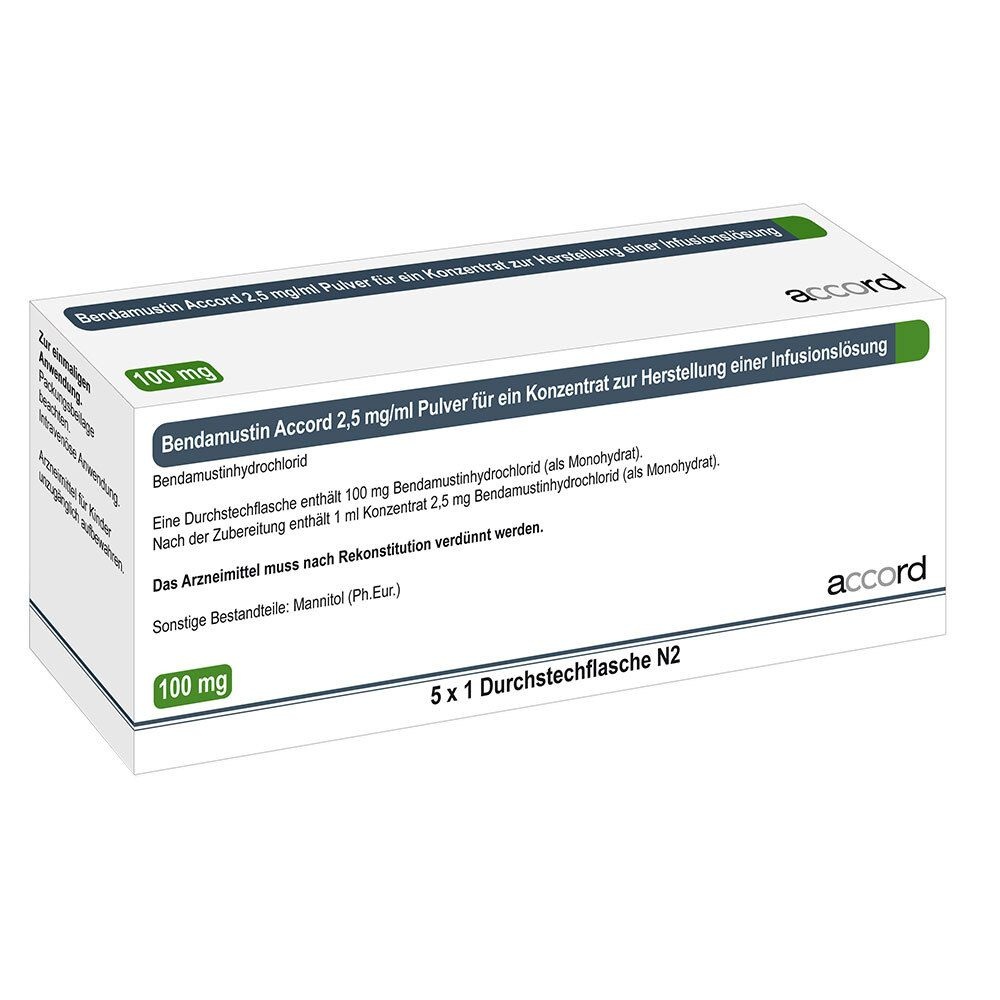
- País de registro
- Forma farmacéuticaINYECTABLE PERFUSION, 2,5 mg/ml
- Código ATCL01AA09
- Disponibilidad en farmaciasProblema de suministro reportado
- Principio activo
- Requiere recetaSí
- Fabricante
- ComposiciónMANITOL (E-421) (4,25 mg mg)
- Esta información es de carácter general y no sustituye la consulta con un profesional sanitario.
- Alternativas a BENDAMUSTINA ACCORD 2,5 MG/ML POLVO PARA CONCENTRADO PARA SOLUCION PARA PERFUSION EFGForma farmacéutica: INYECTABLE PERFUSION, 25 mg/mlPrincipio activo: bendamustineFabricante: Accord Healthcare S.L.U.Requiere recetaForma farmacéutica: INYECTABLE PERFUSION, 2.5 mg/mlPrincipio activo: bendamustineFabricante: Eugia Pharma (Malta) LimitedRequiere recetaForma farmacéutica: INYECTABLE PERFUSION, 2.5 mg/mlPrincipio activo: bendamustineFabricante: Baxter S.L.Requiere receta
Médicos online para BENDAMUSTINA ACCORD 2,5 MG/ML POLVO PARA CONCENTRADO PARA SOLUCION PARA PERFUSION EFG
Comenta la dosis, los posibles efectos secundarios, interacciones, contraindicaciones o la revisión de receta de BENDAMUSTINA ACCORD 2,5 MG/ML POLVO PARA CONCENTRADO PARA SOLUCION PARA PERFUSION EFG, sujeto a valoración médica y a la normativa local.
Preguntas frecuentes
BENDAMUSTINA ACCORD 2,5 MG/ML POLVO PARA CONCENTRADO PARA SOLUCION PARA PERFUSION EFG requiere receta en España. Puedes confirmarlo con un médico online según tu caso.
El principio activo de BENDAMUSTINA ACCORD 2,5 MG/ML POLVO PARA CONCENTRADO PARA SOLUCION PARA PERFUSION EFG es bendamustine. Esta información ayuda a identificar medicamentos con la misma composición pero con diferentes nombres comerciales.
BENDAMUSTINA ACCORD 2,5 MG/ML POLVO PARA CONCENTRADO PARA SOLUCION PARA PERFUSION EFG es fabricado por Accord Healthcare S.L.U.. La marca y el envase pueden variar según el distribuidor.
Los Médicos de familia, Psiquiatras, Dermatólogos, Cardiólogos, Endocrinólogos, Gastroenterólogos, Neumólogos, Nefrólogos, Reumatólogos, Hematólogos, Infectólogos, Alergólogos, Geriatras, Pediatras, Oncólogos pueden valorar la prescripción de BENDAMUSTINA ACCORD 2,5 MG/ML POLVO PARA CONCENTRADO PARA SOLUCION PARA PERFUSION EFG cuando esté clínicamente indicado. Puedes reservar una videoconsulta para comentar tu caso y las opciones de tratamiento.
La receta la emite un médico tras valorar tu estado de salud. En España, BENDAMUSTINA ACCORD 2,5 MG/ML POLVO PARA CONCENTRADO PARA SOLUCION PARA PERFUSION EFG se dispensa en las farmacias con esa receta médica. Una consulta online no garantiza su emisión: la decisión corresponde siempre al médico.
Para solicitar una valoración puedes usar Oladoctor:
Otros medicamentos con el mismo principio activo (bendamustine) incluyen BENDAMUSTINA ACCORD 25 MG/ML CONCENTRADO PARA SOLUCION PARA PERFUSION, BENDAMUSTINA AUROVITAS 2.5 MG/ML POLVO PARA CONCENTRADO PARA SOLUCION PARA PERFUSION EFG, BENDAMUSTINA BAXTER 2,5 MG/ML POLVO PARA CONCENTRADO PARA SOLUCION PARA PERFUSION EFG. Pueden tener diferentes nombres comerciales o formulaciones, pero contienen el mismo componente terapéutico. Consulta siempre con un médico antes de cambiar o iniciar un nuevo medicamento.
