



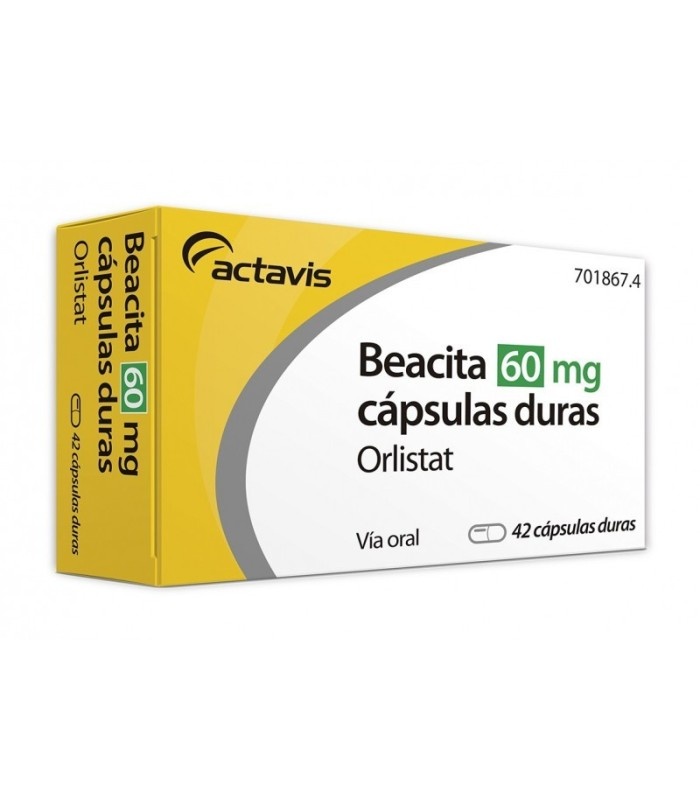
BEACITA 60 mg Capsulas Duras

Revisión de receta online
Un médico revisará tu caso y determinará si la prescripción es médicamente apropiada.

Habla con un médico sobre este medicamento
Comenta tus síntomas y las opciones de tratamiento en una consulta online.



Cómo usar BEACITA 60 MG CAPSULAS DURAS
Contenido del prospecto
- Introducción
- Qué es Beacita y para qué se utiliza
- Qué necesita saber antes de empezar a tomar Beacita
- Cómo tomar Beacita
- Posibles efectos adversos
- Conservación de Beacita
- Contenido del envase e información adicional
Introducción
Prospecto: información para el usuario
Beacita 60 mg cápsulas duras
orlistat
Lea todo el prospecto detenidamente antes de empezar a tomar este medicamento, porque contiene información importante para usted.
Siga exactamente las instrucciones de administración del medicamento contenidas en este prospecto o las indicadas por su médico o farmacéutico.
- Conserve este prospecto, ya que puede tener que volver a leerlo.
- Si necesita consejo o más información, consulte con su farmacéutico.
- Si experimenta efectos adversos, consulte a su médico o farmacéutico, incluso si se trata de efectos adversos que no aparecen en este prospecto. Ver sección 4.
- Si no pierde peso después de tomar Beacita durante 12 semanas, consulte con su médico o farmacéutico. Es posible que tenga que dejar de tomar Beacita.
Contenido del prospecto
- Qué es Beacita y para qué se utiliza
- Qué necesita saber antes de empezar a tomar Beacita
- Cómo tomar Beacita
- Posibles efectos adversos
- Conservación de Beacita
- Contenido del envase e información adicional
1. Qué es Beacita y para qué se utiliza
Beacita 60 mg cápsulas duras (orlistat) es un medicamento contra la obesidad de acción periférica que se utiliza para perder peso en adultos mayores de 18 años con sobrepeso, con un índice de masa corporal (IMC) de 28 o superior. Beacita debe utilizarse en combinación con una dieta baja en calorías y grasas.
El IMC es una forma de saber si usted tiene un peso saludable o si tiene sobrepeso teniendo en cuenta su estatura. La tabla que se incluye a continuación le ayudará a averiguar si tiene sobrepeso y si Beacita es adecuado para usted.
Consulte su peso en la tabla siguiente. Si su peso es inferior al peso que aparece al lado de su estatura, no tome Beacita.
Estatura | Peso |
1,50 m | 63 kg |
1,55 m | 67,25 kg |
1,60 m | 71,75 kg |
1,65 m | 76,25 kg |
1,70 m | 81 kg |
1,75 m | 85,75 kg |
1,80 m | 90,75 kg |
1,85 m | 95,75 kg |
1,90 m | 101 kg |
Riesgos de tener sobrepeso
Tener sobrepeso incrementa el riesgo de desarrollar diversos problemas graves para la salud, tales como diabetes o enfermedad cardiaca. Estas afecciones puede que no hagan que usted se encuentre mal por lo que debe acudir a su médico para que le haga un chequeo general.
Cómo funciona Beacita
El principio activo de Beacita (orlistat) está diseñado para dirigirse a la grasa en su aparato digestivo. Evita que alrededor de la cuarta parte de la grasa que toma en las comidas se absorba. Esta grasa se eliminará de su organismo en las heces (ver sección 4). Por tanto, es importante que siga una dieta baja en calorías y grasas para controlar esos efectos. Si lo hace, la acción de las cápsulas le ayudará en sus esfuerzos ayudándole a perder más peso que sólo con dieta. Por cada 2 kg que pierde sólo con dieta, Beacita podría ayudarle a perder hasta 1 kg más.

¿No estás seguro de si este medicamento es adecuado para ti?
Comenta tus síntomas y tratamiento con un médico online.
2. Qué necesita saber antes de empezar a tomar Beacita
No tome Beacita
? Si es alérgico a orlistat o a alguno de los demás componentes de este medicamento (incluidos en la sección 6).
? Si está embarazada o en periodo de lactancia.
? Si está tomando ciclosporina, utilizada después de un trasplante de órganos, en caso de artritis reumatoide grave y en ciertas afecciones graves de la piel.
? Si está tomando warfarina u otros medicamentos anticoagulantes.
? Si tiene colestasis (una enfermedad donde el flujo de la bilis desde el hígado está bloqueado).
? Si tiene problemas de absorción de los alimentos (síndrome de malabsorción crónica) diagnosticados por un médico.
Advertencias y precauciones
Consulte a su médico o farmacéutico antes de empezar a tomar Beacita.
? Si tiene diabetes. Consulte con su médico si es necesario ajustar su medicación antidiabética.
? Si tiene alguna enfermedad del riñón. Hable con su médico antes de tomar Beacita si tiene problemas de riñón. El uso de orlistat podría estar asociado con piedras en el riñón en pacientes que sufran enfermedades renales crónicas.
Niños y adolescentes
Los niños y adolescentes menores de 18 años no deben tomar este medicamento.
Otros medicamentos y Beacita
Beacita puede afectar a algunos medicamentos que usted tome.
Informe a su médico o farmacéutico si está tomando, ha tomado recientemente o pudiera tener que tomar cualquier otro medicamento.
No tome Beacita junto con los siguientes medicamentos.
? Ciclosporina, utilizada después de un trasplante de órganos, en caso de artritis reumatoide grave y en ciertas enfermedades graves de la piel.
? Warfarina u otros medicamentos anticoagulantes.
Uso de anticonceptivos orales junto con Beacita
? Los anticonceptivos orales pueden ser menos efectivos si sufre diarrea grave. Utilice un método anticonceptivo adicional si sufre diarrea grave.
Tome un multivitamínico todos los días si está tomando Beacita
? Beacita puede reducir los niveles de algunas vitaminas absorbidas por el organismo. El complejo multivitamínico debe contener vitaminas A, D, E y K y debe tomarlo antes de dormir, cuando ya no vaya a tomar Beacita, para asegurarse de que las vitaminas se absorban.
Consulte con su médico antes de tomar Beacita si está tomando
? Amiodarona, utilizada para problemas del ritmo cardiaco.
? Acarbosa (un medicamento antidiabético utilizado para tratar la diabetes mellitus tipo 2). El uso de Beacita no está recomendado en personas que están tomando acarbosa.
? Un medicamento para el tiroides (levotiroxina), ya que puede ser necesario ajustar la dosis y tomar sus medicamentos a distintas horas del día.
? Un medicamento para la epilepsia, ya que cualquier cambio en la frecuencia y gravedad de las convulsiones debe ser discutido con su médico.
? Medicamentos para tratar el VIH. Es importante que consulte a su médico antes de tomar Beacita si está recibiendo tratamiento para el VIH.
? Medicamentos para la depresión, trastornos psiquiátricos o la ansiedad.
Consulte con su médico o farmacéutico mientras está tomando Beacita
? Si está tomando algún medicamento para la tensión sanguínea elevada, ya que puede ser necesario ajustar la dosis.
? Si está tomando algún medicamento para el colesterol elevado, ya que puede ser necesario ajustar la dosis.
Toma de Beacita con alimentos, bebidas y alcohol
Beacita debe utilizarse en conjunto con una dieta baja en calorías y grasas. Intente comenzar esta dieta antes de empezar el tratamiento. Para obtener información sobre cómo establecer su objetivo de calorías y grasas, vea Más información de utilidad, en la sección 6.
Beacita puede tomarse justo antes, durante o hasta una hora después de la comida. La cápsula debe tragarse con agua. Esto normalmente supone una cápsula con el desayuno, otra con la comida y otra con la cena. Si no toma una comida o si la comida no contiene grasa, no tome la cápsula. Beacita no funciona si la comida no contiene algo de grasa.
Si toma una comida con alto contenido en grasa no debe tomar una dosis mayor de la recomendada.
El tomar una cápsula con una comida que contenga demasiada grasa aumenta las posibilidades de sufrir efectos del tratamiento relacionados con la dieta (ver sección 4). Debe realizar todos los esfuerzos posibles para evitar comidas con alto contenido en grasa mientras esté tomando Beacita.
Embarazo y lactancia
No tome Beacita durante el embarazo o la lactancia.
Conducción y uso de máquinas
Es improbable que Beacita afecte su capacidad para conducir o utilizar máquinas.
Beacitacontiene sodio
Este medicamento contiene menos de 23 mg de sodio (1 mmol) por cápsula; esto es, esencialmente “exento de sodio”.
3. Cómo tomar Beacita
Siga exactamente las instrucciones de administración del medicamento contenidas en este prospecto o las indicadas por su médico o farmacéutico. En caso de duda, pregunte a su médico o farmacéutico.
Preparación para perder peso
- Elija su fecha de inicio
Elija con antelación el día que comenzará a utilizar las cápsulas. Antes de empezar a tomar las cápsulas, comience su dieta baja en calorías y grasas y dé a su cuerpo unos días para ajustarse a sus nuevos hábitos alimentarios. Mantenga un registro de lo que está comiendo en un diario. Estos diarios de comidas son efectivos, porque hacen que sea consciente de lo que está comiendo, cuánto está comiendo, y le proporcionan la base para realizar cambios.
- Decida su objetivo de pérdida de peso.
Piense en cuánto peso quiere perder y márquese un objetivo de peso. Una meta realista es perder entre el 5% y el 10% de su peso inicial. La cantidad de peso que pierda puede variar de semana en semana. Debería intentar perder peso a un ritmo gradual y constante de alrededor de 0,5 kg por semana.
- Establezca sus objetivos de calorías y grasas
Para ayudarle a alcanzar su meta de pérdida de peso necesita establecer dos objetivos diarios, uno para calorías y otro para grasas. Para obtener más información vea Más información de utilidaden la sección 6.
Toma de Beacita
Adultos de 18 años o mayores
? Tome una cápsula, tres veces al día.
? Tome Beacita justo antes, durante o hasta una hora después de las comidas. Normalmente, esto significa una cápsula en el desayuno, comida y cena. Asegúrese de que sus tres comidas principales son equilibradas y bajas en calorías y en grasas.
? Si se pierde una comida, o si su comida no contiene grasa, no tome una cápsula. Beacita no funciona a no ser que la comida contenga algo de grasa.
? Trague la cápsula entera con agua.
? No tome más de tres cápsulas al día.
? Tome comidas con bajo contenido en grasa para ayudar a reducir los efectos del tratamiento relacionados con la dieta (ver sección 4).
? Intente ser más activo físicamente antes de iniciar el tratamiento. El ejercicio físico es una parte importante de los programas de pérdida de peso. Recuerde consultar con su médico primero si no ha hecho ejercicio antes.
? Continúe siendo activo mientras esté tomando Beacita y después de dejar de utilizarlo.
Durante cuánto tiempo debe tomarse Beacita
? Beacita no debe tomarse durante más de 6 meses.
? Si no pierde peso después de tomar Beacita durante 12 semanas, consulte con su médico o farmacéutico. Es posible que tenga que dejar de tomar Beacita.
? Para tener éxito en la pérdida de peso no basta con comer de manera distinta durante un corto periodo de tiempo para después regresar a los viejos hábitos. Las personas que pierden peso y mantienen la pérdida hacen cambios en su estilo de vida, que incluyen modificaciones en lo que comen y lo activos que son.
Si toma más Beacita del que debe
No tome más de tres cápsulas al día.
?Si ha tomado demasiadas cápsulas, contacte con un médico lo antes posible.
En caso de sobredosis o ingestión accidental, consulte inmediatamente a su médico o farmacéutico o llame al Servicio de Información Toxicológica, teléfono 91 562 04 20, indicando el medicamento y la cantidad ingerida.
Si olvidó tomar Beacita
Si olvidó tomar una dosis de Beacita:
? Si hace menos de una hora desde su última comida, tome la cápsula olvidada.
? Si hace más de una hora desde su última comida, no tome la cápsula olvidada. Espere y tome la siguiente cápsula con la siguiente comida como habitualmente.
No tome una dosis doble para compensar las dosis olvidadas.
Si tiene cualquier otra duda sobre el uso de este medicamento, consulte a su médico o farmacéutico.

¿Has empezado a tomar el medicamento y tienes preguntas?
Comenta tus síntomas y tratamiento con un médico online.
4. Posibles efectos adversos
Al igual que todos los medicamentos, este medicamento puede producir efectos adversos, aunque no todas las personas los sufran.
La mayoría de los efectos adversos frecuentes relacionados con el uso de Beacita (por ejemplo gases con o sin manchas aceitosas, deposiciones más frecuentes y heces blandas) son el resultado de su mecanismo de acción (ver sección 1). Tome alimentos bajos en grasa para intentar controlar estos efectos del tratamiento relacionados con la dieta.
Efectos adversos graves
No se conoce la frecuencia con la que ocurren estos efectos adversos.
Reacciones alérgicas graves
? Los signos de una reacción alérgica grave incluyen: dificultad grave para respirar, sudoración, erupción en la piel, picor, hinchazón de la cara, ritmo cardiaco rápido, colapso.
?Deje de tomar las cápsulas y busque ayuda médica inmediatamente.
Otros efectos adversos graves
? Sangrado rectal.
? Diverticulitis (inflamación del intestino grueso). Los síntomas incluyen dolor en la parte baja del estómago (abdominal), especialmente en el lado izquierdo, posiblemente con fiebre y estreñimiento.
? Pancreatitis (inflamación del páncreas). Los síntomas pueden incluir dolor abdominal intenso, a veces irradiando hacia la espalda, posiblemente con fiebre, náuseas y vómitos.
? Ampollas en la piel (incluyendo ampollas que explotan).
? Dolor de estómago intenso causado por cálculos biliares (piedras en la vesícula).
? Hepatitis (inflamación del hígado). Los síntomas pueden incluir piel y ojos amarillentos, picores, orina de color oscuro, dolor de estómago e hígado sensible (indicado por dolor debajo de la parte delantera de la caja torácica, en el lado derecho), a veces con falta de apetito.
? Nefropatía por oxalato (depósito de oxalato cálcico que puede dar lugar a piedras en el riñón). Ver la sección 2, Advertencias y precauciones.
?Deje de tomar las cápsulas. Informe a su médico si sufre alguno de estos efectos.
Efectos adversos muy frecuentes
Pueden afectar a más de 1 de cada 10 personas
? Gases (flatulencia) con o sin manchas aceitosas.
? Evacuación repentina.
? Deposiciones aceitosas o grasas.
? Heces blandas.
?Informe a su médico o farmacéutico si alguno de estos efectos adversos empeora o se complica.
Efectos adversos frecuentes
Pueden afectar hasta a 1 de cada 10 personas
? Dolor de estómago (abdominal).
? Incontinencia (fecal).
? Deposiciones fluidas o líquidas.
? Deposiciones más frecuentes.
? Ansiedad.
?Informe a su médico o farmacéutico si alguno de estos efectos adversos empeora o se complica.
Efectos observados en los análisis de sangre
No se conoce la frecuencia con la que ocurren estos efectos(la frecuencia no puede estimarse a partir de los datos disponibles)
? Aumento de los niveles de algunas enzimas hepáticas.
? Efectos en la coagulación sanguínea en personas que estén tomando warfarina u otros medicamentos anticoagulantes.
?Informe a su médico de que está tomando Beacita cuando se haga un análisis de sangre.
Comunicación de efectos adversos
Si experimenta cualquier tipo de efecto adverso, consulte a su médico, farmacéutico o enfermero, incluso si se trata de posibles efectos adversos que no aparecen en este prospecto. También puede comunicarlos directamente a través del Sistema Español de Farmacovigilancia de Medicamentos de Uso Humano: www.notificaram.es. Mediante la comunicación de efectos adversos usted puede contribuir a proporcionar más información sobre la seguridad de este medicamento.
Aprenda a controlar los efectos del tratamiento relacionados con la dieta
Los efectos adversos más comunes están causados por el mecanismo de acción de las cápsulas y se producen por la eliminación de parte de la grasa del organismo. Estos efectos ocurren típicamente durante las primeras semanas de uso de las cápsulas, antes de que haya aprendido a limitar la cantidad de grasa de su dieta. Estos efectos del tratamiento relacionados con la dieta pueden ser una señal de que usted ha comido más grasa de lo que debería.
Puede aprender a minimizar los efectos del tratamiento relacionados con la dieta siguiendo estas directrices básicas:
? Comience una dieta baja en grasa unos días, o incluso una semana, antes de empezar a tomar las cápsulas.
? Averigüe más sobre el contenido en grasa de sus comidas favoritas, y el tamaño de las porciones. Si se familiariza con las porciones será menos probable que exceda accidentalmente su objetivo de grasa.
? Distribuya el límite de grasa de manera uniforme en las comidas a lo largo del día. No “ahorre” ingesta de grasas y calorías para luego tomar una comida con elevado contenido de grasa o un postre, como puede que haya hecho con otros programas para perder peso.
? La mayoría de usuarios que experimentan estos efectos encuentran que pueden controlarlos y manejarlos ajustando su dieta.
No se preocupe si no experimenta estos problemas. Eso no significa que las cápsulas no estén funcionando.
5. Conservación de Beacita
Mantener este medicamento fuera de la vista y del alcance de los niños.
No utilice este medicamento después de la fecha de caducidad que aparece en la caja y en el blíster después de CAD. La fecha de caducidad es el último día del mes que se indica.
No conservar a temperatura superior a 25ºC. Conservar en el embalaje original para protegerlo de la luz y de la humedad.
Los medicamentos no se deben tirar por los desagües ni a la basura. Deposite los envases y los medicamentos que no necesita en el Punto SIGRE de la farmacia. En caso de duda, pregunte a su farmacéutico cómo deshacerse de los envases y de los medicamentos que ya no necesita. De esta forma, ayudará a proteger el medio ambiente.
6. Contenido del envase e información adicional
Composición deBeacita
- El principio activo es orlistat. Cada cápsula dura contiene 60 mg de orlistat.
- Los demás componentes son:
Relleno de la cápsula:celulosa microcristalina PH 112, carboximetilalmidón sódico (tipo A) (procedente de almidón de patata), sílice coloidal hidrófoba, lauril sulfato sódico.
Cuerpo de la cápsula:gelatina, dióxido de titanio (E171), índigo carmín (E132).
Aspecto del producto y contenido del envase
Las cápsulas de Beacita tienen cuerpo y tapa de color azul claro.
Beacita 60 mg cápsulas duras está disponible en tamaños de envase de 42 y 84 cápsulas.
Titular de la autorización de comercialización
Aurovitas Spain, S.A.U.
Avda. de Burgos, 16-D
28036 Madrid
España
Telf.: 91 630 86 45
Fax: 91 630 26 64
Responsable de la fabricación
Pharmaceutical Works POLPHARMA S.A.
19 Pelplinska Street
83-200 Starogard Gdanski
Polonia
O
Rontis Hellas Medical and Pharmaceutical Products S.A.
p.o. BOX 3012 Larisa Industrial Area
41004 Larisa
Grecia
Fecha de la última revisión del prospecto: octubre de 2020
Otras fuentes de información
La información detallada de este medicamento está disponible en la página web de la Agencia Española de Medicamentos y Productos Sanitarios (AEMPS) (http://www.aemps.gob.es/).
MÁS INFORMACION DE UTILIDAD
Riesgos de tener sobrepeso
Tener sobrepeso afectará a su salud y aumentará su riesgo de desarrollar problemas de salud graves como:
? Hipertensión
? Diabetes
? Enfermedad cardiaca
? Derrame cerebral
? Ciertos tipos de cáncer
? Osteoartritis
Hable con su médico sobre el riesgo de desarrollar estas enfermedades.
Importancia de perder peso
Perder peso y mantener la pérdida de peso, por ejemplo mejorando su dieta y aumentando su actividad física, puede ayudarle a reducir los riesgos de graves problemas para la salud y a mejorar su salud.
Consejos útiles sobre su dieta y sus objetivos de calorías y grasas mientras esté tomando Beacita
Beacita debe utilizarse con una dieta baja en calorías y grasas. Las cápsulas funcionan evitando que parte de la grasa que come sea absorbida, pero puede seguir comiendo alimentos de todos los principales grupos alimentarios. Aunque debe centrarse en las calorías y grasas que come, es importante comer una dieta equilibrada. Debe elegir comidas que contengan una gama de diferentes nutrientes y aprender a comer de manera saludable a largo plazo.
Entender la importancia de los objetivos de calorías y grasas
Las calorías son una medida de la energía que necesita su organismo. A veces se llaman kilocalorías o kcal. La energía también puede medirse en kilojulios, que también puede haber visto en tablas nutricionales.
? El objetivo de calorías es el número máximo de calorías que va a comer cada día. Vea el cuadro que se incluye más adelante en esta sección.
? Su objetivo de gramos de grasa es el número máximo de gramos de grasa que va a comer en cada comida. El cuadro de objetivo de gramos de grasa se ha elaborado siguiendo la información mostrada más abajo sobre cómo fijar el objetivo de calorías.
? Controlar el objetivo de grasas es esencial debido al mecanismo de acción de las cápsulas. Tomar Beacita significa que su cuerpo va a eliminar más grasa, y por tanto, le resultará más dificil manejar tanta grasa en las comidas como antes. Por tanto, al ajustarse a su objetivo de grasas, maximizará los resultados de pérdida de peso mientras minimiza el riesgo de efectos del tratamiento relacionados con la dieta.
? Debería tener como objetivo perder peso de manera gradual y constante. Lo ideal es perder alrededor de 0,5 kg a la semana
Como fijar su objetivo de calorías.
La siguiente tabla ha sido diseñada de tal manera que le proporciona un objetivo de calorías que es aproximadamente 500 calorías menos de las que su organismo necesita para mantener su peso actual. Esto supone hasta 3.500 calorías menos por semana, aproximadamente el número de calorías que hay en 0,5 kg de grasa.
Su objetivo de calorías debería permitirle perder peso a un ritmo gradual y estable de 0,5 kg a la semana sin sentimientos de frustración o privación.
No se recomienda tomar menos de 1.200 kcal al día.
Necesitará conocer su nivel de actividad física para establecer sus objetivos de calorías. Cuanto más activo sea, mayor será su objetivo de calorías.
? “Baja actividad” significa que nunca o casi nunca anda, sube escaleras, practica la jardinería u otra actividad diariamente.
? “Actividad moderada” significa quemar 150 calorías al día en actividad física. Ejemplos de actividad moderada son andar aproximadamente tres kilómetros, trabajar en el jardín de 30 a 45 minutos o correr dos kilómetros en 15 minutos.
Elija el nivel que se ajuste mejor a su rutina diaria. Si no está seguro de en qué nivel está, elija “Baja actividad”.
Mujeres
Baja actividad | menos de 68,1 kg | 1.200 calorías |
68,1 kg a 74,7 kg | 1.400 calorías | |
74,8 kg a 83,9 kg | 1.600 calorías | |
84,0 kg y superior | 1.800 calorías | |
Actividad moderada | menos de 61,2 kg | 1.400 calorías |
61,3 kg a 65,7 kg | 1.600 calorías | |
65,8 kg y superior | 1.800 calorías |
Hombres
Baja actividad | menos de 65,7 kg | 1.400 calorías |
65,8 kg a 70,2 kg | 1.600 calorías | |
70,3 kg y superior | 1.800 calorías | |
Actividad moderada | 59,0 kg y superior | 1.800 calorías |
Cómo fijar su objetivo de grasas
El siguiente cuadro muestra cómo fijar su objetivo de grasas basándose en la cantidad de calorías que puede recibir por día. Debe planear hacer tres comidas al día. Si se ha fijado un objetivo de 1.400 calorías al día, por ejemplo, la cantidad máxima de grasa permitida por comida sería 15 g. Para permanecer dentro de la cantidad asignada de grasas, los aperitivos no deben contener más de 3 g de grasa.
Cantidad de calorías que puede tomar al día | Cantidad máxima de grasas permitida por comida | Cantidad máxima de grasas provenientes de aperitivos permitida por día |
1.200 calorías | 12 g | 3 g |
1.400 calorías | 15 g | 3 g |
1.600 calorías | 17 g | 3 g |
1.800 calorías | 19 g | 3 g |
Recuerde:
? Ajustarse a objetivos realistas de calorías y grasas, ya que es una manera de mantener los logros de pérdida de peso a largo plazo.
? Apunte lo que come en un diario de comidas, incluyendo el contenido en calorías y grasas.
? Intente ser más activo físicamente antes de comenzar a tomar las cápsulas. La actividad física es una parte importante de un programa de pérdida de peso. Recuerde consultar con su médico si no ha hecho ejercicio anteriormente.
? Continúe siendo activo mientras esté tomando Beacita y después de dejar de tomarlo.
- País de registro
- Forma farmacéuticaCAPSULA, 60 mg
- Código ATCA08AB01
- Principio activo
- Requiere recetaNo
- Fabricante
- ComposiciónCARBOXIMETILALMIDON SODICO (20,75 mg mg), LAURILSULFATO DE SODIO (1,15 mg mg)
- Esta información es de carácter general y no sustituye la consulta con un profesional sanitario.
- Alternativas a BEACITA 60 MG CAPSULAS DURASForma farmacéutica: CAPSULA, 60 mgPrincipio activo: OrlistatFabricante: Haleon Ireland Dungarvan LimitedNo requiere recetaForma farmacéutica: CAPSULA, 60 mgPrincipio activo: OrlistatFabricante: Haleon Ireland Dungarvan LimitedNo requiere recetaForma farmacéutica: CAPSULA, 60 mgPrincipio activo: OrlistatFabricante: Haleon Ireland Dungarvan LimitedNo requiere receta
Médicos online para BEACITA 60 MG CAPSULAS DURAS
Comenta la dosis, los posibles efectos secundarios, interacciones, contraindicaciones o la revisión de receta de BEACITA 60 MG CAPSULAS DURAS, sujeto a valoración médica y a la normativa local.









Obtén una receta de BEACITA 60 MG CAPSULAS DURAS online
Rellena un formulario de 2 minutos
Cuéntanos tus síntomas, historial y el medicamento que necesitas.
Elige un médico o nosotros te asignamos uno
Escoge un especialista o te conectamos con el próximo médico disponible.
El médico revisa tu caso
Normalmente en 30 minutos. Puede hacerte preguntas adicionales por chat.
Recógela en cualquier farmacia
Receta electrónica enviada a tu correo, válida en toda España.
Preguntas frecuentes
BEACITA 60 MG CAPSULAS DURAS no requiere receta en España. Puedes confirmarlo con un médico online según tu caso.
El principio activo de BEACITA 60 MG CAPSULAS DURAS es Orlistat. Esta información ayuda a identificar medicamentos con la misma composición pero con diferentes nombres comerciales.
BEACITA 60 MG CAPSULAS DURAS es fabricado por Aurovitas Spain, S.A.U.. La marca y el envase pueden variar según el distribuidor.
Los Médicos de familia, Psiquiatras, Dermatólogos, Cardiólogos, Endocrinólogos, Gastroenterólogos, Neumólogos, Nefrólogos, Reumatólogos, Hematólogos, Infectólogos, Alergólogos, Geriatras, Pediatras, Oncólogos pueden valorar la prescripción de BEACITA 60 MG CAPSULAS DURAS cuando esté clínicamente indicado. Puedes reservar una videoconsulta para comentar tu caso y las opciones de tratamiento.
España cuenta con una infraestructura sanitaria bien desarrollada en ciudades principales como Madrid, Barcelona, Valencia y Sevilla. Las farmacias están ampliamente disponibles y operan bajo estrictas regulaciones, garantizando el acceso a medicamentos con receta.
Puedes comprar BEACITA 60 MG CAPSULAS DURAS en Madrid, Barcelona, Sevilla o Valencia en cualquier farmacia local con una receta válida.
Para obtener una receta, puedes utilizar Oladoctor:
Otros medicamentos con el mismo principio activo (Orlistat) incluyen ALLI 60 mg CAPSULAS DURAS ORLISTAT, ALLI 60 MG CAPSULAS DURAS, ALLI 60 mg CAPSULAS DURAS. Pueden tener diferentes nombres comerciales o formulaciones, pero contienen el mismo componente terapéutico. Consulta siempre con un médico antes de cambiar o iniciar un nuevo medicamento.
