



ARTISS ADHESIVO TISULAR

Revisión de receta online
Un médico revisará tu caso y determinará si la prescripción es médicamente apropiada.

Habla con un médico sobre este medicamento
Comenta tus síntomas y las opciones de tratamiento en una consulta online.



Cómo usar ARTISS SOLUCIONES PARA ADHESIVO TISULAR, ULTRACONGELADAS
Contenido del prospecto
- Introducción
- Qué es Artiss y para qué se utiliza
- Qué necesita saber antes de empezar a usar Artiss
- Cómo Artiss
- Posibles efectos adversos
- Conservación de Artiss
- Contenido del envase en información adicional
Introducción
Prospecto: información para el usuario
ARTISS
Soluciones para adhesivo tisular
Ultracongeladas
Fibrinógeno humano, trombina humana, aprotinina, cloruro de calcio dihidrato
Lea todo el prospecto detenidamente antes de empezar a usar el medicamento, porque contiene información importante para usted.
- Conserve este prospecto, ya que puede tener que volver a leerlo.
- Si tiene alguna duda, consulte a su médico o farmacéutico.
- Si experimenta efectos adversos, consulte a su médico o farmacéutico, incluso si se trata de efectos adversos que no aparecen en este prospecto. Ver sección 4.
Contenido del prospecto:
- Qué es ARTISS y para qué se utiliza
- Qué necesita saber antes de empezar a usar ARTISS
- Cómo usar ARTISS
- Posibles efectos adversos
- Conservación de ARTISS
- Contenido del envase e información adicional
1. Qué es Artiss y para qué se utiliza
Qué es ARTISS
ARTISS es un sellante de fibrina de dos componentes que contiene dos de las proteínas que permiten la coagulación de la sangre. Estas proteínas se llaman fibrinógeno y trombina. Cuando estas proteínas se mezclan durante la aplicación, forman un coágulo en el lugar donde el cirujano las aplica.
ARTISS se prepara como dos soluciones (solución de proteína sellante y solución de trombina), las cuales se mezclan cuando se aplican.
Para qué se utiliza ARTISS
ARTISS es un adhesivo tisular.
ARTISS se aplica para sellar tejidos blandos en cirugía plástica, reconstructiva o de quemados.
Por ejemplo, ARTISS puede utilizarse para pegar injertos de piel o colgajos de piel a las heridas producidas por quemaduras o para pegar la piel al tejido subyacente en cirugía plástica. ARTISS puede pegar también piel artificial a las heridas.
El coágulo producido por ARTISS es muy similar al coágulo que se produce de forma natural.
Esto significa que se disolverá de manera natural sin dejar residuos. Sin embargo, se añade aprotinina (una proteína que retrasa la disolución de los coágulos) para aumentar la duración del coágulo y evitar su disolución prematura.

¿No estás seguro de si este medicamento es adecuado para ti?
Comenta tus síntomas y tratamiento con un médico online.
2. Qué necesita saber antes de empezar a usar Artiss
No use ARTISS:
- Si es alérgico a los principios activos o a alguno de los demás componentes de este medicamento (incluidos en la sección 6).
- No se debe usar ARTISS en el caso de hemorragias masivas o rápidas.
- ARTISS no está indicado para reemplazar las suturas de la piel realizadas para cerrar una herida quirúrgica.
- NO SE DEBE inyectar ARTISS dentro de los vasos sanguíneos (venas o arterias) o de los tejidos. Como ARTISS forma un coágulo cuando se aplica, la inyección de ARTISS puede causar reacciones graves (p.ej. oclusión de los vasos). ARTISS sólo debe aplicarse en la superficie de los tejidos como una capa fina donde sea necesario.
- No debe recibir ARTISS si es alérgico (hipersensible) a los principios activos, a las proteínas bovinas o a cualquiera de los demás componentes (ver sección 6) de ARTISS. Puede causar reacciones alérgicas graves.
Informe a su médico o cirujano si usted sabe que es alérgico a la aprotinina o a cualquier proteína bovina.
- ARTISS no se debe aplicar por pulverización en procedimientos endoscópicos. Para procedimientos laparoscópicos (cirugía mínimamente invasiva), ver sección “Advertencias y precauciones”.
Advertencias y precauciones
- Consulte a su médico, farmacéutico o enfermero antes de empezar a usar Artiss.
- Se han producido casos de embolia gaseosa (aire o gas) (introducción de aire en la circulación sanguínea que puede ser fatal o poner en peligro la vida) como consecuencia del uso de equipos pulverizadores con reguladores de presión para aplicar los adhesivos tisulares de fibrina. Estos casos parecen estar relacionados con el uso del equipo de pulverización a presiones superiores a las recomendadas y/o a una distancia muy próxima a la superficie tisular. El riesgo parece ser mayor cuando los adhesivos tisulares de fibrina se pulverizan con aire, en comparación con CO2 y, por lo tanto, no se pueden excluir con ARTISS.
- Al aplicar ARTISS con un equipo pulverizador, se debe asegurar de que tanto la presión como la distancia de pulverización se encuentran en el intervalo recomendado por el fabricante. ARTISS se debe administrar exactamente como se especifica en las instrucciones y sólo con los equipos recomendados para este producto.
- Siempre que se pulverice ARTISS, se deben monitorizar los cambios en la presión arterial, el pulso, la saturación de oxígeno yel nivel de CO2 al final de la espiración,para detectar una posible embolia gaseosa.
- No se debe utilizar ARTISS con el sistema Easy Spray/Spray Set en espacios anatómicos confinados debido a serias razones de seguridad.
- Artiss no está recomendado en cirugía laparoscópica (cirugía mínimamente invasiva).
- ARTISS solo se debe aplicar con equipos con marcado CE.
- Si se usan boquillas accesorias con este producto, se deben seguir las instrucciones de uso de las boquillas.
- Si usted ha recibido alguna vez ARTISS o aprotinina, puede que su cuerpo haya desarrollado sensibilidad. Es posible que pueda ser alérgico a este material aunque no tuviera ninguna reacción en la primera aplicación. Informe a su médico si cree que ha recibido alguno de los productos en una operación anterior.
- Si hay algún signo de reacción alérgica, su médico interrumpirá inmediatamente la aplicación de ARTISS y le dará el tratamiento adecuado.
- Artiss no está indicado para detener el sangrado o para el sellado en situaciones en las que se requiere una rápida coagulación del sellante. Especialmente, Artiss no debe utilizarse en procedimientos de cirugía cardiaca en los cuales el objetivo sea el sellado de las conexiones quirúrgicas de vasos sanguíneos.
- ARTISS no está indicado para utilizarse en neurocirugía o como apoyo de suturas en casos de anastomosis gastrointestinal o vascular ya que no hay datos disponibles que apoyen estas indicaciones.
- Antes de la administración de ARTISS las partes del cuerpo exteriores al área de aplicación se tienen que proteger/cubrir suficientemente para prevenir cualquier adhesión de tejido no deseada.
- ARTISS se aplica como una capa fina. Un coágulo excesivamente grueso puede afectar negativamente a la eficacia del producto y al proceso de curación de la herida.
- Su médico no utilizará preparaciones que contengan oxicelulosa como material de transporte ya que pueden reducir la eficacia de Artiss.
Cuando se administran medicamentos derivados de plasma o sangre humano, hay que llevar a cabo ciertas medidas para evitar que las infecciones pasen a los pacientes. Tales medidas incluyen:
- una cuidadosa selección de los donantes, para excluir a aquellos que están en riesgo de ser portadores de enfermedades infecciosas,
- análisis de marcadores específicos de infecciones en las donaciones individuales y en las mezclas de plasma,
- así como la inclusión de etapas en el proceso de fabricación para eliminar / inactivar virus.
A pesar de esto, cuando se administran medicamentos derivados de la sangre o plasma humanos, la posibilidad de transmisión de agentes infecciosos no se puede excluir totalmente. Esto también se refiere a virus emergentes o de naturaleza desconocida u otros tipos de infecciones. Estas medidas se consideran efectivas para virus envueltos como el virus de la inmunodeficiencia humana (VIH), virus de la hepatitis B y virus de la hepatitis C y para virus no envueltos de la hepatitis A.
Las medidas tomadas pueden tener un valor limitado frente a virus no envueltos, como por ejemplo parvovirus B19. La infección por parvovirus B19 puede ser grave para una mujer embarazada (infección fetal) y para individuos cuyo sistema inmune está deprimido o para pacientes con algún tipo de anemia (por ejemplo enfermedad drepanocítica o anemia hemolítica).
Se recomienda encarecidamente que, cada vez que se administre una dosis de ARTISS se deje constancia del nombre del medicamento y número de lote administrado con el fin de mantener un registro de los lotes utilizados.
Uso de ARTISS con otros medicamentos
Informe a su médico o farmacéutico si está utilizando, ha utilizado recientemente o pudiera tener que utilizar cualquier otro medicamento.
ARTISS puede ser utilizado al mismo tiempo que otros medicamentos. No se conocen interacciones entre ARTISS y otros medicamentos. Como sucede con productos parecidos o soluciones de trombina, el producto puede desnaturalizarse si se expone a soluciones que contienen alcohol, yodo o metales pesados (p. ej., soluciones antisépticas). Se debe tener cuidado de eliminar dichas sustancias tanto como sea posible antes de aplicar el producto.
Uso de ARTISS con alimentos y bebidas
Pregunte a su médico. El médico decidirá si puede comer o beber antes de la aplicación de ARTISS.
Embarazo, lactancia y fertilidad
Si está embarazada o en periodo de lactancia, cree que podría estar embarazada o tiene intención de quedarse embarazada, consulte a su médico antes de utilizar este medicamento. Su médico decidirá si ARTISS puede ser usado durante el embarazo y la lactancia.
Conducción y uso de máquinas
ARTISS no afectará su capacidad para conducir o utilizar otro tipo de máquinas.
3. Cómo Artiss
- ARTISS sólo debe ser administrado durante la intervención quirúrgica. El uso de ARTISS se
limita a cirujanos experimentados que hayan sido debidamente formados acerca del uso de
ARTISS.
- La cantidad de ARTISS que se va a aplicar depende de varios factores, como el tipo de
cirugía, el tamaño de la superficie de tejido que se va a tratar durante su operación y el modo
de aplicación de ARTISS. El cirujano decidirá la cantidad adecuada.
- Durante su operación, el cirujano aplicará ARTISS sobre el tejido específico utilizando el
equipo de aplicación especial que se suministra. Este equipo asegura que se aplican al mismo
tiempo cantidades iguales de los dos componentes del adhesivo de fibrina, lo que es
importante para conseguir unos resultados óptimos con ARTISS.
- Antes de aplicar ARTISS es necesario secar la superficie de la herida utilizando para ello una
técnica estándar (por ejemplo, aplicación intermitente de compresas, torundas, el uso de
dispositivos de succión).
. ARTISS solo se debe pulverizar sobre zonas de aplicación que estén visibles.
- Se recomienda que la aplicación inicial cubra toda el área de superficie a tratar.
Al aplicar ARTISS con un equipo pulverizador, se debe asegurar de que la presión y la
distancia al tejido se encuentran dentro de los intervalos recomendados por el fabricante,
según se indica a continuación:
Presión, distancia y equipos recomendados para la aplicación por pulverización de ARTISS | |||||
Equipo pulverizador que se debe utlizar | Puntas aplicadoras que se debe utilizar | Regulador de presión que se debe utilizar | Distancia del tejido de destino recomendada | Presión de pulverización recomendada | |
Cirugía abierta de tejido subcutáneo | Equipo pulverizador Tisseel/Artiss | n.a. | EasySpray | 10–15 cm | 1,5-2,0 bares (21,5-28,5 psi) |
Equipo pulverizador Tisseel/Artiss, envase de 10 | n.a. | EasySpray |
Siempre que se pulverice ARTISS, y debido a que cabe la posibilidad de que se produzca una embolia gaseosa (aire o gas), se deben monitorizar los cambios en la presión arterial, el pulso, la saturación de oxígeno y el nivel de CO2 al final de la espiración(ver sección 2).
Si usa más ARTISS del que debiera
Solamente se aplicará ARTISS durante una intervención quirúrgica. Se aplica por un cirujano y la cantidad de ARTISS la determinará el cirujano.
Si tiene cualquier otra duda sobre el uso de este producto, pregunte a su médico o farmacéutico.

¿Has empezado a tomar el medicamento y tienes preguntas?
Comenta tus síntomas y tratamiento con un médico online.
4. Posibles efectos adversos
Al igual que todos los medicamentos, este medicamento puede producir efectos adversos, aunque no todas las personas los sufran. La siguiente tabla explica el significado de cada frecuencia, tal y como se proporcionan en la siguiente sección:
muy frecuentes: pueden afectar a más de 1 de cada 10 personas |
frecuentes: pueden afectar hasta 1 de cada 10 personas |
poco frecuentes: pueden afectar hasta 1 de cada 100 personas |
raros: pueden afectar hasta 1 de cada 1.000 personas |
muy raros: pueden afectar hasta 1 de cada 10.000 personas |
no conocida: no puede estimarse a partir de los datos disponibles |
- Existe una ligera posibilidad de que pueda tener una reacción alérgica a uno de los componentes de ARTISS (ver sección 6). Esto es más probable si ya se le ha administrado ARTISS o aprotinina durante una operación anterior. Las reacciones alérgicas pueden ser graves por lo que es muy importante que hable detenidamente sobre esta posibilidad con su médico.
- Pueden aparecer reacciones alérgicas de tipo anafiláctico/anafilactoide, de frecuencia no conocida. Los primeros síntomas de las reacciones alérgicas pueden ser: sofocos, bajada de tensión arterial, aumento o disminución del pulso, náusea (sentirse indispuesto), ronchas, picor, dificultad al respirar.
- El equipo quirúrgico que le trate deberá conocer el riesgo de este tipo de reacción y, si observa cualquiera de estos síntomas, se parará inmediatamente la aplicación de ARTISS. Los síntomas graves pueden requerir un tratamiento de urgencia. La frecuencia de las reacciones alérgicas es no conocida.
- Si se inyecta ARTISS en los tejidos blandos, puede dañar los tejidos locales. Frecuencia no conocida.
- Si se inyecta ARTISS en vasos sanguíneos (venas o arterias) se pueden producir coágulos (trombosis). Frecuencia no conocida.
- Como ARTISS se fabrica a partir de plasma procedente de donaciones de sangre, el riesgo de infecciones no se puede excluir totalmente, aunque el fabricante adopta numerosas medidas para reducir el riesgo (ver sección 2).
- Se han producido casos de embolia gaseosa (aire o gas) que pueden poner en riesgo la vida o ser mortales (introducción de aire en la circulación sanguínea que puede ser grave o puede poner en peligro la vida) como consecuencia del uso de equipos pulverizadores con reguladores de presión para aplicar los adhesivos tisulares de fibrina. Estos casos parecen estar relacionados con el uso del equipo de pulverización a presiones superiores a las recomendadas y/o a una distancia muy próxima a la superficie tisular.
Las reacciones adversas notificadas durante los ensayos clínicos de Artiss y durante la experiencia poscomercialización con los adhesivos tisulares de fibrina de Baxter, se describen a continuación. Las frecuencias conocidas de estas reacciones adversas se basan en un ensayo clínico controlado realizado en 138 pacientes donde se utilizó ARTISS para fijar injertos de piel en zonas sin piel por quemaduras. Ninguno de estos acontecimientos observados en el ensayo clínico se clasificó como grave.
Tabla 1 Reacciones adversas | |
Reacción adversa | Frecuencia |
Quiste dérmico | Poco frecuentes |
Prurito | Frecuentes |
Fallo del injerto de piel | Frecuentes |
Burbujas de aire en el sistema vascular (embolia gaseosa) * | No conocida |
*Se han producido casos de penetración de burbujas de gas o aire en el sistema vascular (embolia gaseosa) cuando se aplican sellantes de fibrina con equipos pulverizadores que utilizan gas o aire a presión; se cree que la causa de este efecto es el uso inapropiado del equipo de pulverización (p. ej., a presiones superiores a las recomendadas y a una distancia muy próxima a la superficie tisular).
Las siguientes reacciones adveras se han notificado para otros adhesivos de fibrina, sus frecuencias no se pueden proporcionar: alergia, reacción alérgica grave, ritmo cardiaco disminuido, ritmo cardiaco rápido, disminución de la tensión sanguínea, hemorragia, dificultad para respirar, malestar, habones, enrojecimiento, alteraciones de la cicatrización, inflamación, fiebre, acumulación de linfa y de otros líquidos transparentes del cuerpo debajo de la piel y cerca de la zona quirúrgica.
Comunicación de efectos adversos
Si experimenta cualquier tipo de efecto adverso, consulte a su médico, farmacéutico o enfermero, incluso si se trata de posibles efectos adversos que no aparecen en este prospecto. También puede comunicarlos directamente a través del Sistema Español de Farmacovigilancia de Medicamentos de Uso Humano: www.notificaRAM.es.
Mediante la comunicación de efectos adversos usted puede contribuir a proporcionar más información sobre la seguridad de este medicamento.
5. Conservación de Artiss
- Mantener este medicamento fuera de la vista y del alcance de los niños.
- No utilice ARTISS después de la fecha de caducidad que aparece en el envase después de “CAD”.
- Conservar y transportar congelado (a ? -20°C)sin interrupción hasta la preparación para su aplicación.
- Conservar ARTISS en el embalaje original para protegerlo de la luz.
Conservación después de la descongelación:
Las bolsas descongeladas a temperatura ambiente sin abrir pueden conservarse hasta 14 días a temperatura ambiente controlada (que no exceda los +25°C).
¡Una vez descongelado, no volver a congelar o refrigerar!
Los medicamentos no se deben tirar por los desagües ni a la basura. Pregunte a su farmacéutico cómo deshacerse de los envases y de los medicamentos que no necesita. De esta forma, ayudará a proteger el medio ambiente.
6. Contenido del envase en información adicional
ARTISS contiene dos componentes:
Componente 1 = Solución de Proteína Sellante:
Los principios activos contenidos en 1 ml de solución de proteína sellante son:
Fibrinógeno humano, 91 mg/ml producido a partir de plasma de donantes humanos; aprotinina sintética, 3000 UIC/ml.
Los demás componentes son albúmina humana, L-histidina, niacinamida, polisorbato 80, citrato de sodio dihidratado y agua para preparaciones inyectables.
Componente 2 = Solución de Trombina
Los principios activos contenidos en 1 ml de solución de trombina son:
Trombina humana, 4 UI/ml producida a partir de plasma de donantes humanos; cloruro de calcio dihidrato, 40 mmol/ml.
Los demás componentes son albúmina humana, cloruro de sodio y agua para preparaciones inyectables.
Después de la mezcla | 1 ml | 2 ml | 4 ml | 10 ml |
Componente 1: Solución de proteína sellante Fibrinógeno humano (como proteína coagulable) Aprotinina (sintética) | 45,5 mg 1.500 UIC | 91 mg 3.000 UIC | 182 mg 6.000 UIC | 455 mg 15.000 UIC |
Componente 2: Solución de trombina Trombina humana Cloruro de calcio dihidrato | 2 UI 20 mmol | 4 UI 40 mmol | 8 UI 80 mmol | 20 UI 200 mmol |
ARTISS contiene factor XIII humano copurificado con fibrinógeno humano en un rango de 0,6 - 5 UI/ml.
Aspecto del producto y contenido del envase
Soluciones para adhesivo tisular.
Soluciones congeladas para adhesivo tisular (solución de proteína sellante de 1 ml, 2 ml ó 5 ml y solución de trombina de 1 ml, 2 ml ó 5 ml en una jeringa de doble cámara de un sólo uso contenida en una bolsa). Envase unitario.
Contenido del envase con jeringa PRIMA:
1 ml, 2 ml ó 5 ml de solución de proteína sellante y 1 ml, 2 ml ó 5 ml de solución de trombina en una jeringa de doble cámara precargada de un solo uso (polipropileno) cerrada con un tapón de rosca, envasada en dos bolsas y con un dispositivo con 2 boquillas de unión y 4 cánulas de aplicación.
Contenido del envase con jeringa AST:
1 ml, 2 ml ó 5 ml de solución de proteína sellante y 1 ml, 2 ml ó 5 ml de solución de trombina en una jeringa de doble cámara precargada de un solo uso (polipropileno) cerrada con un tapón de rosca, envasada en dos bolsas y con un dispositivo con un émbolo de jeringa doble, 2 boquillas de unión, 4 cánulas de aplicación.
La solución es incolora o de color amarillo pálido.
Puede que solamente estén comercializados algunos tamaños de envases.
Titular de la autorización de comercialización
BAXTER, S.L.
Pouet de Camilo, 2
46394 Ribarroja del Turia (Valencia)
Tel: 962 722 800
Fax: 962 722 795
Responsable de la fabricación
Takeda Manufacturing Austria AG
Industriestraße 67
A-1221 Viena
Austria
Este medicamento está autorizado en los estados miembros del Espacio Económico Europeo con los siguientes nombres:
ARTISSen los siguientes paises: AT, BE, CZ, DE, EL, ES, FI, FR, IE, IT, LU, NL, NO, PL, PT, UK.
Artissen DK, IS, SE.
Fecha de la última revisión de este prospecto: Abril 2021
La información detallada y actualizada de este medicamento está disponible en la página Web de la Agencia Española de Medicamentos y Productos Sanitarios (AEMPS) http://www.aemps.gob.es/
---------------------------------------------------------------------------------------------------------------
Esta información está destinada únicamente a médicos o profesionales del sector sanitario:
Fertilidad, embarazo y lactancia
No se ha establecido la seguridad de los adhesivos de fibrina/hemostáticos en mujeres embarazadas o en periodo de lactancia en ensayos clínicos controlados. No se han realizado ensayos en animales.
Por tanto, el producto no se debe administrar a mujeres embarazadas o en periodo de lactancia a no ser que sea estrictamente necesario.
Los efectos de ARTISS sobre la fertilidad no se han establecido.
Posología y forma de administración
ARTISS es solamente para uso hospitalario. El uso de ARTISS se limita a cirujanos experimentados que hayan sido debidamente formados acerca del uso de ARTISS.
Posología
Tanto la cantidad de ARTISS que se debe aplicar como la frecuencia de aplicación deben estar siempre orientadas a las necesidades clínicas subyacentes del paciente.
La dosis que se debe aplicar depende de algunas variables como el tipo de intervención quirúrgica, el tamaño del área y el método de aplicación y el número de aplicaciones, entre otras.
El médico debe individualizar la aplicación del producto. En ensayos clínicos, las dosis individuales han oscilado normalmente entre 0,2 y 12 ml.Puede que sea necesario suministrar volúmenes mayores en algunos procedimientos (p. ej., sellado de grandes superficies quemadas).
Debe aplicarse una cantidad inicial de producto en la zona anatómica o la superficie destinada a ser tratada suficiente para cubrir completamente el área de aplicación deseada. Si es necesario, la aplicación puede repetirse en cualquiera de las áreas pequeñas que no han podido ser tratadas previamente. Sin embargo, se debe evitar volver a aplicar ARTISS a una capa ya existente de ARTISS polimerizada, ya que ARTISS no se adherirá a una capa polimerizada.
Se recomienda que la aplicación inicial cubra toda el área de superficie a tratar.
Como guía para el sellado de superficies, 1 envase de ARTISS de 2 ml (1 ml de solución de proteína sellante más 1 ml de solución de trombina) será suficiente, como mínimo, para un área de 10 cm2.
El injerto de piel se tiene que poner en el lecho de la herida inmediatamente después de la aplicación de ARTISS. El cirujano tiene hasta 60 segundos para manipular y posicionar el injerto antes de la polimerización. Después de que se haya posicionado el injerto o colgajo, mantenerlo en la posición deseada mediante una compresión suave durante, al menos, 3 minutos para asegurar que ARTISS se fija adecuadamente y que el injerto o el colgajo se adhiere firmemente al tejido subyacente.
La cantidad necesaria de Artiss depende del tamaño de la superficie a cubrir. Las áreas aproximadas de superficie cubiertas por cada tamaño de envase de Artiss cuando se aplican mediante pulverización son las siguientes:
Área aproximada que requiere adherencia de tejido | Tamaño de envase de Artiss requerido |
100 cm2 200 cm2 500 cm2 | 2ml 4ml 10ml |
Para evitar la excesiva formación de tejido de granulación y para asegurar la absorción gradual del adhesivo de fibrina solidificado, sólo debe aplicarse una capa fina de las soluciones de proteína sellante-trombina mezcladas.
En los ensayos clínicos ARTISS no ha sido administrado a mayores de 65 años.
Población pediátrica
Los datos disponibles actualmente se encuentran descritos en la sección 5.1 de la Ficha Técnica pero no se puede establecer una recomendación posológica.
Forma de administración
Para uso epilesional (tópico). No inyectar.
Sólo para uso subcutáneo. No se recomienda el uso de ARTISS en cirugía laparoscópica.
Para garantizar un uso seguro y óptimo de ARTISS se debe pulverizar utilizando un equipo regulador de presión que proporcione una presión máxima de hasta 2,0 bares (28,5 psi).
Antes de aplicar ARTISS es necesario secar la superficie de la herida utilizando para ello una técnica estándar (por ejemplo, aplicación intermitente de compresas, torundas, el uso de dispositivos de succión). No utilice ni aire ni gas presurizados para secar la zona.
ARTISS solo se debe pulverizar sobre zonas de aplicación que estén visibles.
ARTISS se debe reconstituir y administrar exactamente como se especifica en las instrucciones y sólo con los equipos recomendados para este producto.
Para la aplicación por pulverización, ver la sección Administración a continuación.
Antes de la administración de ARTISS se debe tener la precaución de proteger/cubrir las partes del cuerpo exteriores al área de aplicación suficientemente para prevenir cualquier adhesión de tejido de áreas no deseadas.
Precauciones especiales de eliminación y otras manipulaciones (envase final: jeringa PRIMA)
Generales
- Antes de la administración de ARTISS, se debe tener la precaución de cubrir todas las partes del cuerpo exteriores al área a tratar con el fin de prevenir cualquier adhesión de tejido en áreas no deseadas.
- Para evitar la adhesión de ARTISS a guantes e instrumentos quirúrgicos, éstos deben humedecerse con una solución de cloruro de sodio antes de que se produzca el contacto.
- Como guía para el sellado de superficies, 1 envase de ARTISS de 2 ml (1 ml de solución de proteína sellante más 1 ml de solución de trombina) será suficiente, como mínimo, para un área de 10 cm2.
- La dosis necesaria depende del tamaño de la superficie que se debe cubrir.
- NO aplique los dos componentes de ARTISS por separado. Ambos componentes deben aplicarse juntos.
- NO exponga ARTISS a temperaturas superiores a 37°C. NO calentar en microondas.
- NO descongele el producto sosteniéndolo con las manos.
- NO utilice ARTISS hasta que se haya descongelado por completo y calentado a 33°C – 37°C.
- Retire el tapón protector de la jeringa solo cuando la descongelación y el calentamiento se hayan completado. Para facilitar la extracción del tapón de la jeringa, balancee el tapón moviéndolo hacia delante y hacia atrás y retire la tapa protectora de la jeringa.
- Expulse todo el aire de la jeringa y luego conecte la boquilla de unión y la cánula de aplicación.
Instrucciones de manipulación y preparación
La bolsa interior y su contenido son estériles a menos que la integridad del envase exterior se vea comprometida. Use una técnica estéril para transferir la bolsa interior estéril y su contenido al campo estéril.
La jeringa lista para usar puede descongelarse Y calentarse mediante uno de los siguientes métodos:
- Descongelación/calentamiento rápido (baño de agua estéril):método recomendado
- Descongelación/calentamiento en un baño de agua no estéril
- Descongelación/calentamiento en un incubador
- La jeringa lista para usar también se puede descongelar y mantener a temperatura ambiente (no superior a 25°C) durante un máximo de 14 días. Se debe calentar antes de su utilización.
- Descongelación/calentamiento rápido (baño de agua estéril), método recomendado:
Se recomienda descongelar y calentar los dos componentes del adhesivo tisular utilizando un baño de agua estéril a una temperatura de 33°C –37°C.
- El baño de agua no debe exceder los 37°C. Para monitorizar el rango de temperatura especificado, debe controlarse la temperatura del agua utilizando un termómetro y cambiar el agua cuando sea necesario.
- Si se utiliza el baño de agua estéril para la descongelación y calentamiento, retire la jeringa precargada de las bolsas antes de colocarla en el baño de agua estéril.
Instrucciones:
Coloque la bolsa interior en el campo estéril, retire la jeringa lista para usar de la bolsa interior y colóquela directamente en el baño de agua estéril. Asegúrese de que el contenido de la jeringa lista para usar quede totalmente sumergido en el agua.
Tabla 1: Tiempos mínimos de descongelación y calentamiento con un baño de agua estéril
Tamaño del envase | Tiempos mínimos de descongelación/calentamiento 33°C a 37°C, baño de agua estéril, producto retirado de las bolsas |
2 ml | 5 minutos |
4 ml | 5 minutos |
10 ml | 10 minutos |
- Descongelación/calentamiento en un baño de agua no estéril
Instrucciones:
Deje la jeringa lista para usar dentro de ambas bolsas y colóquela en un baño de agua fuera del campo estéril durante un período de tiempo adecuado (vea la tabla 2). Asegúrese de que las bolsas permanezcan sumergidas en el agua durante todo el tiempo de descongelación. Tras la descongelación, retire las bolsas del baño de agua, seque la bolsa exterior y coloque la bolsa interior con la jeringa lista para usar en el campo estéril.
Tabla 2: Tiempos mínimos de descongelación y calentamiento con un baño de agua no estéril
Tamaño del envase | Tiempos mínimos de descongelación/calentamiento 33°C a 37°C, baño de agua no estéril Producto en bolsas |
2 ml | 15 minutos |
4 ml | 20 minutos |
10 ml | 35 minutos |
- Descongelación/calentamiento en un incubador
Instrucciones:
Deje la jeringa lista para usar dentro de ambas bolsas y colóquela en un incubador fuera del campo estéril durante un período de tiempo adecuado (vea la tabla 3). Tras la descongelación/el calentamiento, retire las bolsas del incubador, retire la bolsa exterior y coloque la bolsa interior con la jeringa lista para usar en el campo estéril.
Tabla 3: Tiempos mínimos de descongelación y calentamiento en un incubador
Tamaño del envase | Tiempos mínimos de descongelación/calentamiento 33°C a 37°C, incubador Producto en bolsas |
2 ml | 40 minutos |
4 ml | 50 minutos |
10 ml | 90 minutos |
- Descongelación a temperatura ambiente (no superior a +25°C) ANTES de calentar:
Instrucciones:
Deje la jeringa lista para usar dentro de ambas bolsas y descongélela a temperatura ambiente fuera del campo estéril durante un período de tiempo adecuado (vea la tabla 4). Una vez descongelado, para calentar el producto para su uso, caliéntelo en la bolsa exterior en un incubador. Después de descongelar a temperatura ambiente, el tiempo máximo que el producto puede mantenerse (en ambas bolsas) a temperatura ambiente es 14 días.
Tabla 4: Tiempos mínimos de descongelación a temperatura ambiente (= TA) fuera del campo estéril y tiempos de calentamiento adicional en incubador a 33°C hasta 37°C
Tamaño del envase | Tiempos mínimos de descongelación del producto a temperatura ambiente (no superior a 25°C) seguidos de calentamiento adicional, previo a su utilización, en incubador a 33°C hasta un máximo de 37°C Producto en bolsas |
Descongelación a temperatura ambiente (no superior a 25°C) | Calentamiento en incubador (33°C-37°C) |
2 ml | 80 minutos+11 minutos |
4 ml | 90 minutos + 13 minutos |
10 ml | 160 minutos + 25 minutos |
Estabilidad después de la descongelación
Después de la descongelación y el calentamiento(a temperaturas entre 33°C y 37°C, métodos 1, 2 y 3), se ha demostrado la estabilidad química y física durante 4 horas a una temperatura entre 33°C y 37°C.
En el caso del producto descongeladoa temperatura ambiente en la bolsa sin abrir (método 4), se ha demostrado la estabilidad química y física durante 14 días a temperaturas no superiores a 25°C. Calentar a una temperatura entre 33°C y 37°C inmediatamente antes de su utilización.
Desde el punto de vista microbiológico, a menos que el método de apertura y descongelación excluya el riesgo de contaminación microbiana, el producto debe utilizarse inmediatamente después de haber sido calentado entre 33°C y 37°C.
De no utilizarse inmediatamente, las condiciones y los tiempos de conservación necesarios para su uso son responsabilidad del usuario.
No volver a congelar o refrigerar una vez iniciada la descongelación.
Manipulación después de la descongelación/antes de la aplicación
Para conseguir una mezcla óptima de las dos soluciones y la solidificación óptima del adhesivo tisular de fibrina, mantenga los dos componentes a 33°C-37°C hasta la aplicación.
Las soluciones de proteína sellante y de trombina deben ser transparentes o ligeramente opalescentes. No utilizar soluciones que estén turbias o tengan depósitos. El producto descongelado debe inspeccionarse visualmente antes de su uso para descartar la presencia de partículas y decoloración o cualquier variación de su apariencia. Si se da alguna de estas circunstancias, deseche las soluciones.
La solución de proteína sellante descongelada debe ser un líquido ligeramente viscoso. Si la solución tiene la consistencia de un gel solidificado, se debe asumir que se ha desnaturalizado (posiblemente debido a la interrupción de la cadena de conservación en frío o por exceso de calor durante el calentamiento). En este caso, NO utilice ARTISS de ninguna manera.
- Retire la jeringa de las bolsas poco antes de utilizarla.
- Utilice ARTISS solo cuando se haya descongelado y calentado totalmente (consistencia líquida).
- Retire el tapón protector de la jeringa inmediatamente antes de la aplicación.
En el caso de la jeringa PRIMA: Para facilitar la extracción del tapón de la jeringa, balancee el tapón moviéndolo hacia delante y hacia atrás y retire la tapa protectora de la jeringa.
Administración sin pulverización con la jeringa PRIMA:
Para la aplicación, la jeringa de doble cámara lista para usar con la solución de proteína sellante y la solución de trombina tiene que conectarse a una boquilla de unión y a una cánula de aplicación, incluidas en el equipo de dispositivos de aplicación. La pieza que une en el extremo los émbolos de la jeringa de doble cámara lista para usar, garantiza que volúmenes iguales de los dos componentes del adhesivo tisular saldrán a través de la boquilla de unión hacia la cánula de aplicación en la que se mezclarán antes de su aplicación.
Instrucciones de uso de la jeringa PRIMA:
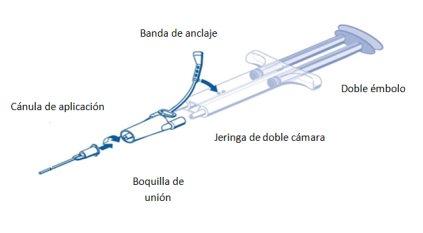
- Expulse todo el aire de la jeringa antes de conectarla a cualquier dispositivo de aplicación.
- Alinee la boquilla de unión y ancle el lateral de la jeringa en el orificio de la banda de anclaje.
- Conecte las boquillas de la jeringa de doble cámara lista para usar a la boquilla de unión y asegúrese de que ambas estén firmemente sujetas.
- Asegure la boquilla de unión fijando la banda de anclaje a la jeringa de doble cámara lista para usar.
- Si la banda de anclaje se rompe, utilice la boquilla de unión incluida en el equipo.
- Si no hay ninguna boquilla de unión de repuesto disponible, todavía es posible utilizar el sistema si se tiene cuidado de que la conexión sea segura y a prueba de fugas.
- NO expulse el aire que quede dentro de la boquilla de unión.
- Conecte una cánula de aplicación a la boquilla de unión.
- NO expulse el aire que quede dentro de la boquilla de unión y dentro de la cánula de aplicación hasta que inicie la aplicación porque esto podría obstruir la cánula de aplicación.
Administración
Antes de aplicar ARTISS, es necesario secar la superficie de la herida utilizando para ello una técnica estándar (por ejemplo, aplicación intermitente de compresas, torundas, el uso de dispositivos de succión). No utilice aire ni gas presurizado para secar la zona.
- Aplique la mezcla de solución de proteína sellante-trombina sobre la superficie o superficies de las partes que se van a sellar presionando lentamente la parte posterior del émbolo común.
- En los procedimientos quirúrgicos que requieran el uso de volúmenes mínimos de adhesivo tisular de fibrina, es recomendable expulsar y desechar las primeras gotas del producto.
- Después de aplicar ARTISS, espere al menos 3 minutos para conseguir una polimerización suficiente.
Nota: Si la aplicación de los componentes del adhesivo tisular de fibrina se interrumpe, se podrían producir coágulos en la cánula. En este caso, sustituya la cánula de aplicación por una nueva inmediatamente antes de reanudar la aplicación. Si las aberturas de la boquilla de unión se obstruyen, utilice la boquilla de unión adicional proporcionada en el envase.
BAXTER también proporciona otros accesorios para realizar la aplicación que son especialmente adecuados para, p. ej., aplicación en áreas grandes o de difícil acceso. Cuando se utilizan estos dispositivos de aplicación, deben seguirse estrictamente las Instrucciones de Uso de los dispositivos.
Para más instrucciones de preparación consultar a la enfermera o médico responsable.
Aplicación por pulverización
El regulador de presión se debe utilizar según las instrucciones del fabricante.
Al aplicar ARTISS con un equipo de pulverización, se debe asegurar de que se utiliza una presión y una distancia al tejido dentro de los intervalos recomendados por el fabricante del siguiente modo:
Presión, distancia y equipos recomendados para la aplicación por pulverización de ARTISS | |||||
Equipo pulverizador que se debe utilizar | Puntas aplicadoras que se deben utilizar | Regulador de presión que se debe utilizar | Distancia del tejido de destino recomendada | Presión de pulverización recomendada | |
Cirugía con herida abierta de tejido subcutáneo | Equipo pulverizador Tisseel/Artiss | n.a. | EasySpray | 10 – 15 cm | 1,5-2,0 bar (21,5-28,5 psi) |
Equipo pulverizador Tisseel/Artiss, envase de 10 | n.a. | EasySpray |
Al pulverizar ARTISS, se deben monitorizar los cambios en la presión arterial, el pulso, la saturación de oxígeno y el nivel de CO2al final de la espiración, para detectar una posible embolia gaseosa (aire o gas) (ver secciones 4.2 y 4.4 de la Ficha Técnica).
Cuando se usan boquillas accesorias con este producto, se deben seguir las instrucciones de uso de las boquillas.
Eliminación
La eliminación del medicamento no utilizado y de todos los materiales que hayan estado en contacto con él, se realizará de acuerdo con la normativa local.
Precauciones especiales de eliminación y otras manipulaciones (envase final: Jeringa AST)
Generales
- Antes de la administración de ARTISS, se debe tener la precaución de cubrir todas las partes del cuerpo exteriores al área a tratar con el fin de prevenir cualquier adhesión de tejido en áreas no deseadas.
- Para evitar la adhesión de ARTISS a guantes e instrumentos quirúrgicos, estos deben humedecerse con una solución de cloruro de sodio antes de que se produzca el contacto.
- Como guía para el sellado de superficies, 1 envase de ARTISS de 2 ml (1 ml de solución de proteína sellante más 1 ml de solución de trombina) será suficiente, como mínimo, para un área de 10 cm2.
- La dosis necesaria depende del tamaño de la superficie que se debe cubrir.
- NO aplique los dos componentes de ARTISS por separado. Ambos componentes deben aplicarse juntos.
- NO exponga ARTISS a temperaturas superiores a 37°C. NO calentar en microondas.
- NO descongele el producto sosteniéndolo con las manos.
- NO utilice ARTISS hasta que se haya descongelado por completo y calentado a 33°C – 37°C.
- Retire el tapón protector de la jeringa solo cuando la descongelación y el calentamiento se hayan completado.
- Expulse todo el aire de la jeringa y luego conecte la boquilla de unión y la cánula de aplicación.
Instrucciones de manipulación y preparación
La bolsa interior y su contenido son estériles a menos que la integridad del envase exterior se vea comprometida. Use una técnica estéril para transferir la bolsa interior estéril y su contenido al campo estéril.
La jeringa lista para usar puede descongelarse Y calentarse mediante uno de los siguientes métodos:
- Descongelación/calentamiento rápido (baño de agua estéril),método recomendado:
- Descongelación/calentamiento en un baño de agua no estéril
- Descongelación/calentamiento en un incubador
- La jeringa lista para usar también se puede descongelar y mantener a temperatura ambiente (no superior a 25°C) durante un máximo de 14 días. Se debe calentar antes de su utilización.
- Descongelación/calentamiento rápido (baño de agua estéril), método recomendado:
Se recomienda descongelar y calentar los dos componentes del adhesivo tisular utilizando un baño de agua estéril a una temperatura de 33°C‑37°C.
- El baño de agua no debe exceder los 37°C. Para monitorizar el rango de temperatura especificado, debe controlarse la temperatura del agua utilizando un termómetro y cambiar el agua cuando sea necesario.
- Si se utiliza el baño de agua estéril para la descongelación y calentamiento, retire la jeringa precargada de las bolsas antes de colocarla en el baño de agua estéril.
Instrucciones:
Coloque la bolsa interior en el campo estéril, retire la jeringa lista para usar de la bolsa interior y colóquela directamente en el baño de agua estéril. Asegúrese de que el contenido de la jeringa lista para usar quede totalmente sumergido en el agua.
Tabla 1: Tiempos mínimos de descongelación y calentamiento con un baño de agua estéril
Tamaño del envase | Tiempos mínimos de descongelación/calentamiento 33°C a 37°C, baño de agua estéril, Producto retirado de las bolsas |
2 ml | 5 minutos |
4 ml | 5 minutos |
10 ml | 12 minutos |
- Descongelación/calentamiento en un baño de agua no estéril
Instrucciones:
Deje la jeringa lista para usar dentro de ambas bolsas y colóquela en un baño de agua fuera del campo estéril durante un período de tiempo adecuado (vea la tabla 2). Asegúrese de que las bolsas permanezcan sumergidas en el agua durante todo el tiempo de descongelación. Tras la descongelación, retire las bolsas del baño de agua, seque la bolsa exterior y coloque la bolsa interior con la jeringa lista para usar en el campo estéril.
Tabla 2: Tiempos mínimos de descongelación y calentamiento con un baño de agua no estéril
Tamaño del envase | Tiempos mínimos de descongelación/calentamiento 33°C a 37°C, baño de agua no estéril Producto en bolsas |
2 ml | 30 minutos |
4 ml | 40 minutos |
10 ml | 80 minutos |
- Descongelación/calentamiento en un incubador
Instrucciones:
Deje la jeringa lista para usar dentro de ambas bolsas y colóquela en un incubador fuera del campo estéril durante un período de tiempo adecuado (vea la tabla 3). Tras la descongelación/el calentamiento, retire las bolsas del incubador, retire la bolsa exterior y coloque la bolsa interior con la jeringa lista para usar en el campo estéril.
Tabla 3: Tiempos mínimos de descongelación y calentamiento en un incubador
Tamaño del envase | Tiempos mínimos de descongelación/calentamiento 33°C a 37°C, incubador Producto en bolsas |
2 ml | 40 minutos |
4 ml | 85 minutos |
10 ml | 105 minutos |
- Descongelación a temperatura ambiente (no superior a +25°C) ANTES de calentar:
Instrucciones:
Deje la jeringa lista para usar dentro de ambas bolsas y descongélela a temperatura ambiente fuera del campo estéril durante un período de tiempo adecuado (vea la tabla 4). Una vez descongelado, para calentar el producto para su uso, caliéntelo en la bolsa exterior en un incubador. Después de descongelar a temperatura ambiente, el tiempo máximo que el producto puede mantenerse (en ambas bolsas) a temperatura ambiente es 14 días.
Tabla 4: Tiempos mínimos de descongelación a temperatura ambiente (= TA) fuera del campo estéril y tiempos de calentamiento adicional en incubador a 33°C hasta 37°C
Tamaño del envase | Tiempos mínimos de descongelación del producto a temperatura ambiente (no superior a 25°C) seguidos de calentamiento adicional, previo a su utilización, en incubador a 33°C hasta un máximo de 37°C Producto en bolsas |
Descongelación a temperatura ambiente (no superior a 25°C) | Calentamiento en incubador (33°C -37°C) |
2 ml | 60 minutos+15 minutos |
4 ml | 110 minutos + 25 minutos |
10 ml | 160 minutos + 35 minutos |
Estabilidad después de la descongelación
Después de la descongelación y el calentamiento(a temperaturas entre 33°C y 37°C, métodos 1, 2 y 3), se ha demostrado la estabilidad química y física durante 4 horas a una temperatura entre 33°C y 37°C.
En el caso del producto descongeladoa temperatura ambiente en la bolsa sin abrir (método 4), se ha demostrado la estabilidad química y física durante 14 días a temperaturas no superiores a 25°C. Calentar a una temperatura entre 33°C y 37°C inmediatamente antes de su utilización.
Desde el punto de vista microbiológico, a menos que el método de apertura y descongelación excluya el riesgo de contaminación microbiana, el producto debe utilizarse inmediatamente después de haber sido calentado entre 33°C y 37°C.
De no utilizarse inmediatamente, las condiciones y los tiempos de conservación necesarios para su uso son responsabilidad del usuario.
No volver a congelar o refrigerar una vez iniciada la descongelación.
Manipulación después de la descongelación/antes de la aplicación
Para conseguir una mezcla óptima de las dos soluciones y la solidificación óptima del adhesivo tisular de fibrina, mantenga los dos componentes a 33°C-37°C hasta la aplicación.
Las soluciones de proteína sellante y de trombina deben ser transparentes o ligeramente opalescentes. No utilizar soluciones que estén turbias o tengan depósitos. El producto descongelado debe inspeccionarse visualmente antes de su uso para descartar la presencia de partículas y decoloración o cualquier variación de su apariencia. Si se da alguna de estas circunstancias, deseche las soluciones.
La solución de proteína sellante descongelada debe ser un líquido ligeramente viscoso. Si la solución tiene la consistencia de un gel solidificado, se debe asumir que se ha desnaturalizado (posiblemente debido a la interrupción de la cadena de conservación en frío o por exceso de calor durante el calentamiento). En este caso, NO utilice ARTISS de ninguna manera.
- Retire la jeringa de las bolsas poco antes de utilizarla.
- Utilice ARTISS solo cuando se haya descongelado y calentado totalmente (consistencia líquida).
- Retire el tapón protector de la jeringa inmediatamente antes de la aplicación.
Administración sin pulverización con la jeringa AST:
Para la aplicación, la jeringa de doble cámara lista para usar con la solución de proteína sellante y la solución de trombina tiene que conectarse a una boquilla de unión y una cánula de aplicación, incluidas en el equipo de dispositivos de aplicación. El émbolo común de la jeringa de doble cámara lista para usar, incluida en el equipo de dispositivos de aplicación, garantiza que volúmenes iguales de los dos componentes del adhesivo tisular saldrán a través de una boquilla de unión hacia la cánula de aplicación en la que se mezclarán antes de su aplicación.
Instrucciones de uso de la jeringa AST:
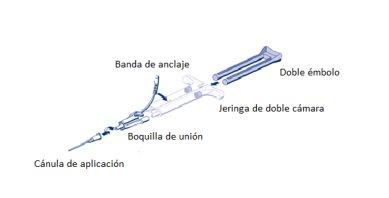
- Expulse todo el aire de la jeringa antes de conectarla a cualquier dispositivo de aplicación.
- Alinee la boquilla de unión y ancle el lateral de la jeringa en el orificio de la banda de anclaje.
- Conecte las boquillas de la jeringa de doble cámara lista para usar a la boquilla de unión y asegúrese de que ambas estén firmemente sujetas.
- Asegure la boquilla de unión fijando la banda de anclaje a la jeringa de doble cámara lista para usar.
- Si la banda de anclaje se rompe, utilice la boquilla de unión incluida en el equipo.
- Si no hay ninguna boquilla de unión de repuesto disponible, todavía es posible utilizar el sistema si se tiene cuidado de que la conexión sea segura y a prueba de fugas.
- NO expulse el aire que quede dentro de la boquilla de unión.
- Conecte una cánula de aplicación a la boquilla de unión.
- NO expulse el aire que quede dentro de la boquilla de unión y dentro de la cánula de aplicación hasta que inicie la aplicación porque esto podría obstruir la cánula de aplicación.
Administración
Antes de aplicar ARTISS, es necesario secar la superficie de la herida utilizando para ello una técnica estándar (por ejemplo, aplicación intermitente de compresas, torundas, el uso de dispositivos de succión). No utilice aire ni gas presurizado para secar la zona.
- Aplique la mezcla de solución de proteína sellante-trombina sobre la superficie o superficies de las partes que se van a sellar presionando lentamente la parte posterior del émbolo común.
- En los procedimientos quirúrgicos que requieran el uso de volúmenes mínimos de adhesivo tisular de fibrina, es recomendable expulsar y desechar las primeras gotas del producto.
- Después de aplicar ARTISS, espere al menos 3 minutos para conseguir una polimerización suficiente.
Nota: Si la aplicación de los componentes del adhesivo tisular de fibrina se interrumpe, se podrían producir coágulos en la cánula. En este caso, sustituya la cánula de aplicación por una nueva inmediatamente antes de reanudar la aplicación. Si las aberturas de la boquilla de unión se obstruyen, utilice la boquilla de unión adicional proporcionada en el envase.
BAXTER también proporciona otros accesorios para realizar la aplicación que son especialmente adecuados para, p. ej., aplicación en áreas grandes o de difícil acceso. Cuando se utilizan estos dispositivos de aplicación, deben seguirse estrictamente las Instrucciones de Uso de los dispositivos.
Para más instrucciones de preparación consultar a la enfermera o médico responsable.
Aplicación por pulverización
El regulador de presión se debe utilizar según las instrucciones del fabricante.
Al aplicar ARTISS con un equipo de pulverización, se debe asegurar de que se utiliza una presión y una distancia al tejido dentro de los intervalos recomendados por el fabricante del siguiente modo:
Presión, distancia y equipos recomendados para la aplicación por pulverización de ARTISS | |||||
Equipo pulverizador que se debe utilizar | Puntas aplicadoras que se deben utilizar | Regulador de presión que se debe utilizar | Distancia del tejido de destino recomendada | Presión de pulverización recomendada | |
Cirugía con herida abierta de tejido subcutáneo | Equipo pulverizador Tisseel/Artiss | n.a. | EasySpray | 10 – 15 cm | 1,5-2,0 bares (21.5-28.5 psi) |
Equipo pulverizador Tisseel/Artiss envase de 10 | n.a. | EasySpray |
Al pulverizar ARTISS, se deben monitorizar los cambios en la presión arterial, el pulso, la saturación de oxígeno y el nivel de CO2al final de la espiración, para detectar una posible embolia gaseosa (aire o gas) (ver secciones 4.2 y 4.4).
Cuando se usan boquillas accesorias con este producto, se deben seguir las instrucciones de uso de las boquillas.
Eliminación
La eliminación del medicamento no utilizado y de todos los materiales que hayan estado en contacto con él, se realizará de acuerdo con la normativa local.
- País de registro
- Forma farmacéuticaADHESIVO TISULAR, en función de las necesidades clínicas del pacient
- Código ATCB02BC30
- Principio activo
- Requiere recetaSí
- Fabricante
- ComposiciónPOLISORBATO 80 (06-1,9 mg mg), CITRATO DE SODIO (E-331) (4,8-9,7 mg mg), CLORURO DE SODIO (3,5-5,5 mg mg)
- Esta información es de carácter general y no sustituye la consulta con un profesional sanitario.
- Alternativas a ARTISS SOLUCIONES PARA ADHESIVO TISULAR, ULTRACONGELADASForma farmacéutica: ADHESIVO TISULAR, 50-90 mg/ml 800-1200 UIPrincipio activo: combinationsFabricante: Omrix BiopharmaceuticalsRequiere recetaForma farmacéutica: ADHESIVO TISULAR, -Principio activo: combinationsFabricante: Corza Medical GmbhRequiere recetaForma farmacéutica: ADHESIVO TISULAR, -Principio activo: combinationsFabricante: Corza Medical GmbhRequiere receta
Médicos online para ARTISS SOLUCIONES PARA ADHESIVO TISULAR, ULTRACONGELADAS
Comenta la dosis, los posibles efectos secundarios, interacciones, contraindicaciones o la revisión de receta de ARTISS SOLUCIONES PARA ADHESIVO TISULAR, ULTRACONGELADAS, sujeto a valoración médica y a la normativa local.









Obtén una receta de ARTISS SOLUCIONES PARA ADHESIVO TISULAR, ULTRACONGELADAS online
Rellena un formulario de 2 minutos
Cuéntanos tus síntomas, historial y el medicamento que necesitas.
Elige un médico o nosotros te asignamos uno
Escoge un especialista o te conectamos con el próximo médico disponible.
El médico revisa tu caso
Normalmente en 30 minutos. Puede hacerte preguntas adicionales por chat.
Recógela en cualquier farmacia
Receta electrónica enviada a tu correo, válida en toda España.
Preguntas frecuentes
ARTISS SOLUCIONES PARA ADHESIVO TISULAR, ULTRACONGELADAS requiere receta en España. Puedes confirmarlo con un médico online según tu caso.
El principio activo de ARTISS SOLUCIONES PARA ADHESIVO TISULAR, ULTRACONGELADAS es combinations. Esta información ayuda a identificar medicamentos con la misma composición pero con diferentes nombres comerciales.
ARTISS SOLUCIONES PARA ADHESIVO TISULAR, ULTRACONGELADAS es fabricado por Baxter S.L.. La marca y el envase pueden variar según el distribuidor.
Los Médicos de familia, Psiquiatras, Dermatólogos, Cardiólogos, Endocrinólogos, Gastroenterólogos, Neumólogos, Nefrólogos, Reumatólogos, Hematólogos, Infectólogos, Alergólogos, Geriatras, Pediatras, Oncólogos pueden valorar la prescripción de ARTISS SOLUCIONES PARA ADHESIVO TISULAR, ULTRACONGELADAS cuando esté clínicamente indicado. Puedes reservar una videoconsulta para comentar tu caso y las opciones de tratamiento.
España cuenta con una infraestructura sanitaria bien desarrollada en ciudades principales como Madrid, Barcelona, Valencia y Sevilla. Las farmacias están ampliamente disponibles y operan bajo estrictas regulaciones, garantizando el acceso a medicamentos con receta.
Puedes comprar ARTISS SOLUCIONES PARA ADHESIVO TISULAR, ULTRACONGELADAS en Madrid, Barcelona, Sevilla o Valencia en cualquier farmacia local con una receta válida.
Para obtener una receta, puedes utilizar Oladoctor:
Otros medicamentos con el mismo principio activo (combinations) incluyen EVICEL SOLUCIONES PARA ADHESIVO TISULAR, TACHOSIL MATRIZ ADHESIVA, TACHOSIL MATRIZ ADHESIVA. Pueden tener diferentes nombres comerciales o formulaciones, pero contienen el mismo componente terapéutico. Consulta siempre con un médico antes de cambiar o iniciar un nuevo medicamento.
