



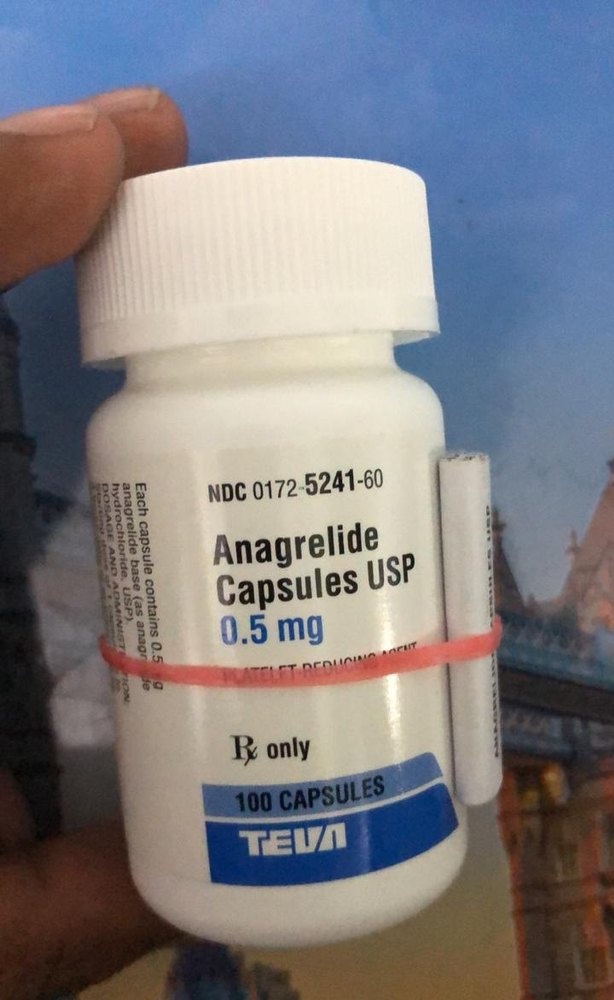
ANAGRELIDA 0,5 MG CAPSULAS DURAS

Revisión de receta online
Un médico revisará tu caso y determinará si la prescripción es médicamente apropiada.

Habla con un médico sobre este medicamento
Comenta tus síntomas y las opciones de tratamiento en una consulta online.



Cómo usar ANAGRELIDA TEVA 0,5 MG CAPSULAS DURAS EFG
Contenido del prospecto
- Introducción
- Qué es Anagrelida Teva y para qué se utiliza
- Qué necesita saber antes de empezar a tomar Anagrelida Teva
- Cómo tomar Anagrelida Teva
- Posibles efectos adversos
- Conservación de Anagrelida Teva
- Contenido del envase e información adicional
Introducción
Prospecto:información para el paciente
Anagrelida Teva 0,5 mg cápsulas duras EFG
Lea todo el prospecto detenidamente antes de empezar a tomar este medicamento,porque contiene información importante para usted.
- Conserve este prospecto, ya que puede tener que volver a leerlo.
- Si tiene alguna duda, consulte a su médico o farmacéutico.
- Este medicamento se le ha recetado solamente a usted, y no debe dárselo a otras personas aunque tengan los mismos síntomas que usted, ya que puede perjudicarles.
- Si experimenta efectos adversos, consulte a su médico o farmacéutico, incluso si se trata de efectos adversos que no aparecen en este prospecto. Ver sección 4.
Contenido del prospecto
- Qué es Anagrelida Teva y para qué se utiliza
- Qué necesita saber antes de empezar a tomar Anagrelida Teva
- Cómo tomar Anagrelida Teva
- Posibles efectos adversos
- Conservación de Anagrelida Teva
- Contenido del envase e información adicional
1. Qué es Anagrelida Teva y para qué se utiliza
Anagrelida Teva contiene el principio activo, anagrelida. Anagrelida Teva es un medicamento que interfiere en el desarrollo de las plaquetas. Reduce el número de plaquetas producidas por la médula ósea lo que da lugar a una reducción en el recuento de plaquetas en sangre que se aproxima a un nivel más normal. Por este motivo, se utiliza para tratar a los pacientes con trombocitemia esencial.
La trombocitemia esencial es una afección que tiene lugar cuando la médula ósea produce un número excesivo de las células de la sangre conocidas como plaquetas. Un elevado número de plaquetas en la sangre puede provocar graves problemas de circulación y coagulación sanguínea.

¿No estás seguro de si este medicamento es adecuado para ti?
Comenta tus síntomas y tratamiento con un médico online.
2. Qué necesita saber antes de empezar a tomar Anagrelida Teva
No tome Anagrelida Teva
- si es alérgico a anagrelida o a alguno de los demás componentes de este medicamento (incluidos en la sección 6). Las reacciones alérgicas pueden manifestarse por erupción, picor, hinchazón de cara y labios o dificultad para respirar,
- si tiene problemas moderados o graves de hígado,
- si tiene problemas moderados o graves de riñón.
Advertencias y precauciones
Consulte a su médico antes de empezar a tomar Anagrelida Teva:
- si tiene o cree que podría tener un problema cardiaco,
- si nació con intervalo QT prolongado o tiene antecedentes familiares de intervalo QT prolongado (observado en el ECG, registro eléctrico del corazón) o si está tomando otros medicamentos que producen cambios anormales en el ECG o si tiene niveles bajos de electrolitos, p. ej.: potasio, magnesio o calcio (ver la sección “Toma de Anagrelida Teva con otros medicamentos”),
- si tiene problemas de hígado o de riñón.
En combinación con ácido acetilsalicílico (una sustancia presente en muchos medicamentos utilizados para aliviar el dolor y bajar la fiebre, así como para evitar la coagulación de la sangre), hay mayor riesgo de presentar hemorragias (sangrado) mayores (ver sección “Toma de Anagrelida Teva con otros medicamentos”).
Mientras esté en tratamiento con Anagrelida Teva, debe tomar la dosis exacta recetada por su médico. No deje de tomar el medicamento sin informar a su médico previamente. No debe dejar de tomar este medicamento de forma repentina sin consultar con su médico. La retirada brusca del medicamento puede aumentar el riesgo de accidente cerebrovascular.
Los signos y síntomas de un accidente cerebrovascular pueden incluir entumecimiento o debilidad repentina en la cara, el brazo o la pierna, especialmente en un lado del cuerpo, confusión repentina, dificultad para hablar o dificultad para entender el habla, dificultad repentina para ver con uno o ambos ojos, dificultad repentina para caminar, mareos, pérdida del equilibrio o falta de coordinación y dolor de cabeza intenso y repentino sin causa conocida. Por favor, consulte a su médico inmediatamente.
Niños y adolescentes
La información sobre el uso de Anagrelida Teva en niños y adolescentes es limitada y, por tanto, este medicamento se debe utilizar con precaución.
Toma de Anagrelida Tevaconotros medicamentos
Informe a su médico o farmacéutico si está tomando, ha tomado recientemente o pudiera tener que tomar cualquier otro medicamento.
Informe a su médico si está tomando alguno de los siguientes medicamentos:
- medicamentos que pueden alterar el ritmo cardíaco, por ejemplo, sotalol, amiodarona
- fluvoxamina, usado para tratar la depresión,
- ciertos tipos de antibióticos, como enoxacina, utilizados para tratar las infecciones,
- teofilina, usado para tratar el asma y los problemas respiratorios graves,
- medicamentos para tratar afecciones cardiacas como, por ejemplo, milrinona, enoximona, amrinona, olprinona y cilostazol,
- ácido acetilsalicílico (una sustancia presente en muchos medicamentos utilizados para aliviar el dolor y bajar la fiebre, así como para evitar la coagulación de la sangre),
- otros medicamentos para tratar afecciones que afectan a las plaquetas en la sangre como, por ejemplo, clopidogrel,
- omeprazol, usado para reducir la cantidad de ácido producida en el estómago,
- anticonceptivos orales: si experimenta diarrea intensa mientras toma este medicamento, puede disminuir el efecto del anticonceptivo oral y se recomienda utilizar un método anticonceptivo adicional (p. ej., preservativo). Consulte las indicaciones que aparecen en el prospecto del anticonceptivo oral que está tomando.
Si se usan conjuntamente puede que, bien Anagrelida Teva o bien estos medicamentos, no funcionen correctamente.
Consulte a su médico o farmacéutico si tiene dudas.
Embarazo ylactancia
Consulte a su médico si está embarazada o tiene intención de quedarse embarazada. Si está embarazada, no debe tomar Anagrelida Teva. Las mujeres con posibilidades de quedarse embarazadas deben asegurarse de tomar medidas anticonceptivas eficaces mientras estén tomando Anagrelida Teva. Consulte a su médico si necesita consejo sobre anticonceptivos.
Consulte a su médico si está dando el pecho o planea darle el pecho a su hijo. No puede tomar Anagrelida Teva mientras esté dando el pecho. Si está tomando Anagrelida Teva deberá dejarde dar el pecho.
Conducción y uso de máquinas
Algunos pacientes que estaban tomando Anagrelida Teva han comunicado síntomas de mareo. Noconduzca ni maneje máquinas si se siente mareado.
Anagrelida Teva contiene lactosa y sodio
Este medicamento contiene lactosa. Si su médico le ha indicado que padece una intolerancia a ciertos azúcares, consulte con él antes de tomar este medicamento.
Este medicamento contiene menos de 1 mmol de sodio (23 mg) por cápsula dura; esto es, esencialmente “exento de sodio”.
3. Cómo tomar Anagrelida Teva
Siga exactamente las instrucciones de administración de este medicamento indicadas por su médico. En caso de duda, consulte de nuevo a su médico o farmacéutico.
La cantidad de Anagrelida Teva que pueden tomar los distintos pacientes puede variar, pues dicha cantidad depende de la afección. El médico le recetará la dosis más conveniente en su caso.
La dosis inicial normal de Anagrelida Teva es 1 mg. Esta dosis se toma con una cápsula de 0,5 mg dos veces al día durante una semana como mínimo. Tras este periodo, su médico puede aumentar o disminuir el número de cápsulas que debe tomar hasta encontrar la dosis que mejor se ajuste a su caso y que trate la afección del modo más eficaz.
Las cápsulas se deben tragar enteras con un vaso de agua. Notriture las cápsulas ni diluya el contenido en un líquido. Puede tomar las cápsulas con alimentos, después de las comidas o con el estómago vacío. Se recomienda tomar la(s) cápsula(s) siempre a la misma hora.
Notome más o menos cápsulas de las que le haya recomendado el médico. Nodeje de tomar el medicamento sin informar a su médico previamente. No debe dejar de tomar este medicamento de forma repentina por su cuenta.
Su médico le indicará que se someta a análisis de sangre con regularidad para comprobar si el medicamento es eficaz y si su hígado y riñones funcionan bien.
Si toma más AnagrelidaTevadel que debe
Si toma más Anagrelida Teva del que debe o si otra persona ha tomado este medicamento, informe a su médico o farmacéutico inmediatamente. Deberá mostrarles el envase de Anagrelida Teva.
En caso de sobredosis o ingestión accidental, acuda a un centro médico o llame al Servicio de Información Toxicológica, teléfono: 91 562 04 20, indicando el medicamento y la cantidad utilizada.
Si olvidó tomar Anagrelida Teva
Tome las cápsulas tan pronto como se acuerde. Tome la siguiente dosis a la hora habitual. No tome una dosis doble para compensar las dosis olvidadas.

¿Has empezado a tomar el medicamento y tienes preguntas?
Comenta tus síntomas y tratamiento con un médico online.
4. Posibles efectos adversos
Al igual que todos los medicamentos, este medicamento puede producir efectos adversos, aunque no todas las personas los sufran. Si le preocupa este aspecto, consulte a su médico.
Efectos adversos graves:
Poco frecuentes: Insuficiencia cardiaca (los signos incluyen falta de aliento, dolor en el pecho, hinchazón de piernas por acumulación de líquido), problema grave con la frecuencia cardiaca o el ritmo cardiaco (taquicardia ventricular, taquicardia supraventricular o fibrilación auricular), inflamación del páncreas que provoca dolor intenso en la espalda y el abdomen (pancreatitis), vómitos con sangre o heces oscuras o sanguinolentas, disminución grave del recuento de células sanguíneas que puede provocar debilidad, cardenales, hemorragia o infecciones (pancitopenia), hipertensión pulmonar (los signos incluyen falta de aliento, hinchazón de piernas o tobillos y color azulado de los labios y la piel).
Raros: Insuficiencia renal (cuando se orina poco o nada), ataque al corazón.
Si observa alguno de estos efectos adversos, póngase en contacto con su médico inmediatamente.
Efectos adversos muy frecuentes: pueden afectar a más de 1 de cada 10 pacientes
Dolor de cabeza.
Efectos adversos frecuentes: pueden afectar hasta 1 de cada 10 pacientes
Mareo, cansancio, latido cardiaco rápido, latido cardiaco fuerte o irregular (palpitaciones), ganas de vomitar (náuseas), diarrea, dolor de estómago, gases, vómitos, disminución del recuento de glóbulos rojos (anemia), retención de líquidos o erupción.
Efectos adversos poco frecuentes: pueden afectar hasta 1 de cada 100 pacientes
Sensación de debilidad o malestar, hipertensión, latido cardiaco irregular, desmayos, escalofríos o fiebre, indigestión, pérdida de apetito, estreñimiento, cardenales, hemorragia, hinchazón (edema), pérdida de peso, dolor muscular, dolor de articulaciones, dolor de espalda, pérdida o disminución de sensibilidad o sensación como entumecimiento (especialmente en la piel), sensibilidad o sensación anormal como hormigueo y adormecimiento, insomnio, depresión, confusión, nerviosismo, sequedad de boca, pérdida de memoria, sensación de falta de aire, hemorragia nasal, infección pulmonar grave con fiebre, falta de aliento, tos o flemas, caída de pelo, picazón en la piel, cambios del color de la piel, impotencia, dolor en el pecho, disminución del recuento de plaquetas en la sangre que aumenta el riesgo de hemorragias o cardenales (trombocitopenia), acumulación de líquido en los pulmones o un aumento de las enzimas hepáticas. El médico puede hacerle unos análisis de sangre que podrían indicar un aumento de enzimas hepáticas.
Efectos adversos raros: pueden afectar hasta 1 de cada 1.000 pacientes
Encías sangrantes, aumento de peso, dolor intenso en el pecho (angina de pecho), enfermedad
muscular cardiaca (los signos incluyen fatiga, dolor en el pecho y palpitaciones), agrandamiento del corazón, acumulación de líquido en el corazón, espasmo doloroso de los vasos sanguíneos del corazón (mientras descansa, normalmente por la noche o a primera hora de la mañana) (angina de Prinzmetal), pérdida de coordinación, dificultad para hablar, sequedad de piel, migraña, alteraciones visuales o visión doble, zumbidos en los oídos, mareos al levantarse (sobre todo al levantarse después de estar sentado o acostado), aumento de la necesidad de orinar durante la noche, dolor, síntomas “pseudogripales”, somnolencia, dilatación de los vasos sanguíneos, inflamación del intestino grueso (los signos incluyen diarrea acompañada normalmente de sangre o mucosidad, dolor de estómago, fiebre), inflamación del estómago (los signos incluyen: dolor, náuseas, vómitos), área de densidad anormal en los pulmones, aumento de los niveles de creatinina en los análisis de sangre que puede ser un indicio de problemas renales.
Se han comunicado los siguientes efectos adversos, aunque se desconoce la frecuencia exacta con la que se producen:
- latido cardiaco irregular potencialmente mortal (Torsade de pointes),
- inflamación del hígado, entre los síntomas se incluyen náuseas, vómitos, picor, coloración amarillenta de la piel y los ojos, coloración anormal de las heces y la orina (hepatitis),
- inflamación pulmonar (los signos incluyen fiebre, tos, dificultad para respirar o sibilancias; esto provoca la cicatrización pulmonar) (alveolitis alérgica que incluye enfermedad pulmonar intersticial y neumonitis),
- inflamación de los riñones (nefritis tubulointersticial).
- accidente cerebrovascular (ver sección 2 “Advertencias y precauciones”).
Comunicación de efectos adversos
Si experimenta cualquier tipo de efecto adverso, consulte a su médico o farmacéutico, incluso si se trata de posibles efectos adversos que no aparecen en este prospecto. También puede comunicarlos directamente a través del Sistema Español de Farmacovigilancia de medicamentos de Uso Humano: https://www.notificaram.es. Mediante la comunicación de efectos adversos usted puede contribuir a proporcionar más información sobre la seguridad de este medicamento.
5. Conservación de Anagrelida Teva
Mantenereste medicamentofuera de la vista y del alcance de los niños.
No utilice este medicamento después de la fecha de caducidad que aparece en el envase y en el frasco después de CAD. La fecha de caducidad es el último día del mes que se indica.
No conservar a temperatura superior a 30ºC.
Conservar en el embalaje original para protegerlo de la luz y de la humedad.
Si su médico interrumpe el tratamiento, no conserve las cápsulas sobrantes a menos que el médico le indique lo contrario.Los medicamentos no se deben tirar por los desagües ni a la basura. Deposite los envases y los
medicamentos que no necesita en el Punto SIGRE de la farmacia. En caso de duda pregunte a su farmacéutico cómo deshacerse de los envases y de los medicamentos que ya no necesita. De esta forma, ayudará a proteger el medio ambiente.
6. Contenido del envase e información adicional
Composición de Anagrelida Teva
- El principio activo es anagrelida. Cada cápsula contiene 0,5 mg de anagrelida (como hidrocloruro de anagrelida monohidrato).
- Los demás componentes son:
Contenido de la cápsula: lactosa monohidrato, croscarmelosa sódica, povidona K 29/32, lactosa, celulosa microcristalina y estearato de magnesio (ver sección 2, “Anagrelida Teva contiene lactosa y sodio”).
Cubierta de la cápsula: gelatina y dióxido de titanio (E171).
Aspecto del producto y contenido del envase
Anagrelida Teva se presenta en forma de cápsulas duras opacas de color blanco con una longitud aproximada de 14,3 mm. Las cápsulas se presentan en frascos de 42 y 100 cápsulas duras.
Puede que solamente estén comercializados algunos tamaños de envases.
Titular de la autorización de comercialización y responsable de la fabricación
Titular de la autorización de comercialización
Teva B.V.
Swensweg 5,
2031GA Haarlem
Países Bajos
Representante local:
Teva Pharma, S.L.U.
C/ Anabel Segura, 11, Edificio Albatros B, 1ª planta
28108 Alcobendas, Madrid (España)
Responsable de la fabricación
Synthon Hispania, S.L.
C/ Castelló, nº1, Pol. Las Salinas,
08830 Sant Boi de Llobregat, Barcelona (España)
ó
Synthon B.V.
Microweg 22
6545CM Nijmegen
Países Bajos
ó
Merckle GmbH
Ludwig-Merckle-Strasse 3,
89143 Blaubeuren
Alemania
ó
Actavis Italy S.p.A.
Via Pasteur 10
Nerviano
20014 Milan
Italia
Este medicamento está autorizado en los estados miembros del Espacio Económico Europeo con los siguientes nombres:
Austria Anagrelid ratiopharm 0,5 mg Kapseln
Chequia Anagrelide Teva
Dinamarca Anagrelid Teva
Grecia Anagrelide/Teva 0,5 mg σκληρ? καψ?κια
España Anagrelida Teva 0,5 mg cápsulas duras EFG
Finlandia Anagrelide ratiopharm 0,5 mg kapseli, kova
Francia Anagrelide Teva 0,5 mg gélule
Italia Anagrelide Teva
Lituania Anagrelide Teva 0,5 mg kietosios kapsules
Letonia Anagrelide Teva 0,5 mg cietas kapsulas
Países Bajos Anagrelide Teva 0,5 mg, harde capsules
Portugal Anagrelida Teva
Rumanía ANAGRELIDA TEVA 0,5 mg capsule
Eslovenia Anagrelid Teva 0,5 mg trde kapsule
Fecha de la última revisión de esteprospecto: Noviembre 2022
La información detallada de este medicamento está disponible en la página web de la Agencia Española de Medicamentos y Productos Sanitarios (AEMPS) (http://www.aemps.gob.es/)
- País de registro
- Forma farmacéuticaCAPSULA, 0.5 mg
- Código ATCL01XX35
- Principio activo
- Requiere recetaSí
- Fabricante
- ComposiciónLACTOSA MONOHIDRATO (28.025 mg mg), CROSCARMELOSA SODICA (0.785 mg mg), LACTOSA (32.90 mg mg)
- Esta información es de carácter general y no sustituye la consulta con un profesional sanitario.
- Alternativas a ANAGRELIDA TEVA 0,5 MG CAPSULAS DURAS EFGForma farmacéutica: CAPSULA, 0.5 mgPrincipio activo: AnagrelidaFabricante: Aurovitas Spain, S.A.U.Requiere recetaForma farmacéutica: CAPSULA, 0.5 mgPrincipio activo: AnagrelidaFabricante: Bluefish Pharmaceuticals Ab (Publ)Requiere recetaForma farmacéutica: CAPSULA, 0.5 mgPrincipio activo: AnagrelidaFabricante: Glenmark Arzneimittel GmbhRequiere receta
Médicos online para ANAGRELIDA TEVA 0,5 MG CAPSULAS DURAS EFG
Comenta la dosis, los posibles efectos secundarios, interacciones, contraindicaciones o la revisión de receta de ANAGRELIDA TEVA 0,5 MG CAPSULAS DURAS EFG, sujeto a valoración médica y a la normativa local.
Obtén una receta de ANAGRELIDA TEVA 0,5 MG CAPSULAS DURAS EFG online
Rellena un formulario de 2 minutos
Cuéntanos tus síntomas, historial y el medicamento que necesitas.
Elige un médico o nosotros te asignamos uno
Escoge un especialista o te conectamos con el próximo médico disponible.
El médico revisa tu caso
Normalmente en 30 minutos. Puede hacerte preguntas adicionales por chat.
Recógela en cualquier farmacia
Receta electrónica enviada a tu correo, válida en toda España.
Preguntas frecuentes
ANAGRELIDA TEVA 0,5 MG CAPSULAS DURAS EFG requiere receta en España. Puedes confirmarlo con un médico online según tu caso.
El principio activo de ANAGRELIDA TEVA 0,5 MG CAPSULAS DURAS EFG es Anagrelida. Esta información ayuda a identificar medicamentos con la misma composición pero con diferentes nombres comerciales.
ANAGRELIDA TEVA 0,5 MG CAPSULAS DURAS EFG es fabricado por Teva B.V.. La marca y el envase pueden variar según el distribuidor.
Los Médicos de familia, Psiquiatras, Dermatólogos, Cardiólogos, Endocrinólogos, Gastroenterólogos, Neumólogos, Nefrólogos, Reumatólogos, Hematólogos, Infectólogos, Alergólogos, Geriatras, Pediatras, Oncólogos pueden valorar la prescripción de ANAGRELIDA TEVA 0,5 MG CAPSULAS DURAS EFG cuando esté clínicamente indicado. Puedes reservar una videoconsulta para comentar tu caso y las opciones de tratamiento.
España cuenta con una infraestructura sanitaria bien desarrollada en ciudades principales como Madrid, Barcelona, Valencia y Sevilla. Las farmacias están ampliamente disponibles y operan bajo estrictas regulaciones, garantizando el acceso a medicamentos con receta.
Puedes comprar ANAGRELIDA TEVA 0,5 MG CAPSULAS DURAS EFG en Madrid, Barcelona, Sevilla o Valencia en cualquier farmacia local con una receta válida.
Para obtener una receta, puedes utilizar Oladoctor:
Otros medicamentos con el mismo principio activo (Anagrelida) incluyen ANAGRELIDA AUROVITAS 0.5 MG CAPSULAS DURAS EFG, ANAGRELIDA BLUEFISH 0,5 MG CAPSULAS DURAS EFG, ANAGRELIDA GLENMARK 0,5 MG CAPSULAS DURAS EFG. Pueden tener diferentes nombres comerciales o formulaciones, pero contienen el mismo componente terapéutico. Consulta siempre con un médico antes de cambiar o iniciar un nuevo medicamento.
