


Amoxicilina/Ácido Clavulánico Ardineclav 875/125 mg polvo para suspensión oral en sobres

Revisión de receta online
Un médico revisará tu caso y determinará si la prescripción es médicamente apropiada.

Habla con un médico sobre este medicamento
Comenta tus síntomas y las opciones de tratamiento en una consulta online.



Cómo usar AMOXICILINA/ACIDO CLAVULANICO ARDINECLAV 875/125 mg POLVO PARA SUSPENSION ORAL EN SOBRES EFG
Contenido del prospecto
- Introducción
- Qué es Amoxicilina/Ácido clavulánico ArdineClav y para qué se utiliza
- Antes de tomar Amoxicilina/Ácido clavulánico ArdineClav
- Cómo tomar Amoxicilina/Ácido clavulánico ArdineClav
- Posibles efectos adversos
- Conservación de Amoxicilina/Ácido clavulánico ArdineClav
- Información adicional
Introducción
PROSPECTO: INFORMACIÓN PARA EL USUARIO
Amoxicilina/ácido clavulánico ArdineClav 875 mg/125 mg polvo para suspensión oral en sobres EFG
Lea todo el prospecto detenidamente antes de empezar a tomar el medicamento.
- Conserve este prospecto, ya que puede tener que volver a leerlo.
- Si tiene alguna duda, consulte a su médico o farmacéutico.
- Este medicamento se le ha recetado a usted (o a su hijo) y no debe dárselo a otras personas, aunque tengan los mismos síntomas, ya que puede perjudicarles.
- Si considera que alguno de los efectos adversos que sufre es grave o si aprecia cualquier efecto adverso no mencionado en este prospecto, informe a su médico o farmacéutico.
Contenido del prospecto:
- Qué es Amoxicilina/Ácido clavulánico ArdineClav y para qué se utiliza
- Antes de tomar Amoxicilina/Ácido clavulánico ArdineClav
- Cómo tomar Amoxicilina/Ácido clavulánico ArdineClav
- Posibles efectos adversos
- Conservación de Amoxicilina/Ácido clavulánico ArdineClav
- Información adicional
1. Qué es Amoxicilina/Ácido clavulánico ArdineClav y para qué se utiliza
Amoxicilina/Ácido clavulánico ArdineClav es un antibiótico que elimina las bacterias que causan las infecciones. Contiene dos fármacos diferentes llamados amoxicilina y ácido clavulánico. La amoxicilina pertenece al grupo de medicamentos conocido como “penicilinas” que a veces puede perder su eficacia (se inactiva). El otro componente (ácido clavulánico) evita que esto ocurra.
Los antibióticos se utilizan para tratar infecciones bacterianas y no sirven para tratar infecciones víricas como la gripe o el catarro. Es importante que siga las instrucciones relativas a la dosis, el intervalo de administración y la duración del tratamiento indicadas por su médico. No guarde ni reutilice este medicamento. Si una vez finalizado el tratamiento le sobra antibiótico, devuélvalo a la farmacia para su correcta eliminación. No debe tirar los medicamentos por el desagüe ni a la basura. |
Amoxicilina/Ácido clavulánico ArdineClav se utiliza en adultos y niños para tratar las siguientes infecciones:
- Infecciones del oído medio y de los senos nasales
- Infecciones del tracto respiratorio
- Infecciones del tracto urinario
- Infecciones de la piel y tejidos blandos incluyendo infecciones dentales
- Infecciones de los huesos y articulaciones.

¿No estás seguro de si este medicamento es adecuado para ti?
Comenta tus síntomas y tratamiento con un médico online.
2. Antes de tomar Amoxicilina/Ácido clavulánico ArdineClav
No tome Amoxicilina/Ácido clavulánico ArdineClav:
- si es alérgico (hipersensible) a amoxicilina, ácido clavulánico, a las penicilinas o a cualquiera de los demás componentes de Amoxicilina/Ácido clavulánico ArdineClav (ver apartado 6)
- si alguna vez ha tenido una reacción alérgica grave (de hipersensibilidad) a cualquier otro antibiótico. Esto podría incluir erupción cutánea o hinchazón de cara o cuello
- si alguna vez ha tenido problemas de hígado o ictericia (coloración amarillenta de la piel) al tomar un antibiótico.
- No tome Amoxicilina/ Ácido clavulánico ArdineClav si se incluye en alguno de los puntos anteriores. Antes de iniciar el tratamiento con Amoxicilina/Ácido clavulánico ArdineClav, si no está seguro, consulte con su médico o farmacéutico.
Tenga especial cuidado con Amoxicilina/Ácido clavulánico ArdineClav
Informe a su médico o farmacéutico antes de tomar este medicamento si:
- tiene mononucleosis infecciosa
- está recibiendo tratamiento para problemas de hígado o riñón
- no orina regularmente.
Si no está seguro de si alguno de los anteriores síntomas le afectan, informe a su médico o farmacéutico antes de tomar Amoxicilina/Ácido clavulánico ArdineClav.
En algunos casos, su médico puede investigar el tipo de bacteria que está causando su infección. Dependiendo de los resultados, puede que le receten una presentación diferente de Amoxicilina/Ácido clavulánico u otro medicamento.
Síntomas a los que debe estar atento
Amoxicilina/ Ácido clavulánico ArdineClav puede empeorar determinadas condiciones existentes, o causar efectos adversos serios. Éstos incluyen reacciones alérgicas, convulsiones e inflamación del intestino grueso. Debe estar atento a determinados síntomas mientras tome Amoxicilina/ Ácido clavulánico ArdineClav para reducir el riesgo de problemas. Ver “Síntomas a los que debe estar atento” en el apartado 4.
Análisis de sangre y orina
Si se le están realizando análisis de sangre (como estudios del estado de los glóbulos rojos o estudios de función hepática) o análisis de orina (para controlar los niveles de glucosa), informe a su médico o enfermera que está tomando Amoxicilina/ Ácido clavulánico ArdineClav. Esto es porque Amoxicilina/ Ácido clavulánico ArdineClav puede alterar los resultados de estos tipos de análisis.
Uso de otros medicamentos
Informe a su médico o farmacéutico si está utilizando o ha utilizado recientemente otros medicamentos, incluso los adquiridos sin receta y los medicamentos a base de plantas.
Si está tomando alopurinol (usado para la gota) con Amoxicilina/Ácido clavulánico ArdineClav, puede ser más probable que sufra una reacción alérgica en la piel.
Si está tomando probenecid (usado para tratar la gota) su médico puede que le ajuste la dosis de Amoxicilina/ Ácido clavulánico ArdineClav. El uso concomitante de probenecid puede reducir la excreción de amoxicilina y no se recomienda.
Si se toman anticoagulantes (como la warfarina) con Amoxicilina/Ácido clavulánico ArdineClav se necesitarán más análisis de sangre.
Amoxicilina/Ácido clavulánico ArdineClav puede afectar la acción de metotrexato (medicamento empleado para tratar el cáncer y psoriasis grave o enfermedades reumáticas). Las penicilinas pueden reducir la excreción de metotrexato y causar un aumento potencial de los efectos adversos.
Embarazo y lactancia
Si está embarazada, piensa que pueda estarlo o si está en periodo de lactancia, hable con su médico o farmacéutico.
Consulte a su médico o farmacéutico antes de utilizar cualquier medicamento.
Conducción y uso de máquinas
Amoxicilina/Ácido clavulánico ArdineClav puede tener efectos adversos y los síntomas pueden hacer que no deba conducir.
No conduzca o maneje maquinaria a no ser que se encuentre bien.
Información importante sobre alguno de los componentes de Amoxicilina/ Ácido clavulánico ArdineClav 875 mg/125 mg polvo para suspensión oral en sobres
Este medicamento contiene glucosa. Los pacientes con problemas de absorción de glucosa o galactosa no deben tomar este medicamento.
Este medicamento contiene sacarosa. Si su médico le ha indicado que padece una intolerancia a ciertos azúcares, consulte con él antes de tornar este medicamento.
Puede producir caries.
Este medicamento contiene 12,50 mg de aspartamo en cada sobre.
El aspartamo contiene una fuente de fenilalanina que puede ser perjudicial en caso de padecer fenilcetonuria (FCN), una enfermedad genética rara en la que la fenilalanina se acumula debido a que el organismo no es capaz de eliminarla correctamente.
3. Cómo tomar Amoxicilina/Ácido clavulánico ArdineClav
Siga exactamente las instrucciones de administración de Amoxicilina/Ácido clavulánico ArdineClav indicadas por su médico. Consulte a su médico o farmacéutico si tiene dudas.
Adultos y niños de 40 kg o más
- Dosis habitual - 1 sobre administrado dos veces al día
- Dosis superior - 1 sobre administrado tres veces al día
Niños de menos de 40 kg de peso
Amoxicilina/Ácido clavulánico ArdineClav 875 mg/125 mg sobres, no está recomendado.
Pacientes con problemas de riñón e hígado
- Si tiene problemas de riñón puede que le cambien la dosis. Puede que su médico elija una presentación diferente u otro medicamento.
- Si tiene problemas de hígado se le harán análisis sanguíneos más frecuentemente para comprobar cómo funciona su hígado.
Cómo tomar Amoxicilina/Ácido clavulánico ArdineClav
- Justo antes de tomar Amoxicilina/ Ácido clavulánico ArdineClav, abra el sobre y mezcle el contenido en medio vaso de agua o zumo y agitar con una cucharilla para conseguir una perfecta homogeneización
- Tómelo al comienzo de las comidas o un rato antes
- Espacie las tomas durante el día, al menos 4 horas. No tome 2 dosis en 1 hora.
- No tome Amoxicilina/ Ácido clavulánico ArdineClav durante más de 2 semanas. Si se sigue encontrando mal consulte a su médico.
Si toma más Amoxicilina/Ácido clavulánico ArdineClav del que debiera
Si toma demasiado Amoxicilina/Ácido clavulánico ArdineClav, pueden aparecer síntomas como malestar de estómago (náuseas, vómitos o diarrea) o convulsiones. Consulte a su médico lo antes posible. Lleve el envase consigo para enseñárselo al médico.
También puede llamar al Servicio de Información Toxicológica, teléfono 91 562 04 20 indicando el medicamento y la cantidad tomada.
Si olvidó tomar Amoxicilina/Ácido clavulánico ArdineClav
Si olvida tomar una dosis, tómela tan pronto como se acuerde. No debe tomar la siguiente dosis demasiado pronto, espere al menos 4 horas antes de tomar la siguiente dosis.
Si deja de tomar Amoxicilina/Ácido clavulánico ArdineClav
Continúe tomando Amoxicilina/Ácido clavulánico ArdineClav hasta que termine el tratamiento, aunque se encuentre mejor. Necesita tomar el tratamiento completo para curar la infección. Si no lo hace, las bacterias que sobrevivan pueden hacer que vuelva a tener la infección.
Si tiene cualquier otra duda sobre el uso de este producto, pregunte a su médico o farmacéutico.

¿Has empezado a tomar el medicamento y tienes preguntas?
Comenta tus síntomas y tratamiento con un médico online.
4. Posibles efectos adversos
Al igual que todos los medicamentos, Amoxicilina/ Ácido clavulánico ArdineClav puede producir efectos adversos, aunque no todas las personas los sufran. Los efectos adversos descritos abajo pueden ocurrirle al tomar este medicamento.
Síntomas a losquetiene que estar atento
Reacciones alérgicas:
- erupción cutánea
- inflamación de los vasos sanguíneos (vasculitis) que puede aparecer como puntos rojos o morados en la piel, pero que puede afectar a otras partes del cuerpo
- fiebre, dolor de articulaciones, glándulas hinchadas en el cuello, axilas o ingles
- hinchazón, a veces de la cara o boca (angioedema), que causa dificultad para respirar
- colapso.
- Contactecon su médico inmediatamentesi sufre cualquiera de estos síntomas. Deje de tomar Amoxicilina/ácido clavulánico ArdineClav .
Inflamación del intestino grueso
Inflamación del intestino grueso, que causa diarrea acuosa, generalmente con sangre y moco, dolor de estómago y/o fiebre.
- Contactecon su médico lo antes posiblepara que le aconseje si tiene estos síntomas
Efectos adversos muy frecuentes
Pueden afectar a más de 1 por cada 10 pacientes
- diarrea (en adultos).
Efectos adversos frecuentes
Pueden afectar a hasta 1 de cada 10 pacientes
- aftas (candida – infección por hongos en la vagina, boca o mucosas)
- náuseas, especialmente cuando se toman dosis elevadas
- si le ocurre esto tome Amoxicilina/ Ácido clavulánico ArdineClav antes de las comidas
- vómitos
- diarrea (en niños).
Efectos adversos poco frecuentes
Pueden afectar a 1 de cada 100 pacientes
- erupción cutánea, picor
- erupción pruriginosa aumentada (habón urticarial)
- indigestión
- mareos
- dolor de cabeza.
Efectos adversos poco frecuentes que pueden aparecer en sus análisis de sangre:
- Aumento en algunas sustancias (enzimas) producidas por el hígado.
Efectos adversos raros
Pueden afectar hasta 1 de cada 1.000 pacientes
- erupción de la piel, que puede formar ampollas que parecen pequeñas dianas (punto central oscuro rodeado por un área más pálida, con un anillo oscuro alrededor del borde – eritema multiforme)
- si tiene cualquiera de estos síntomas consulte a su médico urgentemente
Efectos adversos raros que pueden aparecer en sus análisis de sangre:
- bajo recuento de las células implicadas en la coagulación de la sangre
- bajo recuento de glóbulos blancos
Otros efectos adversos
Otros efectos adversos que han tenido lugar en un número muy pequeño de pacientes y cuya frecuencia exacta no se conoce:
- Reacciones alérgicas (ver arriba)
- Inflamación del intestino grueso (ver arriba)
- Inflamación de la membrana protectora que rodea el cerebro (meningitis aséptica)
- Reacciones cutáneas graves:
- erupción generalizada con ampollas y descamación de la piel, particularmente alrededor de la boca, nariz, ojos y genitales (síndrome de Stevens-Johnson), y en su forma más grave, causando una descamación generalizada de la piel (más del 30% de la superficie corporal – necrolisis epidérmica tóxica)
- erupción generalizada con pequeñas ampollas con pus (dermatitis exfoliativa bullosa)
- erupción roja, con bultos debajo de la piel y urticaria (pustulosis exantemática)
- síntomas de tipo gripal con erupción cutánea, fiebre, inflamación de glándulas y resultados anormales en los análisis de sangre (como aumento de los leucocitos (eosinofilia) y elevación de las enzimas hepáticas) (reacción medicamentosa con eosinofilia y síntomas sistémicos (DRESS)).
- Dolor en el pecho en el contexto de reacciones alérgicas, que puede ser un síntoma de infarto cardíaco desencadenado por alergia (síndrome de Kounis).
- Síndrome de enterocolitis inducido por fármaco (DIES): Se ha notificado DIES principalmente en niños que reciben amoxicilina. Es un cierto tipo de reacción alérgica con el síntoma principal de vómitos repetitivos (de 1-4 horas después de tomar el medicamento). Otros síntomas pueden incluir dolor abdominal, letargia, diarrea y presión arterial baja.
- Cristales en la orina que provocan una lesión renal aguda.
- Erupción con ampollas dispuestas en círculo con costra central o como un collar de perlas (enfermedad por IgA lineal)Inflamación de las membranas que envuelven el cerebro y la médula espinal (meningitis aséptica)
- Inflamación aguda del páncreas (pancreatitis aguda).
Si tiene dolor intenso y continuo en el área del estómago, esto podría ser un signo de pancreatitis aguda.
- Contacte con un médico inmediatamente si tiene cualquiera de estos síntomas.
- Inflamación del hígado (hepatitis)
- ictericia, causada por el aumento de bilirrubina en sangre (una sustancia producida por el hígado) que puede hacer que la piel y el blanco de los ojos se tornen amarillentos
- inflamación de los conductos de los riñones
- retardo en la coagulación de la sangre
- hiperactividad
- convulsiones (en pacientes que toman dosis elevadas de Amoxicilina/Ácido clavulánico o que tienen problemas renales)
- lengua negra que parece pilosa
- dientes manchados (en niños), que normalmente desaparece con el cepillado.
Efectos adversos que pueden aparecer en los análisis de sangre o de orina:
- reducción importante en el número de glóbulos blancos
- bajo recuento de glóbulos rojos (anemia hemolítica)
- cristales en la orina.
Si tiene efectos adversos
- Si considera que alguno de los efectos adversos que sufre es grave o si aprecia cualquier efecto adverso no mencionado en este prospecto, informe a su médico o farmacéutico.
Comunicación de efectos adversos
Si experimenta cualquier tipo de efecto adverso, consulte a su médico, farmacéutico o enfermero, incluso si se trata de posibles efectos adversos que no aparecen en este prospecto. También puede comunicarlos directamente a través del Sistema Español de Farmacovigilancia de Medicamentos de Uso Humano: http://www.notificaRAM.es. Mediante la comunicación de efectos adversos usted puede contribuir a proporcionar más información sobre la seguridad de este medicamento.
5. Conservación de Amoxicilina/Ácido clavulánico ArdineClav
Conservar en el embalaje original para protegerlo de la humedad. No requiere condiciones especiales de conservación.
Mantener fuera del alcance y de la vista de los niños.
No utilice Amoxicilina/Ácido clavulánico ArdineClav después de la fecha de caducidad que aparece en el envase. La fecha de caducidad es el último día del mes que se indica.
No use Amoxicilina/Ácido clavulánico ArdineClav si los sobres están rotos o dañados.
Los medicamentos no se deben tirar por los desagües ni a la basura. Deposite los envases y los medicamentos que no necesita en el Punto SIGRE de la farmacia. En caso de duda pregunte a su farmacéutico cómo deshacerse de los envases y de los medicamentos que no necesita. De esta forma ayudará a proteger el medio ambiente.
6. Información adicional
Composición de Amoxicilina/Ácido clavulánico ArdineClav 875 mg/125 mg polvo para suspensión oral en sobres
Los principios activos son Amoxicilina y Acido clavulánico. Cada sobre contiene:
Amoxicilina (como amoxicilina trihidrato) 875 mg
Ácido clavulánico (como clavulanato potásico) 125 mg
Los demás componentes (excipientes) son: Aspartamo (E-951) y saborizante de naranja (contiene glucosa procedente de maíz, sacarosa y almidón de maíz).
Aspecto del producto y contenido del envase
Polvo de color blanco a blanquecino.
Envases de 20, 30 y 500 sobres
Titular de la autorización de comercialización y responsable de la fabricación
Titular:
Laboratorio Reig Jofré, S.A
Gran Capitán, 10, 08970 Sant Joan Despí (Barcelona)
Responsable de la fabricación:
Laboratorio Reig Jofré, S.A
C/Jarama 111. Pol Industrial
45007 Toledo
Este prospecto ha sido revisado en Enero 2023
La información detallada y actualizada de este medicamento está disponible en la página Web de la Agencia Española de Medicamentos y Productos Sanitarios (AEMPS) http://www.aemps.gob.es
Instrucciones para la reconstitución
Verter el contenido del sobre en 10-20 ml de agua, agitar hasta obtener una suspensión y tomar inmediatamente.
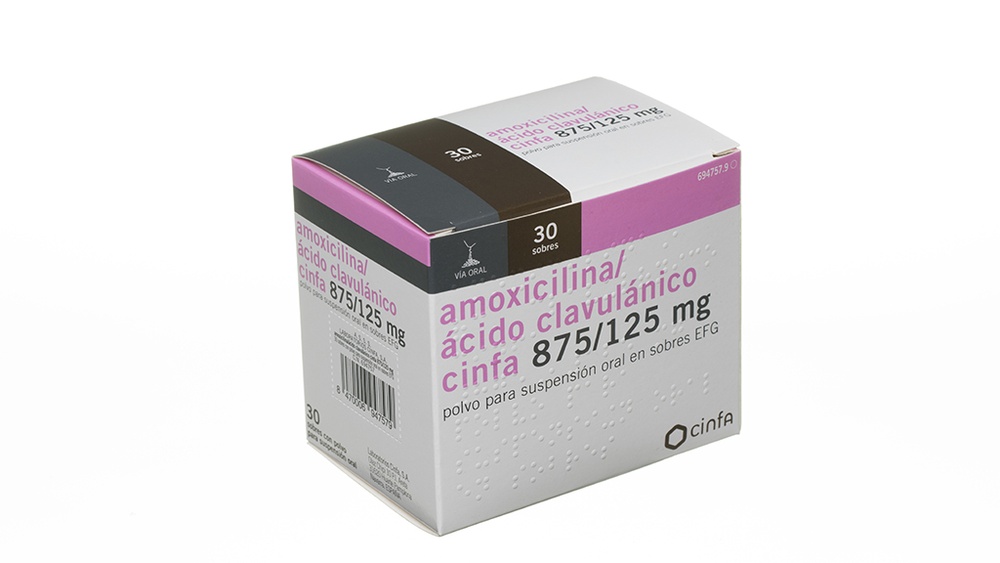
- País de registro
- Forma farmacéuticaSOLUCIÓN/SUSPENSIÓN ORAL, 875/125 mg/mg
- Código ATCJ01CR02
- Precio medio en farmacia6.81 EUR
- Principio activo
- Requiere recetaSí
- Fabricante
- ComposiciónASPARTAMO (E-951) (12,50 mg mg)
- Esta información es de carácter general y no sustituye la consulta con un profesional sanitario.
- Alternativas a AMOXICILINA/ACIDO CLAVULANICO ARDINECLAV 875/125 mg POLVO PARA SUSPENSION ORAL EN SOBRES EFGForma farmacéutica: SOLUCIÓN/SUSPENSIÓN ORAL, 250 mg amoxicilina/62,5 mg acido clavulanicoPrincipio activo: amoxicillin and beta-lactamase inhibitorFabricante: Sandoz Farmaceutica S.A.Requiere recetaForma farmacéutica: INYECTABLE PERFUSION, 2 G./200 MG.Principio activo: amoxicillin and beta-lactamase inhibitorFabricante: Laboratorio Reig Jofre, S.A.Requiere recetaForma farmacéutica: COMPRIMIDO, 500 mg amoxicilina/125 mg acido clavulanicoPrincipio activo: amoxicillin and beta-lactamase inhibitorFabricante: Sun Pharmaceutical Industries (Europe) B.V.Requiere receta
Médicos online para AMOXICILINA/ACIDO CLAVULANICO ARDINECLAV 875/125 mg POLVO PARA SUSPENSION ORAL EN SOBRES EFG
Comenta la dosis, los posibles efectos secundarios, interacciones, contraindicaciones o la revisión de receta de AMOXICILINA/ACIDO CLAVULANICO ARDINECLAV 875/125 mg POLVO PARA SUSPENSION ORAL EN SOBRES EFG, sujeto a valoración médica y a la normativa local.









Preguntas frecuentes
AMOXICILINA/ACIDO CLAVULANICO ARDINECLAV 875/125 mg POLVO PARA SUSPENSION ORAL EN SOBRES EFG requiere receta en España. Puedes confirmarlo con un médico online según tu caso.
El principio activo de AMOXICILINA/ACIDO CLAVULANICO ARDINECLAV 875/125 mg POLVO PARA SUSPENSION ORAL EN SOBRES EFG es amoxicillin and beta-lactamase inhibitor. Esta información ayuda a identificar medicamentos con la misma composición pero con diferentes nombres comerciales.
El precio medio en farmacia de AMOXICILINA/ACIDO CLAVULANICO ARDINECLAV 875/125 mg POLVO PARA SUSPENSION ORAL EN SOBRES EFG es de aproximadamente 6.81 EUR. Puede variar según el fabricante y la forma farmacéutica.
AMOXICILINA/ACIDO CLAVULANICO ARDINECLAV 875/125 mg POLVO PARA SUSPENSION ORAL EN SOBRES EFG es fabricado por Laboratorio Reig Jofre, S.A.. La marca y el envase pueden variar según el distribuidor.
Los Médicos de familia, Psiquiatras, Dermatólogos, Cardiólogos, Endocrinólogos, Gastroenterólogos, Neumólogos, Nefrólogos, Reumatólogos, Hematólogos, Infectólogos, Alergólogos, Geriatras, Pediatras, Oncólogos pueden valorar la prescripción de AMOXICILINA/ACIDO CLAVULANICO ARDINECLAV 875/125 mg POLVO PARA SUSPENSION ORAL EN SOBRES EFG cuando esté clínicamente indicado. Puedes reservar una videoconsulta para comentar tu caso y las opciones de tratamiento.
La receta la emite un médico tras valorar tu estado de salud. En España, AMOXICILINA/ACIDO CLAVULANICO ARDINECLAV 875/125 mg POLVO PARA SUSPENSION ORAL EN SOBRES EFG se dispensa en las farmacias con esa receta médica. Una consulta online no garantiza su emisión: la decisión corresponde siempre al médico.
Para solicitar una valoración puedes usar Oladoctor:
Otros medicamentos con el mismo principio activo (amoxicillin and beta-lactamase inhibitor) incluyen AMOXICILINA / ACIDO CLAVULANICO SANDOZ 250 mg/62,5 mg/5 ml POLVO PARA SUSPENSION ORAL EFG, AMOXICILINA ACIDO CLAVULANICO SALA 2.000 mg/200 mg POLVO PARA SOLUCION PARA PERFUSION EFG, AMOXICILINA ACIDO CLAVULANICO SUN 500 MG/125 MG COMPRIMIDOS RECUBIERTOS CON PELICULA EFG. Pueden tener diferentes nombres comerciales o formulaciones, pero contienen el mismo componente terapéutico. Consulta siempre con un médico antes de cambiar o iniciar un nuevo medicamento.
