



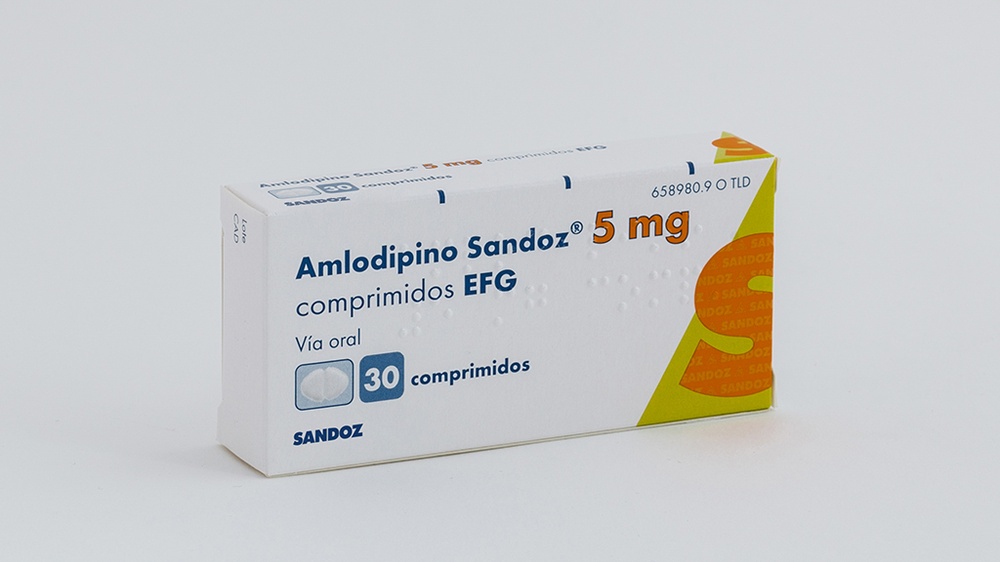
AMLODIPINO 5 mg Comprimidos

Revisión de receta online
Un médico revisará tu caso y determinará si la prescripción es médicamente apropiada.

Habla con un médico sobre este medicamento
Comenta tus síntomas y las opciones de tratamiento en una consulta online.



Cómo usar AMLODIPINO SANDOZ 5 MG COMPRIMIDOS EFG
Contenido del prospecto
- Introducción
- Qué es Amlodipino Sandoz y para qué se utiliza
- Qué necesita saber antes de empezar a tomar Amlodipino Sandoz
- Cómo tomar Amlodipino Sandoz
- Posibles efectos adversos
- Conservación de Amlodipino Sandoz
- Contenido del envase e información adicional
Introducción
Prospecto: información para el paciente
Amlodipino Sandoz 5 mg comprimidos EFG
Amlodipino Sandoz 10 mg comprimidos EFG
Lea todo el prospecto detenidamente antes de empezar a tomar este medicamento, porque contiene información importante para usted.
- Conserve este prospecto, ya que puede tener que volver a leerlo.
- Si tiene alguna duda, consulte a su médico o farmacéutico.
- Este medicamento se le ha recetado solamente a usted y no debe dárselo a otras personas, aunque tengan los mismos signos de enfermedad que usted, ya que puede perjudicarles.
- Si experimenta efectos adversos, consulte a su médico o farmacéutico, incluso si se trata de efectos adversos que no aparecen en este prospecto. Ver sección 4.
Contenido del prospecto:
- Qué es Amlodipino Sandoz y para qué se utiliza
- Qué necesita saber antes de empezar a tomar Amlodipino Sandoz
- Cómo tomar Amlodipino Sandoz
- Posibles efectos adversos
- Conservación de Amlodipino Sandoz
- Contenido del envase e información adicional
1. Qué es Amlodipino Sandoz y para qué se utiliza
Amlodipino pertenece a un grupo de medicamentos conocidos como antagonistas del calcio.
Amlodipino Sandoz se utiliza para tratar:
- la tensión arterial alta (hipertensión),
- un cierto tipo de dolor en el pecho llamado angina, a la que pertenece un tipo poco frecuente que es la angina de Prinzmetal o angina variante.
En pacientes con tensión arterial alta este medicamento funciona relajando los vasos sanguíneos, de modo que la sangre pasa a través de ellos más fácilmente.
En pacientes con angina, amlodipino mejora la llegada de la sangre al músculo del corazón que así recibe más oxígeno y como resultado se previene el dolor en el pecho. Amlodipino no proporciona un alivio inmediato del dolor en el pecho debido a la angina.

¿No estás seguro de si este medicamento es adecuado para ti?
Comenta tus síntomas y tratamiento con un médico online.
2. Qué necesita saber antes de empezar a tomar Amlodipino Sandoz
No tome Amlodipino Sandoz
- si es alérgico a amlodipino, a cualquier otro antagonista del calcio o a alguno de los demás componentes de este medicamento (incluidos en la sección 6). Estos pueden dar lugar a picor, enrojecimiento de la piel o dificultad al respirar,
- si tiene la tensión arterial muy baja (hipotensión),
- si tiene en el corazón un estrechamiento de la válvula aórtica (estenosis aórtica) o shock cardiogénico (una enfermedad en la que el corazón es incapaz de bombear suficiente sangre al cuerpo),
- si sufre de insuficiencia cardiaca después de un ataque al corazón.
Advertencias y precauciones
Consulte a su médico o farmacéutico antes de empezar a tomar amlodipino.
Informe a su médico o farmacéutico si tiene o ha tenido alguna de las siguientes enfermedades:
- ataque al corazón reciente,
- insuficiencia del corazón,
- aumento grave de la tensión sanguínea (crisis hipertensiva),
- enfermedad del hígado,
- es una persona de edad avanzada y su dosis necesita aumentarse.
Niños y adolescentes
Amlodipino no ha sido estudiado en niños menores de 6 años. Amlodipino sólo se debe utilizar para tratar la hipertensión arterial en niños y adolescentes de 6 a 17 años de edad (ver sección 3).
Para más información, consulte a su médico.
Otros medicamentos y Amlodipino Sandoz
Informe a su médico o farmacéutico si está tomando, ha tomado recientemente o pudiera tener que tomar cualquier otro medicamento.
Amlodipino puede afectar o puede ser afectado por otros medicamentos, tales como:
- ketoconazol, itraconazol (medicamentos antifúngicos),
- ritonavir, indinavir, nelfinavir (también llamados inhibidores de la proteasa utilizados para tratar el SIDA),
- rifampicina, eritromicina, claritromicina (antibióticos),
- Hypericum perforatum(Hierba de San Juan),
- verapamilo,diltiazem (medicamentos para el corazón),
- dantroleno (en perfusión para las anomalías graves de la temperatura corporal),
- simvastatina (medicamento para bajar los niveles altos de colesterol en sangre),
- tacrolimus, sirolimus, everolimus y ciclosporina (utilizado para prevenir el rechazo del órgano trasplantado y para el cáncer),
- temisirolimus (utilizado para el cáncer).
Si usted ya está tomando otros medicamentos para tratar la tensión arterial alta, amlodipino puede disminuir su tensión arterial aún más.
Toma de Amlodipino Sandoz con alimentos y bebidas
Las personas que están tomando amlodipino no deben consumir pomelo, ni zumo de pomelo. Esto se debe a que el pomelo y el zumo de pomelo pueden dar lugar a un aumento de los niveles en sangre del principio activo amlodipino, que puede causar un aumento imprevisible en el efecto de bajar la tensión sanguínea de amlodipino.
Embarazo, lactancia y fertilidad
Embarazo
No ha sido establecida la seguridad de amlodipino durante el embarazo. Si está embarazada o en periodo de lactancia, cree que podría estar embarazada o tiene la intención de quedarse embarazada, consulte a su médico antes de utilizar este medicamento.
Lactancia
Se ha demostrado que amlodipino pasa a la leche materna en pequeñas cantidades. Si usted está dando el pecho, o está a punto de hacerlo, debe informar a su médico antes de tomar amlodipino.
Conducción y uso de máquinas
Amlodipino puede afectar su capacidad para conducir o utilizar máquinas. Si amlodipino le hace sentirse enfermo, mareado o cansado, o le producen dolor de cabeza, no conduzca ni use maquinaria y contacte inmediatamente con su médico.
Amlodipino Sandoz contiene sodio
Este medicamento contiene menos de 1 mmol de sodio (23 mg) por comprimido; esto es, esencialmente “exento de sodio”.
3. Cómo tomar Amlodipino Sandoz
Siga exactamente las instrucciones de administración de este medicamento indicadas por su médico. En caso de duda, consulte de nuevo a su médico o farmacéutico.
La dosis inicial normal es 5 mg de amlodipino, una vez al día. La dosis se puede aumentar a 10 mg de amlodipino, una vez al día.
Puede tomar su medicamento antes o después de las comidas y bebidas. Se lo debe tomar a la misma hora cada día, con un vaso de agua. No tome amlodipino con zumo de pomelo.
Uso en niños y adolescentes
Para niños y adolescentes (entre 6 y 17 años de edad), la dosis inicial recomendada normalmente es de 2,5 mg al día. La dosis máxima recomendada es de 5 mg al día.
Es importante no interrumpir la administración de los comprimidos. No espere a que los comprimidos se le acaben para acudir a su médico.
El comprimido se puede partir en dosis iguales.
Si toma más Amlodipino Sandoz del que debe
La ingesta de demasiados comprimidos puede producir una bajada de la tensión arterial o incluso una bajada peligrosa. Puede sentirse mareado, aturdido, sufrir mareo postural al incorporarse o debilidad.
Si la bajada de la tensión arterial es lo bastante grave se puede producir un shock. Puede sentir su piel fría y húmeda y podría perder el conocimiento.
El exceso de líquido puede acumularse en los pulmones (edema pulmonar) causando dificultad para respirar que puede desarrollarse hasta 24-48 horas después de la ingesta.
Si ha tomado más amlodipino del que debe, consulte inmediatamente a su médico, a su farmacéutico o llame al Servicio de Información Toxicológica, teléfono: 91 562 04 20, indicando el medicamento y la cantidad utilizada.
Si olvidó tomar Amlodipino Sandoz
No se preocupe. Si olvidó tomarse un comprimido, no tome esa dosis. Tome la siguiente dosis a la hora correcta. No tome una dosis doble para compensar las dosis olvidadas.
Si interrumpe el tratamiento con Amlodipino Sandoz
El médico le indicará durante cuánto tiempo debe tomar este medicamento. Su enfermedad puede reaparecer si deja de tomar este medicamento antes de que se lo indique su médico.
Si tiene cualquier otra duda sobre el uso de este medicamento, pregunte a su médico o farmacéutico.

¿Has empezado a tomar el medicamento y tienes preguntas?
Comenta tus síntomas y tratamiento con un médico online.
4. Posibles efectos adversos
Al igual que todos los medicamentos, este medicamento puede producir efectos adversos, aunque no todas las personas los sufran.
Acuda a su médico inmediatamentesi experimenta alguno de los siguientes efectos adversos
tras tomar este medicamento.
- Silbidos repentinos al respirar, compresión en el pecho, falta de aliento o dificultad para respirar.
- Hinchazón de los párpados, cara o labios.
- Hinchazón de la lengua y la garganta que causa gran dificultad para respirar.
- Reacciones graves de la piel que incluyen erupción cutánea intensa, habones, enrojecimiento de la piel por todo el cuerpo, picor intenso, síntomas gripales seguidos de formación de ampollas, descamación e inflamación de la piel, boca, ojos y genitales (Síndrome de Stevens Johnson, necrólisis epidérmica tóxica) u otras reacciones alérgicas.
- Ataque al corazón, latido anormal del corazón.
- Inflamación del páncreas que puede causar dolor abdominal grave y dolor de espalda acompañado de gran sensación de malestar.
- Inflamación del hígado (hepatitis) que puede causar amarilleamiento de la piel y del blanco de los ojos, fiebre, escalofríos, cansancio, pérdida de apetito, dolor de esómago, sensación de malestar y oscurecimiento de la orina.
Se han notificado los siguientes efectos adversos muy frecuentes. Si le causan problemas o si duran más de una semana, consulte con su médico.
Muy frecuentes:pueden afectar a mas de 1 de cada 10 personas
- Edema (retención de liquidos)
Se han notificado los siguientes efectos adversos frecuentes. Si le causan problemas o si duran más de una semana, consulte con su médico.
Frecuentes:pueden afectar hasta 1 de cada 10 personas.
- Dolor de cabeza, mareos, somnolencia (especialmente al principio del tratamiento).
- Palpitaciones (sentir los latidos del corazón), sofoco.
- Dificultada para respirar.
- Dolor abdominal, sensación de malestar (náuseas).
- Alteración del hábito intestinal, diarrea, estreñimiento, indigestión.
- Hinchazón de tobillos.
- Cansancio, debilidad.
- Alteraciones visuales, visión doble.
- Calambres musculares.
Se han notificado otros efectos adversos que se incluyen en la siguiente lista. Si considera que alguno de los efectos adversos que sufre es grave o si aprecia cualquier efecto adverso no mencionado en este prospecto, informe a su médico o farmacéutico.
Poco frecuentes:pueden afectar hasta 1 de cada 100 personas.
- Cambios de humor, ansiedad, depresión, insomnio.
- Temblor, alteraciones del gusto, desmayos.
- Entumecimiento o sensación de hormigueo en las extremidades, pérdida de sensación de dolor.
- Zumbidos en los oídos.
- Disminución de la tensión arterial.
- Estornudos/secreción nasal causada por la inflamación de la mucosa de la nariz (rinitis).
- Tos.
- Sequedad de boca, vómitos (malestar).
- Caída del cabello, aumento de la sudoración, picor en la piel, erupciones, manchas rojas en la piel, decoloración de la piel.
- Trastorno de la micción, aumento de la necesidad de orinar durante la noche, aumento del número de veces de orinar.
- Imposibilidad de obtener una erección, incomodidad o aumento de las mamas en los hombres.
- Dolor en el pecho.
- Dolor, sensación de malestar.
- Dolor en los músculos o en las articulaciones, dolor de espalda.
- Aumento o pérdida de peso.
Raros:pueden afectar hasta 1 de cada 1.000 personas.
- Confusión.
Muy raros:pueden afectar hasta 1 de cada 10.000 personas.
- Disminución del número de células blancas de la sangre, disminución de plaquetas de la sangre que puede provocar sangrado fácil o moratones inusuales.
- Exceso de azúcar en sangre (hiperglucemia).
- Un trastorno en los nervios que puede causar debilidad muscular, hormigueo o entumecimiento.
- Inflamación de las encías.
- Hinchazón abdominal (gastritis).
- Función anormal del hígado, coloración amarillenta de la piel (ictericia), aumento de enzimas hepáticas que pueden tener efecto en algunas pruebas médicas.
- Aumento de la tensión muscular.
- Inflamación de los vasos sanguíneos, a menudo con erupciones en la piel.
- Sensibilidad a la luz.
No conocidos:no puede estimarse a partir de los datos disponibles:
- Temblores, rigidez, cara con apariencia de máscara, movimientos lentos y caminar lento y sin equilibrio.
Comunicación de efectos adversos
Si experimenta cualquier tipo de efecto adverso, consulte a su médico o farmacéutico, incluso si se trata de posibles efectos adversos que no aparecen en este prospecto. También puede comunicarlos directamente a través del Sistema Español de Farmacovigilancia de Medicamentos de Uso Humano: https://www.notificaram.es. Mediante la comunicación de efectos adversos usted puede contribuir a proporcionar más información sobre la seguridad de este medicamento.
5. Conservación de Amlodipino Sandoz
Mantener este medicamento fuera de la vista y del alcance de los niños.
No utilice este medicamento después de la fecha de caducidad que aparece en el envase y el blíster o en el frasco después de CAD/EXP. La fecha de caducidad es el último día del mes que se indica.
Blíster: Conservar en el embalaje original para protegerlo de la luz. No conservar a temperatura superior a 30 ºC.
Frasco HDPE: Conservar en el embalaje original para protegerlo de la luz.
Los medicamentos no se deben tirar por los desagües ni a la basura. Deposite los envases y los medicamentos que no necesita en el Punto SIGRE de la farmacia. En caso de duda pregunte a su farmacéutico cómo deshacerse de los envases y de los medicamentos que no necesita. De esta forma, ayudará a proteger el medio ambiente.
6. Contenido del envase e información adicional
Composición de Amlodipino Sandoz
- El principio activo es amlodipino.
Cada comprimido de Amlodipino Sandoz 5 mg comprimidos contiene 5 mg de amlodipino (como besilato).
Cada comprimido de Amlodipino Sandoz 10 mg comprimidos contiene 10 mg de amlodipino (como besilato).
- Los demás componentes son celulosa microcristalina, hidrogenofosfato de calcio anhidro, carboximetilalmidón sódico (tipo A) (de patata) y estearato de magnesio.
Aspecto de Amlodipino Sandoz y contenido del envase
Amlodipino Sandoz 5 mg comprimidos
Comprimido blanco o casi blanco, oblongo con los cantos biselados, con una ranura en una cara y con la marca "5" en la otra.
Amlodipino Sandoz 10 mg comprimidos
Comprimidos blanco a casi blanco, oblongo con los cantos biselados, con una ranura en una cara y con la marca "10" en la otra.
Los comprimidos se envasan en blíster Alu/PVC o Alu/OPA/Alu/PVC envasados en cajas de cartón o en envases de HDPE y tapones de rosca (sello de inviolabilidad).
Tamaños de envase:
Blíster Alu/PVC o Alu/OPA/Alu/PVC: 10, 14, 20, 28, 30, 50, 50x1, 60, 100 y 120 comprimidos.
Envases de HDPE: de 20, 30, 50, 60, 90, 100, 105, 120, 200 y 250 comprimidos.
Puede que solamente estén comercializados algunos tamaños de envases.
Titular de la autorización de comercialización y responsable de la fabricación
Titular de la autorización de comercialización
Sandoz Farmacéutica, S.A.
Centro Empresarial Parque Norte
Edificio Roble
C/ Serrano Galvache, 56
28033 Madrid
España
Responsables de la fabricación
Lek Pharmaceuticals d.d.
Verovškova, 57
SLO-1526 Ljubljana
Eslovenia
ó
SALUTAS PHARMA GMBH
Otto Von Guericke Alle, 1 (Barleben)
D-39179
Alemania
ó
ROWA PHARMACEUTICALS LIMITED
Newtown (Bantry, Co Cork)
Irlanda
ó
LEK, S.A.
Ul Domaniewska 50 C
Warszawa, PL 02-672
Polonia
ó
S.C. Sandoz, S.R.L.
Str. Livezeni nr. 7A
RO-540472 Targu-Mures
Rumanía
Lek S.A.
Ul. Podlipie 16,
95 010 Strykow
Polonia
ó
Lek Pharmaceuticals d.d.
Trimlini 2D, 9220
Lendava
Eslovenia
Este medicamento está autorizado en los estados miembros del Espacio Económico Europeo y en el Reino Unido (Irlanda del Norte) con los siguientes nombres:
Austria: Amlodipin Sandoz 5 mg – Tabletten
Amlodipin Sandoz 10 mg – Tabletten
Bélgica: Amlodipin besilaat Sandoz 5 mg tabletten
Amlodipin besilaat Sandoz 10 mg tabletten
Bulgaria: ??????? 5 MG ????????
??????? 10 MG ????????
República Checa: Orcal Neo
Dinamarca: Amlodipin "Sandoz"
Estonia: Amlocard 5 mg
Amlocard 10 mg
Finlandia: Amlodipin Sandoz 5 mg tabletit
Amlodipin Sandoz 10 mg tabletit
Grecia: Amlibon Bes 10 mg δισκ?α
Italia: AMLODIPINA SANDOZ
Holanda: Amlodipine (als besilaat) Sandoz 5 mg, tabletten
Amlodipine (als besilaat) Sandoz 10 mg, tabletten
Noruega: Amlodipin Sandoz 5 mg tabletter
Amlodipin Sandoz 10 mg tabletter
Portugal: Amlodipina Sandoz
Eslovaquia: AMLOPIN S 5 mg tablety
AMLOPIN S 10 mg tablety
Eslovenia: Amlopin 5 mg tablete
Amlopin 10 mg tablete
Suecia: Amlodipin Sandoz 5 mg tabletter
Amlodipin Sandoz 10 mg tabletter
Reino Unido (Irlanda del Norte):
Amlodipine 5 mg Tablets
Amlodipine 10 mg Tablets
Fecha de la última revisión de este prospecto:septiembre 2022
La información detallada de este medicamento está disponible en la página web de la Agencia Española de Medicamentos y Productos Sanitarios (AEMPS) http://www.aemps.gob.es/
- País de registro
- Forma farmacéuticaCOMPRIMIDO, 5 mg
- Código ATCC08CA01
- Precio medio en farmacia1.25 EUR
- Principio activo
- Requiere recetaSí
- Fabricante
- ComposiciónCARBOXIMETILALMIDON SODICO (4 mg mg)
- Esta información es de carácter general y no sustituye la consulta con un profesional sanitario.
- Alternativas a AMLODIPINO SANDOZ 5 MG COMPRIMIDOS EFGForma farmacéutica: COMPRIMIDO, 10 mgPrincipio activo: amlodipinoFabricante: Accord Healthcare S.L.U.Requiere recetaForma farmacéutica: COMPRIMIDO, 5 mgPrincipio activo: amlodipinoFabricante: Accord Healthcare S.L.U.Requiere recetaForma farmacéutica: COMPRIMIDO, 10 mgPrincipio activo: amlodipinoFabricante: Almus Farmaceutica S.A.U.Requiere receta
Médicos online para AMLODIPINO SANDOZ 5 MG COMPRIMIDOS EFG
Comenta la dosis, los posibles efectos secundarios, interacciones, contraindicaciones o la revisión de receta de AMLODIPINO SANDOZ 5 MG COMPRIMIDOS EFG, sujeto a valoración médica y a la normativa local.
Obtén una receta de AMLODIPINO SANDOZ 5 MG COMPRIMIDOS EFG online
Rellena un formulario de 2 minutos
Cuéntanos tus síntomas, historial y el medicamento que necesitas.
Elige un médico o nosotros te asignamos uno
Escoge un especialista o te conectamos con el próximo médico disponible.
El médico revisa tu caso
Normalmente en 30 minutos. Puede hacerte preguntas adicionales por chat.
Recógela en cualquier farmacia
Receta electrónica enviada a tu correo, válida en toda España.
Preguntas frecuentes
AMLODIPINO SANDOZ 5 MG COMPRIMIDOS EFG requiere receta en España. Puedes confirmarlo con un médico online según tu caso.
El principio activo de AMLODIPINO SANDOZ 5 MG COMPRIMIDOS EFG es amlodipino. Esta información ayuda a identificar medicamentos con la misma composición pero con diferentes nombres comerciales.
El precio medio en farmacia de AMLODIPINO SANDOZ 5 MG COMPRIMIDOS EFG es de aproximadamente 1.25 EUR. Puede variar según el fabricante y la forma farmacéutica.
AMLODIPINO SANDOZ 5 MG COMPRIMIDOS EFG es fabricado por Sandoz Farmaceutica S.A.. La marca y el envase pueden variar según el distribuidor.
Los Médicos de familia, Psiquiatras, Dermatólogos, Cardiólogos, Endocrinólogos, Gastroenterólogos, Neumólogos, Nefrólogos, Reumatólogos, Hematólogos, Infectólogos, Alergólogos, Geriatras, Pediatras, Oncólogos pueden valorar la prescripción de AMLODIPINO SANDOZ 5 MG COMPRIMIDOS EFG cuando esté clínicamente indicado. Puedes reservar una videoconsulta para comentar tu caso y las opciones de tratamiento.
España cuenta con una infraestructura sanitaria bien desarrollada en ciudades principales como Madrid, Barcelona, Valencia y Sevilla. Las farmacias están ampliamente disponibles y operan bajo estrictas regulaciones, garantizando el acceso a medicamentos con receta.
Puedes comprar AMLODIPINO SANDOZ 5 MG COMPRIMIDOS EFG en Madrid, Barcelona, Sevilla o Valencia en cualquier farmacia local con una receta válida.
Para obtener una receta, puedes utilizar Oladoctor:
Otros medicamentos con el mismo principio activo (amlodipino) incluyen AMLODIPINO ACCORD 10 MG COMPRIMIDOS EFG, AMLODIPINO ACCORD 5 MG COMPRIMIDOS EFG, AMLODIPINO ALMUS 10 mg COMPRIMIDOS EFG. Pueden tener diferentes nombres comerciales o formulaciones, pero contienen el mismo componente terapéutico. Consulta siempre con un médico antes de cambiar o iniciar un nuevo medicamento.
