



AMINOPLASMAL PAED 10% SOLUCION PARA PERFUSION

Revisión de receta online
Un médico revisará tu caso y determinará si la prescripción es médicamente apropiada.

Habla con un médico sobre este medicamento
Comenta tus síntomas y las opciones de tratamiento en una consulta online.



Cómo usar AMINOPLASMAL PAED 10% SOLUCION PARA PERFUSION
Contenido del prospecto
- Introducción
- Qué es Aminoplasmal Paed 10 % y para qué se utiliza
- Qué necesita saber antes de que su hijo empiece a usar Aminoplasmal Paed 10 %
- Cómo usar Aminoplasmal Paed 10 %
- Posibles efectos adversos
- Conservación de Aminoplasmal Paed 10 %
- Contenido del envase e información adicional
- Advertencias y precauciones especiales de empleo:
- Precauciones especiales de eliminación y otras manipulaciones
Introducción
Prospecto: información para el paciente
Aminoplasmal Paed 10% solución para perfusión
Para uso en niños (0-11 años)
Aminoácidos
Lea todo el prospecto detenidamente antesde empezar a usar este medicamento, porque contiene información importante para usted.
- Conserve este prospecto, ya que puede tener que volver a leerlo.
- Si tiene alguna duda, consulte a su médico o enfermero.
- Este medicamento se le ha recetado solamente a su hijo, y no debe dárselo a otras personas aunque tengan los mismos síntomas que su hijo, ya que puede perjudicarles.
- Si su hijo experimenta efectos adversos, consulte a su médico o enfermero, incluso si se trata de efectos adversos que no aparecen en este prospecto. Ver sección 4.
Contenido del prospecto
- Qué es Aminoplasmal Paed 10 % y para qué se utiliza
- Qué necesita saber antes de que su hijo empiece a usar Aminoplasmal Paed 10 %
- Cómo usar Aminoplasmal Paed 10 %
- Posibles efectos adversos
- Conservación de Aminoplasmal Paed 10 %
- Contenido del envase e información adicional
1. Qué es Aminoplasmal Paed 10 % y para qué se utiliza
Aminoplasmal Paed 10 % es una solución que se administra a su hijo a través de un pequeño tubo con una cánula colocada en una vena (perfusión intravenosa).
La solución contiene aminoácidos, que son esenciales para el crecimiento y la recuperación del organismo.
La solución está adaptada para satisfacer las necesidades específicas de los recién nacidos, prematuros y a término, lactantes y niños.
Recibirán este medicamento si no pueden ingerir alimentos normalmente y tampoco pueden ser alimentados a través de una sonda colocada en el estómago. También podrán recibir otros nutrientes como soluciones de glucosa o emulsiones grasas en combinación con Aminoplasmal Paed 10 %.

¿No estás seguro de si este medicamento es adecuado para ti?
Comenta tus síntomas y tratamiento con un médico online.
2. Qué necesita saber antes de que su hijo empiece a usar Aminoplasmal Paed 10 %
No use Aminoplasmal Paed 10% si su hijo
- es alérgico a los principios activos o a cualquiera de los demás componentes de este medicamento (incluidos en la sección 6)
- si padece un error congénito del metabolismo de los aminoácidos y/o de las proteínas
- si padece un trastorno de la circulación grave (es decir, potencialmente mortales (choque circulatorio)tiene un aporte insuficiente de oxígeno (hipoxia)
- tiene sustancias ácidas que se acumulan en la sangre (acidosis metabólica)
- si padece una enfermedad hepática grave (insuficiencia hepática grave);
- Si padece un fallo renal grave (insuficiencia renal grave) no tratado adecuadamente con un aparato de hemodiálisis o tratamientos similares;
- Si padece una insuficiencia cardiaca grave con una alteración importante de la circulación sanguínea (insuficiencia cardiaca descompensada);
- tiene acumulación de líquidos en los pulmones (edema pulmonar agudo)
Advertencias y precauciones
Cuando se utilice en niños de edades comprendidas entre el nacimiento prematuro y los 2 años, la solución (en las bolsas y equipos de administración) se debe proteger de la exposición a la luz hasta que finalice la administración. La exposición de las soluciones de nutrición parenteral que contengan Aminoplasmal Paed 10 % a la luz ambiental, en especial después de mezclarlas con oligoelementos o vitaminas, genera peróxidos y otros productos de degradación que pueden reducirse si se protege el producto de la exposición a la luz.
Consulte a su médico o enfermero antes de usar Aminoplasmal Paed 10 % si su hijo
- sufre una alteración del metabolismo de las proteínas y de los aminoácidos producida por una patología distinta a las mencionadas anteriormente (ver sección «No use Aminoplasmal Paed 10 % si su hijo...»);
- sufre un deterioro de la función hepática o renal;
- sufre un deterioro de la función cardiaca;
- tiene una concentración de suero sanguíneo anormalmente alta (osmolaridad sérica elevada)
Si el equilibrio de agua o sales del organismo de su hijo está alterado, este trastorno debe corregirse antes de que el niño reciba este medicamento. Algunos ejemplos de este trastorno son la falta simultánea de agua y sales (deshidratación hipotónica) o la falta de sodio (hiponatremia) o de potasio (hipopotasemia).
Tanto antes como mientras los niños estén recibiendo esta solución, el médico comprobará los niveles de sales y de azúcar en la sangre, el balance hídrico y el equilibrio acidobásico. También hará un seguimiento de las proteínas sanguíneas y de la función del hígado y de los riñones. A tal efecto, se obtendrán muestras de sangre y de orina para su correspondiente análisis.
Las soluciones de aminoácidos son solo un componente de la nutrición parenteral. Normalmente, los niños recibirán Aminoplasmal Paed 10 % como parte de la alimentación por vía intravenosa, que también incluye suplementos de energía no proteínica (soluciones de hidratos de carbono, emulsiones grasas), ácidos grasos esenciales, electrólitos, vitaminas, líquidos y oligoelementos.
Uso de Aminoplasmal Paed 10% con otros medicamentos
Informe a su médico o enfermero si su hijo está tomando, ha tomado recientemente o podría tener que tomar cualquier otro medicamento.
Embarazo y lactancia
Aminoplasmal Paed 10 % solo está destinado para su uso en niños (menores de doce años de edad).
Conducción y uso de máquinas
No procede.
3. Cómo usar Aminoplasmal Paed 10 %
Aminoplasmal Paed 10 % es administrado por parte de profesionales sanitarios.
En los niños, el médico ajustará la dosis según la edad, el grado de desarrollo y la enfermedad de cada niño.
La cantidad administrada será aproximadamente:
Recién nacidos prematuros: 40 ml por kg de peso corporal por día
Recién nacidos a término (de 0 a 27 días): 30 ml por kg de peso corporal por día
Lactantes (de 28 días a 23 meses): 25 ml por kg de peso corporal por día
Niños (de 2 a 11 años):20 ml por kg de peso corporal por día
Para los niños en estado crítico, la cantidad administrada puede ser más alta (hasta 30 ml por kilogramo de peso por día).
Pacientes con enfermedad renal o hepática
Las dosis se ajustarán según las necesidades individuales del niño si este padece una enfermedad hepática o renal.
Duración del tratamiento
Este medicamento puede utilizarse mientras el niño requiera alimentación por vía intravenosa.
Forma de administración
Este medicamento se le administrará a su hijo a través de un pequeño tubo que se inserta en una vena (perfusión intravenosa).
Cuando se utilice en niños de edades comprendidas entre el nacimiento prematuro y los 2 años, la solución (en las bolsas y equipos de administración) se debe proteger de la exposición a la luz hasta que finalice la administración (ver sección 2).
Si su hijo recibe más Aminoplasmal Paed 10% del que debe
Es poco probable que esto ocurra, ya que el médico determinará las dosis diarias para su hijo.
No obstante, si su hijo recibe una sobredosis o la velocidad de perfusión de la solución es demasiado rápida, su hijo podría sentir náuseas, vomitar y tener escalofríos o dolor de cabeza.
Además, la sangre podría contener demasiadas sustancias ácidas (acidosis metabólica) o demasiado amoníaco (hiperamoniemia) y su hijo podría sufrir una pérdida de aminoácidos en la orina.
Su hijo también podría tener demasiado líquido en su cuerpo (hiperhidratación), el equilibrio de sales del organismo de su hijo podría estar alterado (desequilibrio electrolítico) y su hijo podría tener líquido en los pulmones (edema pulmonar). Si esto sucede, se interrumpirá la perfusión y se reanudará a una velocidad de perfusión menor poco tiempo después.
Si tiene cualquier otra duda sobre el uso de este medicamento, pregunte a su médico o al personal de enfermería.

¿Has empezado a tomar el medicamento y tienes preguntas?
Comenta tus síntomas y tratamiento con un médico online.
4. Posibles efectos adversos
Al igual que todos los medicamentos, este medicamento puede producir efectos adversos, aunque no todas personas los sufran.
Estos efectos adversos no están específicamente relacionados con Aminoplasmal Paed 10 %, sino que se pueden producir con cualquier tipo de alimentación intravenosa, especialmente al inicio.
Los siguientes efectos adversos pueden ser graves. Si su hijo presenta alguno de los siguientes efectos adversos, informe inmediatamente a su médico, quien dejará de administrar este medicamento asu hijo:
Frecuencia no conocida (no puede estimarse a partir de los datos disponibles)
? Reacciones alérgicas.
Otros efectos adversos
Poco frecuentes (pueden afectar hasta 1 de cada 100 personas)
? Vómitos, náuseas.
Comunicación de efectos adversos
Si su hijo experimenta cualquier tipo de efecto adverso, consulte a su médico o enfermero, incluso si se trata de posibles efectos adversos que no aparecen en este prospecto. También puede comunicarlos directamente a través del Sistema de Farmacovigilancia de Medicamentos de Uso Humano www.notificaRAM.es. Mediante la comunicación de efectos adversos usted puede contribuir a proporcionar más información sobre la seguridad de este medicamento.
5. Conservación de Aminoplasmal Paed 10 %
Mantener este medicamento fuera de la vista y del alcance de los niños.
Cuando se utilice en niños de edades comprendidas entre el nacimiento prematuro y los 2 años, la solución (en las bolsas y equipos de administración) se debe proteger de la exposición a la luz hasta que finalice la administración (ver sección 2).
No utilice este medicamento después de la fecha de caducidad que aparece en las etiquetas de la bolsa y de la caja. La fecha de caducidad es el último día del mes que se indica.
No requiere condiciones especiales de conservación.
No congelar.
Tras la perfusión, nunca debe conservarse la solución restante para su uso posterior.
6. Contenido del envase e información adicional
Composición de Aminoplasmal Paed 10%
Los principios activos son aminoacidos.
Este medicamento contiene:
Aminoácidos | por 1ml | por 100ml | por 250ml |
Isoleucina | 5,10 mg | 0,51 g | 1,28 g |
Leucina | 7,60 mg | 0,76 g | 1,90 g |
Lisina monohidrato (equivalente en lisina) | 9,88 mg (8,80 mg) | 0,99 g (0,88 g) | 2,47 g (2,20 g) |
Metionina | 2,00 mg | 0,20 g | 0,50 g |
Fenilalanina | 3,10 mg | 0,31 g | 0,78 g |
Treonina | 5,10 mg | 0,51 g | 1,28 g |
Triptófano | 4,00 mg | 0,40 g | 1,00 g |
Valina | 6,10 mg | 0,61 g | 1,53 g |
Arginina | 9,10 mg | 0,91 g | 2,28 g |
Histidina | 4,60 mg | 0,46 g | 1,15 g |
Alanina | 15,90 mg | 1,59 g | 3,98 g |
Glicina | 2,00 mg | 0,20 g | 0,50 g |
Ácido aspártico | 6,60 mg | 0,66 g | 1,65 g |
Ácido glutámico | 9,30 mg | 0,93 g | 2,33 g |
Prolina | 6,10 mg | 0,61 g | 1,53 g |
Serina | 2,00 mg | 0,20 g | 0,50 g |
N-acetiltirosina (equivalente en tirosina) | 1,30 mg (1,06 mg) | 0,13 g (0,11 g) | 0,33 g (0,27 g) |
Acetilcisteína (equivalente en cisteína) | 0,700 mg (0,520 mg) | 0,070 g (0,052 g) | 0,175 g (0,13 g) |
Taurina | 0,300 mg | 0,030 g | 0,075 g |
por 1ml | por 100ml | por 250ml | |
Aminoácidos totales | 0,1 g | 10 g | 25 g |
Nitrógeno total | 0,0152 g | 1,52 g | 3,8 g |
Energía [kJ/l (kcal/l)] | 1.700 (406) |
Osmolaridad teórica [mOsm/l] | 790 |
Acidez (titulación a pH 7,4) [mmol NaOH/l] | 23 |
pH | aprox. 6,1 |
Los demás componentes son ácido cítrico monohidrato (para el ajuste del pH) y agua para preparaciones inyectables.
Aspecto del producto y contenido del envase
Aminoplasmal Paed 10 % es una solución transparente, entre incolora y de color amarillo claro.
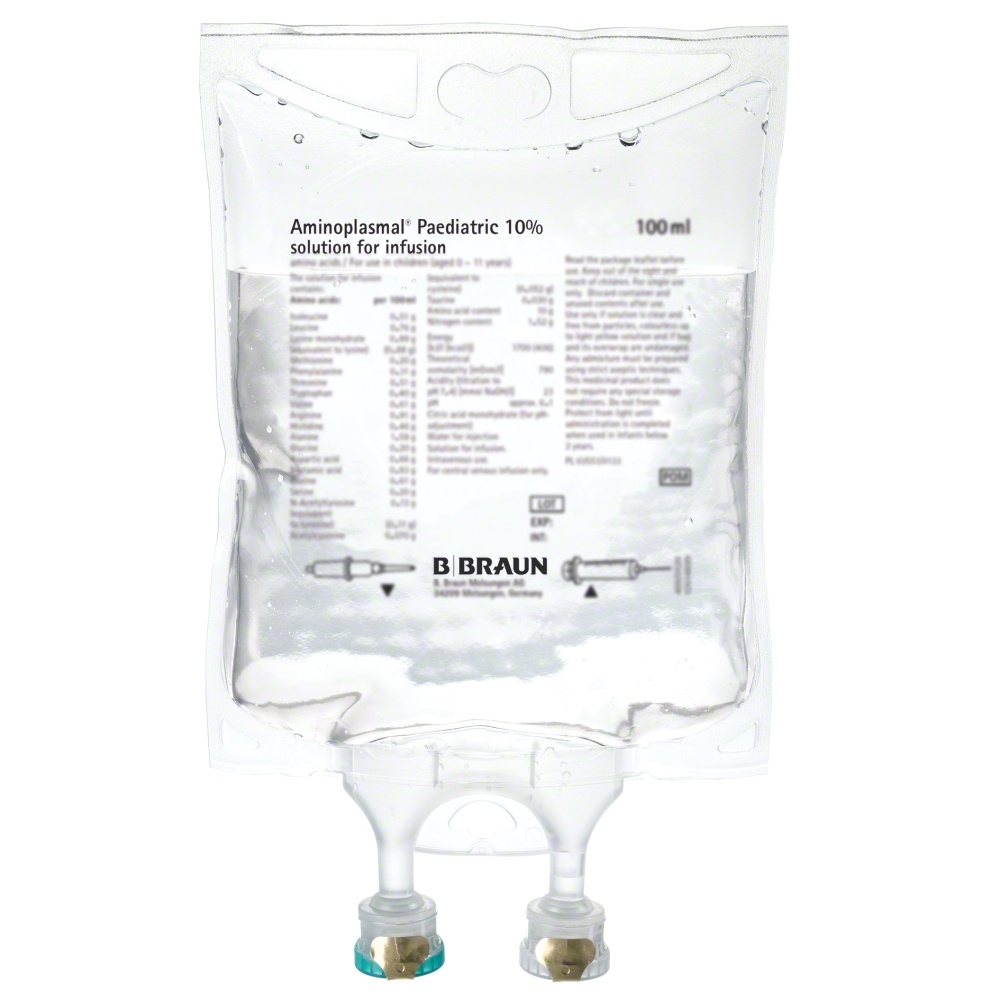
Se suministra en bolsas flexibles que contienen 100 ml o 250 ml de solución de aminoácidos. Las bolsas están hechas de una hoja multicapa. La capa interna que está en contacto con la solución se compone de polipropileno.
El envase no contiene PVC, DEHP ni látex.
La bolsa está empaquetada en una envoltura protectora. . Se ha colocado un absorbente de oxígeno y un indicador de oxígeno entre la bolsa y la envoltura; el indicador de oxígeno es un blíster termoconformado y contiene resorufina sódica, un colorante sensible al oxígeno; el sobre de absorbente de oxígeno está compuesto de un material inerte y contiene hidróxido de hierro.
Los diferentes tamaños de envase se presentan en cajas de 12 bolsas. Tamaños de envases: 12 x 100 ml y 12 x 250 ml
Puede que solamente estén comercializados algunos tamaños de envases
Titular de la autorización de comercialización yresponsable de la fabricación
- Braun Melsungen AG
Carl-Braun-Straße 1
34212 Melsungen, Alemania
Dirección postal:
34209 Melsungen, Alemania
Teléfono: +49/5661/71-0
Fax: +49/5661/71-4567
Este medicamento está autorizado en los estados miembros del Espacio Económico Europeo con los siguientes nombres:
Austria Aminoplasmal Paed 10% Infusionslösung
Czech Republic Amiped
Denmark Amiped
Germany Aminoplasmal Paed 10% Infusionslösung
Greece Aminoplasmal Paed 10%
Italy Amiped
Luxembourg Aminoplasmal Paed 10%
Netherlands Aminoplasmal Paed 100mg/ml, oplossing voor infusie
Norway Amiped
Poland Aminoplasmal Paed 10%
Portugal Aminoplasmal Paed 100mg/ml, Solucao para perfusao
Slovak Republic Amiped 10% infuzny roztok
Slovenia Aminoplasmal Paed 100mg/ml, raztopina za infundiranje
Spain Aminoplasmal Paed 10 % solucion para perfusion
United Kingdom Aminoplasmal Paediatric 10% solution for infusion
Fecha de la última revisión de este prospecto:Enero 2020.
--------------------------------------------------------------------------------------------------------------------
Esta información está destinada únicamente a profesionales del sector sanitario:
Posología
Forma de administración
Vía intravenosa.
Únicamente para perfusión venosa central.
Cuando se utilice en niños de edades comprendidas entre el nacimiento prematuro y los 2 años, la solución (en las bolsas y equipos de administración) se debe proteger de la exposición a la luz hasta que finalice la administración. Durante la preparación de las mezclas, la envoltura para la protección de la luz puede no ser adecuada. No obstante, se debe prestar atención a reducir al máximo la exposición a la luz durante la preparación de las mezclas.
Población pediátrica
Las dosis para los grupos indicados, a continuación son valores promedio de orientación. La dosis exacta debe ajustarse de forma individual de acuerdo con la edad, el grado de desarrollo y la enfermedad predominante.
La administración debe iniciarse por debajo del valor de velocidad de perfusión objetivo e incrementarse hasta el mismo durante la primera hora.
El suministro de aminoácidos por vía parenteral que se considera adecuado para la mayoría de los pacientes pediátricos:
Dosis diaria para reciénnacidos prematuros:
1,5-4,0 g de aminoácidos/kg de peso corporal ? 15-40 ml/kg de peso corporal
Dosis diaria para recién nacidos a término (de0 a27días):
1,5-3,0 g/kg de peso corporal ? 15-30 ml/kg de peso corporal
Dosis diaria para lactantes (de 28días a 23meses):
1,0-2,5 g/kg de peso corporal ? 10-25 ml/kg de peso corporal
Dosis diaria para niños (de2 a11años):
1,0-2,0 g/kg de peso corporal ? 10-20 ml/kg de peso corporal
Advertencias y precauciones especiales de empleo:
La exposición a la luz de las soluciones para nutrición parenteral por vía intravenosa, en especial después de mezclarlas con oligoelementos y/o vitaminas, puede tener efectos adversos en el desenlace clínico de los recién nacidos debido a la generación de peróxidos y otros productos de degradación. Cuando se utilice en niños de edades comprendidas entre el nacimiento prematuro y los 2 años, Aminoplasmal Paed 10 % se debe proteger de la luz ambiental hasta que finalice la administración.
Precauciones especiales de eliminación y otras manipulaciones
Utilizar un equipo de administración estéril para la administración de Aminoplasmal paed 10 %.
Antes de abrir la envoltura protectora, comprobar el color del indicador de oxígeno (ver Figura A). No usar si el indicador de oxígeno ha adquirido un color rosa. Usar sólo si el indicador de oxígeno tiene un color amarillo.
Si en el contexto de una nutrición parenteral total es necesario añadir otros nutrientes como, por ejemplo, hidratos de carbono, lípidos, vitaminas, electrólitos y oligoelementos a este medicamento, la mezcla debe realizarse en condiciones asépticas estrictas. Mezclar bien tras la adición de cualquier aditivo. Aminoplasmal Paed 10 % solo puede mezclarse con otros nutrientes cuya compatibilidad se haya documentado. El fabricante puede proporcionar previa solicitud los datos de compatibilidad de diferentes aditivos y el periodo de validez correspondiente de dichas mezclas.
Cuando se utilice en niños de edades comprendidas entre el nacimiento prematuro y los 2 años, las soluciones de nutrición parenteral que contengan Aminoplasmal Paed 10 % deben protegerse de la exposición a la luz hasta que finalice la administración. La exposición de dichas soluciones a la luz ambiental, en especial después de mezclarlas con oligoelementos y/o vitaminas, genera peróxidos y otros productos de degradación que pueden reducirse si se protege el producto de la exposición a la luz.
Precauciones especiales de conservación
El producto no debe utilizarse si la solución no es transparente, entre incolora y de color amarillo claro, no está libre de partículas, o si la bolsa o su cierre están dañados.
Los envases son válidos para un solo uso. Desechar la envoltura, el indicador de oxígeno, el absorbente de oxígeno, el envase y el contenido restante después del uso.
Durante la preparación de las mezclas
Durante la preparación de las mezclas, la envoltura para la protección de la luz puede no ser adecuada. No obstante, se debe prestar atención a reducir al máximo la exposición a la luz durante la preparación de las mezclas.
Periodo de validez después de la mezcla de aditivos
Desde un punto de vista microbiológico, las mezclas deben administrarse inmediatamente después de su preparación. Si no se administran inmediatamente, las condiciones y los tiempos de almacenamiento de las mezclas antes del uso son responsabilidad del usuario y, normalmente, no deberían sobrepasar las 24 horas a una temperatura de 2 °C a 8 °C, a menos que la mezcla se haya realizado en condiciones asépticas controladas y validadas.
Para ver la información completa de este medicamento, consultar la Ficha Técnica o Resumen de las Características del Producto.
Aminoplasmal Paed 10%:Manipulación
Figura A:Bolsa y envoltura
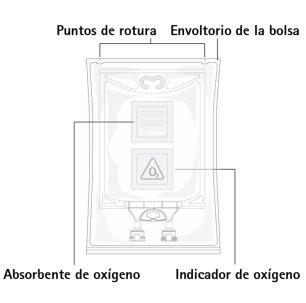
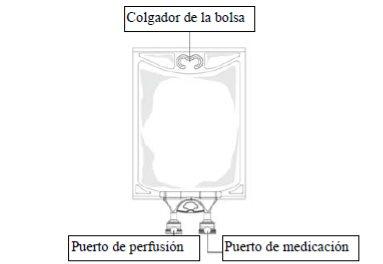
Figura B:Bolsa
Para abrir:
Retire la bolsa de su envoltura protectora a partir de los puntos de rotura de la parte superior y extraiga el envase de la solución (figura 1). Deseche la envoltura, el absorbente y el indicador de oxígeno.
Compruebe la existencia de fugas. Deseche el producto si la bolsa tiene fugas, puesto que la esterilidad puede haberse visto afectada.
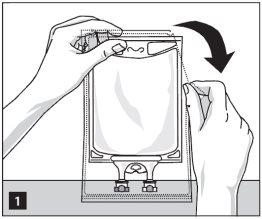
Para añadir el medicamento:
Las mezclas deben prepararse siguiendo técnicas asépticas estrictas.
Pueden añadirse medicamentos suplementarios compatibles a través del puerto de la medicación (color transparente).
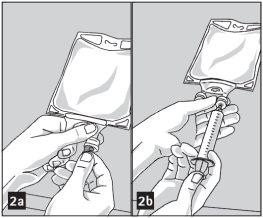
- Prepare el puerto de medicación (color transparente) retirando la hoja de aluminio (figura 2a). Tenga en cuenta que la zona por debajo de la hoja del puerto de medicación es estéril.
- Pinche el puerto de medicación resellable e inyecte el (los) aditivo(s) (figura 2b).
- Mezcle completamente la solución y el medicamento (figura 3a).
- El puerto de medicación puede limpiarse con un desinfectante (p. ej., isopropanol) antes de volver a pincharlo.
- Compruebe visualmente la mezcla en busca de partículas (figura 3b).
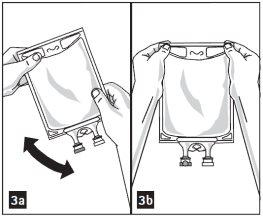
Durante la preparación de las mezclas
Durante la preparación de las mezclas, la envoltura para la protección de la luz puede no ser adecuada. No obstante, se debe prestar atención a reducir al máximo la exposición a la luz durante la preparación de las mezclas.
Preparación para su administración:
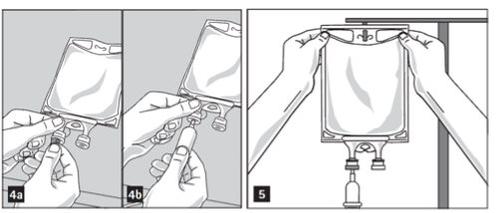
- Retire la hoja de aluminio del puerto de perfusión (color verde) de la parte inferior del envase (figura 4a) y conecte el equipo de administración (figura 4b): utilice un equipo de perfusión sin toma de aire o cierre la toma de aire de un equipo que la tenga. Siga las instrucciones de uso del equipo de perfusión. Tenga en cuenta que la zona por debajo de la hoja del puerto de perfusión es estéril.
- Cuelgue la bolsa en un poste IV (figura 5).
- País de registro
- Forma farmacéuticaINYECTABLE PERFUSION, N/A (más de 3 PA)
- Código ATCB05BA01
- Principio activo
- Requiere recetaSí
- Fabricante
- Esta información es de carácter general y no sustituye la consulta con un profesional sanitario.
- Alternativas a AMINOPLASMAL PAED 10% SOLUCION PARA PERFUSIONForma farmacéutica: INYECTABLE PERFUSION, 100 G/L TOTAL AMINOACIDOSPrincipio activo: aminoácidosFabricante: B. Braun Melsungen AgRequiere recetaForma farmacéutica: INYECTABLE PERFUSION, 100 G/L TOTAL AMINOACIDOSPrincipio activo: aminoácidosFabricante: B. Braun Melsungen AgRequiere recetaForma farmacéutica: INYECTABLE PERFUSION, 150 g/l total aminoácidosPrincipio activo: aminoácidosFabricante: B. Braun Melsungen AgRequiere receta
Médicos online para AMINOPLASMAL PAED 10% SOLUCION PARA PERFUSION
Comenta la dosis, los posibles efectos secundarios, interacciones, contraindicaciones o la revisión de receta de AMINOPLASMAL PAED 10% SOLUCION PARA PERFUSION, sujeto a valoración médica y a la normativa local.









Obtén una receta de AMINOPLASMAL PAED 10% SOLUCION PARA PERFUSION online
Rellena un formulario de 2 minutos
Cuéntanos tus síntomas, historial y el medicamento que necesitas.
Elige un médico o nosotros te asignamos uno
Escoge un especialista o te conectamos con el próximo médico disponible.
El médico revisa tu caso
Normalmente en 30 minutos. Puede hacerte preguntas adicionales por chat.
Recógela en cualquier farmacia
Receta electrónica enviada a tu correo, válida en toda España.
Preguntas frecuentes
AMINOPLASMAL PAED 10% SOLUCION PARA PERFUSION requiere receta en España. Puedes confirmarlo con un médico online según tu caso.
El principio activo de AMINOPLASMAL PAED 10% SOLUCION PARA PERFUSION es aminoácidos. Esta información ayuda a identificar medicamentos con la misma composición pero con diferentes nombres comerciales.
AMINOPLASMAL PAED 10% SOLUCION PARA PERFUSION es fabricado por B. Braun Melsungen Ag. La marca y el envase pueden variar según el distribuidor.
Los Médicos de familia, Psiquiatras, Dermatólogos, Cardiólogos, Endocrinólogos, Gastroenterólogos, Neumólogos, Nefrólogos, Reumatólogos, Hematólogos, Infectólogos, Alergólogos, Geriatras, Pediatras, Oncólogos pueden valorar la prescripción de AMINOPLASMAL PAED 10% SOLUCION PARA PERFUSION cuando esté clínicamente indicado. Puedes reservar una videoconsulta para comentar tu caso y las opciones de tratamiento.
España cuenta con una infraestructura sanitaria bien desarrollada en ciudades principales como Madrid, Barcelona, Valencia y Sevilla. Las farmacias están ampliamente disponibles y operan bajo estrictas regulaciones, garantizando el acceso a medicamentos con receta.
Puedes comprar AMINOPLASMAL PAED 10% SOLUCION PARA PERFUSION en Madrid, Barcelona, Sevilla o Valencia en cualquier farmacia local con una receta válida.
Para obtener una receta, puedes utilizar Oladoctor:
Otros medicamentos con el mismo principio activo (aminoácidos) incluyen AMINOPLASMAL B.BRAUN 10% E SOLUCION PARA PERFUSION, AMINOPLASMAL B.BRAUN 10% SOLUCION PARA PERFUSION, AMINOPLASMAL B.BRAUN 15% SOLUCION PARA PERFUSION. Pueden tener diferentes nombres comerciales o formulaciones, pero contienen el mismo componente terapéutico. Consulta siempre con un médico antes de cambiar o iniciar un nuevo medicamento.
