






Cómo usar AMICACINA B BRAUN 5 MG/ML SOLUCION PARA PERFUSION INTRAVENOSA
Traducción generada por IA
Este contenido ha sido traducido automáticamente y se ofrece solo con fines informativos. No sustituye la consulta con un profesional sanitario.
Ver originalContenido del prospecto
- Introducción
- Qué es Amicacina B. Braun 5 mg/ml y para qué se utiliza
- Qué necesita saber antes de empezar a usar Amicacina B. Braun 5 mg/ml.
- Durante la lactancia, su médico valorará el posible beneficio frente al riesgo de la administración de amikacina para el lactante y le informará sobre si debe interrumpir la lactancia durante el tratamiento.
- Cómo usar Amicacina B. Braun 5 mg/ml.
- Posibles efectos adversos
- Conservación de Amicacina B. Braun 5 mg/ml.
- Contenido del envase e información adicional
Introducción
Prospecto: información para el usuario
Amicacina B. Braun5 mg/ml solución para perfusión
Lea todo el prospecto detenidamente antes de empezar a usar este medicamento, porque contiene información importante para usted.
- Conserve este prospecto, ya que puede tener que volver a leerlo.
- Si tiene alguna duda, consulte a su médico o farmacéutico.
- Este medicamento se le ha recetado solamente a usted, y no debe dárselo a otras personas aunque tengan los mismos síntomas que usted, ya que puede perjudicarles.
- Si experimenta efectos adversos, consulte a su médico o farmacéutico, incluso si se trata de efectos adversos que no aparecen en este prospecto. Ver sección 4.
Contenido del prospecto
- Qué es Amicacina B. Braun 5 mg/ml y para qué se utiliza
- Qué necesita saber antes de empezar a usar Amicacina B. Braun 5 mg/ml
- Cómo usar Amicacina B. Braun 5 mg/ml
- Posibles efectos adversos
- Conservación de Amicacina B. Braun 5 mg/ml
- Contenido del envase e información adicional
1. Qué es Amicacina B. Braun 5 mg/ml y para qué se utiliza
Este medicamento contiene un antibiótico que pertenece al grupo de los aminoglucósidos, amikacina
Los antibióticos se utilizan para tratar infecciones bacterianas y no sirven para tratar infecciones víricas como la gripe o el catarro. Es importante que siga las instrucciones relativas a la dosis, las tomas y la duración del tratamiento indicadas por su médico. No guarde ni reutilice este medicamento. Si una vez finalizado el tratamiento le sobra antibiótico, devuélvalo a la farmacia para su correcta eliminación. No debe tirar los medicamentos por el desagüe ni a la basura. |
Se utiliza para el tratamiento, a corto plazo, de las infecciones graves producidas por microorganismos sensibles. Se utiliza principalmente en los casos siguientes
- infección en sangre, que se conoce con el nombre de sepsis,
- infecciones graves de las vías respiratorias incluyendo pacientes con fibrosis quística,
- infecciones del sistema nervioso central (incluyendo meningitis y ventriculitis),
- infecciones del tracto gastrointestinal, incluyendo peritonitis,
- infecciones complicadas y periódicas de las vías urinarias,
- infecciones de la piel y tejidos blandos (incluyendo quemaduras),
- infecciones óseas, incluyendo articulaciones,
- infecciones después de una intervención quirúrgica.

2. Qué necesita saber antes de empezar a usar Amicacina B. Braun 5 mg/ml.
No use Amicacina B. Braun 5 mg/ml:
Si es alérgico (hipersensible) a la amikacina o a otros antibióticos de tipo aminoglucósidos o a alguno de los demás componentes de este medicamento (incluidos en la sección 6). No debe administrarse junto con otros medicamentos que sean tóxicos para el oído o el riñón, ni con diuréticos (medicamentos empleados para aumentar la eliminación de orina) potentes.
Advertencias y precauciones
Consulte a su médico o farmacéutico antes de empezar a usar Amicacina B. Braun 5 mg/ml.
Informe a su médico de cualquier alergia o problema médico que tenga o haya tenido, especialmente:
- si es alérgico a la amikacina o a otros antibióticos aminoglucósidos,
- si sus riñones no funcionan bien, ya que puede aumentar el riesgo de toxicidad,
- si tiene trastornos musculares, como miastenia gravis o Parkinson, ya que se puede agravar la debilidad muscular,
- si está tomando diuréticos que puedan ser tóxicos para el oído,
- si aparecen síntomas de toxicidad para los oídos tales como mareo, vértigo, tinnitus (sensación de campanilleo en los oídos), zumbidos en los oídos y pérdida de audición o síntomas de toxicidad en los riñones,
- si usted o los miembros de su familia tienen una enfermedad por mutación mitocondrial (una enfermedad genética) o pérdida de audición debida a los antibióticos, se le aconseja que informe a su médico o farmacéutico antes de tomar un aminoglucósido; ciertas mutaciones mitocondriales pueden aumentar su riesgo de pérdida auditiva con este medicamento. Su médico puede recomendarle pruebas genéticas antes de la administración de Amicacina B. Braun 5 mg/ml solución para perfusión,
- Amikacina puede producir alteraciones en los valores de análisis de algunas sustancias como: nitrógeno ureico, transaminasas, fosfatasa alcalina, bilirrubina, creatinina, lactato deshidrogenasa, sodio, potasio, magnesio y calcio.
Uso en niños
Este medicamento se administrará con precaución, y solamente si no existe otra alternativa, en niños prematuros y recién nacidos debido a que estos pacientes presentan un desarrollo incompleto de los riñones.
Usoen pacientes de edad avanzada
Este medicamento debe administrarse con precaución en este tipo de pacientes, ya que es probable que presenten una disminución de la función de los riñones y, con ello, una mayor probabilidad de que se produzca toxicidad generalizada (sistémica).
Uso de Amicacina B. Braun 5 mg/ml con otros medicamentos
Informe a su médico o farmacéutico si está utilizando, ha utilizado recientemente o pudiera tener que utilizar cualquier otro medicamento.
La administración de este medicamento junto con los siguientes medicamentos puede hacer necesario modificar la dosis de alguno de ellos o la interrupción del tratamiento.
- Otros antibióticos del mismo tipo que amikacina, aminoglucósidos (gentamicina, tobramicina…) o capreomicina.
- Amfotericina (medicamento para tratar las infecciones producidas por hongos), vancomicina (antibiótico), agentes que disminuyen la inmunidad, agentes citotóxicos (tóxicos para las células como ciclosporina o cisplatino), cefalosporinas (cefalotina) o diuréticos potentes (para aumentar la eliminación de orina).
- Anestésicos del tipo hidrocarburos halogenados que se administran por inhalación, transfusiones masivas de sangre citratada y bloqueantes neuromusculares.
- Antihistamínicos (medicamentos para la alergia).
- Buclizina, ciclizina, meclozina o trimetobenzamida (medicamentos para controlar náuseas y vómitos).
- Loxapina (para la esquizofrenia).
- Fenotiazinas, tioxantenos (fármacos utilizados en psiquiatría).
- Antiemiasténicos (medicamentos para tratar la miastenia grave - debilidad de los músculos).
- Indometacina (medicamento de tipo antiinflamatorio).
- Malatión (pesticida).
- Antibióticos del tipo polipeptídicos (colistina, polimixina).
- Analgésicos opiáceos (derivados del opio utilizados para el tratamiento del dolor).
- Antibióticos del tipo b-lactámicos (penicilina).
Embarazo y lactancia
Si está embarazada o en periodo de lactancia, cree que podría estar embarazada o tiene intención de quedarse embarazada, consulte a su médico o farmacéutico antes de utilizar este medicamento.
No está recomendado el tratamiento durante el embarazo aunque el médico valorará la conveniencia de su utilización. Si el medicamento se utiliza durante el embarazo, o si la paciente se queda embarazada durante el tratamiento, ésta debe ser informada de los posibles riesgos.
Durante la lactancia, su médico valorará el posible beneficio frente al riesgo de la administración de amikacina para el lactante y le informará sobre si debe interrumpir la lactancia durante el tratamiento.

Conducción y uso de máquinas
No existe evidencia de efectos sobre la capacidad para conducir vehículos o utilizar máquinas. Sin embargo, dicha capacidad puede verse alterada si aparecen reacciones adversas como mareo, vértigo, etc.
Amicacina B. Braun 5 mg/ml contiene sodio
Este medicamento contiene 354 mg de sodio (componente principal de la sal de mesa/para cocinar) en cada botella de 100 ml. Esto equivale al 17,7% de la ingesta máxima diaria de sodio recomendada para un adulto.
3. Cómo usar Amicacina B. Braun 5 mg/ml.
Siga exactamente las instrucciones de administración de este medicamento indicadas por su médico. En caso de duda, consulte de nuevo a su médico.
Su médico decidirá la duración de su tratamiento.
Su médico determinará cual es la dosis más adecuada para usted, y ésta dependerá de su edad, peso, estado general, gravedad de la infección y funcionamiento de los riñones. Debe realizarse un seguimiento de la función del riñón durante el tratamiento.
Como norma general, la dosis usual en adultos con función renal normal es de 15 mg/kg/día, administrada en forma de dosis única diaria o repartidas en dos o tres dosis iguales administradas a intervalos equivalentes, es decir, 7,5 mg/kg cada 12 h o 5 mg/kg cada 8 h.
Se administra mediante perfusión intravenosa lenta.
Si usa más Amicacina B. Braun 5 mg/ml de la que debe
En caso de sobredosis o ingestión accidental consulte inmediatamente a su médico o farmacéutico o llame al Servicio de Información Toxicológica, teléfono: 91 562 04 20, indicando el medicamento y la cantidad ingerida.
En caso de presentarse una reacción tóxica por administración de más dosis de la debida o por acumulación, la aplicación de diálisis peritoneal o hemodiálisis pueden favorecer la eliminación del antibiótico. Esto debe ser considerado especialmente en pacientes que presenten insuficiencia grave de riñón.
Si se produjese una reacción de hipersensibilidad se suspenderá su administración, aplicándose al paciente el tratamiento específico adecuado a la naturaleza e intensidad de la misma (antihistamínicos, corticosteroides, adrenalina...).
Si tiene cualquier otra duda sobre el uso de este producto, pregunte a su médico o farmacéutico.
4. Posibles efectos adversos
Al igual que todos los medicamentos, este medicamento puede producir efectos adversos, aunque no todas las personas los sufran.
La frecuencia de los efectos adversos se clasifica en las siguientes categorías:
Muy frecuentes (pueden afectar a más de 1 de cada 10 personas)
- Nefrotoxicidad: aumento del nitrógeno ureico y no proteico y de la creatinina en sangre, albuminuria (pérdida de la proteína albúmina por la orina), presencia en la orina de glóbulos rojos y blancos…
- Neurotoxicidad-ototoxicidad: toxicidad del VIII par craneal: pérdida de la audición, vértigo, daño coclear (parte del oído interno) incluyendo pérdida de la audición en frecuencias altas.
Pueden producirse mareos, ataxia (desorden que afecta a los movimientos voluntarios) vértigo, tinnitus, zumbido de oídos y pérdida de audición.
- Neurotoxicidad-bloqueo neuromuscular: parálisis muscular aguda y apnea (suspensión de la respiración), entumecimiento, hormigueo, espasmos musculares y convulsiones.
Poco frecuentes (pueden afectar hasta 1 de cada 100 personas):
- Dolor de cabeza, temblores.
- Erupción en la piel, enrojecimiento y aumento de la temperatura en el lugar de inyección.
- Náuseas, vómitos.
- Parestesia (sensación de adormecimiento, hormigueo, o ardor en la piel), artralgia (dolor en articulaciones).
- Dolor en el sitio de la inyección.
Raras(pueden afectar hasta 1 de cada 1.000 personas):
- Eosinofilia (presencia de una cantidad anormalmente alta de eosinófilos – un tipo de glóbulos blancos – en la sangre), anemia (baja concentración de glóbulos rojos).
- Hipotensión (baja tensión arterial); hipomagnesemia (bajo nivel de magnesio).
Comunicación de efectos adversos
Si experimenta cualquier tipo de efecto adverso, consulte a su médico o farmacéutico, incluso si se trata de posibles efectos adversos que no aparecen en este prospecto. También puede comunicarlos directamente a través del Sistema Español de Farmacovigilancia de Medicamentos de Uso Humano: www.notificaRAM.es.
Mediante la comunicación de efectos adversos usted puede contribuir a proporcionar más información sobre la seguridad de este medicamento.
5. Conservación de Amicacina B. Braun 5 mg/ml.
Mantener este medicamento fuera de la vista y del alcance de los niños.
No requiere condiciones especiales de conservación. Conservar en el embalaje original.
No utilice este medicamento después de la fecha de caducidad que aparece en el envase después de CAD. La fecha de caducidad es el último día del mes que se indica.
El contenido debe ser utilizado inmediatamente tras su apertura. Una vez abierto el envase, desechar la porción no utilizada de la solución.
Los medicamentos no se deben tirar por los desagües ni a la basura. Pregunte a su farmacéutico cómo deshacerse de los envases y de los medicamentos que ya no necesita. De esta forma, ayudará a proteger el medio ambiente.
6. Contenido del envase e información adicional
Composición de Amicacina B. Braun 5 mg/ml
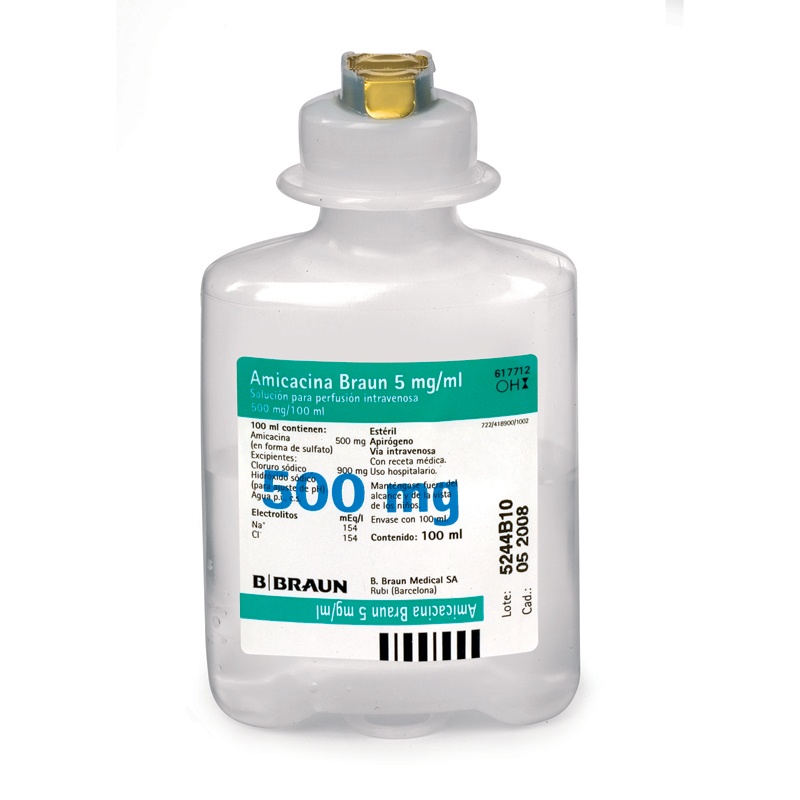
- El principio activo es amikacina (como sulfato). Cada 5 ml de solución contiene 25 mg de amikacina (como sulfato). Cada ml de solución contiene 5 mg de amikacina (como sulfato). Cada botella de 100 ml contiene 500 mg de amikacina (como sulfato).
- Los demás componentes (excipientes) son cloruro de sodio, hidróxido de sodio (ajuste de pH) y agua para preparaciones inyectables.
Aspecto del producto y contenido del envase
Se presenta en envases conteniendo 1 y 20 botellas de plástico de 100 ml acondicionadas en una caja de cartón.
Titular de la autorización de comercialización y responsable de la fabricación
- Braun Medical, S.A.
Ctra. de Terrassa, 121
08191Rubí (Barcelona)
España
Fecha de la última revisión de este prospecto: Febrero 2015
La información detallada de este medicamento está disponible en la página web de la Agencia Española de Medicamentos y Productos Sanitarios (AEMPS) (http://www.aemps.gob.es/).
----------------------------------------------------------------------------------------------
Esta información está destinada únicamente a médicos o profesionales del sector sanitario:
Deben observarse cuidadosamente las funciones tanto renal como del nervio auditivo en paciente con insuficiencia renal, cuando se use durante periodos largos o cuando se administre en dosis superiores a las recomendadas ya que han sido comunicados trastornos del VIII par craneal así como de la función renal. La aparición de signos de nefro u ototoxicidad determinará un reajuste de la dosificación o la suspensión del tratamiento según los casos.
Como norma general, la dosis usual en adultos con función renal normal es de 15 mg/kg/día, administrada en forma de dosis única diaria o repartidas en dos o tres dosis iguales administradas a intervalos equivalentes, es decir, 7,5 mg/kg cada 12 h o 5 mg/kg cada 8 h.
Deben estudiarse los niveles plasmáticos de amikacina, ajustando su dosificación para evitar prolongados niveles superiores a 35 microgramos/ml. Se debe examinar la orina para detectar incrementos en la excreción de proteínas, la presencia de células o cilindros y disminución de la densidad.
La ototoxicidad en niños no está bien determinada.
En caso de aparecer sobreinfecciones producidas por microorganismos resistentes, debe suspenderse el tratamiento y aplicarse la terapia adecuada.
Los pacientes deben estar bien hidratados durante el tratamiento.
Amicacina B. Braun 5 mg/ml es una solución lista para usar y por lo tanto, no debe ser diluida antes de su administración. Sin embargo, puede administrarse en la misma línea intravenosa de manera simultánea con soluciones cloruro sódico al 0,9% o glucosa al 5%.
Posología y forma de administración
Antes de iniciar el tratamiento con amikacina es aconsejable realizar un antibiograma. Si la gravedad del proceso lo requiere y el cuadro clínico permite sospechar una infección por microorganismos sensibles a amikacina, puede iniciarse la terapia con amikacina antes de conocer el resultado del antibiograma (ver sección 4.4.).
La dosis y pauta de administración se establecen según la gravedad de la infección, la sensibilidad de microorganismo responsable, la edad, el peso y el estado general del paciente. En pacientes con infecciones graves y en casos de insuficiencia renal es aconsejable la monitorización de los niveles plasmáticos de amikacina
Debe establecerse el estado de la función renal determinando la concentración de creatinina sérica o el ritmo de aclaramiento de creatinina endógena. La determinación del nitrógeno de la urea sanguínea es menos fiable en este caso. Debe realizarse un seguimiento de la función renal durante el tratamiento.
Siempre que sea posible, deben determinarse las concentraciones de amikacina en suero, para asegurar niveles adecuados pero no excesivos. Se recomienda medir las concentraciones séricas mínimas y máximas intermitentemente durante el tratamiento. Deben evitarse concentraciones máximas (30-90 minutos después de la inyección) superiores a 35 mg/ml y concentraciones mínimas (justo antes de la siguiente dosis) superiores a 10 mg/ml. La dosis se ajustará como se indica.
Posología
Pacientes confunción renal normal
Los pacientes con función renal normal se les pueden administrar una dosis única diaria, siempre que el máximo de concentración no exceda de 35 mg/ml.
Adultos, adolescentes (12 a menos de 18 años) y niños (2 a 11 años)
La dosis intravenosa recomendada para adultos es de 15 mg/kg/día, administrada en forma de dosis única diaria o repartidas en dos o tres dosis iguales administradas a intervalos equivalentes, es decir, 7,5 mg/kg cada 12 h o 5 mg/kg cada 8 h. El tratamiento en pacientes de gran masa corporal no debe sobrepasar 1,5 g/día.
Lactantes (28 días a 23 meses)
La dosis intravenosa recomendada en niños mayores de 2 semanas es de 7,5 mg/kg cada 12 h o 5 mg/kg cada 8 h.
Neonatos (0 a 27 días)
La dosis de carga es de 10 mg/kg para seguir con dosis de 7,5 mg/kg cada 12 horas.
Prematuros
La dosis intravenosa recomendada es de 7,5 mg/kg cada 12 horas.
Dosis diaria única
La administración en forma de dosis única diaria (15 mg/kg/día) por perfusión intravenosa durante 60 minutos es una pauta posológica alternativa en pacientes adultos no neutropénicos y pacientes inmunocompetentes con una función renal normal.
En pacientes con función renal normal reflejada por un aclaramiento de creatinina ≥ 50 ml/min, se puede administrar una dosis única diaria intravenosa de 15 mg/kg/día en adultos, o 20 mg/kg/día en niños (de 4 semanas de edad o mayores) para el tratamiento de bacteriemia, sepsis, infecciones del tracto respiratorio, infecciones complicadas del tracto urinario, infecciones intra-abdominales y en casos de neutropenia febril. No se dispone de información suficiente acerca de la utilización de una dosis diaria única en pacientes con afectación de otros órganos o sistemas
Cuando amikacina está indicada para infecciones no complicadas del tracto urinario se puede administrar una dosis total diaria de 500 mg en dosis única o dividida en dos dosis (250 mg BID).
La duración del tratamiento es de 7-10 días. La dosis total diaria no debe sobrepasar 15mg/kg/día. En infecciones difíciles y complicadas que requieran un tratamiento superior a 10 días, debe reconsiderarse el uso de este medicamento. En el caso de continuar, se recomienda controlar las funciones renal, auditiva y vestibular y los niveles séricos de amikacina.
Las infecciones no complicadas producidas por microorganismos sensibles a amikacina, deberán responder en 24-48 h. Si no se obtiene respuesta clínica definitiva en 3-5 días, se suspenderá la terapia y se revisará la sensibilidad del microorganismo al antibiótico. El fallo del tratamiento puede deberse a una resistencia del microorganismo o a la presencia de un foco séptico que precise drenaje quirúrgico.
Pacientes con función renal alterada
En pacientes con insuficiencia renal que se refleja por un aclaramiento de creatinina < 50 ml/min, la administración total de amikacina en dosis única, no es recomendable ya que estos pacientes tendrán una exposición prolongada a concentraciones valle elevadas. (Ver ajuste de dosis con insuficiencia renal).
En pacientes con insuficiencia renal que reciben dosis diarias habituales divididas en dos o tres veces, siempre que sea posible, las concentraciones séricas de amikacina deben monitorizarse por procedimientos de análisis apropiados. Las dosis pueden ajustarse en pacientes con insuficiencia renal administrando dosis normales a intervalos prolongados o bien administrando dosis reducidas a intervalos fijos.
Ambas posibilidades están basadas en el aclaramiento de creatinina del paciente o en los valores séricos de creatinina, ya que en pacientes con disminución de la función renal se ha observado una correlación entre estos valores y la vida media de los aminoglucósidos. Estos esquemas de dosificación pueden utilizarse junto con cuidadosas observaciones clínicas y de laboratorio del paciente y deben ser modificadas cuando sea necesario, incluso cuando vaya a realizarse diálisis.
Dosis normal a intervalos prolongados de dosificación
Si no se dispone del aclaramiento renal de creatinina y el paciente está estable, el intervalo de dosificación en horas para una dosis única, (esto es, se dará a los pacientes con función renal normal en esquema BID, 7,5 mg/kg) puede ser calculada multiplicando el valor de la creatininemia por 9. Por ejemplo, si el valor de creatinina sérica es de 2 mg/100 ml, se le administraría una dosis única de 7,5 mg/kg cada 18 h.
Dosis reducida a intervalos fijos de dosificación
Cuando la función renal está alterada y es aconsejable administrar este medicamento a intervalos fijos, la dosis debe ser reducida. En estos pacientes deben determinarse las concentraciones séricas de amikacina para asegurar una administración exacta y evitar concentraciones excesivas. Si no se pueden realizar determinaciones séricas y el paciente está estable, los valores de creatinina sérica y aclaramiento de creatinina son los indicadores más fácilmente disponibles del grado de daño renal para utilizar como guía para la dosificación.
Inicialmente se administrará la dosis normal de 7,5 mg/kg, como dosis de carga. Esta dosis es la misma que la dosis normal recomendada, la cual debería ser calculada para un paciente con función renal normal, tal como se escribió anteriormente.
Para determinar la dosis de mantenimiento cada 12 h, la dosis de base deberá reducirse en proporción con la reducción del aclaramiento de la creatinina:
Dosis de mantenimiento (cada 12 h):
- A.C. observado en ml/ min
- --------------------------------x dosis de carga (mg)
- A.C. normal en ml/ min
A.C.= aclaramiento de creatinina
Una guía aproximada alternativa para determinar la dosis reducida a intervalos de 12 horas (para pacientes con valores séricos de creatinina en estado estacionario conocidos) es dividir la dosis recomendada habitual por el valor de la creatinina sérica del paciente.
Estos esquemas de dosis no pretenden ser recomendaciones de estricto cumplimiento, sino una guía de dosificación cuando no sea posible determinar los niveles séricos de amikacina.
En el caso de que se conozca el valor de la creatinina sérica del paciente, la manera de determinar las dosis es dividir la dosis normal (7,5 mg/kg) por el valor de la creatinina. Estas dosificaciones no se consideran de estricto cumplimiento, pero son recomendadas cuando no es posible determinar los niveles séricos de amikacina.
Otras poblaciones de riesgo
Pacientes de edad avanzada
Pueden necesitar dosis de mantenimiento menores que en los jóvenes, para obtener concentraciones plasmáticas terapéuticas.
La dosis debe ajustarse al peso corporal y a la función renal. En pacientes obesos la dosis inicial debe calcularse en el peso ideal más un 40% de exceso de peso.
Pacientes con quemadurasypacientes con infecciones graves
Pueden necesitar una administración mayor o intervalos de cuatro a seis horas debido a que en estos casos la vida media del fármaco es menor.
Forma de administración
Vía intravenosa. Administración por perfusión intravenosa durante un periodo de 30-60 minutos.
-

- País de registro
- Forma farmacéuticaINYECTABLE PERFUSION, 500 mg
- Código ATCJ01GB06
- Principio activo
- Requiere recetaSí
- Fabricante
- Esta información es de carácter general y no sustituye la consulta con un profesional sanitario.
- Alternativas a AMICACINA B BRAUN 5 MG/ML SOLUCION PARA PERFUSION INTRAVENOSAForma farmacéutica: INYECTABLE PERFUSION, 1000 mgPrincipio activo: amikacinFabricante: B Braun Medical S.A.Requiere recetaForma farmacéutica: INYECTABLE, 500 mgPrincipio activo: amikacinFabricante: B Braun Medical S.A.Requiere recetaForma farmacéutica: INYECTABLE PERFUSION, 5 mg/mlPrincipio activo: amikacinFabricante: Fresenius Kabi España, S.A.U.Requiere receta

Médicos online para AMICACINA B BRAUN 5 MG/ML SOLUCION PARA PERFUSION INTRAVENOSA
Comenta la dosis, los posibles efectos secundarios, interacciones, contraindicaciones o la revisión de receta de AMICACINA B BRAUN 5 MG/ML SOLUCION PARA PERFUSION INTRAVENOSA, sujeto a valoración médica y a la normativa local.









Obtén una receta de AMICACINA B BRAUN 5 MG/ML SOLUCION PARA PERFUSION INTRAVENOSA online
Rellena un formulario de 2 minutos
Cuéntanos tus síntomas, historial y el medicamento que necesitas.
Elige un médico o nosotros te asignamos uno
Escoge un especialista o te conectamos con el próximo médico disponible.
El médico revisa tu caso
Normalmente en 30 minutos. Puede hacerte preguntas adicionales por chat.
Recógela en cualquier farmacia
Receta electrónica enviada a tu correo, válida en toda España.
Preguntas frecuentes
AMICACINA B BRAUN 5 MG/ML SOLUCION PARA PERFUSION INTRAVENOSA requires receta en España. Puedes confirmarlo con un médico online según tu caso.
El principio activo de AMICACINA B BRAUN 5 MG/ML SOLUCION PARA PERFUSION INTRAVENOSA es amikacin. Esta información ayuda a identificar medicamentos con la misma composición pero con diferentes nombres comerciales.
AMICACINA B BRAUN 5 MG/ML SOLUCION PARA PERFUSION INTRAVENOSA es fabricado por B Braun Medical S.A.. La marca y el envase pueden variar según el distribuidor.
Los Médicos de familia, Psiquiatras, Dermatólogos, Cardiólogos, Endocrinólogos, Gastroenterólogos, Neumólogos, Nefrólogos, Reumatólogos, Hematólogos, Infectólogos, Alergólogos, Geriatras, Pediatras, Oncólogos pueden valorar la prescripción de AMICACINA B BRAUN 5 MG/ML SOLUCION PARA PERFUSION INTRAVENOSA cuando esté clínicamente indicado. Puedes reservar una videoconsulta para comentar tu caso y las opciones de tratamiento.
España cuenta con una infraestructura sanitaria bien desarrollada en ciudades principales como Madrid, Barcelona, Valencia y Sevilla. Las farmacias están ampliamente disponibles y operan bajo estrictas regulaciones, garantizando el acceso a medicamentos con receta.
Puedes comprar AMICACINA B BRAUN 5 MG/ML SOLUCION PARA PERFUSION INTRAVENOSA en Madrid, Barcelona, Sevilla o Valencia en cualquier farmacia local con una receta válida.
Para obtener una receta, puedes utilizar Oladoctor:
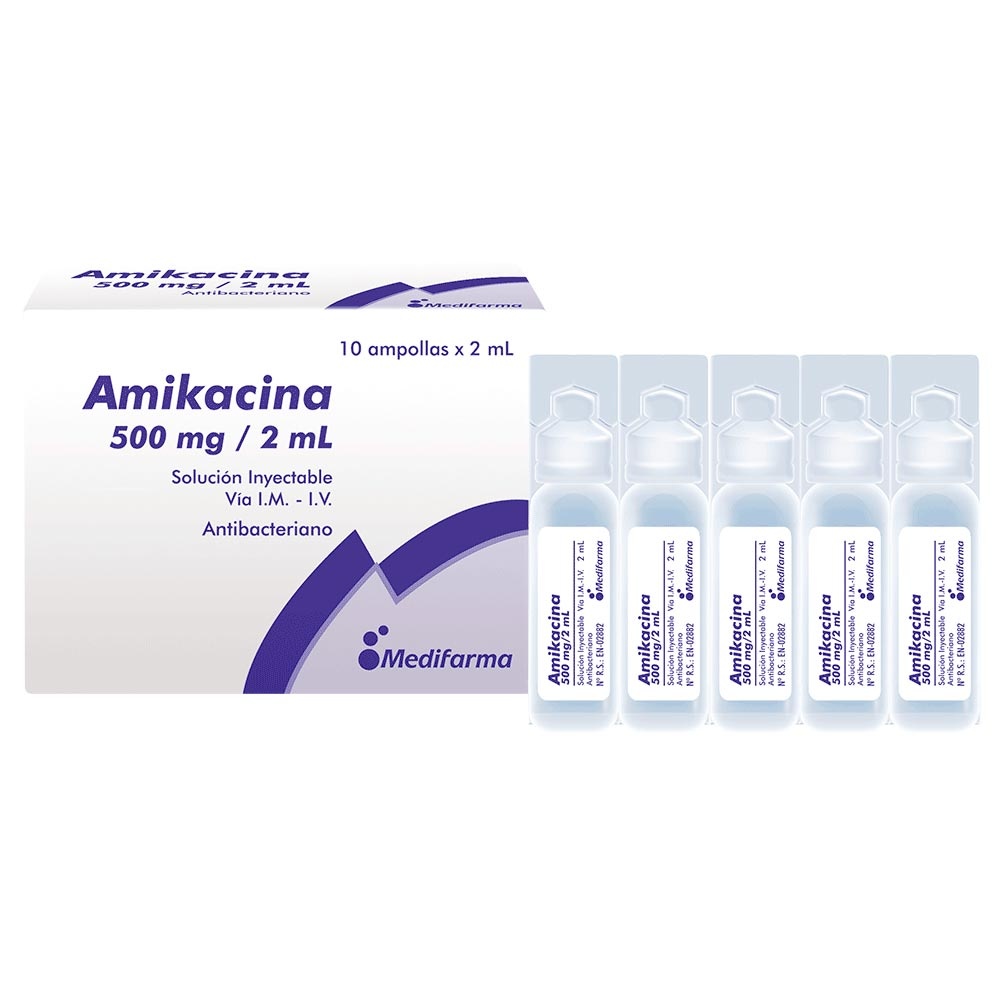
Otros medicamentos con el mismo principio activo (amikacin) incluyen AMICACINA B BRAUN 10 mg/ml SOLUCION PARA PERFUSION INTRAVENOSA, AMICACINA BRAUN 500 MG/2ML SOLUCIÓN INYECTABLE, AMIKACINA KABI 5 MG/ML SOLUCION PARA PERFUSION. Pueden tener diferentes nombres comerciales o formulaciones, pero contienen el mismo componente terapéutico. Consulta siempre con un médico antes de cambiar o iniciar un nuevo medicamento.
