


AMICACIN B BRAUN 5 mg/ml SOLUTION FOR INTRAVENOUS INFUSION



How to use AMICACIN B BRAUN 5 mg/ml SOLUTION FOR INTRAVENOUS INFUSION
Translated with AI
This page provides general information and does not replace a doctor’s consultation. Always consult a doctor before taking any medication. Seek urgent medical care if symptoms are severe.
Show originalContents of the leaflet
- Introduction
- What Amicacina B. Braun 5 mg/ml is and what it is used for
- What you need to know before you use Amicacina B. Braun 5 mg/ml.
- During breastfeeding, your doctor will assess the possible benefit versus the risk of amikacin administration to the infant and will inform you whether you should interrupt breastfeeding during treatment.
- How to use Amicacina B. Braun 5 mg/ml.
- Possible side effects
- Storage of Amicacina B. Braun 5 mg/ml.
- Container Content and Additional Information
Introduction
Package Leaflet: Information for the User
Amicacina B. Braun5 mg/ml solution for infusion
Read all of this leaflet carefully before you start using this medicine because it contains important information for you.
- Keep this leaflet, you may need to read it again.
- If you have any further questions, ask your doctor or pharmacist.
- This medicine has been prescribed for you only. Do not pass it on to others. It may harm them, even if their signs of illness are the same as yours.
- If you get any side effects, talk to your doctor or pharmacist. This includes any possible side effects not listed in this leaflet. See section 4.
Contents of the pack
- What Amicacina B. Braun 5 mg/ml is and what it is used for
- What you need to know before you use Amicacina B. Braun 5 mg/ml
- How to use Amicacina B. Braun 5 mg/ml
- Possible side effects
- Storage of Amicacina B. Braun 5 mg/ml
- Contents of the pack and other information
1. What Amicacina B. Braun 5 mg/ml is and what it is used for
This medicine contains an antibiotic belonging to the group of aminoglycosides, amikacin
Antibiotics are used to treat bacterial infections and are not effective against viral infections such as flu or colds. It is important that you follow the instructions regarding dosage, administration, and duration of treatment as indicated by your doctor. Do not store or reuse this medicine. If you have any leftover antibiotic after finishing the treatment, return it to the pharmacy for proper disposal. Do not throw away medicines via wastewater or household waste. |
It is used for the short-term treatment of severe infections caused by sensitive microorganisms. It is mainly used in the following cases:
- blood infection, known as sepsis,
- severe respiratory tract infections, including patients with cystic fibrosis,
- infections of the central nervous system (including meningitis and ventriculitis),
- gastrointestinal tract infections, including peritonitis,
- complicated and recurrent urinary tract infections,
- skin and soft tissue infections (including burns),
- bone infections, including joints,
- infections after surgical intervention.

2. What you need to know before you use Amicacina B. Braun 5 mg/ml.
Do not use Amicacina B. Braun 5 mg/ml:
If you are allergic (hypersensitive) to amikacin or other aminoglycoside antibiotics or to any of the other components of this medicine (listed in section 6). It must not be administered together with other medicines that are toxic to the ear or kidney, or with potent diuretics (medicines used to increase urine elimination).
Warnings and precautions
Consult your doctor or pharmacist before starting to use Amicacina B. Braun 5 mg/ml.
Inform your doctor of any allergy or medical problem you have or have had, especially:
- Amikacin may produce alterations in the values of some substances such as urea nitrogen, transaminases, alkaline phosphatase, bilirubin, creatinine, lactate dehydrogenase, sodium, potassium, magnesium, and calcium.
Use in children
This medicine will be administered with caution, and only if there is no other alternative, in premature and newborn infants because these patients have incomplete kidney development.
Use in elderly patients
This medicine should be administered with caution in these patients, as they are likely to have decreased kidney function and, therefore, a higher risk of generalized toxicity (systemic).
Use of Amicacina B. Braun 5 mg/ml with other medicines
Inform your doctor or pharmacist if you are using, have recently used, or may need to use any other medicine.
Administration of this medicine together with the following medicines may require modification of the dose of one of them or interruption of treatment.
- Other antibiotics of the same type as amikacin, aminoglycosides (gentamicin, tobramycin...), or capreomycin.
- Amphotericin (a medicine for treating fungal infections), vancomycin (an antibiotic), agents that decrease immunity, cytotoxic agents (toxic to cells such as cyclosporine or cisplatin), cephalosporins (cephalothin), or potent diuretics (to increase urine elimination).
- Anesthetics of the type halogenated hydrocarbons administered by inhalation, massive blood transfusions citrated, and neuromuscular blockers.
- Antihistamines (medicines for allergies).
- Buclizine, cyclizine, meclozine, or trimethobenzamide (medicines for controlling nausea and vomiting).
- Loxapine (for schizophrenia).
- Phenothiazines, thioxanthenes (drugs used in psychiatry).
- Anti-myasthenic (medicines for treating myasthenia gravis - muscle weakness).
- Indomethacin (a type of anti-inflammatory medicine).
- Malathion (pesticide).
- Antibiotics of the type polypeptides (colistin, polymyxin).
- Opioid analgesics (derived from opium used for pain treatment).
- Antibiotics of the type beta-lactam (penicillin).
Pregnancy and breastfeeding
If you are pregnant or breastfeeding, think you may be pregnant, or are planning to have a baby, ask your doctor or pharmacist for advice before using this medicine.
Treatment during pregnancy is not recommended, although the doctor will assess the convenience of its use. If the medicine is used during pregnancy, or if the patient becomes pregnant during treatment, she should be informed of the possible risks.
During breastfeeding, your doctor will assess the possible benefit versus the risk of amikacin administration to the infant and will inform you whether you should interrupt breastfeeding during treatment.

Driving and using machines
There is no evidence of effects on the ability to drive vehicles or use machines. However, this ability may be altered if adverse reactions such as dizziness, vertigo, etc. occur.
Amicacina B. Braun 5 mg/ml contains sodium
This medicine contains 354 mg of sodium (main component of table/cooking salt) in each 100 ml bottle. This is equivalent to 17.7% of the maximum daily sodium intake recommended for an adult.
3. How to use Amicacina B. Braun 5 mg/ml.
Follow exactly the administration instructions of this medicine as indicated by your doctor. In case of doubt, consult your doctor again.
Your doctor will decide the duration of your treatment.
Your doctor will determine the most suitable dose for you, and this will depend on your age, weight, general condition, severity of the infection, and kidney function. Monitoring of kidney function should be performed during treatment.
As a general rule, the usual dose in adults with normal renal function is 15 mg/kg/day, administered as a single daily dose or divided into two or three equal doses administered at equivalent intervals, i.e., 7.5 mg/kg every 12 hours or 5 mg/kg every 8 hours.
It is administered by slow intravenous infusion.
If you use more Amicacina B. Braun 5 mg/ml than you should
In case of overdose or accidental ingestion, consult your doctor or pharmacist immediately or call the Toxicology Information Service, phone: 91 562 04 20, indicating the medicine and the amount ingested.
In case of a toxic reaction due to administration of more doses than necessary or accumulation, the application of peritoneal dialysis or hemodialysis may favor the elimination of the antibiotic. This should be considered especially in patients with severe kidney failure.
If a hypersensitivity reaction occurs, its administration will be discontinued, and the patient will receive specific treatment according to the nature and intensity of the reaction (antihistamines, corticosteroids, adrenaline...).
If you have any further questions on the use of this product, ask your doctor or pharmacist.
4. Possible side effects
Like all medicines, this medicine can cause side effects, although not everybody gets them.
The frequency of side effects is classified into the following categories:
Very common (may affect more than 1 in 10 people)
- Nephrotoxicity: increased urea nitrogen and non-protein nitrogen and creatinine in blood, albuminuria (loss of albumin protein in the urine), presence of red and white blood cells in the urine…
- Neurotoxicity-ototoxicity: toxicity of the VIII cranial nerve: hearing loss, vertigo, cochlear damage (part of the inner ear) including high-frequency hearing loss.
Dizziness, ataxia (disorder affecting voluntary movements), vertigo, tinnitus, buzzing in the ears, and hearing loss may occur.
- Neurotoxicity-neuromuscular blockade: acute muscle paralysis and apnea (suspension of breathing), numbness, tingling, muscle spasms, and convulsions.
Uncommon (may affect up to 1 in 100 people):
- Headache, tremors.
- Skin rash, redness, and increased temperature at the injection site.
- Nausea, vomiting.
- Paresthesia (sensation of numbness, tingling, or burning in the skin), arthralgia (joint pain).
- Pain at the injection site.
Rare(may affect up to 1 in 1,000 people):
- Eosinophilia (presence of an abnormally high amount of eosinophils - a type of white blood cell - in the blood), anemia (low red blood cell concentration).
- Hypotension (low blood pressure); hypomagnesemia (low magnesium level).
Reporting of side effects
If you experience any side effects, talk to your doctor or pharmacist, even if it is possible side effects not listed in this leaflet. You can also report side effects directly through the Spanish Pharmacovigilance System for Human Use Medicines: www.notificaRAM.es.
By reporting side effects, you can help provide more information on the safety of this medicine.
5. Storage of Amicacina B. Braun 5 mg/ml.
Keep this medicine out of the sight and reach of children.
No special storage conditions are required. Store in the original packaging.
Do not use this medicine after the expiry date which is stated on the carton after EXP. The expiry date is the last day of the month indicated.
The contents should be used immediately after opening. Once the pack is opened, discard the unused portion of the solution.
Medicines should not be disposed of via wastewater or household waste. Ask your pharmacist how to dispose of medicines no longer required. This will help protect the environment.
6. Container Content and Additional Information
Composition of Amikacin B. Braun 5 mg/ml
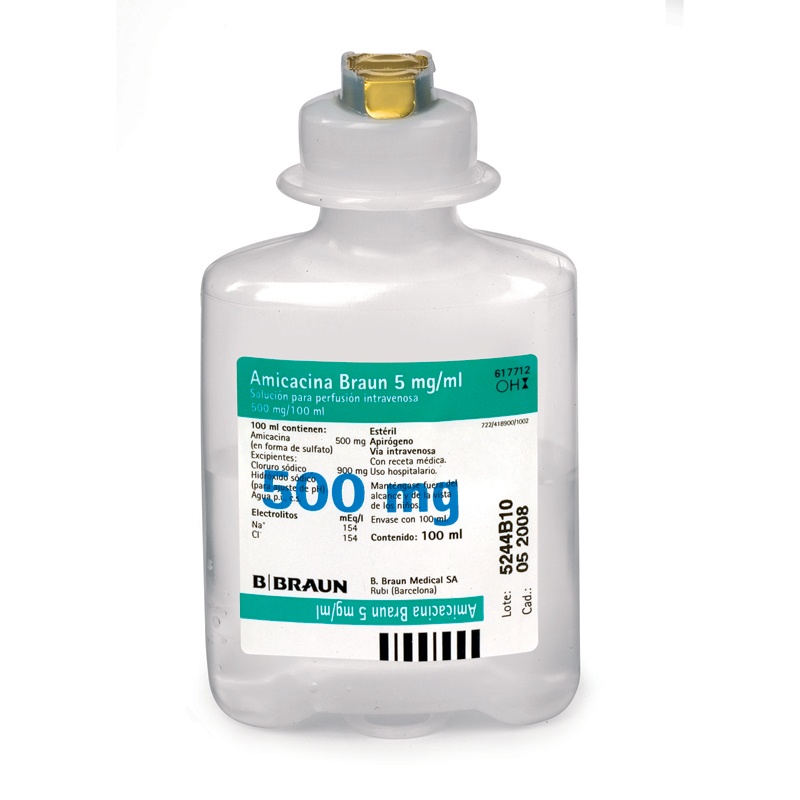
- The active ingredient is amikacin (as sulfate). Each 5 ml of solution contains 25 mg of amikacin (as sulfate). Each ml of solution contains 5 mg of amikacin (as sulfate). Each 100 ml bottle contains 500 mg of amikacin (as sulfate).
- The other components (excipients) are sodium chloride, sodium hydroxide (pH adjustment), and water for injectable preparations.
Appearance of the Product and Container Content
It is presented in containers containing 1 and 20 plastic bottles of 100 ml, packaged in a cardboard box.
Marketing Authorization Holder and Manufacturer
- Braun Medical, S.A.
Ctra. de Terrassa, 121
08191 Rubí (Barcelona)
Spain
Date of the Last Revision of this Prospectus: February 2015
Detailed information about this medication is available on the website of the Spanish Agency for Medicines and Health Products (AEMPS) (http://www.aemps.gob.es/).
----------------------------------------------------------------------------------------------
This information is intended only for doctors or healthcare professionals:
Renal and auditory nerve functions should be carefully monitored in patients with renal insufficiency when used for long periods or when administered in doses higher than recommended, as VIII cranial nerve disorders and renal function have been reported. The appearance of signs of nephrotoxicity or ototoxicity will determine a readjustment of the dosage or suspension of treatment according to the cases.
As a general rule, the usual dose in adults with normal renal function is 15 mg/kg/day, administered as a single daily dose or divided into two or three equal doses administered at equivalent intervals, i.e., 7.5 mg/kg every 12 hours or 5 mg/kg every 8 hours.
Amikacin plasma levels should be studied, adjusting the dosage to avoid prolonged levels above 35 micrograms/ml. Urine should be examined to detect increases in protein excretion, the presence of cells or cylinders, and a decrease in density.
Ototoxicity in children is not well determined.
In the event of superinfections produced by resistant microorganisms, treatment should be suspended and appropriate therapy applied.
Patients should be well-hydrated during treatment.
Amikacin B. Braun 5 mg/ml is a ready-to-use solution and therefore should not be diluted before administration. However, it can be administered simultaneously in the same intravenous line with 0.9% sodium chloride or 5% glucose solutions.
Posology and Administration Method
Before starting treatment with amikacin, it is advisable to perform an antibiogram. If the severity of the process requires it and the clinical picture allows suspicion of an infection by microorganisms sensitive to amikacin, therapy with amikacin can be initiated before knowing the result of the antibiogram (see section 4.4).
The dose and administration schedule are established according to the severity of the infection, the sensitivity of the responsible microorganism, the age, weight, and general condition of the patient. In patients with severe infections and in cases of renal insufficiency, it is advisable to monitor amikacin plasma levels.
The state of renal function should be established by determining the serum creatinine concentration or the endogenous creatinine clearance rate. The determination of blood urea nitrogen is less reliable in this case. Renal function should be monitored during treatment.
Whenever possible, amikacin serum concentrations should be determined to ensure adequate but not excessive levels. It is recommended to measure intermittent minimum and maximum serum concentrations during treatment. Maximum concentrations (30-90 minutes after injection) above 35 mg/ml and minimum concentrations (just before the next dose) above 10 mg/ml should be avoided. The dose will be adjusted as indicated.
Posology
Patient withNormal Renal Function
Patients with normal renal function can be administered a single daily dose, as long as the maximum concentration does not exceed 35 mg/ml.
Adults, Adolescents (12 to less than 18 years) and Children (2 to 11 years)
The recommended intravenous dose for adults is 15 mg/kg/day, administered as a single daily dose or divided into two or three equal doses administered at equivalent intervals, i.e., 7.5 mg/kg every 12 hours or 5 mg/kg every 8 hours. Treatment in patients with high body mass should not exceed 1.5 g/day.
Infants (28 days to 23 months)
The recommended intravenous dose in children over 2 weeks is 7.5 mg/kg every 12 hours or 5 mg/kg every 8 hours.
Neonates (0 to 27 days)
The loading dose is 10 mg/kg, followed by doses of 7.5 mg/kg every 12 hours.
Premature Infants
The recommended intravenous dose is 7.5 mg/kg every 12 hours.
Single Daily Dose
Administration in the form of a single daily dose (15 mg/kg/day) by intravenous perfusion for 60 minutes is an alternative posology in non-neutropenic adult patients and immunocompetent patients with normal renal function.
In patients with normal renal function reflected by a creatinine clearance ≥ 50 ml/min, a single daily intravenous dose of 15 mg/kg/day can be administered in adults or 20 mg/kg/day in children (from 4 weeks of age or older) for the treatment of bacteremia, sepsis, respiratory tract infections, complicated urinary tract infections, intra-abdominal infections, and in cases of febrile neutropenia. There is not enough information about the use of a single daily dose in patients with impairment of other organs or systems.
When amikacin is indicated for uncomplicated urinary tract infections, a total daily dose of 500 mg can be administered in a single dose or divided into two doses (250 mg BID).
The duration of treatment is 7-10 days. The total daily dose should not exceed 15 mg/kg/day. In difficult and complicated infections that require treatment for more than 10 days, the use of this medication should be reconsidered. If continued, it is recommended to monitor renal, auditory, and vestibular functions and amikacin serum levels.
Uncomplicated infections produced by microorganisms sensitive to amikacin should respond within 24-48 hours. If a definitive clinical response is not obtained within 3-5 days, therapy should be suspended and the sensitivity of the microorganism to the antibiotic should be reviewed. Treatment failure may be due to resistance of the microorganism or the presence of a septic focus that requires surgical drainage.
Patients with Altered Renal Function
In patients with renal insufficiency reflected by a creatinine clearance <50 ml min, the administration of amikacin in a single dose is not recommended, as these patients will have prolonged exposure to high trough concentrations. (see adjustment with renal insufficiency).< p>
In patients with renal insufficiency who receive usual daily doses divided into two or three times, whenever possible, amikacin serum concentrations should be monitored by appropriate analysis procedures. Doses can be adjusted in patients with renal insufficiency by administering normal doses at prolonged intervals or by administering reduced doses at fixed intervals.
Both possibilities are based on the patient's creatinine clearance or serum creatinine values, as a correlation has been observed between these values and the half-life of aminoglycosides in patients with decreased renal function. These dosing schemes can be used along with careful clinical and laboratory observation of the patient and should be modified when necessary, even when dialysis is to be performed.
Normal Dose at Prolonged Dosage Intervals
If the renal creatinine clearance is not available and the patient is stable, the dosage interval in hours for a single dose (i.e., given to patients with normal renal function in a BID scheme, 7.5 mg/kg) can be calculated by multiplying the creatinine value by 9. For example, if the serum creatinine value is 2 mg/100 ml, a single dose of 7.5 mg/kg would be administered every 18 hours.
Reduced Dose at Fixed Dosage Intervals
When renal function is altered and it is advisable to administer this medication at fixed intervals, the dose should be reduced. In these patients, amikacin serum concentrations should be determined to ensure exact administration and avoid excessive concentrations. If serum determinations cannot be performed and the patient is stable, serum creatinine and creatinine clearance values are the most easily available indicators of the degree of renal damage to use as a guide for dosing.
Initially, the normal dose of 7.5 mg/kg will be administered as a loading dose. This dose is the same as the normal recommended dose, which should be calculated for a patient with normal renal function, as mentioned above.
To determine the maintenance dose every 12 hours, the base dose should be reduced in proportion to the reduction in creatinine clearance:
Maintenance dose (every 12 hours):
- Observed C.C. in ml/min
- --------------------------------x loading dose (mg)
- Normal C.C. in ml/min
C.C. = creatinine clearance
An alternative approximate guide for determining the reduced dose at 12-hour intervals (for patients with known steady-state serum creatinine values) is to divide the usual recommended dose by the patient's serum creatinine value.
These dosing schemes are not intended to be strict recommendations but rather a dosing guide when it is not possible to determine amikacin serum levels.
In the event that the patient's serum creatinine value is known, the way to determine the doses is to divide the normal dose (7.5 mg/kg) by the creatinine value. These dosages are not considered strict but are recommended when it is not possible to determine amikacin serum levels.
Other Risk Populations
Elderly Patients
May require lower maintenance doses than in younger patients to achieve therapeutic plasma concentrations.
The dose should be adjusted according to body weight and renal function. In obese patients, the initial dose should be calculated based on ideal weight plus 40% of excess weight.
Patients with BurnsandPatients with Severe Infections
May require greater administration or intervals of four to six hours because, in these cases, the half-life of the drug is shorter.
Administration Method
Intravenous route. Administration by intravenous perfusion for a period of 30-60 minutes.
- Country of registration
- Dosage formINJECTABLE INFUSION, 500 mg
- ATC codeJ01GB06
- Active substance
- Prescription requiredYes
- Manufacturer
- This information is for reference only and does not constitute medical advice. Always consult a doctor before taking any medication. Oladoctor is not responsible for medical decisions based on this content.
- Alternatives to AMICACIN B BRAUN 5 mg/ml SOLUTION FOR INTRAVENOUS INFUSIONDosage form: INJECTABLE PERFUSION, 1000 mgActive substance: amikacinManufacturer: B Braun Medical S.A.Prescription requiredDosage form: INJECTABLE, 500 mgActive substance: amikacinManufacturer: B Braun Medical S.A.Prescription requiredDosage form: INJECTABLE PERFUSION, 5 mg/mlActive substance: amikacinManufacturer: Fresenius Kabi España, S.A.U.Prescription required
Online doctors for AMICACIN B BRAUN 5 mg/ml SOLUTION FOR INTRAVENOUS INFUSION
Discuss questions about AMICACIN B BRAUN 5 mg/ml SOLUTION FOR INTRAVENOUS INFUSION, including use, safety considerations and prescription review, subject to medical assessment and local regulations.











Get AMICACIN B BRAUN 5 mg/ml SOLUTION FOR INTRAVENOUS INFUSION Prescription Online
Fill in a 2-min form
Tell us your symptoms, history, and what medicine you're requesting.
Pick a doctor or let us assign
Choose a specialist or we'll match you with the next available doctor.
Doctor reviews your case
Usually within 30 minutes. They may ask follow-up questions via chat.
Collect from any pharmacy
Electronic prescription sent to your email — valid across Spain.
Frequently Asked Questions
