


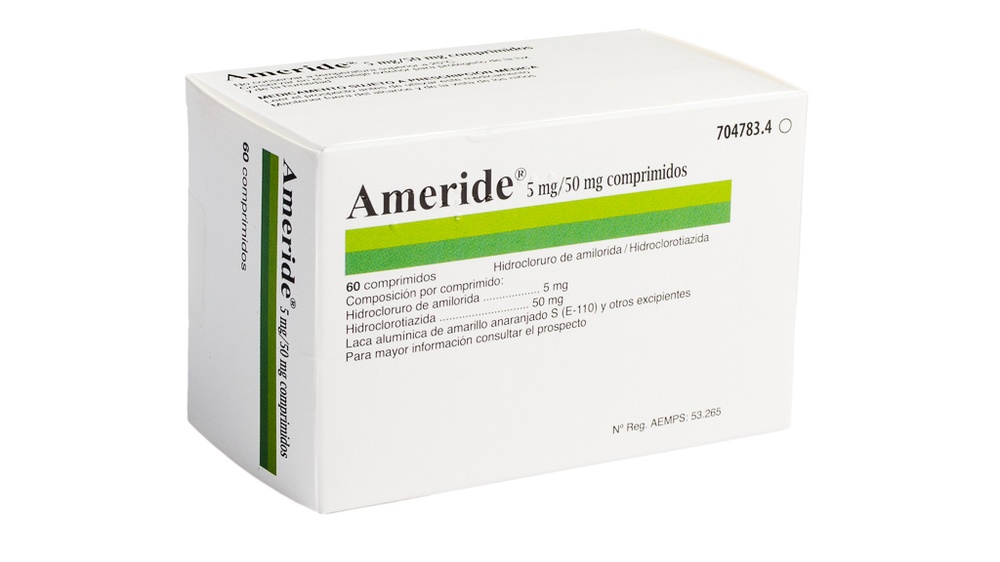
Ameride 5 mg/50 mg comprimidos

Solicitud de receta online
Un médico revisará tu caso y determinará si la prescripción es médicamente apropiada.

Habla con un médico sobre este medicamento
Comenta tus síntomas y las opciones de tratamiento en una consulta online.



Cómo usar AMERIDE 5 mg/50 mg COMPRIMIDOS
Contenido del prospecto
- Introducción
- Qué es Ameride y para qué se utiliza
- Qué necesita saber antes de empezar a tomar Ameride
- Cómo tomar Ameride
- Posibles efectos adversos
- Conservación de Ameride
- Contenido del envase e información adicional
Introducción
Prospecto: información para el usuario
Ameride 5 mg/50 mg comprimidos
amilorida hidrocloruro/hidroclorotiazida
Lea todo el prospecto detenidamente antes de empezar a tomar este medicamento, porque contiene información importante para usted.
- Conserve este prospecto, ya que puede tener que volver a leerlo.
- Si tiene alguna duda, consulte a su médico, farmacéutico o enfermero.
- Este medicamento se le ha recetado solamente a usted, y no debe dárselo a otras personas aunque tengan los mismos síntomas que usted, ya que puede perjudicarles.
- Si experimenta efectos adversos, consulte a su médico, farmacéutico o enfermero, incluso si se trata de efectos adversos que no aparecen en este prospecto. Ver sección 4.
Contenido del prospecto:
- Qué es Ameride y para qué se utiliza
- Qué necesita saber antes de empezar a tomar Ameride
- Cómo tomar Ameride
- Posibles efectos adversos
- Conservación de Ameride
- Contenido del envase e información adicional
1. Qué es Ameride y para qué se utiliza
El componente amilorida del Ameride pertenece al grupo de medicamentos llamados antikaliuréticos (ahorradores de potasio): amilorida es también un débil diurético. El componente hidroclorotiazida del Ameride pertenece al grupo de medicamentos llamados diuréticos (tiazidas).
Ameride actúa haciendo que los riñones eliminen más agua y sales y retengan más potasio.
Esto ayuda a reducir la hipertensión y algunas formas de edema, mientras que al mismo tiempo ayuda al mantenimiento de los niveles normales de potasio en sangre.
Ameride está indicado para el tratamiento de la hipertensión (tensión arterial alta), en especial en pacientes que presentan niveles bajos de potasio; edema de origen cardiaco (hinchazón de tobillos, pies o piernas, debido a retención de agua); o ascitis (acumulación de agua en el abdomen) debida a cirrosis (enfermedad del hígado).

¿No estás seguro de si este medicamento es adecuado para ti?
Comenta tus síntomas y tratamiento con un médico online.
2. Qué necesita saber antes de empezar a tomar Ameride
No tome Ameride
- si es alérgico al hidrocloruro de amilorida, a la hidroclorotiazida o a alguno de los demás componentes de este medicamento (incluidos en la sección 6).
- si es alérgico a algún medicamento derivado de las sulfonamidas (consulte a su médico si no está seguro de qué medicamentos son derivados de las sulfonamidas).
- si por naturaleza tiene elevados niveles de potasio en sangre.
- si está tomando otros medicamentos o suplementos que incrementan la cantidad de potasio en sangre.
- si tiene enfermedad de los riñones.
Consulte a su médico si no está seguro si debe empezar a tomar este medicamento.
Advertencias y precauciones
Consulte a su médico, farmacéutico o enfermero antes de empezar a tomar Ameride:
- si usted padece o ha padecido algún problema médico o cualquier alergia informe a su médico.
- informe a su médico si tiene niveles elevados de potasio en plasma. Informe a su médico si tiene alguna enfermedad del corazón o de los pulmones, problemas de hígado o de los riñones, gota o lupus eritematoso (enfermedad de tipo autoinmune), o si está siendo tratado con otros diuréticos. En tales casos, su médico podría modificar la dosis de sus medicaciones.
- si tiene diabetes (niveles altos de azúcar en la sangre), consulte a su médico, ya que el tratamiento con tiazidas puede requerir un ajuste de la dosis de los antidiabéticos, incluida la insulina.
- antes de intervenciones quirúrgicas o anestesia (incluso en el dentista) informe al médico o dentista que está tomando Ameride, ya que puede producirse un descenso repentino de la presión sanguínea asociado a la anestesia.
- si ha tenido cáncer de piel o si le aparece una lesión de la piel inesperada durante el tratamiento consulte a su médico. El tratamiento con hidroclorotiazida, en particular su uso a largo plazo a dosis altas, puede aumentar el riesgo de algunos tipos de cáncer de piel y labios (cáncer de piel no- melanoma). Proteja la piel de la exposición al sol y a los rayos UV mientras esté tomando Ameride.
- si experimenta una disminución de la visión o dolor ocular, podrían ser síntomas de acumulación de líquido en la capa vascular del ojo (derrame coroideo) o un aumento de la presión en el ojo y se pueden producir en un plazo de entre unas horas y una semana después de tomar Ameride. Si no se trata, esto puede llevar a la pérdida permanente de la visión. Si ha tenido anteriormente una reacción alérgica a la penicilina o a una sulfonamida puede tener mayor riesgo de desarrollar esto.
- si ha tenido problemas respiratorios o pulmonares (como inflamación o líquido en los pulmones) tras la toma de hidroclorotiazida en el pasado. Si presenta disnea o dificultad para respirar grave después de tomar Ameride, acuda al médico inmediatamente.
Niños y adolescentes
No ha sido establecida la seguridad y eficacia en niños, por lo tanto no se recomienda la administración en menores.
Consulte a su médico, incluso si cualquiera de las circunstancias anteriormente mencionadas le hubiera ocurrido alguna vez.
Otros medicamentos y Ameride
Informe a su médico o farmacéutico si está tomando, ha tomado recientemente o pudiera tener que tomar cualquier otro medicamento, incluso los adquiridos sin receta.
En general se puede tomar Ameride con otros medicamentos. No obstante, es importante informar al médico de cualquier otro medicamento que esté tomando, incluidos aquellos sin receta, ya que algunos medicamentos pueden comprometer la acción de otros.
Es especialmente importante que su médico sepa si está tomando algún inhibidor de la ECA (utilizados para tratar la tensión arterial alta), otros medicamentos ahorradores de potasio o suplementos de potasio. Informe también a su médico si está tomando otros medicamentos antihipertensivos, otros diuréticos, resinas que reducen los niveles altos de colesterol, antidiabéticos incluida la insulina, relajantes musculares, aminas presoras como la adrenalina (medicamentos utilizados en caso de parada cardiaca o reacciones alérgicas graves), esteroides, ciertos analgésicos y antiinflamatorios, medicamentos que disminuyen la acción de las defensas del organismo (ciclosporina, tacrolimus) o litio (medicamento usado en algunos tipos de depresión). El uso de sedantes, narcóticos, tranquilizantes, alcohol y analgésicos puede aumentar el efecto antihipertensivo de Ameride, por lo que debe informar al médico si toma alguno de ellos.
Toma de Ameride con alimentos y bebidas
Informe a su médico si toma suplementos de potasio o ingiere una dieta rica en potasio.
Embarazo y lactancia
Si está embarazada o en periodo de lactancia, cree que podría estar embarazada o tiene intención de quedarse embarazada, consulte a su médico o farmacéutico antes de utilizar este medicamento.
El uso de Ameride no se recomienda durante el embarazo.
El componente hidroclorotiazida de Ameride pasa a la leche materna. En caso de ser imprescindible el tratamiento con este medicamento, la lactancia debe ser interrumpida.
Conducción y uso de máquinas
No se dispone de datos de los efectos sobre la capacidad para conducir y utilizar máquinas.
Uso en deportistas
Se informa a los deportistas que este medicamento contiene un componente que puede establecer un resultado analítico de control del dopaje como positivo.
Ameride contiene amarillo anaranjado y lactosa
Este medicamento puede producir reacciones alérgicas porque contiene amarillo anaranjado S (E-110). Puede provocar asma, especialmente en pacientes alérgicos al ácido acetilsalicílico.
Este medicamento contiene lactosa. Si su médico le ha indicado que padece una intolerancia a ciertos azúcares, consulte con él antes de tomar este medicamento.
3. Cómo tomar Ameride
Siga exactamente las instrucciones de administración de este medicamento indicadas por su médico o farmacéutico. En caso de duda, consulte de nuevo a su médico o farmacéutico.
El médico decidirá la dosis conveniente, según la condición del enfermo y si está o no tomando otros medicamentos.
La mayoría de las personas toman los comprimidos con un poco de agua.
Tome Ameride a diario. No ingiera más comprimidos de la dosis recetada.
Siga estas instrucciones a menos que su médico le haya dado otras indicaciones distintas.
Recuerde tomar su medicamento.
- Edema de origen cardiaco
La dosis inicial habitual es un comprimido de Ameride al día.
- Hipertensión
La dosis inicial habitual es de un comprimido de Ameride tomado una vez al día o dividido en dos dosis.
- Cirrosis con ascitis
La dosis habitual es un comprimido de Ameride tomado una vez al día.
Esta dosis puede ser aumentada por su médico si es necesario, sin exceder de dos comprimidos al día. En algunos pacientes, el tratamiento de mantenimiento puede ser controlado con pautas posológicas intermitentes si su médico así se lo indica.
Los comprimidos pueden dividirse para facilitar el ajuste de la dosis si su médico así se lo indica.
Si estima que la acción de Ameride es demasiado fuerte o débil, comuníqueselo a su médico o farmacéutico.
Su médico le indicará la duración de su tratamiento con Ameride. No suspenda el tratamiento antes, ya que sólo su médico sabe lo que le conviene.
Uso en niños
No ha sido establecida la seguridad y eficacia en niños, por lo tanto, no se recomienda la administración en menores.
Si toma más Ameride del que debe
En caso de sobredosis, llame al médico inmediatamente. Los síntomas más probables serán una sensación de aturdimiento o mareo, debido al descenso de la presión sanguínea y/o sed excesiva, confusión, reducción del volumen de orina o palpitaciones rápidas (latidos del corazón fuertes y rápidos).
En caso de sobredosis o ingestión accidental, consulte al Servicio de Información Toxicológica. Teléfono: 91 562 04 20.
Si olvidó tomar Ameride
No tome una dosis doble para compensar las dosis olvidadas.
Si interrumpe el tratamiento con Ameride
No deje de tomar este medicamento sin consultar con su médico.
Si tiene cualquier otra duda sobre el uso de este medicamento, pregunte a su médico, farmacéutico o enfermero.

¿Has empezado a tomar el medicamento y tienes preguntas?
Comenta tus síntomas y tratamiento con un médico online.
4. Posibles efectos adversos
Al igual que todos los medicamentos, este medicamento puede producir efectos adversos, aunque no todas las personas los sufran.
Trastornos del sistema inmunológico:reacción anafiláctica.
Trastornos de la sangre y del sistema linfático:alteraciones en el recuento de las células de la sangre, manchas rojas en la piel.
Trastornos del metabolismo y de la nutrición:más frecuentemente: anorexia (pérdida de apetito); puede producir cambios en su análisis de sangre relativos al recuento de sodio, potasio, glucosa y ácido úrico. También puede aumentar los niveles de glucosa en orina. Gota, deshidratación.
Trastornos psiquiátricos:falta de sueño, nerviosismo, confusión mental, depresión, sensación de sueño, agitación, reducción del deseo sexual.
Trastornos del sistema nervioso:dolor de cabeza*, mareos*; desvanecimientos, vértigo, sensación de hormigueo, estupor, temblores, enfermedad del cerebro, mal sabor de boca.
Trastornos oculares:disminución de la visión o dolor en los ojos debido a una presión elevada [signos posibles de acumulación de líquido en la capa vascular del ojo (derrame coroideo) o glaucoma agudo de ángulo cerrado], alteraciones de la visión, hipertensión ocular (aumento de la tensión dentro del ojo).
Trastornos del oído y del laberinto:zumbidos en los oídos.
Trastornos cardíacos:arritmia (alteración de la frecuencia del corazón), taquicardia (aumento de la frecuencia del corazón), dolor en el pecho y palpitaciones (latidos del corazón fuertes y rápidos).
Trastornos vasculares:hipotensión ortostática (sensación de mareo o aturdimiento debida al descenso de la presión sanguínea al ponerse de pie súbitamente) y otras anomalías del corazón.
Trastornos respiratorios, torácicos y mediastínicos:tos, trastornos respiratorios, dolor de pecho, dificultad en la respiración, congestión nasal.
Trastornos gastrointestinales:más frecuentemente: náuseas; vómitos, diarrea, estreñimiento, dolor abdominal, sangrado gastrointestinal, alteraciones del apetito, pesadez abdominal, flatulencia (gases), sed, hipo, mal sabor de boca, sequedad de boca, calambres, digestión difícil, inflamación del páncreas, dolor y/o úlcera de estómago.
Trastornos hepatobiliares:puede producir cambios en su análisis de sangre relativo a los enzimas del hígado y bilirrubina.
Trastornos de la piel y del tejido subcutáneo:más frecuentemente: erupción cutánea; picor, enrojecimiento, sudoración, caída del pelo, sensibilidad a la luz, inflamación de las glándulas salivares, aparición de ampollas, necrólisis epidérmica tóxica (reacción grave de la piel que se caracteriza por la aparición de ampollas).
Frecuencia no conocida: Cáncer de piel y labios (cáncer de piel no-melanoma).
Trastornos musculoesqueléticos y del tejido conjuntivo:dolor de extremidades, calambres musculares, dolor de las articulaciones, dolor de espalda, dolor de cuello y hombros.
Trastornos renales y urinarios:alteraciones de la micción, disfunción renal incluyendo fallo de los riñones, inflamación de los riñones.
Trastornos del sistema reproductor y de la mama:impotencia.
Trastornos generales y alteraciones en el lugar de administración:fatiga, malestar, debilidad, reacción alérgica, fiebre.
Muy raros: Dificultad respiratoria aguda (los signos incluyen dificultad respiratoria grave, fiebre, debilidad y confusión).
Cuando aparecen efectos adversos su médico le puede reducir la dosis de Ameride o interrumpir el tratamiento.
Comunicación de efectos adversos
Si experimenta cualquier tipo de efecto adverso, consulte a su médico, farmacéutico o enfermero, incluso si se trata de efectos adversos que no aparecen en este prospecto. También puede comunicarlos directamente a través del Sistema Español de Farmacovigilancia de Medicamentos de Uso Humano: www.notificaRAM.es. Mediante la comunicación de efectos adversos usted puede contribuir a proporcionar más información sobre la seguridad de este medicamento.
5. Conservación de Ameride
Mantener este medicamento fuera de la vista y del alcance de los niños.
No conservar a temperatura superior a 25 ºC.
Conservar en el embalaje exterior para protegerlo de la luz y de la humedad.
No utilice este medicamento después de la fecha de caducidad que aparece en el envase después de CAD. La fecha de caducidad es el último día del mes que se indica.
Los medicamentos no se deben tirar por los desagües ni a la basura. Pregunte a su farmacéutico cómo deshacerse de los envases y de los medicamentos que ya no necesita. Deposite los envases y los medicamentos que no necesita en el Punto SIGRE de la farmacia.. De esta forma, ayudará a proteger el medio ambiente.
6. Contenido del envase e información adicional
Composición de Ameride
- Los principios activos son hidrocloruro de amilorida e hidroclorotiazida. Cada comprimido ranurado contiene 5 mg de hidrocloruro de amilorida y 50 mg de hidroclorotiazida.
- Los demás componentes son: lactosa monohidrato, hidrogenofosfato de calcio dihidrato, almidón de maíz, almidón pregelatinizado, goma guar, estearato de magnesio, laca alumínica de amarillo anaranjado S (E-110).
Aspecto del producto y contenido del envase
Ameride se presenta en forma de comprimidos ranurados, en blíster, en envases de 20 y 60 comprimidos. Los comprimidos son de color melocotón, grabados con “AMERIDE” en una cara y ranurados en la otra.
Titular de la autorización de comercialización y responsable de la fabricación
Titular de la autorización de comercialización
PAN QUÍMICA-FARMACÉUTICA, S.A.
Rufino González, 50
28037 Madrid
España
Responsable de la fabricación
ROVI Pharma Industrial Services, S.A.
Vía Complutense, 140
Alcalá de Henares 28805 – Madrid
(España)
Representante local
Laboratorios Farmacéuticos ROVI, S.A.
Julián Camarillo, 35
28037 Madrid
España
Fecha de la última revisión de este prospecto: Febrero 2022
Otras fuentes de información
La información detallada de este medicamento está disponible en la página Web de la Agencia Española de Medicamentos y Productos Sanitarios (AEMPS) http://www.aemps.gob.es/
- País de registro
- Forma farmacéuticaCOMPRIMIDO, 5/50 mg/mg
- Código ATCC03EA01
- Precio medio en farmacia2.5 EUR
- Principio activo
- Requiere recetaSí
- Fabricante
- ComposiciónLACTOSA MONOHIDRATO (71,0 mg mg), AMARILLO ANARANJADO S (E 110, CI=15985) (0,158 mg mg)
- Esta información es de carácter general y no sustituye la consulta con un profesional sanitario.
- Alternativas a AMERIDE 5 mg/50 mg COMPRIMIDOSForma farmacéutica: COMPRIMIDO, 50/5 mg/mgPrincipio activo: hydrochlorothiazide and potassium-sparing agentsFabricante: Teofarma S.R.L.Requiere recetaForma farmacéutica: COMPRIMIDO, 25 mg espironolactona/15 mg altizidaPrincipio activo: altizide and potassium-sparing agentsFabricante: Pfizer S.L.Requiere recetaForma farmacéutica: COMPRIMIDO, 50 mg espironolactona; 50 mg clortalidonaPrincipio activo: chlortalidone and potassium-sparing agentsFabricante: Teofarma S.R.L.Requiere receta
Médicos online para AMERIDE 5 mg/50 mg COMPRIMIDOS
Comenta la dosis, los posibles efectos secundarios, interacciones, contraindicaciones o si una receta es apropiada para AMERIDE 5 mg/50 mg COMPRIMIDOS, sujeto a valoración médica y a la normativa local.
Preguntas frecuentes
AMERIDE 5 mg/50 mg COMPRIMIDOS requiere receta en España. Puedes confirmarlo con un médico online según tu caso.
El principio activo de AMERIDE 5 mg/50 mg COMPRIMIDOS es hydrochlorothiazide and potassium-sparing agents. Esta información ayuda a identificar medicamentos con la misma composición pero con diferentes nombres comerciales.
El precio medio en farmacia de AMERIDE 5 mg/50 mg COMPRIMIDOS es de aproximadamente 2.5 EUR. Puede variar según el fabricante y la forma farmacéutica.
AMERIDE 5 mg/50 mg COMPRIMIDOS es fabricado por Pan Quimica Farmaceutica S.A.. La marca y el envase pueden variar según el distribuidor.
Los Médicos de familia, Psiquiatras, Dermatólogos, Cardiólogos, Endocrinólogos, Gastroenterólogos, Neumólogos, Nefrólogos, Reumatólogos, Hematólogos, Infectólogos, Alergólogos, Geriatras, Pediatras, Oncólogos pueden valorar la prescripción de AMERIDE 5 mg/50 mg COMPRIMIDOS cuando esté clínicamente indicado. Puedes reservar una videoconsulta para comentar tu caso y las opciones de tratamiento.
La receta la emite un médico tras valorar tu estado de salud. En España, AMERIDE 5 mg/50 mg COMPRIMIDOS se dispensa en las farmacias con esa receta médica. Una consulta online no garantiza su emisión: la decisión corresponde siempre al médico.
Para solicitar una valoración puedes usar Oladoctor:
Otros medicamentos con el mismo principio activo (hydrochlorothiazide and potassium-sparing agents) incluyen DIUZINE 5 mg/50 mg COMPRIMIDOS, ALDACTACINE 25 mg/15 mg COMPRIMIDOS, ALDOLEO 50 MG/50 MG COMPRIMIDOS. Pueden tener diferentes nombres comerciales o formulaciones, pero contienen el mismo componente terapéutico. Consulta siempre con un médico antes de cambiar o iniciar un nuevo medicamento.
