



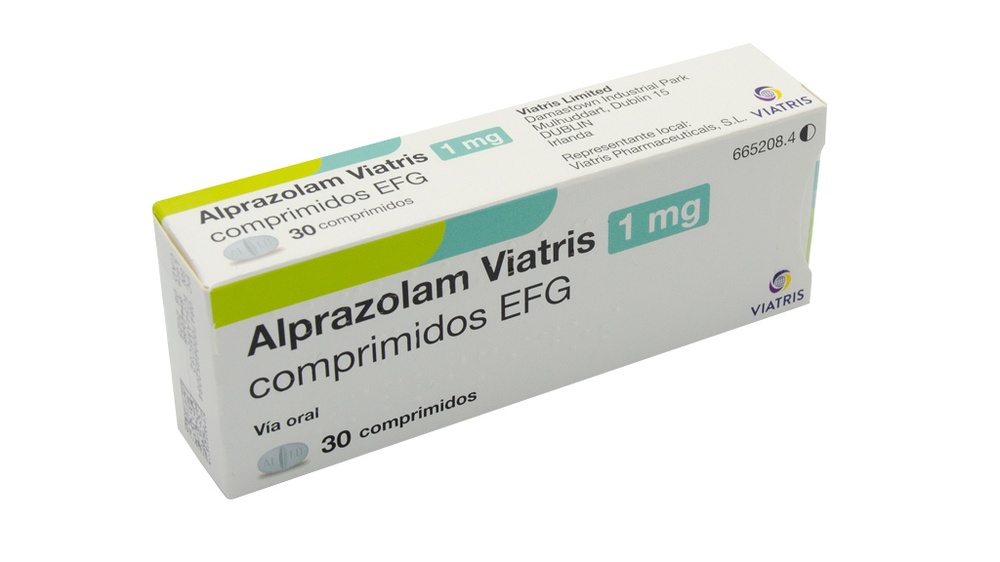
ALPRAZOLAM VIATRIS 1 mg Comprimidos

Revisión de receta online
Un médico revisará tu caso y determinará si la prescripción es médicamente apropiada.

Habla con un médico sobre este medicamento
Comenta tus síntomas y las opciones de tratamiento en una consulta online.



Cómo usar ALPRAZOLAM VIATRIS 1 MG COMPRIMIDOS EFG
Contenido del prospecto
- Introducción
- Qué es Alprazolam Viatris y para qué se utiliza
- Qué necesita saber antes de empezar a tomar Alprazolam Viatris
- Cómo tomar Alprazolam Viatris
- Posibles efectos adversos
- Conservación de Alprazolam Viatris
- Contenido del envase e información adicional
Introducción
Prospecto: información para el paciente
Alprazolam Viatris 1 mg comprimidos EFG
Lea todo el prospecto detenidamente antes de empezar a tomar este medicamento, porque contiene información importante para usted.
- Conserve este prospecto, ya que puede tener que volver a leerlo.
- Si tiene alguna duda, consulte a su médico o farmacéutico.
- Este medicamento se le ha recetado solamente a usted, y no debe dárselo a otras personas aunque tengan los mismos síntomas que usted, ya que puede perjudicarles.
- Si experimenta efectos adversos, consulte a su médico o farmacéutico, incluso si se trata de efectos adversos que no aparecen en este prospecto. Ver sección 4.
Contenido del prospecto
- Qué es Alprazolam Viatris y para qué se utiliza
- Qué necesita saber antes de empezar a tomar Alprazolam Viatris
- Cómo tomar Alprazolam Viatris
- Posibles efectos adversos
- Conservación de Alprazolam Viatris
- Contenido del envase e información adicional
1. Qué es Alprazolam Viatris y para qué se utiliza
Los comprimidos contienen alprazolam, que pertenece al grupo de medicamentos denominados benzodiazepinas.
Se cree que alprazolam puede incrementar la acción de una sustancia natural, llamada GABA, en el cerebro. Alprazolam se usa para el tratamiento a corto plazo del trastorno grave de ansiedad.
Alprazolam solo debe utilizarse a corto plazo, ya que puede ocasionar dependencia.

¿No estás seguro de si este medicamento es adecuado para ti?
Comenta tus síntomas y tratamiento con un médico online.
2. Qué necesita saber antes de empezar a tomar Alprazolam Viatris
No tomeAlprazolam Viatris:
- Si es alérgico a alprazolam o a cualquiera de los demás componentes de este medicamento (incluidos en la sección 6).
- Si padece una enfermedad llamada miastenia gravis que se caracteriza por debilidad muscular.
- Si padece graves dificultades respiratorias o enfermedades del pulmón.
- Si padece apnea del sueño (respiración irregular mientras duerme).
- Si tiene alteraciones graves del hígado.
- Si padece alcoholismo o adicción a las drogas.
- Si está tomando otra medicación con acción conocida sobre el sistema nervioso central (por ejemplo benzodiazepinas, neurolépticos).
- Si padece glaucoma.
Advertencias y precauciones
Consulte a su médico o farmacéutico antes de empezar a tomar Alprazolam Viatris:
- Si tiene problemas de pulmón a largo plazo, problemas de hígado leves o moderados o de riñón.
- Si padece depresión o ansiedad asociada a depresión, ya que alprazolam puede aumentar cualquier sentimiento suicida que pueda tener.
- Si está tomando cualquier otro medicamento para la ansiedad o insomnio.
- Si tiene antecedentes de alcoholismo, drogadicción o le resulta difícil dejar de tomar medicamentos, de beber o de consumir drogas. Su médico puede ayudarle a dejar de tomar este medicamento.
- Si padece trastornos de la personalidad.
- Si es un paciente de edad avanzada, ya que alprazolam puede causar somnolencia o debilidad muscular que, a su vez, pueden ocasionar caídas, a menudo con consecuencias graves en esta población.
Puede experimentar pérdida temporal de la memoria mientras esté tomando este medicamento. Para reducir el riesgo, debe procurar dormir durante toda la noche (7-8 horas) mientras esté tomando este medicamento.
Alprazolam ha sido asociado con reacciones poco comunes tales como inquietud, agitación, irritabilidad, agresividad, confusión, ataques de ira, pesadillas, alucinaciones (ver o escuchar cosas que no existen), psicosis (pérdida de contacto con la realidad) y conducta inadecuada. Si nota cualquiera de estos cambios en su comportamiento mientras esté tomando este medicamento, por favor póngase en contacto con su médico, ya que deberá parar el tratamiento.
Niños y adolescentes
Alprazolam no está recomendado en niños y adolescentes menores de 18 años.
Otros medicamentos y Alprazolam Viatris
Comunique a su médico o farmacéutico si está tomando, ha tomado recientemente o podría tener que tomar cualquier otro medicamento, incluso los adquiridos sin receta. Es especialmente importante que le comunique a su médico si está tomando cualquiera de los siguientes medicamentos:
- Antipsicóticos (medicamentos utilizados para tratar problemas mentales) como haloperidol y clorpromazina, hipnóticos (medicamentos utilizados para inducir el sueño) como fenobarbital y zolpidem, sedantes (medicamentos utilizados para tratar la ansiedad) como diazepam y lorazepam, analgésicos narcóticos (medicamentos para tratar el dolor) como propoxifeno, antitusivos (medicamentos para tratar la tos) como dextrometorfano y codeína, medicamentos como la metadona (que puede ser utilizado para el alivio del dolor o como ayuda a la adicción de opiáceos), anestésicos (medicamentos utilizados en la anestesia) como halotano y bupivacaína o algunos antidepresivos, ya que estos también pueden aumentar los efectos de alprazolam.
- Clozapina (un medicamento utilizado para tratar enfermedades mentales como la esquizofrenia). Este medicamento puede aumentar la cantidad de alprazolam en sangre.
- Medicamentos conocidos como Inhibidores Selectivos de la Recaptación de Serotonina (ISRS), utilizados para tratar la depresión (por ejemplo, fluoxetina y sertralina).
- Medicamentos para tratar la epilepsia (por ejemplo, fenitoína y carbamazepina).
- Medicamentos para la alergia (antihistamínicos como cetirizina y ciclizina).
- Medicamentos para tratar infecciones por hongos (por ejemplo, ketoconazol, itraconazol, posaconazol, voriconazol y otros derivados azoicos).
- Cimetidina (para tratar úlceras de estómago), nefazodona (para tratar la depresión) o fluvoxamina (para tratar el Trastorno obsesivo-compulsivo, TOC), ya que su dosis de alprazolam puede tener que ajustarse.
- Imipramina o desipramina, medicamentos conocidos como antidepresivos tricíclicos (ATC), utilizados para tratar la depresión, ya que su dosis de estos medicamentos puede tener que ajustarse.
- Anticonceptivos orales (la “píldora”).
- Diltiazem (usado para tratar angina de pecho y tensión alta).
- Determinados antibióticos (por ejemplo, eritromicina, claritromicina, telitromicina, troleandomicina y rifampicina).
- Medicamentos conocidos como Inhibidores de proteasas utilizados para tratar VIH (por ejemplo, ritonavir).
- Digoxina (un medicamento utilizado para el tratamiento de las enfermedades del corazón). Se puede intoxicar con digoxina (los signos de la intoxicación son: latidos irregulares del corazón, confusión, delirio, trastornos de la visión, dolor de cabeza, dolor abdominal, náuseas y vómitos) mientras esté tomando digoxina con este medicamento.
El uso concomitante de este medicamento y opioides (analgésicos fuertes, medicamentos para la terapia de substitución y algunos medicamentos para la tos) aumenta el riesgo de somnolencia, dificultades al respirar (depresión respiratoria), coma y puede ser potencialmente mortal. Se han registrado muertes. Debido a esto, el uso concomitante solo se debe considerar cuando no sean posibles otras opciones de tratamiento.
No obstante, si su médico le prescribe comprimidos Alprazolam Viatris junto con opioides, el médico debe limitar la dosis y la duración del tratamiento concomitante.
Informe a su médico de todos los opioides que esté tomando y siga cuidadosamente la recomendación de dosis de su médico. Puede ser de ayuda informar a sus amigos o familiares para que estén al tanto de los signos y síntomas anteriormente descritos. Póngase en contacto con su médico si experimenta dichos síntomas.
Si va a ser sometido a una operación en la que le vayan a suministrar anestesia general, comuníquele a su médico que está tomando alprazolam.
Toma deAlprazolam Viatriscon bebidas y alcohol
No beba alcohol mientras está tomando alprazolam, el alcohol aumenta los efectos de este medicamento y por tanto debería evitarse. No beba, excesivamente, grandes cantidades de zumo uva mientras esté tomando este medicamento, ya que puede aumentar la cantidad de alprazolam en sangre.
Embarazo y lactancia
Si está embarazada o en periodo de lactancia, cree que podría estar embarazada o tiene intención de quedarse embarazada, consulte a su médico o farmacéutico antes de utilizar este medicamento. No tomealprazolam si está embarazada a menos que usted y su médico hayan evaluado los riesgos y beneficios implicados.
Si toma alprazolam regularmente durante los 3 últimos meses de embarazo, su bebé podría desarrollar una dependencia a alprazolam y estar en riesgo de sufrir síntomas de síndrome de abstinencia después de su nacimiento.
Si su médico ha decidido que debe tomar este medicamento al final del embarazo o durante el parto, su bebé podría sufrir una bajada de temperatura corporal, flacidez, dificultades respiratorias y de alimentación, temblores, aumento de la excitabilidad y agitación.
No debe tomar alprazolam si está en periodo de lactancia ya que el medicamento puede pasar a la leche materna.
Conducción y uso de máquinas
No conduzca o maneje maquinaria después de tomar alprazolam porque puede perder la concentración o el control muscular, pérdida de memoria, tener vértigo, sentirse adormecido o mareado.
Alprazolam Viatris contiene lactosa
Alprazolam Viatris contiene lactosa. Si su médico le ha diagnosticado que sufre intolerancia a algunos azúcares acuda a su médico antes de tomar alprazolam.
Alprazolam Viatris contiene sodio
Este medicamento contiene menos de 1 mmol de sodio (23 mg) por comprimido, es decir, esencialmente “exento de sodio”.
Alprazolam Viatris contiene benzoato de sodio
Este medicamento contiene 0,1 mg de benzoato de sodio en cada comprimido.
El benzoato de sodio puede aumentar la ictericia (coloración amarillenta de la piel y de los ojos) en los recién nacidos (hasta 4 semanas de edad).
3. Cómo tomar Alprazolam Viatris
Siga exactamente las instrucciones de administración de este medicamento indicadas por su médico o farmacéutico. En caso de duda, consulte de nuevo a su médico o farmacéutico.
Adultos (mayores de 18 años)
La dosis recomendada está entre 0,25 mg y 0,5 mg tres veces al día.
Si es necesario, su médico puede decidir aumentar su dosis hasta un máximo de 3 mg por día. Consulte a su médico o farmacéutico si tiene dudas. El aumento de la dosis debe hacerse con precaución y debería aumentarse la dosis de la noche antes que la dosis de día.
Si nunca antes ha tomado este tipo de medicamentos o tiene un historial de alcoholismo podría ser necesaria una dosis más baja.
Pacientes de edad avanzada
La dosis recomendada en pacientes de edad avanzada es de 0,25 mg dos o tres veces al día. Si está bien físicamente y fuese necesario, su médico podría decidir aumentar la dosis 0,5 mg cada 3 días hasta un máximo de 1,5 mg al día. Los pacientes débiles de edad avanzada no deben tomar más de 0,75 mg al día.
Los comprimidos de Alprazolam Viatris deben tomarse vía oral. La ranura sirve únicamente para partir el comprimido si le resulta difícil tragarlo entero.
Pacientes con problemas de hígado o riñón
Si usted tiene problemas de hígado o riñón, su médico puede recomendarle tomar una dosis menor de la habitual. La dosis máxima recomendada para los pacientes con problemas de hígado o riñón es 0,75 mg a 1,5 mg al día.
Duración del tratamiento
Alprazolam Viatris no debe tomarse durante más tiempo del establecido por su médico y generalmente no deberá exceder las 8-12 semanas. Esto es debido a que tomar alprazolam durante demasiado tiempo y a dosis demasiado elevadas puede llevar a una dependencia física y mental de esta sustancia.
Si toma más Alprazolam Viatris del que debe
En caso de sobredosis o ingesta accidental, contacte inmediatamente a su médico o a su farmacéutico o llame al Servicio de Información Toxicológica. Teléfono 91 562 04 20 indicando el medicamento y la cantidad ingerida.
Se recomienda llevar el envase y el prospecto del medicamento al profesional sanitario. Los síntomas de una sobredosis incluyen somnolencia, confusión, falta de coordinación o movimientos involuntarios, dificultad respiratoria, disminución de la presión arterial, cansancio, pérdida de la conciencia y muy raramente la muerte.
Si olvidó tomar Alprazolam Viatris
No tome una dosis doble para compensar las dosis olvidadas, espere a la siguiente dosis.
Si interrumpe el tratamiento con Alprazolam Viatris
Se recomienda en general no interrumpir la medicación bruscamente, sino reducir gradualmente la dosis, de acuerdo siempre a las instrucciones del médico.
Al cesar la administración pueden aparecer efectos adversos como ansiedad, inquietud, convulsiones, dolores de cabeza, dolor muscular, tensión, confusión, irritabilidad, movimientos involuntarios y puede que tenga problemas para dormir. En casos extremos, esto también puede incluir síntomas como la falta de conciencia de sí mismo, pérdida de contacto con la realidad, aumento de la sensibilidad a la luz, al sonido y al contacto físico, sensación de entumecimiento u hormigueo en las extremidades, ver o escuchar cosas que no son reales, convulsiones, espasmos estomacales, calambres musculares, vómitos, sudoración y agitación.
Consulte inmediatamente a su médico si sufre cualquiera de estos síntomas o cambios en el estado de ánimo.
Si tiene cualquier otra duda sobre el uso de este medicamento, pregunte a su médico o farmacéutico.

¿Has empezado a tomar el medicamento y tienes preguntas?
Comenta tus síntomas y tratamiento con un médico online.
4. Posibles efectos adversos
Al igual que todos los medicamentos, este medicamento puede producir efectos adversos, aunque no todas las personas los sufran.
Se ha detectado comportamiento dañino u hostil en personas con un historial de violencia, trastorno límite de la personalidad, historial de alcoholismo y en personas que han tomado medicamentos que afectan al Sistema Nervioso Central. Si sufre trastorno de estrés post-traumático, parar el tratamiento con alprazolam podría causarle irritabilidad, hostilidad e ideas y pensamientos desagradables.
Algunos de los efectos adversos más comunes se observan al inicio del tratamiento. Generalmente estos efectos adversos desaparecen durante el tratamiento.
Comunique inmediatamente a su médicosi experimenta cualquiera de los siguientes efectos adversos que pueden ser graves:
Poco frecuentes(pueden afectar hasta 1 de cada 100 personas)
- Ataques o convulsiones.
- Ataques cerebrales que pueden afectar a la actividad muscular, a uno de los sentidos, a las funciones corporales o a la manera de pensar, sentir o experimentar las cosas.
- Pérdida de la memoria (amnesia).
- Una reacción inusual a este medicamento puede incluir uno o más de los siguientes síntomas: inquietud, agitación, irritabilidad, agresividad, pensamientos irracionales (delirio), rabia, pesadillas, ver o escuchar cosas que no existen (alucinaciones), pérdida de contacto con la realidad (psicosis) o comportamiento extraño.
- Síntomas de abstinencia.
Frecuencia no conocida(no puede estimarse a partir de los datos disponibles)
- Aumento de la cantidad de infecciones que puede experimentar en forma de fiebre, escalofríos intensos, úlceras en la boca o dolor de garganta. Estos síntomas podrían ser indicativos de niveles bajos de glóbulos blancos.
- Obstrucción de las vías respiratorias que provoca dificultades para respirar.
- Inflamación del hígado (hepatitis), que puede causar náuseas, vómitos, pérdida de apetito, malestar general, fiebre, picor, coloración amarillenta de la piel o del blanco de los ojos, heces de color claro, orina de color oscuro.
- Signos de una reacción alérgica grave, incluyendo síntomas como picor, erupciones en la piel, hinchazón de los párpados, cara, labios, boca, lengua o garganta que puede causar dificultad al tragar o respirar.
- Orinar con dificultad poca cantidad o no orinar, con posible dolor.
- Abuso de drogas
Tendrá que interrumpir el tratamiento con este medicamento. Su médico le indicará cómo debe realizar la interrupción del tratamiento.
Otros posibles efectos adversos podrían ser:
Muy frecuentes(pueden afectar a más de 1 de cada 10 personas)
- Sueño o somnolencia.
- Dificultad para dormir.
- Mareos, dificultad para controlar los movimientos (ataxia).
- Dolores de cabeza.
- Dificultad para hablar.
- Estreñimiento intenso, sequedad de boca.
- Cansancio.
- Aumento o disminución de peso.
- Depresión.
- Dificultad para recordar.
Frecuentes(pueden afectar hasta 1 de cada 10 personas)
- Aumento o disminución del apetito.
- Visión borrosa.
- Sensación de estar desconectado o separado del propio cuerpo (despersonalización).
- Ver a otras personas y al entorno como un sueño o irreal (desrealización).
- Temor, nerviosismo o ansiedad, confusión, desorientación.
- Hormigueo, espasmos incontrolables, sacudidas o contorsiones, coordinación anormal, temblores o convulsiones, problemas con el equilibrio.
- Dificultad para concentrarse, falta de energía.
- Latidos del corazón rápidos que se perciben como punzantes en el pecho (palpitaciones).
- Sofocos.
- Congestión nasal, dolor de garganta o tos productiva. Estos síntomas podrían ser indicativos de una infección.
- Respiración rápida.
- Aumento o disminución del deseo sexual.
- Incapacidad para conciliar el sueño (insomnio).
- Sueño excesivo.
- Disfunción sexual.
- Aumento de la saliva.
- Malestar (vómitos), molestias estomacales, diarrea, ganas de vomitar (náuseas), dolor de estómago.
- Sudoración excesiva.
- Erupción cutánea, picor de la piel.
- Espasmos o calambres musculares, dolor de espalda, dolor muscular, dolor articular.
- Dolor en el pecho.
- Debilidad inusual.
- Hinchazón debido a un exceso de líquido en el cuerpo (edema).
- Zumbidos en los oídos.
- Riesgo de accidentes de tráfico.
Poco frecuentes(pueden afectar hasta 1 de cada 100 personas)
- Mayor tendencia a desarrollar cardenales.
- Alteraciones del sueño.
- Locuacidad (hablar mucho o demasiado), impulsividad, pensamientos ralentizados.
- Debilidad muscular.
- Movilidad reducida.
- Visión doble, otros problemas de la vista.
- Euforia o sentirse sobreexcitado, incapacidad para disfrutar de las actividades placenteras normales.
- Incapacidad persistente para alcanzar el orgasmo.
- Cambios de humor.
- Ataques de pánico.
- Desmayos.
- Torpeza.
- Problemas con el gusto.
- Estado cercano a la inconsciencia (estupor).
- Agarrotamiento articular, dolor en las extremidades.
- Pérdida involuntaria de orina (incontinencia) o frecuente, micción anormal durante el día.
- Problemas de eyaculación, incapacidad para conseguir o mantener una erección.
- Periodo menstrual irregular en las mujeres.
- Sensación anormal.
- Cambio en la forma de caminar, sensación de embriaguez, sensación de nerviosismo o tensión, sensación de relajación, sensación de resaca.
- Síntomas similares a la gripe, aletargamiento.
- Sed.
- Aumento de los niveles de bilirrubina que se pueden observar mediante análisis de sangre.
- Caídas, lesiones en las extremidades.
- Sobredosis.
- Adicción a drogas
Frecuencia no conocida(no puede estimarse a partir de los datos disponibles)
- Niveles altos de prolactina en sangre que se pueden observar mediante un análisis de sangre (hiperprolactinemia).
- Comportamiento hostil.
- Incapacidad para permanecer sentado o estar quieto, hiperactividad.
- Pensamiento anormal.
- Dificultades de aprendizaje y resolución de problemas.
- Problemas con los vasos sanguíneos.
- Hinchazón de manos y piernas (edema periférico).
- Estado de alerta excesivo.
- Aumento de la sensibilidad a la luz.
- Latidos cardíacos rápidos (taquicardia).
- Presión arterial baja.
- Disminución de la salivación.
- Función hepática anormal que puede ser detectable en análisis de sangre.
- Problemas con el tono muscular.
- Sensación de calor.
- Aumento de la presión ocular.
- Abuso de drogas
Comunicación de efectos adversos
Si experimenta cualquier tipo de efecto adverso, consulte a su médico o farmacéutico, incluso si se trata de posibles efectos adversos que no aparecen en este prospecto. También puede comunicarlos directamente a través del Sistema Español de Farmacovigilancia de Medicamentos de Uso Humano: https://www.notificaram.es. Mediante la comunicación de efectos adversos usted puede contribuir a proporcionar más información sobre la seguridad de este medicamento.
5. Conservación de Alprazolam Viatris
Mantener este medicamento fuera de la vista y del alcance de los niños.
No conservar a temperatura superior a 25ºC. Conservar en el embalaje original para protegerlo de la luz.
No utilice este medicamento después de la fecha de caducidad que aparece en el envase después de CAD o EXP. La fecha de caducidad es el último día del mes que se indica.
Los medicamentos no se deben tirar por los desagües ni a la basura. Deposite los envases y los medicamentos que no necesita en el Punto SIGRE de la farmacia. En caso de duda pregunte a su farmacéutico cómo deshacerse de los envases y de los medicamentos que no necesita. De esta forma, ayudará a proteger el medio ambiente.
6. Contenido del envase e información adicional
Composición deAlprazolam Viatris
- El principio activo es alprazolam. Cada comprimido contiene 1 mg de alprazolam.
- Los demás componentes son lactosa monohidrato (ver sección 2, “Alprazolam Viatris contiene lactosa”), celulosa microcristalina, almidón de maíz, benzoato de sodio (E-211), docusato de sodio, povidona, sílice coloidal anhidra, almidón glicolato sódico de patata (almidón de patata), estearato de magnesio y colorante carmín de índigo (E-132).
Aspecto del producto y contenido del envase
Los comprimidos de 1 mg son celestes, ovalados, marcados con “AL” ranura “1.0” en un lado y “G” en el reverso.
Alprazolam Viatris está disponible en frascos de plástico de 20, 28, 30, 50, 56, 60, 84 y 100 comprimidos y en blísteres de PVC transparentes o verdes/Aluminio 20, 28, 30, 40, 50, 56, 60, 84 y 100 comprimidos.
Puede que solamente estén comercializados algunos tamaños de envase.
Titular de la autorización de comercialización y responsable de la fabricación
Titular de la autorización de comercialización:
Viatris Limited
Damastown Industrial Park
Mulhuddart , Dublín 15
Dublín
Irlanda
Responsable de la fabricación:
McDermott Laboratories Ltd. t/a Gerard Laboratories
35/36 Baldoyle Industrial Estate
Grange Road, Dublín 13
Irlanda
o
Mylan B.V.
Krijgsman 20
1186 DM Amstelveen
Países Bajos
o
Mylan Hungary Kft.
Mylan utca 1.
Komárom, 2900
Hungría
Pueden solicitar más información respecto a este medicamento dirigiéndose al representante local del titular de la autorización de comercialización:
Viatris Pharmaceuticals, S.L.U.
C/ General Aranaz, 86
28027 - Madrid
España
Este medicamento está autorizado en los estados miembros del Espacio Económico Europeo con los siguientes nombres:
Dinamarca: Alprazolam Mylan 1.0 mg
España: Alprazolam Viatris 1 mg comprimidos EFG
Fecha de la última revisión de este prospecto: septiembre 2020
La información detallada de este medicamento está disponible en la página Web de la Agencia Española de Medicamentos y Productos Sanitarios (AEMPS) https://www.aemps.gob.es/
- País de registro
- Forma farmacéuticaCOMPRIMIDO, 1 mg
- Código ATCN05BA12
- Precio medio en farmacia2.5 EUR
- Principio activo
- Requiere recetaSí
- Fabricante
- ComposiciónBENZOATO DE SODIO (E 211) (0,1 mg mg), DIOCTILSULFOSUCCINATO SODICO (0,58 mg mg), CARBOXIMETILALMIDON SODICO (3 mg mg), LACTOSA HIDRATADA (92 mg mg)
- Esta información es de carácter general y no sustituye la consulta con un profesional sanitario.
- Alternativas a ALPRAZOLAM VIATRIS 1 MG COMPRIMIDOS EFGForma farmacéutica: COMPRIMIDO, 0,25 mgPrincipio activo: alprazolamFabricante: Laboratorios Alter S.A.Requiere recetaForma farmacéutica: COMPRIMIDO, 0,5 mgPrincipio activo: alprazolamFabricante: Laboratorios Alter S.A.Requiere recetaForma farmacéutica: COMPRIMIDO, 1 mgPrincipio activo: alprazolamFabricante: Laboratorios Alter S.A.Requiere receta
Médicos online para ALPRAZOLAM VIATRIS 1 MG COMPRIMIDOS EFG
Comenta la dosis, los posibles efectos secundarios, interacciones, contraindicaciones o la revisión de receta de ALPRAZOLAM VIATRIS 1 MG COMPRIMIDOS EFG, sujeto a valoración médica y a la normativa local.







Obtén una receta de ALPRAZOLAM VIATRIS 1 MG COMPRIMIDOS EFG online
Rellena un formulario de 2 minutos
Cuéntanos tus síntomas, historial y el medicamento que necesitas.
Elige un médico o nosotros te asignamos uno
Escoge un especialista o te conectamos con el próximo médico disponible.
El médico revisa tu caso
Normalmente en 30 minutos. Puede hacerte preguntas adicionales por chat.
Recógela en cualquier farmacia
Receta electrónica enviada a tu correo, válida en toda España.
Preguntas frecuentes
ALPRAZOLAM VIATRIS 1 MG COMPRIMIDOS EFG requiere receta en España. Puedes confirmarlo con un médico online según tu caso.
El principio activo de ALPRAZOLAM VIATRIS 1 MG COMPRIMIDOS EFG es alprazolam. Esta información ayuda a identificar medicamentos con la misma composición pero con diferentes nombres comerciales.
El precio medio en farmacia de ALPRAZOLAM VIATRIS 1 MG COMPRIMIDOS EFG es de aproximadamente 2.5 EUR. Puede variar según el fabricante y la forma farmacéutica.
ALPRAZOLAM VIATRIS 1 MG COMPRIMIDOS EFG es fabricado por Viatris Limited. La marca y el envase pueden variar según el distribuidor.
Los Médicos de familia, Psiquiatras, Dermatólogos, Cardiólogos, Endocrinólogos, Gastroenterólogos, Neumólogos, Nefrólogos, Reumatólogos, Hematólogos, Infectólogos, Alergólogos, Geriatras, Pediatras, Oncólogos pueden valorar la prescripción de ALPRAZOLAM VIATRIS 1 MG COMPRIMIDOS EFG cuando esté clínicamente indicado. Puedes reservar una videoconsulta para comentar tu caso y las opciones de tratamiento.
España cuenta con una infraestructura sanitaria bien desarrollada en ciudades principales como Madrid, Barcelona, Valencia y Sevilla. Las farmacias están ampliamente disponibles y operan bajo estrictas regulaciones, garantizando el acceso a medicamentos con receta.
Puedes comprar ALPRAZOLAM VIATRIS 1 MG COMPRIMIDOS EFG en Madrid, Barcelona, Sevilla o Valencia en cualquier farmacia local con una receta válida.
Para obtener una receta, puedes utilizar Oladoctor:
Otros medicamentos con el mismo principio activo (alprazolam) incluyen ALPRAZOLAM ALTER 0,25 MG COMPRIMIDOS EFG, ALPRAZOLAM ALTER 0,50 MG COMPRIMIDOS EFG, ALPRAZOLAM ALTER 1 MG COMPRIMIDOS EFG. Pueden tener diferentes nombres comerciales o formulaciones, pero contienen el mismo componente terapéutico. Consulta siempre con un médico antes de cambiar o iniciar un nuevo medicamento.
