



ALGIDRIN 600 mg Solución/Suspensión Oral

Revisión de receta online
Un médico revisará tu caso y determinará si la prescripción es médicamente apropiada.

Habla con un médico sobre este medicamento
Comenta tus síntomas y las opciones de tratamiento en una consulta online.



Cómo usar ALGIDRIN 600 POLVO PARA SUSPENSION ORAL
Contenido del prospecto
- Introducción
- Qué es Algidrin y para qué se utiliza
- Qué necesita saber antes de empezar a tomar Algidrin
- Cómo tomar Algidrin
- Posibles efectos adversos
- Conservación de Algidrin
- Contenido del envase e información adicional
Introducción
Prospecto: información para el usuario
Algidrin 600 mg polvo para suspensión oral
Ibuprofeno (lisina)
Lea todo el prospecto detenidamente antes de empezar a tomar el medicamento, porque contiene información importante para usted
- Conserve este prospecto, ya que puede tener que volver a leerlo.Si tiene alguna duda, consulte a su médico o farmacéutico.
- Este medicamento se le ha recetado solamente a usted y no debe dárselo a otras personas, aunque tengan los mismos síntomas, ya que puede perjudicarles.
- Si experimenta efectos adversos, consulte a su médico o farmacéutico, incluso si se trata de efectos adversos que no aparecen en este prospecto. Ver sección 4.
Contenido del prospecto
- Qué es Algidrin y para qué se utiliza
- Qué necesita saber antes de empezar a tomar Algidrin
- Cómo tomar Algidrin
- Posibles efectos adversos
- Conservación de Algidrin
- Contenido del envase e información adicional
1. Qué es Algidrin y para qué se utiliza
Algidrin pertenece al grupo de medicamentos denominados analgésicos. El ibuprofeno, principio activo de este medicamento, es un analgésico, antipirético y antiinflamatorio no esteroideo que se presenta en forma de sal soluble (Ibuprofeno lisina).
Este medicamento se utiliza en el tratamiento sintomático del dolor, de intensidad leve a moderada y de procesos inflamatorios no crónicos, tales como dolor de cabeza, dolor dental, dolor post- operatorio, dolor musculoesquelético y dolor menstrual.

¿No estás seguro de si este medicamento es adecuado para ti?
Comenta tus síntomas y tratamiento con un médico online.
2. Qué necesita saber antes de empezar a tomar Algidrin
No tome Algidrin si
- Es alérgico (hipersensible) a ibuprofeno, a cualquier otro antiinflamatorio no esteroideo, al ácido acetilsalicílico o a cualquiera de los demás componentes de este medicamento.
- Ha tenido anteriormente una hemorragia de estómago o duodeno o ha sufrido una perforación del aparato digestivo mientras tomaba un medicamento antiinflamatorio no esteroideo.
- Padece agravamiento de una enfermedad inflamatoria de los intestinos (colitis ulcerosa).
- Padece enfermedad de hígado o riñón grave.
- Padece insuficiencia cardiaca grave.

- Se encuentra en el tercer trimestre del embarazo.
Advertencias y precauciones
Con el ibuprofeno se han notificado signos de reacción alérgica a este medicamento, como problemas
respiratorios, hinchazón de la cara y de la región del cuello (angioedema), y dolor torácico.Deje
de utilizar inmediatamente Algidrin y póngase en contacto inmediatamente con su médico o con
el servicio de urgencias si observa alguno de estos sígnos.
Consulte a su médico o farmacéutico antes de empezar a tomar este medicamento.
Precauciones gastrointestinales
- Si ha tenido o desarrolla una úlcera, hemorragia o perforación en el estómago o en el duodeno, pudiéndose manifestar por un dolor abdominal intenso o persistente y/o por heces de color negro, o incluso sin síntomas previos de alerta.
- Este riesgo es mayor cuando se utilizan dosis altas y tratamientos prolongados, en pacientes con antecedentes de úlcera péptica y en los pacientes de edad avanzada. En estos casos su médico considerará la posibilidad de asociar un medicamento protector del estómago.
- Informe a su médico si padece la enfermedad de Crohn (enfermedad crónica en la que el sistema inmune ataca el intestino provocando inflamación que produce generalmente diarrea con sangre) o una colitis ulcerosa pues este medicamento pueden empeorar estas patologías.
Precauciones con otros medicamentos
- Informe a su médico si toma simultáneamente medicamentos que alteran la coagulación de la sangre como, anticoagulantes orales, antiagregantes plaquetarios del tipo del ácido acetilsalicílico. También debe comentarle la utilización de otros medicamentos que podrían aumentar el riesgo de dichas hemorragias como los corticoides y los antidepresivos inhibidores selectivos de la recaptación de serotonina.
Precauciones cardiovasculares y cerebrovasculares
Los medicamentos antinflamatorios/analgésicos como ibuprofeno se pueden asociar con un pequeño aumento del riesgo de sufrir un ataque al corazón o un ictus, en especial cuando se utiliza en dosis altas. No supere la dosis recomendada ni la duración del tratamiento.
Debe comentar su tratamiento con su médico o farmacéutico antes de tomar este medicamento si:
- Tiene problemas de corazón, incluida una insuficiencia cardiaca, angina (dolor torácico) o si ha sufrido un ataque al corazón, cirugía de bypass, arteriopatía periférica (problemas de circulación en las piernas o pies debido a un estrechamiento o a un bloqueo de las arterias), o cualquier tipo de ictus (incluido un “mini-ictus” o accidente isquémico transitorio “AIT”).
- Tiene la presión arterial alta, diabetes, el colesterol alto, tiene antecedentes familiares de enfermedad de corazón o ictus o si es fumador.
Asimismo este tipo de medicamentos pueden producir retención de líquidos, especialmente en pacientes con insuficiencia cardiaca y/o tensión arterial elevada (hipertensión).
Precauciones durante el embarazo y en mujeres en edad fértil
Debido a que la administración de ibuprofeno se ha asociado a un aumento del riesgo de sufrir anomalías congénitas/abortos no se recomienda la administración del mismo durante el primer y segundo trimestre del embarazo salvo que se considere estrictamente necesario. En estos casos la dosis y duración se limitará al mínimo posible.
En el tercer trimestre la administración de ibuprofeno está contraindicada.
Para las pacientes en edad fértil se debe tener en cuenta que ibuprofeno se ha asociado con una disminución de la capacidad para concebir.
Otros trastornos y consideraciones
Si ha padecido una enfermedad de los riñones o del hígado.

Si padece asma o cualquier otro trastorno respiratorio.
En otras condiciones que predispongan a la retención de líquidos, el ibuprofeno debe administrarse con precaución y bajo control médico. En pacientes de edad avanzada, en pacientes con alteraciones de la sangre, tendencia a hemorragias, lupus eritematoso sistémico (enfermedad crónica que afecta al sistema inmunitario que puede afectar distintos órganos vitales, al sistema nervioso, los vasos sanguíneos, la piel y las articulaciones), o enfermedad mixta del tejido conectivo ya que puede producirse meningitis aséptica (inflamación de las meninges que son las membranas que protegen el cerebro y la médula espinal, no causada por bacterias).
Reacciones Cutáneas
Se han notificado reacciones cutáneas graves, como dermatitis exfoliativa, eritema multiforme,
síndrome de Stevens-Johnson, necrólisis epidérmica tóxica, reacción a fármacos con eosinofilia
y síntomas sistémicos (síndrome DRESS), pustulosis exantemática generalizada aguda (PEGA), en
asociación con el tratamiento con ibuprofeno. Interrumpa el tratamiento con este medicamento y
busque atención médica inmediatamente si nota alguno de los síntomas relacionados con estas
reacciones cutáneas graves descritas en la sección 4.
- Si tiene una infección, ver encabezado “infecciones” más adelante.
Infecciones
Ibuprofeno puede ocultar los signos de una infección, como fiebre y dolor. Por consiguiente,
es posible que ibuprofeno retrase el tratamiento adecuado de la infección, lo que puede
aumentar el riesgo de complicaciones. Esto se ha observado en la neumonia provocada por
bacterias y en las infecciones bacterianas de la piel relacionadas con la varicela. Si toma este
medicamento mientras tiene una infección y los íntomas de la infección persisten o empeoran,
consulte a un médico sin demora.
Otros medicamentos y Algidrin
Informe a su médico o farmacéutico si está utilizando, o ha utilizado recientemente, cualquier otro medicamento, incluso los adquiridos sin receta médica, especialmente furosemida, diuréticos tiazídicos, digoxina, fenitoína, litio, metotrexato, hipoglucemiantes orales, insulina, zidovudina, corticosteroides, bifosfonatos u oxipentifilina. El uso de este medicamento junto con salicilatos, fenilbutazona, indometacina u otros antiinflamatorios no esteroideos puede potenciar las lesiones gastrointestinales, por lo que no se recomienda una terapia conjunta.
Este medicamento puede afectar o ser afectado por otros medicamentos. Por ejemplo:
- Medicamentos anticoagulantes (p.ej. para tratar problemas de coagulación/evitar la coagulación, p. ej. ácido acetilsalicílico, warfarina, ticlopidina)
- Medicamentos que bajan la presión arterial (inhibidores de la ECA como captopril, betabloqueantes como medicamentos como el atenolol y antagonistas de los receptores de angiotensina II como losartán).
Otros medicamentos también pueden afectar o ser afectados por el tratamiento con este medicamento. Por tanto, debe consultar siempre a su médico o farmacéutico antes de utilizarlo con otros medicamentos.
Toma de Algidrin con alimentos,bebidas y alcohol
Este medicamento puede administrarse independientemente de las comidas.
El consumo de alcohol durante el tratamiento puede aumentar el riesgo de reacciones adversas gastrointestinales..
Embarazo, lactancia y fertilidad
Consulte a su médico o farmacéutico antes de utilizar cualquier medicamento.
No se debe tomar ibuprofeno durante el tercer trimestre (ver sección precauciones durante el embarazo y en mujeres en edad fértil).
Se recomienda evitar el uso de este medicamento durante la lactancia ya que pasa a la leche materna.Por ello, si está en período de lactancia, consulte a su médico.
Uso en pacientes de edad avanzada
Generalmente no se requiere modificar la posología, aunque en algunos casos podría ser necesaria una reducción de la misma.
Uso en niños
No se recomienda la administración a niños menores de 12 años debido a la dosis de principio activo que contiene.
Conducción y uso de máquinas
El ibuprofeno puede presentar, como reacción adversa de baja incidencia, somnolencia o vértigo, que pueden interferir en la capacidad para conducir o utilizar máquinas.
Algidrin contieneciclodextrina (betadex E-459), tartrazina (E-102),sacarosa y sodio.
-Este medicamento contiene 3 g de ciclodextrina en cada sobre.
-Este medicamento puede producir reacciones alérgicas porque contiene tartrazina (E-102). Puede provocar asma, especialmente en pacientes alérgicos al ácido acetilsalicílico.
-Este medicamento contiene sacarosa.Si su médico le ha indicado que padece una intolerancia a ciertos azúcares, consulte con él antes de tomar este medicamento.Puede producir caries.
-Este medicamento contiene menos de 1 mmol (23 mg) por sobre, esto es, esencialmente “exento de sodio”.

3. Cómo tomar Algidrin
Siga exactamente las instrucciones de administración de este medicamento indicadas por su médico o farmacéutico. En caso de duda, consulte de nuevo a su médico o farmacéutico.
Se debe utilizar la dosis eficaz más baja durante el menor tiempo necesario para aliviar los síntomas. Si tiene una infección, consulte sin demora a un médico si los síntomas (como fiebre y dolor) persisten o empeoran (ver sección 2).
Adultos
En adultos y adolescentes a partir de 14 años se recomienda tomar un sobre (600 mg de ibuprofeno) cada 6-8 horas, según la intensidad de la sintomatología y la evolución del tratamiento.
En general, la dosis diaria recomendada es de 1.200 mg de ibuprofeno, repartido en 3 o 4 tomas. En algunos tratamientos pueden necesitarse dosis superiores pero, en cualquier caso, se recomineda no sobrepasar la dosis máxima diaria de 2.400 mg de ibuprofeno en adultos y de 1.600 mg en adolescentes de 12 a 18 años.
Niños:
No se recomienda el uso de este medicamento en niños y adolescentes menores de 14 años, ya que la dosis de ibuprofeno que contiene no es adecuada para la posología recomendada en este grupo de pacientes.
Pacientes de edad avanzada:
Es posible que su médico le recete una dosis más baja de la habitual. Si es así, sólo podrá aumentarse la dosis una vez que su médico haya comprobado que tolera bien el medicamento.
Pacientes con enfermedades de los riñones y/o del hígado:
Si padece una enfermedad de los riñones y/o del hígado, es posible que su médico le recete una dosis más baja de la habitual. Si es así, tome la dosis exacta que éste le haya prescrito.
Forma de empleo
Para administración por vía oral.
Verter el contenido de un sobre en medio vaso de agua, agitar y tomar a continuación.
Los pacientes con molestias de estómago deben tomar el medicamento durante las comidas.
Su médico le indicará la duración de su tratamiento con este medicamento. No suspenda el tratamiento antes de lo indicado.
Si toma más Algidrin del que debe
Si ha tomado más cantidad de medicamento del que debe, o si un niño ha ingerido el medicamento de forma accidental, consulte inmediatamente con un médico o farmacéutico, acuda al hospital más cercano o llame al Servicio de Información Toxicológica (teléfono 91 562 04 20), indicando el medicamento y la cantidad ingerida, para informarse sobre el riesgo y pedir consejo sobre las medidas a tomar.
Los síntomas por sobredosis pueden incluir náuseas, dolor de estómago, vómitos (que pueden contener esputos con sangre), dolor de cabeza, zumbido de oídos, confusión y movimiento involuntario de los ojos. A dosis elevadas se han notificado síntomas de somnolencia, dolor en el pecho, palpitaciones, pérdida de conciencia, convulsiones (principalmente en niños), debilidad y mareo, sangre en la orina, escalofríos y problemas para respirar.
En casos de ingestión de cantidades importantes, deberá administrarse carbón activado. El vaciado de estómago se planteará si ha ingerido cantidades importantes y durante los 60 minutos siguientes a la ingestión.
Si olvidó tomar Algidrin
No tome una dosis doble para compensar las dosis olvidadas.
Si olvida tomar su dosis correspondiente, tómela tan pronto como se acuerde. Sin embargo, si la hora de la siguiente toma está muy próxima, salte la dosis que olvisó y tome la dosis siguiente en su hora habitual.
Si tiene cualquier otra duda sobre el uso del medicamento, pregunte a su médico o farmacéutico.

¿Has empezado a tomar el medicamento y tienes preguntas?
Comenta tus síntomas y tratamiento con un médico online.
4. Posibles efectos adversos
Como todos los medicamentos, este medicamento puede tener efectos adversos, aunque no todas las personas los sufran.
Los efectos adversos observados se describen a continuación según la frecuencia de la presentación: muy frecuentes (pueden afectar a más de 1 de cada 10 pacientes); frecuentes (pueden afectar hasta 1 de cada 10 pacientes); poco frecuentes (pueden afectar hasta 1 de cada 100 pacientes); raros (pueden afectar hasta 1 de cada 1.000 pacientes); muy raros (pueden afectar hasta 1 de cada 10.000 pacientes); frecuencia no conocida (no puede estimarse a partir de los datos disponibles).
Gastrointestinales:
Los efectos adversos más frecuentes que pueden ocurrir son los gastrointestinales: náuseas, vómitos, diarrea y dispepsia. Con poca frecuencia úlceras pépticas, hemorragias digestivas, perforaciones (en algunos casos mortales), especialmente en los pacientes de edad avanzada. También se han observado (frecuencia no conocida) flatulencias, estreñimiento, ardor de estómago, dolor abdominal, gastritis, sangre en heces, aftas bucales, empeoramiento de colitis ulcerosa y enfermedad de Crohn.
Cardiovasculares:
Puede asociarse con un moderado aumento de riesgo de sufrir un ataque cardiaco (“infarto de miocardio”) o cerebral.
Raramente se han observado edema (retención de líquidos), hipertensión arterial, e insuficiencia cardiaca (frecuencia no conocida) en asociación con tratamientos con este medicamento.
Frecuencia no conocida: Dolor torácico, que puede ser un síntoma de una reacción alérgica potencialmente grave llamada síndrome de Kounis.
Cutáneos
Del sistema inmunológico:
Puede asociarse, en muy raras ocasiones, a reacciones ampollosas muy graves como el Síndrome de Stevens Johnson (cuadro clínico que afecta a la piel, mucosas y otros órganos internos) y la Necrolisis Epidérmica Tóxica (enfermedad cutánea que se manifiesta con la aparición de ampollas y lesiones exfoliativas de la piel).
Raramente pueden observarse reacciones de hipersensibilidad (reacción exagerada del sistema inmunitario), que se manifiestan en forma de erupción cutánea con más o menos picor, y reacción anafiláctica.
De forma muy rara, y en todo caso en pacientes predispuestos, puede dar lugar a broncoespasmo (contracción de los bronquios).
Frecuencia no conocida: se puede producir una reacción cutánea grave conocida como síndrome
DRESS. Los síntomas del síndrome DRESS incluyen: erupción cutánea, inflamación de los
ganglios linfáticos y eosinófilos elevados (un tipo de glóbulos blancos). Erupción generalizada
roja escamosa, con bultos debajo de la piel y ampollas localizadas principalmente en los
pliegues cutáneos, el tronco y las extremidades superiores, que se acompaña de fiebre al
inicio del tratamiento (pustulosis exantemática generalizada aguda). Deje de tomar Algidrin
si presenta estos síntomas y solicite atención médica de inmediato. Ver también sección 2. La
piel se vuelve sensible a la luz
Del sistema nervioso central:
Raramente puede observarse sensación de dolor de cabeza y somnolencia. Reacciones de tipo neurológico como depresión, confusión, aturdimiento.
Muy raramente, se ha descrito meningitis aséptica (inflamación de las meninges no causada por bacterias).
Auditivos:
Raramente puede aparecer zumbido de oídos.
Oculares:
Muy raramente pueden observarse alteraciones visuales como visión borrosa, disminución de la agudeza visual o cambios en la percepción del color que remiten de forma espontánea.
Sanguíneos:
Raramente puede dar lugar a trastornos hematológicos como trombocitopenia (disminución de la cantidad de plaquetas), agranulocitosis (disminución de la cantidad de neutrófilos, un tipo de glóbulos blancos), anemia aplásica (disminución de glóbulos rojos producida por déficit de su formación) y anemia hemolítica (disminución de glóbulos rojos producida por una destrucción prematura).
Hepáticos:
 Ibuprofeno puede asociarse, en raras ocasiones, a lesiones
hepáticas.
Si aparece alguno de los efectos adversos citados a continuación, interrumpa el tratamiento y acuda de inmediato a su médico:
- Manchas rojizas no elevadas, en forma de diana o circulares en el tronco, a menudo con ampollas en el centro, descamación de la piel, úlceras de boca, garganta, nariz, genitales y ojos. Estas erupciones cutáneas graves pueden ir precedidas de fiebre y síntomas similares a los de la gripe (dermatitits exfoliativas, eritema poliforme, síndrome de Stevens-Johnson, necrólisis epidérmica tóxica).
- Erupción cutánea generalizada, temperatura corporal elevada y ganglios linfáticos hipertrofiados (síndrome DRESS).
- Erupción generalizada, roja y escamosa, con protuberancias bajo la piel y ampollas, acompañada de fiebre. Los síntomas suelen aparecer al inicio del tratamiento (pustulosis exantemática generalizada aguda).
Comunicación de efectos adversos
Si experimenta cualquier tipo de efecto adverso, consulte a su médico, farmacéutico o enfermero, incluso si se trata de posibles efectos adversos que no aparecen en este prospecto. También puede comunicarlos directamente a través del Sistema Español de Farmacovigilancia de Medicamentos de Uso Humano: https://www.notificaram.es. Mediante la comunicación de efectos adversos usted puede contribuir a proporcionar más información sobre la seguridad de este medicamento.
5. Conservación de Algidrin
No requiere condiciones especiales de conservación.
Una vez abierto el sobre, debe prepararse la suspensión inmediatamente según las instrucciones de uso.
Mantener este medicamento fuera de la vista y del alcance de los niños.
No utilice este medicamento después de la fecha de caducidad que aparece en el envase después de (CAD). La fecha de caducidad es el último día del mes que se indica.
Los medicamentos no se deben tirar por los desagües ni a la basura. Deposite los envases y los medicamentos que no necesita en el Punto Sigre de la farmacia. Pregunte a su farmacéutico cómo deshacerse de los envases y de los medicamentos que no necesita. De esta forma, ayudará a proteger el medio ambiente.
6. Contenido del envase e información adicional
Composición de Algidrin
- El principio activo es Ibuprofeno (lisina). Cada sobre contiene 600 mg de Ibuprofeno (aportados por 1025 mg de Ibuprofeno lisina).
- Los demás componentes (excipientes) son betadex (E-459), aroma de limón (contiene tartrazina (E-102), almidón de maíz y maltodextrina de maíz), sacarina sódica, ciclamato sódico, citrato sódico y sacarosa.
Aspecto de Algidrin y contenido del envase
Se presenta en forma de polvo, de color blanco, acondicionado en sobres.
Cada envase contiene 20 sobres unidosis.
Titular de la autorización de comercialización y responsable de la fabricación
LABORATORIO DE APLICACIONES FARMACODINÁMICAS, S.A. (FARDI)
Grassot, 16; 08025 Barcelona (España)
Fecha de la última revisión de este prospecto:Enero 2024
La información detallada de este medicamento está disponible en la página web de la Agencia Española de Medicamentos y Productos Sanitarios (AEMPS) http://www.aemps.gob.es/
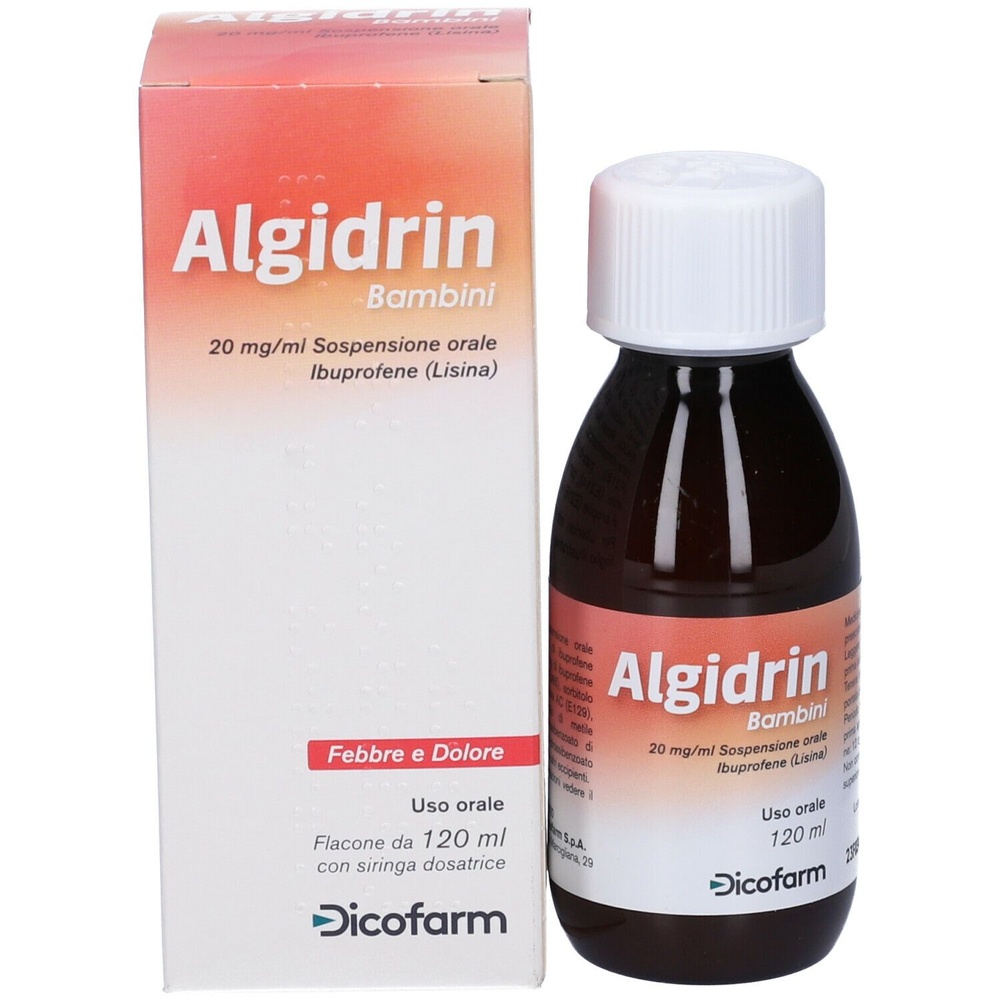
- País de registro
- Forma farmacéuticaSOLUCIÓN/SUSPENSIÓN ORAL, 600 mg ibuprofeno
- Código ATCM01AE01
- Principio activo
- Requiere recetaSí
- Fabricante
- ComposiciónSACARINA SODICA (17 mg mg), CITRATO DE SODIO (E-331) (100 mg mg), BETADEX (3075 mg mg), CICLAMATO DE SODIO (25 mg mg), SACAROSA (1.900 mg mg)
- Esta información es de carácter general y no sustituye la consulta con un profesional sanitario.
- Alternativas a ALGIDRIN 600 POLVO PARA SUSPENSION ORALForma farmacéutica: SOLUCIÓN/SUSPENSIÓN ORAL, 200 mgPrincipio activo: IbuprofenoRequiere recetaForma farmacéutica: SOLUCIÓN/SUSPENSIÓN ORAL, 20 mg/mlPrincipio activo: IbuprofenoRequiere recetaForma farmacéutica: SOLUCIÓN/SUSPENSIÓN ORAL, 68.34 mg/mlPrincipio activo: IbuprofenoRequiere receta
Médicos online para ALGIDRIN 600 POLVO PARA SUSPENSION ORAL
Comenta la dosis, los posibles efectos secundarios, interacciones, contraindicaciones o la revisión de receta de ALGIDRIN 600 POLVO PARA SUSPENSION ORAL, sujeto a valoración médica y a la normativa local.









Obtén una receta de ALGIDRIN 600 POLVO PARA SUSPENSION ORAL online
Rellena un formulario de 2 minutos
Cuéntanos tus síntomas, historial y el medicamento que necesitas.
Elige un médico o nosotros te asignamos uno
Escoge un especialista o te conectamos con el próximo médico disponible.
El médico revisa tu caso
Normalmente en 30 minutos. Puede hacerte preguntas adicionales por chat.
Recógela en cualquier farmacia
Receta electrónica enviada a tu correo, válida en toda España.
Preguntas frecuentes
ALGIDRIN 600 POLVO PARA SUSPENSION ORAL requiere receta en España. Puedes confirmarlo con un médico online según tu caso.
El principio activo de ALGIDRIN 600 POLVO PARA SUSPENSION ORAL es Ibuprofeno. Esta información ayuda a identificar medicamentos con la misma composición pero con diferentes nombres comerciales.
ALGIDRIN 600 POLVO PARA SUSPENSION ORAL es fabricado por Laboratorio De Aplicaciones Farmacodinamicas S.A.. La marca y el envase pueden variar según el distribuidor.
Los Médicos de familia, Psiquiatras, Dermatólogos, Cardiólogos, Endocrinólogos, Gastroenterólogos, Neumólogos, Nefrólogos, Reumatólogos, Hematólogos, Infectólogos, Alergólogos, Geriatras, Pediatras, Oncólogos pueden valorar la prescripción de ALGIDRIN 600 POLVO PARA SUSPENSION ORAL cuando esté clínicamente indicado. Puedes reservar una videoconsulta para comentar tu caso y las opciones de tratamiento.
España cuenta con una infraestructura sanitaria bien desarrollada en ciudades principales como Madrid, Barcelona, Valencia y Sevilla. Las farmacias están ampliamente disponibles y operan bajo estrictas regulaciones, garantizando el acceso a medicamentos con receta.
Puedes comprar ALGIDRIN 600 POLVO PARA SUSPENSION ORAL en Madrid, Barcelona, Sevilla o Valencia en cualquier farmacia local con una receta válida.
Para obtener una receta, puedes utilizar Oladoctor:
Otros medicamentos con el mismo principio activo (Ibuprofeno) incluyen ALGIDRIN INFANTIL 200 mg POLVO PARA SUSPENSION ORAL, ALGIDRIN PEDIATRICO 20 MG/ML SUSPENSION ORAL, ALGIDRIN PEDIATRICO 40 MG/ML SUSPENSION ORAL. Pueden tener diferentes nombres comerciales o formulaciones, pero contienen el mismo componente terapéutico. Consulta siempre con un médico antes de cambiar o iniciar un nuevo medicamento.
