



AGRASTAT 0,25 mg/ml Concentrado para solución para perfusión

Revisión de receta online
Un médico revisará tu caso y determinará si la prescripción es médicamente apropiada.

Habla con un médico sobre este medicamento
Comenta tus síntomas y las opciones de tratamiento en una consulta online.



Cómo usar AGRASTAT 0,25 mg/ml CONCENTRADO PARA SOLUCIÓN PARA PERFUSION
Contenido del prospecto
- Introducción
- Qué es AGRASTAT y para qué se utiliza
- Qué necesita saber antes de empezar a usar AGRASTAT
- Cómo usar AGRASTAT
- Posibles efectos adversos
- Conservación de AGRASTAT
- Contenido del envase e información adicional
Introducción
Prospecto: información para el paciente
AGRASTAT 0,25 mg/ml concentrado para solución para perfusión
(tirofibán)
Lea todo el prospecto detenidamente antes de empezar a usar este medicamento, porque contiene información importante para usted.
- Conserve este prospecto, ya que puede tener que volver a leerlo.
- Si tiene alguna duda, consulte a su médico o farmacéutico.
- Este medicamento se le ha recetado solamente a usted,y no debe dárselo a otras personas aunque tengan los mismos síntomas que usted, ya que puede perjudicarles.
- Si experimenta efectos adversos, consulte a su médico o farmacéutico, incluso si se trata de efectos adversos que no aparecen en este prospecto. Ver sección 4.
Contenido del prospecto:
- Qué es AGRASTAT y para qué se utiliza
- Qué necesita saber antes de empezar a usar AGRASTAT
- Cómo usar AGRASTAT
- Posibles efectos adversos
- Conservación de AGRASTAT
- Contenido del envase e información adicional
1. Qué es AGRASTAT y para qué se utiliza
AGRASTAT se utiliza para ayudar a facilitar el flujo sanguíneo al corazón, y a prevenir el dolor en el pecho y los ataques al corazón. Funciona previniendo la agregación de las plaquetas, células que se encuentran en la sangre, y que forman coágulos de sangre.
Este medicamento también puede ser utilizado en pacientes cuyas venas se dilatan con un balón (intervención coronaria percutánea o ICP). Este es un procedimiento, que se consigue con la implantación de un pequeño tubo (stent) para mejorar el flujo de sangre al corazón.
AGRASTAT está destinado a ser utilizado con aspirina y heparina no fraccionada.

¿No estás seguro de si este medicamento es adecuado para ti?
Comenta tus síntomas y tratamiento con un médico online.
2. Qué necesita saber antes de empezar a usar AGRASTAT
No use AGRASTAT:
- Si usted es alérgico (hipersensible) a tirofibán o a cualquiera de los demás componentes de AGRASTAT (incluidos en la sección 6.).
- Si usted tiene una hemorragia interna o antecedente de hemorragia interna en los últimos 30 días.
- Si usted tiene antecedentes de sangrado intracraneal, un tumor en el cerebro o vasos sanguíneos anormales en el cerebro.
- Si usted tiene hipertensión arterial grave no controlada (hipertensión maligna).
- Si usted tiene un recuento plaquetario bajo (Trombocitopenia) o alteraciones de la coagulación sanguínea.
- Si usted desarrolló una trombocitopenia mientras estaba en tratamiento con AGRASTAT u otro medicamento del mismo grupo terapéutico.
- Si usted ha tenido antecedente de ictus en los últimos 30 días o cualquier antecedente de ictus hemorrágico.
- Si usted ha tenido un traumatismo importante o intervención de cirugía mayor en las últimas seis semanas.
- Si usted tiene insuficiencia hepática grave.
Su médico revisará su historial médico para ver si usted tiene un mayor riesgo de padecer efectos secundarios asociados con el uso de este medicamento.
Advertencias y precauciones
Consulte a su médico antes de empezar a usar AGRASTAT, si usted tiene o ha tenido:
- Cualquier problema médico.
- Cualquier alergia
- Reanimación cardiopulmonar, biopsia o litotricia en las 2 últimas semanas.
- Traumatismo grave o cirugía mayor en los últimos 3 meses.
- Ulcera en el estómago o intestino (duodeno) en los 3 últimos meses.
- Reciente trastorno hemorrágico (en el último año) como sangrado en el estómago o intestino, o sangre en la orina o heces.
- Intervención espinal reciente.
- Antecedentes o síntomas de rotura de la aorta (disección aórtica).
- Hipertensión no controlada.
- Inflamación de la membrana que recubre el corazón (Pericarditis).
- Inflamación de las venas (vasculitis activa).
- Problemas en los vasos sanguíneos del fondo del ojo (retina).
- Problemas con medicamentos que ayudan a prevenir o disolver coágulos de sangre.
- Problema de riñón.
- Inserción por debajo de la clavícula de un catéter intravenoso especial en las últimas 24 horas.
- Fallo cardíaco.
- Baja presión arterial debido a un fallo cardíaco (shock cardiogénico)
- Trastorno del hígado
- Recuento sanguíneo bajo o anemia
Uso de AGRASTAT con otros medicamentos:
En general, AGRASTAT puede usarse con otros medicamentos. Por favor, informe a su médico si está tomando, ha tomado recientemente o podría tomar cualquier otro medicamento, incluyendo los medicamentos sin receta, ya que puede afectar a la acción de estos. Es my importante que comunique a su médico si usted está tomando medicamentos que previenen la formación de coágulos como la warfarina.
Uso de AGRASTAT con alimentos, bebidas y alcohol
Los alimentos y bebidas no tienen efecto en este medicamento.
Embarazo, lactancia y fertilidad
Si está embarazada o en periodo de lactancia, cree que podría estar embarazada o tiene intención de quedarse embarazada, consulte a su médico antes de utilizar este medicamento
Conducción y uso de máquinas
Debido a su estado, usted no será capaz de conducir o manejar maquinaria mientras utiliza AGRASTAT.
AGRASTAT contiene sodio
Este medicamento contiene aproximadamente 189 mg de sodio por cada vial de 50 ml, lo que deberá tenerse en cuenta en el tratamiento de pacientes con dietas pobres en sodio.
3. Cómo usar AGRASTAT
AGRASTAT debe ser prescrito por médicos cualificados con experiencia en el manejo de síndromes coronarios agudos.
AGRASTAT se administra por vía intravenosa. Su médico decidirá la dosis apropiada, dependiendo de su condición y del peso.
Uso en niños
El uso en niños no está recomendado.
Si usa más AGRASTAT del que debe
Su dosis de AGRASTAT será monitorizada cuidadosamente y vigilada por su doctor y farmacéutico.
El efecto adverso más reportado por sobredosis fue el sangrado. Si usted nota sangrado, debe notificárselo a su médico inmediatamente.
En caso de sobredosis o ingestión accidental, consulte inmediatamente a su médico o farmacéutico o llame al Servicio de Información Toxicológica, teléfono: 91 562 04 20, indicando el medicamento y la cantidad ingerida.
Si olvidó usar AGRASTAT
Su médico decidirá cuándo administrar AGRASTAT.
Si interrumpe el tratamiento con AGRASTAT
Su médico decidirá cuándo debe interrumpirse el tratamiento. Sin embargo, si usted desea interrumpir el tratamiento antes, deberá discutir otras opciones con su médico.
Si tiene cualquier otra duda sobre el uso de este medicamento, pregunte a su médico o farmacéutico.

¿Has empezado a tomar el medicamento y tienes preguntas?
Comenta tus síntomas y tratamiento con un médico online.
4. Posibles efectos adversos
Al igual que todos los medicamentos, este medicamento puede tener efectos adversos, aunque no todas las personas lo sufran.
El efecto adverso más común en el tratamiento con AGRASTAT es el sangrado que puede suceder en cualquier lugar de su cuerpo. Este efecto adverso puede ser grave y, raramente, puede ser fatal.
Si sufre efectos adversos, puede que necesite atención médica. Mientras esté usando AGRASTAT, si usted desarrolla cualquiera de los siguientes síntomas, debe contactar a su médico inmediatamente:
- Signos de sangrado intracraneal como dolor en la cabeza, deficiencias sensoriales (visuales o auditivas), dificultades en el habla, entumecimiento o problemas con el movimiento o equilibrio.
- Signos de hemorragia interna tales como tos con sangre o presencia de sangre en la orina o heces.
- Signos de reacciones alérgicas serias como dificultad al respirar o mareos.
A continuación se detallan los efectos adversos que han ocurrido en pacientes tras el tratamiento con AGRASTAT. Estos efectos adversos se clasifican en orden decreciente de frecuencia.
Efectos adversos muy frecuentes (pueden afectar a más de 1 de cada 10 personas):
Sangrado después de una operación
Sangrado bajo la piel en el sitio de inyección, o en el músculo causando inflamación
Pequeños cardenales rojos en la piel
Sangre invisible en la orina o heces
Sensación de mareo
Dolor de cabeza
Efectos adversos frecuentes (pueden afectar hasta 1 de cada 10 personas):
Sangre en orina
Tos con sangre
Hemorragias nasales
Sangrado en encías y boca
Sangrado en el sitio de punción
Reducción del recuento sanguíneo (reducción del hematocrito y la hemoglobina)
Disminución del recuento de plaquetas por debajo de 90.000/mm3
Fiebre
Efectos adversos poco frecuentes (pueden afectar hasta 1 de cada 100 personas):
Sangrado en estómago o intestino
Vómito con sangre
Disminución del recuento de plaquetas por debajo de 50.000/mm3
Efectos adversos de frecuencia no conocida (no se puede estimar sobre la base de los datos disponibles):
Sangrado intracraneal
Hematoma en la región espinal
Sangrado retroperitoneal
Acumulación de sangre alrededor del corazón
Hemorragia pulmonar
Disminución aguda y grave del recuento de plaquetas por debajo de 20.000/mm3
Reacciones alérgicas graves con opresión en el pecho, urticaria, incluyendo reacciones que pueden causar dificultad al respirar y mareos.
Comunicación de efectos adversos
Si experimenta cualquier tipo de efecto adverso, consulte a su médico o farmacéutico, incluso si se trata de posibles efectos adversos que no aparecen en este prospecto. También puede comunicarlos directamente a través del Sistema Español de Farmacovigilancia de Medicamentos de Uso Humano: www.notificaRAM.com. Mediante la comunicación de efectos adversos usted puede contribuir a proporcionar más información sobre la seguridad de este medicamento.
5. Conservación de AGRASTAT
Su médico o farmacéutico sabrá cómo almacenar y desechar este medicamento.
Mantener este medicamento fuera de la vista y del alcance de los niños.
No use este medicamento después de la fecha de caducidad que aparece en la bolsa después de CAD. La fecha de caducidad es el último día del mes que se indica.
No congelar.
No use AGRASTAT si hay partículas visibles o si la solución esta descolorida antes de su uso.
Los medicamentos no se deben tirar por los desagües ni a la basura. Deposite los envases y los medicamentos que no necesita en el Punto SIGRE de la farmacia. En caso de duda pregunte a su farmacéutico cómo deshacerse de los envases y de los medicamentos que ya no necesita. De esta forma, ayudará a proteger el medio ambiente.
6. Contenido del envase e información adicional
Composición de AGRASTAT
El principio activo es tirofibán hidrocloruro monohidrato.
1 ml contiene 281 microgramos de tirofibán hidrocloruro monohidrato equivalente a 250 microgramos de tirofibán.
Los demás componentes son: Cloruro de sodio, citrato de sodio dihidrato, ácido cítrico anhidro, agua para inyección, ácido clorhídrico y/o hidróxido de sodio (para ajuste del pH).
Aspecto de AGRASTAT y contenido del envase
AGRASTAT es una solución concentrada transparente e incolora que se presenta en viales de vidrio tipo I de 50 ml.
Titular de la autorización de comercialización y responsable de la fabricación
Titular de la autorización de comercialización
Advanz Pharma Limited
Unit 17, Northwood House,
Northwood Crescent,
Dublín 9,
D09 V504,
Irlanda
Responsable de fabricación
Orion Corporation, Orion Pharma Espoo site
Orionintie 1, FI 00220, Espoo, Finlandia
ARVATO DISTRIBUTION GMBHGottlieb-Daimler-Strasse, 1 Harsewinkel, Germany 33428 Alemania
Representante local:
Advanz Pharma Spain S.L.U.
Paseo de la Castellana 135,
7ª 28046 Madrid (España)
Tf: +34 900 834 889
Fecha de la última revisión de este prospecto: Octubre 2013
Otras fuentes de información
Información detallada de este medicamento está disponible en la página web de la Agencia Europea del Medicamento: http://www.ema.europa.eu/.
Esta información está destinada únicamente a profesionales del sector sanitario:
Este producto está destinado únicamente al uso hospitalario, para ser usado por médicos especialistas con experiencia en el tratamiento de síndromes coronarios agudos.
AGRASTAT concentrado debe diluirse antes de usar.
AGRASTAT debe administrarse con heparina no fraccionada y tratamiento antiplaquetario oral, incluyendo ácido acetilsalicílico (AAS).
Posología y forma de administración
En los pacientes que son tratados con una estrategia invasiva precoz para el Síndrome coronario agudo sin elevación del ST (SCA-SEST) y no planea someterse a una angiografía por lo menos durante 4 horas y hasta 48 horas después del diagnóstico, AGRASTAT se administra por vía intravenosa en una velocidad de perfusión inicial de 0,4 microgramos/kg/min durante 30 minutos. Al final de la perfusión inicial, AGRASTAT debe continuarse a una velocidad de perfusión de mantenimiento de 0,1 microgramos/kg/min. AGRASTAT debe administrarse con heparina no fraccionada (generalmente un bolo intravenoso de 50-60 unidades (U)/kg simultáneamente con el inicio de la terapia de AGRASTAT, después de aprox. 1000 (U) por hora, ajustarse en función de la tromboplastina parcial activada (TTPA), que debe ser aproximadamente el doble del valor normal) y el tratamiento antiplaquetario oral, incluyendo pero no limitado al AAS, salvo que esté contraindicado.
En los pacientes SCA-SEST que se sometan a una intervención coronaria percutánea (ICP) programada dentro de las primeras 4 horas a partir del diagnóstico o en pacientes con infarto de miocardio agudo con ICP primaria programada, AGRASTAT debe administrarse utilizando un bolo inicial de 25 microgramos/kg administrada durante un período de 3 minutos, seguido de una perfusión continua a una tasa de 0,15 microgramos/kg/min por 12-24, y hasta 48 horas. AGRASTAT debe administrarse con heparina no fraccionada (dosis arriba indicada) y tratamiento antiplaquetario oral, incluyendo pero no limitado al ácido acetilsalicílico (AAS), salvo que esté contraindicado.
No se requiere ajuste de dosis para los pacientes de edad avanzada.
Pacientes con insuficiencia renal grave
En la insuficiencia renal grave (aclaramiento de creatinina <30 ml/min) la dosis de AGRASTAT debe reducirse en un 50%.
Población pediátrica
La seguridad y eficacia de AGRASTAT en niños no ha sido establecida.
No hay datos disponibles.
Inicio y duración de AGRASTAT
En los pacientes que son tratados con una estrategia invasiva precoz para el Síndrome coronario agudo sin elevación del ST (SCA-SEST) y no planea someterse a una angiografía por lo menos durante 4 horas y hasta 48 horas después del diagnóstico, el régimen de dosis de AGRASTAT que deberá iniciarse tras el diagnóstico será de 0,4 microgramos/kg/min carga. La duración recomendada de la perfusión de mantenimiento debe ser de al menos 48 horas. La perfusión de AGRASTAT y heparina no fraccionada se mantendrá durante la angiografía coronaria, y debe mantenerse durante al menos 12 horas y no más de 24 horas después de la angioplastia/aterectomía. Una vez que el paciente está clínicamente estable y sin que haya una intervención coronaria prevista por el médico, la perfusión se debe interrumpir. Toda la duración del tratamiento no debe exceder de 108 horas.
Si el paciente con diagnóstico de SCA-SEST es tratado con una estrategia invasiva y se somete a una angiografía en las 4 horas siguientes al diagnóstico, el régimen de dosis en bolo de AGRASTAT 25 microgramos/kg debe iniciarse al comienzo del PCI con una perfusión continua de 12 a 24 horas y hasta 48 horas.
En los pacientes con infarto de miocardio agudo con ICP primaria programada, el régimen de perfusión en bolo debe iniciarse lo antes posible después del diagnóstico.
Tratamiento concomitante (heparina no fraccionada, tratamiento antiplaquetario oral incluyendo AAS)
El tratamiento con heparina no fraccionada se inicia con un bolo intravenoso de 50-60 U/kg, y continúa con una perfusión de mantenimiento de 1.000 unidades por hora. La dosis de heparina se titula para mantener una tromboplastina parcial activada (TTPA) de aproximadamente el doble del valor normal.
A menos que esté contraindicado, todos los pacientes deben recibir antiagregantes plaquetarios orales, incluyendo pero no limitado a AAS, antes del inicio del tratamiento con AGRASTAT. Este medicamento se debe continuar por lo menos durante la duración de la perfusión con AGRASTAT.
La mayoría de los estudios que investigan la administración de AGRASTAT como complemento de ICP han empleado AAS en combinación con clopidogrel como tratamiento antiplaquetario oral. No se ha establecido la eficacia de la combinación de AGRASTAT con prasugrel o ticagrelor en ensayos aleatorizados y controlados.
Si la angioplastia (ICP) es requerida, se debe suspender la heparina después del ICP, y las cánulas deben ser retiradas una vez que la coagulación haya vuelto a la normalidad, por ejemplo, cuando el tiempo de coagulación activado (ACT) sea menor de 180 segundos (generalmente 2-6 horas después de suspender la heparina).
Incompatibilidades
Se han dado casos de incompatibilidad con diazepam. Por lo tanto, AGRASTAT y diazepam no deben de ser administrados por la misma vía intravenosa.
No se han encontrado incompatibilidades entre AGRASTAT y las siguientes formulaciones intravenosas: sulfato de atropina, dobutamina, dopamina, clorhidrato de epinefrina, furosemida, heparina, lidocaína, clorhidrato de midazolam, sulfato de morfina, nitroglicerina, cloruro de potasio, clorhidrato de propranolol, y famotidina inyectable.
Instrucciones de uso:
AGRASTAT Concentrado debe diluirse antes de su uso:
- Extraer 50 ml de un envase de 250 ml de solución salina estéril al 0,9 % o glucosa al 5 % en agua y sustituirlos por 50 ml de AGRASTAT (de un vial de punción de 50 ml) para conseguir una concentración de 50 microgramos/ml. Mezclar bien antes de usar.
- Usarlo de acuerdo con la tabla de dosificación.
Se proporciona la siguiente tabla como guía para el ajuste de la dosis en función del peso.
Peso paciente (kg) | 0,4 microgramos/kg/min Régimen de dosis de carga Mayoría de los pacientes | 0,4 microgramos/kg/min Régimen de dosis de carga Insuficiencia renal grave | 25 microgramos/kg Régimen de dosis de bolo Mayoría de los pacientes | 25 microgramos/kg Régimen de dosis de bolo Insuficiencia renal grave | ||||
Velocidad de perfusión de carga 30 min (ml/h) | Velocidad de perfusión de manteni-miento (ml/h) | Velocidad de perfusión de la carga 30 min (ml/h) | Velocidad de pefusión de manteni-miento (ml/h) | Bolus (ml) | Velocidad de perfusión de manteni-miento (ml/h) | Bolus (ml) | Velocidad de perfusión de manteni-miento (ml/h) | |
30-37 | 16 | 4 | 8 | 2 | 17 | 6 | 8 | 3 |
38-45 | 20 | 5 | 10 | 3 | 21 | 7 | 10 | 4 |
46-54 | 24 | 6 | 12 | 3 | 25 | 9 | 13 | 5 |
55-62 | 28 | 7 | 14 | 4 | 29 | 11 | 15 | 5 |
63-70 | 32 | 8 | 16 | 4 | 33 | 12 | 17 | 6 |
71-79 | 36 | 9 | 18 | 5 | 38 | 14 | 19 | 7 |
80-87 | 40 | 10 | 20 | 5 | 42 | 15 | 21 | 8 |
88-95 | 44 | 11 | 22 | 6 | 46 | 16 | 23 | 8 |
96-104 | 48 | 12 | 24 | 6 | 50 | 18 | 25 | 9 |
105-112 | 52 | 13 | 26 | 7 | 54 | 20 | 27 | 10 |
113-120 | 56 | 14 | 28 | 7 | 58 | 21 | 29 | 10 |
121-128 | 60 | 15 | 30 | 8 | 62 | 22 | 31 | 11 |
129-137 | 64 | 16 | 32 | 8 | 67 | 24 | 33 | 12 |
138-145 | 68 | 17 | 34 | 9 | 71 | 25 | 35 | 13 |
146-153 | 72 | 18 | 36 | 9 | 75 | 27 | 37 | 13 |
AGRASTAT Concentrado debe diluirse primero tal y como se indica enInstrucciones de uso
- Siempre que la solución y el envase lo permitan, los fármacos parenterales deben inspeccionarse para identificar la presencia de partículas visibles o de coloración antes de su uso.
- AGRASTAT sólo debe administrarse por vía intravenosa y puede administrarse con heparina no fraccionada a través del mismo tubo de perfusión.
- Se recomienda administrar AGRASTAT con un equipo de perfusión calibrado utilizando material estéril.
- Debe tenerse cuidado de no prolongar la perfusión de la dosis inicial y de evitar errores de cálculo de las velocidades de perfusión para la dosis de mantenimiento basándose en el peso del paciente.
Precauciones especiales de conservación
No utilice AGRASTAT después de la fecha de caducidad que aparece en el etiquetado y en el cartonaje exterior. La fecha de caducidad es el último día del mes que se indica.
No congelar. Mantener el envase en la caja para protegerlo de la luz.
Después de la dilución el producto debe utilizarse inmediatamente. Si no se usa inmediatamente, las condiciones de conservación no deben será mayores de 24 horas a 2 - 8°C.
Aspecto del producto y contenido del envase
AGRASTAT es una solución concentrada transparente e incolora que se presenta en viales de vidrio tipo I de 50 ml.
Precauciones especiales de eliminación y otras manipulaciones
La eliminación del medicamento no utilizado y de todos los materiales que hayan estado en contacto con él, se realizará de acuerdo con la normativa local.
“La información detallada y actualizada de este medicamento está disponible en la página Web de la Agencia Española de Medicamentos y Productos Sanitarios (AEMPS)http://www.aemps.gob.es/”
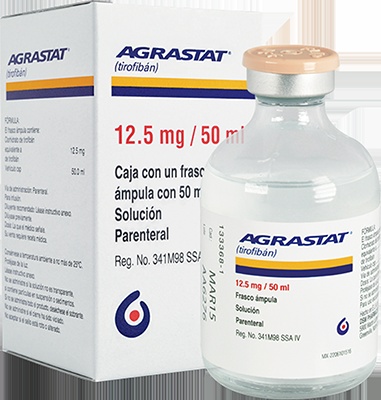
- País de registro
- Forma farmacéuticaINYECTABLE PERFUSION, 250 µg/ml
- Código ATCB01AC17
- Principio activo
- Requiere recetaSí
- Fabricante
- ComposiciónHIDROXIDO DE SODIO (E 524) (c.s. pH 6 - mg), CLORURO DE SODIO (8 mg mg), CITRATO DE SODIO (E-331) (2,7 mg mg)
- Esta información es de carácter general y no sustituye la consulta con un profesional sanitario.
- Alternativas a AGRASTAT 0,25 mg/ml CONCENTRADO PARA SOLUCIÓN PARA PERFUSIONForma farmacéutica: INYECTABLE PERFUSION, 50 µg/mlPrincipio activo: TirofibanFabricante: Advanz Pharma LimitedRequiere recetaForma farmacéutica: INYECTABLE PERFUSION, 0,05 mg/mlPrincipio activo: TirofibanFabricante: Altan Pharmaceuticals SaRequiere recetaForma farmacéutica: COMPRIMIDO, 100 mgPrincipio activo: Acetilsalicilico acidoFabricante: Laboratorio Stada S.L.Requiere receta
Médicos online para AGRASTAT 0,25 mg/ml CONCENTRADO PARA SOLUCIÓN PARA PERFUSION
Comenta la dosis, los posibles efectos secundarios, interacciones, contraindicaciones o la revisión de receta de AGRASTAT 0,25 mg/ml CONCENTRADO PARA SOLUCIÓN PARA PERFUSION, sujeto a valoración médica y a la normativa local.









Obtén una receta de AGRASTAT 0,25 mg/ml CONCENTRADO PARA SOLUCIÓN PARA PERFUSION online
Rellena un formulario de 2 minutos
Cuéntanos tus síntomas, historial y el medicamento que necesitas.
Elige un médico o nosotros te asignamos uno
Escoge un especialista o te conectamos con el próximo médico disponible.
El médico revisa tu caso
Normalmente en 30 minutos. Puede hacerte preguntas adicionales por chat.
Recógela en cualquier farmacia
Receta electrónica enviada a tu correo, válida en toda España.
Preguntas frecuentes
AGRASTAT 0,25 mg/ml CONCENTRADO PARA SOLUCIÓN PARA PERFUSION requiere receta en España. Puedes confirmarlo con un médico online según tu caso.
El principio activo de AGRASTAT 0,25 mg/ml CONCENTRADO PARA SOLUCIÓN PARA PERFUSION es Tirofiban. Esta información ayuda a identificar medicamentos con la misma composición pero con diferentes nombres comerciales.
AGRASTAT 0,25 mg/ml CONCENTRADO PARA SOLUCIÓN PARA PERFUSION es fabricado por Advanz Pharma Limited. La marca y el envase pueden variar según el distribuidor.
Los Médicos de familia, Psiquiatras, Dermatólogos, Cardiólogos, Endocrinólogos, Gastroenterólogos, Neumólogos, Nefrólogos, Reumatólogos, Hematólogos, Infectólogos, Alergólogos, Geriatras, Pediatras, Oncólogos pueden valorar la prescripción de AGRASTAT 0,25 mg/ml CONCENTRADO PARA SOLUCIÓN PARA PERFUSION cuando esté clínicamente indicado. Puedes reservar una videoconsulta para comentar tu caso y las opciones de tratamiento.
España cuenta con una infraestructura sanitaria bien desarrollada en ciudades principales como Madrid, Barcelona, Valencia y Sevilla. Las farmacias están ampliamente disponibles y operan bajo estrictas regulaciones, garantizando el acceso a medicamentos con receta.
Puedes comprar AGRASTAT 0,25 mg/ml CONCENTRADO PARA SOLUCIÓN PARA PERFUSION en Madrid, Barcelona, Sevilla o Valencia en cualquier farmacia local con una receta válida.
Para obtener una receta, puedes utilizar Oladoctor:
Otros medicamentos con el mismo principio activo (Tirofiban) incluyen AGRASTAT 0,05 mg/ml SOLUCION PARA PERFUSION, TIROFIBAN ALTAN 50 MICROGRAMOS/ML SOLUCION PARA PERFUSION EFG, A.A.S. 100 mg COMPRIMIDOS. Pueden tener diferentes nombres comerciales o formulaciones, pero contienen el mismo componente terapéutico. Consulta siempre con un médico antes de cambiar o iniciar un nuevo medicamento.
