


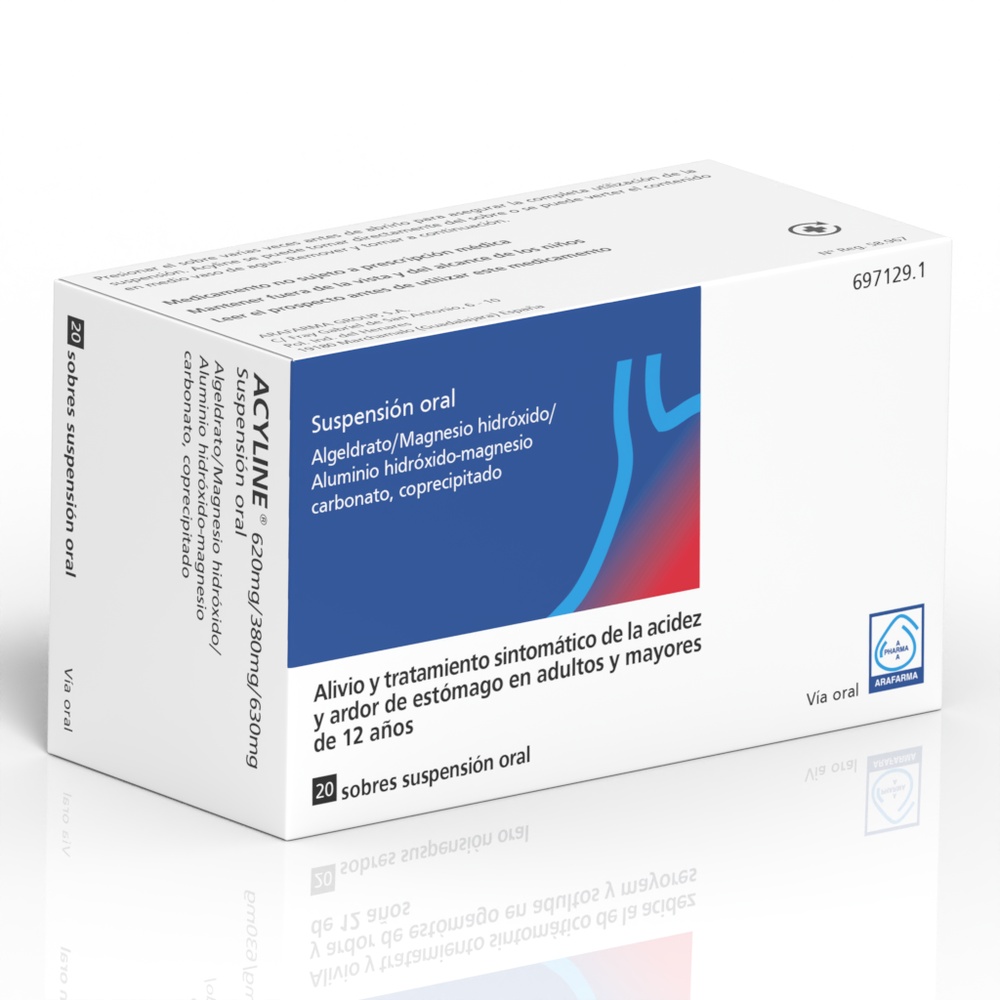
Acyline suspensión oral

Revisión de receta online
Un médico revisará tu caso y determinará si la prescripción es médicamente apropiada.

Habla con un médico sobre este medicamento
Comenta tus síntomas y las opciones de tratamiento en una consulta online.



Cómo usar ACYLINE 620 mg/380 mg/630 mg SUSPENSION ORAL
Contenido del prospecto
- Introducción
- Qué es ACYLINE y para qué se utiliza
- Qué necesita saber antes de empezar a tomar ACYLINE
- Cómo tomar ACYLINE
- Posibles efectos adversos
- Conservación de ACYLINE
- Contenido del envase e información adicional
Introducción
Prospecto: información para el usuario
Acyline620 mg/380 mg/630 mgSuspensión oral
Algeldrato, magnesio hidróxido, aluminio hidróxido-magnesio carbonato, coprecipitado
Lea todo el prospecto detenidamente antes de empezar a tomar este medicamento, porque contiene información importante para usted.
Siga exactamente las instrucciones de administración del medicamento contenidas en este prospecto o las indicadas por su médico o farmacéutico.
- Conserve este prospecto, ya que puede tener que volver a leerlo.
- Si necesita consejo o más información, consulte a su farmacéutico.
- Si experimenta efectos adversos, consulte a su médico o farmacéutico, incluso si se trata de efectos adversos que no aparecen en este prospecto. Ver sección 4.
- Debe consultar a un médico si empeora o si no mejora después de 14 días.
Contenido del prospecto
- Qué es ACYLINE y para qué se utiliza
- Qué necesita saber antes de empezar a tomar ACYLINE
- Cómo tomar ACYLINE
- Posibles efectos adversos
- Conservación de ACYLINE
- Contenido del envase e información adicional
1. Qué es ACYLINE y para qué se utiliza
ACYLINE contiene algeldrato, magnesio hidróxido y aluminio hidróxido-magnesio carbonato, coprecipitado. Pertenece al grupo de fármacos denominados antiácidos, que actúan neutralizando el exceso de ácido del estómago.
ACYLINE está indicado para el alivio y tratamiento sintomático de la acidez y ardor de estómago en adultos y mayores de 12 años.
Debe consultar a un médico si empeora o si no mejora después de 14 días.

¿No estás seguro de si este medicamento es adecuado para ti?
Comenta tus síntomas y tratamiento con un médico online.
2. Qué necesita saber antes de empezar a tomar ACYLINE
No tome ACYLINE:
- Si es alérgico al hidróxido de aluminio, hidróxido de magnesio ó al coprecipitado de hidróxido de aluminio carbonato de magnesio o a cualquiera de los demás componentes de este medicamento (incluidos en la sección 6).
- Si tiene algún síntoma de apendicitis, obstrucción o inflamación intestinal, como dolor abdominal, retortijones, vientre hinchado, sensación dolorosa, náuseas o vómitos.
- Si tiene insuficiencia renal grave.
- Si presenta hemorragia gastrointestinal o de recto (última porción del tubo digestivo) sin diagnosticar.
- Si presenta hipermagnesemia (cuando sus niveles de magnesio en sangre son altos).
- Si presenta alcalosis (alteración del equilibrio ácido base de la sangre).
Advertencias y precauciones
Consulte a su médico ó farmacéutico antes de empezar a tomar ACYLINE.
Como ocurre con otros antiácidos, este medicamento puede enmascarar los síntomas de una enfermedad del estómago más grave, como una úlcera péptica o un proceso maligno, por lo que si los síntomas perduran o empeoran después de 14 días de tratamiento, se debe consultar al médico.
Si sigue una dieta baja en fósforo, presenta diarrea, mala absorción o le han realizado un transplante de riñón puede producirse, sobre todo con tratamientos prolongados, una disminución del contenido de fosfatos en sangre (pérdida de apetito, debilidad muscular, malestar general, etc.) que se acompaña de alteraciones los huesos (osteomalacia).
A dosis altas este medicamento podría provocar o empeorar una obstrucción intestinal sobretodo en pacientes con enfermedades renales, alteraciones intestinales y pacientes de edad avanzada.
Si tiene alguna enfermedad del riñón (insuficiencia renal) de leve a moderada, y necesita tomar este medicamento lo hará con precaución evitando su uso prolongado ya que pueden aparecer: alteraciones en el sistema nervioso central, disminución del número de glóbulos rojos en la sangre, o empeorar enfermedades de los huesos.
No se recomienda el uso de antiácidos que contienen aluminio en pacientes con enfermedad de Alzheimer, ya podría contribuir al desarrollo de la enfermedad.
En pacientes de edad avanzada el uso continuado de antiácidos que contienen aluminio puede agravar alguna enfermedad existente de huesos .
Si presenta porfiria (conjunto de trastornos hereditarios que implican anomalías en la producción del pigmento de los glóbulos rojos) y está en tratamiento de hemodiálisis (proceso para eliminar los residuos que hay en sangre cuando los riñones son incapaces de hacerlo), debe consultar a su médico antes de tomar este medicamento.
Debe comunicar al médico la aparición de algún síntoma que indique hemorragia, como por ejemplo heces (deposiciones) negras o vómitos como posos de café.
Interferencias con pruebas diagnósticas
Si le van a realizar alguna prueba diagnóstica (incluidos análisis de sangre, orina, prueba con radiofármacos) comunique al médico que está tomando este medicamento, ya que puede alterar los resultados.
Si le van a realizar alguna prueba de evaluación de la función secretora del ácido gástrico, no deberá tomar antiácidos la misma mañana en que se realice la prueba.
Niños
No se recomienda el uso de antiácidos en niños menores de 12 años, ya que pueden ocultarse síntomas de otras enfermedades ya existentes (por ejemplo apéndicitis). En los niños pequeños existe el riesgo de un aumento del magnesio en sangre o toxicidad por aluminio, sobre todo si están deshidratados o tienen alguna enfermedad del riñón.
Toma de ACYLINE con otros medicamentos
Informe a su médico o farmacéutico si está tomando, ha tomado recientemente o podría tener que tomar cualquier otro medicamento.
Los antiácidos pueden modificar la acción de otros medicamentos, por lo que deberá separar la toma de cualquier antiácido de otros medicamentos.
Es importante que informe a su médico si toma alguno de los siguientes fármacos:
- Antagonistas H2 (medicamentos utilizados para tratar problemas del aparato digestivo)
- Atenolol, propranolol, metoprolol (medicamentos utilizados para problemas cardiacos y para tratar la hipertensión)
- Cloroquinas (utilizados para tratar la malaria)
- Diflunisal (antiinflamatorio no esteroideo)
- bifosfonatos (para tratar la osteoporosis)
- Antibióticos (lincosamidas, tetraciclinas, fluorquinolonas, azitromicina, Cefdinir, cefpodoxima )
- Ketoconazol (para tratar infecciones por hongos)
- Penicilamina (para el tratamiento de enfermedades reumáticas)
- Kayexalato (para el tratamiento de los niveles altos de potasio en sangre)
- Digoxina (para tratar problemas del corazón)
- Etambutol, isoniazida, rifampicina (para tratar la tuberculosis)
- Fluoruro de sodio (desinfectante)
- Glucocorticoides (prednisona)
- Indometacina (antiinflamatorio)
- Neurolépticos (utilizados para el tratamiento de trastornos mentales)
- Sales de hierro (para el tratamiento de la anemia)
- Medicamento para la hipertensión (captopril, fosinoprilo)
- Levotiroxina (para tratar problemas de tiroides)
- Rosuvastatina (para dismuinuir los niveles de colesterol en sangre).
- Metenamina (utilizada para eliminar las bacterias de la vías urinarias)
- Mecamilamina (utilizada para reducir la presión arterial
- Fenitoina (utilizada para el tramiento de las convulsiones)
- Anfetaminas (utilizadas como un potente estimulante del sistema nervioso central)
- Fosfato sodio de celulosa (utilizado para prevenir la formación de cálculos en los riñones.
- Quinidinas (medicamentos utilizados para tratar problemas del corazón).
- Sales de citrato (para el tratamiento de las piedras de riñón y otros problemas de riñón, deshidratación, diarrea)
- Salicilatos (ácido acetilsalicílico, utilizado para tratar la inflamación, el dolor y la fiebre).
- Sucralfato (medicamento utilizado para el tratamiento de la úlcera)
En todos estos casos, se recomienda dejar pasar un tiempo de 2 horas entre la toma de alguno de estos medicamentos y la toma de ACYLINE (4 horas en el caso de las fluoroquinolonas) para evitar interacciones no deseadas.
Los antiácidos pueden destruir el recubrimiento de algunos medicamentos orales (cubierta que presentan algunos medicamentos para evitar que se deshagan/disuelvan en el estómago).
Embarazo y lactancia
Si está embarazada o en periodo de lactancia, cree que podría estar embarazada o tiene intención de quedarse embarazada, consulte a su médico o farmacéutico antes de utilizar este medicamento.
El consumo de este medicamento durante el embarazo puede ser peligroso para el embrión o el feto y debe de ser vigilado por su médico.
Se recomienda evitar el uso crónico o excesivo de ACYLINE durante el embarazo.
Conducción y uso de máquinas
ACYLINE no afecta a la capacidad de conducción ni al manejo de maquinaria.
ACYLINEcontieneetanol (96 por ciento)
Este medicamento contiene 0,6% de etanol (96 por ciento), que se corresponde con una cantidad de 60 mg por dosis, lo que equivale a 1,2 ml de cerveza o 0,5 ml de vino.
Este medicamento es perjudicial para personas que padecen alcoholismo.
El contenido en alcohol debe tenerse en cuenta en el caso de mujeres embarazadas o en periodo de lactancia, niños y grupos de alto riesgo, como pacientes con enfermedades del hígado o epilepsia.
3. Cómo tomar ACYLINE
Siga exactamente las instrucciones de administración de ACYLINE contenidas en este prospecto o las indicadas por su médico ó farmacéutico. En caso de duda, pregunte a su médico o farmacéutico.
La dosis recomendada en adultos y mayores de 12 años es de medio sobre a 1 sobre de suspensión oral (de 5ml a 10 ml ) cuatro veces al día, cuando aparezcan los síntomas, de 20 minutos a una hora después de las tres pincipales comidas y antes de acostarse.
Uso en niños
No administrar este medicamento a niños menores de 12 años.
Este medicamento se toma por vía oral.
Presionar el sobre varias veces antes de abrirlo para asegurar la completa homogeneización de la suspensión. ACYLINE se puede tomar directamente del sobre o se puede verter el contenido en medio vaso de agua. Remover y tomar a continuación
No tomar más de 4 sobres al día .
Si los síntomas no mejoran en 14 días debe suspender el tratamiento y acudir al médico
Si toma más ACYLINE del que debe
A las dosis recomendadas es improbable una intoxicación con este medicamento.
En caso de sobredosis o ingestión accidental, consulte inmediatamente a su médico o farmacéutico o llame al Servicio de Información Toxicológica, teléfono: 91 562 04 20, indicando el medicamento y la cantidad ingerida.
Se recomienda llevar el envase y el prospecto del medicamento al profesional sanitario.
Si olvidó tomarACYLINE
No tome una dosis doble para compensar las dosis olvidadas.
Si tiene cualquier otra duda sobre el uso de este medicamento, pregunte a su médico o farmacéutico.

¿Has empezado a tomar el medicamento y tienes preguntas?
Comenta tus síntomas y tratamiento con un médico online.
4. Posibles efectos adversos
Al igual que todos los medicamentos, este medicamento puede producir efectos adversos, aunque no todas las personas lo sufran.
Los efectos adversos observados son, en general, leves y transitorios.
Si presenta los siguientes efectos adversos deje de tomar el medicamento y consulte con su médico: reacciones alérgicas como prurito (picor), urticaria (ronchas, irritación y picor de la piel), angioedema (urticaria generalizada acompañada de inflamación de pies, manos, garganta, labios y vías respiratorias), estas reacciones adversas son de frecuencia no conocida (no puede estimarse a partir de los datos disponibles).
Otros efectos adversos que pueden aparecer son:
- Poco frecuentes (pueden afectar hasta 1 de cada 100 pacientes): estreñimiento, diarrea o regurgitaciones.
- Frecuencia no conocida (no puede estimarse a partir de los datos disponibles):
- hipermagnesemia (cuando sus niveles de magnesio en sangre están elevados)
- hiperaluminemia (cuando sus niveles de aluminio en sangre están elevados)
- hipofosfatemia (cuando sus niveles de fósforo en sangre están disminuidos).
En casos de uso prolongado o en pacientes con dietas pobres en fósforo pueden aparecer piedras en el riñón y enfermedades en los huesos.
Comunicación de efectos adversos:Si experimenta cualquier tipo de efecto adverso, consulte a su médico o farmacéutico, incluso si se trata de posibles efectos adversos que no aparecen en este prospecto. También puede comunicarlos directamente a través del Sistema Español de Farmacovigilancia de Medicamentos de Uso Humano: https://www.notificaram.es. Mediante la comunicación de efectos adversos usted puede contribuir a proporcionar más información sobre la seguridad de este medicamento.
5. Conservación de ACYLINE
Mantener este medicamento fuera de la vista y del alcance de los niños.
No utilice este medicamento después de la fecha de caducidad que aparece en el envase después de CAD. La fecha de caducidad es el último día del mes que se indica.
No requiere condiciones especiales de conservación.
No utilice ACYLINE si observa indicios visibles de deterioro.
Los medicamentos no se deben tirar por los desagües ni a la basura. Deposite los envases y los medicamentos que no necesita en el Punto SIGRE de la farmacia. En caso de duda, pregunte a su farmacéutico cómo deshacerse de los envases y de los medicamentos que no necesita. De esta forma, ayudará a proteger el medio ambiente.
6. Contenido del envase e información adicional
Composición de ACYLINE
Los principios activos son: Algeldrato 620 mg, Magnesio hidróxido 380 mg, Aluminio hidróxido-magnesio carbonato, coprecipitado 630 mg.
Los demás componentes (excipientes) son: Sucralosa (E-955), Etanol (96 por ciento), Clorhexidina acetato, Hidroxietilcelulosa, Aroma de menta y Agua purificada. Ver sección 2 “ACYLINE contiene etanol (96 por ciento)”
Aspecto del producto y contenido del envase
ACYLINE se presenta en forma de suspensión de color blanco.
Cada envase contiene 20 sobres con 10 ml de suspensión
Titular de la autorización de comercialización y responsable de la fabricación
ARAFARMA GROUP S.A.
C/ Fray Gabriel de San Antonio 6-10
Pol. Ind. Henares
19180 Marchamalo, Guadalajara
E-mail: [email protected]
Teléfono: 949 22 56 22
Fecha de la última revisión de este prospecto: marzo 2014
La información detallada y actualizada de este medicamento está disponible en la página Web de la Agencia Española de Medicamentos y Productos Sanitarios (AEMPS) http://www.aemps.gob.es/
- País de registro
- Forma farmacéuticaSOLUCIÓN/SUSPENSIÓN ORAL, 310 mg; 190 mg; 315 mg/5 ml
- Código ATCA02AD01
- Principio activo
- Requiere recetaNo
- Fabricante
- ComposiciónALCOHOL ETILICO (ETANOL) (60,0 mg mg)
- Esta información es de carácter general y no sustituye la consulta con un profesional sanitario.
- Alternativas a ACYLINE 620 mg/380 mg/630 mg SUSPENSION ORALForma farmacéutica: COMPRIMIDO MASTICABLE, 680 mg calcio carbonato; 80 mg magnesio carbonatoPrincipio activo: ordinary salt combinationsFabricante: Bayer Hispania S.L.No requiere recetaForma farmacéutica: COMPRIMIDO MASTICABLE, 680 mg calcio carbonato; 80 mg magnesio carbonatoPrincipio activo: ordinary salt combinationsFabricante: Bayer Hispania S.L.No requiere recetaForma farmacéutica: SOLUCIÓN/SUSPENSIÓN ORAL, 1,5 gPrincipio activo: AlmagatoFabricante: Laboratorio Stada S.L.No requiere receta
Médicos online para ACYLINE 620 mg/380 mg/630 mg SUSPENSION ORAL
Comenta la dosis, los posibles efectos secundarios, interacciones, contraindicaciones o la revisión de receta de ACYLINE 620 mg/380 mg/630 mg SUSPENSION ORAL, sujeto a valoración médica y a la normativa local.









Preguntas frecuentes
ACYLINE 620 mg/380 mg/630 mg SUSPENSION ORAL no requiere receta en España. Puedes confirmarlo con un médico online según tu caso.
El principio activo de ACYLINE 620 mg/380 mg/630 mg SUSPENSION ORAL es ordinary salt combinations. Esta información ayuda a identificar medicamentos con la misma composición pero con diferentes nombres comerciales.
ACYLINE 620 mg/380 mg/630 mg SUSPENSION ORAL es fabricado por Arafarma Group S.A.. La marca y el envase pueden variar según el distribuidor.
Los Médicos de familia, Psiquiatras, Dermatólogos, Cardiólogos, Endocrinólogos, Gastroenterólogos, Neumólogos, Nefrólogos, Reumatólogos, Hematólogos, Infectólogos, Alergólogos, Geriatras, Pediatras, Oncólogos pueden valorar la prescripción de ACYLINE 620 mg/380 mg/630 mg SUSPENSION ORAL cuando esté clínicamente indicado. Puedes reservar una videoconsulta para comentar tu caso y las opciones de tratamiento.
La receta la emite un médico tras valorar tu estado de salud. En España, ACYLINE 620 mg/380 mg/630 mg SUSPENSION ORAL se dispensa en las farmacias con esa receta médica. Una consulta online no garantiza su emisión: la decisión corresponde siempre al médico.
Para solicitar una valoración puedes usar Oladoctor:
Otros medicamentos con el mismo principio activo (ordinary salt combinations) incluyen RENNIE 680 MG/80 MG COMPRIMIDOS MASTICABLES CON SACARINA, RENNIE 680 MG/80 MG COMPRIMIDOS MASTICABLES CON SACAROSA, ALMAGATO STADAPHARM 1,5 G SUSPENSION ORAL. Pueden tener diferentes nombres comerciales o formulaciones, pero contienen el mismo componente terapéutico. Consulta siempre con un médico antes de cambiar o iniciar un nuevo medicamento.
