



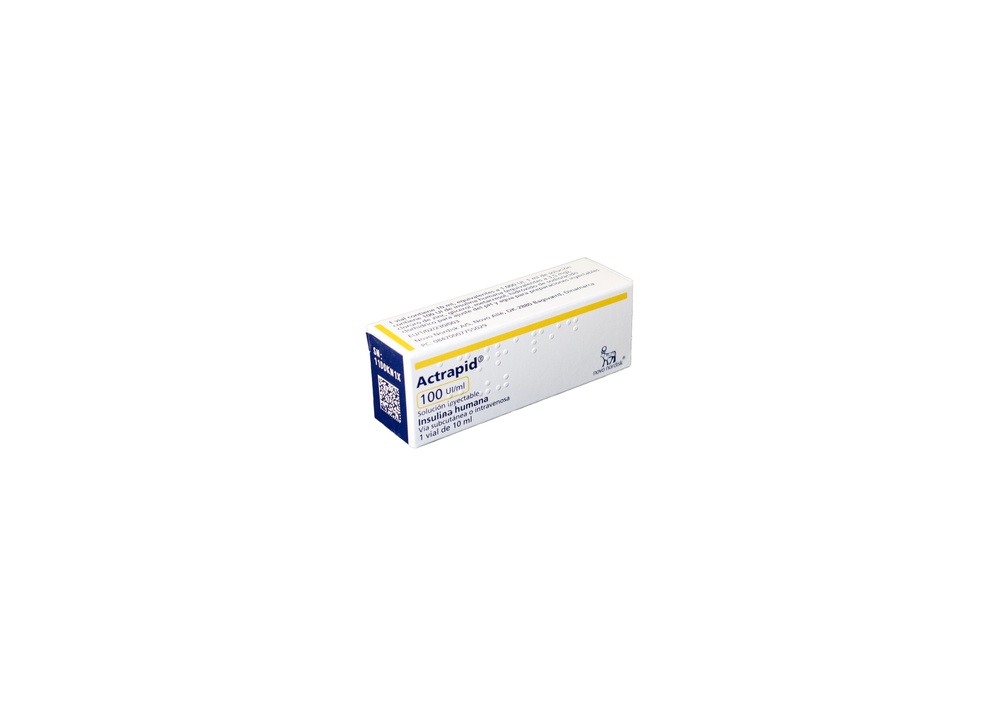
ACTRAPID 100 UI/ML SOLUCIÓN INYECTABLE EN UN VIAL

Revisión de receta online
Un médico revisará tu caso y determinará si la prescripción es médicamente apropiada.

Habla con un médico sobre este medicamento
Comenta tus síntomas y las opciones de tratamiento en una consulta online.



Cómo usar ACTRAPID 100 UI/ML SOLUCION INYECTABLE EN UN VIAL
Contenido del prospecto
- Introducción
- Qué es Actrapid y para qué se utiliza
- Qué necesita saber antes de empezar a usar Actrapid
- Cómo usar Actrapid
- Posibles efectos adversos
- Conservación de Actrapid
- Contenido del envase e información adicional
Introducción
Prospecto: información para el usuario
Actrapid 100UI/ml(unidades internacionales/ml) solución inyectable en vial
insulina humana
Lea todo el prospecto detenidamente antes de empezar a usar este medicamento, porque contiene información importante para usted.
- Conserve este prospecto, ya que puede tener que volver a leerlo.
- Si tiene alguna duda, consulte a su médico, farmacéutico o enfermero.
- Este medicamento se le ha recetado solamente a usted, y no debe dárselo a otras personas aunque tengan los mismos síntomas que usted, ya que puede perjudicarles.
- Si experimenta efectos adversos, consulte a su médico, farmacéutico o enfermero, incluso si se trata de efectos adversos que no aparecen en este prospecto. Ver sección 4.
1. Qué es Actrapid y para qué se utiliza
Actrapid es una insulina humana de acción rápida.
Actrapid se utiliza para reducir los niveles elevados de azúcar en sangre en pacientes con diabetes mellitus (diabetes). La diabetes es una enfermedad en la que su organismo no produce suficiente insulina para controlar el nivel de azúcar en sangre. El tratamiento con Actrapid ayuda a prevenir las complicaciones de la diabetes.
Actrapid empieza a reducir su nivel de azúcar en sangre unos 30 minutos después de la inyección y el efecto dura aproximadamente unas 8 horas. Actrapid se suele administrar en combinación con preparados de insulina de acción intermedia o prolongada

¿No estás seguro de si este medicamento es adecuado para ti?
Comenta tus síntomas y tratamiento con un médico online.
2. Qué necesita saber antes de empezar a usar Actrapid
No use Actrapid
?Si es alérgico a la insulina humana o a alguno de los demás componentes de este medicamento, ver sección 6.
?Si sospecha que está empezando a sufrir hipoglucemia (bajo nivel de azúcar en sangre), ver Resumen de efectos adversos graves y muy frecuentes en la sección 4.
? En bombas de perfusión de insulina.
?Si el capuchón protector está suelto o falta. Cada vial lleva un capuchón protector de plástico de seguridad. Si el capuchón no está en perfectas condiciones al adquirir el vial, devuelva el vial a su proveedor.
?Si no se ha almacenado correctamente o se ha congelado, ver sección 5.
? Si la insulina no tiene un aspecto transparente e incoloro.
Si se da cualquiera de estas circunstancias, no use Actrapid. Consulte a su médico, farmacéutico o enfermero.
Antes de usar Actrapid
? Compruebe la etiqueta para asegurarse de que es el tipo de insulina correcto.
? Retire el capuchón protector.
? Utilice siempre una aguja nueva para cada inyección con el fin de evitar la contaminación.
? Las agujas y jeringas no se deben compartir.
Advertencias y precauciones
Algunas alteraciones y actividades pueden afectar a sus necesidades de insulina. Consulte a su médico:
?Si tiene problemas con el riñón, el hígado, las glándulas suprarrenales, pituitaria o tiroidea.
?Si hace más ejercicio físico de lo normal o si desea cambiar su dieta habitual, ya que ello puede afectar a su nivel de azúcar en sangre.
?Si está enfermo, debe seguir usando la insulina y consultar a su médico.
?Si va a viajar al extranjero, viajar a distintas zonas horarias puede afectar a su requerimiento de insulina y al momento de administración de la misma.
Cambios en la piel en el punto de inyección
Se debe rotar el punto de inyección para ayudar a evitar cambios en el tejido adiposo, como engrosamiento de la piel, encogimiento de la piel o bultos bajo la piel. La insulina puede no funcionar muy bien si se inyecta en una zona abultada, encogida o engrosada (ver sección 3). Informe a su médico si detecta cualquier cambio en la zona de inyección. Informe a su médico si actualmente está inyectándose en estas zonas afectadas, antes de comenzar a inyectarse en una zona distinta. Su médico puede indicarle que compruebe sus niveles de azúcar en sangre más de cerca, y que ajuste la insulina o la dosis de sus otras medicaciones antidiabéticas.
Otros medicamentos y Actrapid
Informe a su médico, farmacéutico o enfermero si está tomando, ha tomado recientemente o pudiera tener que tomar cualquier otro medicamento.
Algunos medicamentos afectan a su nivel de azúcar en sangre, y esto puede implicar que su dosis de insulina se tenga que modificar. A continuación se indican los medicamentos más comunes que pueden afectar a su tratamiento insulínico.
Su nivel de azúcar en sangre puede disminuir (hipoglucemia) si toma:
- Otros medicamentos para el tratamiento de la diabetes
- Inhibidores de la monoamino oxidasa (IMAO) (utilizados para tratar la depresión)
- Betabloqueantes (utilizados para tratar la tensión arterial alta)
- Inhibidores de la enzima conversora de la angiotensina (IECA) (utilizados para tratar ciertas afecciones cardiacas o la tensión arterial alta)
- Salicilatos (utilizados para aliviar el dolor y bajar la fiebre)
- Esteroides anabolizantes (como la testosterona)
- Sulfonamidas (utilizadas para tratar infecciones).
Su nivel de azúcar en sangre puede aumentar (hiperglucemia) si toma:
- Anticonceptivos orales (píldora anticonceptiva)
- Tiazidas (utilizadas para tratar la tensión arterial alta o una retención de líquidos excesiva)
- Glucocorticoides (como la cortisona, utilizada para tratar la inflamación)
- Hormona tiroidea (utilizada para tratar trastornos de la glándula tiroidea)
- Simpaticomiméticos (como epinefrina [adrenalina], salbutamol o terbutalina, utilizados para tratar el asma)
- Hormona de crecimiento (medicamento para estimular el crecimiento óseo y somático y con influencia significativa en los procesos metabólicos del organismo)
- Danazol (medicamento que actúa sobre la ovulación).
La octreotida y la lanreotida (utilizadas para el tratamiento de la acromegalia, un trastorno hormonal poco frecuente que suele darse en adultos de mediana edad, provocado por un exceso de producción de hormona de crecimiento en la glándula pituitaria) pueden aumentar o disminuir el nivel de azúcar en sangre.
Los betabloqueantes (utilizados para tratar la tensión arterial alta) pueden debilitar o suprimir por completo los primeros síntomas de advertencia que ayudan a reconocer un nivel de azúcar en sangre bajo.
Pioglitazona (comprimidos utilizados para el tratamiento de la diabetes tipo 2)
Algunos pacientes con diabetes tipo 2 de larga duración y enfermedad cardiaca o ictus previo que fueron tratados con pioglitazona e insulina desarrollaron insuficiencia cardiaca. Informe a su médico, lo antes posible, si tiene signos de insuficiencia cardiaca tales como una inusual falta de aire, aumento rápido de peso o inflamación localizada (edema).
Si ha tomado alguno de los medicamentos de esta lista, informe a su médico, farmacéutico o enfermero.
Uso de Actrapid con alcohol
? Si bebe alcohol, sus necesidades de insulina pueden cambiar, ya que el nivel de azúcar en sangre puede aumentar o disminuir. Se recomienda seguir un control estricto.
Embarazo y lactancia
? Si está embarazada, cree que podría estar embarazada o tiene intención de quedarse embarazada, consulte a su médico antes de utilizar este medicamento. Actrapid se puede usar durante el embarazo. Puede que sea necesario modificar la dosis de insulina durante el embarazo y tras el parto. Llevar un control estricto de la diabetes, sobre todo para prevenir la hipoglucemia, es importante para la salud de su bebé.
? No hay restricciones en el tratamiento con Actrapid durante la lactancia.
Consulte a su médico, farmacéutico o enfermero antes de utilizar este medicamento durante el embarazo o el periodo de lactancia.
Conducción y uso de máquinas
?Pregunte a su médico si puede conducir vehículos o manejar una máquina:
- Si sufre episodios frecuentes de hipoglucemia.
- Si le resulta difícil reconocer los síntomas de la hipoglucemia.
Si su nivel de azúcar en sangre es alto o bajo, puede afectar a su concentración y capacidad de reacción y, por tanto, también a su capacidad para conducir o manejar una máquina. Tenga en cuenta que se puede poner en peligro a sí mismo o a los demás.
Actrapid contiene sodio
Actrapid contiene menos de 1 mmol de sodio (23 mg) por dosis; esto es, esencialmente “exento de sodio”.
3. Cómo usar Actrapid
Dosis y cuándo usar la insulina
Siga exactamente las instrucciones de administración de este medicamento y la dosis indicada por su médico. En caso de duda, consulte de nuevo a su médico, farmacéutico o enfermero.
Tome alimentos que contengan hidratos de carbono en los 30 minutos siguientes a la inyección para evitar un descenso en el nivel de azúcar en sangre.
No cambie de insulina a menos que su médico se lo indique. Si éste le cambia de un tipo o marca de insulina a otro, es posible que deba realizar un ajuste de la dosis.
Uso en niños y adolescentes
Actrapid se puede utilizar en niños y adolescentes.
Uso en grupos de pacientes especiales
Si tiene insuficiencia renal o hepática o si es mayor de 65 años, debe comprobar su nivel de azúcar en sangre con mayor regularidad y hablar con su médico sobre los posibles cambios en la dosis de insulina.
Cómo y dónde inyectar la insulina
Actrapid se administra mediante inyección bajo la piel (administración subcutánea). Nunca debe inyectarse directamente en una vena (inyección intravenosa) o músculo (inyección intramuscular). Si es necesario, puede administrarse directamente en una vena, pero esto solo deben hacerlo profesionales sanitarios.
Con cada inyección, cambie el punto de inyección dentro de la zona determinada de la piel que utilice. Esto puede reducir el riesgo de desarrollar abultamientos y depresiones en la piel, ver sección 4. Las mejores zonas para la inyección son las siguientes: la parte delantera de la cintura (abdomen), la región glútea, la parte frontal del muslo o la parte superior del brazo. El efecto de la insulina será más rápido si se realiza la inyección en la cintura (abdomen). Debe medir su nivel de azúcar en sangre con regularidad.
Cómo usar Actrapid
Los viales de Actrapid deben utilizarse con jeringas de insulina graduadas con la escala de unidades correspondiente.
Si solo usa un tipo de insulina
- Extraiga en la jeringa la misma cantidad de aire que la dosis de insulina que vaya a inyectarse. Inyecte el aire en el vial.
- Dé la vuelta al vial y a la jeringa y extraiga en esta la dosis adecuada de insulina. Retire la aguja del vial. A continuación, extraiga el aire de la jeringa y compruebe que la dosis es correcta.
Si tiene que mezclar dos tipos de insulina
- Justo antes del uso, haga girar entre sus manos el vial de insulina de acción intermedia o prolongada (lechosa) hasta que el líquido tenga un aspecto blanco y turbio uniforme.
- Extraiga en la jeringa la misma cantidad de aire que la dosis de insulina de acción intermedia o prolongada. Inyecte el aire en el vial que contiene la insulina de acción intermedia o prolongada y retire la aguja.
- Extraiga en la jeringa la misma cantidad de aire que la dosis de Actrapid. Inyecte el aire en el vial que contiene Actrapid. A continuación, dé la vuelta al vial y a la jeringa y extraiga la dosis prescrita de Actrapid. Extraiga el aire de la jeringa y compruebe que la dosis es correcta.
- Inserte la aguja en el vial de insulina de acción intermedia o prolongada, dé la vuelta al vial y a la jeringa y extraiga la dosis que se le haya prescrito. Extraiga el aire de la jeringa y compruebe que la dosis es correcta. Inyecte la mezcla inmediatamente.
- Mezcle siempre en el mismo orden Actrapid y la insulina de acción intermedia o prolongada.
Cómo inyectar Actrapid
?La insulina debe inyectarse bajo su piel. Utilice la técnica de inyección aconsejada por su médico o enfermero.
?Mantenga la aguja bajo la piel al menos durante 6 segundos para asegurarse de que se ha inyectado toda la insulina.
? Deseche la aguja y la jeringa después de cada inyección.
Si usa más insulina de la que debe
Si usa demasiada insulina, su nivel de azúcar en sangre descenderá en exceso (hipoglucemia). Ver Resumen de efectos adversos graves y muy frecuentes en la sección 4.
Si olvidó usar lainsulina
Si olvida usar la insulina, su nivel de azúcar en sangre puede subir en exceso (hiperglucemia). Ver Efectos derivados de la diabetes en la sección 4.
Si interrumpe el tratamiento con insulina
No deje de usar la insulina sin hablar antes con su médico, quien le indicará lo que debe hacer. Dejar la insulina puede provocar un aumento excesivo del nivel de azúcar en sangre (hiperglucemia grave) y cetoacidosis. Ver Efectos derivados de la diabetes en la sección 4.
Si tiene cualquier otra duda sobre el uso de este medicamento, pregunte a su médico, farmacéutico o enfermero.

¿Has empezado a tomar el medicamento y tienes preguntas?
Comenta tus síntomas y tratamiento con un médico online.
4. Posibles efectos adversos
Al igual que todos los medicamentos, este medicamento puede producir efectos adversos, aunque no todas las personas los sufran.
Resumen de efectos adversos graves y muy frecuentes
El descenso del nivel de azúcar en sangre (hipoglucemia)es un efecto adverso muy frecuente. Puede afectar a más de 1 de cada 10 personas.
El nivel de azúcar en sangre puede descender si:
- Se inyecta demasiada insulina.
- Come muy poco o se salta una comida.
- Hace más ejercicio físico de lo habitual.
- Bebe alcohol, ver Uso de Actrapid con alcohol en la sección 2.
Signos de un descenso en el nivel de azúcar en sangre: sudor frío, piel fría y pálida, dolor de cabeza, latido cardiaco acelerado, sensación de malestar, apetito excesivo, trastornos visuales temporales, somnolencia, cansancio y debilidad no habituales, nerviosismo o temblor, ansiedad, confusión y dificultad de concentración.
Un descenso grave en el nivel de azúcar en sangre puede llevar a la pérdida de consciencia. Si el bajo nivel prolongado de azúcar en sangre no se trata, puede causar daño cerebral (transitorio o permanente) e incluso la muerte. Puede recuperar el conocimiento más rápidamente si le administra una inyección de glucagón una persona que sepa cómo hacerlo. Si le administran glucagón, debe tomar también glucosa o un producto azucarado tan pronto como recupere el conocimiento. Si no responde al tratamiento con glucagón, debe acudir inmediatamente a un hospital.
Qué hacer si sufre un descenso en el nivel de azúcar en sangre:
? Si sufre un descenso en el nivel de azúcar en sangre, ingiera pastillas de glucosa u otro producto con gran contenido en azúcar (por ejemplo, caramelos, galletas, zumo de frutas). Mida su nivel de azúcar en sangre, si es posible, y descanse. Lleve siempre consigo pastillas de glucosa o productos con un gran contenido en azúcar, por si acaso.
? Cuando los síntomas del nivel bajo de azúcar en sangre hayan desaparecido o cuando su nivel de azúcar en sangre se haya estabilizado, continúe con el tratamiento con insulina de la forma habitual.
? Si su nivel de azúcar en sangre es tan bajo que llega a desmayarse, si ha necesitado una inyección de glucagón o si ha sufrido muchos episodios de nivel bajo de azúcar en sangre, hable con su médico. Es posible que tenga que ajustar la dosis o frecuencia de administración de la insulina, sus hábitos de alimentación o el ejercicio.
Indique a las personas pertinentes que tiene diabetes y cuáles pueden ser las consecuencias, como el riesgo de desmayarse (perder la consciencia) debido a un bajo nivel de azúcar en sangre. Hágales saber que, si se desmaya, deben girarle sobre un costado y pedir ayuda médica de inmediato. No deben suministrarle alimentos o bebidas, porque se puede asfixiar.
La reacción alérgica gravea Actrapid o a uno de sus componentes (llamada reacción alérgica sistémica) es un efecto adverso muy raro, pero que puede llegar a ser letal. Puede afectar hasta 1 de cada 10.000 personas.
Consulte inmediatamente al médico:
- Si los síntomas de alergia se extienden a otras partes del cuerpo.
- Si de repente se siente enfermo y tiene sudores, sensación de malestar (vómitos), dificultad para respirar, latido cardiaco acelerado y la sensación de que va a perder el conocimiento.
? Si nota cualquiera de estos síntomas, busque ayuda médica de inmediato.
Cambios en la piel en el punto de inyección: Si se inyecta insulina en el mismo lugar, el tejido graso se puede encoger (lipoatrofia) o hacerse más grueso (lipohipertrofia) (puede afectar hasta 1 de cada 100 personas). Los bultos bajo la piel también pueden producirse por la acumulación de una proteína denominada amiloide (amiloidosis cutánea; no se sabe con qué frecuencia se produce esto). La insulina puede no funcionar muy bien si se inyecta en una zona abultada, encogida o engrosada. Cambie el punto de inyección para ayudar a evitar estos cambios en la piel.
Lista de otros efectos adversos
Efectos adversos poco frecuentes
Pueden afectar hasta 1 de cada 100 personas.
Síntomas de alergia:pueden producirse reacciones alérgicas locales (dolor, enrojecimiento, ronchas, inflamación, hematoma, hinchazón y picor) en el punto de inyección. Suelen desaparecer a las pocas semanas de empezar a usar la insulina. Si no desaparecen, o si se extienden por todo el cuerpo, hable de inmediato con su médico. Consulte también las reacciones alérgicas graves que se indican anteriormente.
Problemas de visión:al empezar el tratamiento con insulina, este puede afectar a su visión, pero, por lo general, solo de forma temporal.
Inflamación de las articulaciones:al empezar el tratamiento con insulina, la acumulación de líquido puede causar inflamación de los tobillos y otras articulaciones. Este efecto suele desaparecer rápidamente. De no ser así, hable con su médico.
Neuropatía dolorosa(dolor debido a daño en los nervios): si su nivel de azúcar en sangre mejora muy rápidamente, es posible que sufra dolor relacionado con los nervios. Es lo que se conoce como neuropatía dolorosa aguda y suele ser transitoria.
Efectos adversos muy raros
Pueden afectar hasta 1 de cada 10.000 personas.
Retinopatía diabética(enfermedad ocular relacionada con la diabetes que puede llevar a la pérdida de visión): si tiene retinopatía diabética y su nivel de azúcar en sangre mejora muy rápido, la retinopatía puede empeorar. En este caso debe consultar con su médico.
Comunicación de efectos adversos
Si experimenta cualquier tipo de efecto adverso, consulte a su médico, farmacéutico o enfermero, incluso si se trata de posibles efectos adversos que no aparecen en este prospecto. También puede comunicarlos directamente a través del Sistema Español de Farmacovigilancia de Medicamentos de Uso Humano: www.notificaRAM.es. Mediante la comunicación de efectos adversos usted puede contribuir a proporcionar más información sobre la seguridad de este medicamento.
Efectos derivados de la diabetes
Nivel elevado de azúcar en sangre (hiperglucemia)
Puede experimentar un nivel elevado de azúcar en sangre si:
- No se ha inyectado suficiente insulina.
- Olvida inyectarse la insulina o deja de usarla.
- Se inyecta repetidamente menos insulina de la que necesita.
- Sufre una infección y/o fiebre.
- Come más de lo habitual.
- Hace menos ejercicio físico de lo habitual.
Síntomas de advertencia de un nivel elevado de azúcar en sangre:
Los síntomas de aviso aparecen gradualmente e incluyen orina abundante, sed, pérdida de apetito, sensación de malestar (náuseas y vómitos), somnolencia o cansancio, piel seca y enrojecida, sequedad de boca y aliento con olor afrutado (acetona).
Qué hacer si sufre un aumento en el nivel de azúcar en sangre:
? Si sufre alguno de los síntomas anteriormente indicados: compruebe su nivel de azúcar en sangre y el nivel de cetonas en la orina, si es posible, y, a continuación, busque ayuda médica de inmediato.
? Pueden ser síntomas de una afección muy grave llamada cetoacidosis diabética (formación de ácido en la sangre debido a que el organismo está descomponiendo grasa en lugar de azúcar). Si no se trata, podría producir un coma diabético e incluso la muerte.
5. Conservación de Actrapid
Mantener este medicamento fuera de la vista y del alcance de los niños.
No utilice este medicamento después de la fecha de caducidad que aparece en la etiqueta y el embalaje del vial después de CAD. La fecha de caducidad es el último día del mes que se indica.
Antes de la apertura:conservar en nevera (entre 2°C y 8°C). Mantener alejado del elemento refrigerador. No congelar.
Durante el uso o si se lleva de repuesto:no refrigerar o congelar. Se puede llevar encima y conservar a temperatura ambiente (por debajo de 25°C) hasta 6 semanas.
Conservar siempre el vial en el embalaje exterior, cuando no se esté utilizando, para protegerlo de la luz.
Desechar la aguja y la jeringa después de cada inyección.
Los medicamentos no se deben tirar por los desagües ni a la basura. Pregunte a su farmacéutico cómo deshacerse de los envases y de los medicamentos que ya no necesita. De esta forma, ayudará a proteger el medio ambiente.
6. Contenido del envase e información adicional
Composición de Actrapid
- El principio activo es insulina humana. Cada ml contiene 100 UI de insulina humana. Cada vial contiene 1.000 UI de insulina humana en 10 ml de solución inyectable.
- Los demás componentes son cloruro de zinc, glicerol, metacresol, hidróxido de sodio, ácido clorhídrico y agua para preparaciones inyectables.
Aspecto del producto y contenido del envase
Actrapid se presenta como solución inyectable.
Tamaños de envases de 1 o 5 viales de 10 ml o envase múltiple de 5 envases de 1 vial de 10 ml. Puede que solamente estén comercializados algunos tamaños de envases.
La solución es transparente e incolora.
Titular de la autorización de comercialización
Novo Nordisk A/S, Novo Allé, DK-2880 Bagsværd, Dinamarca
Responsable de la fabricación
El responsable de la fabricación puede identificarse por el número de lote impreso en la tapa del envase de cartón y en la etiqueta:
- Si el segundo y tercer caracteres son S6 o ZF, el responsable de la fabricación es Novo Nordisk A/S, Novo Allé, DK-2880 Bagsværd, Dinamarca.
- Si el segundo y tercer caracteres son T6, el responsable de la fabricación es Novo Nordisk Production SAS, 45 Avenue d’Orléans, F-28000 Chartres, Francia.
Fecha de la última revisión de este prospecto:
Otras fuentes de información
La información detallada de este medicamento está disponible en la página web de la Agencia Europea de Medicamentos: http://www.ema.europa.eu.
- País de registro
- Forma farmacéuticaINYECTABLE, 100 U/ml
- Código ATCA10AB01
- Principio activo
- Requiere recetaSí
- Fabricante
- ComposiciónGLICEROL (E 422) (0 - mg), HIDROXIDO DE SODIO (E 524) (0 - mg)
- Esta información es de carácter general y no sustituye la consulta con un profesional sanitario.
- Alternativas a ACTRAPID 100 UI/ML SOLUCION INYECTABLE EN UN VIALForma farmacéutica: INYECTABLE, 100 U/mlPrincipio activo: insulina humanaFabricante: Novo Nordisk A/SRequiere recetaForma farmacéutica: INYECTABLE, 100 UI/MLPrincipio activo: insulina humanaFabricante: Lilly S.A.Requiere recetaForma farmacéutica: INYECTABLE, 100 UI/mlPrincipio activo: insulina humanaFabricante: Sanofi-Aventis Deutschland GmbhRequiere receta
Médicos online para ACTRAPID 100 UI/ML SOLUCION INYECTABLE EN UN VIAL
Comenta la dosis, los posibles efectos secundarios, interacciones, contraindicaciones o la revisión de receta de ACTRAPID 100 UI/ML SOLUCION INYECTABLE EN UN VIAL, sujeto a valoración médica y a la normativa local.









Obtén una receta de ACTRAPID 100 UI/ML SOLUCION INYECTABLE EN UN VIAL online
Rellena un formulario de 2 minutos
Cuéntanos tus síntomas, historial y el medicamento que necesitas.
Elige un médico o nosotros te asignamos uno
Escoge un especialista o te conectamos con el próximo médico disponible.
El médico revisa tu caso
Normalmente en 30 minutos. Puede hacerte preguntas adicionales por chat.
Recógela en cualquier farmacia
Receta electrónica enviada a tu correo, válida en toda España.
Preguntas frecuentes
ACTRAPID 100 UI/ML SOLUCION INYECTABLE EN UN VIAL requiere receta en España. Puedes confirmarlo con un médico online según tu caso.
El principio activo de ACTRAPID 100 UI/ML SOLUCION INYECTABLE EN UN VIAL es insulina humana. Esta información ayuda a identificar medicamentos con la misma composición pero con diferentes nombres comerciales.
ACTRAPID 100 UI/ML SOLUCION INYECTABLE EN UN VIAL es fabricado por Novo Nordisk A/S. La marca y el envase pueden variar según el distribuidor.
Los Médicos de familia, Psiquiatras, Dermatólogos, Cardiólogos, Endocrinólogos, Gastroenterólogos, Neumólogos, Nefrólogos, Reumatólogos, Hematólogos, Infectólogos, Alergólogos, Geriatras, Pediatras, Oncólogos pueden valorar la prescripción de ACTRAPID 100 UI/ML SOLUCION INYECTABLE EN UN VIAL cuando esté clínicamente indicado. Puedes reservar una videoconsulta para comentar tu caso y las opciones de tratamiento.
España cuenta con una infraestructura sanitaria bien desarrollada en ciudades principales como Madrid, Barcelona, Valencia y Sevilla. Las farmacias están ampliamente disponibles y operan bajo estrictas regulaciones, garantizando el acceso a medicamentos con receta.
Puedes comprar ACTRAPID 100 UI/ML SOLUCION INYECTABLE EN UN VIAL en Madrid, Barcelona, Sevilla o Valencia en cualquier farmacia local con una receta válida.
Para obtener una receta, puedes utilizar Oladoctor:
Otros medicamentos con el mismo principio activo (insulina humana) incluyen ACTRAPID INNOLET 100 UI/ML SOLUCION INYECTABLE EN UNA PLUMA PRECARGADA, HUMULINA REGULAR 100 UI/ML SOLUCION INYECTABLE EN VIAL, INSUMAN INFUSAT 100 UI/ml SOLUCION INYECTABLE EN UN CARTUCHO. Pueden tener diferentes nombres comerciales o formulaciones, pero contienen el mismo componente terapéutico. Consulta siempre con un médico antes de cambiar o iniciar un nuevo medicamento.
