


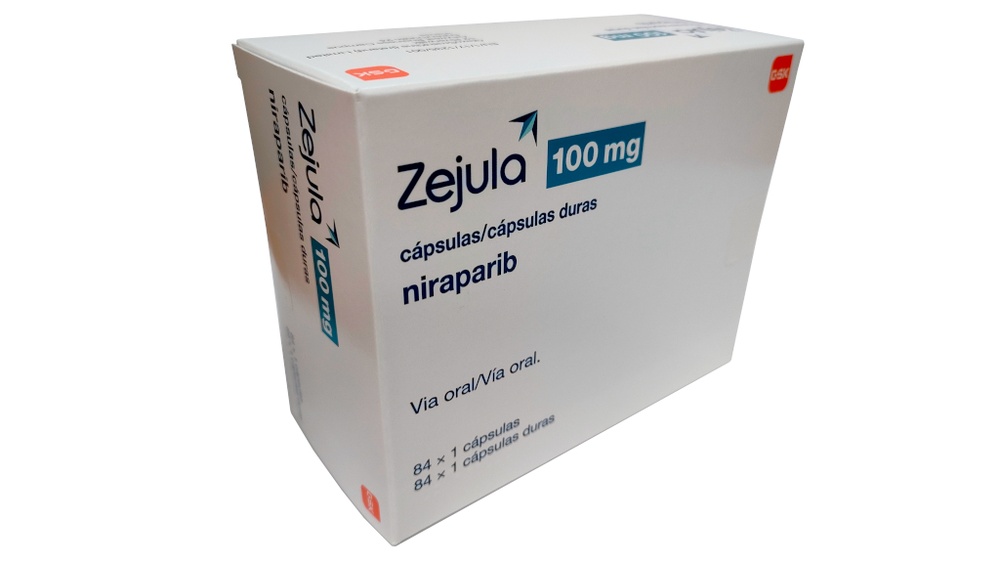
Zejula 100 mg cápsulas duras

Prescription review online
A doctor will review your case and decide whether a prescription is medically appropriate.

Talk to a doctor about this medicine
Discuss your symptoms and possible next steps in a quick online consultation.



How to use ZEJULA 100 mg HARD CAPSULES
Contents of the leaflet
- Introduction
- What is Zejula and what is it used for
- What you need to know before you take Zejula
- How to take Zejula
- Possible side effects
- Storage of Zejula
- Container contents and additional information
Introduction
Package Leaflet: Information for the Patient
Zejula 100mg hard capsules
niraparib
Read all of this leaflet carefully before you start taking this medicine because it contains important information for you.
- Keep this leaflet, you may need to read it again.
- If you have any further questions, ask your doctor, pharmacist, or nurse.
‑ This medicine has been prescribed for you only. Do not pass it on to others. It may harm them, even if their signs of illness are the same as yours.
- If you experience any side effects, talk to your doctor, pharmacist, or nurse. This includes any possible side effects not listed in this leaflet. See section 4.
Contents of the pack
- What is Zejula and what is it used for
- What you need to know before you take Zejula
- How to take Zejula
- Possible side effects
- Storage of Zejula
- Contents of the pack and further information
1. What is Zejula and what is it used for
What is Zejula and how does it work
Zejula contains the active substance called niraparib. Niraparib is a type of anticancer medicine called a PARP inhibitor. PARP inhibitors block an enzyme called poly(ADP-ribose) polymerase (PARP). PARP helps cells to repair damaged DNA, so blocking it means that DNA in cancer cells cannot be repaired. This leads to the death of cancer cells, helping to control the cancer.
What is Zejula used for
Zejula is used in adult women to treat ovarian cancer, fallopian tube cancer (a part of the female reproductive system that connects the ovaries to the uterus), or peritoneal cancer (the membrane that lines the abdomen).
Zejula is used for cancer that has:
- responded to previous treatment with platinum-based chemotherapy, or
- come back (recurred) after the cancer has responded to previous standard platinum-based chemotherapy.

Not sure if this medicine is right for you?
Discuss your symptoms and treatment with a doctor online.
2. What you need to know before you take Zejula
Do not take Zejula
- if you are allergic to niraparib or any of the other ingredients of this medicine (listed in section 6).
- if you are breast-feeding.
Warnings and precautions
Talk to your doctor, pharmacist, or nurse before you start taking this medicine or while you are taking it, if any of the following apply to you:
Low blood cell count
Zejula reduces the number of blood cells, such as red blood cells (anemia), white blood cells (neutropenia), or platelets (thrombocytopenia). Signs and symptoms to look out for include fever or infection, and bruising or abnormal bleeding (see section 4 for more information). Your doctor will regularly perform blood tests during your treatment.
Myelodysplastic syndrome/acute myeloid leukaemia
Rarely, a low blood cell count can be a sign of more serious problems with the bone marrow, such as "myelodysplastic syndrome" (MDS) or "acute myeloid leukaemia" (AML). Your doctor may want to examine your bone marrow to detect these problems.
High blood pressure
Zejula can cause an increase in blood pressure, which in some cases can be severe. Your doctor will regularly check your blood pressure during your treatment. They may also give you a medicine to treat high blood pressure and, if necessary, adjust your dose of Zejula. Your doctor may advise you to check your blood pressure at home and give you instructions to contact them if your blood pressure increases.
Posterior reversible encephalopathy syndrome (PRES)
A rare neurological side effect called PRES has been associated with Zejula treatment. If you have a headache, changes in vision, confusion, or seizures with or without high blood pressure, contact your doctor.
Children and adolescents
Children under 18 years should not take Zejula. This medicine has not been studied in this age group.
Other medicines and Zejula
Tell your doctor or pharmacist if you are taking, have recently taken, or might take any other medicines.
Zejula may affect how other medicines work. It is especially important to mention any medicine that contains the active substance metformin (used to lower blood sugar), as your doctor may need to adjust the dose of metformin.
Pregnancy
Do not take Zejula during pregnancy, as it may harm the baby. If you are pregnant, think you may be pregnant, or plan to become pregnant, talk to your doctor before taking this medicine.
If you are a woman who could become pregnant, you must use a highly effective method of birth control while taking Zejula and must continue to use a highly effective method of birth control for 6 months after taking the last dose. Your doctor will ask you to confirm that you are not pregnant through a pregnancy test before starting treatment. Contact your doctor immediately if you become pregnant while taking Zejula.
Breast-feeding
Do not take Zejula if you are breast-feeding, as it is not known whether it passes into breast milk. If you are breast-feeding, you must stop before starting to take Zejula and must not breast-feed again until 1 month after taking the last dose. Talk to your doctor before taking this medicine.
Driving and using machines
While taking Zejula, you may feel weak, dizzy, tired, or nauseous, and this may affect your ability to drive or use machines. Be careful when driving or using machines.
Zejula contains lactose
If your doctor has told you that you have an intolerance to some sugars, talk to them before taking this medicine.
Zejula contains tartrazine (E102)
It may cause allergic reactions.
3. How to take Zejula
Always take this medicine exactly as your doctor or pharmacist has told you. If you are not sure, talk to your doctor or pharmacist.
For ovarian cancer that has responded to first-line treatment with platinum-based chemotherapy
The recommended starting dose is 200 mg (two 100 mg capsules) taken together once a day, with or without food. If you weigh ≥ 77 kg and have a platelet count ≥ 150,000/μl before starting treatment, the recommended starting dose is 300 mg (three 100 mg capsules) taken together once a day, with or without food.
For ovarian cancer that has come back (recurred)
The recommended starting dose is 300 mg (three 100 mg capsules) taken together once a day, with or without food.
Take Zejula at about the same time every day. If you take Zejula at bedtime, it may help you cope with nausea.
Your doctor may adjust your starting dose if you have liver problems.
Swallow the capsules whole with some water. Do not chew or crush the capsules. This will ensure that the medicine works as well as possible.
Your doctor may recommend a lower dose if you experience side effects (such as nausea, tiredness, abnormal bleeding or bruising, or anemia).
Your doctor will see you regularly, and you will keep taking Zejula as long as you are benefiting from it and not experiencing unacceptable side effects.
If you take more Zejula than you should
If you take a higher dose than normal, talk to your doctor immediately.
If you forget to take Zejula
Do not take another dose if you forget a dose or vomit after taking Zejula. Take the next dose at the scheduled time. Do not take a double dose to make up for forgotten doses.
If you have any further questions on the use of this medicine, ask your doctor, pharmacist, or nurse.

Started taking the medicine and have questions?
Discuss your symptoms and treatment with a doctor online.
4. Possible side effects
Like all medicines, this medicine can cause side effects, although not everybody gets them.
Contact your doctor immediately if you notice any of the following serious side effects - you may need urgent medical treatment:
Very common(may affect more than 1 in 10 people)
- Bruising or bleeding for a longer time than usual if you are injured: these can be signs of a low platelet count (thrombocytopenia).
- Difficulty breathing, feeling very tired, pale skin, or a fast heart rate can be signs of a low red blood cell count (anemia).
- Fever or infection: a low white blood cell count (neutropenia) can increase the risk of infection. Signs may include fever, chills, feeling weak or confused, cough, pain or burning when urinating. Some infections can be serious and life-threatening.
- Low white blood cell count (leucopenia).
Common(may affect up to 1 in 10 people)
- Allergic reaction (including a severe allergic reaction that can be life-threatening). Signs include a raised, itchy rash (hives) and swelling, sometimes of the face or mouth (angioedema), which can cause difficulty breathing and collapse or loss of consciousness.
- Low blood cell count due to a problem with the bone marrow or blood cancer originating in the bone marrow, such as "myelodysplastic syndrome" (MDS) or "acute myeloid leukaemia" (AML).
Uncommon(may affect up to 1 in 100 people)
- Fever with a low white blood cell count (febrile neutropenia).
- Low red blood cell, white blood cell, and platelet count (pancytopenia).
Rare(may affect up to 1 in 1,000 people)
- A sudden increase in blood pressure, which can be a medical emergency that could cause organ damage or be life-threatening.
- A brain condition with symptoms including seizures (fits), headache, confusion, and changes in vision (posterior reversible encephalopathy syndrome or PRES), which is a medical emergency that could cause organ damage or be life-threatening.
Tell your doctor if you experience any other side effects. These may include:
Very common(may affect more than 1 in 10 people)
- Feeling sick (nausea)
- Low white blood cell count
- Low platelet count
- Low red blood cell count (anemia)
- Feeling tired
- Feeling weak
- Constipation
- Vomiting
- Stomach pain
- Difficulty sleeping
- Headache
- Loss of appetite
- Runny or stuffy nose
- Diarrhoea
- Shortness of breath
- Back pain
- Joint pain
- High blood pressure
- Indigestion (dyspepsia)
- Dizziness
- Cough
- Urinary tract infection
- Palpitations (feeling of rapid or irregular heartbeat).
Common(may affect up to 1 in 10 people)
- Sunburn-type reaction after exposure to light
- Swelling of the feet, ankles, legs, and/or hands
- Low potassium levels in the blood
- Inflammation or swelling of the airways between the mouth and nose and the lungs, bronchitis
- Feeling of abdominal bloating
- Feeling anxious, nervous, or restless
- Feeling sad, depressed
- Nosebleeds
- Weight loss
- Muscle pain
- Decline in concentration, understanding, memory, and thinking (cognitive impairment)
- Pink eyes (conjunctivitis)
- Fast heart rate that can cause dizziness, chest pain, or difficulty breathing
- Dry mouth
- Inflammation of the mouth and/or digestive tract
- Rash
- Increased blood test results
- Abnormal blood test results
- Unusual taste in the mouth.
Uncommon(may affect up to 1 in 100 people)
- State of confusion
- Inflammation of the lungs that can cause shortness of breath and difficulty breathing (non-infectious pneumonitis).
Reporting of side effects
If you experience any side effects, talk to your doctor, pharmacist, or nurse. This includes any possible side effects not listed in this leaflet. You can also report side effects directly via the national reporting system listed in Appendix V. By reporting side effects, you can help provide more information on the safety of this medicine.
5. Storage of Zejula
Keep this medicine out of the sight and reach of children.
Do not use this medicine after the expiry date which is stated on the carton after CAD and on the blister after EXP. The expiry date is the last day of the month shown.
Do not store above 30°C.
Medicines should not be disposed of via wastewater or household waste. Ask your pharmacist how to dispose of medicines no longer required. These measures will help protect the environment.
6. Container contents and additional information
Zejula composition
- The active substance is niraparib. Each hard capsule contains niraparib monohydrate tosilate equivalent to 100 mg of niraparib.
- The other components (excipients) are:
Capsule content: magnesium stearate, lactose monohydrate
Capsule shell: titanium dioxide (E 171), gelatin, brilliant blue FCF (E 133), erythrosine (E 127), tartrazine (E 102)
Printing ink: shellac (E 904), propylene glycol (E 1520), potassium hydroxide (E 525), black iron oxide (E 172), sodium hydroxide (E 524), povidone (E 1201), and titanium dioxide (E 171).
This medicinal product contains lactose and tartrazine. For more information, see section 2.
Appearance of Zejula and container contents
Zejula hard capsules have a white opaque body and a purple opaque cap. The body of the capsule, white opaque, is printed with "100 mg" in black ink, and the cap of the capsule, purple, is printed with "Niraparib" in white ink. The capsules contain a white to off-white powder.
The hard capsules are packaged in unit dose blister packs of:
- 84 × 1 hard capsules
- 56 × 1 hard capsules
- 28 × 1 hard capsules
Only some pack sizes may be marketed.
Marketing authorisation holder
GlaxoSmithKline (Ireland) Limited
12 Riverwalk
Citywest Business Campus
Dublin 24
Ireland
Manufacturer
GlaxoSmithKline Trading Services Ltd.
12 Riverwalk
Citywest Business Campus
Dublin 24
Ireland
You can request more information about this medicinal product by contacting the local representative of the marketing authorisation holder:
België/Belgique/Belgien GlaxoSmithKline Pharmaceuticals s.a./n.v. Tel: + 32 (0) 10 85 52 00 | Lietuva GlaxoSmithKline (Ireland) Limited Tel: + 370 80000334 |
| Luxembourg/Luxemburg GlaxoSmithKline Pharmaceuticals s.a./n.v. Belgique/Belgien Tel: + 32 (0) 10 85 52 00 |
Ceská republika GlaxoSmithKline, s.r.o. Tel: + 420 222 001 111 | Magyarország GlaxoSmithKline (Ireland) Limited Tel.: + 36 80088309 |
Danmark GlaxoSmithKline Pharma A/S Tlf.: + 45 36 35 91 00 | Malta GlaxoSmithKline (Ireland) Limited Tel: + 356 80065004 |
Deutschland GlaxoSmithKline GmbH & Co. KG Tel.: + 49 (0)89 36044 8701 | Nederland GlaxoSmithKline BV Tel: + 31 (0) 33 2081100 |
Eesti GlaxoSmithKline (Ireland) Limited Tel: + 372 8002640 | Norge GlaxoSmithKline AS Tlf: + 47 22 70 20 00 |
Ελλάδα GlaxoSmithKline Μονοπρ?σωπη A.E.B.E. Τηλ: + 30 210 68 82 100 | Österreich GlaxoSmithKline Pharma GmbH Tel: + 43 (0)1 97075 0 |
España GlaxoSmithKline, S.A. Tel: + 34 900 202 700 | Polska GSK Services Sp. z o.o. Tel.: + 48 (0)22 576 9000 |
France Laboratoire GlaxoSmithKline Tél: + 33 (0)1 39 17 84 44 | Portugal GlaxoSmithKline – Produtos Farmacêuticos, Lda. Tel: + 351 21 412 95 00 |
Hrvatska GlaxoSmithKline (Ireland) Limited Tel: +385 800787089 Ireland GlaxoSmithKline (Ireland) Limited Tel: + 353 (0)1 4955000 | România GlaxoSmithKline (Ireland) Limited Tel: + 40 800672524 Slovenija GlaxoSmithKline (Ireland) Limited Tel: + 386 80688869 |
Ísland Vistor ehf. Sími: + 354 535 7000 | Slovenská republika GlaxoSmithKline (Ireland) Limited Tel: + 421 800500589 |
Italia GlaxoSmithKline S.p.A. Tel: + 39 (0)45 7741111 | Suomi/Finland GlaxoSmithKline Oy Puh/Tel: + 358 (0)10 30 30 30 |
Κύπρος GlaxoSmithKline (Ireland) Limited Τηλ: + 357 80070017 | Sverige GlaxoSmithKline AB Tel: + 46 (0)8 638 93 00 |
Latvija GlaxoSmithKline (Ireland) Limited Tel: + 371 80205045 |
Date of last revision of this leaflet:
Other sources of information
Detailed information on this medicinal product is available on the European Medicines Agency website: https://www.ema.europa.eu.
- Country of registration
- Dosage formCAPSULE, 100 mg
- ATC codeL01XK02
- Active substance
- Prescription requiredYes
- Manufacturer
- CompositionLACTOSA MONOHIDRATO (254.50 mg mg)
- This information is for reference only and does not constitute medical advice. Always consult a doctor before taking any medication. Oladoctor is not responsible for medical decisions based on this content.
- Alternatives to ZEJULA 100 mg HARD CAPSULESDosage form: TABLET, 100 mgActive substance: niraparibManufacturer: Glaxosmithkline (Ireland) LimitedPrescription requiredDosage form: TABLET, 100 mg/500 mgActive substance: niraparib and abirateroneManufacturer: Janssen-Cilag International N.VPrescription requiredDosage form: TABLET, 50 mg/500 mgActive substance: niraparib and abirateroneManufacturer: Janssen-Cilag International N.VPrescription required
Online doctors for ZEJULA 100 mg HARD CAPSULES
Discuss questions about ZEJULA 100 mg HARD CAPSULES, including use, safety considerations and prescription review, subject to medical assessment and local regulations.
Frequently Asked Questions
ZEJULA 100 mg HARD CAPSULES requires a prescription in Spain. You can check with a doctor online whether this medicine may be appropriate for your situation.
The active ingredient in ZEJULA 100 mg HARD CAPSULES is niraparib. This information helps identify medicines with the same composition but different brand names.
ZEJULA 100 mg HARD CAPSULES is manufactured by Glaxosmithkline (Ireland) Limited. Pharmacy brands and packaging may differ depending on the distributor.
Doctors such as Family doctors, Psychiatrists, Dermatologists, Cardiologists, Endocrinologists, Gastroenterologists, Pulmonologists, Nephrologists, Rheumatologists, Hematologists, Infectious disease physicians, Allergists, Geriatricians, Paediatricians, Oncologists may assess whether ZEJULA 100 mg HARD CAPSULES is appropriate, depending on your situation and local regulations. You can book an online consultation to discuss your symptoms and possible next steps.
The prescription is issued by a doctor after assessing your health. In Spain, ZEJULA 100 mg HARD CAPSULES is then dispensed in pharmacies with that prescription. An online consultation does not guarantee that a prescription will be issued: the decision always rests with the doctor.
To request a review, you can use Oladoctor:
Other medicines with the same active substance (niraparib) include ZEJULA 100 MG FILM-COATED TABLETS, AKEEGA 100 MG/500 MG FILM-COATED TABLETS, AKEEGA 50 MG/500 MG FILM-COATED TABLETS. These may have different brand names or formulations but contain the same therapeutic ingredient. Always consult a doctor before switching or starting a new medicine.
