



VOKANAMET 150 mg/850 mg Film-Coated Tablets

Prescription review online
A doctor will review your case and decide whether a prescription is medically appropriate.

Talk to a doctor about this medicine
Discuss your symptoms and possible next steps in a quick online consultation.



How to use VOKANAMET 150 mg/850 mg FILM-COATED TABLETS
Contents of the leaflet
- Introduction
- What is Vokanamet and what is it used for
- What you need to know before you take Vokanamet
- How to take Vokanamet
- Possible Adverse Effects
- Storage of Vokanamet
- Package Contents and Additional Information
Introduction
Package Leaflet: Information for the Patient
Vokanamet 50 mg/850 mg film-coated tablets
Vokanamet 50 mg/1,000 mg film-coated tablets
Vokanamet 150 mg/850 mg film-coated tablets
Vokanamet 150 mg/1,000 mg film-coated tablets
canagliflozin/metformin hydrochloride
Read all of this leaflet carefully before you start taking this medicine because it contains important information for you.
- Keep this leaflet, you may need to read it again.
- If you have any further questions, ask your doctor, pharmacist, or nurse.
- This medicine has been prescribed for you only. Do not pass it on to others. It may harm them, even if their signs of illness are the same as yours.
- If you get any side effects, talk to your doctor, pharmacist, or nurse. This includes any possible side effects not listed in this leaflet. See section 4.
Contents of the pack
- What is Vokanamet and what is it used for
- What you need to know before you take Vokanamet
- How to take Vokanamet
- Possible side effects
- Storage of Vokanamet
- Contents of the pack and other information
1. What is Vokanamet and what is it used for
Vokanamet contains two different active substances, canagliflozin and metformin. These are two medicines that work together in different ways to lower blood sugar levels and may help prevent heart disease in adults with type 2 diabetes.
This medicine is given alone or in combination with other medicines that you may already be taking to treat your type 2 diabetes (such as insulin, a DPP-4 inhibitor [such as sitagliptin, saxagliptin, or linagliptin], a sulfonylurea [such as glimepiride or glipizide], or pioglitazone) that lower blood sugar levels. You may already be taking one or more of these medicines to treat your type 2 diabetes. Vokanamet is used when your blood sugar levels cannot be controlled adequately with metformin alone or in combination with other diabetes medicines. If you are already taking canagliflozin and metformin as separate tablets, Vokanamet may replace them in a single tablet.
It is important that you do not stop following the advice about diet and exercise given to you by your doctor or nurse.
What is type 2 diabetes?
Type 2 diabetes is a disorder in which the body does not make enough insulin and the insulin it produces does not work as well as it should. It can also be that your body makes too much sugar. When this happens, sugar (glucose) builds up in the blood. This can cause serious medical problems, such as heart disease, kidney disease, blindness, and amputations.

Not sure if this medicine is right for you?
Discuss your symptoms and treatment with a doctor online.
2. What you need to know before you take Vokanamet
Do not take Vokanamet
- if you are allergic to canagliflozin, metformin, or any of the other ingredients of this medicine (listed in section 6)
- if you have liver problems
- if you have severe kidney problems
- if you have uncontrolled diabetes with, for example, severe hyperglycemia (high blood sugar), nausea, vomiting, diarrhea, rapid weight loss, lactic acidosis (see "Risk of lactic acidosis" below), or ketoacidosis. Ketoacidosis is a condition in which substances called "ketone bodies" accumulate in the blood, which can lead to a pre-diabetic coma. Symptoms include stomach pain, rapid and deep breathing, drowsiness, or if your breath develops an unusual fruity odor
- if you have any severe infection
- if you have lost a lot of fluid from your body (dehydration), e.g., due to severe or prolonged diarrhea or if you have vomited several times in a row
- if you have a pre-diabetic coma
- if you have recently had a heart attack or have severe blood circulation problems, such as "shock" or breathing difficulties
- if you drink excessive amounts of alcohol (either every day or from time to time)
- if you have or have recently had heart failure.
Warnings and precautions
Risk of lactic acidosis
Vokanamet may cause a very rare but very serious side effect called lactic acidosis, especially if your kidneys are not working properly. The risk of developing lactic acidosis is also increased with uncontrolled diabetes, severe infections, prolonged fasting, or alcohol consumption, dehydration (see more information below), liver problems, and any medical condition in which a part of the body has a reduced oxygen supply (such as acute and severe heart disease).
If any of the above applies to you, consult your doctor for further instructions.
Stop taking Vokanamet temporarily if you have a condition that may be associated with dehydration(significant loss of body fluids), such as severe vomiting, diarrhea, fever, heat exposure, or if you drink less fluid than usual. Consult your doctor for further instructions.
Stop taking Vokanamet and talk to a doctor or go to the nearest hospital immediately if you experience any of the symptoms that lactic acidosis produces,as this condition can lead to a coma.
The symptoms of lactic acidosis include:
- vomiting
- stomach pain (abdominal pain)
- muscle cramps
- general feeling of discomfort, with intense tiredness
- difficulty breathing
- reduction of body temperature and heart rate
Lactic acidosis is a medical emergency and should be treated in a hospital.
Consult your doctor, pharmacist, or nurse before starting to take Vokanamet and during treatment:
- to know what you can do to prevent dehydration (see section 4 for symptoms of dehydration)
- if you have type 1 diabetes because Vokanamet should not be used to treat this disease
- if you experience rapid weight loss, feeling sick or being sick, stomach pain, excessive thirst, rapid and deep breathing, confusion, drowsiness, or unusual tiredness, sweet smell on your breath, sweet or metallic taste in your mouth, or different smell of your urine or sweat, talk to your doctor or go to the nearest hospital immediately. These symptoms may be signs of a "diabetic ketoacidosis" - a rare but serious, sometimes potentially fatal problem that you may have with diabetes due to increased levels of "ketone bodies" in your urine or blood, detected in analyzes. The risk of developing "diabetic ketoacidosis" may be increased with prolonged fasting, excessive alcohol consumption, dehydration, sudden reduction in insulin dose, or increased need for insulin due to major surgery or serious illness
- if you are going to undergo major surgery or a procedure that requires prolonged fasting, ask your doctor if you should stop taking Vokanamet and when you should start taking it again.
- if you have ever had severe heart disease or if you have had a stroke
- if you are taking medicines to lower your blood pressure (antihypertensives) or if you have ever had low blood pressure (hypotension). You can find more information in the section "Other medicines and Vokanamet"
- if you have had a lower limb amputation
- It is essential that you regularly check your feet and follow any other advice about foot care, in addition to proper hydration, that your doctor has indicated. You should immediately inform your doctor if you notice any wound or discoloration or if you experience any sensitivity or pain in your feet. Some studies indicate that taking canagliflozin may have contributed to the risk of lower limb amputation (mainly amputations of the toes and midfoot)
- Consult your doctor immediately if you present a combination of symptoms of pain, pain on palpation, redness, or inflammation of the genitals or the area between the genitals and the anus, with fever or general malaise. These symptoms could be a sign of a rare but serious, sometimes potentially fatal infection called necrotizing fasciitis of the perineum or Fournier's gangrene, which destroys tissue under the skin. Fournier's gangrene should be treated immediately.
- if you have symptoms of a fungal genital infection such as irritation, itching, unusual discharge, or odor.
- if you have a severe kidney or urinary tract infection with fever. Your doctor may ask you to stop taking Vokanamet until you have recovered.
Kidney function
You will have a kidney check through a blood test before starting to take Vokanamet. During treatment with Vokanamet, your doctor will check your kidney function at least once a year or more frequently if you are an elderly person and/or if your kidney function is worsening.
Surgery
If you need to undergo major surgery, you should stop taking Vokanamet during the procedure and for a period after it. Your doctor will decide when you should stop taking Vokanamet and when you should start taking it again.
Your doctor will decide if you need any other treatment to control your blood sugar while you stop taking Vokanamet. It is essential that you follow your doctor's instructions exactly.
Glucose in urine
Due to the way canagliflozin works, your urine will test positive for sugar (glucose) while you are taking this medicine.
Children and adolescents
Vokanamet is not recommended for children and adolescents under 18 years of age, as there is no data available for these patients.
Other medicines and Vokanamet
If you need to be given an injection of a contrast medium that contains iodine into your bloodstream, for example, in the context of an X-ray or scan, you should stop taking Vokanamet before the injection or at the time of the injection. Your doctor will decide when you should stop taking Vokanamet and when you should start taking it again.
Tell your doctor if you are taking, have recently taken, or might take any other medicines. You may need more frequent blood glucose and kidney function tests, or your doctor may need to adjust the dose of Vokanamet. It is especially important to mention the following:
- insulin or a sulfonylurea (such as glimepiride or glipizide) for diabetes - your doctor may decide to reduce the dose to avoid excessive lowering of blood sugar levels (hypoglycemia)
- medicines that increase urine production (diuretics)
- St. John's Wort or hypericum (a herbal medicine used to treat depression)
- carbamazepine, phenytoin, or phenobarbital (medicines used to control seizures)
- lithium (a medicine used to treat bipolar disorder)
- efavirenz or ritonavir (medicines used to treat HIV infection)
- rifampicin (an antibiotic used to treat tuberculosis)
- cholestyramine (a medicine used to lower blood cholesterol levels). See section 3, "How to take this medicine"
- digoxin or digitoxin (medicines used for certain heart problems). If you take Vokanamet, you may need to have your digoxin or digitoxin blood levels measured
- dabigatran (an anticoagulant medicine that reduces the risk of blood clots)
- medicines that contain alcohol. See section "Vokanamet with alcohol"
- cimetidine (a medicine used to treat stomach problems)
- corticosteroids (used to treat a range of disorders, such as severe skin inflammation or asthma) given by mouth, injection, or inhalation
- beta-2 agonists (such as salbutamol or terbutaline) used to treat asthma
- medicines used to treat pain and inflammation (NSAIDs and COX-2 inhibitors, such as ibuprofen and celecoxib)
- certain medicines used to treat high blood pressure (ACE inhibitors and angiotensin II receptor antagonists).
Taking Vokanamet with alcohol
Avoid excessive alcohol consumption while taking Vokanamet, as this may increase the risk of lactic acidosis (see section "Warnings and precautions").
Pregnancy and breastfeeding
If you are pregnant or breastfeeding, think you may be pregnant, or are planning to have a baby, ask your doctor or pharmacist for advice before taking or continuing to take this medicine.
Canagliflozin, one of the components of Vokanamet, should not be used during pregnancy. Ask your doctor about the best way to control your blood sugar without Vokanamet as soon as you know you are pregnant.
You should not take this medicine if you are breastfeeding. Ask your doctor if you should stop taking this medicine or if you should stop breastfeeding.
Driving and using machines
Vokanamet has no or negligible influence on the ability to drive, ride a bicycle, or use tools or machines. However, dizziness or drowsiness has been reported, which may affect your ability to drive, ride a bicycle, or use tools or machines.
Taking Vokanamet with other diabetes medicines called sulfonylureas (such as glimepiride or glipizide) or insulin may increase the risk of low blood sugar (hypoglycemia). Symptoms include blurred vision, tingling in the lips, tremors, sweating, pallor, mood change, anxiety, or confusion. All of this may affect your ability to drive, ride a bicycle, or use tools or machines. Tell your doctor as soon as possible if you have any symptoms of low blood sugar.
Vokanamet contains sodium
This medicine contains less than 1 mmol (23 mg) of sodium per tablet; this is essentially "sodium-free".
3. How to take Vokanamet

Started taking the medicine and have questions?
Discuss your symptoms and treatment with a doctor online.
Follow exactly the instructions of administration of this medicine given to you by your doctor or pharmacist. In case of doubt, consult your doctor or pharmacist again.
How much to take
- The dose of Vokanamet is one tablet twice a day.
- The concentration of Vokanamet that you should take will vary depending on your condition and the amount of canagliflozin and metformin needed to control your blood sugar.
- Your doctor will prescribe the correct dose for you.
How to take this medicine
- Swallow the tablet whole with water.
- It is best to take the tablet with a meal. This will reduce the likelihood of stomach upset.
- Try to take it at the same time every day. This will help you remember to take it.
- If your doctor has prescribed this medicine with a cholesterol-lowering medicine such as cholestyramine, you should take this medicine at least 1 hour before or 4 to 6 hours after taking the cholesterol-lowering medicine.
Your doctor may prescribe Vokanamet with another medicine to lower your blood sugar. Remember to take all your medicines as directed by your doctor to get the best results for your health.
Diet and exercise
To help control your diabetes, you should also follow the advice of your doctor, pharmacist, or nurse about diet and exercise. In particular, if you are following a weight-control diabetic diet, you should continue it while taking this medicine.
If you take more Vokanamet than you should
Since Vokanamet contains metformin, if you take more medicine than you should, you may develop lactic acidosis. If this happens to you, you may need immediate treatment in a hospital, as lactic acidosis can cause a coma. The symptoms of lactic acidosis include vomiting, stomach pain, muscle cramps, general feeling of discomfort with intense tiredness, or difficulty breathing. Other symptoms are a reduction in body temperature and heart rate. Stop taking this medicine immediately and contact a doctor or the nearest hospital (see section 2). Bring the medicine pack with you.
If you forget to take Vokanamet
- If you forget to take a dose, take it as soon as you remember. However, if it is already time for the next dose, skip the missed dose.
- Do not take a double dose to make up for the missed dose.
If you stop taking Vokanamet
Your blood sugar levels may rise if you stop taking this medicine. Do not stop taking this medicine without talking to your doctor first.
If you have any further questions on the use of this medicine, ask your doctor, pharmacist, or nurse.
4. Possible Adverse Effects
Like all medicines, this medicine can cause adverse effects, although not all people suffer from them.
Stop taking Vokanamet and talk to a doctor or go to the nearest hospital immediately if you notice any of the following serious adverse effects:
Severe allergic reaction (rare, may affect up to 1 in 1,000 people)
Possible symptoms of a severe allergic reaction may include:
- swelling of the face, lips, mouth, tongue, or throat that can cause difficulty breathing or swallowing.
Lactic acidosis (very rare, may affect up to 1 in 10,000 people)
Vokanamet may cause a very rare (may affect up to 1 user in 10,000), but very serious, adverse effect called lactic acidosis (see section "Warnings and precautions"). If this happens to you, you must stop taking Vokanamet and talk to a doctor or go to the nearest hospital immediately, as lactic acidosis can lead to coma.
Diabetic ketoacidosis (rare, may affect up to 1 in 1,000 people)
These are symptoms of diabetic ketoacidosis (see also section 2):
- increase in "ketone bodies" in your urine or blood
- rapid weight loss
- nausea or vomiting
- stomach pain
- excessive thirst
- rapid and deep breathing
- confusion
- unusual drowsiness or fatigue
- sweet smell in your breath, sweet taste or metallic taste in your mouth, or different smell of your urine or sweat.
This can occur regardless of blood glucose levels. Your doctor may decide to interrupt treatment with Vokanamet temporarily or permanently.
Dehydration (uncommon, may affect up to 1 in 100 people)
- excessive loss of fluids from your body (dehydration). This effect is more frequently observed in elderly people (75 years or older), people with kidney problems, and people taking diuretics
Possible symptoms of dehydration are:
- feeling of dizziness or lightheadedness
- loss of consciousness (fainting) or feeling of dizziness or fainting when standing up
- very dry or sticky mouth, intense feeling of thirst
- feeling of great tiredness or weakness
- little or no urination
- rapid heartbeat.
Report to your doctor as soon as possible if you experience any of the following adverse effects:
Hypoglycemia (very common, may affect more than 1 in 10 people)
- low blood sugar (hypoglycemia) - when taking this medicine with insulin or with a sulfonylurea (such as glimepiride or glipizide)
Possible symptoms of low blood sugar are:
- blurred vision
- tingling in the lips
- tremors, sweating, paleness
- change in mood or feeling of anxiety or confusion.
Your doctor will explain how to treat low blood sugar and what to do if you have any of the above symptoms.
Urinary tract infections (common, may affect up to 1 in 10 people)
- These are signs of a serious urinary tract infection, e.g.,
- fever and/or chills
- burning sensation when passing fluid (urinating)
- back or side pain.
Although rare, if you notice blood in your urine, inform your doctor immediately.
Other adverse effects of treatment with canagliflozin alone:
Very common (may affect more than 1 in 10 people)
- vaginal fungal infection.
Common (may affect up to 1 in 10 people)
- skin rash or redness of the penis or foreskin (fungal infection)
- changes in urine (including more frequent need to urinate or increased urine production, urgent need to urinate, need to urinate at night)
- constipation
- feeling of thirst
- feeling sick (nausea)
- blood tests may indicate changes in lipid levels (cholesterol) and increased red blood cell count in your blood (hematocrit).
Uncommon (may affect up to 1 in 100 people)
- skin rash or redness - this can cause itching and include raised bumps, rash with discharge, or blisters
- hives
- blood tests may show changes related to kidney function (increased creatinine or urea) or increased potassium
- blood tests may show increased phosphate levels in your blood
- bone fracture
- kidney failure (mainly as a result of significant loss of fluid from your body)
- amputations of lower limbs (mainly toes) especially if you have a high risk of heart disease
- phimosis - difficulty retracting the foreskin from the tip of the penis.
- skin reactions after exposure to sunlight.
Frequency not known (cannot be estimated from available data)
- necrotizing fasciitis of the perineum or Fournier's gangrene, a serious infection of the soft tissues of the genitals or the area between the genitals and the anus.
Adverse effects during treatment with metformin alone that were not described for canagliflozin:
- very common: feeling sick (nausea), being sick (vomiting), diarrhea, stomach pain, and loss of appetite
- common: metallic taste (altered taste), decreased vitamin B12 levels (can cause anemia - low red blood cell count)
- very rare: changes in liver function tests, hepatitis (a liver problem), and itching.
Reporting of adverse effects
If you experience any type of adverse effect, consult your doctor, pharmacist, or nurse, even if it is a possible adverse effect not listed in this leaflet. You can also report them directly through the national reporting system included in Appendix V. By reporting adverse effects, you can contribute to providing more information on the safety of this medicine.
5. Storage of Vokanamet
Keep this medicine out of the sight and reach of children.
Do not use this medicine after the expiration date that appears on the bottle and the box after EXP. The expiration date is the last day of the month indicated.
Do not store above 30°C.
Do not use Vokanamet if you notice visible signs of deterioration or tampering.
Medicines should not be disposed of via wastewater or household waste. Ask your pharmacist how to dispose of the packaging and any unused medicine. This will help protect the environment.
6. Package Contents and Additional Information
Composition of Vokanamet
- The active ingredients are canagliflozin and metformin hydrochloride.
- Each 50 mg/850 mg tablet contains canagliflozin hemihydrate, equivalent to 50 mg of canagliflozin and 850 mg of metformin hydrochloride.
- Each 50 mg/1,000 mg tablet contains canagliflozin hemihydrate, equivalent to 50 mg of canagliflozin and 1,000 mg of metformin hydrochloride.
- Each 150 mg/850 mg tablet contains canagliflozin hemihydrate, equivalent to 150 mg of canagliflozin and 850 mg of metformin hydrochloride.
- Each 150 mg/1,000 mg tablet contains canagliflozin hemihydrate, equivalent to 150 mg of canagliflozin and 1,000 mg of metformin hydrochloride.
- Tablet core: microcrystalline cellulose, hypromellose, sodium croscarmellose, and magnesium stearate.
- Coating:
- 50 mg/850 mg tablets: macrogol 3350, polyvinyl alcohol, talc, titanium dioxide (E171), red iron oxide (E172), and black iron oxide (E172).
- 50 mg/1,000 mg tablets: macrogol 3350, polyvinyl alcohol, talc, titanium dioxide (E171), yellow iron oxide (E172), and red iron oxide (E172).
- 150 mg/850 mg tablets: macrogol 3350, polyvinyl alcohol, talc, titanium dioxide (E171), and yellow iron oxide (E172).
- 150 mg/1,000 mg tablets: macrogol 3350, polyvinyl alcohol, talc, titanium dioxide (E171), red iron oxide (E172), and black iron oxide (E172).
Appearance of Vokanamet and Package Contents
- Vokanamet 50 mg/850 mg film-coated tablets (tablets) are pink, capsule-shaped, 20 mm long, with "CM" engraved on one side and "358" on the other side.
- Vokanamet 50 mg/1,000 mg film-coated tablets (tablets) are beige, capsule-shaped, 21 mm long, with "CM" engraved on one side and "551" on the other side.
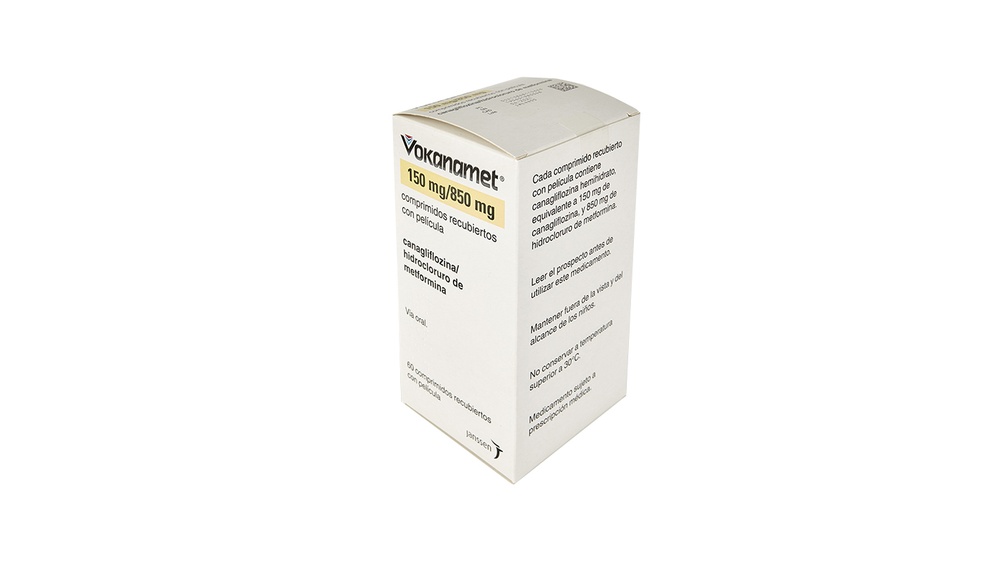
- Vokanamet 150 mg/850 mg film-coated tablets (tablets) are pale yellow, capsule-shaped, 21 mm long, with "CM" engraved on one side and "418" on the other side.
- Vokanamet 150 mg/1,000 mg film-coated tablets (tablets) are purple, capsule-shaped, 22 mm long, with "CM" engraved on one side and "611" on the other side.
Vokanamet is available in HDPE bottles with child-resistant closures. The package sizes are boxes of 20 and 60 tablets, and multiple packages of 180 tablets (3 bottles containing 60 tablets each).
Not all package sizes may be marketed.
Marketing Authorization Holder
Janssen-Cilag International NV
Turnhoutseweg 30
B-2340 Beerse
Belgium
Manufacturer
Janssen-Cilag SpA
Via C. Janssen
Borgo San Michele
04100 Latina
Italy
You can request more information about this medicine by contacting the local representative of the marketing authorization holder:
België/Belgique/Belgien Menarini Benelux NV/SA Tel: +32 (0)2 721 4545 | Lietuva UAB "JOHNSON & JOHNSON" Tel: +370 5 278 68 88 |
| Luxembourg/Luxemburg Menarini Benelux NV/SA Tel: +32 (0)2 721 4545 |
Ceská republika Berlin-Chemie/A.Menarini Ceska republika s.r.o. Tel: +420 267 199 333 | Magyarország Janssen‑Cilag Kft. Tel.: +36 1 884 2858 |
Danmark Berlin-Chemie AG Tlf: +45 78 71 31 21 | Malta AM MANGION LTD Tel: +356 2397 6000 |
Deutschland Janssen‑Cilag GmbH Tel: 0800 086 9247 / +49 2137 955 6955 | Nederland Menarini Benelux NV/SA Tel: +32 (0)2 721 4545 |
Eesti UAB "JOHNSON & JOHNSON" Eesti filiaal Tel: +372 617 7410 | Norge Berlin-Chemie AG Tlf: +45 78 71 31 21 |
Ελλ?δα MENARINI HELLAS AE Tηλ: +30 210 8316111-13 | Österreich
Tel: +43 1 879 95 85-0 |
España Laboratorios Menarini, S.A. Tel: +34 93 462 88 00 | Polska Berlin-Chemie/Menarini Polska Sp. z o.o. Tel.: +48 22 566 21 00 |
France MENARINI France Tél: +33 (0)1 45 60 77 20 | Portugal
Tel: +351 210 935 500 |
Hrvatska Johnson & Johnson S.E. d.o.o. Tel: +385 1 6610 700 | România Johnson & Johnson România SRL Tel: +40 21 207 1800 |
Ireland
Tel: +353 1 284 6744 | Slovenija Johnson & Johnson d.o.o. Tel: +386 1 401 18 00 |
Ísland Janssen‑Cilag AB c/o Vistor hf. Sími: +354 535 7000 | Slovenská republika Berlin-Chemie / A. Menarini Distribution Slovakia s.r.o Tel: +421 2 544 30 730 |
Italia Laboratori Guidotti S.p.A. Tel: +39 050 971011 | Suomi/Finland Berlin-Chemie/A. Menarini Suomi Oy Puh/Tel: +358 403 000 760 |
Κ?προς MENARINI HELLAS AE Τηλ: +30 210 8316111-13 | Sverige Berlin-Chemie AG Tfn: +45 78 71 31 21 |
Latvija UAB "JOHNSON & JOHNSON" filiale Latvija Tel: +371 678 93561 | United Kingdom (Northern Ireland)
Tel: +44 (0)1628 856400 |
Date of last revision of this leaflet: September 2024.
Other sources of information
Detailed information on this medicine is available on the European Medicines Agency website: https://www.ema.europa.eu and on the website of the Spanish Agency for Medicines and Health Products (AEMPS) (http://www.aemps.gob.es/).
- Country of registration
- Dosage formTABLET, 150 mg/850 mg
- ATC codeA10BD16
- Average pharmacy price83.83 EUR
- Active substance
- Prescription requiredYes
- Manufacturer
- CompositionCROSCARMELOSA SODICA (18 mg mg), CROSCARMELOSA SODICA (24,71 mg mg)
- This information is for reference only and does not constitute medical advice. Always consult a doctor before taking any medication. Oladoctor is not responsible for medical decisions based on this content.
- Alternatives to VOKANAMET 150 mg/850 mg FILM-COATED TABLETSDosage form: TABLET, 150 mg/1000 mgActive substance: metformin and canagliflozinManufacturer: Janssen-Cilag International N.VPrescription requiredDosage form: TABLET, 50 mg/1000 mgActive substance: metformin and canagliflozinManufacturer: Janssen-Cilag International N.VPrescription requiredDosage form: TABLET, 50 mg/850 mgActive substance: metformin and canagliflozinManufacturer: Janssen-Cilag International N.VPrescription required
Online doctors for VOKANAMET 150 mg/850 mg FILM-COATED TABLETS
Discuss questions about VOKANAMET 150 mg/850 mg FILM-COATED TABLETS, including use, safety considerations and prescription review, subject to medical assessment and local regulations.

Get VOKANAMET 150 mg/850 mg FILM-COATED TABLETS Prescription Online
Fill in a 2-min form
Tell us your symptoms, history, and what medicine you're requesting.
Pick a doctor or let us assign
Choose a specialist or we'll match you with the next available doctor.
Doctor reviews your case
Usually within 30 minutes. They may ask follow-up questions via chat.
Collect from any pharmacy
Electronic prescription sent to your email — valid across Spain.
Frequently Asked Questions
VOKANAMET 150 mg/850 mg FILM-COATED TABLETS requires a prescription in Spain. You can check with a doctor online whether this medicine may be appropriate for your situation.
The active ingredient in VOKANAMET 150 mg/850 mg FILM-COATED TABLETS is metformin and canagliflozin. This information helps identify medicines with the same composition but different brand names.
The average pharmacy price for VOKANAMET 150 mg/850 mg FILM-COATED TABLETS is around 83.83 EUR. Prices may vary depending on the manufacturer and dosage form.
VOKANAMET 150 mg/850 mg FILM-COATED TABLETS is manufactured by Janssen-Cilag International N.V. Pharmacy brands and packaging may differ depending on the distributor.
Doctors such as Family doctors, Psychiatrists, Dermatologists, Cardiologists, Endocrinologists, Gastroenterologists, Pulmonologists, Nephrologists, Rheumatologists, Hematologists, Infectious disease physicians, Allergists, Geriatricians, Paediatricians, Oncologists may assess whether VOKANAMET 150 mg/850 mg FILM-COATED TABLETS is appropriate, depending on your situation and local regulations. You can book an online consultation to discuss your symptoms and possible next steps.
Spain has a well-developed healthcare infrastructure across major cities such as Madrid, Barcelona, Valencia, and Seville. Pharmacies are widely available and operate under strict regulations, ensuring access to prescribed medications.
You can buy VOKANAMET 150 mg/850 mg FILM-COATED TABLETS in Madrid, Barcelona, Seville, or Valencia at any local pharmacy with a valid prescription.
To obtain a prescription, you can use Oladoctor:
Other medicines with the same active substance (metformin and canagliflozin) include VOKANAMET 150 MG/1000 MG FILM-COATED TABLETS, VOKANAMET 50 mg/1000 mg FILM-COATED TABLETS, VOKANAMET 50 mg/850 mg FILM-COATED TABLETS. These may have different brand names or formulations but contain the same therapeutic ingredient. Always consult a doctor before switching or starting a new medicine.
