



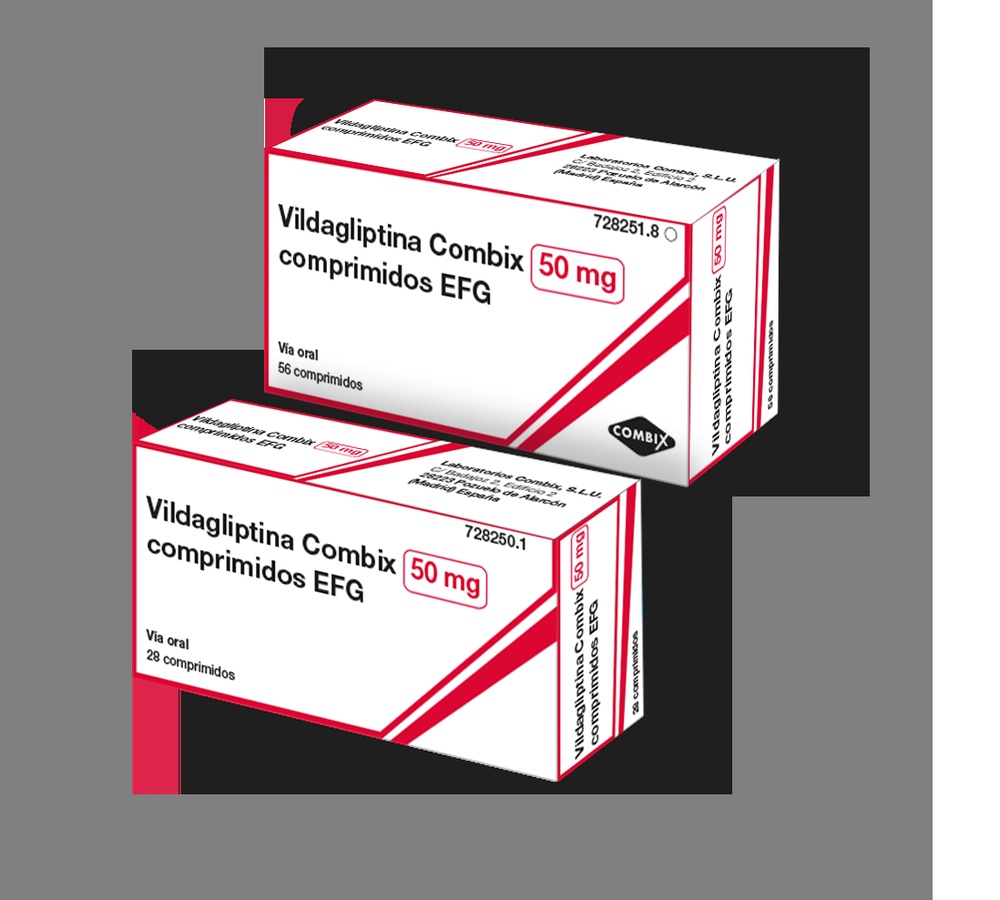
VILDAGLIPTINA 50 mg Tablets

Prescription review online
A doctor will review your case and decide whether a prescription is medically appropriate.

Talk to a doctor about this medicine
Discuss your symptoms and possible next steps in a quick online consultation.



How to use VILDAGLIPTINA COMBIX 50 mg TABLETS
Contents of the leaflet
- Introduction
- What is Vildagliptina Combix and what is it used for
- What you need to know before you take Vildagliptina Combix
- How to take/use Vildagliptina Combix
- Possible side effects
- Storing Vildagliptina Combix
- Contents of the pack and other information
Introduction
Package Leaflet: Information for the User
Vildagliptina Combix 50 mg Tablets EFG
vildagliptina
Read all of this leaflet carefully before you start taking this medicine because it contains important information for you.
- Keep this leaflet, you may need to read it again.
- If you have any further questions, ask your doctor or pharmacist.
- This medicine has been prescribed for you only. Do not pass it on to others. It may harm them, even if their signs of illness are the same as yours.
- If you get any side effects, talk to your doctor, pharmacist or nurse. This includes any possible side effects not listed in this leaflet. See section 4.
Contents of the pack and other information
- What is Vildagliptina Combix and what is it used for
- What you need to know before you take Vildagliptina Combix
- How to take Vildagliptina Combix
- Possible side effects
- Storing Vildagliptina Combix
- Contents of the pack and other information
1. What is Vildagliptina Combix and what is it used for
The active substance vildagliptin belongs to a group of medicines called “oral antidiabetics”.
Vildagliptina is used to treat adult patients with type 2 diabetes when diabetes cannot be controlled by diet and exercise alone. It helps to control blood sugar levels. Your doctor will prescribe vildagliptina alone or in combination with other antidiabetic medicines that you are already taking if they are not effective enough to control your diabetes.
Type 2 diabetes occurs when the body does not produce enough insulin or when the insulin produced does not work properly. It can also occur when the body produces too much glucagon.
Insulin is a substance that helps to lower blood sugar levels, especially after meals. Glucagon is a substance that promotes the production of sugar by the liver and increases blood sugar levels. Both substances are produced in the pancreas.
How vildagliptina works
Vildagliptina stimulates the pancreas to produce more insulin and less glucagon. This helps to control blood sugar levels. This medicine has been shown to reduce blood sugar, which will help to prevent complications of your diabetes.
Although you start taking this medicine for your diabetes, it is important that you continue with the diet and/or exercise that your doctor has recommended.

Not sure if this medicine is right for you?
Discuss your symptoms and treatment with a doctor online.
2. What you need to know before you take Vildagliptina Combix
Do not take Vildagliptina Combix
- if you are allergic to vildagliptina or any of the other ingredients of this medicine (listed in section 6). If you think you may be allergic to vildagliptina or any other ingredient of this medicine, do not take this medicine and consult your doctor.
Warnings and precautions
Consult your doctor, pharmacist or nurse before you start taking Vildagliptina Combix
- if you have type 1 diabetes (i.e., your body does not produce insulin) or if you have a condition called diabetic ketoacidosis,
- if you are taking an antidiabetic medicine known as a sulfonylurea (your doctor may want to reduce your dose of sulfonylurea when taken together with vildagliptina to avoid low blood sugar levels [hypoglycemia]),
- if you have moderate or severe kidney disease (you will need to take a lower dose of vildagliptina),
- if you are undergoing dialysis,
- if you have liver disease,
- if you have heart failure,
- if you have or have had pancreatitis.
If you have previously taken vildagliptina but had to stop taking it due to liver disease, you should not take this medicine.
Skin lesions are common complications of diabetes. Follow your doctor's or nurse's recommendations for skin and foot care, paying special attention to the appearance of blisters or ulcers while taking vildagliptina. If this happens, you should consult your doctor as soon as possible.
Liver function tests should be performed before starting treatment with vildagliptina, at intervals of three months during the first year and periodically thereafter. This is done to detect any signs of increased liver enzymes (transaminases) as soon as possible.
Children and adolescents
The use of this medicine is not recommended in children and adolescents under 18 years of age.
Using Vildagliptina Combix with other medicines
Tell your doctor or pharmacist if you are using, have recently used or might use any other medicines.
Your doctor may change your dose of vildagliptina if you are taking other medicines such as:
- thiazides or other diuretics (also called water pills),
- corticosteroids (generally used to treat inflammation),
- thyroid medicines,
- certain medicines that affect the nervous system.
Pregnancy and breastfeeding
If you are pregnant or breastfeeding, think you may be pregnant or are planning to have a baby, ask your doctor or pharmacist for advice before taking this medicine.
You should not use vildagliptina during pregnancy. It is not known if this medicine passes into breast milk. You should not take vildagliptina if you are breastfeeding or planning to breastfeed.
Driving and using machines
If you feel dizzy while taking this medicine, do not drive or use tools or machines.
Your ability to concentrate and react may be impaired due to symptoms caused by hypoglycemia or hyperglycemia, such as blurred vision. This can be dangerous in situations where these skills are important (e.g., driving or using machines). Therefore, consult your doctor if it is advisable to drive or use machines.
Vildagliptina Combix contains lactose and sodium
This medicine contains lactose (milk sugar). If your doctor has told you that you have an intolerance to some sugars, consult them before taking this medicine.
This medicine contains less than 23 mg of sodium (1 mmol) per tablet; this is essentially “sodium-free”.
3. How to take/use Vildagliptina Combix
Follow exactly the instructions for administration of this medicine given by your doctor or pharmacist. If you are unsure, consult your doctor or pharmacist again.
How much to take and when
The dose of vildagliptina that you should take varies depending on your condition. Your doctor will tell you exactly how many vildagliptina tablets to take. The maximum daily dose is 100 mg.
The recommended dose of vildagliptina is:
- 50 mg once daily in the morning if you are taking vildagliptina with another medicine known as a sulfonylurea.
- 100 mg daily in two doses (50 mg in the morning and 50 mg in the evening) if you are taking vildagliptina alone, with another medicine called metformin or a glitazone, with a combination of metformin and a sulfonylurea, or with insulin.
- 50 mg daily in the morning if you have moderate to severe kidney disease or if you are undergoing dialysis.
How to take Vildagliptina
- Swallow the tablet whole with a little water.
Duration of treatment with Vildagliptina
- Take vildagliptina every day for as long as your doctor recommends. You may need to continue this treatment for a long time.
- Your doctor will perform regular checks to ensure that the treatment is having the desired effect.
If you take more Vildagliptina than you should
If you have taken too many vildagliptina tablets, or if someone else has taken your medicine, consult your doctor immediately, or call the Toxicology Information Service, phone 91 562 04 20. You may need medical attention. If you have to visit a doctor or go to the nearest hospital, take the package with you.
If you forget to take Vildagliptina
If you forget to take a dose of this medicine, take it as soon as you remember. Then take the next dose at the usual time. If it is almost time for the next dose, skip the missed dose. Do not take a double dose to make up for forgotten doses.
If you stop taking Vildagliptina
Do not stop taking vildagliptina unless your doctor tells you to. If you have any doubts about the duration of treatment with vildagliptina, consult your doctor.

Started taking the medicine and have questions?
Discuss your symptoms and treatment with a doctor online.
4. Possible side effects
Like all medicines, this medicine can cause side effects, although not everybody gets them.
Some symptoms require immediate medical attention
You should stop taking vildagliptina and see your doctor immediately if you experience any of the following side effects:
- angioedema (rare: may affect up to 1 in 1,000 people): symptoms including swelling of the face, tongue or throat, difficulty swallowing, difficulty breathing, sudden appearance of rash or hives, which may be indicative of a reaction called “angioedema”,
- liver disease (hepatitis) (frequency not known): symptoms including yellowing of the skin and eyes, nausea, loss of appetite or dark urine, which may be indicative of liver disease (hepatitis).
- pancreatitis (rare: may affect up to 1 in 1,000 people): symptoms including severe and persistent abdominal pain (stomach area), which may radiate to the back, as well as nausea and vomiting.
Other side effects
Some patients experienced the following side effects while taking vildagliptina:
- Very common: (may affect more than 1 in 10 people): sore throat, nasal congestion, fever.
- Common (may affect up to 1 in 10 people): itchy rash, tremor, headache, dizziness, muscle pain, joint pain, swollen hands, ankles or feet (edema), excessive sweating, vomiting, stomach pain and abdominal area (abdominal pain), diarrhea, heartburn, nausea (discomfort), blurred vision.
- Uncommon (may affect up to 1 in 100 people): weight gain, chills, weakness, sexual dysfunction, low blood sugar levels, flatulence.
- Rare (may affect up to 1 in 1,000 people): pancreatitis
Since the marketing of this product, the following side effects have also been reported:
- Frequency not known (cannot be estimated from the available data): localized skin peeling or blisters, inflammation of blood vessels (vasculitis) that can cause skin rashes or red, flat, round spots under the skin surface or bruising.
Reporting of side effects
If you experience any side effects, talk to your doctor, pharmacist or nurse, even if it is possible side effects not listed in this leaflet. You can also report side effects directly through the Spanish Medicines Surveillance System for Human Use: https://www.notificaram.es. By reporting side effects, you can help provide more information on the safety of this medicine.
5. Storing Vildagliptina Combix
Keep this medicine out of the sight and reach of children.
Do not use this medicine after the expiry date which is stated on the blister and on the carton after “EXP”. The expiry date is the last day of the month shown.
This medicine does not require any special storage conditions.
Do not use this medicine if you notice that the packaging is damaged or shows visible signs of deterioration.
Medicines should not be disposed of via wastewater or household waste. Ask your pharmacist how to dispose of medicines no longer required. These measures will help protect the environment.
6. Contents of the pack and other information
- Composition of Vildagliptina Combix
- The active substance is vildagliptina. Each tablet contains 50 mg of vildagliptina.
- The other ingredients (excipients) are:
Lactose anhydrous, sodium stearyl fumarate and sodium, microcrystalline cellulose and sodium croscarmellose.
Appearance of the product and contents of the pack
Vildagliptina Combix 50 mg are round, biconvex tablets, white to off-white in color, approximately 8.0 mm in diameter, available in aluminum/aluminum blisters containing 7, 14, 28, 30, 56, 60, 90, 112, 180 or 336 tablets and in multiple packs consisting of 3 packs, each containing 112 tablets.
Not all pack sizes may be marketed.
Marketing authorization holder and manufacturer
Marketing authorization holder
Laboratorios Combix, S.L.U.
C/ Badajoz 2, Edificio 2
28223 – Pozuelo de Alarcón (Madrid)
Spain
Manufacturer
GALENICUM HEALTH, S.L.U.
Sant Gabriel, 50,
Esplugues de Llobregat, 08950 Barcelona,
Spain
or
SAG MANUFACTURING, S.L.U.
Ctra. N-I, km 36
28750 San Agustín de Guadalix
Madrid – Spain
This medicine is authorized in the Member States of the European Economic Area under the following names:
BG – Bulgaria ???????????? ????????? 50 mg ???????
ES – Spain Vildagliptina Galenicum 50 mg tablets
MT – Malta Vildagliptin Galenicum 50 mg tablets
LV - Latvia Vildagliptin Galenicum 50 mg tablets
HR – Croatia Vildagliptin Galenicum 50 mg tablets
EE – Estonia Vildagliptin Galenicum 50 mg tablets
DE – Germany Vildagliptin Galenicum 50 mg tablets
Date of last revision of this leaflet:April 2023
Detailed information on this medicine is available on the website of the Spanish Agency for Medicines and Health Products (AEMPS) http://www.aemps.gob.es/.
- Country of registration
- Dosage formTABLET, 50 mg
- ATC codeA10BH02
- Average pharmacy price15.61 EUR
- Active substance
- Prescription requiredYes
- Manufacturer
- CompositionLACTOSA (119,59 mg mg), FUMARATO DE ESTEARILO Y SODIO (2,5 mg mg), CROSCARMELOSA SODICA (4 mg mg)
- This information is for reference only and does not constitute medical advice. Always consult a doctor before taking any medication. Oladoctor is not responsible for medical decisions based on this content.
- Alternatives to VILDAGLIPTINA COMBIX 50 mg TABLETSDosage form: TABLET, 50 mgActive substance: vildagliptinManufacturer: Novartis Europharm LimitedPrescription requiredDosage form: TABLET, 50 mgActive substance: vildagliptinManufacturer: Novartis Europharm LimitedPrescription requiredDosage form: TABLET, 50 mgActive substance: vildagliptinManufacturer: Novartis Europharm LimitedPrescription required
Online doctors for VILDAGLIPTINA COMBIX 50 mg TABLETS
Discuss questions about VILDAGLIPTINA COMBIX 50 mg TABLETS, including use, safety considerations and prescription review, subject to medical assessment and local regulations.

Get VILDAGLIPTINA COMBIX 50 mg TABLETS Prescription Online
Fill in a 2-min form
Tell us your symptoms, history, and what medicine you're requesting.
Pick a doctor or let us assign
Choose a specialist or we'll match you with the next available doctor.
Doctor reviews your case
Usually within 30 minutes. They may ask follow-up questions via chat.
Collect from any pharmacy
Electronic prescription sent to your email — valid across Spain.
Frequently Asked Questions
VILDAGLIPTINA COMBIX 50 mg TABLETS requires a prescription in Spain. You can check with a doctor online whether this medicine may be appropriate for your situation.
The active ingredient in VILDAGLIPTINA COMBIX 50 mg TABLETS is vildagliptin. This information helps identify medicines with the same composition but different brand names.
The average pharmacy price for VILDAGLIPTINA COMBIX 50 mg TABLETS is around 15.61 EUR. Prices may vary depending on the manufacturer and dosage form.
VILDAGLIPTINA COMBIX 50 mg TABLETS is manufactured by Laboratorios Combix S.L.U.. Pharmacy brands and packaging may differ depending on the distributor.
Doctors such as Family doctors, Psychiatrists, Dermatologists, Cardiologists, Endocrinologists, Gastroenterologists, Pulmonologists, Nephrologists, Rheumatologists, Hematologists, Infectious disease physicians, Allergists, Geriatricians, Paediatricians, Oncologists may assess whether VILDAGLIPTINA COMBIX 50 mg TABLETS is appropriate, depending on your situation and local regulations. You can book an online consultation to discuss your symptoms and possible next steps.
Spain has a well-developed healthcare infrastructure across major cities such as Madrid, Barcelona, Valencia, and Seville. Pharmacies are widely available and operate under strict regulations, ensuring access to prescribed medications.
You can buy VILDAGLIPTINA COMBIX 50 mg TABLETS in Madrid, Barcelona, Seville, or Valencia at any local pharmacy with a valid prescription.
To obtain a prescription, you can use Oladoctor:
Other medicines with the same active substance (vildagliptin) include GALVUS 50 mg TABLETS, GALVUS 50 mg TABLETS, JALRA 50 mg TABLETS. These may have different brand names or formulations but contain the same therapeutic ingredient. Always consult a doctor before switching or starting a new medicine.
