



VIAFLO 1.4% Injectable Perfusion

Prescription review online
A doctor will review your case and decide whether a prescription is medically appropriate.

Talk to a doctor about this medicine
Discuss your symptoms and possible next steps in a quick online consultation.



How to use VIAFLO SODIUM BICARBONATE 1.4%, SOLUTION FOR INFUSION
Contents of the leaflet
- Introduction
- What Viaflo Sodium Bicarbonate 1.4% is and what it is used for
- Before you use Viaflo Sodium Bicarbonate 1.4%
- How to use Viaflo Sodium Bicarbonate 1.4%
- Possible side effects
- Storage of Viaflo Sodium Bicarbonate 1.4%
- Further information
Introduction
PACKAGE LEAFLET: INFORMATION FOR THE USER
VIAFLO SODIUM BICARBONATE 1.4% solution for infusion
Read all of this leaflet carefully before you start using this medicine.
- Keep this leaflet, you may need to read it again.
- If you have any further questions, ask your doctor or pharmacist.
- This medicine has been prescribed for you only. Do not pass it on to others. It may harm them, even if their symptoms are the same as yours.
- If you experience any side effects, talk to your doctor, pharmacist or nurse. This includes any possible side effects not listed in this leaflet.
Contents of the pack:
- What Viaflo Sodium Bicarbonate 1.4% is and what it is used for
- Before you use Viaflo Sodium Bicarbonate 1.4%
- How to use Viaflo Sodium Bicarbonate 1.4%
- Possible side effects
- Storage of Viaflo Sodium Bicarbonate 1.4%
- Further information
1. What Viaflo Sodium Bicarbonate 1.4% is and what it is used for
Viaflo Sodium Bicarbonate 1.4% is a solution for infusion used:
- In metabolic acidosis (when the blood becomes too acidic).
In the treatment of phenobarbital poisoning.

Not sure if this medicine is right for you?
Discuss your symptoms and treatment with a doctor online.
2. Before you use Viaflo Sodium Bicarbonate 1.4%
DO NOT use Viaflo Sodium Bicarbonate 1.4% if you have any of the following conditions:
- if you are allergic to sodium bicarbonate or any of the other ingredients listed at the end of this leaflet
- if you have a condition in which the blood becomes too alkaline (metabolic or respiratory alkalosis).
- if you have a condition in which the blood becomes too acidic due to respiratory failure (respiratory acidosis).
- if your blood has low levels of calcium (hypocalcemia)
- if your blood has low levels of chloride (hypochloremia)
Be careful with Viaflo Sodium Bicarbonate 1.4%:
Tell your doctor if you have or have had any of the following medical conditions:
- Any condition that indicates you are more prone to having low potassium levels in your blood (hypokalemia).
- Any condition that indicates you retain water and salt (sodium and water retention).
- Heart disease (heart failure)
- Kidney disease or impaired kidney function (renal failure)
- Any condition for which you are taking corticosteroids (e.g. if you have an inflammatory disease such as arthritis or asthma)
- Any condition that indicates an increase in carbon dioxide levels in your blood (hypercapnia)
- Any condition that indicates severe liver disease (cirrhosis) and fluid accumulation in the body (ascitic-edematous syndrome).
When you are given this solution, your doctor will take blood samples to determine:
- The amount of chemical substances, such as sodium and potassium, in your blood (your plasma electrolytes).
- The acidity of your blood and urine (your acid-base balance and plasma pH).
When you are given this solution, your doctor will regularly check:
- The proper functioning of your heart, lungs, and kidneys.
If your blood is too acidic (metabolic acidosis), your doctor will investigate the cause. Sodium bicarbonate is only effective if the underlying cause is also treated.
Using other medicines
Sodium bicarbonate may increase the levels of certain medicines in your blood, such as quinidine, flecainide, amphetamine, dextroamphetamine, ephedrine, pseudoephedrine, or memantine.
Sodium bicarbonate may decrease the levels of certain medicines in your blood, such as salicylates, phenobarbital, or lithium.
Tell your doctor if you are taking these medicines while using Viaflo Sodium Bicarbonate 1.4%.
Tell your doctor or pharmacist if you are using or have recently used any other medicines, including those obtained without a prescription.
Your doctor will check if the mixtures of other medicines (that are given to you intravenously) can be used with Viaflo Sodium Bicarbonate 1.4%.
Pregnancy and breastfeeding
Viaflo Sodium Bicarbonate 1.4% is not recommended during pregnancy or breastfeeding.
Ask your doctor or pharmacist for advice before taking any medicine.
Tell your doctor before administration if:
- You are pregnant or think you may be pregnant.
- You are breastfeeding.
3. How to use Viaflo Sodium Bicarbonate 1.4%
Your doctor will decide the amount and frequency of administration needed according to your disease.
Viaflo Sodium Bicarbonate 1.4% should be administered as a slow intravenous infusion. A needle is inserted into a vein and the medicine flows slowly into the body.
If you receive more sodium bicarbonate than you should
You may develop:
- high blood alkalinity (metabolic alkalosis)
- respiratory problems (respiratory acidosis)
- low potassium levels in the blood (hypokalemia)
- heart failure (heart failure) or cardiac arrhythmias
- acute inflammation and/or fluid accumulation in the lungs (pulmonary edema)
- painful muscle spasms and tremors (convulsions)
- bleeding in the brain (intracranial hemorrhage) due to increased carbon dioxide levels in the blood (hypercapnia), especially in newborns and premature babies
Immediately contact a doctor if you experience any of these symptoms.
If you have any further questions on the use of this product, ask your doctor or pharmacist.

Started taking the medicine and have questions?
Discuss your symptoms and treatment with a doctor online.
4. Possible side effects
Like all medicines, Viaflo Sodium Bicarbonate 1.4% can cause side effects, although not everybody gets them.
- high blood alkalinity (metabolic or respiratory alkalosis)
- low potassium levels in the blood (hypokalemia)
- low calcium levels in the blood (hypocalcemia)
- high sodium levels in the blood (hypernatremia)
- damage at the infusion site (tissue destruction at the injection site may occur after extravasation)
- fluid accumulation in the ankles (edema)
- mood changes and/or irritability
- decreased blood pressure (hypotension)
If you experience any side effects, talk to your doctor, pharmacist, or nurse. This includes any possible side effects not listed in this leaflet.
5. Storage of Viaflo Sodium Bicarbonate 1.4%
Keep out of the reach and sight of children.
Viaflo Sodium Bicarbonate 1.4% should NOT be administered after the expiry date stated on the bag. The expiry date is the last day of the month stated.
This medicine does not require any special storage conditions.
Use only if the solution is clear, free from visible particles, and the container is not damaged.
Do not remove the bag from its outer bag until it is ready for use.
The inner bag maintains the sterility of the product.
Do not dispose of medicines via wastewater or household waste. Ask your pharmacist how to dispose of medicines no longer required. This will help protect the environment.
6. Further information
Composition of Viaflo Sodium Bicarbonate 1.4%
The active substance is:
Sodium bicarbonate 1.4 g
Per 100 ml.
1 ml of solution contains 14 mg of sodium bicarbonate.
Sodium 167 mmol/l
Carbonate 167 mmol/l
pH = 7.0 - 8.5
Osmolality: 334 mOsm/l
The other ingredients are: water for injections and carbon dioxide.
Appearance of Viaflo Sodium Bicarbonate 1.4% and container contents
Viaflo Sodium Bicarbonate 1.4% is a solution for infusion presented in a 500 ml plastic bag.
Each bag is packaged in a protective plastic overbag, which serves only to protect it.
The product is marketed in boxes of 20 bags of 500 ml.
Marketing authorisation holder and manufacturer
Marketing authorisation holder:
Baxter, S.L.
Pouet de Camilo 2, 46394 Ribarroja del Turia (Valencia)
Manufacturer:
Baxter SA
Boulevard René Branquart, 80
7860 Lessines
Belgium
Bieffe Medital S.A.
Ctra de Biescas, Senegüé
22666 Sabiñánigo (Huesca)
Spain
This leaflet was approved in April 2011
Detailed and up-to-date information on this medicine is available on the website of the Spanish Agency for Medicines and Health Products (AEMPS) http://www.aemps.gob.es/
---------------------------------------------------------------------------------------------------------------------------
This information is intended only for healthcare professionals
Viaflo Sodium Bicarbonate 1.4% allows for the regulation of the acid-base balance of the plasma. However, the correction of metabolic acidosis with sodium bicarbonate provides no benefit without the correction of the underlying cause.
This medicine may worsen or reveal hypokalemia.
Check for the absence of hypokalemia. If it exists, administer a potassium salt.
Be aware of sodium administration.
The alkalinity of the solution causes numerous incompatibilities.
Check the integrity of the bag and the transparency of the solution before use.
Due to the alkalinity of this solution, check compatibility before mixing medicines to be administered concomitantly in the infusion and check the transparency and color of the solution before infusion.
When mixing medicines to be administered by infusion, consider the pH of the solution (alkaline) and the presence of bicarbonate and sodium ions.
Typical examples of chemical incompatibility: All medicines with an acidic reaction in solution (including chlorohydrates, insulin, etc.) and those whose basic form is insoluble (alkaloids, antibiotics, etc.).
Combination that requires precautions for use:
Quinidine:increased quinidine levels in plasma and risk of overdose (decreased renal excretion of quinidine due to urinary alkalization).
Clinical monitoring, electrocardiogram, and the possibility of monitoring quinidine levels if necessary, adjustment of the dosage during and after alkalizing treatment.
Method of use of the Viaflo bag
The infusion solution must be visually inspected before use.
Use only if the solution is clear, free from visible particles, and the container is not damaged. Administer immediately after connecting the infusion equipment.
Do not remove the bag from its outer bag until it is ready for use.
The inner bag maintains the sterility of the product.
Do not connect plastic containers in series. This type of use may produce gas embolisms due to residual air drawn from the primary container before the liquid contained in the secondary container is completely administered.
The solution must be administered with sterile equipment using an aseptic technique. The equipment must be primed with the solution to prevent air from entering the system.
Additives can be introduced before or during the infusion through the injection point.
When additives are added, check isotonicity before parenteral administration. It is essential that the mixing of products is done under extreme asepsis conditions. Solutions containing additives should be used immediately and not stored.
The addition of medicines or the use of an incorrect administration technique can cause the appearance of febrile reactions due to the possible introduction of pyrogens. In case of an adverse reaction, the infusion should be interrupted immediately.
Discard after a single use.
Discard partially used containers.
Do not reconnect partially used bags.
1- To open
- Remove the Viaflo bag from the protective overbag immediately before use.
- Check for the absence of small leaks by squeezing the inner bag firmly. If you detect leaks, discard the solution, as it may not be sterile.
- Check the transparency of the solution and the absence of foreign particles. Discard the solution if it is not transparent or contains foreign particles.
2- Preparation for administration
Use sterile material for preparation and administration.
- Hang the container by the hanger
- Remove the plastic protector from the outlet tube at the bottom of the container.
- Hold the small wing of the outlet tube neck with one hand.
- Hold the large wing of the closure cap with the other hand and turn.
- The cap will come off.
- Use an aseptic technique to prepare the infusion
- Connect the administration equipment. Refer to the instructions accompanying the equipment for connection, priming, and administration of the solution.
3- Techniques for injecting added medication
Warning: Added medicines may be incompatible.
To add medication before administration
- Disinfect the injection point
- Using a syringe with a 19 (1.10 mm) to 22 (0.70 mm) gauge needle, puncture the resealable injection point and inject.
- Mix the medication and solution carefully. For high-density medications, such as potassium chloride, gently move the tubes while they are in a vertical position and mix.
Caution: do not store bags with added medication.
To add medication during administration
- Close the equipment clamp.
- Disinfect the injection point.
- Using a syringe with a 19 (1.10 mm) to 22 (0.70 mm) gauge needle, puncture the resealable injection point and inject.
- Remove the container from the intravenous stand and/or turn it to put it in a vertical position.
- Empty both tubes by gently tapping them while the container is in a vertical position.
- Mix the solution and medication carefully.
- Return the container to the operating position, reopen the clamp, and continue administration.
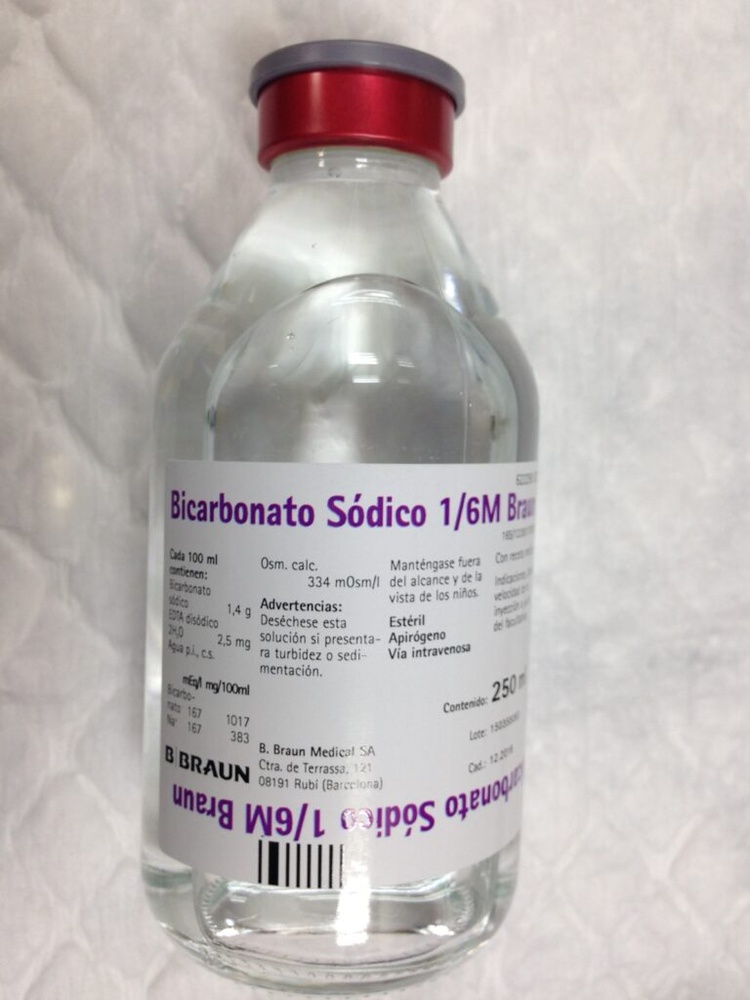
- Country of registration
- Dosage formINJECTABLE PERFUSION, 1.4%
- ATC codeB05XA02
- Active substance
- Prescription requiredYes
- Manufacturer
- This information is for reference only and does not constitute medical advice. Always consult a doctor before taking any medication. Oladoctor is not responsible for medical decisions based on this content.
- Alternatives to VIAFLO SODIUM BICARBONATE 1.4%, SOLUTION FOR INFUSIONDosage form: INJECTABLE INFUSION, 100 mlActive substance: sodium bicarbonateManufacturer: Fresenius Kabi España, S.A.U.Prescription requiredDosage form: INJECTABLE, 0.840 g sodium bicarbonate/10 mlActive substance: sodium bicarbonateManufacturer: Laboratorios Grifols S.A.Prescription requiredDosage form: INJECTABLE PERFUSION, 21 g sodium bicarbonateActive substance: sodium bicarbonateManufacturer: Fresenius Kabi España, S.A.U.Prescription required
Online doctors for VIAFLO SODIUM BICARBONATE 1.4%, SOLUTION FOR INFUSION
Discuss questions about VIAFLO SODIUM BICARBONATE 1.4%, SOLUTION FOR INFUSION, including use, safety considerations and prescription review, subject to medical assessment and local regulations.









Get VIAFLO SODIUM BICARBONATE 1.4%, SOLUTION FOR INFUSION Prescription Online
Fill in a 2-min form
Tell us your symptoms, history, and what medicine you're requesting.
Pick a doctor or let us assign
Choose a specialist or we'll match you with the next available doctor.
Doctor reviews your case
Usually within 30 minutes. They may ask follow-up questions via chat.
Collect from any pharmacy
Electronic prescription sent to your email — valid across Spain.
Frequently Asked Questions
VIAFLO SODIUM BICARBONATE 1.4%, SOLUTION FOR INFUSION requires a prescription in Spain. You can check with a doctor online whether this medicine may be appropriate for your situation.
The active ingredient in VIAFLO SODIUM BICARBONATE 1.4%, SOLUTION FOR INFUSION is sodium bicarbonate. This information helps identify medicines with the same composition but different brand names.
VIAFLO SODIUM BICARBONATE 1.4%, SOLUTION FOR INFUSION is manufactured by Baxter S.L.. Pharmacy brands and packaging may differ depending on the distributor.
Doctors such as Family doctors, Psychiatrists, Dermatologists, Cardiologists, Endocrinologists, Gastroenterologists, Pulmonologists, Nephrologists, Rheumatologists, Hematologists, Infectious disease physicians, Allergists, Geriatricians, Paediatricians, Oncologists may assess whether VIAFLO SODIUM BICARBONATE 1.4%, SOLUTION FOR INFUSION is appropriate, depending on your situation and local regulations. You can book an online consultation to discuss your symptoms and possible next steps.
Spain has a well-developed healthcare infrastructure across major cities such as Madrid, Barcelona, Valencia, and Seville. Pharmacies are widely available and operate under strict regulations, ensuring access to prescribed medications.
You can buy VIAFLO SODIUM BICARBONATE 1.4%, SOLUTION FOR INFUSION in Madrid, Barcelona, Seville, or Valencia at any local pharmacy with a valid prescription.
To obtain a prescription, you can use Oladoctor:
Other medicines with the same active substance (sodium bicarbonate) include SODIUM BICARBONATE 1/6 M MEIN SOLUTION FOR INFUSION, SODIUM BICARBONATE 1M GRIFOLS INJECTABLE SOLUTION, VENOFUSIN SODIUM BICARBONATE 1 M SOLUTION FOR INFUSION. These may have different brand names or formulations but contain the same therapeutic ingredient. Always consult a doctor before switching or starting a new medicine.
