



VANFLYTA 17.7 mg Film-coated tablets

Prescription review online
A doctor will review your case and decide whether a prescription is medically appropriate.

Talk to a doctor about this medicine
Discuss your symptoms and possible next steps in a quick online consultation.



How to use VANFLYTA 17.7 mg FILM-COATED TABLETS
Contents of the leaflet
- Introduction
- What is VANFLYTA and what is it used for
- What you need to know before you take VANFLYTA
- How to take VANFLYTA
- Possible side effects
- Storage of VANFLYTA
- Package Contents and Additional Information
Introduction
Package Leaflet: Information for the Patient
VANFLYTA 17.7 mg film-coated tablets
VANFLYTA 26.5 mg film-coated tablets
quizartinib
This medicine is subject to additional monitoring, which will allow for quick identification of new safety information. You can help by reporting any side effects you may have. The last section of section 4 will tell you how to report side effects.
Read all of this leaflet carefully before you start taking this medicine, because it contains important information for you.
- Keep this leaflet, you may need to read it again.
- If you have any further questions, ask your doctor, pharmacist, or nurse.
- This medicine has been prescribed for you only. Do not pass it on to others. It may harm them, even if their signs of illness are the same as yours.
- If you get any side effects, talk to your doctor, pharmacist, or nurse. This includes any possible side effects not listed in this leaflet. See section 4.
Contents of the pack
- What is VANFLYTA and what is it used for
- What you need to know before you take VANFLYTA
- How to take VANFLYTA
- Possible side effects
- Storage of VANFLYTA
- Contents of the pack and other information
1. What is VANFLYTA and what is it used for
What is VANFLYTA
VANFLYTA contains the active substance quizartinib. It is a type of cancer medicine called a "protein kinase inhibitor". The medicine is used together with chemotherapy to treat adults who have acute myeloid leukemia (AML, a type of blood cancer), with a mutation (change) in the FLT3gene called "FLT3-ITD". It can also be continued after a bone marrow transplant when patients have recovered enough.
Your doctor will test your cancer cells beforehand for changes in the FLT3gene to detect FLT3-ITD mutations and make sure VANFLYTA is suitable for you.
How VANFLYTA works
In AML, the body produces a large number of defective white blood cells that do not mature to become healthy cells. VANFLYTA works by blocking the action of some proteins called "tyrosine kinases" in these defective cells. This slows down or stops the uncontrolled division and growth of the defective cells and helps the immature cells to become normal cells.

Not sure if this medicine is right for you?
Discuss your symptoms and treatment with a doctor online.
2. What you need to know before you take VANFLYTA
Do not take VANFLYTA
- if you are allergic to quizartinib or any of the other ingredients of this medicine (listed in section 6). If you think you may be allergic, consult your doctor for advice;
- if you have a heart problem called "long QT syndrome" (abnormal heart electrical activity that affects the rhythm);
- if you are breastfeeding (see "Pregnancy, breastfeeding, and fertility").
Warnings and precautions
Tell your doctor, pharmacist, or nurse before you start taking VANFLYTA:
- if you have or have had any heart problems, such as arrhythmia (abnormal heart rhythm), myocardial infarction (heart attack) in the last 6 months, congestive heart failure (the heart does not pump with enough force), uncontrolled angina (chest pain), or uncontrolled high blood pressure;
- if you have ever been told you have low levels of potassium or magnesium in your blood;
- if you are taking medicines that may prolong the QT interval (irregular heart rhythm; see "Other medicines and VANFLYTA");
- if you are taking potent CYP3A inhibitors (see "Other medicines and VANFLYTA");
- if you have or have had fever, cough, chest pain, shortness of breath, fatigue, or pain when urinating.
Monitoring during treatment with VANFLYTA
Blood tests
Your doctor will perform blood tests periodically during treatment with VANFLYTA to check your blood cells (white blood cells, red blood cells, and platelets) and electrolytes (salts such as sodium, potassium, magnesium, calcium, chloride, and bicarbonate in the blood). Your doctor will check your electrolytes more frequently if you have diarrhea or vomiting.
Electrocardiogram
Before and during treatment, your doctor will check your heart with an electrocardiogram (ECG) to make sure your heart is beating normally. ECGs will be performed weekly at the beginning and less frequently afterwards, as determined by your doctor. Your doctor will check your heart more frequently if you are taking other medicines that prolong the QT interval (see "Other medicines and VANFLYTA").
Infections in patients over 65 years of age
Older patients are at a higher risk of developing severe infections compared to younger patients, especially during the initial period of treatment. If you are over 65 years of age, you will be closely monitored for severe infections during induction.
Children and adolescents
Do not give this medicine to children or adolescents under 18 years of age because there is not enough information on its use in this age group.
Other medicines and VANFLYTA
Tell your doctor or pharmacist if you are taking, have recently taken, or might take any other medicines, including those bought without a prescription, vitamins, antacids (medicines used for heartburn and stomach acid), and herbal supplements. This is because some medicines may affect the way VANFLYTA works.
In particular, the following medicines may increase the risk of side effects with VANFLYTA by increasing the levels of this medicine in the blood:
- certain medicines used to treat fungal infections, such as itraconazole, posaconazole, or voriconazole;
- certain antibiotics, such as clarithromycin or telithromycin;
- nefazodone, a medicine used to treat major depression.
The following medicines may reduce the effectiveness of VANFLYTA:
- certain medicines used to treat tuberculosis, such as rifampicin;
- certain medicines used to treat seizures or epilepsy, such as carbamazepine, primidone, phenobarbital, or phenytoin;
- some medicines used to treat prostate cancer, such as apalutamide and enzalutamide;
- mitotane, a medicine used to treat symptoms of adrenal gland tumors;
- bosentan, a medicine used to treat high blood pressure in the lungs (pulmonary arterial hypertension);
- St. John's Wort (Hypericum perforatum), a herbal product used for anxiety and mild depression.
Certain medicines used to treat HIV may increase the risk of side effects (e.g., ritonavir) or reduce the effectiveness (e.g., efavirenz or etravirine) of VANFLYTA.
Medicines that prolong the QT interval
Taking VANFLYTA with other medicines that prolong the QT interval may further increase the risk of QT interval prolongation. Medicines that prolong the QT interval include antifungal azoles, ondansetron, granisetron, azithromycin, pentamidine, doxycycline, moxifloxacin, atovaquone, prochlorperazine, and tacrolimus.
Pregnancy, breastfeeding, and fertility
Pregnancy
Do not take VANFLYTA during pregnancy. This is because it may harm the fetus. Women of childbearing age should have a pregnancy test within 7 days before taking this medicine.
Women should use effective contraceptive methods during treatment with VANFLYTA and for at least 7 months after finishing treatment. Men should use effective contraceptive methods during treatment with VANFLYTA and for at least 4 months after finishing treatment.
If you are pregnant, think you may be pregnant, or plan to become pregnant, consult your doctor, pharmacist, or nurse before using this medicine.
Breastfeeding
Do not breastfeed during treatment with VANFLYTA, and for at least 5 weeks after finishing treatment. This is because it is unknown whether VANFLYTA is excreted in breast milk (see "Do not take VANFLYTA").
If you are breastfeeding, consult your doctor, pharmacist, or nurse before using this medicine.
Fertility
VANFLYTA may reduce fertility in men and women. You should discuss this with your doctor before starting treatment.
Driving and using machines
VANFLYTA is unlikely to affect your ability to drive or use machines.
3. How to take VANFLYTA
Follow the instructions for administration of this medicine exactly as told by your doctor or pharmacist. If you are unsure, consult your doctor or pharmacist again.
How much VANFLYTA to take
Your doctor or pharmacist will tell you exactly how much VANFLYTA to take. Do not change the dose or stop taking VANFLYTA without talking to your doctor first.
Usually, you will start by taking 35.4 mg (two 17.7 mg tablets) once a day for 2 weeks during each chemotherapy cycle. The maximum recommended dose is 53 mg once a day.
Your doctor may tell you to start with a lower dose of one 17.7 mg tablet once a day if you are taking certain medicines.
After finishing chemotherapy, your doctor may change your dose to one 26.5 mg tablet once a day for 2 weeks, and then increase your dose to 53 mg (two 26.5 mg tablets) once a day, depending on how you respond to VANFLYTA.
Your doctor may temporarily stop your treatment or change your dose based on blood tests, side effects, or other medicines you may be taking.
Your doctor will stop treatment if you are going to have a stem cell transplant. Your doctor will tell you when to stop taking the medicine and when to restart it.
Taking this medicine
- Take VANFLYTA by mouth, with or without food.
- Take VANFLYTA at about the same time each day. This will help you remember to take your medicine.
- If you vomit after taking the medicine, do not take more tablets until the next scheduled dose.
How long to take VANFLYTA
Keep taking VANFLYTA for as long as your doctor tells you. Your doctor will regularly check your disease to see if the treatment is still working.
If you have any questions about how long to take VANFLYTA, consult your doctor or pharmacist.
If you take more VANFLYTA than you should
If you accidentally take more tablets than you should, or if someone else accidentally takes your medicine, consult a doctor immediately or go to the hospital and take this leaflet with you. Medical treatment may be necessary.
If you forget to take VANFLYTA
If you forget to take VANFLYTA, take it as soon as possible on the same day. Take the next dose at the usual time the next day.
Do not take an extra dose (two doses on the same day) to make up for missed doses.
If you stop taking VANFLYTA
Stopping treatment with VANFLYTA may make your disease worse. Do not stop taking your medicine unless your doctor tells you to.
If you have any other questions about the use of this medicine, ask your doctor or pharmacist.

Started taking the medicine and have questions?
Discuss your symptoms and treatment with a doctor online.
4. Possible side effects
Like all medicines, this medicine can cause side effects, although not everybody gets them.
Serious side effects
Tell your doctor, pharmacist, or nurse immediately if you notice any of the following side effects:
- feeling dizzy, lightheaded, or faint. These could be signs of a heart problem called "long QT interval" (abnormal heart electrical activity that affects the rhythm);
- fever, cough, chest pain, shortness of breath, fatigue, or pain when urinating. These could be signs of an infection or neutropenic sepsis (low white blood cell count with fever).
Very common side effects
(may affect more than 1 in 10 people)
- increased alanine aminotransferase (abnormal liver enzyme results);
- thrombocytopenia (low platelet count in the blood);
- anemia (low red blood cell count);
- neutropenia (low neutrophil count, a type of white blood cell);
- diarrhea;
- nausea (feeling sick);
- abdominal pain (stomach pain);
- headache;
- vomiting;
- edema (swelling of the face, arms, and legs);
- upper respiratory tract infections (infections of the nose and throat);
- decreased appetite;
- epistaxis (nosebleeds);
- fungal infections;
- herpes infections;
- dyspepsia (indigestion);
- bacteremia (presence of bacteria in the blood).
Common side effects
(may affect up to 1 in 10 people)
- pancytopenia (low levels of all types of blood cells).
Uncommon side effects
(may affect up to 1 in 100 people)
- cardiac arrest (heart stops beating);
- ventricular fibrillation (dangerous, irregular, and uncoordinated contractions of the heart's lower chambers).
Reporting of side effects
If you experience any side effects, talk to your doctor, pharmacist, or nurse, even if it is possible that they are not listed in this leaflet. You can also report side effects directly through the national reporting system listed in Appendix V. By reporting side effects, you can help provide more information on the safety of this medicine.
5. Storage of VANFLYTA
Keep this medicine out of the sight and reach of children.
Do not use this medicine after the expiry date which is stated on the carton and blister after EXP. The expiry date is the last day of the month stated.
This medicine does not require any special storage conditions.
Do not use this medicine if you notice that the packaging is damaged or if there are any signs of tampering with the closure.
Medicines should not be disposed of via wastewater or household waste. Ask your pharmacist how to dispose of medicines no longer required. This will help protect the environment.
6. Package Contents and Additional Information
VANFLYTA Composition
- The active ingredient is quizartinib.
VANFLYTA 17.7 mg: Each film-coated tablet contains 17.7 mg of quizartinib (as dihydrochloride).
VANFLYTA 26.5 mg: Each film-coated tablet contains 26.5 mg of quizartinib (as dihydrochloride).
- The other components are:
VANFLYTA 17.7 mg:
Tablet core: hydroxypropylbetadex, microcrystalline cellulose, magnesium stearate. Coating: hypromellose, talc, triacetin, titanium dioxide.
VANFLYTA 26.5 mg:
Tablet core: hydroxypropylbetadex, microcrystalline cellulose, magnesium stearate. Coating: hypromellose, talc, triacetin, titanium dioxide.
Product Appearance and Package Contents
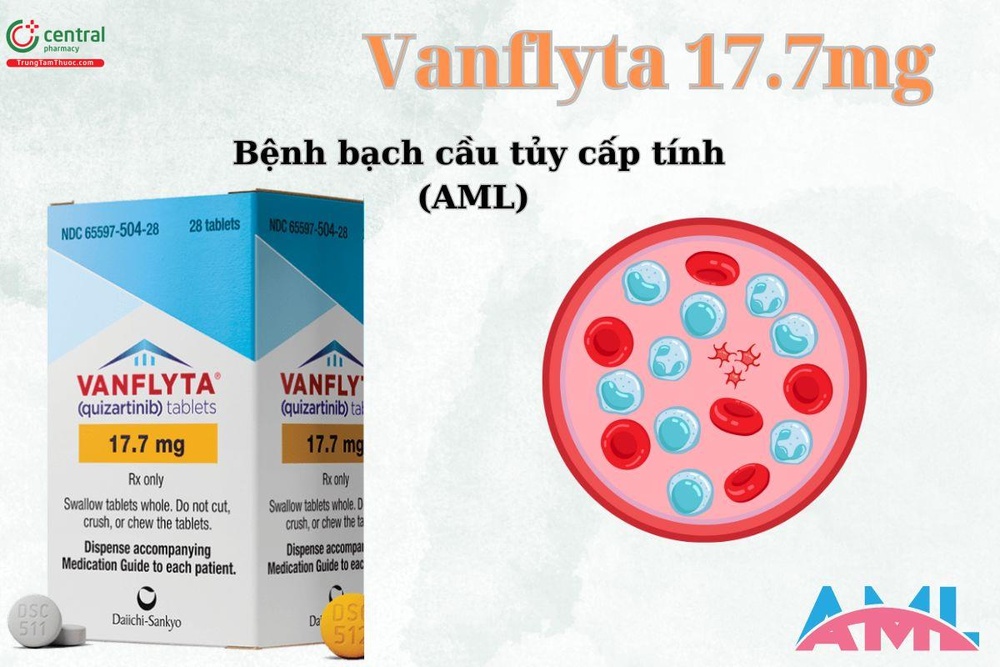
VANFLYTA 17.7 mg film-coated tablets (tablets) are white, round, and have the inscription “DSC 511” on one side, and are available in boxes containing 14 x 1 or 28 x 1 film-coated tablets in aluminum/aluminum perforated unit-dose blisters.
VANFLYTA 26.5 mg film-coated tablets (tablets) are yellow, round, and have the inscription “DSC 512” on one side, and are available in boxes containing 14 x 1, 28 x 1, or 56 x 1 film-coated tablets in aluminum/aluminum perforated unit-dose blisters.
Only some pack sizes may be marketed.
Marketing Authorization Holder
Daiichi Sankyo Europe GmbH
Zielstattstrasse 48
81379 Munich
Germany
Manufacturer
Daiichi Sankyo Europe GmbH
Luitpoldstrasse 1
85276 Pfaffenhofen
Germany
You can request more information about this medication by contacting the local representative of the marketing authorization holder:
Belgium Daiichi Sankyo Belgium N.V.-S.A Tel: +32-(0) 2 227 18 80 | Lithuania Daiichi Sankyo Europe GmbH Tel: +49-(0) 89 7808 0 |
| Luxembourg Daiichi Sankyo Belgium N.V.-S.A Tel: +32-(0) 2 227 18 80 |
Czech Republic Daiichi Sankyo Europe GmbH Tel: +49-(0) 89 7808 0 | Hungary Daiichi Sankyo Europe GmbH Tel: +49-(0) 89 7808 0 |
Denmark Daiichi Sankyo Nordics ApS Tel: +45 (0) 33 68 19 99 | Malta Daiichi Sankyo Europe GmbH Tel: +49-(0) 89 7808 0 |
Germany Servier Deutschland GmbH Tel: +49 (0)89 57095 01 | Netherlands Daiichi Sankyo Nederland B.V. Tel: +31-(0) 20 4 07 20 72 |
Estonia Daiichi Sankyo Europe GmbH Tel: +49-(0) 89 7808 0 | Norway Daiichi Sankyo Nordics ApS Tel: +47 (0) 21 09 38 29 |
Greece Daiichi Sankyo Greece Single Member S.A Tel: +30 2104448037 | Austria Daiichi Sankyo Austria GmbH Tel: +43-(0) 1 4858642 0 |
Spain Daiichi Sankyo España, S.A. Tel: +34 91 539 99 11 | Poland Daiichi Sankyo Europe GmbH Tel: +49-(0) 89 7808 0 |
France Daiichi Sankyo France S.A.S Tel: +33 (0) 1 55 62 14 60 | Portugal Daiichi Sankyo Portugal, Unip. LDA Tel: +351 21 4232010 |
Croatia Daiichi Sankyo Europe GmbH Tel: +49-(0) 89 7808 0 | Romania Daiichi Sankyo Europe GmbH Tel: +49-(0) 89 7808 0 |
Ireland Daiichi Sankyo Ireland Ltd Tel: +353-(0) 1 489 3000 | Slovenia Daiichi Sankyo Europe GmbH Tel: +49-(0) 89 7808 0 |
Iceland Daiichi Sankyo Nordics ApS Tel: +354 5357000 | Slovakia Daiichi Sankyo Europe GmbH Tel: +49-(0) 89 7808 0 |
Italy Daiichi Sankyo Italia S.p.A. Tel: +39-06 85 2551 | Finland Daiichi Sankyo Nordics ApS Tel: +358 (0) 9 3540 7081 |
Cyprus Daiichi Sankyo Europe GmbH Tel: +49-(0) 89 7808 0 | Sweden Daiichi Sankyo Nordics ApS Tel: +46 (0) 40 699 2524 |
Latvia Daiichi Sankyo Europe GmbH Tel: +49-(0) 89 7808 0 | United Kingdom (Northern Ireland) Daiichi Sankyo Europe GmbH Tel: +49-(0) 89 7808 0 |
Date of the Last Revision of this Leaflet:
Other Sources of Information
Detailed information about this medication is available on the European Medicines Agency website: https://www.ema.europa.eu. There are also links to other websites about rare diseases and orphan medicines.
- Country of registration
- Dosage formTABLET, 17.7 mg
- ATC codeL01EX11
- Active substance
- Prescription requiredYes
- Manufacturer
- CompositionHIDROXIPROPILBETADEX (200 mg mg)
- This information is for reference only and does not constitute medical advice. Always consult a doctor before taking any medication. Oladoctor is not responsible for medical decisions based on this content.
- Alternatives to VANFLYTA 17.7 mg FILM-COATED TABLETSDosage form: TABLET, 26.5 mgActive substance: quizartinibManufacturer: Daiichi Sankyo Europe GmbhPrescription requiredDosage form: TABLET, 100 mgActive substance: avapritinibManufacturer: Blueprint Medicines (Netherlands) B.V.Prescription requiredDosage form: TABLET, 200 mgActive substance: avapritinibManufacturer: Blueprint Medicines (Netherlands) B.V.Prescription required
Online doctors for VANFLYTA 17.7 mg FILM-COATED TABLETS
Discuss questions about VANFLYTA 17.7 mg FILM-COATED TABLETS, including use, safety considerations and prescription review, subject to medical assessment and local regulations.
Get VANFLYTA 17.7 mg FILM-COATED TABLETS Prescription Online
Fill in a 2-min form
Tell us your symptoms, history, and what medicine you're requesting.
Pick a doctor or let us assign
Choose a specialist or we'll match you with the next available doctor.
Doctor reviews your case
Usually within 30 minutes. They may ask follow-up questions via chat.
Collect from any pharmacy
Electronic prescription sent to your email — valid across Spain.
Frequently Asked Questions
VANFLYTA 17.7 mg FILM-COATED TABLETS requires a prescription in Spain. You can check with a doctor online whether this medicine may be appropriate for your situation.
The active ingredient in VANFLYTA 17.7 mg FILM-COATED TABLETS is quizartinib. This information helps identify medicines with the same composition but different brand names.
VANFLYTA 17.7 mg FILM-COATED TABLETS is manufactured by Daiichi Sankyo Europe Gmbh. Pharmacy brands and packaging may differ depending on the distributor.
Doctors such as Family doctors, Psychiatrists, Dermatologists, Cardiologists, Endocrinologists, Gastroenterologists, Pulmonologists, Nephrologists, Rheumatologists, Hematologists, Infectious disease physicians, Allergists, Geriatricians, Paediatricians, Oncologists may assess whether VANFLYTA 17.7 mg FILM-COATED TABLETS is appropriate, depending on your situation and local regulations. You can book an online consultation to discuss your symptoms and possible next steps.
Spain has a well-developed healthcare infrastructure across major cities such as Madrid, Barcelona, Valencia, and Seville. Pharmacies are widely available and operate under strict regulations, ensuring access to prescribed medications.
You can buy VANFLYTA 17.7 mg FILM-COATED TABLETS in Madrid, Barcelona, Seville, or Valencia at any local pharmacy with a valid prescription.
To obtain a prescription, you can use Oladoctor:
Other medicines with the same active substance (quizartinib) include VANFLYTA 26.5 mg FILM-COATED TABLETS, AYVAKYT 100 mg FILM-COATED TABLETS, AYVAKYT 200 mg FILM-COATED TABLETS. These may have different brand names or formulations but contain the same therapeutic ingredient. Always consult a doctor before switching or starting a new medicine.
