



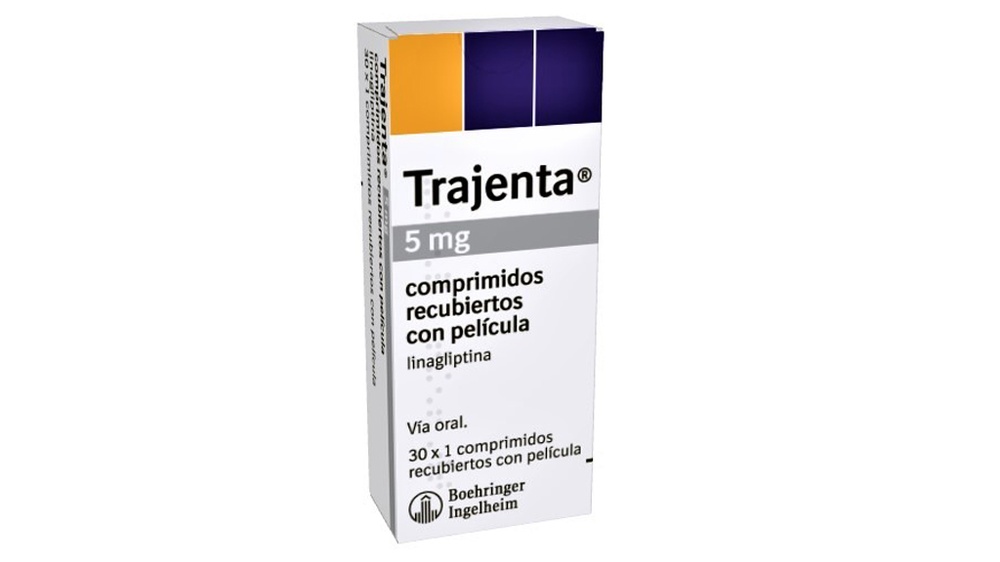
TRAJENTA 5 mg Film-Coated Tablets

Prescription review online
A doctor will review your case and decide whether a prescription is medically appropriate.

Talk to a doctor about this medicine
Discuss your symptoms and possible next steps in a quick online consultation.



How to use TRAJENTA 5 mg FILM-COATED TABLETS
Contents of the leaflet
- Introduction
- What is Trajenta and what is it used for
- What you need to know before you take Trajenta
- How to take Trajenta
- Possible side effects
- Storing Trajenta
- Contents of the pack and other information
Introduction
Package Leaflet: Information for the User
Trajenta 5mg film-coated tablets
linagliptin
Read all of this leaflet carefully before you start taking this medicine because it contains important information for you.
- Keep this leaflet, you may need to read it again.
- If you have any further questions, ask your doctor, pharmacist, or nurse.
- This medicine has been prescribed for you only. Do not pass it on to others. It may harm them, even if their signs of illness are the same as yours.
- If you get any side effects, talk to your doctor, pharmacist, or nurse. This includes any possible side effects not listed in this leaflet. See section 4.
Contents of the pack
- What is Trajenta and what is it used for
- What you need to know before you take Trajenta
- How to take Trajenta
- Possible side effects
- Storing Trajenta
- Contents of the pack and other information
1. What is Trajenta and what is it used for
Trajenta contains the active substance linagliptin which belongs to a group of medicines called “oral anti-diabetics”. Oral anti-diabetics are used to treat high blood sugar levels. They work by helping your body to reduce the level of sugar in your blood.
Trajenta is used to treat type 2 diabetes in adults when the disease cannot be controlled by diet and exercise or by diet and exercise combined with another oral anti-diabetic medicine (metformin or sulphonylureas). Trajenta can be used alone or in combination with other anti-diabetic medicines, such as metformin, sulphonylureas (e.g. glimepiride, glipizide), empagliflozin, or insulin.
It is important that you follow the advice about diet and exercise given by your doctor or nurse.

Not sure if this medicine is right for you?
Discuss your symptoms and treatment with a doctor online.
2. What you need to know before you take Trajenta
Do not take Trajenta
- if you are allergic to linagliptin or any of the other ingredients of this medicine (listed in section 6).
Warnings and precautions
Tell your doctor, pharmacist, or nurse before you start taking Trajenta if you:
- have type 1 diabetes (your body does not produce insulin) or diabetic ketoacidosis (a complication of diabetes with high blood sugar levels, rapid weight loss, nausea, or vomiting). Trajenta should not be used to treat these conditions.
- are taking a sulphonylurea medicine (e.g. glimepiride, glipizide); your doctor may want to reduce your dose of sulphonylurea when taken with Trajenta to avoid your blood sugar levels falling too low.
- have had an allergic reaction to any other medicine you take to control the amount of sugar in your blood.
- have or have had a disease of the pancreas.
If you have symptoms of acute pancreatitis, such as severe and persistent stomach pain (abdominal pain), you should contact your doctor.
If you notice blisters on your skin, it could be a sign of a disease called bullous pemphigoid. Your doctor may advise you to stop taking Trajenta.
Diabetic skin lesions are a common complication of diabetes. Follow the advice on skin and foot care given by your doctor or nurse.
Children and adolescents
Trajenta is not recommended for children and adolescents under 18 years of age. It is not effective in children and adolescents between 10 and 17 years of age. The safety and efficacy of this medicine in children under 10 years of age have not been established.
Other medicines and Trajenta
Tell your doctor or pharmacist if you are taking, have recently taken, or might take any other medicines.
In particular, you should tell your doctor if you are using medicines that contain any of the following active substances:
- Carbamazepine, phenobarbital, or phenytoin. These may be used to control epilepsy (seizures) or chronic pain.
- Rifampicin. This is an antibiotic used to treat infections such as tuberculosis.
Pregnancy and breast-feeding
If you are pregnant or breast-feeding, think you may be pregnant, or are planning to have a baby, ask your doctor or pharmacist for advice before taking this medicine.
It is not known if Trajenta is harmful to the unborn baby. Therefore, it is preferable to avoid using Trajenta if you are pregnant.
It is not known if Trajenta passes into breast milk. Your doctor will decide whether you should stop breast-feeding or stop taking Trajenta.
Driving and using machines
Trajenta has no or negligible influence on the ability to drive and use machines.
Taking Trajenta in combination with the medicines called sulphonylureas and/or insulin may cause your blood sugar levels to fall too low (hypoglycaemia), which may affect your ability to drive and use machines or work without a safe support. However, more frequent blood glucose monitoring may be recommended to reduce the risk of hypoglycaemia, especially when Trajenta is combined with a sulphonylurea and/or insulin.
3. How to take Trajenta
Take this medicine exactly as your doctor has told you. If you are not sure, ask your doctor or pharmacist.
The recommended dose of Trajenta is one 5 mg tablet once a day.
You can take Trajenta with or without food.
Your doctor may prescribe Trajenta along with another oral anti-diabetic medicine. Remember to take all your medicines as your doctor has told you to get the best results for your health.
If you take more Trajenta than you should
If you take more Trajenta than you should, contact a doctor immediately.
If you forget to take Trajenta
- If you forget to take a dose of Trajenta, take it as soon as you remember. However, if it is nearly time for your next dose, do not take the missed dose.
- Do not take a double dose to make up for a forgotten dose. Never take two doses on the same day.
If you stop taking Trajenta
Do not stop taking Trajenta without first talking to your doctor. Your blood sugar levels may increase when you stop taking Trajenta.
If you have any further questions on the use of this medicine, ask your doctor, pharmacist, or nurse.

Started taking the medicine and have questions?
Discuss your symptoms and treatment with a doctor online.
4. Possible side effects
Like all medicines, this medicine can cause side effects, although not everybody gets them.
Some symptoms need immediate medical attention
Stop taking Trajenta and contact a doctor immediately if you experience the following symptoms of low blood sugar: shaking, sweating, anxiety, blurred vision, tingling of the lips, paleness, mood changes, or confusion (hypoglycaemia). Hypoglycaemia (frequency: very common, may affect more than 1 in 10 people) is a side effect identified when Trajenta is taken with metformin and a sulphonylurea.
Some patients have experienced allergic reactions (hypersensitivity; frequency: uncommon, may affect up to 1 in 100 people) while taking Trajenta alone or in combination with other diabetes medicines, which can be serious, including wheezing (“whistling” while breathing) and shortness of breath (bronchial hyperreactivity; frequency: not known, cannot be estimated from the available data). Some patients have experienced skin reactions (frequency: uncommon), hives (frequency: rare, may affect up to 1 in 1,000 people), and swelling of the face, lips, tongue, and throat that can cause difficulty breathing or swallowing (angioedema; frequency: rare). If you experience any of the above-mentioned signs of illness, stop taking Trajenta and call your doctor immediately. Your doctor may prescribe a medicine to treat your allergic reaction and a different medicine for your diabetes.
Some patients have experienced pancreatitis (frequency: rare, may affect up to 1 in 1,000 people) while taking Trajenta alone or in combination with other diabetes medicines.
Stop taking Trajenta and contact a doctor immediatelyif you notice any of the following serious side effects:
- Severe and persistent stomach pain (abdominal pain), which may radiate to your back, as well as nausea and vomiting, as this could be a sign of an inflamed pancreas (pancreatitis).
Some patients have experienced the following side effects while taking Trajenta alone or in combination with other diabetes medicines:
- Common: elevated levels of the enzyme lipase in the blood.
- Uncommon: inflammation of the nose or throat (nasopharyngitis), cough, constipation (in combination with insulin), elevated levels of the enzyme amylase in the blood.
- Rare: blisters on the skin (bullous pemphigoid).
Reporting of side effects
If you get any side effects, talk to your doctor, pharmacist, or nurse. This includes any possible side effects not listed in this leaflet. You can also report side effects directly via the national reporting system listed in Appendix V. By reporting side effects, you can help provide more information on the safety of this medicine.
5. Storing Trajenta
Keep this medicine out of the sight and reach of children.
Do not use this medicine after the expiry date which is stated on the blister and on the carton after EXP. The expiry date refers to the last day of that month.
This medicine does not require any special storage conditions.
Do not use Trajenta if the packaging is damaged or shows signs of tampering.
Medicines should not be disposed of via wastewater or household waste. Ask your pharmacist how to dispose of medicines no longer required. These measures will help protect the environment.
6. Contents of the pack and other information
What Trajenta contains
- The active substance is linagliptin.
Each film-coated tablet contains 5 mg of linagliptin.
- The other ingredients are:
Core: mannitol, pregelatinised maize starch, maize starch, copovidone, magnesium stearate.
Coating: hypromellose, titanium dioxide (E171), talc, macrogol (6000), red iron oxide (E172).
Appearance and packaging of Trajenta
- Trajenta 5 mg film-coated tablets are red, round, 8 mm in diameter, and engraved with the code “D5” on one side and the Boehringer Ingelheim logo on the other.
- Trajenta is available in single-dose, pre-cut aluminium/aluminium blister packs. The pack sizes are 10 x 1, 14 x 1, 28 x 1, 30 x 1, 56 x 1, 60 x 1, 84 x 1, 90 x 1, 98 x 1, 100 x 1, and 120 x 1 tablets.
Not all pack sizes may be marketed in your country.
Marketing authorisation holder
Boehringer Ingelheim International GmbH
Binger Strasse 173
55216 Ingelheim am Rhein
Germany
Manufacturer
Boehringer Ingelheim Pharma GmbH & Co. KG
Binger Strasse 173
55216 Ingelheim am Rhein
Germany
Boehringer Ingelheim Hellas Single Member S.A.
5th km Paiania – Markopoulo
Koropi Attiki, 19441
Greece
Dragenopharm Apotheker Püschl GmbH
Göllstraße 1
84529 Tittmoning
Germany
For further information on this medicine, contact the local representative of the marketing authorisation holder:
België/Belgique/Belgien Boehringer Ingelheim SComm Tel: +32 2 773 33 11 | Lietuva Boehringer Ingelheim RCV GmbH & Co KG Lietuvos filialas Tel: +370 5 2595942 |
България Бохрингер Ингелхайм България ЕООД Тел: +359 2 958 79 98 | Luxembourg/Luxemburg Boehringer Ingelheim SComm Tel: +32 2 773 33 11 |
Ceská republika Boehringer Ingelheim spol. s r.o. Tel: +420 234 655 111 | Magyarország Boehringer Ingelheim RCV GmbH & Co KG Magyarországi Fióktelepe Tel.: +36 1 299 8900 |
Danmark Boehringer Ingelheim Danmark A/S Tlf: +45 39 15 88 88 | Malta Boehringer Ingelheim Ireland Ltd. Tel: +353 1 295 9620 |
Deutschland Boehringer Ingelheim Pharma GmbH & Co. KG Tel: +49 (0) 800 77 90 900 | Nederland Boehringer Ingelheim B.V. Tel: +31 (0) 800 22 55 889 |
Eesti Boehringer Ingelheim RCV GmbH & Co KG Eesti filiaal Tel: +372 60 80 940 | Norge Boehringer Ingelheim Norway KS Tlf: +47 66 76 13 00 |
Ελλάδα Boehringer Ingelheim Ελλάς Μονοπρόσωπη Α.Ε. Τηλ: +30 2 10 89 06 300 | Österreich Boehringer Ingelheim RCV GmbH & Co KG Tel: +43 1 80 105-7870 |
España Boehringer Ingelheim España, S.A. Tel: +34 93 404 51 00 | Polska Boehringer Ingelheim Sp.zo.o. Tel.: +48 22 699 0 699 |
France Boehringer Ingelheim France S.A.S. Tél: +33 3 26 50 45 33 | Portugal Boehringer Ingelheim Portugal, Lda. Tel: +351 21 313 53 00 |
Hrvatska Boehringer Ingelheim Zagreb d.o.o. Tel: +385 1 2444 600 | România Boehringer Ingelheim RCV GmbH & Co KG Viena - Sucursala Bucuresti Tel: +40 21 302 28 00 |
Ireland Boehringer Ingelheim Ireland Ltd. Tel: +353 1 295 9620 | Slovenija Boehringer Ingelheim RCV GmbH & Co KG, Podružnica Ljubljana Tel: +386 1 586 40 00 |
Ísland Vistor hf. Sími: +354 535 7000 | Slovenská republika Boehringer Ingelheim RCV GmbH & Co KG, organizacná zložka Tel: +421 2 5810 1211 |
Italia Boehringer Ingelheim Italia S.p.A. Tel: +39 02 5355 1 | Suomi/Finland Boehringer Ingelheim Finland Ky Puh/Tel: +358 10 3102 800 |
Κύπρος Boehringer Ingelheim Ελλάς Μονοπρόσωπη Α.Ε. Τηλ: +30 2 10 89 06 300 | Sverige Boehringer Ingelheim AB Tel: +46 8 721 21 00 |
Latvija Boehringer Ingelheim RCV GmbH & Co KG Latvijas filiale Tel: +371 67 240 011 | United Kingdom(Northern Ireland) Boehringer Ingelheim Ireland Ltd. Tel: +353 1 295 9620 |
Date of last revision of this leaflet:
Detailed information on this medicine is available on the European Medicines Agency web site: http://www.ema.europa.eu.
- Country of registration
- Dosage formTABLET, 5 mg linagliptin
- ATC codeA10BH05
- Average pharmacy price55.75 EUR
- Active substance
- Prescription requiredYes
- Manufacturer
- CompositionMANITOL (E-421) (130,900 mg mg)
- This information is for reference only and does not constitute medical advice. Always consult a doctor before taking any medication. Oladoctor is not responsible for medical decisions based on this content.
- Alternatives to TRAJENTA 5 mg FILM-COATED TABLETSDosage form: TABLET, 5 mgActive substance: linagliptinManufacturer: Laboratorios Alter S.A.Prescription requiredDosage form: TABLET, 5 mgActive substance: linagliptinManufacturer: Viatris LimitedPrescription requiredDosage form: TABLET, 5 mgActive substance: linagliptinManufacturer: Laboratorios Alter S.A.Prescription required
Online doctors for TRAJENTA 5 mg FILM-COATED TABLETS
Discuss questions about TRAJENTA 5 mg FILM-COATED TABLETS, including use, safety considerations and prescription review, subject to medical assessment and local regulations.

Get TRAJENTA 5 mg FILM-COATED TABLETS Prescription Online
Fill in a 2-min form
Tell us your symptoms, history, and what medicine you're requesting.
Pick a doctor or let us assign
Choose a specialist or we'll match you with the next available doctor.
Doctor reviews your case
Usually within 30 minutes. They may ask follow-up questions via chat.
Collect from any pharmacy
Electronic prescription sent to your email — valid across Spain.
Frequently Asked Questions
TRAJENTA 5 mg FILM-COATED TABLETS requires a prescription in Spain. You can check with a doctor online whether this medicine may be appropriate for your situation.
The active ingredient in TRAJENTA 5 mg FILM-COATED TABLETS is linagliptin. This information helps identify medicines with the same composition but different brand names.
The average pharmacy price for TRAJENTA 5 mg FILM-COATED TABLETS is around 55.75 EUR. Prices may vary depending on the manufacturer and dosage form.
TRAJENTA 5 mg FILM-COATED TABLETS is manufactured by Boehringer Ingelheim International Gmbh. Pharmacy brands and packaging may differ depending on the distributor.
Doctors such as Family doctors, Psychiatrists, Dermatologists, Cardiologists, Endocrinologists, Gastroenterologists, Pulmonologists, Nephrologists, Rheumatologists, Hematologists, Infectious disease physicians, Allergists, Geriatricians, Paediatricians, Oncologists may assess whether TRAJENTA 5 mg FILM-COATED TABLETS is appropriate, depending on your situation and local regulations. You can book an online consultation to discuss your symptoms and possible next steps.
Spain has a well-developed healthcare infrastructure across major cities such as Madrid, Barcelona, Valencia, and Seville. Pharmacies are widely available and operate under strict regulations, ensuring access to prescribed medications.
You can buy TRAJENTA 5 mg FILM-COATED TABLETS in Madrid, Barcelona, Seville, or Valencia at any local pharmacy with a valid prescription.
To obtain a prescription, you can use Oladoctor:
Other medicines with the same active substance (linagliptin) include DONUMID 5 mg FILM-COATED TABLETS, ILINPRU 5 mg FILM-COATED TABLETS, LINAGLIPTIN ALTER 5 mg FILM-COATED TABLETS. These may have different brand names or formulations but contain the same therapeutic ingredient. Always consult a doctor before switching or starting a new medicine.
