



TOLURA 40 mg Tablets

Prescription review online
A doctor will review your case and decide whether a prescription is medically appropriate.

Talk to a doctor about this medicine
Discuss your symptoms and possible next steps in a quick online consultation.



How to use Tolura 40 mg tablets
Contents of the leaflet
- Introduction
- What is Tolura and what is it used for
- What you need to know before you take Tolura
- How to take Tolura
- Possible side effects
- Storing Tolura
- Package Contents and Additional Information
Introduction
Package Leaflet: Information for the User
Tolura 40 mg Tablets EFG
telmisartan
Read all of this leaflet carefully before you start taking this medicine because it contains important information for you.
- Keep this leaflet, you may need to read it again.
- If you have any further questions, ask your doctor or pharmacist.
- This medicine has been prescribed for you only. Do not pass it on to others. It may harm them, even if their signs of illness are the same as yours.
- If you get any side effects, talk to your doctor or pharmacist. This includes any possible side effects not listed in this leaflet. See section 4.
Contents of the pack:
- What is Tolura and what is it used for
- What you need to know before you take Tolura
- How to take Tolura
- Possible side effects
- Storing Tolura
- Contents of the pack and other information
1. What is Tolura and what is it used for
Tolura belongs to a class of medicines known as angiotensin II receptor antagonists. Angiotensin II is a substance produced in your body which makes your blood vessels narrow, thus increasing your blood pressure. Tolura blocks the action of angiotensin II, so that your blood vessels relax and your blood pressure is reduced.
Tolura is used totreat essential hypertension (high blood pressure) in adults. “Essential” means that the high blood pressure is not caused by any other condition.
High blood pressure, if not treated, can damage your blood vessels in various organs, which can lead, in some cases, to heart attacks, heart failure, or kidney failure, strokes, or blindness. Usually, high blood pressure does not cause any symptoms before damage occurs. Therefore, it is important to regularly measure your blood pressure to check if it is within the normal range.
Tolura is also used toreduce cardiovascular events (e.g., heart attacks or strokes) in adults at risk because the blood supply to the heart or legs is reduced or blocked, or who have had a stroke or have a high risk of developing diabetes. Your doctor will inform you if you have a high risk of having these events.

Not sure if this medicine is right for you?
Discuss your symptoms and treatment with a doctor online.
2. What you need to know before you take Tolura
Do not take Tolura
- if you are allergic to telmisartan or any of the other ingredients of this medicine (listed in section 6).
- if you are more than 3 months pregnant. (In any case, it is better to avoid taking this medicine during the first few months of pregnancy - see section Pregnancy.)
- if you have severe liver problems, such as cholestasis or biliary obstruction (problems with the drainage of bile from the liver and gall bladder) or any other severe liver disease.
- if you have diabetes or kidney impairment and you are treated with a blood pressure medicine containing aliskiren.
If any of these apply to you, tell your doctor or pharmacist before taking Tolura.
Warnings and precautions
Tell your doctor if you are suffering or have ever suffered from any of the following conditions or diseases:
- Kidney disease or kidney transplant.
- Renal artery stenosis (narrowing of the blood vessels to one or both kidneys).
- Liver disease.
- Heart problems.
- High levels of aldosterone (water and salt retention in the body, along with an imbalance of various minerals in the blood).
- Low blood pressure (hypotension) which may occur if you are dehydrated (excessive loss of water from the body) or have low salt levels due to treatment with diuretics, low-salt diet, diarrhea, or vomiting.
- High levels of potassium in the blood.
- Diabetes.
Tell your doctor before taking Tolura:
- if you are taking digoxin.
- if you are taking any of the following medicines used to treat high blood pressure:
- an angiotensin-converting enzyme inhibitor (ACE inhibitor) (e.g., enalapril, lisinopril, ramipril), especially if you have kidney problems related to diabetes.
- aliskiren.
If you are pregnant, think you may be pregnant, or plan to become pregnant, inform your doctor. Tolura is not recommended during the first few months of pregnancy (first trimester) and should not be used after the third month of pregnancy, as it may cause serious harm to your baby (see section Pregnancy).
In case of surgery or anesthesia, inform your doctor that you are taking Tolura.
Tolura may be less effective in lowering blood pressure in black patients.
Your doctor may check your kidney function, blood pressure, and blood electrolyte levels (e.g., potassium) at regular intervals.
See also the information under the heading “Do not take Tolura”.
Children and adolescents
Tolura is not recommended for children and adolescents under 18 years.
Using Tolura with other medicines
Tell your doctor or pharmacist if you are using, have recently used, or might use any other medicines. Your doctor may need to change the dose of these medicines or take other precautions. In some cases, you may need to stop taking one of the medicines. This is especially important for the following medicines when taken with Tolura:
Medicines containing lithium for treating some types of depression.
- Medicines that may increase potassium levels in the blood, such as potassium-sparing diuretics, ACE inhibitors, angiotensin II receptor blockers, non-steroidal anti-inflammatory drugs (NSAIDs, e.g., aspirin or ibuprofen), heparin, immunosuppressants (e.g., cyclosporin or tacrolimus), and the antibiotic trimethoprim.
- Diuretics, especially when taken in high doses with Tolura, may cause excessive water loss and low blood pressure (hypotension).
- If you are taking an ACE inhibitor or aliskiren (see also the information under the headings “Do not take Tolura” and “Warnings and precautions”).
- Digoxin.
The effect of Tolura may be reduced when you use NSAIDs (e.g., aspirin or ibuprofen) or corticosteroids.
Tolura may increase the blood pressure-lowering effect of other medicines used to treat high blood pressure or medicines that may potentially lower blood pressure (e.g., baclofen, amifostine).
Additionally, the reduction in blood pressure may be increased by alcohol, barbiturates, narcotics, or antidepressants. You may notice this effect as dizziness when standing up. You should consult your doctor if you need to adjust the dose of your other medicines while taking Tolura.
Pregnancy and breastfeeding
Pregnancy
Inform your doctor if you are pregnant, think you may be pregnant, or plan to become pregnant. Your doctor will normally advise you to stop taking Tolura before you become pregnant or as soon as you know you are pregnant and will advise you to take another medicine to treat your high blood pressure. Tolura is not recommended during the first few months of pregnancy and should not be used after the third month of pregnancy, as it may cause serious harm to your baby.
Breastfeeding
Inform your doctor if you are about to start or are already breastfeeding, as Tolura is not recommended for use during breastfeeding. Your doctor may decide to prescribe a different treatment if you want to breastfeed, especially if your baby is a newborn or premature.
Driving and using machines
Some people feel dizzy or tired when taking Tolura. If you feel dizzy or tired, do not drive or use machines.
Tolura contains lactose and sorbitol (E420).
If your doctor has told you that you have an intolerance to some sugars, consult your doctor before taking this medicine.
This medicine contains 149.8 mg of sorbitol in each tablet.
Sorbitol is a source of fructose. If your doctor has told you that you have an intolerance to some sugars, or you have been diagnosed with hereditary fructose intolerance (HFI), a rare genetic disorder, in which you cannot break down fructose, consult your doctor before taking this medicine.
3. How to take Tolura
Always take this medicine exactly as your doctor has told you. Check with your doctor or pharmacist if you are not sure.
The recommended dose of Tolura is one tablet once a day. Try to take the tablet at the same time each day. You can take Tolura with or without food. The tablets should be swallowed with a little water or another non-alcoholic drink. It is important that you take Tolura every day until your doctor tells you to stop. If you feel that the effect of Tolura is too strong or too weak, talk to your doctor or pharmacist.
For the treatment of high blood pressure, the usual dose of Tolura for most patients is one 40 mg tablet once a day to control blood pressure over a 24-hour period. However, your doctor may sometimes recommend a lower dose of 20 mg or a higher dose of 80 mg. Tolura tablets cannot be divided, and therefore, it is not suitable for patients who need a 20 mg dose of telmisartan. For these patients, a different medicine with the same active substance is available. Tolura can also be used in combination with diuretics, such as hydrochlorothiazide, which has been shown to have an additional blood pressure-lowering effect with Tolura.
For the reduction of cardiovascular events, the usual dose of Tolura is one 80 mg tablet once a day. When starting preventive treatment with Tolura 80 mg, blood pressure should be frequently monitored.
If your liver is not working properly, the usual dose should not exceed 40 mg once a day.
If you take more Tolura than you should
If you accidentally take too many tablets, contact your doctor, pharmacist, or the nearest hospital emergency department immediately.
If you forget to take Tolura
If you forget to take a dose, do not worry. Take it as soon as you remember and then continue as before. If you do not take your tablet on one day, take your normal dose the next day. Do not take a double dose to make up for a forgotten dose.
If you have any further questions on the use of this medicine, ask your doctor or pharmacist.

Started taking the medicine and have questions?
Discuss your symptoms and treatment with a doctor online.
4. Possible side effects
Like all medicines, Tolura can cause side effects, although not everybody gets them.
Some side effects can be serious and require immediate medical attention:
If you experience any of the following symptoms, you should see your doctor immediately:
Sepsis* (often called “blood infection”, a severe infection that involves an inflammatory reaction of the whole body), rapid swelling of the skin and mucous membranes (angioedema); these side effects are rare (may affect up to 1 in 1,000 people) but are extremely serious and patients should stop taking the medicine and see their doctor immediately. If these side effects are not treated, they can be fatal.
Possible side effects of Tolura:
Common side effects (may affect up to 1 in 10 people)
Low blood pressure (hypotension) in users treated for cardiovascular event reduction.
Uncommon side effects (may affect up to 1 in 100 people)
Urinary tract infections, upper respiratory tract infections (e.g., sore throat, sinusitis, common cold), anemia (low red blood cell count), high potassium levels, insomnia (difficulty sleeping), depression, fainting (syncope), dizziness (vertigo), slow heart rate (bradycardia), low blood pressure (hypotension) in users treated for high blood pressure, dizziness when standing up (orthostatic hypotension), difficulty breathing, cough, abdominal pain, diarrhea, abdominal discomfort, abdominal distension, vomiting, itching, increased sweating, drug rash (skin reaction to medicines), back pain, muscle cramps, muscle pain (myalgia), kidney failure including acute kidney failure, chest pain, symptoms of weakness, and high creatinine levels in the blood.
Rare side effects (may affect up to 1 in 1,000 people)
Sepsis* (often called “blood infection”, a severe infection that involves an inflammatory reaction of the whole body and can cause death), increased eosinophils (a type of white blood cell), low platelet count (thrombocytopenia), severe allergic reaction (anaphylactic reaction), allergic reaction (e.g., rash, itching, difficulty breathing, wheezing, swelling of the face or low blood pressure), low blood sugar levels (in diabetic patients), anxiety, somnolence, vision disturbances, increased heart rate (tachycardia), dry mouth, stomach upset, taste disturbances (dysgeusia), abnormal liver function (Japanese patients show a higher tendency to experience this side effect), sudden swelling of the skin and mucous membranes that can cause death (angioedema including fatal outcome), eczema (a skin disorder), skin redness, hives (urticaria), severe drug rash, joint pain (arthralgia), limb pain, tendon pain, pseudogrip syndrome, decrease in hemoglobin (a blood protein), increased blood uric acid levels, increased liver enzymes or creatine phosphokinase in the blood.
Very rare side effects (may affect up to 1 in 10,000 people)
Progressive scarring of lung tissue (interstitial lung disease) **.
- This may have been an isolated case or may be related to an unknown mechanism.
** Cases of progressive scarring of lung tissue have been reported during treatment with telmisartan. However, it is not known whether telmisartan was the cause.
Reporting of side effects
If you get any side effects, talk to your doctor or pharmacist. This includes any possible side effects not listed in this leaflet. You can also report side effects directly via the national reporting system listed in Annex V. By reporting side effects, you can help provide more information on the safety of this medicine.
5. Storing Tolura
Keep this medicine out of the sight and reach of children.
Do not use this medicine after the expiry date which is stated on the carton after “EXP”. The expiry date refers to the last day of the month shown.
Do not store above 30°C.
Store in the original package to protect from light.
Medicines should not be disposed of via wastewater or household waste. Ask your pharmacist how to dispose of medicines no longer required. These measures will help protect the environment.
6. Package Contents and Additional Information
Tolura Composition
The active ingredient is telmisartan. Each tablet contains 40 mg of telmisartan.
The other ingredients are povidone, meglumine, sodium hydroxide, lactose monohydrate, sorbitol (E420), and magnesium stearate. See section 2 "Tolura contains lactose and sorbitol (E420)."
Appearance of Tolura and Package Contents
Tolura 40 mg tablets are white or almost white, biconvex, and oval.
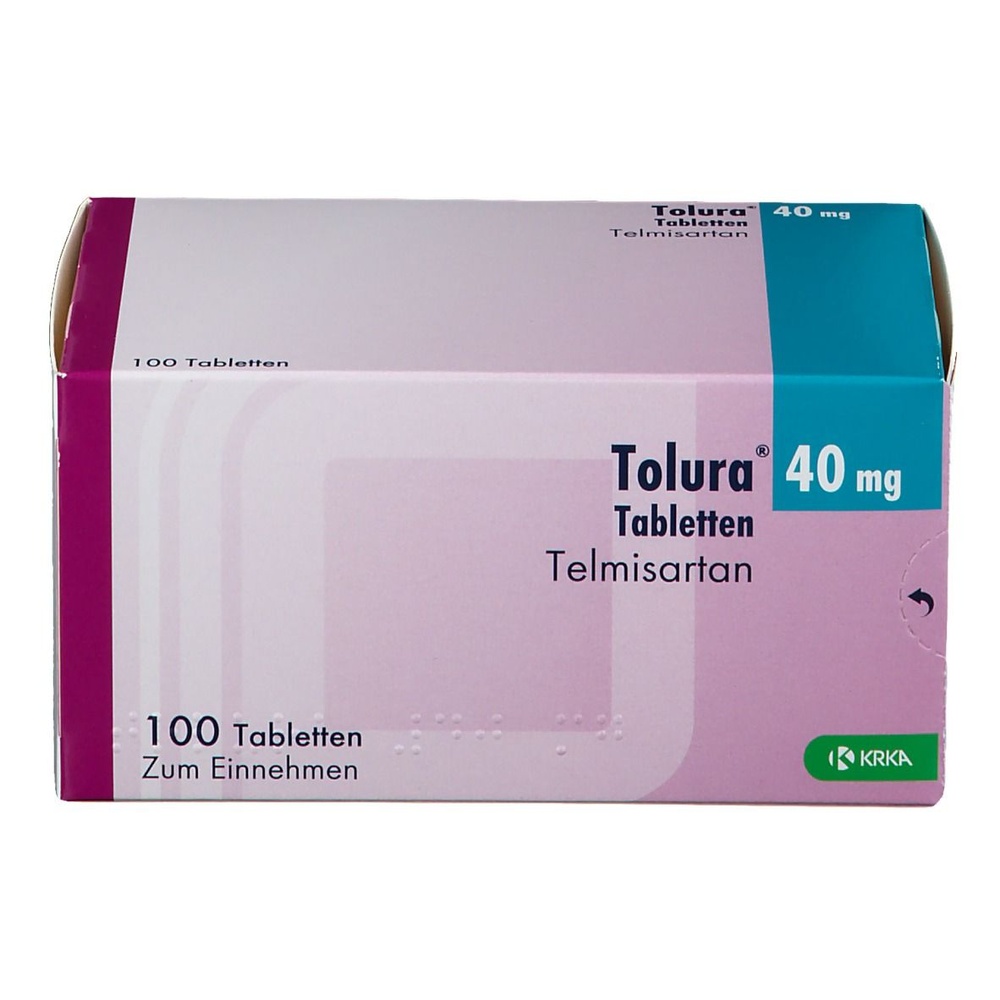
Tolura is available in blisters of 14, 28, 30, 56, 84, 90, 98, and 100 tablets in a box. Not all pack sizes may be marketed.
Marketing Authorization Holder
KRKA, d.d., Novo mesto, Šmarješka cesta 6, 8501 Novo mesto, Slovenia
Manufacturer
KRKA, d.d., Novo mesto, Šmarješka cesta 6, 8501 Novo mesto, Slovenia
KRKA-POLSKA Sp. z o.o., Ul. Równolegla 5, 02-235 Warszawa, Poland
For more information about this medicinal product, please contact the local representative of the marketing authorization holder:
Belgium KRKA Belgium, SA. Tel: + 32 (0) 487 50 73 62 | Lithuania UAB KRKA Lietuva Tel: + 370 5 236 27 40 |
| Luxembourg KRKA Belgium, SA. Tel: + 32 (0) 487 50 73 62 (BE) |
Czech Republic KRKA CR, s.r.o. Tel: + 420 (0) 221 115 150 | Hungary KRKA Magyarország Kereskedelmi Kft. Tel.: + 36 (1) 355 8490 |
Denmark KRKA Sverige AB Tlf: + 46 (0)8 643 67 66 (SE) | Malta E.J. Busuttil Ltd. Tel: + 356 21 445 885 |
Germany TAD Pharma GmbH Tel: + 49 (0) 4721 606-0 | Netherlands KRKA Belgium, SA. Tel: + 32 (0) 487 50 73 62 (BE) |
Estonia KRKA, d.d., Novo mesto Eesti filiaal Tel: + 372 (0) 6 671 658 | Norway KRKA Sverige AB Tlf: + 46 (0)8 643 67 66 (SE) |
Greece KRKA ΕΛΛΑΣ ΕΠΕ Τηλ: + 30 2100101613 | Austria KRKA Pharma GmbH, Wien Tel: + 43 (0)1 66 24 300 |
Spain KRKA Farmacéutica, S.L. Tel: + 34 911 61 03 80 | Poland KRKA-POLSKA Sp. z o.o. Tel.: + 48 (0)22 573 7500 |
France KRKA France Eurl Tél: + 33 (0)1 57 40 82 25 | Portugal KRKA Farmacêutica, Sociedade Unipessoal Lda. Tel: + 351 (0)21 46 43 650 |
Croatia KRKA - FARMA d.o.o. Tel: + 385 1 6312 100 | Romania KRKA Romania S.R.L., Bucharest Tel: + 4 021 310 66 05 |
Ireland KRKA Pharma Dublin, Ltd. Tel: + 353 1 413 3710 | Slovenia KRKA, d.d., Novo mesto Tel: + 386 (0) 1 47 51 100 |
Iceland LYFIS ehf. Sími: + 354 534 3500 | Slovakia KRKA Slovensko, s.r.o. Tel: + 421 (0) 2 571 04 501 |
Italy KRKA Farmaceutici Milano S.r.l. Tel: + 39 02 3300 8841 | Finland KRKA Finland Oy Puh/Tel: + 358 20 754 5330 |
Cyprus KI.PA. (PHARMACAL) LIMITED Τηλ: + 357 24 651 882 | Sweden KRKA Sverige AB Tel: + 46 (0)8 643 67 66 (SE) |
Latvia KRKA Latvija SIA Tel: + 371 6 733 86 10 | United Kingdom (Northern Ireland) KRKA Pharma Dublin, Ltd. Tel: + 353 1 413 3710 |
Date of Last Revision of this Leaflet:
Detailed information on this medicinal product is available on the European Medicines Agency website http://www.ema.europa.eu/.
- Country of registration
- Dosage formTABLET, 40 mg
- ATC codeC09CA07
- Active substance
- Prescription requiredYes
- Manufacturer
- CompositionHIDROXIDO DE SODIO (E 524) (3,36 mg mg), LACTOSA MONOHIDRATO (60,00 mg mg), SORBITOL (149,84 mg mg)
- This information is for reference only and does not constitute medical advice. Always consult a doctor before taking any medication. Oladoctor is not responsible for medical decisions based on this content.
- Alternatives to Tolura 40 mg tabletsDosage form: TABLET, 20 mgActive substance: telmisartanManufacturer: Boehringer Ingelheim International GmbhPrescription requiredDosage form: TABLET, 40 mgActive substance: telmisartanManufacturer: Boehringer Ingelheim International GmbhPrescription requiredDosage form: TABLET, 80 mgActive substance: telmisartanManufacturer: Boehringer Ingelheim International GmbhPrescription required
Online doctors for Tolura 40 mg tablets
Discuss questions about Tolura 40 mg tablets, including use, safety considerations and prescription review, subject to medical assessment and local regulations.
Get Tolura 40 mg tablets Prescription Online
Fill in a 2-min form
Tell us your symptoms, history, and what medicine you're requesting.
Pick a doctor or let us assign
Choose a specialist or we'll match you with the next available doctor.
Doctor reviews your case
Usually within 30 minutes. They may ask follow-up questions via chat.
Collect from any pharmacy
Electronic prescription sent to your email — valid across Spain.
Frequently Asked Questions
Tolura 40 mg tablets requires a prescription in Spain. You can check with a doctor online whether this medicine may be appropriate for your situation.
The active ingredient in Tolura 40 mg tablets is telmisartan. This information helps identify medicines with the same composition but different brand names.
Tolura 40 mg tablets is manufactured by Krka D.D. Novo Mesto. Pharmacy brands and packaging may differ depending on the distributor.
Doctors such as Family doctors, Psychiatrists, Dermatologists, Cardiologists, Endocrinologists, Gastroenterologists, Pulmonologists, Nephrologists, Rheumatologists, Hematologists, Infectious disease physicians, Allergists, Geriatricians, Paediatricians, Oncologists may assess whether Tolura 40 mg tablets is appropriate, depending on your situation and local regulations. You can book an online consultation to discuss your symptoms and possible next steps.
Spain has a well-developed healthcare infrastructure across major cities such as Madrid, Barcelona, Valencia, and Seville. Pharmacies are widely available and operate under strict regulations, ensuring access to prescribed medications.
You can buy Tolura 40 mg tablets in Madrid, Barcelona, Seville, or Valencia at any local pharmacy with a valid prescription.
To obtain a prescription, you can use Oladoctor:
Other medicines with the same active substance (telmisartan) include MICARDIS 20 mg TABLETS, MICARDIS 40 mg TABLETS, MICARDIS 80 mg TABLETS. These may have different brand names or formulations but contain the same therapeutic ingredient. Always consult a doctor before switching or starting a new medicine.
