



SUERO 0.9% Injectable Perfusion

Prescription review online
A doctor will review your case and decide whether a prescription is medically appropriate.

Talk to a doctor about this medicine
Discuss your symptoms and possible next steps in a quick online consultation.



How to use PHYSIOLOGICAL SERUM VITULIA 0.9% SOLUTION FOR INFUSION
Contents of the leaflet
- Introduction
- What Vitulia Physiological Serum is and what it is used for
- Before using Vitulia Physiological Serum
- How to use Vitulia Physiological Serum
- Possible side effects
- Storage of Vitulia Physiological Serum
- Additional information
Introduction
Leaflet: information for the user
Vitulia Physiological Serum 0.9% solution for infusion
Sodium chloride
Read the entire leaflet carefully before starting to use this medication
- Keep this leaflet as you may need to read it again.
- If you have any doubts, consult your doctor or pharmacist.
- This medication has been prescribed to you and should not be given to others, even if they have the same symptoms, as it may harm them.
- If you consider that any of the adverse effects you are suffering from is serious or if you notice any adverse effect not mentioned in this leaflet, inform your doctor or pharmacist.
Contents of the leaflet
- What Vitulia Physiological Serum is and what it is used for
- Before using Vitulia Physiological Serum
- How to use Vitulia Physiological Serum
- Possible side effects
- Storage of Vitulia Physiological Serum
- Additional information
1. What Vitulia Physiological Serum is and what it is used for
Vitulia Physiological Serum belongs to the group of intravenous solution medications.
Vitulia Physiological Serum is used to replace water and sodium and chloride salts that may be low due to various alterations or disorders. It is also used as a transport solution for other compatible medications.

Not sure if this medicine is right for you?
Discuss your symptoms and treatment with a doctor online.
2. Before using Vitulia Physiological Serum
Do not useVitulia Physiological Serum
- If you are allergic (hypersensitive) to the active ingredient of Vitulia Physiological Serum.
If you have:
- excess water in the body (hyperhydration), sodium (hypernatremia), or chloride (hyperchloremia)
- acidosis (pH below the normal range)
- edematous conditions in patients with cardiac, hepatic, or renal disorders and severe hypertension.
It should not be administered to patients with low potassium levels (hypokalemia), especially in cardiovascular patients.
Be careful withVitulia Physiological Serum
If you have disorders where sodium intake is restricted, such as heart failure, generalized fluid retention (edema), fluid accumulation in the lungs (pulmonary edema), hypertension (high blood pressure), pregnancy-induced hypertension (eclampsia), and severe kidney failure.
The serum electrolytes, water balance, and acid-base balance should be regularly monitored.
In prolonged therapies and in patients with acid-base imbalance, cardiac, hepatic, and/or renal disorders, as well as those being treated with corticosteroids or adrenocorticotropic hormone, frequent monitoring of blood electrolytes should be performed.
In case of hypertonic dehydration (water loss with excess salts), a high perfusion rate should be avoided as it may cause an increase in plasma osmolarity (salt concentration in plasma) and, in particular, plasma sodium concentration.
In premature and infant patients, sodium chloride administration should only be given after determining serum sodium levels.
Use of other medications
Inform your doctor or pharmacist if you are using or have recently used other medications, including those purchased without a prescription.
The administration of sodium chloride accelerates the renal excretion of lithium, leading to a decrease in its therapeutic effect.
It should be administered with caution in patients treated with corticosteroids or adrenocorticotropic hormone as they may retain water and sodium.
Before mixing with other medications, compatibility tables should be checked, pH should be taken into account, and ions should be monitored.
Pregnancy and breastfeeding
Consult your doctor or pharmacist before using any medication.
Vitulia Physiological Serum can be used when indicated during pregnancy and breastfeeding.
Currently, there are no relevant epidemiological data available, so it is recommended that if used during these periods, it should be done with caution.
Driving and using machines
This section is not applicable due to the characteristics of the medication.
3. How to use Vitulia Physiological Serum
Follow the administration instructions of Vitulia Physiological Serum exactly as indicated by your doctor. Consult your doctor or pharmacist if you have doubts.
The normal daily dose is up to 40 ml per kg of body weight.
The recommended perfusion rate is approximately 5 ml per kg of body weight per hour, which corresponds to 1.7 drops per kg of body weight per minute.
Your doctor will decide the dose and frequency at which the solution will be administered, depending on your age, weight, and clinical situation.
A larger amount of solution and a higher speed should be administered in patients who show a plasma volume deficit (hypovolemic shock).
If you use moreVitulia Physiological Serumthan you should
It is unlikely that this will happen since your doctor will determine your daily doses. However, if you receive an overdose, it may cause an excess of sodium, chloride, and electrolytes in general in the blood, or an excess of hydration and related manifestations such as metabolic acidosis (low blood pH), cardiac overload, and edema formation. In such a case, perfusion should be interrupted, diuretic medications should be administered to eliminate excess fluid, along with monitoring of blood electrolytes and acid-base balance.
If you are not hospitalized, go to the nearest hospital or consult the Toxicology Information Service. Telephone: 91 562 04 20, indicating the medication and the amount used.
If you have any other doubts about the use of this product, ask your doctor or pharmacist.

Started taking the medicine and have questions?
Discuss your symptoms and treatment with a doctor online.
4. Possible side effects
Like all medications, Vitulia Physiological Serum can cause side effects, although not everyone will experience them.
If large amounts of the solution are administered, plasma levels of sodium and chloride may increase.
If it is continuously administered in the same perfusion site, pain, fever, infection, and phlebitis that extends from the injection site, extravasation, and hypervolemia may occur.
If it is used as a vehicle for the administration of other medications, the nature of the added medications will determine the likelihood of other adverse reactions.
In case of adverse reactions, perfusion should be interrupted.
If you consider that any of the side effects you are suffering from is serious or if you notice any side effect not mentioned in this leaflet, inform your doctor or pharmacist.
5. Storage of Vitulia Physiological Serum
Keep out of the reach and sight of children.
No special storage conditions are required.
Do not use Vitulia Physiological Serum after the expiration date stated on the packaging. The expiration date is the last day of the month indicated.
Do not use Vitulia Physiological Serum if the solution is turbid or sedimented (presence of particles at the bottom of the container) or if the packaging shows visible signs of deterioration.
Medications should not be thrown away through the sewers or in the trash. Deposit the packaging and medications that are no longer needed at the SIGRE point of the pharmacy. In case of doubt, ask your pharmacist how to dispose of the packaging and medications that are no longer needed. This will help protect the environment.
6. Additional information
Composition of Vitulia Physiological Serum
The active ingredient is:
Active IngredientPer 100 ml
Sodium chloride 0.9 g
Electrolytesmmol/lmEq/l
Sodium 154 154
Chloride 154 154
Theoretical Osmolarity 308 mOsm/l
Acidity (up to pH 7.4) < 0.3 mmol/l
pH 4.5 – 7.0
The other components are: water for injection.
Appearance of the product and packaging content
Vitulia Physiological Serum is a transparent and colorless solution for infusion, presented in plastic bottles.
Standard packaging: Bottle with 50, 100, 250, 500 or 1000 mL and 10 bottles of 250 mL.
Clinical packaging: 20 bottles of 50 ml
20 bottles of 100 ml
20 bottles of 250 ml
10 bottles of 500 ml
10 bottles of 1000 ml
Not all packaging sizes may be marketed.
Marketing authorization holder and manufacturer
Marketing authorization holder:
LABORATORIOS ERN, S.A.
C/ Perú, 228
08020 Barcelona, Spain.
Manufacturer:
LABORATORIOS ERN, S.A.
C/ Gorcs i Lladó, 188
Polígono Industrial Can Salvatella
08210 Barberá del Vallés – Barcelona
Spain
Or
Parenteral Solution Industry Vioser S.A.
9th km Trikala-Larisa Nt.Rd.
42100 Trikala
Greece
This leaflet was revised inAugust 2017.
-------------------------------------------------------------------------------------------
This information is intended only for doctors or healthcare professionals:
Single-use packaging. Discard any unused contents after finishing the infusion.
The solution should only be used if the packaging is not damaged and the solution is clear.
Use the sterile administration set for administration.
Detailed and updated information on this medication is available on the website of the Spanish Agency for Medicines and Health Products (AEMPS) http://www.aemps.gob.es/
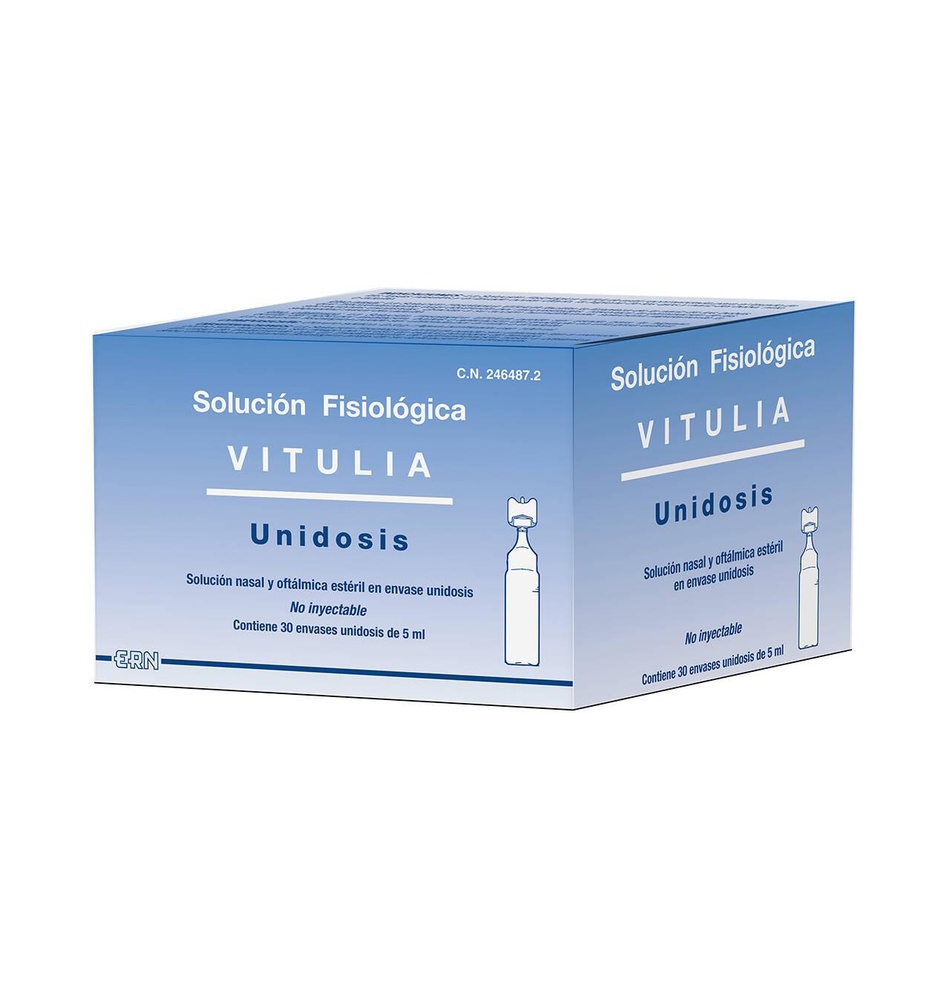
- Country of registration
- Dosage formINJECTABLE PERFUSION
- ATC codeB05BB91
- Average pharmacy price1.9 EUR
- Active substance
- Prescription requiredYes
- Manufacturer
- This information is for reference only and does not constitute medical advice. Always consult a doctor before taking any medication. Oladoctor is not responsible for medical decisions based on this content.
- Alternatives to PHYSIOLOGICAL SERUM VITULIA 0.9% SOLUTION FOR INFUSIONDosage form: INJECTABLE INFUSION, 100 mlActive substance: Solutions affecting the electrolyte balanceManufacturer: Fresenius Kabi España, S.A.U.Prescription requiredDosage form: INJECTABLE INFUSION, 900 mg sodium chloride / 100 mlActive substance: Solutions affecting the electrolyte balanceManufacturer: B Braun Medical S.A.Prescription requiredDosage form: INJECTABLE INFUSION, 100mlActive substance: Solutions affecting the electrolyte balanceManufacturer: Fresenius Kabi España, S.A.U.Prescription required
Online doctors for PHYSIOLOGICAL SERUM VITULIA 0.9% SOLUTION FOR INFUSION
Discuss questions about PHYSIOLOGICAL SERUM VITULIA 0.9% SOLUTION FOR INFUSION, including use, safety considerations and prescription review, subject to medical assessment and local regulations.









Get PHYSIOLOGICAL SERUM VITULIA 0.9% SOLUTION FOR INFUSION Prescription Online
Fill in a 2-min form
Tell us your symptoms, history, and what medicine you're requesting.
Pick a doctor or let us assign
Choose a specialist or we'll match you with the next available doctor.
Doctor reviews your case
Usually within 30 minutes. They may ask follow-up questions via chat.
Collect from any pharmacy
Electronic prescription sent to your email — valid across Spain.
Frequently Asked Questions
PHYSIOLOGICAL SERUM VITULIA 0.9% SOLUTION FOR INFUSION requires a prescription in Spain. You can check with a doctor online whether this medicine may be appropriate for your situation.
The active ingredient in PHYSIOLOGICAL SERUM VITULIA 0.9% SOLUTION FOR INFUSION is Solutions affecting the electrolyte balance. This information helps identify medicines with the same composition but different brand names.
The average pharmacy price for PHYSIOLOGICAL SERUM VITULIA 0.9% SOLUTION FOR INFUSION is around 1.9 EUR. Prices may vary depending on the manufacturer and dosage form.
PHYSIOLOGICAL SERUM VITULIA 0.9% SOLUTION FOR INFUSION is manufactured by Laboratorios Ern S.A.. Pharmacy brands and packaging may differ depending on the distributor.
Doctors such as Family doctors, Psychiatrists, Dermatologists, Cardiologists, Endocrinologists, Gastroenterologists, Pulmonologists, Nephrologists, Rheumatologists, Hematologists, Infectious disease physicians, Allergists, Geriatricians, Paediatricians, Oncologists may assess whether PHYSIOLOGICAL SERUM VITULIA 0.9% SOLUTION FOR INFUSION is appropriate, depending on your situation and local regulations. You can book an online consultation to discuss your symptoms and possible next steps.
Spain has a well-developed healthcare infrastructure across major cities such as Madrid, Barcelona, Valencia, and Seville. Pharmacies are widely available and operate under strict regulations, ensuring access to prescribed medications.
You can buy PHYSIOLOGICAL SERUM VITULIA 0.9% SOLUTION FOR INFUSION in Madrid, Barcelona, Seville, or Valencia at any local pharmacy with a valid prescription.
To obtain a prescription, you can use Oladoctor:
Other medicines with the same active substance (Solutions affecting the electrolyte balance) include SODIUM CHLORIDE MEIN 0.9% SOLUTION FOR INFUSION, FISIOLOGICO B. BRAUN 0.9% SOLUTION FOR INFUSION, FREEFLEX 0.9% SODIUM CHLORIDE. These may have different brand names or formulations but contain the same therapeutic ingredient. Always consult a doctor before switching or starting a new medicine.
